News & Updates
The latest news and updates from companies in the WLTH portfolio.
Could TSA Chaos Return to the Atlanta Airport? DHS Funding to Run Out
More than 60 days into a partial government shutdown, Department of Homeland Security Secretary Markwayne Mullin said the agency may have to stop paying salaries in May. "Fortunately, what President Trump did through an executive order allowed us to grab emergency funding that came out of the One Big Beautiful Bill ... but that money is dried up, if I continue down this path, the first week of May," Mullin said in an interview with Fox News. When paychecks last went unpaid, officers with the Transportation Security Administration began calling out of their shifts, leaving just a few officers to handle security lines at airports across the country. At airports like Hartsfield-Jackson in Atlanta, lines to get through airport security lasted hours and passengers missed flights as they waited for their identities to be checked and bags scanned. If funding runs out before the partial shutdown is over, will chaos return to Atlanta? President Trump ordered funds to be rerouted to pay airport security on March 27, after the agency had already been running unfunded for weeks. The order used "funds that have a reasonable and logical nexus to TSA operations to provide TSA employees with the compensation and benefits that would have accrued to them if not for the Democrat-led shutdown," according to the decree. TSA officers did start to receive paychecks after the order, but many have not received backpay for the hours they worked before the order was signed and after the government was shut down, meaning many are still short significant wages. In Atlanta, city officials have voted to prevent power from being cut off in homes of TSA workers who have missed payments, and the shutdown has become a major talking point in the Georgia race for U.S. Senate. TSA officers were also working at the end of March unpaid while Immigration and Customs Enforcement officers were providing support, but were being paid. In some cases, paid ICE officers were scanning IDs while unpaid TSA workers were working the security scanning machines at Hartsfield-Jackson. Last week, TSA's deputy administrator Ha Nguyen McNeill argued privatizing TSA could be a way to keep officers' salaries from being at the whim of political actions. "As of today, TSA has been shut down for 109 days, nearly 60% of FY26. If this year demonstrates anything, it is that the TSA workforce and our operations cannot depend on predictable Congressional funding," Nguyen McNeill said in the April 16 hearing. The deputy administrator argued airports that have already started some form of privatization were spared the long lines seen in other airports like Hartsfield-Jackson. Privatization of TSA was also included in the controversial Project 2025, a conservative playbook from the Heritage Foundation for the second Trump presidency. The plan argues the current system makes officers both the regulators and the regulated organization, and that it is too costly. In the early hours Thursday, Senate Republicans adopted a budget resolution that would allow Congress to vote on a budget reconciliation package next month. The package would reopen DHS and fund immigration enforcement, The Hill reported. The resolution passed along party lines, with Lisa Murkowski (AK-R) and Rand Paul (KY-R) voting against the resolution with Democrats.

Brits Brace for Holiday Chaos as Jet Fuel Crisis Hits Airlines
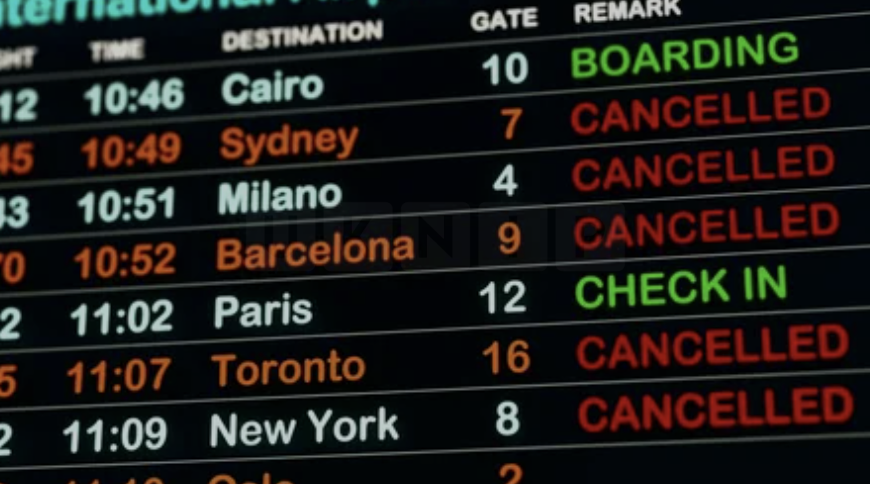
Brit holidaymakers face a summer of cancelled flights and soaring ticket prices. The closure of the vital Strait of Hormuz has triggered a severe jet fuel shortage, forcing airlines worldwide to slash schedules and hike fares. EU Warns of Travel Carnage EU Energy Commissioner Dan Jorgensen delivered a grim forecast. Speaking to Sky News, he said disruption to summer getaways is now "very likely." "Unfortunately, it's very likely that many people's holidays will be affected, either by flight cancellations or very, very expensive tickets," He warned. "Even if we do everything we can do, if the jet fuel is not there, then it's not there." Jet Fuel Shortage Looms Over Europe The International Energy Agency (IEA) says physical jet fuel shortages could hit Europe as early as June. IEA chief Fatih Birol revealed Europe relies on Middle Eastern refineries for 75% of its jet fuel -- and that supply has plummeted to nearly zero. Europe scrambles to find alternatives from the US and Nigeria, but summer demand spikes by around 40%, risking a full-blown crisis. "If the supply stays where it is now, the challenge can be even bigger," Costly Consequences for Passengers * Jet fuel prices have doubled since February, peaking at $209 per barrel in April. * Airlines are passing on the pain: United Airlines may raise ticket prices by 20%, Air France-KLM adds €50 on long-haul flights, and Delta plus Southwest hike baggage fees. * Major carriers cut flights: Lufthansa axed 20,000 short-haul services, KLM cancelled 160 European flights in one month, and SAS scrapped 1,000 departures in April. Aviation expert Richard Evans says cuts are down to soaring fuel prices and Middle East disruptions, with more cancellations "extremely likely." Ryanair hints at 5-10% schedule cuts if prices stay high. Delta has dropped plans to grow flight capacity in 2026. Calls to Rethink Travel Plans Italy's Civil Aviation Authority chief, Pierluigi di Palma, suggests Europeans ditch foreign trips for domestic holidays. "The psychological effect is having a destructive effect on passengers," Airports Council International warns that without reopening the Strait of Hormuz within three weeks, jet fuel shortages will hit the EU hard. Airlines UK urges UK ministers to act now before the crisis deepens. The ongoing war is already costing Europe around €500 million daily, and summer travel looks set to suffer big time.
'Multiple measurement currencies create chaos, need single source of truth': Karthik Rao, CEO of Nielsen
At a time when the domestic media landscape is fragmenting across TV, mobile and digital platforms and being reshaped by AI -- audience measurement is under scrutiny. The complexities of the market here, says Karthik Rao, chief executive officer, Nielsen, a global leader in measuring viewership, presents an opportunity for the company to fine-tune its products and services. In an interview with Viveat Susan Pinto, Rao outlines his priorities for India. Excerpts: Why is India so critical to Nielsen right now? India is unlike any other market. Print remains resilient, linear TV hasn't declined as sharply as in other regions, and yet streaming and mobile viewership are growing rapidly. Add AI into the mix, and you have a highly complex media ecosystem. For us, that complexity is an advantage. If we can build solutions here, we can scale them globally. That's why we see India not just as a market, but as an innovation hub for the world. What does that translate to in terms of investment? We've grown to nearly 6,000 employees in just three years, and we're still growing. But the more significant shift is structural -- India is now a decision-making hub. Global leaders across technology, finance, and marketing are based here, shaping decisions for the entire company. This is no longer the traditional offshore model; India is central to how we operate globally. There's a growing push for multiple measurement currencies in India. What is your view on this? Multiple currencies create chaos and confusion. If the same show has four different numbers, which one is the truth? You need a single source of truth because trust comes from a single, transparent standard. You can layer other metrics on top of that. But the base has to be one common truth. Otherwise, you fragment the market and devalue content. How is AI changing your business? AI will fundamentally reshape both consumption and measurement. On the consumer side, discovery will become seamless -- you won't need to jump across apps. On our side, we're building AI-first systems, enhancing metadata to go deeper into content, and even exploring synthetic panelists to scale insights. We're also starting to measure how people use AI itself. That's becoming a new layer of media consumption. What are the key innovations coming out of India? Cross-media measurement is a major focus. Take our work on the Indian Premier League -- we're integrating streaming, mobile, and linear TV data to deliver a unified view of audiences across platforms. This is being done in partnership with the Broadcast Audience Research Council of India. It's a challenge the industry has been trying to solve for years. While we began with sports, the model can extend across all forms of content. Tell us about your new 'Streaming Plus' audience measurement panel. With the rise of big data, is panel-based measurement still relevant? 'Streaming Plus' is our next-generation system, launched first in India. It tracks viewing across mobile and connected TV, captures app-switching behaviour, and measures both ads and content -- while also beginning to map actions such as shopping. Over time, we plan to scale this to more than 100,000 panelists. The idea is simple: combine human-observed data with big data to get both accuracy and scale. To your question on relevance of panel-based measurement, I think it is more than ever relevant today. While big data tells you about volume of viewership, panels tell you who is viewing. And media is fundamentally about people. The future is not one or the other -- it's panel plus big data. That's our global approach. Short-form content like micro-dramas is exploding in India. How do you measure that? That's precisely what systems like 'Streaming Plus' are designed for. Consumption is rapidly shifting toward these formats, particularly on mobile. The key is to capture not just what people watch, but why they move across apps and formats. That's where the next level of insight comes from. Indian advertisers are still heavily focused on reach. Is that a limitation? Reach is foundational in a market of this size. If you can't reach people, you can't sell anything. But over time, we'll see a shift towards fandom and community. Look at the Indian Premier League -- it's not just about viewership anymore. It's about year-round engagement and monetisation.

Oil's New Security Premium: Trading Geopolitical Chaos for Institutional Panic
All information and data in this article is solely for informational purposes. For more information please view the Barchart Disclosure Policy here The market is accustomed to pricing in simple math. A war in the Middle East represents a risk premium. Accordingly, a peace agreement should logically trigger an instant price collapse. Traders and speculators are holding their breath for de-escalation, expecting that a return to geopolitical calm will send oil tumbling back to familiar pre-crisis lows. Expecting a return to cheap oil relies on ignoring a new physical and psychological reality. Even under the most optimistic scenario, the structural terrain of the oil market has likely shifted beyond repair. We will probably never see pre-crisis oil again. We need to soberly assess the physical damage. A ceasefire does not rebuild blown-up pumping stations and damaged export terminals with the snap of a finger. The infrastructure in the conflict zone took a critical hit. While diplomats might need just a few days to sign papers, engineers will likely require months -- or perhaps even years -- to conduct massive repair operations. A physical supply deficit seems to be already baked into the system. The market will probably experience a severe shortage of actual barrels long before export capacities revert to their historical baseline. The world survived this recent crisis almost exclusively by eating through its own stockpiles. Strategic petroleum reserves of developed nations were drained to multi-year lows well before the escalation began, and recent months merely worsened the picture. Once logistical chains begin to stabilize, a colossal pent-up demand is expected to flood the market. Governments will likely start aggressively buying oil on any minor price dip, offering massive support to quotes. But a simple return of stockpiles to previous levels is just the tip of the iceberg. The main catalyst that will likely alter oil pricing forever lies in the realm of psychology. This global crisis exposed the sheer energy vulnerability of the world's top economies. Governments experienced a genuine shock, realizing just how close they came to the edge of industrial paralysis. The era of Just-in-Time logistics is essentially dead. We are entering the "Just-in-Case" epoch. Fear is a powerful multiplier. The sudden awareness of their own fragility will likely force nations not just to replace what was spent. They will probably want to dramatically increase the base volume of their reserves. Nobody wants to be a hostage to a single blocked strait or an isolated regional war anymore. Over the next few years, we have a high probability of witnessing a massive investment boom in the construction of new oil storage facilities globally. China, Europe, and the U.S. will likely be ready to freeze hundreds of billions of dollars in underground tanks and concrete bunkers -- buying themselves national security. What does this mean for the market? This widespread anxiety is expected to create a massive overhang of demand for years to come. Millions of barrels will likely be diverted daily away from refineries and straight into strategic vaults. Investors should probably recalibrate their expectations. The military premium might indeed fade from the quotes, but a security premium will almost instantly replace it. The structural demand from states trying to build excess inventories seems to have already poured a new, solid concrete floor under crude prices. A return to cheap energy appears to be officially canceled.

Run BTS 2.0 Episode 1 Out: BTS Bring Back Chaos With Hilarious Room Game, Food Fun And Dark Zombie Challenge
The first episode of Run BTS 2.0 kicked off with excitement as BTS reunited after a long time. Packed with fun, chaos, and emotional moments, the episode captured their natural chemistry and brotherhood. From playful games to hilarious arguments, the show delivered pure entertainment while giving fans a glimpse of the group's bond as they spent time together under one roof again.

Shale Bosses See 'Chaos' From Iran War in Anonymous Fed Survey
US shale executives are frustrated with the "chaos" in oil markets that has come from the Middle East conflict, according to the latest energy survey from the Federal Reserve Bank of Dallas. The report released Thursday is widely read within the energy sector and features anonymous, unfiltered comments from respondents working at production and service companies. The respondents criticized what they characterized as the inability of President Donald Trump to explain the rationale behind the conflict. "If the administration feels that we need to prolong the conflict, it needs to better articulate the long-term strategic goal and the risk of inaction," one respondent was quoted as saying. "This cannot be solely about barrels." Get the Morning & Evening Briefing Americas newsletters. Get the Morning & Evening Briefing Americas newsletters. Get the Morning & Evening Briefing Americas newsletters. Start every morning with what you need to know followed by context and analysis on news of the day each evening. Plus, Bloomberg Weekend. Start every morning with what you need to know followed by context and analysis on news of the day each evening. Plus, Bloomberg Weekend. Start every morning with what you need to know followed by context and analysis on news of the day each evening. Plus, Bloomberg Weekend. Plus Signed UpPlus Sign UpPlus Sign Up By continuing, I agree to the Privacy Policy and Terms of Service. The bank, which typically conducts a quarterly survey of energy firms in Texas, northern Louisiana and southern New Mexico, took the unusual step of asking additional questions following the publication of the first quarter survey in March. The updated responses come at a time of high volatility in energy prices amid the conflict in the Middle East. The insights, published days before the Fed's April meeting, will give policymakers a fresh look into a rapidly evolving market. West Texas Intermediate, the US benchmark for oil, has climbed by more than a third since the US-Israel war with Iran began in late February. Although US drillers are generally expected to ramp up output in response to the price spike, the largest publicly traded oil companies have yet to announce any updates to drilling plans. The Strait of Hormuz remains mostly closed, trapping roughly a fifth of the world's crude supplies. About 80% respondents to the survey expect traffic to normalize no earlier than August. But, of course, an estimate like that comes with plenty of hedging. "With all of the chaos, predicting anything in the energy sector is very difficult," another executive was quoted as saying in the Dallas Fed report. The survey has often highlighted criticism of US presidents and the effect of their policy on the industry. The latest report features heightened frustrations with Trump. "The long-term consequences of this war were not fully considered," an executive from an oilfield services firm was quoted as saying. "The disruption this will cause to energy markets and other macroeconomic measures will be significant. The unpredictable nature of the current administration makes business modeling near impossible."

DoorDash Alum Built Streamline AI To Fix Legal Dept. Chaos - Law360 Pulse
After Kathy Zhu created the legal operations department at DoorDash in 2019, she tested generic tools, contract lifecycle management systems and other legal-specific products. But nothing solved her real pain points:... Unlock these benefits today when you sign-up for a FREE 7-day trial: * Gain a competitive edge with exclusive data visualization tools to tailor to your practice * Stay informed with daily newsletters and custom alerts across 14+ coverage areas relevant to you * Streamline your business of law needs with integrated news and research in a single destination Already have an account? Sign In Now

Heathrow Faces Criticism Over 'Colossal Failure' in Fire-Related Shutdown - News Directory 3
Heathrow Airport has been accused of a "colossal failure" following a fire at an electricity substation that caused a major power outage and forced the airport to shut down for nearly a day, disrupting travel for hundreds of thousands of passengers. The incident occurred when a fire broke out at the North Hyde electrical substation in west London, which supplies power to Heathrow. The blaze led to the loss of electricity across the airport, grounding flights and leaving passengers stranded in terminals and on aircraft. The Daily Telegraph called it the "Colossal failure of Heathrow blackout" next to a photo of the secretary of state for energy, Ed Miliband, who, as the subheading explains, "admits site looks 'vulnerable'". The shutdown affected more than 1,350 flights and disrupted journeys for hundreds of thousands of travellers, with widespread cancellations and delays reported across the UK and internationally. Passengers described scenes of confusion and frustration as they waited for updates and attempted to rebook travel. Heathrow delays - live updates The closure of Heathrow, Europe's busiest airport, due to a fire at a nearby electrical substation dominates the front pages of British newspapers on Saturday, with more than 1,350 flights cancelled and journeys disrupted for hundreds of thousands of passengers. The Mirror sums it up with one word - "Grounded" - splashed above a photo of the fire helpfully captioned as an "inferno" and another of a teary passenger. "Fire sparks travel chaos," the strapline says, and "Boss admits airport can't be run on backup" is further down.... British Airways, Heathrow's largest airline, stated it expected to operate about 85% of its 600 scheduled flights on the following day as services gradually resumed. However, airlines warned that full recovery would take several days due to the need to reposition aircraft, crews, and passengers. British Airways, Heathrow's biggest airline, said it expects to operate about 85% of its 600 scheduled flights at the airport on Saturday. The UK government launched an inquiry into the incident amid growing concerns over the resilience of national infrastructure. Officials visited the substation site to assess the damage and investigate the causes of the failure. Officials walk through the North Hyde electrical substation in London on Saturday March 22, 2025, which caught fire Thursday night. UK government orders probe into Heathrow shutdown that sparked concern over energy resilience The event has raised broader questions about the vulnerability of critical infrastructure, particularly the reliance on single points of failure in power supply for major transport hubs. Industry leaders and officials have called for improved contingency planning and investment in grid resilience. Airline chiefs have accused Heathrow of "clear failure" after Europe's busiest airport was shut down by a fire in a single electricity substation.

The Rolling Stones' 'Black and Blue' Topped the Charts Amid Creative Chaos
The mid-'70s weren't so great for the Rolling Stones. Commercially speaking, they were on top of the world and never bigger. They were untouchable during this period, with every album shooting straight up the charts and tours selling out in no time. But behind the scenes, they were starting to unravel. And on record, they were far from their best. Keith Richards was barely conscious during the sessions for 1974's It's Only Rock 'N Roll, and the concerts were more workmanlike than life-changing starting around 1972. Things were getting so big and out of hand that the music, too, was starting to feel less eventful with each passing album. From 1968's Beggars Banquet through 1972's Exile on Main St., the Stones released four of rock's all-time greatest albums. Not just four of the Stones' greatest albums, but four of the greatest rock 'n' roll albums ever made. Then they began to slide, first with the tossed-together Goats Head Soup in 1973 and then with the incomplete (but not terrible at all) It's Only Rock 'N Roll the next year. Watch the Rolling Stones' Video for 'Fool to Cry' At first, the plan was to rebound quickly and put out a new album. The Stones returned at the end of 1974 to the same Munich studio where It's Only Rock 'N Roll was recorded to lay down some tracks. At the start of 1975, they were in the Netherlands recording more. But they were still reeling from Mick Taylor's abrupt departure in December 1974 and hadn't yet decided on a replacement guitarist (Jeff Beck, Peter Frampton and Steve Marriott were all considered; the job eventually went to Ronnie Wood). When Was the Rolling Stones' 'Black and Blue' Released? By mid-year, the band was back on the road, and sessions for the record were put on hold. A year after the initial recordings were shelved, the Stones returned to Munich and then headed to Montreux, Switzerland, to polish the tracks. On April 23, 1976, nearly a year and a half after work first started on the record, Black and Blue was released. It wasn't quite what fans were used to. Gone, for the most part, were the guitar-guided rock 'n' roll workouts that dominated the first half of the decade, replaced by funk, soul, jazz, reggae and a stew of simmering sounds not usually found on Rolling Stones records - at least like this. But put in context with the band's personal problems and its history with black music, the record wasn't so much confusing as it was sorta pointless. As critic Lester Bangs summed up in his review in Creem, "This is the first meaningless Rolling Stones album." Watch the Rolling Stones' Video for 'Hot Stuff' The record's two best songs -- the soulful ballad "Fool to Cry" and the funked-up "Hot Stuff" -- were released on the same single, with both cuts charting separately. (The former made it to No. 10, while the latter stalled outside the Top 40.) Featured guests included Billy Preston, Nicky Hopkins, and guitarists Wayne Perkins and Harvey Mandel. Wood also got his face on the LP's back cover and credit as the band's newest full-time member, even though he played guitar on only three tracks. Is the Rolling Stones' 'Black and Blue' a Good Album? Through it all, Black and Blue meanders from groove to groove with little purpose. (Two of its leftover songs would later show up on 1981's Tattoo You.) But that couldn't stop the Stones' commercial roll. The album climbed to No. 1 and stayed there for four weeks, eventually going platinum. It would be another two years before the group finally got around to sorta cleaning up and getting back on track with Some Girls. That proved to be a career-reviving hit which confirmed, even to the swarm of cynics that Black and Blue spawned, that the Rolling Stones were pretty damn close to indestructible. The mid-'70s stumbles were just another part of their legend.

Migrant workers face travel chaos in Bengaluru amid polls in West Bengal and Tamil Nadu
: With Assembly elections in West Bengal and Tamil Nadu, several parts of Bengaluru witnessed severe congestion at railway stations and bus terminals over the past few days as many migrant workers made plans to return home to vote. The rush resulted in many passengers missing scheduled trains and buses, while others were forced to pay exorbitant fares or devise last-minute travel arrangements amid limited transport availability.

Running Jellyfin on a NAS with Docker support turned my media chaos into something that actually works
For a long time, my media setup felt like it had been built one compromise at a time. Storage lived in one place, streaming software lived somewhere else, and playback depended on which device I was using and whether the rest of the stack felt like cooperating that day. It all technically worked, but it never felt especially clean. There was always just a little too much friction between wanting to watch something and actually getting there. Moving Jellyfin onto the NAS and taking advantage of its native Docker support pulled everything into a setup that finally made sense. That changed once I stopped treating my UGREEN DXP4800 Pro NAS like a glorified file cabinet and started treating it like the center of the whole media experience. Moving Jellyfin onto the NAS and taking advantage of its native Docker support pulled everything into a setup that finally made sense. My Apple TV stayed focused on playback, Infuse stayed focused on being dead simple to use, and the backend stopped feeling like a tangle of half-connected systems. Best of all, the whole thing became something I could trust without constantly checking up on it. Proxmox running Xpenology gave me the best of both worlds for my home NAS Synology > TrueNAS > Synology. Posts By Rich Edmonds Putting the streaming platform and the media in one place Jellyfin works better when it lives beside the library The biggest improvement was that Jellyfin finally stopped feeling like one more thing I had to manage separately. Before, the media library and the server software were part of the same overall setup, but they didn't really feel unified. One box stored the content, another handled the server side, and whenever something acted up, I had to stop and think through where the problem probably lived. That arrangement was functional, sure, but it always felt more fiddly than it should've. Once Jellyfin lived directly on the NAS, a lot of that friction disappeared. The server and the library were finally sharing the same home, which made the whole setup feel much more deliberate. I was no longer bouncing between machines just to make a small change or chase down some tiny issue that shouldn't have been a whole thing in the first place. The media stack stopped feeling clever and started feeling organized, which is a much better trade. That also made the setup easier to understand at a glance. I didn't have to think about which machine held the files and which machine made them usable. The NAS handled both jobs, and that made the whole system feel cleaner in my head. Instead of a chain of dependencies, I had a single central platform doing exactly what I needed. Native Docker support turned the NAS into the right kind of hub The supporting services finally lived where they belonged A big part of why this worked so well is that Jellyfin wasn't the only thing I could run there. Native Docker support meant the NAS could host the services that make a modern media setup feel complete, rather than forcing me to scatter them across extra hardware. That cut down on the number of devices involved and made the overall layout feel much less patched together. Fewer boxes means fewer weird little responsibilities hiding in the corners. That kind of consolidation matters more than it gets credit for. Every time a service runs on a different machine, you're adding another dependency, another update cycle, and another point where something can fail in a way that's just annoying enough to waste your evening. Home lab projects have a habit of sprawling over time, especially when it feels easy to toss one more task onto one more device. At some point, though, flexibility stops feeling smart and starts feeling like clutter. This only works because the NAS does more than just storage. The real upgrade was not moving files onto the NAS. It was turning the NAS into the place where Jellyfin and the rest of the media stack actually live. Without Docker support and enough horsepower to back it up, this would have just been tidier storage, not a simpler system. Running the important pieces on the NAS pulled the whole setup back into shape. When I need to check something, I know where to start. When I need to adjust something, I'm not tracing paths across half the network like I'm solving a very boring mystery. The media stack feels less like a pile of conveniences and more like a real system with a clear center. My playback setup got easier because the NAS did more Apple TV and Infuse could stay simple One of the nicest things about this arrangement is that it lets my playback hardware stay in its lane. My Apple TV didn't need to become part of the infrastructure, and that's exactly how I like it. It exists to make watching media easy, and Infuse is a big part of why that works so well. It gives me a polished, low-friction way to access what I want without turning the living room into an extension of the server rack. What changed was everything behind the screen. Because the NAS is now doing the heavier lifting with Jellyfin and the supporting containers, the Apple TV gets to remain the easy part of the chain. I'm not leaning on another always-on machine elsewhere to keep the whole system up, and I'm not relying on a more awkward path from storage to playback. The backend got smarter, which meant the frontend got calmer. That split feels right in daily use. Infuse gives me the clean playback experience I want, while the NAS handles the work that should stay in the background anyway. I don't need the playback device to be clever because the system behind it finally is. That's a much better balance than the one I had before, and I notice it pretty much every time I sit down to watch something. The DXP4800 Pro made this feel practical, not aspirational Hardware transcoding gave the NAS real media server credibility This setup also works because the NAS itself is capable enough to deserve the job. If I were trying to do all of this on a weaker box, the whole idea would feel a lot shakier. But the DXP4800 Pro has enough headroom to run the services I want and still feel like it's doing the work with purpose. That changes the experience from technically possible to actually pleasant. The hardware transcoding capabilities are a big part of that. They give the system some breathing room and make Jellyfin on the NAS feel like a sensible choice instead of a compromise I'm forcing because it sounds tidy on paper. When a media server has enough muscle to handle the demands you put on it, everything downstream feels more stable. You stop wondering whether the box can keep up and start trusting it to do the job. That trust is a major reason the setup feels simpler now. A NAS that can only barely manage the workload would still leave me second-guessing the whole arrangement. In this case, the DXP4800 Pro makes the concept feel justified. It's not just storing the library and hosting the software. It's actually capable of serving as a media platform. There are still good reasons to keep services off the NAS Consolidation is not always the smartest answer To be fair, not everyone will look at this and come to the same conclusion. There's still a perfectly reasonable case for using the NAS strictly for storage and letting another machine handle streaming duties. That approach can give you more flexibility, make upgrades more modular, and reduce your dependence on a single device. For some setups, that separation is worth the extra complexity. There's also the issue of risk concentration. The more roles your NAS takes on, the more important it becomes to your day-to-day setup. Reboots matter more, updates carry more weight, and downtime affects a larger portion of your system. A cleaner architecture on paper can sometimes mean a bigger headache if that one box has a bad day. Cost matters too. A NAS that's comfortable running containers and handling media server workloads isn't the same as a budget enclosure whose only job is to hold disks. If someone only needs storage, there are definitely cheaper and simpler ways to get there. Not every media setup needs this much consolidation, and I do think that's worth acknowledging. For me, easier maintenance mattered more than extra flexibility The better setup was the one I stopped babysitting Even with those tradeoffs, I'd still choose this route again without much hesitation. My goal wasn't to build the most flexible or most modular media stack. It was to make the setup easier to live with every day, and moving the center of gravity onto the NAS absolutely did that. I gave up some separation, but I gained a system that feels much more coherent. That coherence is what really changed the experience. I'm no longer keeping a mental checklist of which box does what and which part of the setup needs to stay awake for everything else to work. Jellyfin lives where the library lives, the supporting services live right alongside it, and the playback devices simply benefit from that structure. The whole thing feels less fragile because it's so much easier to understand. It also just feels more finished. Before, my media setup had the vibe of a project that happened to work. Now it feels like a real system, with a clear center and a clear path from the backend to the screen. That's the kind of simplification that matters long after the novelty wears off. It finally feels like one system What simplified everything wasn't just moving media onto the NAS. It was turning the NAS into the place where the streaming experience actually lives, with Jellyfin, support for Docker containers, and enough transcoding capability to make that consolidation feel like a strength rather than a gamble. My Apple TV and Infuse still handle playback the way I want them to, but now they're sitting on top of a backend that finally makes sense. That balance made the whole setup feel cleaner almost immediately. I can still see why some people would keep storage and services separate, and in some cases, that'll remain the better call. But for my setup, pulling everything inward removed more friction than it added. I ended up with fewer boxes, fewer moving parts, and a much clearer understanding of how the whole thing fits together. That's what actually simplified everything. UGREEN DXP4800 Pro $720 $800 Save $80 CPU Intel Core i3-1315U This NAS is powerful enough to be your entire media streaming stack and more. Memory 8GB (expandable to 96GB) Drive Bays 4 x SATA, 2 x M.2 NVMe SSD Ports 1 x USB-C (10Gbps) 1 x USB-A (10Gbps) 1 x SD Card 3.0 1 x USB-A (5Gbps 2 x USB-A (480Mbps 2.GbE LAN 10GbE LAN Caching 2 x M.2 NVMe SSD (up to 8TB) OS UGOS Pro (Debian 12-based) $720 at UGREEN $720 at Amazon Expand Collapse

From chaos to control: Multi-cloud development strategies | TechTarget
Multi-cloud environments often create fragmentation and risk. A platform-centric model with automation and visibility helps IT teams simplify operations. Multi-cloud promises extensive benefits, from flexibility to resilience, but for many organizations, it introduces fragmentation, inconsistent operations and rising costs. The issue isn't the multi-cloud concept itself -- it's a lack of a cohesive operating model. This article outlines a practical, actionable approach centered on platform standardization, automated governance and unified visibility. IT leaders can simplify operations without slowing innovation by reducing tool sprawl, enforcing consistent policies and aligning cost with performance. The outcomes are greater confidence, control and efficiency.

Stansted Airport set for bank holiday CHAOS as staff plan four-day walkout over pay
Flight delays could hit Stansted Airport during the first May bank holiday weekend. Strikes will go ahead at the airport after a substandard pay offer was rejected. Around 100 ABM workers, who support passengers with disabilities, will walk out from May 3 to May 6. Unite has warned that the action will cause delays to flights, with longer boarding times expected. Sharon Graham, Unite general secretary, said: "ABM staff do a vital job for passengers at the airport, yet they are struggling with low pay while their employer makes huge profits. "This situation is unacceptable and workers at ABM continue to have Unite's full support." Many of the workers are paid below the London living wage of £14.80. They also claim that workloads have increased along with passenger numbers. In January, more than 1.89 million passengers passed through the airport, a two per cent rise on the same month last year. ABM, a global services company, reported $2.2 billion in revenue in March, up 6.1 per cent on the previous year. Steve Edwards, Unite regional officer said: "Workers at ABM are increasingly given bigger workloads and deserve pay that reflects this. "Their employer can afford to come back with an offer workers would accept and could end this dispute easily by doing so. "But until then, Unite members will strike until their voices are heard." A previous strike planned for April 17 to 20 was postponed to allow workers to vote on a last-minute pay offer. An ABM spokesperson said: "We are disappointed that Unite the Union has confirmed, once again, its intention to take industrial action, including over the bank holiday. "This follows a shortfall of just two percentage points in the vote on our structured pay increase - an offer that significantly exceeds the current rate of inflation. "Through comprehensive contingency planning, we will continue delivering services throughout this period with all roles covered, and additional operational and management support in place. "Our focus is on maintaining safety, operational resilience, and service continuity as far as possible for the passengers who rely on our team every day. "We remain open to constructive conversation with Unite the Union and hope that a resolution can be reached in the best interests of our employees and the passengers we serve."

How Chaos accelerates 3D visualization workflows with AI
Artificial intelligence is reshaping how design teams create and communicate visual concepts, particularly in industries like architecture where realism and speed are critical. In this episode of DEMO, Keith Shaw speaks with Roderick Bates, Head of Product Operations at Chaos, about how the company is integrating AI into its visualization platform to streamline traditionally time-intensive workflows. By combining real-time rendering with generative AI capabilities, Chaos enables users to transform basic 3D models into photorealistic environments, complete with lighting, materials, weather effects, and even animated scenes. The demo highlights how AI can significantly reduce the time required to produce high-quality visuals, from generating realistic materials based on simple image inputs to applying targeted edits without rebuilding entire scenes. These capabilities also introduce new ways for teams to collaborate, allowing clients and stakeholders to interact with and refine visual concepts more directly. Rather than replacing designers, Chaos positions AI as an augmentation tool that accelerates repetitive tasks while preserving human creative control. The result is a hybrid workflow that helps organizations move faster from concept to presentation, while improving communication between technical teams and business stakeholders. Watch the full video above and read the transcript below to see how AI-driven visualization tools are evolving and what it could mean for enterprise design and development workflows.

Sinkhole chaos halts trains between Centurion and Irene
PRETORIA - Metrorail in Gauteng said that no train services will operate between Centurion and Irene Stations due to safety concerns following the emergence of a second sinkhole affecting both railway lines on 20 April 2026. Metrorail also said that, as a precaution to ensure commuter safety, partial services will operate as follows until further notice; "Preliminary inspections have confirmed further ground movement, including the expansion of the sinkhole and sagging of the railway line. Current projections suggest that recovery may take around five (5) weeks, depending on weather conditions, which remain unfavourable due to ongoing heavy rainfall," Metrorail said in a statement.

Delhi Metro Chaos: Private Event Sparks Panic at Rohini Stations, Long Queues, Roads Choked for 2 Km - WATCH
Private Event Sparks Panic at Rohini Metro Stations (Credit: X) Some of the Delhi Metro stations saw chaos and panic on Thursday (April 23) as people were seen desperately entering the metro coaches at several metro stations in the Rohini Area when the entry was restricted due to a heavy rush of devotees returning from a private event of a religious preacher. The event was a retelling of the Mahashivapurana Katha, told by Pradeep Mishra. The six-day katha began on April 17 and concluded on Thursday.

GitHub's Quiet Telemetry Switch: CLI Users Auto-Enrolled in Data Tracking Amid Copilot Chaos
GitHub's command-line tool just flipped the script on user privacy. All users now feed pseudonymous telemetry data to Microsoft servers -- by default, no questions asked. The Microsoft-owned platform rolled out the change in recent CLI updates, slipping it into release notes and a new documentation page without fanfare. Developers firing up commands suddenly contribute to GitHub's analytics, helping the team 'understand feature use' and track how AI agents wield the tool. The Register first flagged the shift on April 22, 2026, noting the lack of a standalone announcement. It's not the first time GitHub has stirred privacy pots this month. Just days earlier, the company halted new sign-ups for Copilot Pro, Pro+, and Student plans, citing runaway agentic workloads that torch compute budgets. 'Agentic workflows have fundamentally changed Copilot's compute demands,' GitHub VP of product Joe Binder explained in a blog post. Long sessions and parallel subagents gobble tokens faster than flat-rate subscriptions can handle, forcing tighter limits on sessions and weekly usage. Pro+ users get over five times the quota of Pro, but hit the wall and you're locked out until reset -- CLI sessions now warn as you approach the edge. Back to the CLI telemetry. Data flows client-side: architecture details, OS version, command invocations, even agent flags. A sample payload glimpsed via logging shows device IDs and metadata zipping to internal endpoints. 'Actual payloads may differ considerably,' the docs warn. GitHub justifies it bluntly: 'As agentic adoption of GitHub CLI grows, our team needs visibility into how features are being used in practice.' Fair enough for product tweaks. But default-on? That's where eyes narrow. Opting out exists. Punch . Or export , or . Simple. Yet buried in a fresh Telemetry page at cli.github.com/telemetry. Enable logging first if you want a peek: , then tail or env vars. No server-side toggle, though. And GitHub didn't respond to The Register's queries. This lands amid broader Copilot turbulence. Individual plans face token caps, Opus models yanked from lineups -- 4.5 and 4.6 gone from Pro+, 4.7 hanging on briefly with a 7.5x premium multiplier. Existing subs can bail for refunds by May 20. CLI ties in directly: Copilot CLI demands a Copilot plan, with org admins flipping the policy switch. Agents in terminals now burn premium requests fast; docs urge sparingly on tools like . The Register detailed the signup freeze, quoting Binder on infrastructure strain. Developers aren't silent. X posts lit up post-Register story. '@Unfilteredledgr' called out the v2.91.0 drop: no announcement, just release notes. '@SebbyCorp' shared a quick video disabling it. Hacker News threads hit 176 comments, debating telemetry's worth versus privacy hits. One user griped payloads evade easy scrutiny without debug hacks. CLI's no side project. Millions rely on for repo ops, PRs, issues -- now laced with Copilot agents for terminal AI. Install via brew or downloads, auth with GitHub, trust dirs for file access. Permissions prompt per tool: approve , , or go for all-in trusted spots. But telemetry? That's always on until you say stop. Privacy hawks see patterns. GitHub's March policy tweak let Copilot train on Free/Pro data unless opted out -- Business/Enterprise spared. Now CLI joins the fray, feeding 'pseudoanonymous' bits amid agent boom. Compute crunches force token billing hints; individuals squeezed while enterprises pay premium. Binder: 'Without further action, service quality degrades for everyone.' Translation: AI's hunger outpaces pricing. So what now? Check your CLI: . If 'enabled', flip it. Scrutinize Copilot quotas via in sessions. Alternatives bubble -- open-source CLIs, self-hosted agents. GitHub CLI stays powerhouse. But defaults matter. Quiet changes erode trust, especially when data flows to Redmond. Developers build the future. They deserve say in who watches.

Travel chaos ahead as major London airport faces strikes - exact dates
Workers at Stansted Airport are set to strike in May after a pay offer was rejected, threatening disruption for travellers. Around 100 employees of ABM are scheduled to take industrial action from May 3 to May 6. The decision to strike follows a dispute over what staff members claim to be an "unacceptable" pay proposal from the company. The industrial action involves staff who perform crucial roles, including escorting passengers on and off flights. These workers are also responsible for assisting passengers through the airport, meaning their absence could impact the smooth operation of services during the four-day walkout. The strike marks a significant escalation in the ongoing pay dispute at the major UK aviation hub. Staff had been scheduled to take industrial action from April 17 to 20, but it was called off to allow workers to vote on a last-minute pay offer, The Mirror reports. But the strike is now going to go ahead with Unite calling the situation "unacceptable". Unite general secretary Sharon Graham said: "ABM staff do a vital job for passengers at the airport, yet they are struggling with low pay while their employer makes huge profits. This situation is unacceptable and workers at ABM continue to have Unite's full support." And a statement from Unite reads: "Industrial action by Unite members who look after passengers with disabilities at London Stansted Airport will go ahead next month, after they rejected a new pay offer. "Around 100 workers at ABM will now walk out from 3 May to 6 May, coinciding with the first May bank holiday weekend, after rejecting a substandard pay offer from their employer. ABM staff, who do a crucial job escorting passengers on and off flights and through the airport say the offer failed to tackle low pay. "Many of the workers are paid below the London Living Wage of £14.80. Yet ABM is a highly profitable global company, reporting in March that it made $2.2 billion in revenue, an increase of 6.1 per cent on the previous year." ABM UK is a leading management company that handles the day-to-day operations and maintenance of large-scale commercial and public facilities. The business involves keeping shared spaces clean, safe, and running efficiently behind the scenes. They provide a massive range of on-site services including professional cleaning, technical engineering maintenance, and physical security for anything from corporate offices, shopping centres and airports to distribution hubs.

Stansted Airport set for bank holiday CHAOS as staff plan four-day walkout over pay
Flight delays could hit Stansted Airport during the first May bank holiday weekend. Strikes will go ahead at the airport after a substandard pay offer was rejected. Around 100 ABM workers, who support passengers with disabilities, will walk out from May 3 to May 6. Unite has warned that the action will cause delays to flights, with longer boarding times expected. Sharon Graham, Unite general secretary, said: "ABM staff do a vital job for passengers at the airport, yet they are struggling with low pay while their employer makes huge profits. "This situation is unacceptable and workers at ABM continue to have Unite's full support." Many of the workers are paid below the London living wage of £14.80. They also claim that workloads have increased along with passenger numbers. In January, more than 1.89 million passengers passed through the airport, a two per cent rise on the same month last year. ABM, a global services company, reported $2.2 billion in revenue in March, up 6.1 per cent on the previous year. Steve Edwards, Unite regional officer said: "Workers at ABM are increasingly given bigger workloads and deserve pay that reflects this. "Their employer can afford to come back with an offer workers would accept and could end this dispute easily by doing so. "But until then, Unite members will strike until their voices are heard." A previous strike planned for April 17 to 20 was postponed to allow workers to vote on a last-minute pay offer. The agreement came after a strong strike ballot - reported as a 97 per cent vote for action by Unite. Workers said the offer failed to tackle low pay. ABM is a facilities company that provides special assistance services at Stansted - staff who help passengers with reduced mobility such as wheelchair users and those needing extra boarding help. Over 100 Unite union members at ABM rejected a pay offer which would have increased wages by 1p an hour in year one and 2-3p in year two.

Stansted Airport set for bank holiday CHAOS as staff plan four-day walkout over pay
Flight delays could hit Stansted Airport during the first May bank holiday weekend. Strikes will go ahead at the airport after a substandard pay offer was rejected. Around 100 ABM workers, who support passengers with disabilities, will walk out from May 3 to May 6. Unite has warned that the action will cause delays to flights, with longer boarding times expected. Sharon Graham, Unite general secretary, said: "ABM staff do a vital job for passengers at the airport, yet they are struggling with low pay while their employer makes huge profits. "This situation is unacceptable and workers at ABM continue to have Unite's full support." Many of the workers are paid below the London living wage of £14.80. They also claim that workloads have increased along with passenger numbers. In January, more than 1.89 million passengers passed through the airport, a two per cent rise on the same month last year. ABM, a global services company, reported $2.2 billion in revenue in March, up 6.1 per cent on the previous year. Steve Edwards, Unite regional officer said: "Workers at ABM are increasingly given bigger workloads and deserve pay that reflects this. "Their employer can afford to come back with an offer workers would accept and could end this dispute easily by doing so. "But until then, Unite members will strike until their voices are heard." A previous strike planned for April 17 to 20 was postponed to allow workers to vote on a last-minute pay offer. The agreement came after a strong strike ballot - reported as a 97 per cent vote for action by Unite. Workers said the offer failed to tackle low pay. ABM is a facilities company that provides special assistance services at Stansted - staff who help passengers with reduced mobility such as wheelchair users and those needing extra boarding help. Over 100 Unite union members at ABM rejected a pay offer which would have increased wages by 1p an hour in year one and 2-3p in year two.
