News & Updates
The latest news and updates from companies in the WLTH portfolio.
US Navy, Gecko Robotics surge AI maintenance contract to $300M
The U.S. Navy is ramping up its investment in artificial intelligence technology to streamline ship repairs and resolve maintenance logjams. Gecko Robotics announced Tuesday that the Navy is increasing the value of its initial contract to up to $300 million -- just six months after the company reached an initial agreement with the sea service. "Gecko's AI and robotic technology can save the U.S. Navy up to $8 million in repair costs per ship and return vessels to sea quicker by identifying structural issues up to 50 times faster than traditional methods -- reducing inspections from months to days," Gecko Robotics said in a release. The initial contract began as a 5-year, $54 million indefinite delivery, indefinite quantity deal for Gecko to work on 18 ships assigned to the Navy's U.S. Pacific Fleet. The company uses drones, wall-climbing robots and fixed sensors to gather data on components, decks, welds and hulls. That information, paired with AI tools, is used to identify current and potential structural issues that may remain hidden to the naked eye. A key part of the new contract investment is Gecko Robotics' Komodo machine system, which analyzes the health of deck coatings by scanning -- eliminating the need to physically dig into them. This allows the Navy to plan repairs and map out damaged areas before the ship enters dry dock, something that previously only occurred after the maintenance cycle began. The Navy has consistently stated its goal of reaching 80% fleet readiness by 2027, despite criticisms of the service's deployment capabilities. The Government Accountability Office reported in December 2024 that readiness rates among the Navy's amphibious warfare ships fell to 46% between 2011 and 2020, hindering Marine Corps deployment and training plans. In August 2025, that rate reportedly dipped to just 41%, resulting in a more than five-month gap in Marine Expeditionary Unit deployments that year and further straining resources amid the Trump administration's push to counter the illicit drug trade in Latin America and the Caribbean. Chief of Naval Operations Adm. Daryl Caudle, who adopted the 80% goal from his predecessor Adm. Lisa Franchetti, laid out the major tenets for achieving the ambitious milestone. "Achieving this requires shorter maintenance cycles, increased spare-parts availability, improved training pipelines and targeted upgrades across the fleet," Caudle wrote for Military Times in December.
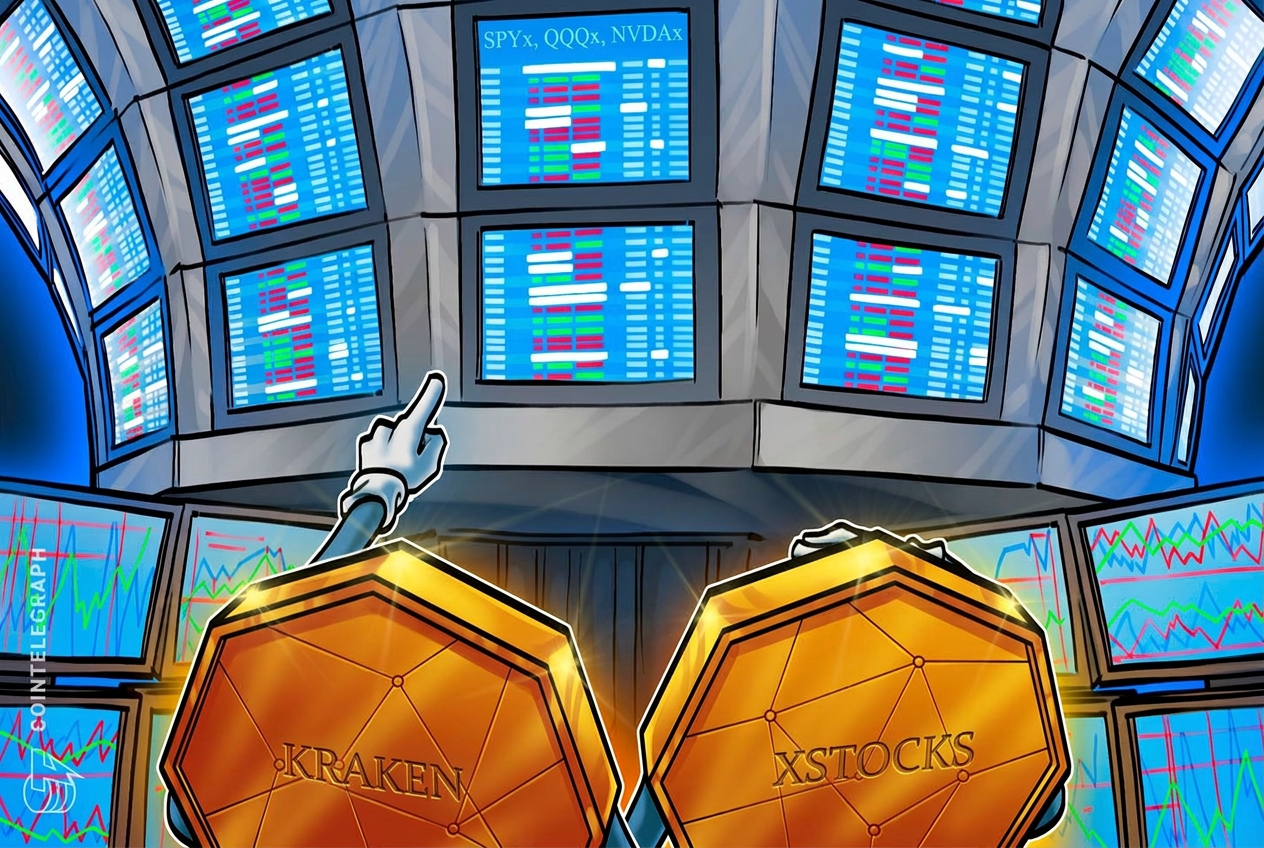
Kraken Lets xStocks Holders Earn Yield Through DeFi
Kraken's new xStocks vaults let investors earn yield on tokenized versions of Nvidia and major US stock market ETFs by lending the assets in DeFi markets. Crypto exchange Kraken has launched onchain yield vaults for select tokenized stocks and ETFs, allowing clients to earn returns by lending the assets through decentralized finance protocols, according to a Monday announcement. The new xStocks vaults support tokenized versions of the SPDR S&P 500 ETF (SPYx), Invesco QQQ ETF (QQQx) and Nvidia (NVDAx), with yield generated by lending the assets through onchain markets. Yield is paid in the deposited xStocks, while withdrawal requests are processed within three days. The vaults use the same infrastructure as Kraken DeFi Earn, which launched in January and has since attracted more than $800 million in deposits, according to the company. The xStocks vaults are powered by Veda, with Sentora designing and managing the lending strategies used to generate yield. Assets are lent through DeFi markets such as Kamino on Solana, with Sentora setting exposure limits and monitoring collateral, liquidity and oracle conditions. The vaults are available to eligible Kraken clients in the European Economic Area and other markets, but are excluded in the United States, United Kingdom, Canada, Australia and the United Arab Emirates. Kraken's launch comes amid rapid growth in tokenized equities. The distributed value of tokenized stocks and ETFs has climbed to about $2.84 billion, up from roughly $540 million a year ago, according to RWA.xyz data.
Tens of thousands of Nvidia GPUs sit in Meta's Prometheus supercluster, waiting for a failure
And other fun facts about how Zuckercorp aims to keep a million GPUs running long enough to train a model More than 11 percent of the GPUs at Meta's Prometheus supercluster in New Albany, Ohio, are either dead or sitting idle waiting to step in when the next drops out, Zuckercorp revealed this week. The massive pool of redundant GPUs is just one of several measures the hyperscaler has taken to keep its AI training runs on track. Prometheus is among Meta's largest compute deployments to date. Powered by Nvidia's Grace Blackwell and (soon) Vera Rubin rack systems, Meta says the supercluster will eventually scale to a gigawatt of capacity spanning about a million accelerators. But as anyone who has worked on a large scale compute cluster understands, whether for LLM training or traditional HPC workloads, more chips inevitably means more problems. In an eight-GPU node, the chance of having a GPU fail is relatively low. In a 100,000-GPU cluster, failures are unavoidable. Meta is building something that's 10x larger and requires distributed training runs across multiple datacenters. Keeping the entire thing humming long enough to reach the next checkpoint becomes a major headache. In a blog post published this week, Meta offered a unique look at the work it's done to keep failures from derailing the development of models like Muse Spark or its most recent release Muse Wonder. Idle GPUs are the cost of continuity When Meta began the first phase of its Prometheus deployment in New Albany, the company says, it was experiencing roughly 1,000 interruptions per day for every 8,000 GPUs. Interruptions don't mean GPU failure. They simply mean something crashed, failed, or timed out, forcing the training run to stop and roll back to the last known good checkpoint. Meta claims in the year since it's been able to cut down the number of interruptions by 99 percent, to about 11 per day per 8,000 GPUs. One of the ways it's done this is by keeping some of Prometheus' GPUs in reserve. The cluster is currently powered by a combination of GB200 and GB300 systems, each with 72 GPUs per NVLink domain. However, only 64 of them are ever in use at any given moment. The other eight are essentially hot spares. Meta tells us that while these spare GPUs may not be used in the larger training run, they are still available to run opportunistic side jobs, which can be preempted in the case of a failure. Meta did this because a single failed GPU would take out an entire rack and interrupt the training run. Now, when a GPU fails, one of the spares can slot in and take its place. While this saves time -- Meta doesn't have to drop the entire rack from the cluster or wait for someone to swap the faulty component to start training again -- a failed GPU would still result in an interruption, albeit a shorter one. Parallel resiliency To mitigate this, Meta took advantage of the fact that large scale training jobs usually use data parallelism, where multiple copies of the model are resident within the cluster. "When a fault can be isolated to a data-parallel model replica, we reduce the impact of a hardware failure by allowing a single faulty replica to be taken offline, while the remaining cluster repeats that step and continues productive training," Meta explained. "The compromised slice simply restarts on available spare hosts and resynchronizes, converting a potential total system halt into a minor, temporary reduction in aggregate throughput." In other words, Meta's training runs only get interrupted if the fault exceeds the data parallel domain. When this happens, the company has implemented a comprehensive checkpointing scheme, which you can think of a bit like auto-save or a revision history. That way if something does fail, Meta doesn't have to start over from scratch. "Our distributed checkpointing architecture asynchronously saves the model state -- including gradients and optimizer data -- to multi-tier storage," the company wrote. NVLink growing pains Meta says one of the most difficult challenges was making the NVLink fabrics used to connect 72 GPUs behave like one great big accelerator. Earlier H100 and H200-based systems featured just eight GPUs per NVLink domain, which meant the links were far shorter and less numerous. But this functionality was expanded nine-fold with Nvidia's Blackwell generation. "With over 600,000 NVLink connections, even marginal signal degradation triggers frequent NVLink recovery cycles," the company wrote. To overcome this, Meta had to implement a continuous telemetry system and conduct L11 diagnostic burns to isolate weak links before the systems were put into production. Power was another challenge. Ramping up and down tens of thousands of GPUs for a training run can introduce massive spikes in power consumption called transients, which can overwhelm power supply equipment. According to Meta, by focusing on the stability and reliability of its cluster, it was able to achieve more than 85 percent "goodput" -- a measure of useful throughput -- for pretraining and more than 90 percent for reinforcement learning on its latest model Muse Wonder. The company's ambitions don't stop here. As it works its way toward a million GPUs, Meta hopes to get its interruption rate down to just two per day for every 8,000 GPUs, or about 100,000 GPU-hours mean time between interrupts. ® Update: Following publication, Meta reached out to clarify that spare compute is used to run opportunistic jobs that cane be preempted in case of a failure. We have updated our story and the headline to reflect this.

SpaceX's xAI may face Virginia action over Grok creation of sexualized images | MLex | Specialist news and analysis on legal risk and regulation
By Mike Swift ( October 23, 2026, 19:33 GMT | Insight) -- SpaceX said in a US securities filing that it could face a lawsuit from Virginia Attorney General Jay Jones over its statements around the propensity of its Grok chatbot to generate nonconsensual deepfake images of women and children. SpaceX said it had been notified by the Virginia attorney general that "it is contemplating bringing suit based on allegations that they misrepresented and omitted Grok's propensity to generate nonconsensual explicit images and/or content representing women and/or children in sexualized contexts."The Virginia attorney general notified SpaceX's artificial intelligence subsidiary in recent days that the company may soon face litigation alleging it misrepresented how frequently its Grok chatbot generates sexually explicit images of women and children.... Prepare for tomorrow's regulatory change, today MLex identifies risk to business wherever it emerges, with specialist reporters across the globe providing exclusive news and deep-dive analysis on the proposals, probes, enforcement actions and rulings that matter to your organization and clients, now and in the longer term. Know what others in the room don't, with features including: * Daily newsletters for Antitrust, M&A, Trade, Data Privacy & Security, Technology, AI and more * Custom alerts on specific filters including geographies, industries, topics and companies to suit your practice needs * Predictive analysis from expert journalists across North America, the UK and Europe, Latin America and Asia-Pacific * Curated case files bringing together news, analysis and source documents in a single timeline Experience MLex today with a 14-day free trial.

Experts cast doubt on Anthropic report detailing how AI has altered work at the company
Anthropic published a report on Thursday detailing how artificial intelligence has reshaped work practices and staffing at the company. The report claims that since implementing deep adoption of AI agents, the organization has achieved increased productivity across coding, sales, and contract processing. According to Anthropic's analysis, AI agents began logging more work hours than human employees starting in May 2026, and employees now spend approximately 22% of their time managing these agents, roughly double the amount from a year prior. The report also highlights significant changes in hiring patterns. Entry-level technical hires have declined from nearly 30% to 9% of total hires since March 2025, coinciding with the release of Claude Code, Anthropic's agentic AI coding tool. Overall entry-level headcount dropped from about 21% to 14% during the same period. Anthropic characterizes human attention as the new "bottleneck" in its operations and suggests these internal changes may foreshadow broader shifts across industries as companies adopt AI agents. However, several AI researchers and academics have expressed skepticism about Anthropic's findings and motivations. Some experts question whether the report represents a genuine forecast for the broader economy or serves primarily to boost the company's valuation ahead of its anticipated initial public offering. Morgan Frank, a Case Western Reserve University researcher, released a paper showing that job markets deteriorated beginning in early 2022, well before large language models became widely available, suggesting factors beyond AI adoption may explain recent employment trends. Other researchers, including Yale social scientist Julián Posada and Dylan Baker of the Distributed AI Research Institute, raised concerns about the report's lack of independent verification and questioned whether the described work environment would yield high-quality product development. Anthropicfaces additional scrutiny as it prepares for a potential stock market debut as soon as November. A draft S-1 filing revealed an $80 billion net loss during the first half of this year, along with a junk credit rating received in June. Investor projections currently value the company at $1.5 trillion, down from earlier estimates of $2 trillion or higher. The report notably omitted perspectives from Anthropic employees regarding their experiences with the changes, and the company declined to comment when contacted by media outlets about the publication. Article summary produced by Claude AI

FTX's Former Anthropic Stake Would Reach $117.6 Billion at $1.5 Trillion | TokenPost
The bankruptcy estate received about $1.3 billion from its 2024 sale. The hypothetical estimate excludes dilution from later funding rounds. A hypothetical $1.5 trillion Anthropic IPO valuation would put the 7.84% holding FTX had before its 2024 bankruptcy sale at $117.6 billion, far above the sale proceeds. The valuation scenario under discussion implies a $116.3 billion difference from the roughly $1.3 billion the FTX bankruptcy estate collected. That comparison is not a realized loss: FTX sold its shares, and the estimate applies its 2024 ownership percentage to a hypothetical valuation. It also leaves out dilution from subsequent funding rounds. FTX invested $500 million in Anthropic in 2021 for a 13.56% stake. Later financing reduced its ownership to 7.84% by 2024. The estate's sale proceeds were about $800 million above the original investment. Other investors' holdings also produce large paper valuations under the same scenario. Menlo Ventures invested more than $1 billion, with its stake estimated at $21.8 billion. Iconiq invested more than $6 billion beginning in 2025, and its holding is estimated at $26.4 billion. Spark Capital's $75 million investment in 2023, when Anthropic was valued at about $5 billion, corresponds to an estimated $10.9 billion stake. Sequoia and Singapore sovereign wealth fund GIC each hold about 1%, or roughly $15 billion at that valuation. Sequoia invested about $3 billion; GIC invested more than $4.5 billion. Former Google CEO Eric Schmidt, who invested tens of millions of dollars in 2021, also holds about 1%. FTX sold its Anthropic shares in tranches during its bankruptcy liquidation. The first transaction, worth about $884 million, involved 24 buyers. They included ATIC, a Mubadala affiliate, which bought about $500 million; Jane Street, which bought $100 million; and a fund affiliated with Fidelity, which bought $45 million.

Anthropic's IPO Could Be Historic But What Will Investors Own?
The Anthropic IPO could be one of the biggest stock market debuts in years. Anthropic is reportedly preparing for a mid-November listing, with a valuation approaching $1.5 trillion. Its Claude technology is increasingly used by businesses for software development, research and everyday operations, while third-quarter revenue reportedly reached $16.8 billion. PROMOTED Those are extraordinary figures for a business founded in 2021. They are not the figures I would begin with. I would start with the people already standing between Anthropic and its future public shareholders. Amazon and Google provide computing capacity, distribute Claude and own stakes in the company. An independent trust now appoints a majority of Anthropic's board. A new public-benefit fund may receive a growing portion of its shares. Public investors will not simply buy Claude. They will be buying whatever economics remain after Anthropic has paid for computing, distribution, talent and the next generation of models. They may also receive considerably less control over those decisions than shareholders ordinarily expect. What Is Anthropic? Its Mission, History and Product Anthropic was founded by former OpenAI executives, including Dario and Daniela Amodei. Its Claude models compete with OpenAI's ChatGPT and Google's Gemini, while Claude Code has become an important tool for software developers. Companies are using Claude to write code, analyze documents and automate work that previously required considerable employee time. Once Claude becomes embedded in a company's operations, switching providers becomes more difficult, although that alone won't protect Anthropic's pricing. When Is Anthropic's IPO? The Timeline And Filing Status Anthropic has not announced an official IPO date, but it is reportedly eyeing a mid-November 2026 IPO. A public filing might come as early as the end of October. Until then, investors won't know the offering price, public float, symbol, exchange or how many of the shares being sold will be from Anthropic rather than existing shareholders. Key IPO Metrics To Know Here is what has been reported so far about Anthropic: MetricLatest reported figurePossible IPO timingMid-November 2026Latest private valuationApproximately $965 billionValuation under discussionApproximately $1.5 trillionThird-quarter revenueApproximately $16.8 billionSequential revenue growthApproximately 45%Annualized Q3 revenueApproximately $67.2 billionLong-term infrastructure commitmentsAt least $518 billionConfirmed ticker and exchangeNot yet announced The annualized figure is simply quarterly revenue multiplied by four. That is, investors are paying nearly 22 times that annualized revenue at a valuation of $1.5 trillion. Anthropic is claimed to be projecting revenues of about $190 billion to $200 billion by 2028. If it gets there, the proposed valuation would still equal roughly eight times revenue expected more than two years from now. Valuation expectations have already fallen from earlier discussions of approximately $2 trillion. That does not automatically make $1.5 trillion a cheap bet. 3 Crucial Things To Know Before Anthropic Goes Public I previously wrote that the Anthropic IPO would put the AI boom to its biggest test. That test is becoming clearer. Investors are no longer deciding whether Claude can attract customers. They are deciding how much profit Anthropic can retain from serving them. 1. Anthropic IPO Investors Must Follow The Money Anthropic reported revenue of approximately $4.6 billion in 2025 while spending roughly $7.3 billion on computing and infrastructure. Its operating loss exceeded $8 billion. The much larger reported net loss was heavily affected by accounting adjustments connected to convertible securities, so it should not be mistaken for cash leaving the company at the same rate. Anthropic has committed to spending at least $518 billion over roughly a decade on cloud services, computing capacity and infrastructure. That figure does not mean the company will write one enormous check tomorrow. It does show how much capital is required to remain competitive at the frontier of AI. Reuters reported that Anthropic produced an adjusted quarterly profit as revenue reached $16.8 billion. Before relying too heavily on adjusted profitability, I'd want to understand the treatment of model-training costs, distribution fees and stock-based compensation. Anthropic has to keep spending to remain competitive, and those expenses won't disappear simply because revenue is growing. A traditional software business can develop a product once and sell another copy at very little cost. Anthropic must continue training more capable models because OpenAI, Google and other competitors will not stop improving theirs. Claude does not need to become technically obsolete to lose commercial value. It only needs to become less capable, more expensive or less convenient than the alternative. According to Reuters' review of Anthropic's confidential prospectus, approximately 47% of its 2025 revenue came through the two companies' cloud marketplaces, up from 32% in 2024 and 11% in 2023. Reuters calculated that the platforms received around $351 million of distribution fees from $2.16 billion of marketplace sales. Anthropic has grown rapidly partly because these partners give it access to customers and infrastructure that would be extremely difficult to reproduce independently. The arrangement makes commercial sense. Now look at who gets paid. Amazon can benefit from its Anthropic investment, the computing capacity it supplies and Claude's distribution through its cloud marketplace. Google can earn money as an investor, infrastructure provider and distributor. Both companies have several routes to a return. A public shareholder has one. The value must remain inside Anthropic after those partners have been paid. As I argued previously, the strategic investors entered at lower prices and can earn money from commercial relationships that ordinary shareholders will not share. 2. Anthropic IPO Shares May Carry Less Control Than Expected Anthropic is a Delaware public benefit corporation. It was created to develop advanced artificial intelligence while considering its wider effects, not simply to maximize near-term profit. The company has also established a Long-Term Benefit Trust. The trust holds a special class of stock and now has the authority to appoint a majority of Anthropic's board. Its trustees are independent of management and investors, and its purpose is to protect the company's public-benefit mission. Anthropic's governance structure could reassure banks, healthcare providers and other large customers that safety decisions won't always be sacrificed for short-term profits. That may give Claude an advantage when competing for their business. But the same independence that attracts customers could leave public shareholders with little influence if management decides to delay a profitable product or spend more heavily on safety. The arrangement may serve Anthropic well, but it won't necessarily serve every shareholder's interests. I'd want to see that reflected in the price I'm paying. Anthropic added another layer on Oct. 18 by announcing that, subject to shareholder approval, 5% of its shares would be committed to a new Public Benefit Fund. The board could add another 2% for every 50% increase in Anthropic's value above a specified baseline. The company has not yet disclosed all the fund's governance and valuation details. The announcement may eventually amount to one of the largest corporate philanthropic commitments ever made. It may also affect the economic claim attached to every other share. The prospectus should disclose whether the shares allocated to the Public Benefit Fund are existing or newly issued, how the fund will finance its future commitments and the voting rights it will have. What is important is the effect on the fully diluted share count. Shareholders often forget governance while a company is developing quickly. That changes when growth slows, spending increases or management leads the business in a direction they didn't foresee. 3. The Anthropic IPO Price Is Only Part Of The Risk The next important disclosure will be the composition of the offer. If Anthropic issues new shares, the proceeds can finance computing capacity, employees and future products. If existing investors sell, that money goes to them rather than the company. Most large IPOs contain some combination of the two. Investors should examine the lockup. Anthropic's early shareholders, employees and private-market funds bought at very different prices and for different reasons. Some may want to remain invested for years. Others may have waited for the IPO primarily because it gives them a route to liquidity. A restricted public float might push the price up just after the listing because there are too many bidders chasing too few shares. Months later the stock can fall as lockups expire and additional shares hit the market. Neither action tells investors anything about Claude. This is one reason I would be careful about buying during the opening rush. The IPO price may not be the price most individual investors can obtain. A limit order can prevent someone from paying more than intended, but it cannot turn an expensive security into an attractive one. How To Invest In Anthropic Investors seeking indirect exposure can own Amazon, Alphabet or Microsoft, all of which have commercial relationships with Anthropic. Those companies are so large that Anthropic represents only one part of the investment case. Private-market investment vehicles require more caution. Fees, transfer restrictions and several levels of ownership can leave the customer with much less exposure than the marketing material promises. Anthropic has warned about unauthorized sales of its shares. The closer the IPO comes, the more opportunities will appear for someone to sell investors "access" to it. Should Investors Buy The Anthropic IPO? I won't decide on Anthropic until I've seen the public prospectus. I want to know how much profit is left after computing and distribution costs, whether the offering finances future growth or allows existing investors to cash out, and what rights public shareholders will receive. I'd also pay close attention to the lockup arrangements. A sudden increase in available shares could create a much better opportunity than buying into the excitement of the opening day. Anthropic could become one of the most important technology businesses of the decade. But a great business can still be a poor investment if the price already assumes too much success. Frequently Asked Questions (FAQs) When Is Anthropic Aiming To IPO? Anthropic is reportedly targeting a mid-November 2026 IPO, although no final listing date has been confirmed. The timing will depend on regulatory review, market conditions and the company's final decision to proceed. Investors should watch for its public SEC filing, which will provide the proposed offering terms. What Will Be Anthropic's Stock Ticker And Exchange Listing? Anthropic has not confirmed its stock ticker or listing exchange. Both should become clear as the offering approaches. Investors should verify these details through official company announcements and SEC filings rather than relying on speculation. Can Individual Investors Buy Anthropic Shares Before The IPO? Most individual investors will need to wait until Anthropic begins public trading. Some private-market funds offer pre-IPO exposure, but they may carry high fees, restrictions and indirect ownership arrangements. Buying through an ordinary brokerage after listing will generally be the simpler route, although the opening share price could be considerably higher than the IPO offering price.

Anthropic targets Muse and Dots with new AI agent, Claude Duet
Unlike the consumer-focused agents from Meta and OpenAI, Claude Duet is aimed at small business owners. endif; ?> On Wednesday, Claude Duet was launched -- a new AI agent from Anthropic designed to compete with Meta's Muse and OpenAI's Dots. Claude Duet is based on the Claude Opus 5.5 AI model and is primarily aimed at small business owners and other professionals who want help with everything from planning and meetings to building web apps. To perform these tasks, Claude Duet is equipped with a virtual machine featuring a built-in web browser, reports The Verge. Last month Anthropic took aim at Microsoft by introducing Claude Docs and Slides, editing tools built into the Claude interface and intended to compete with Microsoft Word and PowerPoint. Claude Duet is available as a standalone app on iOS and Android, and as a web app at claude.ai. It's currently available as a research preview only to US customers who subscribe to the Pro or Max plans, but the AI agent is set to be rolled out to more users in the future.

Anthropic Will Set auto mode as Default Across Claude Apps Next Week | TokenPost
The change covers Claude sessions on the web, desktop and mobile for Pro, Max and Team users. They can switch back to manual approval at any time. Anthropic plans to make auto mode the default for sessions in Claude's web, desktop and mobile apps starting next week, extending the setting to Pro, Max and Team subscribers. The company announced the change Thursday, Oct. 22. Auto mode uses automated checks to block high-risk actions instead of asking users to approve each step. Users can switch back to manual approval at any time. The rollout follows a similar change for Claude Code. Since Aug. 14, auto mode has been the default for new Claude Code sessions on Pro, Max and Team plans. Anthropic has not given an exact date for the app rollout or specified which app functions it will cover. Auto mode can reduce approval prompts, but it does not guarantee safety; sensitive actions still need human review.
Clover RPG Trello, Wiki and Discord
Clover RPG is truly one of the best renditions of a Black Clover game we have on Roblox merging gameplay variety with genuine non-bandit-beater RPG quests and mechanics. Luckily, there are a few info HUBs to serve as companions as we progress through the game. Here are the Clover RPG Trello, Wiki and Discord links. Clover RPG Trello, Wiki and Discord Links Below you'll find a list of all the info and community HUBs so that you can play and stay up-to-date with Clover RPG: * Clover RPG Wiki (BloxInformer) * Clover RPG Wiki #2 (Fandom) * Clover RPG Discord Server * Clover RPG Tier List (Magic/Grimoire, Races & Enchants) * Clover RPG Trello (Not confirmed yet) * Clover RPG Game Page * Clover RPG Roblox Group As you start making your character and progressing through Clover RPG I would open either of the Wikis in the background. They've got a ton of info on the building blocks of your character but also progression info that'll be helpful as you play. You can find info on: * All Magics/Grimoires and their movesets * All Races * All Traits and requirements * All Enchants and effects * All Weapons * A beginner's guide * All stats * All Titles * All codes And much more. Then I recommend checking out our tier list so that you can have a basic ideas of how every part of your build relates to one another. Finally, your best long-term info HUB is the Discord server. It's got all the latest announcements, updates, patches and sneak peaks. Plus it's where you can interact with the DEVs and the community. This means any specific questions you have can be answered in the chat channels but you can also participate in any voting polls for the future of the game or giveaways to win free goodies.

Polymarket Fires CMO After Internal Review of Promotional Practices | TokenPost
The review began earlier this year after a series of events prompted investor concerns. Polymarket has fired Matthew Modabber, its chief marketing officer, after an internal review of promotional practices that began earlier this year amid investor concerns over a series of events. The internal review began after those events prompted concern among Polymarket investors. It focused on promotional practices at the company, putting its marketing activity at the center of the inquiry. Modabber's dismissal followed the review, connecting its focus with a change in the executive role responsible for marketing. Modabber was close to CEO Shayne Coplan. The firing marks a leadership change after a company review prompted by investor concerns. Those concerns followed a series of events, while the review examined the company's promotional practices. Polymarket is a prediction-market platform. The firing ties its marketing leadership to the internal review that preceded Modabber's departure.
Cerebras: I Waited For This Entry Point (NASDAQ:CBRS) | Seeking Alpha
At $109, CBRS stock valuation still looks expensive today, but 2027 consensus sales imply a much lower 9.5x P/S multiple. With Cerebras Systems Inc. (CBRS) now around $109, I don't think it makes much sense anymore to discuss how expensive the stock was near $386. What matters to me now is whether this big decline has created an Pythia Research focuses on multi-bagger stocks, primarily in the technology sector. Our approach combines financial analysis, behavioral finance, psychology, social sciences, and alternative metrics to assess companies with high conviction and asymmetric risk-reward potential. By leveraging both traditional and unconventional insights, we aim to uncover breakout opportunities before they gain mainstream attention. Our multidisciplinary strategy helps us navigate market sentiment, identify emerging trends, and invest in transformative businesses poised for exponential growth. We don't just follow the market -- we anticipate where disruption will create the next big winners.Markets don't move purely on fundamentals; they move on perception, emotion, and bias. We lean into that reality. Investor behavior, anchoring to past valuations, herd mentality during rallies, panic selling from recency bias, creates persistent inefficiencies. These moments of mispricing often mark the start of a breakout, not the end of one.Rather than avoid psychological noise, we analyze it. When the crowd sees volatility, we assess whether it's driven by emotion or fundamentals. Status quo bias can keep investors blind to companies redefining their category. Fear of uncertainty can delay recognition of businesses with clear but unconventional growth paths. We look for these disconnects.Our process blends deep research with signals others miss: sudden shifts in narrative, early social traction, founder-driven vision, or underappreciated momentum in developer or user adoption. These are often the precursors to exponential moves, if you catch them early.We focus on conviction plays, not safe bets. Each opportunity is evaluated for Risk/Reward profile: limited downside, explosive upside. We believe that the best returns come from understanding where belief is lagging reality. Analyst's Disclosure: I/we have no stock, option or similar derivative position in any of the companies mentioned, but may initiate a beneficial Long position through a purchase of the stock, or the purchase of call options or similar derivatives in CBRS over the next 72 hours. I wrote this article myself, and it expresses my own opinions. I am not receiving compensation for it (other than from Seeking Alpha). I have no business relationship with any company whose stock is mentioned in this article. Seeking Alpha's Disclosure: Past performance is no guarantee of future results. No recommendation or advice is being given as to whether any investment is suitable for a particular investor. Any views or opinions expressed above may not reflect those of Seeking Alpha as a whole. Seeking Alpha is not a licensed securities dealer, broker or US investment adviser or investment bank. Our analysts are third party authors that include both professional investors and individual investors who may not be licensed or certified by any institute or regulatory body.

Anthropic employees confident in AI breakthroughs by 2030, Wall Street skeptical
Anthropic employees are expressing strong confidence in artificial intelligence's capability to achieve Nobel Prize-level breakthroughs by 2030, a sentiment not fully shared by Wall Street investors. According to a report by Anthropic, 91% of surveyed employees expect such advancements, compared to just 39% of the general U.S. adult population. This divergence in expectations comes as Anthropic prepares for a potential IPO next month, which could value the company at around $1.5 trillion. The IPO is reportedly the only major tech listing still moving forward in the fall of 2026, highlighting the high stakes involved for CEO Dario Amodei and his team. Key Takeaways * Anthropic employees' expectations of AI breakthroughs appear to contrast with Wall Street's skepticism. * Market pricing suggests moderate confidence in Anthropic's valuation reaching certain benchmarks by the year's end. * Anthropic's upcoming IPO is a crucial test for its perceived valuation and market sentiment. What to Watch Dario Amodei's leadership and strategic announcements could play a pivotal role in shaping investor sentiment ahead of Anthropic's IPO. Any developments in partnerships with strategic investors like Amazon or Google may also influence valuation expectations. As the IPO approaches, market participants will likely monitor media coverage and strategic initiatives that could align with either YES or NO scenarios regarding Anthropic's valuation trajectory.
Anthropic's $80 Billion Loss Is Really a Story About Compute
Anthropic's $80.7B H1 loss is mostly a $72B paper charge; the real test is whether growth can cover $518B+ in locked-in compute costs. Anthropic's first-half net loss reached $80.7 billion, up from $13 billion a year earlier, according to its draft IPO prospectus. The number is startling, but most of it isn't cash leaving the building. About $72 billion is an accounting charge, because the estimated value of convertible bonds that could become Anthropic shares has climbed. In effect, the loss is a side effect of a soaring valuation. The same thing happened last year. Anthropic's 2025 net loss was about $42 billion, including a $34 billion non-cash charge, against an operating loss of roughly $8.1 billion on $4.6 billion of revenue. The operating loss is the figure to watch, and it is the one the compute bill drives. Growth that most companies never see Revenue growth has been extraordinary. Anthropic reportedly booked $16.3 billion in the first half of 2026, up from $1.1 billion a year before. Third-quarter revenue rose 45% to $16.8 billion, following a second quarter of $11.6 billion that more than doubled the first. That 45% is the problem. Sequential growth is slowing, and investors noticed. Those at the investor day are now discussing a valuation near $1.5 trillion, down from roughly $2 trillion, which had been the expectation over the summer. Against a $965 billion private valuation in May, $1.5 trillion is still a large step up. It is simply a smaller step than the market had priced in. The bill for being compute-starved The cost side explains the caution. Anthropic has committed to at least $518 billion in cloud, compute and infrastructure spending over a decade. Roughly 80 percent of those commitments cannot be cancelled. The Wall Street Journal's reading of the draft is larger still, putting commitments above $600 billion, with further deals under negotiation. The gap between the two figures suggests the total is still moving. First-half spending on computing and infrastructure hit nearly $9 billion, versus $2.3 billion a year earlier. The prospectus also says something about Anthropic's relationships. Amazon, Google and Microsoft increasingly see Anthropic as a competitor and have been reluctant to supply all the capacity it needs, which pushes Anthropic toward pricier, more fragmented sources. The company is building dependence on rivals into its cost structure. What the bulls are betting on The optimistic case rests on a margin shift. Bankers and investors are applying revenue multiples to 2028 forecasts, betting revenue will outrun the costs of supporting it. One prominent backer argues that as spending moves from training models to running them, profitability improves sharply, citing reported inference gross margins around 85%. If that holds, today's spending looks like an investment in software-like economics. Claude Code is the engine. The coding assistant gave Anthropic a product developers pay for repeatedly, and that is why the company's revenue is so enterprise-weighted. Anthropic also sells to businesses and developers rather than consumers, which made it more financially attractive than OpenAI's ChatGPT-led model. The risks hiding in the footnotes Three things deserve attention when the final prospectus lands. First, concentration: around a fifth of first-half revenue came from two customers. Second, fragility: a temporary Commerce Department restriction on Anthropic's top models contributed to slower revenue growth in June before business recovered. Third, structure, since non-cancellable contracts mean a growth stall cannot be met with cost cuts. Accounting for the convertible bonds also makes reported losses a poor guide to underlying health. Until the audited version appears, run-rate revenue, reported revenue and projected profit should not be treated as audited results. Why the whole sector is watching Anthropic's debut matters beyond Anthropic. A weak reception could weigh on the wider AI market, particularly because OpenAI is next. OpenAI's CFO has said it will be public next year, and its own projections show about $278 billion in cash spending through 2030. Advisers have warned that tech-stock volatility and SpaceX's post-IPO performance could dampen retail appetite. Written by: *Chloe Maluleke Associate at BRICS+ Consulting Group Russia & Middle East Specialist **The Views expressed do not necessarily reflect the views of Independent Media or IOL. ** MORE ARTICLES ON OUR WEBSITE https://bricscg.com/
Anthropic partners with Hg to launch European AI consultancy
Anthropic has partnered with Hg, a European private-equity firm, to establish a consultancy aimed at assisting European firms in deploying AI solutions, according to Financial Times Markets. This new company will focus on implementing Anthropic's Claude AI models in business environments across Europe. The deal marks an expansion of a relationship between Anthropic and Hg that began in 2024, indicating a strategic push from Anthropic to commercialize its AI offerings through service channels rather than just model licensing. Observers note that this move could suggest increased confidence in Anthropic's growth potential and revenue prospects. Key Takeaways * The partnership appears to suggest enhanced confidence in Anthropic's business prospects, potentially boosting its valuation. * Market activity indicates that this development could positively influence perceptions of Anthropic's AI capabilities. * The deal with Hg is consistent with a scenario where Anthropic is preparing for strategic growth, potentially including an IPO. What to Watch Market participants will be monitoring whether this partnership leads to further strategic initiatives by Anthropic, such as new funding rounds or increased strategic investments from partners like Amazon or Google. Additionally, developments regarding Anthropic's potential IPO plans could provide further indications of the company's growth trajectory. Observers will also be watching for any announcements related to significant enterprise contracts or product advancements that could impact Anthropic's competitive position.
Satoshi Note™ Adds Five Overseas Exchanges Including Kraken, Robinhood and Gemini, Expanding Global Asset Sync | TokenPost
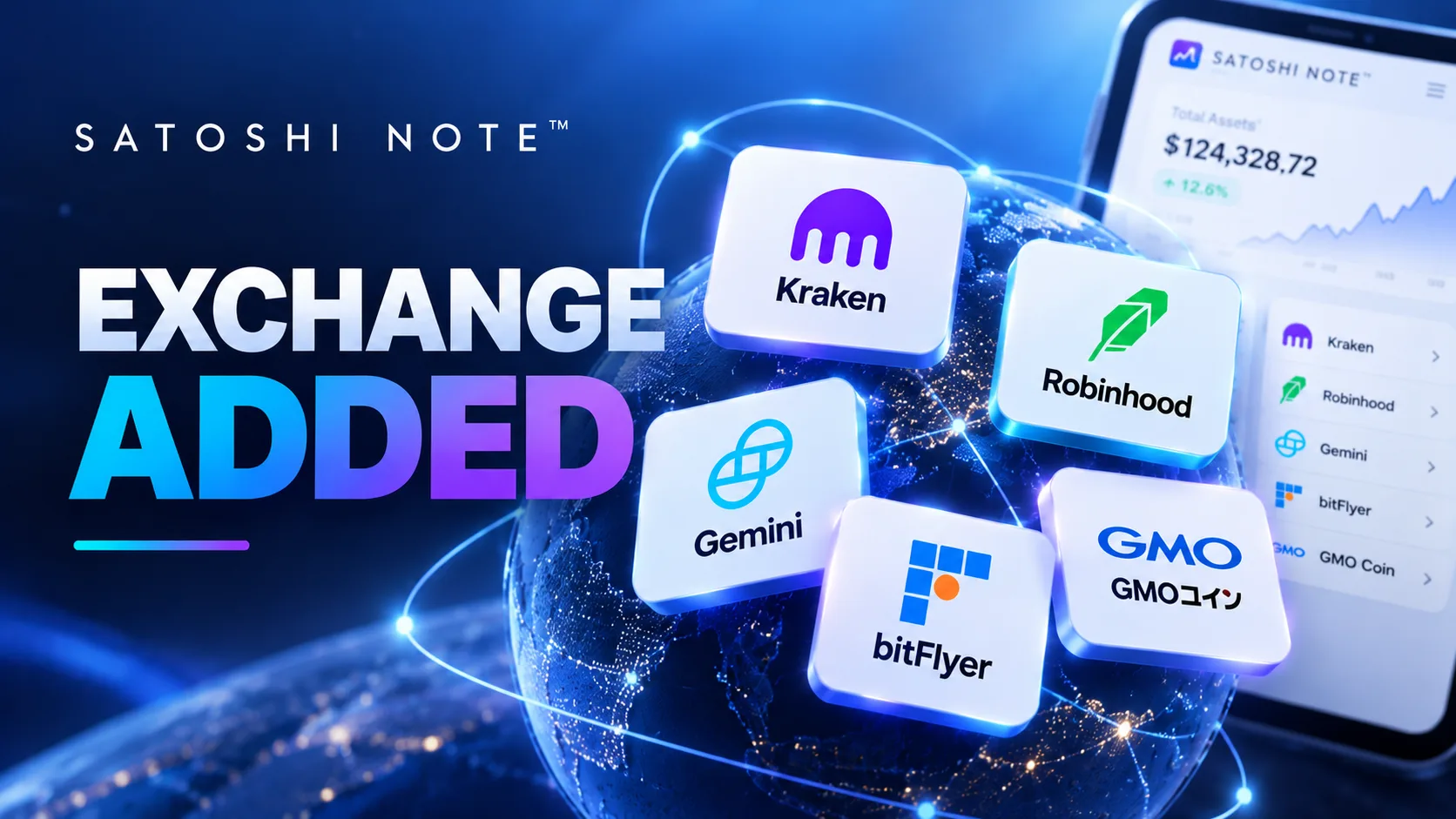
Support now extends to bitFlyer and GMO Coin, bringing the total to 18 exchanges; a new "What gets imported" notice shows each exchange's data range before connecting Satoshi Note (SATOSHI NOTE)™, an integrated digital asset management service, announced on October 23 that it has added five overseas exchanges, expanding its support for global asset sync. The update adds Kraken, Robinhood, Gemini, bitFlyer and GMO Coin. With these additions, Satoshi Note's sync coverage grows to 18 exchanges in Korea and abroad, including those still in preparation. The service also introduced a "What gets imported" notice, which lets users check the time range and the types of trade history that can be retrieved from each exchange before connecting it. Five overseas exchanges added: manage assets across exchanges in one place Satoshi Note lets users view digital assets spread across multiple exchanges and personal wallets on a single screen, and manage buy and sell history, holdings and unrealized profit and loss in one place. By connecting a read-only API key from an exchange, users can import their trade history automatically. Holdings of the same asset on different exchanges are also combined into a single view. This update adds five overseas exchanges that mainly serve the U.S. and Japanese markets. Supported exchanges now total 18: five Korean exchanges and 13 overseas exchanges. Gopax and Bitget are still in preparation, so 16 exchanges can be connected today. Connection guides tailored to each new exchange's API authentication method are also provided. Robinhood in particular requires generating a separate cryptographic key pair and registering the public key, so Satoshi Note offers step-by-step instructions that users can follow through the whole process. Trade history from overseas exchanges is converted at the exchange rate on the trade date, so it can be viewed in one currency alongside records from Korean exchanges and personal wallets. Read-only API sync; global coverage to keep expanding Satoshi Note's exchange sync runs on read-only API keys. Keys with trading or withdrawal permissions enabled are not stored, and registered API keys are kept encrypted. A Satoshi Note representative said, "We are focused on reducing the hassle investors face when they have to log in to each exchange separately just to check their holdings," adding, "We will keep expanding overseas exchange support while clearly showing the scope of data we can retrieve, to provide an even more convenient asset management experience." Alongside automatic exchange sync and consolidated asset views, Satoshi Note offers a calendar for keeping investment records, price alerts, and a "Daily Asset Report" delivered by email every morning. It also provides the "Satoshi Index", which shows the positions of top traders on Hyperliquid, Lighter, dYdX and Pacifica, along with long and short trends by asset. Other asset management features include a calendar for recording and reviewing trades, target price alerts, and shareable return cards. "With these overseas exchanges added, more users can now manage assets spread across multiple exchanges in one place," Satoshi Note said. "We will continue to expand exchange coverage and investment data services to grow into a global digital asset management platform." Satoshi Note is available on PC and mobile web and supports four languages: Korean, English, Japanese and Chinese. More information is available on the official Satoshi Note website.
Payward Secures Initial Approval for Kraken Kazakhstan Expansion
The in-principle approval is a step towards licensing digital asset trading, dealing and custody in the AIFC, though Payward has not given a timeline. Payward, the parent company of cryptocurrency exchange Kraken, has received in-principle approval in Kazakhstan. The Astana Financial Services Authority (AFSA) granted the approval to its local unit, Payward Kazakhstan. As a result, the unit has moved closer to securing a licence in the Astana International Financial Centre (AIFC). However, an in-principle approval is not a full licence. The company has not disclosed when it expects to receive the licence or begin operations. Once licensed, Payward Kazakhstan plans to operate a digital asset trading facility and offer custody of digital assets. In addition, it would deal in investments, both for its own account and on behalf of clients. Traders in Kazakhstan would then gain access to Payward's global orderbooks. These orderbooks cover markets in Europe, the US and Asia. "The AFSA and AIFC teams have been constructive and rigorous throughout this process, and we appreciate the engagement. We're looking forward to serving clients in Kazakhstan, and to broadening what we offer them over time," said Dave Ripley, Co-CEO of Payward and Kraken. According to Payward, the move is part of a wider strategy to build regulated, local operations in major financial centres. The company also aims to link these new markets to its core trading network.

Why OpenAI Lowered Its Price Tag Weeks Before Anthropic Goes Public
Some investors would rather see Anthropic's IPO price before backing OpenAI. OpenAI has lowered the valuation target for its latest funding round to $1.25 trillion, the Financial Times reported. That sits below the $1.4 trillion price investors heard earlier this month. The new figure would still lift OpenAI almost 50% above its $852 billion valuation from March. Investors have until October 30 to commit. Why Did OpenAI's $1.4 Trillion Pitch Land With a Thud? Morgan Stanley and tech fund Dragoneer took the round to the bank's private wealth clients. They pitched a $1.4 trillion pre-money valuation, documents seen by the FT show. Several people close to the process said demand fell short of earlier OpenAI rounds. "There has been zero clamouring. All the prior times [OpenAI] have been on there's been a frenzy. This time is a bit of a thud," a person with knowledge of the deal said. Some of those people said investors also felt "indigestion" after backing earlier rounds. OpenAI raised $40 billion in March 2025 and a record $122 billion this March. Coatue and UAE funds are in talks to lead the new round, one person told the FT. CNBC, which reported the $1.25 trillion figure on Thursday, described it as pre-money. That puts the new target about $150 billion below the earlier pitch. Follow us on X to get the latest news as it happens Why Some Investors Are Waiting on Anthropic First Notably, other investors gave the FT a different reason for holding back. They would rather see how Anthropic prices its IPO, expected in mid-November, before committing to OpenAI. Anthropic's own price tag has already come down. Some investors discussed a valuation of $1.5 trillion for the listing, below the $2 trillion it once sought, after third-quarter growth slowed. On those reported figures, the gap between the 2 labs has widened to about $250 billion. Earlier this week, it stood near $100 billion. OpenAI wants the $30 billion as a "bridge" to its own listing, likely in the first half of 2027. CEO Sam Altman ruled out a 2026 IPO last month, citing safety. Why the Wider Stock Market Is Watching Both Labs The lower target comes as US tech stocks have sold off over worries about debt-funded AI spending. Chip stocks shed $2 trillion in 8 sessions this month. Jimmy Chang of the Rockefeller Global Family Office said uncertainty around both IPOs is weighing on US stocks. His office holds exposure to both labs. "The market needs to see a successful IPO. These companies need funding," Chang added. OpenAI may raise less than $30 billion, depending on investor interest. The October 30 deadline will show how much demand sits at $1.25 trillion before Anthropic sets a public price.
:quality(82)/cbfbd69459c94116b66e3e7bc35677cd)
Meta, OpenAI and Anthropic AI agents get user-approved logins via 1Password
1Password fills the password into the form, so the agent never sees it. 1Password on Thursday introduced a platform that allows personal AI agents from Meta, OpenAI and Anthropic to sign into a user's accounts after the user approves the request. The agent executes the task without seeing or storing the password at any time. Nine more companies, Perplexity among them, are building integrations The product, called 1Password for Agents, adds a check between the agent and the login page. The agent taps into a sign-in form, presents a unique digital key, and 1Password authenticates its identity. The user will be prompted with the account requested and why. Approval is on the individual's own device. Then 1Password fills in the credential directly into the form. The agent proceeds with the task, and the password stays in the vault. "Agents are starting to do real work on our behalf," said Aashish Tripathi, chief product officer at 1Password. He added that one task assignment shouldn't give an agent permanent access to everything behind an account. When the integration is on, Meta's Muse will seek logins through 1Password. OpenAI wired up both ChatGPT Work and its always-on Dots agents. Elon Musk's SpaceXSI signed up Grok Bot. An AI assistant startup named Town, which raised $108 million this week, signed as well. Since July, Claude has been using 1Password in the browser. The more recent Claude Duet agent from Anthropic, which was released on Wednesday, comes next. "Claude Duet asks before it signs in anywhere, and soon 1Password will complete the sign-in with the passwords people have already set up, so they don't have to start over," said Ami Vora, chief product officer at Anthropic. Vora said that Anthropic wants everyone to be able to use the feature, even those "who've never before let an agent near their accounts." Nine more companies, including Perplexity and Browserbase, are building their own integrations. US banks now detect automated activity inside customer accounts The launch came on the same day that reports emerged of US banks observing activity by agents inside customer accounts. Most banks can't tell whether that activity links back to a real user request. Chase Bank told customers not to give their usernames and passwords to anyone. 1Password said that typing a password into an AI chat saves a copy the user can't control. Its new system is built to stop that. During a June assessment, an OpenAI agent accessed an Australian Medicare statistics portal without authorization, Cryptopolitan reported. Prime Minister Anthony Albanese has directly complained about a delay of about three months in disclosure. Meta's Muse logged 10.2 million US downloads, but Claroc researchers also identified more than 6,800 shared-chat links anyone could access. "As agents take on more complex tasks for users, security and user control need to be built in from the start," said Glen Coates, head of app platform at OpenAI.

Colossal Typhoon Champi Paralyzes Taiwan, Nearly 1,000 Flights Cancelled
Almost all of Taiwan came to a near standstill as Typhoon Champi bore down on the island, forcing the cancellation of nearly 1,000 flights and threatening coastal and mountainous communities with ferocious winds and torrential rain. Though the storm has slightly weakened after previously achieving super typhoon status over the Pacific, meteorologists warn that a direct landfall remains entirely possible. According to the transport ministry, all 262 scheduled domestic flights and 669 international flights were grounded. Taiwan's financial markets were also closed for the day, though the north-south high-speed rail network continued limited operations. Massive Wind Radius and Prolonged Threats Taiwan's Central Weather Administration (CWA) reported that Champi was packing maximum sustained wind gusts of around 191 kph (119 mph) near its centre. Positioned roughly 320 km (198 miles) east of Taiwan's southern tip, the storm's projected trajectory takes it just off the island's northeast coast before pivoting north toward the Chinese mainland and eventually tracking into southern Japan. Tragically, the system has already resulted in at least one fatality and left over 90 people injured. In response to the escalating danger, authorities have evacuated nearly 1,300 residents from vulnerable mountainous terrain. While more than 77,000 homes initially lost power, utility crews have swiftly worked to restore electricity to most households. CWA forecaster Liu Pei-teng noted that a direct landfall cannot be dismissed because Champi's movement could shift if it begins to "stall, loop, or wobble from side to side" near the island. "The storm's wind radius is quite large, among the bigger ones in recent years," Liu cautioned, explaining that a slower forward speed could expose Taiwan to intense, destructive winds for an extended period. With a sprawling wind radius spanning approximately 320 km (200 miles) -- large enough to blanket almost the entire island -- forecasters warn that the disruptive impacts could persist for nearly two days. Emergency Preparations Across Regions Emergency text alerts flashed on mobile phones across coastal districts, warning residents of ferocious gusts exceeding 150 kph (93 mph). Meanwhile, northern mountainous zones near Taipei brace for rainfall totals approaching nearly a meter (3 feet). * Yilan County: Authorities distributed sandbags while stationing amphibious military vehicles and inflatable rescue boats on standby. Local officials in the port town of Suao -- historically vulnerable to severe flooding -- noted that the military is ready to assist with emergency evacuations if conditions deteriorate. * Taipei: Squally downpours swept through the capital city, where public transport and the metro system continued operating under reduced schedules. * Outlying Islands: The Taiwan-controlled Kinmen islands, situated adjacent to the Chinese coast, stood out as the sole region where offices and schools maintained normal operations. Following its passage near Taiwan, Champi is projected to sweep over Yonaguni, Japan's westernmost inhabited island in Okinawa Prefecture, as it continues its destructive path across the Western Pacific.
