News & Updates
The latest news and updates from companies in the WLTH portfolio.
Wild take road losing streak into game against the Kraken
The Minnesota Wild will look to break their three-game road skid in a matchup with the Seattle Kraken Minnesota Wild (6-3-2, in the Central Division) vs. Seattle Kraken (7-3-1, in the Pacific Division) Seattle; Saturday, 10 p.m. EDT BOTTOM LINE: The Minnesota Wild hit the road against the Seattle Kraken looking to break a three-game road losing streak. Seattle has a 7-3-1 record overall and a 3-1-0 record on its home ice. The Kraken have scored 42 total goals (3.8 per game) to rank fifth in league play. Minnesota has a 2-3-2 record in road games and a 6-3-2 record overall. The Wild have a +five scoring differential, with 32 total goals scored and 27 given up. The teams meet Saturday for the first time this season. INJURIES: Kraken: Ryan Lindgren: out (upper body), Jake O'Brien: out (lower-body), Jacob Melanson: out (chest). Wild: Filip Gustavsson: out (hip), Nick Foligno: out (upper body), Maxim Shabanov: day to day (upper body), Marcus Foligno: out (lower body), Brock Faber: out (skull). The Associated Press created this story using technology provided by Data Skrive and data from Sportradar.

Anthropic's Pitch to Investors Starts With Taking Their Jobs
The AI company warns its technology could threaten jobs and even humanity. For investors, those risks create a strange reason to buy in. You have to hand it to the AI companies: The pitch is original. A September report from Anthropic said AI could take US unemployment close to 12%. That same ...

Global Market: Anthropic presses ahead with November IPO as AI listings face delays
Anthropic is preparing for a potential mid-November IPO despite market volatility, rising interest rates and concerns over AI spending. With a possible $1.5 trillion valuation, its listing could test investor appetite as several AI infrastructure companies postpone or shelve offerings. Anthropic is pressing ahead with plans for an initial public offering (IPO) in mid-November, even as market volatility, rising interest rates and concerns over the sustainability of artificial intelligence spending force several technology and infrastructure companies to delay their listings. The AI startup could make its prospectus public as early as late October and is expected to begin marketing its shares to prospective investors during the week of November 9, people familiar with the matter told Reuters. The timeline remains subject to change. As on 23 Oct 2026, 01:30 AM IST S&P 500 Top Gainers Pool197.21(14.36%) Allegion176.52(11.02%) Roper Technologies436.23(9.73%) Mohawk Industries128.70(9.03%) Gainers" S&P 500 Top Losers Moderna202.63(-17.57%) Lam Research230.15(-11.76%) GE Vernova827.42(-10.64%) Teradyne308.75(-10.63%) Losers" Anthropic's planned IPO will test whether its position at the centre of the rapidly expanding AI industry can attract strong investor demand despite mounting pressure on technology valuations. Some investors believe the company could command a valuation of as much as $1.5 trillion. While several companies operating in AI infrastructure and data centres have postponed or shelved their listing plans, Anthropic is continuing to prepare for its market debut. The contrast highlights the company's appeal to investors seeking exposure to leading AI developers even as concerns about the industry's capital requirements intensify. AI IPO pipeline shrinks amid market volatility The IPO market for AI infrastructure and data centre companies has faced increasing headwinds since September, as higher interest rates and volatile markets have made it more difficult for issuers to secure attractive valuations. Data centre operator Switch and AI infrastructure provider Nscale have pushed their IPO plans to later this year, people familiar with the matter told Reuters. Nscale's delay was partly driven by the need to address comments from staff at the US Securities and Exchange Commission, one of the people said. SoftBank-backed SB Energy has also postponed its listing. South Korean AI chip startup Elice was among the latest companies to shelve its listing plans. Blackstone-backed AirTrunk REIT and Nvidia-backed Firmus have also withdrawn or paused their offerings. The delays reflect growing investor caution towards businesses that require substantial upfront capital to build data centres and AI infrastructure, particularly as questions mount over whether future revenues will justify the scale of investment. Anthropic attracts investor interest despite sector concerns Despite the turbulence, Anthropic continues to attract interest from large investors seeking exposure to the AI industry. Some institutional investors view the company as one of the few opportunities to invest directly in a sector expected to remain central to long-term technology growth. Other prospective issuers are reluctant to compete with Anthropic for institutional investors' attention and capital. However, Anthropic faces its own challenges, including competition from open-source AI models and concerns about AI safety. Its prospective valuation will depend on investors' assessment of its growth prospects, competitive position and ability to translate demand for AI into sustainable business performance. Investor demand and AI spending under scrutiny Oura's recent IPO experience has added to the cautious mood among prospective issuers. The offering attracted limited participation from long-only investors, a person familiar with the matter told Reuters, raising questions about the depth of institutional demand for newly listed technology companies. Long-only investors are often viewed as an important source of stable shareholder demand following an IPO, making their participation a key consideration for companies planning to go public. Meanwhile, developments involving AI infrastructure provider CoreWeave have added to concerns about a possible slowdown in AI spending. Some market participants, however, do not expect such a downturn to materialise. The broader retreat from AI infrastructure listings reflects investor scrutiny of the enormous capital expenditure required to expand data centre capacity and uncertainty over whether demand will continue to grow rapidly enough to support current valuations. Nscale publicly filed its IPO registration statement in September, while Switch filed confidentially. Confidential filings allow companies to work with regulators on their registration documents before making financial and business details public. Companies typically disclose their prospectuses ahead of investor roadshows, when they begin marketing shares to prospective buyers. Anthropic's planned offering will test whether investor appetite for leading AI developers can remain resilient even as market conditions become increasingly challenging for the wider AI infrastructure sector. (Disclaimer: This article is based on inputs from agencies. These do not represent the views of The Economic Times.)

From Eyeballs To Annual Run Rates: Buzzy Pricing Metrics And The Anthropic Trade | Seeking Alpha
Both Anthropic and OpenAI have been active in raising equity as private companies, and the most recent rounds yield estimates of what these private investors thought they were worth, at least at the time the capital was raised. I was in San Francisco last week to talk to NYU Stern Alumni on October 15, and it was the day that Anthropic (ANTHRO) had a pre-IPO meeting with prospective investors. While I was not I teach corporate finance and valuation at the Stern School of Business at New York University. I am a teacher first, who also happens to love untangling the puzzles of corporate finance and valuation, and writing about my experiences. As a result, I happen to be at the intersection of three businesses, education, publishing and financial services, that are all big, inefficiently run and deserve to be disrupted. I may not have the power to change the status quo in any of these businesses, but I can stir the pot. Please note that the article that you are reading here was originally written on my blog and is republished in Seeking Alpha and other forums. Consequently, I neither track nor respond to comments here. I am sorry! ==Editors' Note: Seeking Alpha monitors Dr. Damodaran blog and posts relevant articles on his behalf. Anthropic's reported $67B ARR and 45% sequential revenue growth underpin aggressive pre-IPO pricing, but the lack of standardized ARR calculation introduces skepticism about comparability and sustainability. To justify such pricing, Anthropic must deliver sustained hypergrowth, expand operating margins to 30%+, achieve favorable unit economics, and mitigate regulatory, financial, and business model risks. With few true peers, investors default to comparing Anthropic with OpenAI, SpaceX, and the Mag Seven, but these analogies are fraught with differences in scale, business model, and life cycle stage.

Kraken squander third-period lead, bounce back to top Mammoth
Mackie Samoskevich scored the tiebreaking goal at 14:35 of the third period and goaltender Philipp Grubauer made 33 saves as the Seattle Kraken defeated the visiting Utah Mammoth 5-3 on Thursday. Jordan Eberle and Brandon Montour had a goal and an assist apiece and Matty Beniers and Frederick Gaudreau also tallied for the Kraken, who improved to 5-1-1 in their past seven games. Logan Cooley scored twice, Vincent Trocheck added a goal and Mikhail Sergachev had two assists for the Mammoth, who had won four of their previous five. Karel Vejmelka stopped 18 of 22 shots. Samoskevich's winner came after Vejmelka made a save on a Bobby McMann shot on a 2-on-1 rush. Montour tracked down the rebound in the left corner and sent a pass through the slot to McMann, who found Samoskevich alone near the right post to tap the puck into a vacated net. Gaudreau clinched the victory with an empty-netter at 19:00. Trailing 3-1, the Mammoth pulled within a goal on a power-play strike by Cooley just 27 seconds into the third period. Cooley tipped over Grubauer's shoulder a shot by Sergachev from between the top of the faceoff circles. Cooley evened the score at 3-3 at 7:42 on a slap shot from just outside the top of the faceoff circles past a screened Grubauer and into the lower right corner of the net. The Kraken opened the scoring with a fluke goal at 3:38 of the first period. Defenseman Ryker Evans sent a stretch pass down the right wing for Eberle, who took a slap shot from just outside the top of the faceoff circle, with Vejmelka making a skate save. The puck ricocheted off the end boards, over the crossbar and hit the goalie in the back before trickling into the net. The teams then traded power-play goals late in the period. Utah tied it at 17:57. Kailer Yamamoto tracked down a loose puck behind the Kraken net and sent a no-look, backhanded pass to Trocheck, who lifted a shot over Grubauer from the bottom of the left faceoff circle. Seattle regained the lead at 18:23. Berkly Catton kept the puck in the offensive zone and passed to Kaapo Kakko along the goal line on the right wing. Kakko sent a backhanded pass across the top of the crease to Beniers, who tipped it in. The Kraken increased their lead to 3-1 on Montour's slap shot from the top of the left faceoff circle on a 5-on-3 advantage at 2:23 of the second, off an assist from Eberle.

Anthropic's IPO stands alone
Other AI infrastructure and data centre listings have been pulled or delayed, but Anthropic is pressing ahead. A once-busy pipeline of US technology listings for the rest of the year is down to just Anthropic. The AI lab is pressing ahead with its initial public offering, planned for the middle of next month, after making its prospectus public as early as late October, people familiar with the matter said, cautioning that the plan and the dates could change. Anthropic is expected to begin marketing its shares to prospective investors in the week of 9 November, one of the people said. That is later than first planned. In September, Anthropic was expected to begin marketing its IPO in mid-October and to list days before the US midterm elections in November. The IPO will test whether Anthropic's position at the centre of the booming AI business, which some investors believe could justify a valuation of as much as US$1.5-trillion, can overcome a market that might normally prompt bankers and lawyers to counsel delay. Other companies in the AI infrastructure and data centre sectors have delayed their listings. A rise in interest rates has helped fuel a punishing sell-off in the shares and bonds of AI operators such as CoreWeave, and there are broader questions about the sustainability of AI spending. The contrast underscores Anthropic's appeal to investors, even as concerns about competition from open-source models and about AI safety weigh on the sector. Many large investors remain bullish on Anthropic's prospects despite the recent turbulence, seeing the company as one of the few ways to gain exposure to a technology that long-term investors cannot afford to ignore. Other issuers are reluctant to compete with Anthropic for institutional investors' attention and capital, two of the people said. Anthropic declined to comment. Valuations under pressure The AI sector's pullback follows a string of IPO delays and withdrawals since September, as market volatility and rising interest rates have made it harder for companies to secure attractive valuations. Data centre operator Switch and AI infrastructure provider Nscale have pushed their IPO plans back to later this year, people familiar with the matter said, stressing that the plans remain fluid. Nscale's delay was partly driven by the need to address comments from staff at the US Securities and Exchange Commission, one other person said. SoftBank-backed SB Energy has also postponed its listing, Reuters previously reported. Nscale declined to comment. Switch did not immediately respond to a request for comment. Blackstone-backed AirTrunk Reit, a real estate investment trust, and Nvidia-backed Firmus have pulled or paused their offerings, Reuters has reported. Smart-ring maker Oura's recent IPO has added to the caution. The offering attracted little participation from long-only investors, a person familiar with the matter said, raising concerns about the depth of demand from the institutional investors that typically provide a stable base of shareholders for newly listed companies. The retreat from AI infrastructure listings reflects growing scrutiny of the enormous capital needed to build data centres, and of whether future demand will justify the investment. Recent developments involving CoreWeave have added to concerns about a slowdown in AI spending, although some market participants do not expect one. Nscale publicly filed its IPO registration statement in September, while Switch filed confidentially, Reuters reported previously. A confidential filing allows a company to work with regulators on its registration statement before disclosing financial and business details to the public. Companies typically publish the filing ahead of their roadshows, when they begin marketing shares to prospective investors. -- Echo Wang, (c) 2026 Reuters, with additional reporting (c) 2026 NewsCentral Media

Anthropic IPO Proceeds Amid AI Market Jitters and Sector Delays
Anthropic Pushes Forward With IPO as AI Market Sees Delays and Caution Anthropic's IPO Amidst a Shifting AI Market Landscape (Corrects paragraph 11 to remove erroneous reference to Elice's listing plan) By Echo Wang Anthropic's Determination to List Oct 22 (Reuters) - A once-robust fall calendar for technology IPOs is down to just Anthropic. The AI lab is pressing ahead to hold its initial public offering as planned in the middle of next month after making its prospectus public as early as late October, people familiar with the matter said, cautioning the plan and the dates are subject to change. Anthropic's planned IPO will test whether its position at the center of the booming AI business, which some investors believe to deem worthy of a potential $1.5 trillion valuation, can overcome a market environment that might typically prompt bankers and deal lawyers to counsel delay. Anthropic is expected to begin marketing its shares to prospective investors during the week of November 9, one of the people said. Contrast With Other AI Sector Listings Other companies in the artificial intelligence infrastructure and data center sectors have delayed their listings, facing a rise in interest rates that has helped fuel a punishing selloff in shares and bonds of AI operators such as CoreWeave and broader questions about the sustainability of AI spending. The contrast underscores Anthropic's appeal to investors even as concerns about competition from open-source models and AI safety weigh on the sector. Investor Sentiment and Market Position Many large investors remain bullish on Anthropic's prospects despite the fall turbulence, viewing the firm as one of the few opportunities to gain exposure to a technology sector that long-term investors cannot afford to ignore. Other issuers are reluctant to compete with Anthropic for institutional investors' attention and capital, two of the people said. Anthropic declined to comment. Valuations Coming Under Pressure The AI sector pullback follows a string of IPO delays and withdrawals since September, as market volatility and rising interest rates have made it harder for companies to secure attractive valuations. Delayed and Withdrawn Listings Switch, a data center operator, and Nscale, an AI infrastructure provider, have pushed their IPO plans back to later this year, people familiar with the matter said, while stressing that plans remain fluid and subject to change. Nscale's delay was partly driven by the need to address comments from SEC staff, one other person said. SoftBank-backed SB Energy has also postponed its listing, Reuters previously reported. NScale declined to comment. Switch didn't immediately respond to a request for comment. Blackstone-backed AirTrunk REIT and Nvidia-backed Firmus have pulled or paused their offerings, Reuters has reported. Market Reaction to Recent IPOs Oura's recent IPO has added to the caution among prospective issuers. The offering attracted little participation from long-only investors, a person familiar with the matter said, raising concerns about the depth of demand from institutional investors that typically provide a stable base of shareholders for newly listed companies. Scrutiny on Multiple Fronts Capital Requirements and Demand Concerns The retreat from AI infrastructure listings reflects growing scrutiny of the enormous capital required to build data centers and whether future demand will justify the investment. Recent developments involving CoreWeave have added to concerns about a potential slowdown in AI spending, although some market participants do not expect such a downturn to materialize. IPO Filing Strategies Nscale publicly filed its IPO registration statement in September, while Switch submitted its filing confidentially, Reuters reported previously. A confidential filing allows a company to work with regulators on its registration statement before disclosing financial and business details to the public. Companies typically publish the filing ahead of investor roadshows, when they begin marketing shares to prospective investors. (Reporting by Echo Wang in New York, editing by Colin Barr)
Polymarket X account withheld in India after legal demand
Polymarket's official X account is now inaccessible in India. Users see X's standard "withheld in response to a legal demand" notice instead of the account's profile and posts. The account remains accessible in other regions. The restriction was first observed on October 22, 2026, approximately five months after Indian authorities took action against the Polymarket website. What happened: Neither the Indian government's Ministry of Electronics and Information Technology (MeitY) nor Polymarket has publicly explained the legal basis for the latest order. X has previously complied with Indian orders under Section 69A of the Information Technology Act, 2000, which allows authorities to block entire profiles. This action appears consistent with that practice. The Legal Framework Behind It The restrictions stem from the Promotion and Regulation of Online Gaming Act, 2025, which received presidential assent in August 2025. MeitY issued the implementing rules on April 22, 2026, which took effect on May 1. The law prohibits online money games, defined as activities in which individuals stake or deposit money with the expectation of financial returns, regardless of whether the outcomes depend on skill or chance. It also restricts related advertising and facilitation. E-sports and certain social or educational games are permitted, subject to registration and safety requirements. Indian authorities classify prediction markets as prohibited. Timeline of Restrictions on Polymarket * April 25, 2026: A MeitY advisory named Polymarket among platforms already blocked under Section 69A. It warned VPN providers and intermediaries against enabling access. The advisory also noted that some users were converting rupees into stablecoins such as USDC to participate despite the ban. * May 21-22, 2026: Internet service providers implemented DNS-level blocks on polymarket.com. Measurements on major Indian networks showed that DNS queries returned sinkhole addresses. Where the domain resolves correctly, the site still responds. * October 22, 2026: The withholding of Polymarket's X account in India was first observed. Polymarket has not included India on its list of geo-restricted countries. However, the report states that the company's automated responses previously confirmed that access from India was restricted in May 2026 because of local gaming regulations. Wider Enforcement The Online Gaming Authority of India has instructed app stores, payment providers and telecom operators to disable money games and related promotions. Most domestic opinion-trading platforms have removed their real-money offerings. Kalshi now lists India as a restricted jurisdiction, and some activity has reportedly shifted to crypto-settled venues. MeitY has emphasised that intermediaries facilitating prohibited services risk losing safe-harbour protection under Section 79 of the IT Act. Crypto on-ramps in India remain costly, with a 30% tax on gains and 1% tax deducted at source (TDS) on transfers.

Hegseth bans troops from betting military operation with Polymarket
Oct. 23 (UPI) -- Defense Secretary Pete Hegseth has banned all Pentagon personnel from using nonpublic information to bet on U.S. military operations under threat of administrative, disciplinary and possibly criminal action. The ban applies to the use of both classified or unclassified nonpublic information and all financial platforms, including Polymarket and Kalshi, both prediction market platforms, according to a memo dated Tuesday and obtained by CBS News. "Make no mistake why this matters. Our enemies watch movements in these markets. When an American service member, intelligence professional or other department civilian engages in a financial transaction on a military outcome, they create a signal. That signal can be aggregated, correlated and exploited by hostile foreign intelligence services to anticipate our movements, targets and timing," Hegseth said in the three-paragraph memo. "The lives of our service members often depend on the enemy not knowing what is coming. The men and women who carry our flag into harm's way deserve a force that protects them -- not one that exposes them to the enemy for personal gain." Hegseth added that financial stakes in military operations could warp judgement, stating a logistician who bets on the date of a strike would have an interest in that date. "That is precisely the kind of dilution of the warrior ethos this department has strived to eradicate under this administration," he said. "We are restoring lethality, discipline and singular focus on fighting and winning our nation's wars, and nothing should distract us from that sacred mission. Not entertainment. Not a payout. Every member of this department will conduct themselves accordingly." Prediction markets, such as Polymarket and Kalshi, have surged in popularity in recent years, allowing users to make wagers on seemingly anything, from who will win the Super Bowl to when the war between Russia and Ukraine will end. In April, the Justice Department charged Gannon Ken Van Dyke, a U.S. Army Special Forces soldier who participated in the capture of Venezuelan leader Nicolas Maduro in January, with using classified information about the operation to make bets on Polymarket. The indictment alleges that Van Dyke was involved in the planning and execution of the operation from about Dec. 8 and placed 13 bets valued at a combined $33,034 concerning U.S. military involvement in Venezuela in late December. Federal prosecutors allege that Van Dyke profitted $409,881 from his bets concerning the Jan. 3 military operation.

Matthew Modabber: Polymarket top executive's firing reportedly angered CEO and school friend Shayne Coplan - THE LOCAL REPORT ARTICLES
Matthew Modabber, who served as Polymarket's chief marketing officer since 2024, has reportedly been fired after an internal investigation which was launched this year. Modabber was known to be closely allied with CEO Shayne Coplan. Modabber's firing is part of the latest upheaval the prediction market giant is facing, as per The New York Post. While Modabber was close to the CEO, his ouster comes amid a series of headline-grabbing incidents, which sparked worries among Polymarket shareholders. This includes a reported scheme where Modabber's team allegedly built a fake website in order to promote staged videos of users making money off of phony trades. The Wall Street Journal uncovered this in June and it triggered an investigation by the Commodity Futures Trading Commission. However, the probe remains ongoing with no wrong-doing established yet. At the time WSJ had reported on the incident, Polymarket had said it was 'committed to maintaining accurate, fair, and transparent market.' Who is Matthew Modabber? As per Modabber's LinkedIn page, he was employee number 11 at Polymarket. He reportedly helped build the company's daily volume from $300,000 to "mid 9-figure daily volume via digital growth hacks". Modabber also claimed to have 'Built and led a 50+ person team across marketing, partnerships, and growth.' Matthew Modabber and Shayne Coplan's relationship in focus An insider told The Post that Polymarket is working on Modabber's separation agreement and both sides have mutual respect for one another. His closeness to the 28-year-old Coplan, has reportedly made matters more complicated. People who spoke to the publication described the outgoing executive as some one who made impulsive decisions which turned into nightmares for public relations. However, disciplining him had been tricky due to the 'buddy-buddy' relationship with Coplan. The two were friends at Beacon School, a prestigious public school in Manhattan's Hell's Kitchen neighborhood. As per the Post, the two were 'thick as thieves' when Polymarket rose to fame - offering users a chance to bet on anything, from the Oscars to the weather. Coplan was reportedly 'irate' and even threatened to terminate members of the legal team which pushed for Modabber's firing. However, the CEO later conceded that parting ways with his school friend and chief marketing officer was best for Polymarket. The company board, comprising of Coplan, crypto investor Nick Tomaino, powerful corporate lawyer Alex Spiro and an unidentified partner at Peter Thiel's investment firm Founders Fund, decided that in recent weeks Modabber was getting in the way of Polymarket trying to shed its image of a startup, as it eyes a possible IPO.

Anthropic security official warns of worsening cyber threats, risks to critical infrastructure
Anthropic's deputy cybersecurity chief warned Thursday that a surge in newly discovered software vulnerabilities could overwhelm defenses in the coming months, putting critical infrastructure at risk as artificial intelligence makes it easier to identify security weaknesses. Jason Clinton, deputy chief information security officer at the US artificial intelligence company, warned of a coming "vulnerability tsunami" that could leave operators of essential systems, including power and water facilities, without enough time to fix security flaws. He urged organizations to isolate sensitive computer networks from outside access to make them harder for hackers to penetrate. "As bad as things have gotten in the past 4 days, they are going to get a lot worse before they get better," Clinton wrote on US social media company X. "Security leaders, never let a crisis go to waste: please go to your boards and ask for help right now. Not for AI, for the basics," he added, warning that organizations would need to withstand heightened cybersecurity risks for approximately 18 months. His comments come amid growing concerns that AI tools could uncover software weaknesses faster than companies and governments can repair them, giving hackers more opportunities to exploit vulnerable systems. On Wednesday, developers of PHP, a widely used programming language that powers websites and online services, released emergency security updates addressing two critical vulnerabilities that could allow attackers to run malicious code on affected servers without needing login credentials. The vulnerabilities were each assigned a severity score of 9.2 out of 10, and developers urged organizations to install the updates immediately. Clinton did not identify which recent incidents prompted his warning or suggest that they were connected. Anthropic has previously reported using its AI models to discover thousands of vulnerabilities in publicly available software, highlighting how the technology is accelerating the discovery of security weaknesses.

Anthropic Opens Managed Claude Platform Through Google Cloud
Anthropic's managed Claude platform is generally available through Google Cloud, with separate account setup, billing and data-processing conditions to check. Anthropic made its managed Claude platform generally available through Google Cloud on October 22, 2026, allowing customers to access its artificial intelligence tools while paying through their existing cloud bill. The launch adds a separate service alongside Google's existing managed offering. Both use Google Cloud credentials, but Anthropic runs the new service and sets its usage limits. Google operates the other offering within its Agent Platform, using the AnthropicVertex software client. "Anthropic operates the service and acts as the data processor," the company said in its launch announcement. Google remains the data processor for the Google-managed service. Okay News reports that spending on the new service counts towards existing Google Cloud commitments, according to Anthropic. Customers can use Claude Fable 5.1, Opus 5.5, Sonnet 5.5 and Haiku 5.5 through the offering. Anthropic said new platform features would become available through this route when they reach its own platform. The announced tools include document uploads, web search and code execution. Claude Managed Agents, for running longer tasks without customers managing the infrastructure, remains a beta product. Opus 5.5 fast mode is generally available through the new service. Its listed rates are US$8 per million input tokens and US$40 per million output tokens, the units used to measure text processed and generated. Those are fast-mode prices, not a uniform charge across the available models. Anthropic's fast-mode documentation says caching and data-residency pricing adjustments can apply on top. Fast mode has separate capacity limits and cannot be used for batch processing. For existing Claude customers, moving to the service requires a new Anthropic organisation rather than converting an existing account. Files and agent resources stay in the old organisation; workspaces and settings must be recreated. The two organisations can run alongside each other while customers move workloads gradually. The company's technical documentation says Zero Data Retention is available on request, but an arrangement covering another Anthropic organisation does not transfer. Some supporting systems, including trust and safety services, process data outside Google Cloud. Data location also requires a separate setting. Although the launch announcement describes United States and global endpoints, the technical instructions say to retain the global routing location and explicitly select United States-only inference, the processing that produces a model's response, when required. Google's managed alternative offers global, United States or European Union multi-region, and regional endpoints. Its regional endpoints support Claude Sonnet 4.6 and older models only, according to Anthropic's documentation; newer models require global or multi-region access. General availability does not remove every feature restriction. Betas limited to selected organisations still require access for the new organisation. The launch announcement does not specify Nigerian customer eligibility. Customers with negotiated discounts must contact their Anthropic or Google Cloud account representative before starting. "Discounts cannot be applied retroactively to usage," Anthropic said.

When is the Anthropic IPO as other AI companies delay their listings? | FXStreet
Anthropic is moving ahead with its planned initial public offering even as several other artificial intelligence companies delay their listings. The AI developer is expected to begin marketing shares to investors during the week of November 9, according to people familiar with the plans. Its prospectus could become public as early as late October. The timeline remains subject to change. But Anthropic's decision to continue with the IPO has attracted attention because the broader market for AI listings has become much more difficult. Rising interest rates, high infrastructure spending and weaker technology valuations have pushed several companies to delay or withdraw IPO plans. Anthropic is taking a different path. When could the Anthropic IPO happen? Anthropic is currently targeting a mid November IPO. The company could begin investor marketing during the week of November 9 before moving toward pricing and listing later in the month. A public prospectus is expected before that process begins. Anthropic has already filed confidential IPO documents with US regulators. That means the company has moved beyond early discussions and is now preparing the disclosures required for a public offering. The exact IPO date has not yet been confirmed. Market conditions could still affect the schedule. Anthropic stands out as AI IPO market weakens The broader technology IPO market has become more cautious. Several AI infrastructure and data center companies have postponed or withdrawn listings in recent weeks. Higher interest rates have increased financing costs. At the same time, investors have started questioning how much capital AI infrastructure companies need to spend before generating sustainable returns. That concern has already pressured shares and bonds of several listed AI companies. Anthropic faces some of the same questions. The difference is that investors appear more willing to give the company access to public markets because of its position in the AI software market. Anthropic develops the Claude family of AI models and competes directly with OpenAI and other large model providers. Anthropic valuation remains a key issue Valuation will be one of the biggest questions before the IPO. Some investors have discussed a valuation of around $1.5 trillion. That is lower than earlier expectations that Anthropic could seek a valuation closer to $2 trillion. The adjustment reflects a broader change in market sentiment. Investors still expect strong growth from leading AI companies. They are becoming less willing to assign extremely high valuations without clearer evidence of long term profitability. Anthropic reported strong third quarter growth. Revenue increased sharply from the previous quarter, while the company also told investors that it had reached adjusted profitability. Those results strengthen the case for an IPO. They do not remove questions about future spending. AI infrastructure costs remain a concern Large AI models require significant computing resources. That means companies such as Anthropic need continued access to chips, cloud infrastructure and data centers. These costs can rise quickly. Investors are now paying closer attention to the relationship between revenue growth and infrastructure spending. This is one reason several other AI IPOs have struggled. Companies with high capital requirements can become more vulnerable when borrowing costs rise. Anthropic has a stronger software revenue profile than many infrastructure focused companies. It still depends heavily on external computing capacity. The IPO will give investors a closer look at how much capital the company expects to spend as demand for Claude grows. Why is Anthropic continuing when other IPOs are delayed? Anthropic occupies a different position in the AI market. Many of the companies delaying listings are focused on data centers, infrastructure or computing capacity. Their business models require large upfront investments. Anthropic sells AI models and services. That gives it a more direct route to recurring revenue. The company has also established itself as one of the few major competitors to OpenAI. That scarcity matters. Public market investors currently have limited options for direct exposure to leading private AI model developers. Anthropic's IPO would give them one. That may help explain why investor interest remains strong despite weaker market conditions. Pre IPO markets are already trading Anthropic expectations Crypto derivatives markets have also created synthetic products linked to Anthropic's expected valuation. These pre IPO perpetual contracts allow traders to speculate on the company's future valuation before its shares begin trading publicly. They do not represent ownership of Anthropic shares. The prices should therefore not be treated as an official IPO valuation. However, they offer an additional indicator of market expectations. Price movements could become more meaningful once Anthropic releases its public prospectus and sets an official valuation range. What should investors watch next? The first major event will be the public prospectus. That document should provide more information about revenue, costs, infrastructure commitments and risk factors. The next step will be the investor roadshow expected in November. Valuation will likely become the main focus at that stage. Anthropic's IPO is becoming more important because it is no longer simply another AI listing. It is becoming a test of whether investors still want exposure to high growth AI companies despite rising rates and growing concerns about infrastructure spending. If the current schedule holds, the market should get its first detailed look at Anthropic's public offering before the end of October.

SEPhIA: spiking electro-photonic integrated tiled architecture leveraging multi-wavelength lasers for scalable optical neuromorphic computing - npj Unconventional Computing
Neuromorphic technologies represent an emerging paradigm that relies on biologically inspired methods and principles for computing and neuroscientific applications. For computing, the objective is to realize more resource and energy-efficient computation, particularly for machine learning (ML), artificial intelligence (AI), and sensor data processing. In the hardware domain, neuromorphic chips utilize a varying set of neuro-inspired concepts, including near-memory and in-memory computing as well as spike-based signaling and computing. The field of neuromorphic accelerators encompasses a broad variety of approaches from both industrial and academic teams. Beyond electronics, photonic computing is a rapidly developing field, focusing on the development of workload-specific accelerators that seize some of the highly desirable properties of photonics, primarily for AI acceleration. Photonic neuromorphic and spike-based computing is comparatively less mature, yet undergoing notable growth in research interest thanks to its promise of computing with ultra-low power, extensive bandwidth surpassing that of electronics, and noise-robustness of spiking neural networks (SNNs). Besides all-optical approaches, optoelectronics allow us to seize the advantages from both of the signal processing domains: the high degree of parallelism and (nearly) lossless communication offered by the optical components, with the maturity, robustness, and readily accessible nonlinearities in the electronic domain. Currently, the arguably most explored aspect of spike-based neuromorphic photonics are the neurons (i.e., exploration of excitable and spiking dynamics in photonic and optoelectronic devices), with comparatively fewer works at circuits and architecture level. Particularly in contrast to general optical computing, comprehensive architecture-focused studies of integrated photonic SNNs are currently less explored. To unlock the full practical potential of photonic spike-based computing, there is a need for neuromorphic photonic architectures that are (a) scalable under realistic consideration for (current) photonic technology, and (b) validated with comprehensive, true-to-hardware, end-to-end SNN models. In terms of scalability, a hardware-software co-designed modeling framework for optical SNNs has been recently reported using spiking DFB-SA lasers and Mach-Zehnder modulator (MZM) cells, demonstrating multiple types of functional photonic cells for realizing spiking convolutional neural networks (CNNs). While certain typical aspects of analog computing are considered (such as limited bit precision of MZMs), other proposed aspects, such as optical power limitations regarding the use of massive optical fan-out (100+ devices), remain a significant practical challenge. In terms of neuromorphic photonic architecture validation and benchmarking, various simplified approaches are often used. These include embedding of a smaller functional photonic (or photonic-like) block(s) in a much larger and complex ML model or pipeline, or making an existing ML model 'photonic' solely by modifying some of its parameters based on photonic devices. However, in the first case, the reported figures of merit (such as classification accuracies) are often heavily determined by the digital ML model rather than the photonic blocks. Meanwhile in the latter case, sole reliance on parameters and characteristics in conventional ML models does not directly capture many of the challenging aspects of optical computing and photonic components' physics, including limited precision, noise, limited (optical) power budgets and scalability constraints. To address both key points above, we propose SEPhIA (Spiking Electro-Photonic Integrated Architecture). SEPhIA is a microring resonator modulator (MRM)-based, non-coherent, wavelength division multiplexing (WDM)-enabled hybrid photonic-electronic neuromorphic architecture that focuses on scalability and practical feasibility, and addresses a multitude of challenges observed in previously proposed photonic neuromorphic devices and architectures, such as: * footprint and scalability limitations of the most common photonic neurons (which typically assign a dedicated laser per each individual neuron) → by using a shared multi-wavelength laser with a single MRM per neuronal unit, the footprint per neuron is significantly reduced (see Discussion for details); * challenges related to all-optical approaches, including limited fan-in of coherent devices, or lack of spike inhibitory functionality → optoelectronic processing with balanced photodetection typically alleviates both of these challenges; * in some cases, limited dynamical expressivity of spiking dynamics in nonlinear physical devices such as excitable lasers → analog CMOS neuron dynamics can be controlled and adjusted conveniently by tuning of circuit parameters; * architecture scaling limitations of analog optical computing → we carefully consider optical power link budget and frequency domain limitations of current photonic technology, and devise our SEPhIA architecture in a multi-tiled, sparsely connected architecture that accounts for these physical constraints while maintaining good performance (see Discussion for details). * energy overheads from use of high-resolution domain converters (such as analog-to-digital converters, ADCs), which can represent a significant part of photonic accelerator energy budget → spike-based optoelectronic computing allows for all-analog (ADC-less) signal processing within the architecture; The SEPhIA analog neuromorphic photonic-electronic architecture implements all the required functional blocks for realizing a deep SNN with optical weighting using graded spikes. Due to the lossy nature of realistic photonic components and our design choice of not implementing additional on-chip optical amplifiers within the architecture (primarily due to their footprint), there's an inherent limitation on the photonic circuit size (see further analysis in Discussion). Acknowledging this, we realize a multi-tiled optoelectronic (O/E) SNN which aims to represent SNNs with block-diagonal sparse weighting matrices (see example in Fig. 1a). Sparsely connected deep neural networks offer significantly better suitability for integration in hardware while often incurring minimal use-case dependent decrease in classification accuracy. These block-diagonal components of a given weighting matrix within an SNN layer can be considered as individual, parallel functional circuits called tiles. The same sparse SNN in the form of tiles is shown in Fig. 1b. In our architecture, these tiles will be referred to as Op-Tiles (optical tiles). Unlike the case of time-domain multiplexed tiled optical processing of matrices, our tiles represent a case of hardware parallelism. The multi-tiled deep O/E-SNN architecture is shown in Fig. 1c. It consists of neural network layers (total of ), where each -th layer contains one or more (total of ) Op-Tile(s). Each Op-Tile (Fig. 1e) contains (a) a single, multi-wavelength optical source (such as a frequency comb laser), (b) a set of neuronal MRMs, shown in Fig. 1d, followed by (c) MRM-based, WDM-enabled integrated photonic signal routing and weighting circuit (an MRM weight bank, previously experimentally demonstrated as suitable for optical spike weighting). Each Op-Tile has two defining size parameters: number of inputs and number of outputs . is defined by the number of available WDM channels, while is flexible and can be adjusted. In the simplest case where , we can refer to the Op-Tile size . Following the MRM weighting block, the weighted optical signals are summed up on pairwise balanced photodetectors (BPDs) for excitatory and inhibitory functionality, followed by an (optional) transimpedance amplifier (TIA) or other form of amplifier (as a source of gain in the electrical domain). All the outputs from a given l-th layer of parallel Op-Tiles drive a set of analog, electronic excitable integrated CMOS circuits (ExICs, ,where the 1/2 factor accounts for the BPDs), which provide the neuron-like excitable dynamics (=spiking). This set of parallel Op-Tiles and the corresponding electronic neurons constitutes a single layer of the feed-forward SNN. To validate the idea of our proposed SEPhIA neuromorphic O/E architecture, we provide a comprehensive set of different types of numerical simulations. First, we utilize a Verilog-A based electronic-photonic co-simulation model for time-domain modeling of the O/E neuronal units (consisting of coupled CMOS + MRM), including a compact model of a MOSCAP-based silicon MRM that captures its electrical and optical dynamics. Second, we implement a multi-layer feed-forward O/E-SNN by leveraging the combination of snnTorch framework and our custom PyTorch-based frequency-domain functional simulator of photonic neural networks based on compact photonic device models. Thanks to the use of PyTorch, our O/E-SNN model is end-to-end differentiable and can utilize the autograd engine for true-to-hardware gradient-descent-based O/E-SNN model training. Device-level co-simulation of the O/E neuronal unit First, we focus on the O/E neuronal unit as shown in Fig. 1e. There are two main functional parts in an O/E neuronal unit of SEPhIA: a photodetector-coupled analog ExIC, and an MRM. The ExIC implements the nonlinear spiking functionality and generates the action potentials (spikes). We utilize an adaptive exponential leaky integrate-and-fire (AdEx LIF) circuit model (Fig. 2a), with optical inputs enabled via a pair of balanced photodetectors (BPDs) for both excitatory (+) and inhibitory (-) functionality. The AdEx ExICs exhibit spike-frequency adaptation and bursting, where the adaptation current and optional refractory period provide each neuron with an intrinsic, tunable fading memory, the same mechanism that grants adaptive spiking neurons their temporal expressivity. The AdEx LIF circuit also exhibits neural heterogeneity through tunable parameters, enabling the O/E spiking neurons to be configured such that they can produce various types of responses. In this demonstration, a set of individual ExICs is coupled to a set of individual MRMs on a shared bus waveguide (Fig. 2b). A schematic of the coupled photonic-electronic Verilog-A co-simulation model is shown in MRMs (Fig. 2c). In the current architecture, neural outputs are encoded at the MRM through port. Various possible methods of photonic-electronic co-integration are depicted in Fig. 2d. The transient responses of the four ExICs simulated in Verilog-A when subject to current inputs from Fig. 2e-g are shown in Fig. 2h-j. We demonstrate three different kinds of spiking behaviors at 1GSpike/s rates: in the first regime (Fig. 2e, h, k), the circuit produces a tonic (repeated, regularly spaced) spiking under a constant input with weak adaptation, representing neurons that sustain continuous firing at nearly constant rates, similar to a conventional LIF neuron. In the second case (Fig. 2f, i, l), a spike-frequency adaptation is observed as the neuron is stimulated with a pulsed input current. With each spike, the spike-triggered adaptation mechanism kicks in, increasing the inter-spike interval, and gradually reducing the firing rate as the neuron adapts to the input pulse. Third (Fig. 2g, j, m), we demonstrate bursting dynamics, with a slower adaptation, in which clusters of continuous spikes are followed by quiescent intervals. For each of the regimes of the ExIC, we provide the corresponding time traces (Fig. 2k-m) for the coupled MRM-ExIC system in the neuronal units. These traces show the optical power per wavelength at the output of the shared bus waveguide for the case where the ExIC circuit outputs simultaneously directly modulate the MRMs, with a model case of mW, and demonstrate the viability of ExIC-driven MRMs for WDM spiking photonic architectures. Figure 3 numerically demonstrates the operation of these MRMs, using a numerically generated comb laser spectrum (in green, see Supplementary Information S2), an ideal transmission spectrum of an MRM (dashed lines) and a pass-through spectrum of multiple MRMs (dark blue). Due to the notch frequency filtering nature of the MRMs, some degree of crosstalk among adjacent modulation channels is inevitable. To evaluate the optimal amount of modulation-induced resonance shifting in the MRM with respect to crosstalk, we aim to maximize a figure of merit (FoM) represented as a sum of the effective extinction ratio (ER) and crosstalk of two adjacent WDM channels, modulated by a single MRM. The figure of merit is shown in a heatmap in Fig. 3e as a function of the ring Q-factor and the on-off keying (OOK) MRM resonance shift , applied to two MRMs operating on adjacent WDM channels. For the depicted case of Q = 7.5K, GHz at 1310 nm, the frequency domain crosstalk-optimized shifting range is observed as pm. This value (and correspondingly scaled values for GHz and GHz) guides the MRM resonance shifting range choices and (for weighting) in the following sections. Hardware-aware trainable O/E-SNN model The full O/E-SNN model training procedure flow diagram is shown in Fig. 4a. Thanks to the end-to-end trainable nature of the developed model, the training procedure directly adapts to key aspects of the photonic hardware, such as non-uniform WDM optical channel powers from the multi-wavelength source, the actual optical powers available for each WDM channel, the specific transfer functions of the MRMs, the frequency-domain crosstalk across MRMs, the optical power attenuation at each photonic component and the limited signal-to-noise ratio (SNR). The O/E-SNN is trained using supervised training with backpropagation through time (BPTT) over discrete timesteps using a surrogate arctan function for gradient calculation of LIF spiking neurons during the backward pass. Figure 4b, c shows an example of O/E-SNN training losses and validation accuracy recorded over 20 epochs for repeated training runs. In this case, we assume all the MRMs' parameters as Q = 10K and ER = 15 dB, and WDM channel spacing of GHz. The full set of simulation parameters is available in the Supplementary Information S2. For the classification problem, we are using a subset (4 classes, similarly to ref. ) of the dimensionally reduced fashion image dataset encoded into rate-coded spike trains (see Supplementary Information S2 for details). Both the curves confirm that the true-to-hardware O/E-SNN model is well trainable, reaching (and exceeding) 90% classification accuracy on the selected problem. In particular, the O/E-SNN trained in this example is a two-layer O/E-SNN, where the first layer contains two parallel Op-Tiles (as shown in Fig. 1e), each of size (corresponding to a 16 × 16 all-pass MRM weight bank), spiking neurons, and the second layer contains a single Op-Tile with , (corresponding to a 16 × 8 weight bank) followed by spiking neurons. The full tiled O/E-SNN architecture with all the main functional blocks is also shown in the schematic in Fig. 5a. As an optical source for each Op-Tile, we assume an idealized frequency comb laser source with WDM channels, with uniformly randomly distributed peak optical power within a 2 dB band from the maximum optical power for each comb line. Figure 5b depicts the internal state variables (membrane potentials) of all the LIF neurons (ExICs) in the first layer (for both Op-Tiles in the layer, divided by thick black line in the plot). Figure 5c depicts the corresponding optical spikes at the output of all the O/E neuronal units between first and second O/E-SNN layer. The slight variation in observed output optical powers for different neurons in Fig. 5c comes from the non-uniform optical power distribution of the WDM channels at the multi-wavelength source, and is adapted for, by the physics-aware O/E-SNN training procedure. Figure 5d depicts the membrane potentials at the final layer of neurons, and Fig. 5e depicts the classifier prediction (based on cumulative count of output spikes per each neuron) over all the timesteps. We can observe the cumulative counts reaching a maximum of spikes for neuron 1, corresponding to a correct classification of the input sample. Figure 5f then depicts the confusion matrix for the trained O/E-SNN on the test set, corresponding to total classification accuracy of 91.35% for a sample run with Q = 10K, ER = 16 dB and GHz. We can compare this to two feed-forward SNN baselines of the same size: a fully-connected two-layer (FC-SNN), and a SNN with structured sparsity (Table 1). Using the same training procedure and same dataset, we achieve 93.65% classification accuracy for the FC-SNN benchmark, and 92.97% classification accuracy for the structurally sparse SNN benchmark. This demonstrates that introducing a degree of structured sparsity into the model for the given task yields a classification accuracy that's comparable to a fully-connected model, and also confirms that the performance of our physics-aware O/E-SNN model with noise and crosstalk effects is comparable to that of an ideal SNN, only trailing behind the conventional SNN by percentage point. Furthermore, the O/E circuit performance is influenced by a complex interplay of various physical characteristics of the system, including MRM parameters (Q-factor, extinction ratio, insertion loss), PD parameters (thermal noise, shot noise and noise equivalent power) and multi-wavelength source characteristics (WDM channel spacing , optical power levels, mode linewidths, noise), among others. The presented model allows us to directly explore the design space of these parameters and their interplay on the selected figure of merit (classifier accuracy) of the O/E-SNN. For WDM channel spacing , we explore three different options: Ⓐ GHz; Ⓑ GHz; and Ⓒ GHz. A corresponding MRM shifting range is set for each . For each , we also explore multiple representative sets of MRM design parameters with various Q-factors and extinction ratios (ER): higher Q MRMs including ① Q = 10K and ER = 15 dB, motivated by realistic MOSCAP MRM device parameters; ② Q = 10K and ER = 6 dB; and lower Q-factor MRMs as ③ Q = 5K and ER = 6 dB. In total, this yields 9 sets of design parameters. In all cases, we assume a fixed set of ideal PD parameters, which yields noise equivalent power (NEP) of or minimum detectable power at 2.5 GHz bandwidth under dark conditions. We can observe the mean O/E-SNN validation accuracies during training for all the parameter sets in Fig. 6. A total of independent repeated training runs have been performed for each set of parameters. We can see that the lowest overall validation loss was achieved for parameter set Ⓐ ① ( GHz, Q = 10K, ER = 15 dB), that is, for the broadest WDM spacing, and for MRMs with high-Q and high ER. In such case, the frequency domain crosstalk effects have the lowest influence. An overall trend of increase in validation losses can be observed as is decreased, indicating that tighter channel spacing brings crosstalk-related impairments to the system performance. Interestingly, it can be observed that for the lowest tested GHz in Fig. 6c, better performance (lower validation loss) is achieved with ② (ER = 6 dB) rather than ① (ER = 15 dB), indicating that for ultra-dense WDM channel spacing, lower MRM extinction ratio can yield a better performing system, which was not the case for larger WDM channel spacing. This further highlights the complexity of the interplay of various physical effects at the device and circuit level, which must be considered when realizing photonic computing architectures. The minimal observed validation losses are summarized in Table 1. Additionally, we explore the robustness of the trained O/E-SNN against changes in WDM channel optical power . Figure 7 shows the sweep results for all 9 parameter sets discussed previously. In all the cases, the O/E-SNN was trained with a peak optical power per WDM channel dBm (denoted as a dash-dotted red vertical line in the figure). After the training, a test set classification was performed while sweeping from 12 dBm to -4 dBm, effectively bringing the system outside of operational conditions it was trained for. In the majority of the cases, we observe that highest accuracies are achieved for powers slightly above the selected training , which means the selected represents the lower bound of optical powers under which the system can perform well. In agreement with previous data, we observe the highest degree of robustness for Ⓐ ① ( GHz, Q = 10K, ER = 15 dB). Furthermore, we observe that with decreasing WDM channel spacing, the performance of ② gradually becomes comparable to ①, which is in agreement with the validation loss data in Fig. 6, and we also observe that in the case of Ⓒ ③ (Fig. 7c), the best O/E-SNN performance is effectively capped by the physical effects (cross-talk, noise), further emphasizing that practical challenges can arise for ultra-dense WDM optical computing systems. Interestingly, we also observe slight accuracy drop at optical powers strongly exceeding the value used for training. This can be attributed to the presence of nonlinearity at the photodetectors (where photodetector current ). The maximal observed test accuracies for each parameter set, as well as the accuracy change when is decreased by 3 dB from the optical power corresponding to the maximum accuracy (as a simple robustness measure) are shown in Table 1. Monte-Carlo functional robustness analysis Finally, we perform a Monte-Carlo analysis to assess the robustness of the trained O/E-SNN against fabrication-induced photonic component variations and wavelength drift of used optical sources. In all the following cases, we assume a model trained with ideal components (no variation-aware training). First, we focus on variations of the Q-factors and ER in all the MRMs (that is, both neuronal and weighting MRMs across all the Op-Tiles). By assuming that both sidewall roughness of ring waveguides and bus-ring gap follow a normal distribution during fabrication, we obtain approximately log-normal expected distribution of observed loaded Q-factors (see Supplementary Information S5). For the extinction ratio (ER) of microrings outside of critical coupling regime, we assume approximately log-normal distribution, or normal distribution for ER specified in dB. Figure 8a-c shows the mean O/E-SNN accuracies during random sampling of both MRM Q-factors and ERs from their respective distributions, assuming the nominal value represents either the mean (ER in dB) or median (Q) of the distribution while sweeping the standard deviation both from 0% to 30% of the nominal respective value. We observe highest ring variation sensitivity for ③ (Q = 5K, ER = 6 dB), particularly with respect to ER variation, while higher Q-factor cases ① (Q = 10K, ER = 15 dB), ② (Q = 10K, ER = 6 dB) exhibit comparable robustness. Interestingly, some of the highest accuracy degradation across all the three cases is observed in the upper-right heatmap corner - that is, with strong ER variation and little to no variation of MRM Q-factors. This hints at a complex interplay between the MRM parameters at an architecture level, where small but non-zero variations in the ring Q-factor can partially compensate the detrimental effects of large ER variation. Second, we evaluate robustness under wavelength drift during inference across all the WDM channels. We explore two variants: a locked drift (all WDM channels drift by an equal randomly sampled amount, which would be the case in a frequency comb source, Fig. 8d), and a 'non-locked' drift (each WDM channel wavelength drifts independently, such as when using an array of individual lasers, Fig. 8e). We sample the optical wavelength drift randomly from a normal distribution around mean nm with standard deviation ranging from 20 to 80 pm. The mean observed accuracy results indicate comparatively highest robustness against wavelength drift in the Q = 5K case, which can be explained by the lower slope of the low-Q MRM notch filter transfer function. Furthermore, we observe measurably stronger robustness against the wavelength drift in the locked case. This can be explained by the effective weights changing by a proportionally similar amount across the whole network, increasing the likelihood of drift compensation at the balanced PD stage. This further highlights the advantage of using a shared multi-wavelength laser in the O/E-SNN SEPhIA architecture. Here, we will discuss various scaling related practical constraints and aspects of the proposed architecture, including (i) the area footprint, (ii) the optical power loss link budget limitations, (iii) the frequency domain limitations, (iv) a power consumption analysis (including our choice of MOSCAP MRMs), (v) comparison with existing state-of-the-art in neuromorphic photonics and (vi) suitability of the architecture for processing of temporal datasets. A first general aspect to consider in terms of an integrated photonic architecture is the area footprint . Arguably the most commonly explored case of spiking photonic laser neurons are multi-section DFB or Fabry-Perot (FP) lasers. In the case of FP lasers, both referenced works report ~1.5 mm cavity length. Since a single device with footprint is used per neuron, the footprint of neural layer with neurons scales . In the case of SEPhIA, the cavity lengths of the used multi-wavelength sources are comparable (0.4 mm to 1.6 mm in ref. , 1.4 mm), but the footprint of neurons within SEPhIA scales only with the number of MRMs with footprint . Given that in silicon photonics, MRM diameters can be <50 μm, and therefore, our shared WDM-laser approach offers significantly reduced footprint and improved scalability prospects. Alternatively, an array of integrated microring lasers could be considered as a footprint-viable optical source option, where the current primary limiting factors are the low maximal achievable levels of output optical power. In terms of optical power link budget for a single Op-Tile of size (, ), we can consider that a single WDM channel signal from the shared multi-wavelength source must first pass through a series of neural MRMs that encode the spikes, then the signal is optically (spatially) broadcast into waveguides and finally passes through weighting MRMs before detection at the (B)PDs (Fig. 9). Therefore, if we assume a given insertion loss () for all the MRMs in the architecture and if we assume the ideal case of lossless optical power broadcasting (each output of the splitter receives $1/N_"out"$ optical power), we can consider the total minimal power reduction (without spiking or weighting) in dB as . This is plotted in Fig. 9c for for various values of . This estimate represents the power budget solely from the power splitting and losses at each component along the signal pathway and does not represent additional optical power requirements due to channel crosstalk or similar effects. To get an estimate for optical power per WDM channel, we can take a recent O-band quantum-dot frequency comb laser study, which reported a 2.2 THz bandwidth laser with channel spacing between 25 and 100 GHz, with optical power of 3.5 mW/mode for 50 GHz spacing. Therefore, to remain within the same magnitude of optical powers, we highlight dBm/mode ( mW/mode) in Fig. 9d as an expected upper limit for the optical power source within state-of-the-art without any additional optical amplification. The same optical power value was also previously used in other microring resonator (MRR) based integrated optical computing works. We also assume a requirement of a dynamic range at the PD stage that enables 4 bits of power resolution. For example, if we assume dB (orange line in Fig. 9d), we see that the Op-Tile size is optical power-limited at approximately . This estimation currently does not consider waveguide propagation losses. In terms of frequency domain limitations, we are constrained by a single free spectral range (FSR) of used MRMs. We can consider a model case of a single SOI MRM with radius and THz at 1310 nm. Using previously reported characteristics of heterogeneous quantum dot (QD) comb lasers, we can consider line spacings 63/31.5/15.5 GHz, and more recently 100/50/25 GHz. Using a simple formula to get the maximum number of resonances within a single MRM FSR range , we obtain numbers ranging from to . While tighter packing of frequency channels towards ultra-dense WDM approaches increases the achievable tile size, they also introduce significant challenges related to channel crosstalk, requirement for high-Q MRMs, and limited power per channel. Limitations related to FSR can also be addressed with the use of interleavers, or through exploiting multiple FSRs. By considering the Op-Tile scaling limitation estimates based on state-of-the-art MRMs and multi-wavelength sources from the perspective of necessary optical power per each WDM channel () and from the perspective of FSR-limit in the frequency domain (the most conservative for the broadest WDM spacing GHz without the use of interleavers or multiple FSRs), we believe the maximum used Op-Tile size selected in our simulations represents a realistic, representative example. In terms of power consumption, one of the most frequently used figures-of-merit in neuromorphic photonics is the energy per spiking event. At our neuronal unit level, there are power consumption contributions from both the electronic () and optical () domains. To enable accurate estimation of energy consumption in implementations of adaptive LIF neurons, we have developed a power-aware model that explicitly accounts for all major current components contributing to both dynamic and static power dissipation (see Methods). The model also separates dynamic and static power contributions and integrates the total instantaneous power over each spike event to estimate the energy-per-spike, which is directly observable at the model output. Based on transient simulations, the proposed electronic neuron circuit (including 10 fF of ) consumes an average power of approximately μW under typical operating conditions. In terms of optical power, using data from Fig. 7a, we can assume required dBm/channel ( mW/channel in continuous-wave (CW) operation; this is for which full O/E-SNN accuracy is still maintained at 90% before the accuracy roll-off, for the O/E-SNN with GHz and MRM parameters Q = 10K and ER = 15 dB). The total required power for operating the O/E neuronal unit within the complete O/E-SNN with Op-Tile size is therefore dominated by the optical power contribution, mW. Assuming a case of continuous 1 GSpike/s spike firing rate, this corresponds to 2.516 pJ/spike. Furthermore, we can consider an illustrative case of a minimal spiking interlink (Fig. 9b), where the optical spikes from a single neuronal unit (using one MRM) are being optically weighted by a single non-volatile MRM before reaching the photodetectors. If we therefore consider this minimal architecture with one neural MRM and one weighting MRM (with the same IL = 0.2 dB as in all the other cases) and target the same peak optical power per WDM channel at the PD stage which enabled good performance of the full O/E-SNN, we obtain required dBm, yielding μW and 44 fJ/spike at 1GSpike/s. While the SEPhIA architecture is in principle not limited to a specific photonic technology, we consider carrier-accumulation MOSCAP MRMs in its implementation. This is motivated by several advantages for both the neuronal and weighting blocks. In an event-driven spiking architecture, the modulator energy should ideally scale with spiking activity rather than with time. MOSCAP MRMs, being capacitive devices with sub-10nA leakage currents (demonstrated on the same material stack) consume energy only during spike transitions, CMRM×Vspike per event, making the E/O conversion energy in the neuronal block directly proportional to network activity. This property aligns naturally with the sparse, event-driven nature of SNN workloads. MOSCAP MRMs have also been shown with sub-volt tuning. Carrier-injection MRMs, in contrast, dissipate continuous current throughout each spike duration to sustain the injected carrier population, and carrier-depletion MRMs, while also capacitive, exhibit lower modulation efficiency in silicon, requiring larger voltage swings and incurring a quadratic energy penalty per spike event. For the weighting block, MOSCAP-based MRMs offer low insertion loss, high modulation efficiency, and absence of thermal crosstalk - all critical requirements for the densely packed Op-Tile architecture in the proposed SEPhIA architecture where multiple MRMs share a single bus waveguide. On the same heterogeneous III-V/Si material stack, insertion losses of ~0.05 dB per device have been measured. Regarding the static power, holding a programmed resonance shift in a MOSCAP requires only its gate leakage current, experimentally measured at the tens-of-picoampere level and corresponding to tuning efficiency of ~5.3 nm/pW (~1 fW/GHz in the O-band) on a related variant of the same platform, at least 9 orders of magnitude below conventional thermal tuning or carrier injection. If we therefore consider an inference-heavy workload with a weight-stationary dataflow (such as the classifier in this work), we can primarily focus on the power consumption from the neuronal modalities. We also want to emphasize that our O/E-SNN processing architecture is fully analog, and therefore ADC-less, thereby avoiding one of the components incurring significant power consumption in optoelectronic computing. To better position our proposed architecture in the context of existing state-of-the-art, we have selected a set of representative published works focusing on optoelectronic and all-optical devices and circuits within the context of SNNs. Table 2 summarizes the comparison in terms of neuron design, possible or proposed network architecture by the reference, neuron dynamics type, maximum firing rate of the neuron, energy per spike, and scalability score of the implementation. Each implementation is graded according to five categories for scalability score: footprint, packaging, WDM, maturity of the fabrication, and cascadability without additional resources (see Supplementary Information S3 for more details on the scoring). Additional details on the calculation of the output optical energy per spiking period are included in the Supplementary Information S4. Beyond the photonic spiking neuron implementations included in Table 2, it is also worth mentioning photonic nonlinear (neuronal) devices that are not spiking, yet exhibit a short-term internal memory effect that is similar to LIF neurons. In terms of all-optical spiking nodes, spiking can be achieved through various means, either by relying on nonlinear dynamical responses in lasers via injection locking, the interaction between a slow thermal nonlinearity and fast free carrier effects in microring resonators, or by using multi-section laser devices. All-optical spiking devices offer the generally highest spiking operation speeds, with the highest firing rates reported from membrane III-V/Si integrated lasers exceeding 12.5 GSpike/s. However, scalability typically represents a challenge. On-chip lasers, as active photonic devices, suffer from complex integration challenges and are often bulky components (up to mm2/device footprint for Fabry-Perot designs). Injection locking of lasers requires precise control of the input optical signal (wavelength, power, polarization), which hinders scalability, and presents limitations with respect to fan-in from other coherent photonic neurons. Wavelength control (for WDM) realized with multiple individual lasers adds a further degree of complexity. Similarly, the free-space photonic links require bulky setups. Multiport interferometer network architectures are typically aimed at coherent operation and are less suitable for WDM. At the time of this manuscript's writing, graphene, phase change materials (PCM), and memristive junctions do not rely on mature fabrication platforms. Lastly, even though multiple references reported their neurons' cascadability, the fan-out of a single neuron's output is only reasonable at moderate levels, ~10-15 post-synaptic neurons, due to limited output spike ER, the coupling and propagation losses, excitability threshold of the neurons, etc. Therefore, these architectures require an amplification stage in between the SNN layers. We conclude that only the optoelectronic neurons with closely integrated MRMs are marked in the 'cascadable without amplifier' category. We also calculate the approximate optical output energy of the neurons over a single spike period (), to further emphasize the challenges in cascading of neuronal responses in some neurons due to the energy difference between spike activation and spike output energy. As a final remark, all-optical spiking methods typically do not offer neural heterogeneity, as well as other modalities such as layer-wide neural inhibition, winner-take-all firing or practical monitoring of internal neural state variables (like membrane potentials, corresponding to carrier dynamics in lasers), all of which might prove beneficial for SNN operation and experimental training procedures. Finally, while the proof-of-concept simulation for SEPhIA is benchmarked on a rate-encoded subset of the standard image classification dataset, we want to emphasize that SEPhIA is not architecturally restricted to static data, as it is a temporal processor by design. As described in Results, the O/E-SNN operates on spike trains with a rate-coded representation drawn for every sample, while the model is trained end-to-end with BPTT and the classification is then decoded from the cumulative spike count over time. Hence, the temporal credit-assignment methodology required for sequence processing is already in place. Since the O/E front-end with neural MRMs and BPDs is spike-driven, natively event-based signals can be input directly, requiring changes only to the input-encoding stage. For example, address-events from a neuromorphic/DVS vision sensor can map directly onto WDM channels, analogous to established event-vision SNN benchmarks such as N-MNIST, DVS-Gesture, and CIFAR10-DVS. A second example is intensity-modulation/direct-detection in short-reach optical links, where the received signal is inherently temporal, and recovering the transmitted data to the accuracy required by communication standards is a task that compact SNNs can solve. SEPhIA is a natural fit here, since it works directly in the telecom O-band (1310 nm), allowing for direct processing of optical input signals. In summary, we have introduced SEPhIA - an integrated optoelectronic WDM-enabled SNN hardware architecture that combines excitable analog CMOS circuits with compact, integrated photonic devices (MRMs) and multi-wavelength lasers shared per multiple neurons. By considering scalability as a key enabling principle, we have devised the optical tile (Op-Tile) as a functional building block of our O/E-SNN, and evaluated the scaling of these tiles from the perspectives of both realistic optical power budgets and frequency domain limitations. Using the estimated realistic optical tile size (), we have hardware-software co-designed the SEPhIA architecture as a multi-tiled, structurally sparse, feed-forward, all-MRM-based WDM-enabled O/E-SNN architecture. We have validated this architecture both at the device (neuron) level, as well as a two-layer SNN classifier using physics-aware BPTT training. We have demonstrated the operation of the O/E-SNN classifier using a widely-used academic benchmarking task (four-class image classification) with rate-based encoding of feature values. Furthermore, we have demonstrated how photonic device parameters and device variance influence the performance (a classification accuracy) at a full SNN level. Finally, we have provided a comparison with other spiking neuromorphic approaches, demonstrating favorable energy/spike metrics. We believe that our O/E-SNN architecture provides a solution to neuromorphic photonic computing that is practically feasible and realistically scalable while offering high computational expressivity for solving non-trivial (temporal) tasks. For future work, we envision a broad set of characteristics that can be further incorporated and explored in the simulations, including quantization (limited bit precision) of photonic modulator states, additional noise sources and different analog neural circuits, among others; as well as more advanced methods for introducing layer sparsity or use of datasets that are natively temporal, spike-based or in the optical domain, such as various time-series data, sensor data or telecommunication data streams. Verilog-A model of the O/E neuronal unit To facilitate co-simulation of the MRM with electronic components, we have implemented compact Verilog-A models. While numerous approaches have been explored for integrating photonic devices such as MRMs and photodetectors with electronic integrated circuit design, embedding photonic models directly in SPICE (which is widely used for circuit design) offers a more efficient workflow, saving significant time and effort during the design phase. The AdEx LIF model (Fig. 2a) was implemented in TSMC 28 nm process and is modeled as a set of coupled differential equations. The membrane potential, , dynamics are governed by a balance between capacitive charging through the membrane capacitance, , leakage currents controlled by the leakage conductance, along with the resting potential, , an adaptation current, and externally applied input current, . The spike is initiated first through an exponential term parameterized by the threshold potential and the slope factor, . Adaptation is introduced through the current which evolves with a time constant . Parameter controls the strength of the subthreshold depolarization that drives the adaptation, while determines the discrete increment of adaptation that occurs after each spike. The membrane potential, , is reset to its reset potential , when it crosses its threshold voltage while the spike-triggered adaptation is governed by . As the adaptation grows, it provides negative feedback to the membrane potential, shaping the temporal structure of spiking activity. The interaction between these elements produces a diverse set of spiking behaviors (Fig. 2). The neuronal model is further coupled to the MOSCAP MRM circuit. The electrical subcircuit of the MOSCAP MRM represents the gated waveguide section as a bias-dependent MOS capacitance, , derived from accumulation-depletion-inversion behavior, in parallel with any additional parasitic capacitance. This capacitive load is driven through a series access resistance, . A dedicated internal node, , is introduced between the ExIC and the MOSCAP to account for the RC-limited charging behavior, ensuring that the voltage used for refractive index and absorption change calculations reflects the actual gate dynamics rather than the ideal drive waveform. As the MOSCAP MRM's RC time constant and carrier dynamics both operate well beneath the ~1 ns spike period, the temporal response of the O/E neuronal unit is limited by the analog CMOS ExIC rather than the photonic modulator, offering a favorable scaling path toward higher spiking rates at more advanced CMOS nodes. The bias-dependent capacitance , effective index change , and absorption change are obtained from polynomial fits to measured or simulated device data, and carrier-density data using plasma dispersion and free-carrier absorption relations. The optical submodel employs time-domain coupled-mode theory to describe the evolution of the intracavity field amplitudes with resonance detuning determined by and round-trip loss modified by . This framework enables accurate prediction of the modulators' through- and drop-port optical powers under arbitrary electrical drive signals, while preserving physical parameters such as ring radius, coupling coefficient, and quality factor of microrings. For the power consumption analysis, the membrane capacitance current models the charging/discharging of the membrane node and dominates the dynamic power during spike initiation and repolarization, calculated as, . The leakage current models the steady-state conductance pulling the membrane potential toward its resting potential, given by , and contributes to static power even in the absence of spiking activity. The exponential spike current captures the activation of channel dynamics near threshold, defined as and dominates the dynamic power during spike onset. To reflect adaptation dynamics, the model also includes an adaptation capacitance that captures the transient charging/discharging during spikes, , where is the adaptation-state potential. This current modeling the continuous adaptation dynamics contributes an additional component to the dynamic power at spike events. In addition, the model includes the buffer-driving current for the microring's MOSCAP load, , which accounts for the extra energy required to drive the spike output into the optical modulator interface. All these currents are explicitly sourced from the supply rail to ensure realistic power accounting during SPICE-level simulations. Furthermore, our model considers closed-loop feedback with an additional PD at the drop port of the MRMs (see Fig. 2b). In WDM systems, where adjacent channel resonances can lead to significant crosstalk, such closed-loop bias stabilization is essential. Our work extends prior demonstrations of automatic wavelength stabilization via bias control of MRMs, which dynamically adjusts the ring bias to align and hold the resonance wavelength per channel under varying operating conditions. The high-speed electrical bias tuning in our design enables each ring to be locked to its optimal wavelength with minimal latency, ensuring stable, low-crosstalk performance across all channels. By actively stabilizing the microring resonance through electrical bias modulation and monitoring, our approach avoids the slower response of purely thermal tuning methods while maintaining robust wavelength alignment across all channels. Compact MRM model in the O/E-SNN For all the MRMs in the O/E-SNN models (that is, both the neuronal MRMs and weighting MRMs), we represent each individual MRM using its input-output transmission (attenuation) characteristic. This compact device model assumes the all-pass MRM through-port transmission as an ideal, Lorentzian-based notch filter. Assuming is the resonance frequency of the MRM and is the Q-factor of the MRM, the notch filter spectral full-width at half-maximum (FWHM) is denoted as . The attenuation of the MRM at a through port (denoted as ) is modeled as: where is the investigated optical frequency (corresponding for example to a given input WDM channel frequency), is the relative through power at the maximum extinction ratio (ER), is the relative pass-through power accounting for device insertion loss (IL) and is the spectral half-width at half-maximum (HWHM). Since the system is operated in a WDM, non-coherent regime, phase-shifts at a component level are not considered in the current numerical model. We also currently do not consider the additional passbands (outside of the main resonant frequency) introduced by the MRM's finite free spectral range (FSR) during individual device modeling. Instead, we ensure that an individual Op-Tile operates within a single FSR range of used MRMs (see frequency domain limitations in the Discussion). We assume that all the all-pass MRMs in the whole architecture (that is, both in the neural layer as well as in the weighting layer) have equivalent properties, namely their Q-factor, ER, and IL, and also assume a fixed notch filter shape (that is, fixed Q-factor and ER) during the MRM tuning. In the presented results, we assume continuously tunable MRM resonances of the MRMs in the weight bank, that is, without resonance tuning (modulation) quantization. We currently model the SEPhIA architecture with all-pass MRMs, but add-drop MRMs can also be utilized to reduce the weight bank ring count in half (while introducing reduced ER for inhibition at the MRM drop port). Training of the O/E-SNN model As highlighted in Fig. 1, the current SEPhIA architecture utilizes a standard MRM weight bank design with all-pass MRMs. The odd rows of the MRM weight bank realize excitatory synaptic functionality, while the even rows realize inhibitory synaptic functionality. The trainable parameters of the model directly correspond to the individual resonance wavelength detuning of each all-pass r-th row, c-th column MRM in -th Op-Tile of -th layer. To effectively limit the MRM resonance shifting range, the model utilizes sigmoid-based clamping of the trainable weights to the desired MRM resonance wavelength shifting interval denoted as . In all cases, positive weight assumes a negative MRM resonance wavelength shift (resonance blue-shift). For both weighting and neuronal MRMs, we assume an ideal case of low, fixed insertion loss (IL) of 0.2 dB following state-of-the-art for silicon MRMs. In addition to MRMs, a second set of trainable parameters models a programmable electrical gain within each neuronal unit, and is intended to provide an (optional) trainable degree of freedom in the model for compensation of lack of optical gain blocks in the signal pathway. The ExIC functionality is modeled using a block of Leaky Integrate and Fire (LIF, snnTorch.Leaky()) neurons, which were extended to optionally exhibit an absolute refractory period to implement some aspects of the adaptive model. The refractory period can be optionally specified in the number of timesteps. We train the O/E-SNN using an AdamW optimizer with cosine learning rate scheduling (targeting lr = 0 at the end of the final epoch). We use the optimizer without weight decay, as we have observed better achieved accuracies without the additional L2 regularization term. We use cross-entropy loss (CELoss) with decoding based on max-over-time-membrane potential (MOTM), where the membrane potential of the desired class is encouraged to increase (and vice versa for the non-desired classes). By extension, this maximizes the number of spikes over the simulation run time at the neuron corresponding to the desired class. Alternative coding approaches include end-over-time-membrane (EOTM) or time-to-first-spike (TTFS), among others. Prior to the neuronal units, we utilize conventional Dropout blocks (p = 0.15) to increase robustness of the neural network training. The explored O/E-SNN has a total of 660 trainable parameters, with 640 parameters corresponding to positive-valued resonance shifts of the programmable MRMs in the weight banks (320 for excitatory and 320 for inhibitory connections). The limited signal-to-noise ratio present in the model is primarily implemented at the photodetector level. The balanced photodetector is modeled as a pair of simplified PDs converting the light signals, represented as complex electromagnetic field , to current , where corresponds to the photodetector responsivity. Furthermore, the PDs incorporate two noise effects: the thermal (Nyquist-Johnson) noise with variance and the shot noise with variance. The simultaneous effect of the two noise effects is modeled at every timestep as a Gaussian white noise with variance described as a sum of the individual effect variances. All used parameter values can be found in the Supplementary Information. Our simulator currently does not model any thermal crosstalk effects among photonic devices.
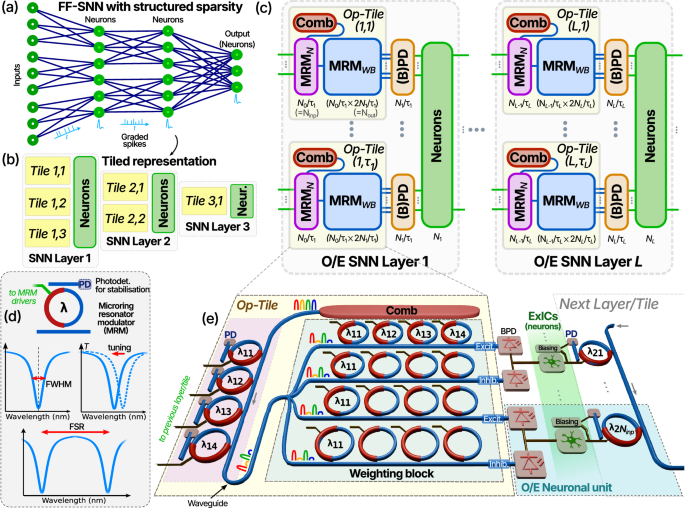
'Vulnerability tsunami' is coming, Anthropic security chief warns
Jason D. Clinton, the Deputy Chief Information Security Officer (CISO) at Anthropic, has warned that the tech industry is headed for a major crisis. In a post on X (formerly Twitter), he said, As bad as things have gotten in the past 4 days, they are going to get a lot worse before they get better, attributed to Jason D. Clinton. His warning comes after a series of global cyberattacks this month. The month of October has seen an unrelenting wave of major cyber incidents. The cybersecurity community has been working around the clock to fend off millions of attempts to exploit a critical PHP code vulnerability worldwide. This comes on top of the weaponization of zero-click spyware via online advertisements and massive data breaches. Clinton had issued a similar warning back in August, predicting a vulnerability tsunami would hit in just a few months. Now that his prediction has come true, he is advising security leaders to use the current state of panic to their advantage. However, instead of asking for advanced AI defense budgets, he is urging them to focus on securing funding for basic cybersecurity measures. When asked about the changes expected after this 18-month period, Clinton shared his vision of vulnzero (zero vulnerabilities). He believes AI scaling laws will soon shrink advanced cyber capabilities into small, cheap models. Once we cross that threshold, software developers worldwide will be able to use these AI tools at minimal costs to identify and permanently fix security bugs before they even reach production. Until this verification technology becomes widely available and integrated into standard development pipelines, malicious actors have a temporary but devastating advantage. Hackers are currently using existing AI models to quickly find, automate, and exploit legacy bugs much faster than human defenders can patch them. This gives them an edge in the ongoing cybersecurity battle.

Polymarket has reportedly fired its marketing chief, also a close friend of the CEO
Polymarket, a well-known online prediction market platform, has reportedly made the significant decision to terminate the employment of its marketing chief, who is not only responsible for overseeing the company's branding and promotional strategies but is also described as a close friend of the company's CEO. This development may raise questions about the reasons behind the dismissal and its potential implications for the company's marketing direction and overall leadership dynamics.

Rs 3.25 crore to write for AI company: Anthropic wants a human writer
The company behind Claude is offering up to Rs 3.25 crore a year for an experienced human writer. The role highlights why executive communication, strategic thinking and sound judgement remain important even as artificial intelligence tools become more capable. Artificial intelligence can draft articles, speeches and emails in seconds. Yet Anthropic, the company behind the AI chatbot Claude, is looking for an experienced human writer and is offering an annual salary of up to Rs 3.25 crore for the role. The opening is for an Executive Communications Writer, with a listed salary range of USD 295,000 to USD 345,000 a year, or approximately Rs 2.78 crore to Rs 3.25 crore. The position is based in San Francisco or New York City, according to Anthropic's official careers listing. The job is not simply about putting words on a page. The selected candidate will work closely with company leaders to explain complex developments, prepare communications for important events and help shape how Anthropic presents its work to the public. NOT JUST WRITING: WHAT WILL THE JOB INVOLVE? The writer will collaborate with Anthropic's senior leaders, external communications team and subject experts. Responsibilities include drafting and editing executive communications, preparing leaders for major public engagements and helping coordinate responses when breaking news requires a quick response. The company also wants someone who can understand technical subjects, including advanced artificial intelligence, and communicate them clearly to audiences with different levels of expertise. WHO CAN APPLY FOR THE ROLE? Anthropic is looking for an experienced professional rather than a fresher. The official listing outlines these requirements: * Experience: At least eight years in high-level executive communications, preferably at a fast-moving organisation. * Writing skills: Strong writing and communication skills, including the ability to work under pressure. * Judgement: Ability to handle uncertain situations, make informed decisions and offer a clear strategic perspective. * Education: A bachelor's degree or an equivalent combination of education, training and experience. * Location: San Francisco or New York City. The company is particularly interested in candidates with expertise in areas such as science and research, products and AI architecture, enterprise strategy, or visual storytelling and brand communication. HOW TO APPLY FOR ANTHROPIC HUMAN WRITER JOB Interested candidates can visit Anthropic's official job listing, review the requirements and submit an application through the careers portal. The position reflects a broader distinction in the workplace: producing text is only one part of communication. Understanding complex ideas, knowing what to say and helping leaders communicate clearly are also central to the role. For Anthropic, those responsibilities come with a senior-level salary.

Anduril and Colossal Team Up for Warhound
The founders of Colossal Biosciences and Anduril, Ben Lamm and Palmer Luckey, have teamed up for a new venture called Warhound. Like the name suggests, the idea is to bring new technology to the field of dogs used for war. The new company has already raised $200 million to get started. On Thursday, a joint venture between Dallas' Colossal Biosciences and defense technology company Anduril announced its emergence from stealth. The startup is called Warhound, and its pitch is that with Colossal's genetic engineering capabilities and Anduril's cybernetic augments, it can create a new generation of working military dogs better suited to, and better protected from, today's advanced battlefields. Warhound, which will based in Dallas, raised $200 million in its seed round led by Sequoia Capital. The release describes Warhound as a "vertically integrated platform, combining Colossal's enhanced genetics platform and secure biobanking capabilities of America's top-performing dog arsenal, controlled delivery through cloning with best-in-class training and animal care." The dogs will then be outfitted with ear and eye protection from Anduril, as well as connected with Anduril's AI and augmented reality Eagle Eye headgear technology, to enable dogs and their handlers better situational awareness in the field. The U.S. doesn't have a lot of war dogs but it does have at least 1,600 according to this Department of War page. Most of the dogs come from overseas breeders but about 13 percent are born here in Texas. The dogs are socialized for several months and at one year they begin basic dog training. At one year they are then evaluated for inclusion into a military training program. These programs are intensive and involve daily training like a full-time job. The Army put together this video showing what the trainers do on an average day. Obviously, not every dog makes it into the training and not every dog who starts the training completes it. Part of what Warhound wants to do is bring the breeding here to the U.S. and also ensure that more of the dogs bred for this program are healthy and fit for purpose. In its launch announcement, the company said that more than 80% of the working dogs used by the U.S. military come from Europe and less than half of them are fit for service. So not only is there a dwindling supply of working dogs for these tasks, but the U.S. has also become increasingly reliant on foreign nations for dogs that play an important role in the U.S. military and in law enforcement. That is key for what Warhound is trying to do. The hope is that Colossal can use its technology to engineer dogs with "characteristics suited to demanding missions," the company said in a press release. Lamm told TechCrunch he met Luckey about a year ago at a conference, where the Anduril co-founder brought up doing more for working dogs in the U.S. military. The two kept in touch, and Lamm did more research, learning about the breeding issues. Many dogs do not make it through training because of genetic dispositions for issues like poor eyesight or the high possibilities of cancer, hip dysplasia, or muscle atrophy. Anduril's role in this partnership will be to provide more advanced technology to keep the dogs safe and also to give their handlers a live view of what they are encountering. Andruil, meanwhile, will provide software and hardware enhancement for items such as dog protection vests and eye goggles to assist the dogs and their handlers with matters like situational awareness and coordination. He said to imagine, for example, bulletproof vests that have data sensors that give information back to the handlers so they can better understand what is happening. "The idea is, if we make the dog safer, make it healthier, make it perform better, it's going to perform better in the line of duty," Lamm said. He added that Anduril's additions aim to make the dogs safer and healthier outside of their genetic components, "on top of the dog, not in the dog." He believes such enhancements will also protect the dogs' human handlers better. It sounds like a good project that could make for dogs that will be even better at doing their jobs for the military. Editor's Note: Thanks to President Trump and his administration's bold leadership, we are once again respected on the world stage, and our enemies are being put on notice.

Colossal commutes to the classroom
While the sky is dark and most of his students are still asleep, Trevor Ivan wakes up early to start his day. The Youngstown State University professor had packed his bag the night before and spent an hour getting ready before leaving at 7 a.m. to depart for his 9:30 a.m. class. Why? Because he has to drive 60 miles from his home in Stark County to YSU. While many live close to their jobs, Ivan drives an hour and 15 minutes to and from Youngstown twice a week to get to work. "I don't like to just walk in here and walk into the classroom. I want to spend some time in my office, just getting ready for the day, printing some things out [and] looking at emails," Ivan said. "I try to get here between 8:30 and 8:45 [a.m.]. Some days that's easier said than done." Ivan is not the only YSU professor who makes a long journey to campus every week and experiences additional stressors of construction, gas prices and weather. Jeffrey Tyus, professor in strategic communication and media, lives in Twinsburg and drives an hour to and from YSU twice a week. One of the biggest stressors the professors pointed out is construction. Tyus described the recent construction in Youngstown as a "major headache." "It seemed like when I came over to Youngstown over the summer it's like, 'What's going on over here?'" Tyus said. "It just seemed like everywhere in my attempt to get home, I was finding traffic or reroutes and all those kinds of things. It's been a little frustrating." Ivan said the construction has not added any extra time to his commute, but he does see it as an inconvenience. "This semester has been pretty bad with the construction on [Interstate] 80 especially. I avoid most of it on [Interstate] 680 because it's all south of where I would come. The construction there has not been pleasant this fall," Ivan said. Cryshanna Jackson Leftwich, professor in politics and international relations, said she commutes from Akron, driving an hour to and from Youngstown twice a week. Jackson Leftwich said the first time she drove through the construction on her way to Youngstown, it added 30 minutes to her commute. She grew up in Youngstown before moving to Akron, so Jackson Leftwich said she was always familiar with driving in the area. "I've done the Youngstown-Akron commute, just not for work, basically since I was 12 because my mom lives in Akron and works in Youngstown. We've both done that," Jackson Leftwich said. "The decision for this job was, 'Well, I've done the commute all the time. I have to come to Youngstown anyways because I have to check on my grandmother, so I'll just work there.'" All three of these professors said they find themselves getting gas once or twice a week. Ivan said the recent increase in gas prices is not a huge stressor, but it is a nuisance. "I feel fortunate enough where I don't feel trapped for money in that. I feel like I have a little cushion to not worry," Ivan said. "It's an annoyance. It's frustrating. There's plenty of other things I'd rather spend money on." Later in the year, when the temperatures drop and snow falls, traveling on the slick roads can add strain to long commutes. Tyus said being familiar with online classes helps him deal with unforeseen circumstances. "That's helped me to the point where even when I have classes that meet in the classroom, if something happens, I can take that class online if I need to," Tyus said. "Being able to teach a class online and just continue to move the class along, that's been very helpful for me as someone who commutes regularly." Tyus uses his familiarity with Webex to help him and his students when the weather poses challenges. "If it is icy, if it is snowing really heavily, things of that nature, then once again, I will take my class on to Webex because not only do I not want to put myself in danger, I don't want my students to be placed in danger either," Tyus said. Ivan said there have been times that he was not able to make it home because of weather conditions. "There have been a couple times where I've started on the journey home and I was just like, 'No, I'm not doing this,' and I just go get a hotel room," Ivan said. Tyus and Jackson Leftwich said that even though they live far away, they still feel connected to and involved with the campus community. Jackson Leftwich said she never felt a disconnect because she is from Youngstown. However, Ivan, who has the longest commute of the three, said the distance can make him feel a disconnect, and there are many events that he wishes he could attend. "The rest of my life is all sort of [in Stark County] -- my friends, my community, my connections to other organizations," Ivan said. "It just feels like it's only like an hour or so away, but it feels like you're somewhat in a different world, because you feel like the two worlds don't always cross." The professors said they keep themselves busy on their commutes by listening to music and podcasts and calling friends or loved ones. Jackson Leftwich said with her busy life at home, she doesn't get much time uninterrupted, so she enjoys using her drive as a time for self-care. "I get to just be in my car, and I can listen to all my podcasts and make all my phone calls, talk to my friends uninterrupted. I get all that done, like my me-time," Jackson Leftwich said. Ivan said he also enjoys the feeling of being disconnected on his commute. "You do use that as an opportunity to learn, to have some time to yourself. It's also a time where you sort of feel unreachable," Ivan said. "It's kind of a nice feeling to just take some time to think and have to yourself."

XAI Floating Rate & Alternative Income Trust Will Host its Q3 2026 Quarterly Webinar on November 2, 2026
CHICAGO, Oct. 22, 2026 (GLOBE NEWSWIRE) -- XAI Floating Rate & Alternative Income Trust (NYSE: XFLT) (the "Trust") today announced that it plans to host the Trust's Quarterly Webinar on November 2, 2026, at 3:00 pm (Eastern Time). Kevin Davis, Managing Director at XA Investments will moderate the Q&A style webinar with Kimberly Flynn, President at XA Investments, and Young Choi, Partner and Global Head of Trading at King Street Capital Management. Young Choi also serves as the Portfolio Manager of Rockford Tower Capital Management, King Street's CLO, CBO and SMA platform. TO JOIN VIA WEB: Please click here to find the online registration link. TO USE YOUR TELEPHONE: After joining via web, if you prefer to use your phone for audio, you must select that option and call in using a number below, based on your current location. Dial: (312) 626-6799 or (646) 558-8656 or (267) 831-0333 or (720) 928-9299 or (213) 338-8477 Webinar ID: 830 6838 9008 REPLAY: A replay of the webinar will be available in the Knowledge Bank section of xainvestments.com. The Trust's common shares are traded on the New York Stock Exchange under the symbol "XFLT." The investment objective of the Trust is to seek attractive total return with an emphasis on income generation across multiple stages of the credit cycle. The Trust seeks to achieve its investment objective by investing in a dynamically managed portfolio of opportunities primarily within the private credit markets. Under normal market conditions, the Trust will invest at least 80% of its Managed Assets in floating rate credit instruments and other structured credit investments. There can be no assurance that the Trust will achieve its investment objective. About XA Investments XA Investments LLC ("XA Investments") is a Chicago-based firm founded by XMS Capital Partners in 2016. XA Investments serves as the investment adviser for two listed closed-end funds, an interval fund, and a tender offer fund. The listed closed-end funds, the XAI Floating Rate & Alternative Income Trust and XAI Madison Equity Premium Income Fund, both trade on the New York Stock Exchange and the interval fund and tender offer fund, XAI CLO & Income Opportunities Fund and Evanston Multi-Alpha Fund, are both available via direct subscription and through select broker/dealers and wealth management platforms. In addition to investment advisory services, the firm also provides investment fund structuring and consulting services focused on registered closed-end funds to meet institutional client needs. XA Investments offers custom product build and consulting services, including product development and market research, marketing and fund management. XA Investments believes that the investing public can benefit from new vehicles to access a broad range of alternative investment strategies and managers. XA Investments provides individual investors with access to institutional-caliber alternative managers. For more information, please visit www.xainvestments.com. About XMS Capital Partners XMS Capital Partners, LLC, established in 2006, is a global, independent, financial services firm providing M&A, corporate advisory and asset management services to clients. It has offices in Chicago, Boston and London. For more information, please visit www.xmscapital.com. About Rockford Tower Asset Management Rockford Tower Asset Management, L.L.C. is a wholly owned subsidiary of King Street Capital Management, L.P. ("King Street") and an affiliate of Rockford Tower Capital Management ("Rockford Tower"). Rockford Tower, King Street's dedicated CLO, CBO and SMA platform, was formed in 2017. Rockford Tower has over $14.7 billion of assets under management as of September 30, 2026, across 19 U.S. CLOs and 10 European CLOs, one CBO transaction and one SMA. In addition, Rockford Tower has traded over $99 billion of loans as of December 31, 2025. About King Street Capital Management King Street is a global alternative investment firm founded in 1995 that manages $30.9 billion in assets as of September 30, 2026 across public and private markets. The firm marries rigorous fundamental research with tactical trading and differentiated sourcing capabilities to identify investment opportunities across asset classes, up and down the capital structure. For more information, please visit www.kingstreet.com. XA Investments does not provide tax advice; please consult a professional tax advisor regarding your specific tax situation. Income may be subject to state and local taxes, as well as the federal alternative minimum tax. Investors should consider the investment objectives and policies, risk considerations, charges and expenses of the Trust carefully before investing. For more information on the Trust, please visit the Trust's webpage at www.xainvestments.com. This press release shall not constitute an offer to sell or a solicitation to buy, nor shall there be any sale of these securities in any state or jurisdiction in which such offer or solicitation or sale would be unlawful prior to registration or qualification under the laws of such state or jurisdiction. NOT FDIC INSURED NO BANK GUARANTEE MAY LOSE VALUE Paralel Distributors, LLC - Distributor