News & Updates
The latest news and updates from companies in the WLTH portfolio.
Amazon Leo beats SpaceX Starlink to South Africa
Amazon Leo has partnered with Herotel, South Africa's largest ISP, to help connect rural population. Starlink is not available in the country. Amazon has announced that its satellite internet constellation, Leo, will provide connectivity for South Africa's largest internet service provider (ISP), Herotel. The company said that Leo will help to connect homes and small businesses that are too uneconomical to get connected with fiber and fixed wireless. Herotel will use Amazon Leo's technology as part of a new service it is offering called Evry. Evry will launch commercially in 2027 to get more residential customers connected to the net. Interestingly, this is the first agreement of this kind for Amazon Leo in Africa. While internet connectivity is a given for most people in places like the United States and Europe, the situation is different in South Africa. According to 2024 data from the International Telecommunication Union (ITU), only 78.4% of individuals are using the internet in South Africa. Amazon notes this "persistent challenge", saying that millions of people who live on farms, in small towns, and in rural communities, still lack reliable internet access due to distance, terrain, and low population density, which make traditional infrastructure impractical and expensive. With Amazon Leo, customers can connect to the net via compact antennas and there is no need for fiber or fixed wireless infrastructure at their premises. Amazon Leo satellites orbit the Earth at 590 kilometers above the planet and deliver internet speeds capable of video calls, streaming, remote work, and online learning. The fact that Amazon Leo is powering this service is good news. Due to the cost of getting satellite constellations into orbit, there are relatively few organizations offering this type of service. The leader of the pack is SpaceX with its Starlink constellation, but others offer similar services, including Eutelsat OneWeb. Notably, Starlink is not available to customers in South Africa yet. By introducing more competition, theoretically we could see prices come down for these services. In some countries, Starlink can be more than twice as expensive as broadband, so lower prices would be nice.
With a Nearly 7% Dividend Yield, Is Verizon Stock a Buy on SpaceX Fears?
Mobile operator Verizon (NYSE: VZ) has seen its shares sell off in the wake of the SpaceX (NASDAQ: SPCX) IPO, lifting Verizon's dividend yield to 6.7%. The sell-off looks overdone in my view, making the stock an attractive buy at current levels. Investors worry that SpaceX will use its leadership in satellite internet to challenge traditional mobile carriers like Verizon. However, there are multiple hurdles to this happening. Two of the biggest are technology constraints and regulatory issues. Missed Nvidia in 2009? This Rare Signal Is Flashing Again. In 2009, a "Double Down" signal flashed for a little-known chipmaker called Nvidia. For the first time in years, that same "Total Conviction" signal is flashing for a company 1/100th the size of Nvidia. Continue " Image source: The Motley Fool. A look at the potential threat Cellular networks, like Verizon's, use dense, localized cell towers and small cell antennas that reuse spectrum thousands of times within a single city. Low-earth-orbit (LEO) satellites like those SpaceX deploys, on the other hand, project massive beams over large areas. If millions of people in a dense city or suburb tried to stream video via direct-to-cell satellite at the same time, capacity would collapse. Meanwhile, modern green building initiatives, such as reinforced concrete, steel, and low-e glass used in office buildings, block satellite signals. Even SpaceX's VP for satellite engineering, Michael Nicolls, stated this at the company's Mobile World Conference: "Satellite is complementary to terrestrial networks; it cannot provide the data density that terrestrial networks have. But it can augment terrestrial networks in areas where they cannot reach. Or when terrestrial networks need additional capacity." Meanwhile, after discussing the potential for SpaceX to offer a mobile network with a former FCC attorney, BNP Paribas analyst Sam McHugh concluded there were few ways for SpaceX to enter the mobile space unless those companies struck a deal with SpaceX. He noted that current FCC rules prevent Elon Musk's company from requiring carriers to enter wholesale network agreements or to provide roaming access. While there is a risk SpaceX gets into space by acquiring a carrier like T-Mobile, the three big carriers did form a joint venture to help address coverage gaps in the U.S. by pooling spectrum, looking to fend off any risk from satellite companies. Bundling opportunity ahead Putting aside SpaceX's concerns, Verizon has a big opportunity ahead as it starts to cross-sell and bundle wireless and broadband services to the customers it gained when it acquired Frontier Communications earlier this year. This should be a nice subscriber and revenue growth driver, as only about 20% of its customers have both wireless and broadband subscriptions. Meanwhile, Verizon's dividend is safe and well covered, with the company having low leverage and a dividend (around $12 billion projected this year) that is easily covered by its free cash flow ($21.5 billion forecast). With a nearly 7% yield and a forward price-to-earnings (P/E) ratio of 8.6 based on 2026 earnings estimates, I think this dividend stock looks like a buy on its recent price dip. Should you buy stock in Verizon Communications right now? Before you buy stock in Verizon Communications, consider this: The Motley Fool Stock Advisor analyst team just identified what they believe are the 10 best stocks for investors to buy now... and Verizon Communications wasn't one of them. The 10 stocks that made the cut could produce monster returns in the coming years. Consider when Netflix made this list on December 17, 2004... if you invested $1,000 at the time of our recommendation, you'd have $398,160!* Or when Nvidia made this list on April 15, 2005... if you invested $1,000 at the time of our recommendation, you'd have $1,249,202!* Now, it's worth noting Stock Advisor's total average return is 918% -- a market-crushing outperformance compared to 209% for the S&P 500. Don't miss the latest top 10 list, available with Stock Advisor, and join an investing community built by individual investors for individual investors. See the 10 stocks " *Stock Advisor returns as of July 15, 2026. Geoffrey Seiler has no position in any of the stocks mentioned. The Motley Fool recommends T-Mobile US and Verizon Communications. The Motley Fool has a disclosure policy. The views and opinions expressed herein are the views and opinions of the author and do not necessarily reflect those of Nasdaq, Inc.

Anthropic Makes Claude Free for All US K-12 Teachers With Standards-Aligned Agentic AI
Free access comes with state-standards alignment, agentic scheduling, and nine edtech connectors. Verified U.S. K-12 teachers can now claim a full year of free premium Claude AI -- not a trimmed-down chatbot, but the same agentic platform that runs Claude Code and Cowork -- as Anthropic on Tuesday launched Claude for Teachers, a product that pairs free premium access with a curriculum database covering every academic standard in all 50 states, nine edtech platform integrations, and FERPA-aligned data terms co-developed with the American Federation of Teachers. Any educator who signs up before June 30, 2027 gets a full year of access at no cost. The launch arrives in a market where Anthropic's biggest competitors have been giving away comparable tools for months. ChatGPT for Teachers launched in November 2025 and is also free for verified U.S. K-12 educators through June 2027. What distinguishes Claude for Teachers is not the free tier, but the architecture underneath it: a standards-aligned data layer called Learning Commons, an open-source library of pedagogy-grounded teaching skills, and nine integrations implemented as Model Context Protocol (MCP) connectors -- the same standardized protocol Anthropic has been building as industry infrastructure since late 2024. This is the same protocol now adopted by OpenAI and Google DeepMind as the de facto standard for connecting AI agents to external systems. This Is Not a Lesson-Plan Generator Claude for Teachers works differently from a general-purpose AI assistant because it knows the specific thing a teacher is working toward before it generates anything. When an educator asks for a lesson on, say, constructing linear functions, Claude queries Learning Commons -- a structured database that maps each of the roughly 150,000 academic standards across all 50 states to the smaller learning competencies each standard contains and the developmental order students typically learn them in -- and scaffolds the lesson accordingly, rather than generating plausible-sounding content that a teacher must then verify against their actual curriculum. Trusted open curricula -- specifically OpenSciEd for science and IM v.360 from Illustrative Mathematics -- are also accessible as sources Claude can draw from when building lessons, adding a layer of subject-matter rigor that distinguishes this from general-purpose AI output. Research supports the design choice. A March 2026 review of more than 800 academic papers on AI and K-12 education from Stanford's SCALE Initiative found that AI tools built with pedagogical guardrails -- systems that guide student reasoning rather than providing direct answers -- showed more promising outcomes than general-purpose chatbots. The 2026 OECD Digital Education Outlook similarly found that co-designing AI tools with teachers can amplify instructional capacity in ways that neither teachers nor AI achieve independently. How the Nine Edtech Integrations Actually Work The nine edtech partners -- ASSISTments, Brisk Teaching, Canva Education, Coteach, Diffit, Eedi, MagicSchool, Snorkl, and TeachFX -- connect to Claude through Anthropic's Model Context Protocol, an open standard the company introduced in November 2024 and donated to the Linux Foundation in December 2025. MCP works by having each partner run an MCP server that advertises specific tools and data resources; Claude's MCP client queries those servers as needed and injects the results into its context window, as described in Anthropic's technical introduction to the protocol. This is the same protocol now adopted by OpenAI and Google DeepMind as the de facto standard for connecting AI agents to external systems. In practical classroom terms: ASSISTments generates auto-scored, standards-aligned math problems for practice and assessment. Eedi surfaces diagnostic questions in both English and Spanish that reveal why a student got a problem wrong, not just that they did. TeachFX gives personalized instructional feedback grounded in real classroom audio. The breadth signals Anthropic's strategic intent. By building these connections on an open protocol and simultaneously releasing an open-source teaching skills repository, Anthropic is positioning Claude as an integration layer for K-12 AI tools -- not just another product competing alongside them. Other education-technology builders can implement the same MCP standard to make their tools Claude-compatible, compounding the network effect. Agentic Scheduling: AI That Works After School Hours Claude for Teachers includes full access to Claude Code and Cowork, the agentic components of Anthropic's platform that let Claude carry multi-step work forward without continuous human prompting. In the context of teaching, this means a teacher can hand Claude a folder of exit tickets, attendance data, and class notes before leaving school, set a recurring task to run at 4 p.m. each school day, and receive a synthesized picture of what each student mastered and a proposed adaptation for the next day's lesson plan -- without prompting Claude again, as SQ Magazine's review of the launch documents. This is a substantive shift from how AI assistance has worked in education. Most classroom AI tools are reactive: a teacher types a request, the AI responds, the teacher decides what to do with it. Agentic workflows are proactive: the teacher sets parameters once, and the AI executes repeatedly and autonomously. That distinction matters because it changes what kind of cognitive labor teachers are doing -- from prompting and reviewing to designing the task upfront and reviewing the output. Whether that shift improves or displaces teacher judgment is a live research question. Stanford's SCALE review found limited causal evidence specifically on agentic teacher tools, given how recently such tools have become available. Privacy Architecture and What FERPA-Aligned Actually Means Education technology has an established and concerning track record on student data. In December 2024, hackers exfiltrated more than 62 million student records and nearly 10 million teacher records from PowerSchool -- a student information system serving approximately 16,000 schools -- in the largest breach of children's data in U.S. history. The perpetrator was sentenced in October 2025; as TechPolicy Press documented, the systemic vulnerabilities that made the breach possible remain largely unaddressed in the industry. Anthropic has built Claude for Teachers with that history in mind. Teacher account data is not used for model training. Student information is covered by a K-12 Data Processing Addendum -- a contractual document published at anthropic.com/legal/k12-dpa -- written to comply with FERPA's requirements. The product is restricted to educators only, consistent with Claude's existing policy requiring users to be at least 18 years old, meaning students cannot interact with the system directly. Anthropic also specifies a service level agreement for deleting stored conversations containing student data. A critical word choice matters here. Anthropic describes these protections as "FERPA-aligned" -- not "FERPA-compliant." The distinction is legal, not semantic. Alignment means the contractual terms are written with FERPA's requirements in mind. Compliance is a determination that applies to each specific district's implementation. Whether a given school's use of Claude for Teachers actually satisfies FERPA depends on that district's specific data governance setup, which teachers should confirm with district administrators and legal counsel rather than assuming the addendum settles the question under federal FERPA law. Anthropic is also working with the American Federation of Teachers to develop a "Gold Standard" for industry best practices on AI safety and privacy in K-12 education. AFT President Randi Weingarten offered measured support for the launch, saying the union has been working with Anthropic toward those standards and welcomed its commitment to them, according to Benzinga's coverage of the announcement. Notably, while the AFT is collaborating with Anthropic, OpenAI, and Microsoft on privacy and educator training, it is not doing so with Google -- which recently struck a separate deal with Utah's state education board to bring Gemini AI into every K-12 school in the state, as Chalkbeat reported. Claude for Teachers vs. ChatGPT for Teachers Anthropic is entering a market where OpenAI arrived first. ChatGPT for Teachers launched in November 2025 and is also free for verified U.S. K-12 educators through at least June 2027, with similar FERPA-aligned commitments, admin controls for district leaders, and integrations with Google Workspace and Microsoft 365. The programs are structurally similar: both trade free access to educators for product feedback, privacy reputation, and future district-tier business. Claude for Teachers differentiates in three specific ways. First, the Learning Commons layer provides standards-aligned lesson scaffolding at a finer granularity than general-purpose AI -- not just state standards but the learning progressions beneath each standard. Second, the agentic scheduling capabilities (Claude Code + Cowork) are not present in the current ChatGPT for Teachers offering. Third, Anthropic is releasing its teaching skills library as open-source, inviting other builders to construct compatible tools rather than closing the ecosystem around its own product. The competitive pressure is accelerating. Use of AI among teachers has roughly doubled: Chalkbeat reported that an Education Week survey found around 61 percent of teachers reported using AI in some capacity in 2025, compared with approximately 32 percent in 2024. Detroit Pilot Will Test What the Evidence Actually Shows Anthropic will pilot Claude for Teachers in the Detroit Public Schools Community District, beginning with the next school year. Detroit was selected in part because the district was already using Claude products and had adopted them in what Anthropic described as a human-centric way. Teachers at a small number of schools will receive training, after which Anthropic will formally evaluate how the product shapes instructional practice and educator wellbeing. The pilot is notable because the evidence base for AI tools specifically designed for teachers -- as opposed to student-facing tutoring systems -- is still thin in terms of rigorous causal studies. The Stanford SCALE 2026 review found the existing evidence on educator-facing tools is suggestive but limited; most studies are observational rather than experimental. The Detroit pilot, if run with the rigor implied by the Gates Foundation partnership framing, could add meaningfully to that base. Skeptics remain. Education researchers have raised concerns that AI-assisted lesson planning, if not carefully implemented, risks reducing the kind of deep content engagement that produces expertise over time, and that the automation of instructional decisions introduces accountability gaps when an AI-adapted plan produces poor results. Those concerns apply most sharply to student-facing AI; the evidence on teacher-facing tools is more favorable. Norway's government, which banned generative AI for students in grades one through seven starting August 2026 after citing declining test scores, drew an explicit line between student-facing and teacher-facing use -- a distinction aligned with where current research points, as TechTimes reported in June 2026. These efforts are part of Anthropic's partnership with the Gates Foundation to co-develop tools that improve educational outcomes for K-12 students. How to Sign Up Claude for Teachers is available now to verified individual K-12 educators in the United States at the Claude for Teachers signup page. Teachers who sign up before June 30, 2027 receive a full year of access at no cost. A separate offering for schools and districts is in development and not yet available. In the meantime, districts can continue accessing Claude through the Claude for Nonprofits program. Alongside the product, Anthropic released a free AI Fluency for K-12 Teachers course co-developed with Teach for America, and a train-the-trainer module co-developed with the AFT -- both Creative Commons-licensed and designed to work with any AI model, not only Claude. Frequently Asked Questions How is Claude for Teachers different from ChatGPT for Teachers? Both products are free for verified U.S. K-12 educators through mid-2027 and both carry FERPA-aligned data commitments. Claude for Teachers differentiates through three technical features absent in the current ChatGPT for Teachers offering: a structured academic standards database (Learning Commons) that grounds lesson generation in state-specific learning progressions rather than general knowledge; agentic scheduling via Claude Code and Cowork, which allows recurring instructional tasks -- such as daily exit-ticket review -- to run automatically without a new prompt from the teacher; and an open-source teaching skills library on GitHub that allows other edtech builders to create Claude-compatible tools. ChatGPT for Teachers launched eight months earlier, in November 2025, and includes district-level admin controls and Microsoft 365/Google Workspace integrations that the Claude product does not yet match at the district tier. Why is Anthropic offering this for free, and what is the catch? Anthropic's business incentive is explicit in its design. Free individual teacher access generates two things money cannot easily buy: real classroom product feedback through the Detroit pilot and individual signups, and a privacy reputation co-signed by the American Federation of Teachers. Both compound if the product performs well in classrooms. Both become liabilities if a data incident occurs before Anthropic builds out a separately negotiated district-tier product with its own contracts. Districts evaluating whether to adopt Claude should treat the current FERPA-aligned addendum as a contractual starting point and confirm compliance with their own legal counsel -- particularly because the district-level offering and its associated terms are not yet available, as SQ Magazine's analysis notes. What student data does Claude for Teachers actually collect and how is it protected? According to Anthropic's documentation, Claude for Teachers data is not used for model training purposes, and student information is covered by a K-12 Data Processing Addendum written to comply with FERPA. Anthropic specifies a service level agreement for deleting stored conversations containing student data. The product is restricted to teachers only -- students cannot interact with it directly. What the addendum does not address is the data flows that occur when Claude queries MCP-connected third-party tools such as ASSISTments or TeachFX; teachers should confirm with each integration partner what data leaves their platform and under what terms. The edtech industry's most significant recent breach -- the December 2024 PowerSchool incident affecting 62 million individuals -- originated with a third-party student information system, not the primary AI platform, as TechPolicy Press analyzed. What does the nine-platform edtech integration actually enable? The integrations are built on Anthropic's Model Context Protocol, an open standard adopted by major AI companies as a way to connect AI agents to external tools without custom per-pairing integration code. Each partner runs an MCP server that Claude queries on demand; Claude's context window is populated with data from the partner system as needed. In practice: ASSISTments can generate auto-scored, standards-aligned math practice problems; Eedi surfaces bilingual diagnostic questions that reveal specific student misconceptions; TeachFX analyzes real classroom audio to give teachers feedback on their own instructional practice; Snorkl provides assignment and class-level progress data. All of this is detailed in Anthropic's Claude for Teachers announcement. The MCP architecture means other edtech developers can build Claude-compatible connections using the same open standard, potentially expanding the integration ecosystem beyond the nine partners at launch.

Polymarket odds: Newsom leads 2028 Dem nominee at 20% as DDHQ outlook hits
Polymarket Reprices 2028 Democratic Nominee Odds After DDHQ House-Blue / Senate 50-50 Forecast Polymarket's "Democratic Presidential Nominee 2028" market keeps Gavin Newsom as the top-priced outcome at 20.05% implied odds on $1,235,991,473 in volume. The latest catalyst in the broader political backdrop is a DDHQ forecast for a Democratic House and a 50-50 Senate, while traders' pricing shows a moderate-volatility, reversal-flagged tape across the last 24 hours. Key Takeaways * Prediction market leader: Gavin Newsom at 20.05% (Yes 20.05 / No 79.95) in Polymarket's 2028 Democratic nominee market. * Basis for repricing: against a fresh midterm-leaning forecast headline, the market's summary flags a reversal with moderate volatility and a 24h move of +4.35 pp. * Key timing: the contract resolves on 2028-11-07, meaning positions are about the eventual nominee, not near-term election-cycle headlines. A new DDHQ forecast headline projects Democrats winning the House while the Senate sits at a 50-50 split in November. The story frames the outlook as a mixed congressional picture rather than a single-party sweep, offering a near-term political signal that traders may reference when thinking about the next presidential cycle. Market Reaction: $1.235B Volume as Newsom Holds 20.05% vs AOC 14.55% and Ossoff 12.05% (+4.35pp, Reversal Flag) This is a multi-outcome Polymarket contract where each named candidate is a separate "Yes" share that pays out if that person wins the 2028 Democratic presidential nomination, and the displayed percentage is the market-implied probability for that outcome. At the top, Gavin Newsom is priced at 20.05% (Yes 20.05 / No 79.95), with Alexandria Ocasio-Cortez at 14.55% (Yes 14.55 / No 85.45) and Jon Ossoff at 12.05% (Yes 12.05 / No 87.95), indicating a fragmented favorite rather than a dominant consensus pick. Despite Newsom leading, the market is not treating the field as settled: the historical summary shows moderate volatility with weak momentum, yet "consensus strengthening," which is consistent with traders clustering more firmly around a short list even as prices swing. The 24-hour and 7-day change are both +4.35 percentage points in the summary while reversal_detected is true, a combination that reads like a recent directional push that has also shown signs of snapping back rather than a smooth trend. Finally, the $1,235,991,473 volume underscores that this is a continuously updated pricing venue; headlines can act as prompts, but the contract ultimately settles on the nomination outcome at the 2028-11-07 resolution date, so short-horizon political forecasts mainly matter insofar as they shift perceptions of who the party will nominate years later. Watch whether the leading outcome remains near ~20% or whether the market broadens again: the reversal flag and moderate volatility make the next meaningful signal a sustained move in the top three (Newsom/AOC/Ossoff) rather than a single headline-driven spike. Cross-Market Readthrough: Which Polymarket Macro and Election Contracts Traders Track Alongside the 2028 Democratic Nomi Zooming out from the 2028 Democratic nomination tape, traders often cross-check similar high-liquidity politics boards to see whether sentiment is firming or wobbling elsewhere on Polymarket. Right now, that includes 31.15% on "Next French Presidential Election" (Marine Le Pen) on $112,743,658 in volume, 60.5% on "Brazil Presidential Election" (Luiz Inácio Lula da Silva) on $112,978,361, and a near-locked 96.0% on "Clacton by-election Winner" (Nigel Farage) on $2,132,671. Watching how these contracts move day-to-day can provide a broader readthrough on risk appetite and how quickly traders are willing to reprice political outcomes across jurisdictions. Odds Trend By the Numbers * Platform: Polymarket * Market: Democratic Presidential Nominee 2028 * Contract type: Price strike ladder: each rung has separate Yes/No; Yes means the spot price is above that USD strike at settlement. * Resolution window: Nov 07, 2028 (UTC) * Status: Active (open for trading) * Volume: ~$1,235,991,473 Top strike rungs +41 more strikes not shown

2,000 TMC ft of Godavari water going to sea a colossal waste, says Chandrababu Naidu
Andhra Pradesh Chief Minister N. Chandrababu Naidu has said at least 2,000 TMCFT of Godavari river water flows into the sea every year on an average, and that it was a colossal waste. By linking the Godavari river with the Krishna, irrigation facilities could be provided for lakhs of acres, he said, recalling that the eminent engineer K.L. Rao proposed the interlinking of the Godavari and Kaveri rivers decades ago, and that the Vajpayee government had set up a task force for linking the Ganga and Kaveri rivers. Paying tributes to K.L. Rao on his 124th birth anniversary at the Pavitra Sangamam, the confluence of the Godavari and Krishna rivers at Ibrahimpatnam here on Wednesday (July 15, 2026), Mr. Chandrababu Naidu said the TDP government had, in 2014-19, brought Godavari water into the Krishna by constructing the Pattiseema project. The government planned to make the Rayalaseema region fertile by taking Godavari water there, and steps were being taken for it, he said. Godavari-Cauvery river linking must be taken up as national project, says Andhra Pradesh CM N. Chandrababu Naidu By diverting Godavari water to the Krishna delta via Pattiseema, the government had saved water in Srisailam, he said, expressing his resolve to provide water to every acre in the State. Mr. Naidu said that in 2014-19, the TDP government had spent ₹68,000 crore on the irrigation sector and nearly ₹24,000 crore in the last two years. Govt. focusing on intra-linking of rivers as immediate priority, says Chandrababu Naidu He said that, as on date, 89% of the Polavaram project construction had been completed and it was poised to be dedicated to the nation by March 2027. The coalition government would complete 36 priority projects in the next three years, he added. The event was attended by K.L. Rao's son K.L. Vijay Rao and Ministers Nimmala Rama Naidu, Y. Satya Kumar and Anagani Satya Prasad.

With a Nearly 7% Dividend Yield, Is Verizon Stock a Buy on SpaceX Fears?
Mobile operator Verizon (NYSE: VZ) has seen its shares sell off in the wake of the SpaceX (NASDAQ: SPCX) IPO, lifting Verizon's dividend yield to 6.7%. The sell-off looks overdone in my view, making the stock an attractive buy at current levels. Investors worry that SpaceX will use its leadership in satellite internet to challenge traditional mobile carriers like Verizon. However, there are multiple hurdles to this happening. Two of the biggest are technology constraints and regulatory issues. Missed Nvidia in 2009? This Rare Signal Is Flashing Again. In 2009, a "Double Down" signal flashed for a little-known chipmaker called Nvidia. For the first time in years, that same "Total Conviction" signal is flashing for a company 1/100th the size of Nvidia. Continue " A look at the potential threat Cellular networks, like Verizon's, use dense, localized cell towers and small cell antennas that reuse spectrum thousands of times within a single city. Low-earth-orbit (LEO) satellites like those SpaceX deploys, on the other hand, project massive beams over large areas. If millions of people in a dense city or suburb tried to stream video via direct-to-cell satellite at the same time, capacity would collapse. Meanwhile, modern green building initiatives, such as reinforced concrete, steel, and low-e glass used in office buildings, block satellite signals. Even SpaceX's VP for satellite engineering, Michael Nicolls, stated this at the company's Mobile World Conference: "Satellite is complementary to terrestrial networks; it cannot provide the data density that terrestrial networks have. But it can augment terrestrial networks in areas where they cannot reach. Or when terrestrial networks need additional capacity." Meanwhile, after discussing the potential for SpaceX to offer a mobile network with a former FCC attorney, BNP Paribas analyst Sam McHugh concluded there were few ways for SpaceX to enter the mobile space unless those companies struck a deal with SpaceX. He noted that current FCC rules prevent Elon Musk's company from requiring carriers to enter wholesale network agreements or to provide roaming access. While there is a risk SpaceX gets into space by acquiring a carrier like T-Mobile, the three big carriers did form a joint venture to help address coverage gaps in the U.S. by pooling spectrum, looking to fend off any risk from satellite companies. Bundling opportunity ahead Putting aside SpaceX's concerns, Verizon has a big opportunity ahead as it starts to cross-sell and bundle wireless and broadband services to the customers it gained when it acquired Frontier Communications earlier this year. This should be a nice subscriber and revenue growth driver, as only about 20% of its customers have both wireless and broadband subscriptions.
SpaceX could launch Starship this week. Here's what's different
SpaceX could launch its next Starship into space as soon as Thursday, according to the company's website and social media posts by CEO Elon Musk. If the launch of the 13th test flight of Starship/Super Heavy proceeds as planned, it would be the quickest turnaround time between launches for the spacefaring company that recently went public and made Musk the world's first trillionaire. It's also expected to mark another first for SpaceX -- the first time that Starship will carry functional Starlink satellites into space. "The upcoming flight will aim to complete similar objectives targeted on the previous flight test... while also carrying next-generation Starlink V3 satellites for the first time," SpaceX said on its website on a page dedicated to upcoming launches. SpaceX last launched a Starship from its Starbase headquarters on May 22. Flight 12 was the first flight of 2026, and the first time that the company deployed its third-generation Starship configuration. Before that, SpaceX hadn't launched a ship since October 13, 2025. But not everything went according to plan during May's test flight. It's something SpaceX acknowledged on the Flight 13 launch page. An error "in engine startup" on Starship during what is known as "hot staging" caused the booster to rotate off kilter by 90 degrees when the two vehicles separated. Further, five of Super Heavy's 33 Raptor engines failed to relight when it attempted its boostback burn, which was meant to point the rocket back toward Earth for a splashdown in the Gulf of Mexico. One of Starship's Raptors also died after separation. SpaceX said it has since corrected both errors. And those corrections were crucial in meeting a federal regulatory prerequisite before Starship could take to the skies again. After the May 22 launch, the Federal Aviation Administration grounded Starship and ordered SpaceX to investigate the so-called "mishap." On Monday, July 13, the FAA officially closed the mishap investigation, paving the way for SpaceX to proceed with Flight 13. "The final mishap report cites two most probable root causes for the loss of the Super Heavy booster as heat effects on propulsion system components during the ascent and erroneous engine alarm system settings," the FAA said in a statement Monday. For the first time, Starship will carry live Starlink satellites into space and attempt to connect them with the existing Starlink network. Until now, SpaceX has relied on its unmanned Falcon 9 reusable rockets to launch the communications satellites into low Earth orbit. "Starship is planned to deploy 20 satellites which will extend solar arrays and antennas and will attempt to connect with the larger Starlink constellation via high-capacity lasers," SpaceX said. But the satellites will not remain in orbit. Instead, they're expected to burn up in the Earth's atmosphere. SpaceX is targeting a 90-minute launch window that's expected to begin at about 5:45 p.m. local time on Thursday, July 16. However, the company has selected July 17 and July 18 as potential backup dates, according to several notices to airmen, or NOTAMs, the FAA published announcing airspace restrictions on those dates.
SpaceX stock falls 33% from peak, slips below $135 IPO price: Here's why
SpaceX shares have fallen below their IPO (Initial Public Offering) price, raising concerns among investors who bought the stock during its market debut. The company's shares closed at $136.08 on Tuesday, just above the IPO price of $135, and later slipped below that level. The IPO price is important because it is the price at which investors first bought the company's shares when it went public. Falling below the IPO price is seen as a negative sign because it means early investors are now losing money on their investment. SpaceX had a very strong stock market debut. The company completed the world's biggest IPO and raised more than $85 billion after the overallotment option was exercised, according to The Motley Fool. According to Bloomberg, the stock has fallen by almost one-third from its highest price after the IPO. This has erased nearly $850 billion in the company's market value. SpaceX was already very popular with investors before its IPO because of its space technology business and the leadership of Elon Musk. The company has three main businesses: rocket launches, satellite internet services, and artificial intelligence. Elon Musk is one of the main reasons many people want to invest in SpaceX. Some investors do not agree with all of his plans, but many others believe in his vision for the future. SpaceX also continued to grow last year. According to The Motley Fool, the company made more than $18 billion in revenue, which was over 30% higher than the year before. Even though SpaceX made more money, the company still lost $4.9 billion. This is because it is spending a lot of money to build new space technology. The company may continue spending heavily because making advanced space technology is very expensive. Later this year, SpaceX plans to launch its fully reusable Starship rocket with payloads. This will be an important step for the company's future plans. Also read: Why are oil and gas prices so high? US is the world's top oil producer and consumer explained Ken Mahoney, CEO of Mahoney Asset Management, said he does not believe the stock has reached its lowest point yet. He said investors should watch whether enough buyers are willing to purchase the additional shares entering the market, according to Bloomberg. Even after the recent decline, Wall Street remains largely optimistic about SpaceX. More than 80% of analysts covering the company have Buy ratings on the stock. The average analyst price target is $236.25, which is over 70% higher than Tuesday's closing price. Several major investment banks, including Morgan Stanley, JPMorgan Chase and Goldman Sachs, started coverage with positive ratings. SpaceX was recently added to the Nasdaq-100 Index through the exchange's fast-entry rules, another major milestone for the company. Seven of those companies posted double-digit losses, while the average decline was around 12%. The report said that if SpaceX follows this historical trend, a $10,000 investment made near the IPO could be worth about $8,800 after one year. The history suggests investors should not rush into IPO stocks, as better buying opportunities may appear after the initial excitement fades. Bloomberg noted that many of the biggest U.S. IPOs this year have also struggled. Six of the ten largest offerings are now trading below the price at which they closed on their first trading day. Talley Leger, chief market strategist at Wealth Consulting Group, said he may consider buying SpaceX shares if the stock falls further, because he likes the company's long-term vision, according to Bloomberg. For now, investors are closely watching whether SpaceX can recover above its IPO price or continue its recent downward trend.
Needham raises SpaceX stock price target to $250 on AI, Starship By Investing.com
Investing.com - Needham raised its price target on SpaceX (NASDAQ:SPCX) to $250 from $200 while maintaining a Buy rating on Tuesday. The upgrade comes as shares trade at $136, near their 52-week low of $135.52, following an 8.2% decline over the past week. According to InvestingPro analysis, the stock appears undervalued at current levels, potentially offering investors an attractive entry point. The firm cited the company's release of Grok 4.5 on July 8, SpaceX's first AI model built for coding and agentic work. The model was trained on Cursor developer data and has received strong reviews on third-party AI benchmarks. Needham noted the model does not quite match leading models from Anthropic or OpenAI but puts SpaceXAI back on track after Elon Musk said in March the company had to completely rebuild its AI program. SpaceX announced its Starship flight 13 is scheduled to launch as early as July 16. The flight will deliver 20 full-size Starlink V3 test units to orbit and advance Ship and Booster re-usability. Needham said AI model performance and Starship success to orbit are key unlocks for the company's total addressable market. The firm raised its price target on increased confidence in execution. InvestingPro data reveals analysts predict the company will turn profitable this year, with 13 additional ProTips available to subscribers. In other recent news, flyExclusive, Inc. has completed its acquisition of aviation assets from Jet.AI. This transaction includes Jet.AI's Jet Card members, two HondaJets, one Citation CJ4, and three future Citation CJ3 delivery positions valued at approximately $4.1 million. Additionally, flyExclusive gained approximately $6.1 million in securities through indirect ownership of Space Exploration Technologies Corp. shares and about $5.3 million in cash. Meanwhile, SpaceX has received significant attention from analysts. Evercore ISI initiated coverage on SpaceX with an "outperform" rating and set a price target of $230. Stifel reiterated a "Buy" rating with a $190 price target, highlighting the upcoming Starship Flight 13 launch. Raymond James also reiterated a "Strong Buy" rating with an $800 price target, noting a significant reduction in the time between recent Starship flights. Deutsche Bank released an analysis suggesting that SpaceX could achieve cost parity between orbital and terrestrial data centers by the early 2030s. This article was generated with the support of AI and reviewed by an editor. For more information see our T&C.

SpaceX Is Failing to Live Up to Wall Street's Hype
S&P 500 futures7,604.50+0.2%Nasdaq 100 futures29,928.50+0.5%US 10-year Treasury yield4.60%+0.01WTI crude oil futures$80.27+1.2%Bloomberg Dollar Spot Index1,218.38+0.0%South Korea Kospi Index7,284.41+6.2% Market data as of 06:21 AM ET. Data is subject to provider delays. Five things you need to ...
Thief with colossal debts skips day in court for South Tyneside crime
A thief who owes around £10k in debt skipped his day in court for a South Tyneside crime. A thief who owes the courts a whopping £10,000 in past fines and costs continued to offend by pinching £95 of Minecraft toys from a South Tyneside store. David Appleby, 35, of Strathmore Crescent, Benwell, Newcastle, has his debt held in two payment accounts - one of £8,579 and the other around £1,500. No details were provided to South Tyneside Magistrates' Court about the past criminal matters that led to them being put in place. Appleby also did not turn up to have his day in court and the allegation that he stole the Minecraft items went ahead without him Prosecutor Mariam Odetoro said the offender went into Home Bargains' outlet in Station Street, Jarrow, on Tuesday, March 10, and stole 12 toys. Ms Odetoro revealed a police officer attended the shop and checked CCTV footage. Reading from his statement, she said he recognised Appleby because he had "spoken to him on a number of occasions". After hearing the evidence, District Judge Zoe Passfield found the case against Appleby proven. She ordered him to pay full compensation of £95.88 to Home Bargains but did not impose court costs or a victim surcharge after being made aware of his colossal debt.

A SpaceX vet raised $65M to pull wire harnesses out of the Cold War era
When Senra CEO Jordan Black was a SpaceX engineer, he took on the job of scaling up the company's wire harnesses to support production of Starship, the company's next-generation rocket. Wire harnesses are what they sound like: the internal electrical cabling that runs through a rocketship, car, plane, or tractor and becomes increasingly important the smarter those vehicles get. They're bespoke, put together by technicians who are, functionally, experienced craftspeople. "I traveled all over the world to go visit wire harness companies," Black told TechCrunch last month. "It really hasn't changed since the Cold War era of wooden tables [and] manual processes." Black and co-founder Benjamin Shanahan started Senra in 2023 to offer a more modern solution to vehicle manufacturers. Today, the startup is announcing a $65 million Series B round, co-led by Lowercarbon and Interlagos with participation from General Catalyst, Sequoia Capital, Andreessen Horowitz, and Founders Fund, among others. Serna isn't looking to take humans out of the handmaking process -- at least not while robots find manipulating wires a challenge and relevant training data remains scarce. Instead, it's turning to software tools and other forms of automation to modernize aspects of the traditional manual work. The company is benefiting from the surge of money into U.S. manufacturing, particularly the defense industrial base. While Black couldn't disclose customers, he said they include builders of "anything from submarines and maritime vehicles, to defense vehicle systems on land, to launch vehicles, to satellites." If it doesn't sound immediately important, consider a recent wire harness disaster. In 2023, Boeing discovered that its Starliner spacecraft's wiring was held together with flammable tape, forcing an expensive delay while the entire wiring system was redone. Black points to that experience as a reason to raise the standards for wire harnessing, using automated systems to track materials and engineering changes. "Having it all in the same software is probably the most important thing, because it's all the little inputs that happen that can make a catastrophic change down the road," he said. Senra uses Amp, a proprietary software platform, to standardize the inputs throughout the wiring process and produce a digital twin to guide its technicians, who are trained by the company in what Black says is the only federally certified wire harness training program. The company is also, as it scales, finding ways to automate more of the process. "It goes back to the Elon principle of, 'automation is last,'" Black told TechCrunch. "We're working on it now, but a lot of it the standardization and the foundation building that made SpaceX be able to scale something like rockets, which you could only build one a year if you were lucky, and now they do hundreds a year." Senra -- which, by the way, is "harness" spelled backwards, minus the "h" and "s," because Black says the company takes the "horsesh*t" out of harnesses -- produces 1,000 each month across two different factories and plans to increae production to 10,000 a month in 2027.

Polymarket: Iran regime-fall odds dip to 9.5% despite escalation report
Polymarket Discounts Iran Escalation Headlines as "Regime Falls Before 2027" Odds Slip to 9.5% Polymarket traders are pricing a 9.5% chance that the Iranian regime falls before 2027, down 1.0 point from 10.5%, even as a new regional escalation headline hit. With $21,988,241 matched, the contract shows how a fast news shock is being discounted into a long-dated regime-change settlement. Key Takeaways * Prediction: Polymarket implies 9.5% Yes / 90.5% No that the Iranian regime falls before 2027 (No leads). * Basis: Despite the escalation catalyst, odds ticked down 1.0 point, signaling traders still see regime fall as unlikely on this timeframe. * Timing: The market resolves on 2026-12-31, so pricing reflects a long horizon rather than immediate battlefield headlines. A report says Iran launched attacks on Kuwait, Bahrain, and Jordan on Tuesday night and claimed it destroyed the US Fifth Fleet's command centre. The same account says the strikes followed continued US attacks on Iran's coastal cities and that talks had collapsed. Market Reaction: $21,988,241 Matched as Yes Drops 1.0 Point (10.5% → 9.5%) and No Holds 90.5% This is a binary Polymarket contract: a Yes share pays out if the regime falls before 2027, while No pays out if it does not by the resolution date. After the catalyst, pricing moved the opposite way -- Yes slipped to 9.5% from 10.5% (down 1.0 point), keeping No firmly in control at 90.5% even with $21,988,241 in matched volume, which reads as broad skepticism that near-term escalation translates into a defined "regime fall" outcome by the deadline. The historical summary flags low volatility and a neutral trend, with consensus described as weakening; paired with +4.0 points over 24h and 7d, that suggests traders have been willing to push the probability around recently, but not into a stable pro-Yes narrative. A prediction market updates continuously, so this small downtick amid a dramatic headline is itself information: the crowd is treating the news as noisy for a long-horizon settlement, rather than a clear step toward the specific condition required for Yes. Watch whether Yes can reclaim the 10% handle on follow-through headlines, and whether the market's "weakening" consensus tightens into a clearer direction as the 2026-12-31 resolution window approaches. Cross-Market Watchlist: How Traders Hedge Iran Risk Across Polymarket Macro, Oil, and Crypto Volatility Contracts Beyond the flagship regime-change line, traders often hedge the same headline risk across faster-resolving Polymarket contracts that map to shipping, policy, and escalation paths. Right now that includes 81.5% No on "Will the U.S. invade Iran before 2027?" (with $41,677,165 matched), 98.85% No on "Strait of Hormuz traffic returns to normal by July 31?" (with $16,788,321 matched), and 42.0% on "Iran announces withdrawal from MOU negotiations by...?" led by "August 15" (with $5,751,743 matched). Watching how those odds move together can show whether traders are pricing a short-term disruption, a policy shift, or a broader conflict trajectory -- even when the long-dated contract stays relatively anchored. Odds Trend By the Numbers * Platform: Polymarket * Market: Will the Iranian regime fall before 2027? * Resolution window: Dec 31, 2026 (UTC) * Status: Active (open for trading) * Leading implied prob.: 9.5% * Volume: ~$21,988,241 * Top outcomes: Yes: Yes 9.5% / No 90.5%; No: Yes 9.5% / No 90.5%

SpaceX's IPO Is Drifting Back Toward Its Offer Price
In an IPO, the offer price is the anchor many buyers judge the deal against, even though a new stock is still "finding" its level. SpaceX has cooled from its early pop: shares closed at $136.08 after dipping near $135, below the $150 opening trade, as investors debate how much future growth is already baked into big-name tech. Reuters notes that IPO banks often try to steady trading in the first few weeks through price-stabilization trades and the "gre.. enshoe" option, which lets underwriters buy shares to limit early selling pressure. That support is temporary, so if the stock is still leaning on $135 as the initial window fades, the market can start to focus more on the next wave of supply, like shares that can be sold later when lockups end. A clean break below the offer price can also change the story around the listing, making it harder for other mega-IPO hopefuls that bankers have been watching to justify aggressive valuations. Why should I care? For markets: SpaceX's $135 level becomes a bigger test once the early IPO "training wheels" come off. The offer price matters because it's where underwriters have the most incentive to keep the stock orderly right after the listing, when they can use stabilization and greenshoe-related buying to absorb some selling. But that backstop is time-bound. If SpaceX is still hovering around $135 as that period ends, the balance can tilt toward regular post-IPO forces, including later selling by early holders once lockups expire. And when a high-profile deal starts trading below its offer price in that phase, future issuers and banks often have to offer a larger discount to attract buyers, or delay a launch altogether, which is why the market is treating SpaceX as a read-through for the next big listings.

Reditus readies first spacecraft for SpaceX launch
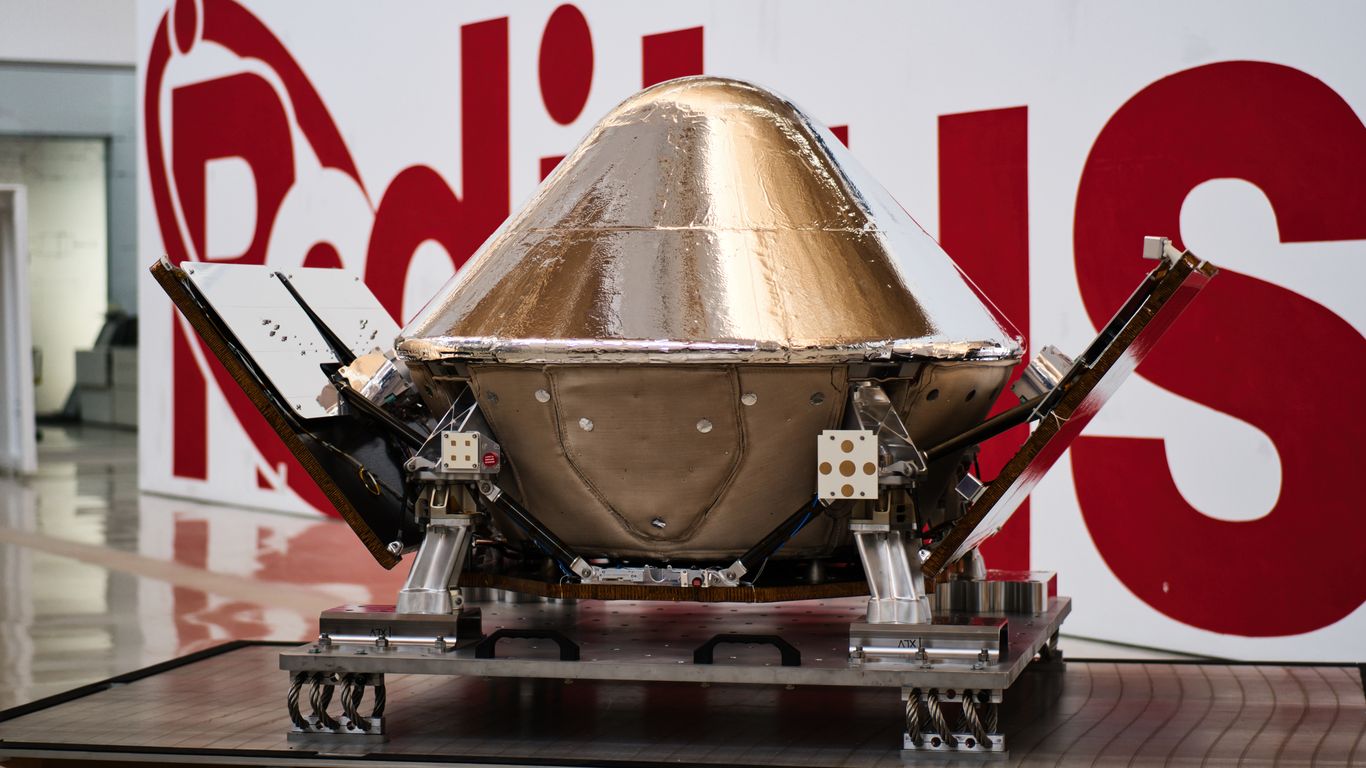
"Hypersonics is one of the areas where there has been a tremendous amount of development in recent years," Crum said in an interview. Driving the news: Reditus recently completed construction of its first spacecraft, ENOS. It has been sent to Vandenberg Space Force Base, California, and is scheduled to launch aboard a SpaceX rideshare this fall. * ENOS, weighing some 440 pounds, is expected to stay in orbit for two months, after which it will de-orbit and splash down off Florida for recovery. * "As we re-enter, we have the relatively unique capability of hitting the atmosphere at north of Mach 25," Crum said. "There are very few things in human existence that go that quickly." Zoom in: Reditus is billing this first mission, focused on commercial microgravity research and manufacturing, as a demonstration, proving to the world it can bring things back from space. * "Things are going to get higher in altitude, faster -- and this is just part of the infrastructure that is needed to keep up," Crum said. State of play: Reditus raised a little more than $7 million last year. * The startup, based in Atlanta, employs around 12 people. What we're watching: The progress of Trump 2.0's Golden Dome, and to what degree the $185 billion promise is influencing defense-industrial business decisions.
Why SpaceX Is Quietly Becoming an Infrastructure Giant
For years, SpaceX (SPCX) has been viewed as the world's leading commercial launch company, celebrated for reusable rockets that dramatically lowered the cost of reaching orbit. That description is still accurate, but it is no longer the whole story. The more interesting case to make is that SpaceX may be evolving into something far larger than an aerospace manufacturer. Through Starlink, Starshield, launch services, and an expanding artificial intelligence strategy, the company is steadily assembling businesses that look less like traditional industrial operations and more like critical infrastructure. That distinction matters because history shows infrastructure companies tend to become some of the most valuable businesses in the world. Railroads powered industrialization. Electric utilities enabled modern cities. Cloud computing became the backbone of the digital economy. The question investors should now be asking is whether SpaceX is beginning a similar transition. Infrastructure Has Changed When most people think about infrastructure, highways, bridges, airports, and power grids come to mind. But that definition has expanded considerably over the past two decades. Digital infrastructure now includes cloud computing platforms, payment networks, fiber-optic cables, and wireless communications, all systems that millions of individuals, businesses, and governments rely on every day without necessarily thinking about who owns them. Space is increasingly becoming another layer of that stack. Reliable launch services, global satellite communications, secure military networks, and eventually orbital computing are turning into strategic assets for both governments and private enterprises. SpaceX now operates across each of those areas, which makes the company increasingly difficult to classify as simply a rocket manufacturer. Rockets Are the Foundation, Not the Business SpaceX's breakthrough was never just about building rockets. It was about changing the economics of getting to space. Elon Musk has long argued that reusability is the key to making space commercially viable, drawing comparisons to every other major mode of transportation. "Every mode of transport is reusable," he has said, making the case that rockets should follow the same economic logic rather than being discarded after a single flight. That philosophy worked. The company's reusable Falcon rockets slashed launch costs and increased launch frequency, fundamentally reshaping the commercial space industry in the process. But lower launch costs created something more valuable than an efficient rocket business. They provided the economic foundation for SpaceX to build entirely new businesses that depend on affordable access to orbit. The rockets, in other words, are increasingly the enabling layer rather than the primary source of long-term value. Starlink Has Changed the Investment Narrative Nothing illustrates this transformation better than Starlink. Originally conceived as a satellite broadband network, it has evolved into a global communications platform serving residential customers, airlines, maritime operators, remote industrial sites, governments, and emergency responders. Unlike launch services, which generate revenue project by project, satellite connectivity produces recurring subscription income, and that changes the financial profile of the business considerably. Recurring revenue is more predictable, more scalable, and typically commands higher valuation multiples than cyclical industrial businesses. The importance of Starlink extends beyond its financial contribution. Every satellite launched strengthens the network, improves coverage, and expands the ecosystem, reinforcing SpaceX's competitive position in ways that are genuinely difficult to replicate. The company is also pursuing a substantial expansion of the constellation, recently seeking regulatory approval for a next-generation network that would dramatically increase the scale of its orbital infrastructure. Governments Are Becoming Long-Term Customers Infrastructure becomes especially valuable when governments depend on it, and SpaceX has been steadily deepening its public-sector relationships. Through NASA missions, defense launches, and national security programs, the company has built a government customer base that tends to be long-term and far less cyclical than commercial markets. Starshield, its government-focused satellite business, reflects a broader trend in which public agencies increasingly purchase commercial infrastructure rather than building every capability internally. As geopolitical tensions rise and nations prioritize resilient communications and space capabilities, commercial providers like SpaceX are becoming harder to replace. That raises a question worth sitting with: at what point does a private aerospace company effectively become part of a nation's critical infrastructure? The Platform Keeps Expanding SpaceX's ambitions are also stretching beyond communications and launch services. The company has outlined plans to leverage technology developed for Starlink to support future orbital AI computing, arguing that many of the building blocks are already in place. "There is not some magic that is necessary," Musk said during a company presentation. "A lot of this is technology we've already made for the Starlink V3 satellites. We don't think this is a super hard problem compared to the things we already do." Whether orbital computing becomes commercially viable in the near term remains an open question. Several Wall Street analysts believe SpaceX's more immediate AI opportunity lies in terrestrial computing infrastructure, and the company has already been investing heavily in that direction alongside its launch and satellite businesses. Either way, the strategic direction is becoming clearer. SpaceX increasingly treats launch, connectivity, and AI as interconnected businesses rather than separate ventures, each one reinforcing the others. Why It Matters for Investors Public market investors still cannot easily buy shares of SpaceX directly, but the company's evolution has implications well beyond its own valuation. Lower launch costs reshape the economics of satellite operators. Expanding communications networks influence telecommunications markets. Defense spending increasingly intersects with commercial space. Future advances in orbital infrastructure could create ripple effects across aerospace, semiconductors, and AI. History suggests investors often only recognize infrastructure businesses after they have already become indispensable. Railroads, electric utilities, cloud platforms, and payment networks all followed similar paths, underestimated early and irreplaceable later. SpaceX may now be entering that same category. If it is, the company's greatest achievement may not turn out to be making rockets reusable. It may be quietly building one of the defining infrastructure platforms of the twenty-first century.

Anthropic launches 'Claude for Teachers' to help US educators with lesson planning and classroom tasks - CNBC TV18
Anthropic has introduced Claude for Teachers, a new AI-powered platform designed specifically for K-12 educators in the United States. The service provides verified teachers with free access to Claude's premium features, along with teaching resources and curriculum support, aligned with academic standards in all 50 states. The artificial intelligence giant said the initiative was intended to help teachers save time on planning and routine tasks, allowing them to focus more on students. "Claude for Teachers is designed to close the gap between educational best practices and what a teacher's week allows. AI tools for teachers can strengthen instructional practice and improve student outcomes. This is the aim of Claude for Teachers: support the craft behind great teaching and protect what teachers value most -- time with their students," the company said in a blogpost. Built around teaching standards Claude for Teachers is integrated with Learning Commons, enabling the AI assistant to access academic standards across all 50 US states. The platform can generate lesson plans aligned with teaching standards while incorporating trusted educational resources, including OpenSciEd and IM v.360 from Illustrative Mathematics. Integration with K-12 tools Teachers can now connect Claude to a whole ecosystem of K-12 tools. These include ASSISTments, Brisk Teaching, Canva Education, Coteach, Diffit, Eedi, MagicSchool, Snorkl and TeachFX, allowing educators to create assignments, classroom activities, assessments and instructional materials more efficiently. How Claude for Teachers Works After completing the verification process, K-12 educators in the US receive access to Claude for Teachers, which integrates with Learning Commons and includes a collection of teaching skills developed using learning science. Anthropic said these features were created in collaboration with Learning Commons based on feedback from educators. The platform can generate lesson plans using curriculum resources that are mapped to state academic standards. It also creates classroom materials that teachers can customise before using them with students. Claude for Teachers can also personalise content by adapting lessons for students with different learning abilities and proficiency levels, helping educators provide differentiated instruction within the same classroom. In addition, the platform includes Claude Code and Cowork, enabling teachers to automate routine tasks. For example, educators can upload attendance records, diagnostics, your own notes, allowing the AI to analyse student performance and better tailor instruction. Teachers can also schedule recurring activities, such as reviewing students' daily assessments and preparing lesson adjustments for the next school day. Privacy and data protection Anthropic said Claude for Teachers has been built specifically for educators and includes privacy safeguards for student information. It said data shared through Claude for Teachers will not be used to train its AI models. The company added that student information is protected under its K-12 Data Processing Addendum, which is designed to comply with the FERPA. The company added that it is working with the American Federation of Teachers (AFT) to align its privacy practices with gold standards in K-12 education. Free access available until 2027 K-12 teachers in the US can sign up for Claude for Teachers free of charge. Anthropic said educators who register by June 30, 2027, will receive one year of free access, while a dedicated version for schools and school districts is expected to be introduced at a later date.

Czech Republic Blacklists Polymarket as Unauthorized Gambling Site
The Czech Finance Ministry added Polymarket to its blacklist of unauthorized online gambling websites, requiring internet providers to block access within 15 days. The Czech Finance Ministry added Polymarket to its list of unauthorized online gambling websites on Monday, requiring internet service providers (ISP) to block access. The ministry listed the prediction market's website under the country's Gambling Act, which prohibits operators from offering unlicensed online gambling services to Czech users. Under the Gambling Act, ISPs must block access to websites included on the ministry's blacklist within 15 days of publication of the name. Polymarket is a prediction market where users trade contracts tied to the outcomes of future events. The platform gained global attention during the 2024 US presidential election, with its markets widely cited as a gauge of election sentiment. Polymarket and rival Kalshi have been restricted by regulators across the European Union, including in France, Germany, Poland, Romania and Spain. Polymarket did not immediately respond to Cointelegraph's request for comment. Prediction markets face watchdog scrutiny beyond Europe Regulators in several jurisdictions argue that some prediction market contracts amount to unlicensed gambling or fall under existing financial market rules. On July 3, the European Securities and Markets Authority (ESMA) warned that many prediction market contracts could already fall under existing restrictions on binary options if they meet the definition of financial instruments. The regulator said companies cannot avoid EU financial rules simply by marketing binary-style products as "event contracts" rather than derivatives. ESMA said the assessment depends on a contract's characteristics rather than how they are marketed, adding that firms offering qualifying contracts to retail investors may already be subject to national restrictions implementing the bloc's 2018 binary options ban. ESMA also said companies offering such products to professional clients may need authorization under the Markets in Financial Instruments Directive, or MiFID II. Outside the EU, prediction markets have faced similar regulatory action in Australia, Indonesia and Singapore. In the US, Kalshi and Polymarket have been targeted by regulators in several states over allegations that their event contracts constitute illegal gambling, while the Commodity Futures Trading Commission maintains such products fall under its exclusive jurisdiction as federally regulated derivatives. The dispute has resulted in conflicting court rulings and prompted calls for Congress to clarify whether sports and political event contracts should be regulated as gambling or federally regulated derivatives.
Anthropic safety hiring targets nuclear and bio harm
Anthropic keeps warning its own AI could help end civilisation. Its latest safety hiring spells out the fear in job titles: enforcement analysts for nuclear, chemical, biological, and cyber harm, brought in to stop Claude ever teaching anyone how to build a weapon. Critics call the lab a doomsayer. It is now spending mid-six-figure salaries to prove it means it. A look at Anthropic safety hiring shows exactly what it fears: analysts brought in to stop its models teaching anyone how to build nuclear, chemical, and biological weapons. Most job ads sell a mission. Anthropic's read like a threat assessment. The company has posted a run of openings for enforcement analysts whose job is to keep its AI from helping people build weapons, run scams, or commit cybercrime, Axios first reported. One listing seeks an "Enforcement Analyst focused on Radiological & Nuclear Harms." Others cover chemicals and explosives, financial fraud, and more. The pay lands in the mid- to upper-$200,000s. The work is not coding. Anthropic wants real-world expertise in fields like biology and explosives. It also wants people who can think like an attacker trying to slip past its defences. Naming the harm on purpose The blunt job titles are deliberate. "Ensuring our models don't provide potentially harmful information is central to responsible development," a spokesperson said. The company said it regularly hires experts in sensitive fields to stress-test its models before a release. Spelling out the exact harm, it added, is how you recruit the right people. Anthropic says hundreds of staff now work on safety, probing for weak spots and patching them. This is the company that critics call the industry's biggest doomsayer. The pattern in Anthropic safety hiring is its answer to that label. It is spending real money on the risks it keeps describing. The catastrophe Amodei keeps describing Chief executive Dario Amodei has spent months sketching the downside. In a January essay he called biological attacks the scenario that worries him most. "I do not think biological attacks will necessarily be carried out the instant it becomes widely possible," he wrote. "But added up across millions of people and a few years of time, I think there is a serious risk of a major attack, with casualties potentially in the millions or more." He has also warned about AI helping cybercriminals and empowering authoritarian states. Earlier this year Anthropic broke with the US Defense Department over the use of its technology for mass surveillance and autonomous weapons. The labs are writing their own rules OpenAI is doing the same. It is hiring a researcher on biological and chemical risks, at a base salary of up to $445,000. As models grow more capable, every serious lab is racing to staff a red team. That race is happening in a vacuum. The US still has no comprehensive AI safety law. Congress has tried for years and passed nothing. Some want a referee: Google's Demis Hassabis has floated a Wall Street-style watchdog for frontier models. Fewer than one in a hundred AI PhDs go into government, so the expertise sits inside the companies. The result is a strange kind of self-regulation. The firms building the most dangerous capability are also the ones deciding how to fence it in. Amodei has named that tension himself, calling AI companies the next tier of risk after hostile states. His careers page is the argument and the warning in one place. The people best placed to stop the catastrophe work for the company that could help cause it.

SpaceX's slide risks turning blockbuster IPO into confidence test - AOL
NEW YORK, July 15 (Reuters) - SpaceX's slip close to its initial public offering price risks turning a marquee stock-market debut into a confidence test, potentially unsettling retail investors and complicating decisions for other companies weighing high-profile listings. Elon Musk's company, spanning rockets to AI, debuted on June 12 and soared in the ensuing days, at one point valuing the company at well above $2 trillion. Since then, trading has been rocky. The stock has slipped below its $150 opening price, but remained above the $135 offer price, with concerns about lofty tech stock valuations continuing to weigh on global indexes. SpaceX shares are at risk of falling below that level. They ended on Tuesday down 2.2% at $136.08, their lowest closing level since the IPO, a week after they started trading as part of the Nasdaq 100 index <.NDX>. The stock dipped as low as $135.52. A break below the IPO price would be a psychological blow for SpaceX shares, said Matthew Maley, chief market strategist at Miller Tabak. "It raises the narrative that the stock is up on fluff, on speculation, on froth, and not on real fundamentals," Maley said. Investors who bought into the excitement around SpaceX's listing, "hoping to 'make a killing' will be disappointed," said Greg Halter, director of research at Carnegie Investment Counsel. He said weakness in SpaceX would put it more in line with 30 years of heavily hyped IPOs, where average and median returns over the first month are often negative. SpaceX did not immediately respond to a request for comment. PRICE DISCOVERY NOT PANIC? A drop below the IPO price would not be unusual for a newly listed company. Shares of Cerebras Systems, which went public in May, have dropped below the IPO price, and Meta, formerly known as Facebook, fell similarly after its debut. Investors often fixate on IPO prices and early trading, said Ryan Lee, senior vice president of product and strategy at financial services firm Direxion. "The reality is, (SpaceX) is still undergoing some of this price discovery process," Lee said. A fall for SpaceX below $135 would reflect "normal, albeit painful" market mechanics, especially as investors, venture capitalists and employees sell shares after lockups expire, said Gabriel Shahin, CEO at Falcon Wealth Planning. "A near-term dip below the $135 threshold would not fundamentally alter our current positioning or cause us to panic-sell," he said. CAUTION OR GREEN LIGHT FOR NEXT IPOS Some investors think SpaceX's stock performance could influence the market for future public listings. OpenAI and Anthropic are eyeing the public markets. Neither company responded to a request for comment. Carnegie's Halter said companies and investment banks considering large IPOs this year are watching SpaceX closely. "No one wants an IPO to flop or have the initial price be ratcheted down," Halter said. He suspects some IPOs would be pulled rather than priced at lower valuations. But Direxion's Lee said SpaceX's capital raise could encourage some companies with large funding needs to move faster. "If I'm OpenAI or if I'm Anthropic and I'm in this true arms race to build the frontier AI model and I need capital, I'm going to try to beat the other one out the door," Lee said. RISKING RETAIL TRADERS' SKEPTICISM A drop below the IPO price could hit retail investors, who received about 20% of the allocation, hard. "Many novice investors have approached SpaceX with a 'meme stock' mentality, buying in with capital they cannot afford to lose," Shahin said, warning that losses could fuel perceptions that markets favor insiders. "The market needs to understand that post-IPO volatility is normal." SpaceX's first earnings report will be a major test for the stock. Underwriters typically support stocks in the first 30 days and may do more for SpaceX given the deal's size, the public attention and the fact other high-profile offerings are imminent, said Maria Llerena, director of financial research at Domini Impact Investments. "Loss-making companies without a clear path to profitability are typically volatile and can fall below their IPO price," said Llerena. (Reporting by Laura Matthews in New York; Additional reporting by Lewis Krauskopf in New York; editing by Megan Davies and Rod Nickel)
