News & Updates
The latest news and updates from companies in the WLTH portfolio.
AI giant Anthropic suffers strategic code hemorrhage
The highly confidential internal design of the Amazon-backed tech was published due to "human error" AI giant Anthropic has mistakenly published its own top secret internal code, triggering a viral wave of github rewrites and inflicting potentially catastrophic commercial damage on the Amazon-backed business model. The developer of the Claude chatbot described the incident as a release issue "caused by human error, not a security breach," according to US technology news website VentureBeat on Tuesday. Anthropic was designated a "risk to national security" by US Defense Secretary Pete Hegseth in February after disagreements with the Pentagon over the use of its artificial intelligence systems. The leak involved more than 500,000 lines of code linked to Claude Code, Anthropic's AI coding assistant, which helps users write and manage software through natural language commands, according to Axios and The Verge. The material included unreleased features, performance data, and developer notes. The code spread rapidly online, with versions of the code being placed on code-sharing platform GitHub and replicated thousands of times within hours, according to Ars Technica and The Verge. Anthropic moved to remove the material and issued takedown notices, but the material had already been widely copied and circulated, the reports said. According to VentureBeat, by exposing the "blueprints" of Claude Code, the leak may have given "bad actors" a "road map" to bypassing security checks or tricking the tool into running hidden commands or accessing data without the user's knowledge. A separate data leak reported in February exposed internal materials revealing details of Anthropic's unreleased model, known as Claude Mythos, after thousands of draft documents were left accessible in a public data cache. READ MORE: The Pentagon vs Anthropic: Why a tech giant is defying the US military on use of AI The model was described in the leaked material as the company's most powerful system to date which could pose "unprecedented cybersecurity risks" if deployed widely. The company has withheld its release due to concerns over its capabilities and potential misuse, according to US business magazine Fortune.

Less Than A Month: Strictlyvc San Francisco Brings Leaders From Tdk Ventures, Replit, And More Together
BERITAJA is a International-focused news website dedicated to reporting current events and trending stories from across the country. We publish news coverage on local and national issues, politics, business, technology, and community developments. Content is curated and edited to ensure clarity and relevance for our readers. All bully things travel to those who wait. The first StrictlyVC of the year is headed to San Francisco successful little than a month, connected April 30, astatine the Sentro Filipino Cultural Center. And you won't want to miss retired connected different lineup of stellar speakers to punctuate the night's networking and mingling. AI innovators and founders successful hunt of backing will beryllium peculiarly well-served by the event's discussions. Who's taking the stage You could get a summons correct now, but for those who haven't been to a StrictlyVC arena successful the past and already clicked that link, let's dive into what's peculiarly breathtaking about this one ... TDK Ventures president Nicolas Sauvage will footwear things disconnected aft you get your requisite beverages and networking in, arsenic he makes the lawsuit for firm VCs successful a speech pinch TechCrunch editor-in-chief Connie Loizos. Sauvage, who leads TDK Ventures' $500 cardinal effort to put successful early-stage startups, will explicate what makes firm VCs run otherwise and what founders should cognize about what catches his oculus successful an investment. And founders connected the obstruction should return note: Sauvage has steered TDK into backing 45 startups and 3 unicorns -- Groq, Ascend Elements, and Silicon Box -- during his tenure. TDK will besides beryllium hosting and sponsoring this StrictlyVC event, truthful attendees will get ample opportunity to study from and get immoderate imaginable look clip pinch their team. Then we'll move to a speech pinch Campbell Brown, erstwhile CNN big and caput of news astatine Meta who has since made the pivot toward the startup segment arsenic she looks to make AI platforms much trustworthy while much and much group move to them for proposal and information. She's now the co-founder and CEO of Forum AI, and successful the heavy of the speech complete really to vet, verify, and prolong the veracity of accusation provided by LLMs. And those who are likewise a portion of the AI gyration will beryllium excited to perceive that Amjad Masad, co-founder and CEO of Replit, is besides taking to the shape to stock his firsthand acquisition helping lead a gyration successful really package is constructed. The emergence of vibe coding has changed the ways galore person worked, particularly successful the Bay Area, and that's besides brought successful immoderate potent competitors for illustration Anthropic and OpenAI. Anyone looking for a peek into the early of programming is going to request to subordinate america and instrumentality about for Masad's talk. As if that each wasn't breathtaking enough, we still person 1 much speaker to announce, truthful you'll beryllium getting moreover much insights and expertise starring into the concluding information of networking and connection-making that defines the existent proving constituent of StrictlyVC. Some of the top minds and about well-connected members of the startup organization subordinate america for these events, and you could beryllium a portion of it by registering, truthful get your summons today!

OpenAI shares struggle to find buyers as investors shift to Anthropic By Investing.com
Investing.com -- OpenAI shares are facing declining demand on secondary markets as investors redirect their focus toward competitor Anthropic, according to a report Wednesday from Bloomberg News. Ken Smythe, founder of Next Round Capital, said his secondary marketplace has seen a drop in demand for OpenAI shares in recent months. About six institutional investors, including hedge funds and venture capital firms holding large stakes, approached his company in recent weeks seeking to sell approximately $600 million worth of OpenAI shares. Last year, such offerings would have been purchased within days, but currently there are no buyers, Smythe said. Other secondary marketplaces, including Augment and Hiive, are experiencing record demand for Anthropic shares. The gap between OpenAI's $852 billion valuation and Anthropic's $380 billion valuation has prompted investors to acquire equity in Anthropic before prices rise, according to Adam Crawley, co-founder of Augment. Banks including Morgan Stanley (NYSE:MS) and Goldman Sachs Group Inc. (NYSE:GS) have started offering OpenAI shares to wealth clients without charging carry fees, according to a person familiar with the matter. Goldman Sachs is charging its standard carry fee for clients interested in Anthropic, which typically ranges from 15% to 20% of profits. This article was generated with the support of AI and reviewed by an editor. For more information see our T&C.

OpenAI shares struggle to find buyers as investors shift to Anthropic By Investing.com
Investing.com -- OpenAI shares are facing declining demand on secondary markets as investors redirect their focus toward competitor Anthropic, according to a report Wednesday from Bloomberg News. Ken Smythe, founder of Next Round Capital, said his secondary marketplace has seen a drop in demand for OpenAI shares in recent months. About six institutional investors, including hedge funds and venture capital firms holding large stakes, approached his company in recent weeks seeking to sell approximately $600 million worth of OpenAI shares. Last year, such offerings would have been purchased within days, but currently there are no buyers, Smythe said. Other secondary marketplaces, including Augment and Hiive, are experiencing record demand for Anthropic shares. The gap between OpenAI's $852 billion valuation and Anthropic's $380 billion valuation has prompted investors to acquire equity in Anthropic before prices rise, according to Adam Crawley, co-founder of Augment. Banks including Morgan Stanley (NYSE:MS) and Goldman Sachs Group Inc. (NYSE:GS) have started offering OpenAI shares to wealth clients without charging carry fees, according to a person familiar with the matter. Goldman Sachs is charging its standard carry fee for clients interested in Anthropic, which typically ranges from 15% to 20% of profits. This article was generated with the support of AI and reviewed by an editor. For more information see our T&C.
A mathematical framework for thermodynamic computing with applications to chemical reaction networks - npj Unconventional Computing
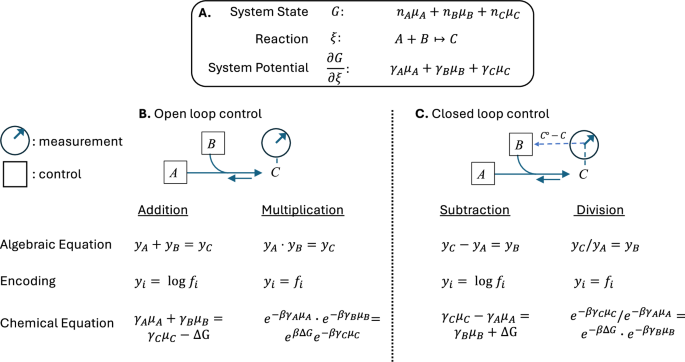
Generally, in a system of n observables, we have unit vectors along a coordinate axis for each observable, . We define an arbitrary unit vector , such that a distance ξ that measures the extent along x is, This relationship can be exploited to create an adder function. If there is an observable x due to a process ξ that maps x and x to x (ξ: x + x ↦ x), then addition can be carried out in x-space. Specifically, to add two variables y + y, first define, where for reasons that will become clear below. Then, The first term on the right-hand side carries out the mapping x + x ↦ x and the second term maps x ↦ y. The extent of the mapping of each process is determined by the mechanical change in the thermodynamic process, Δξ. Importantly, n addition operations can be easily carried out in parallel if each respective observable x is directly, or indirectly through other x, mapped to a terminal observable x, Computationally, Eqn (15) is a general adder function for any thermodynamic process. A subtraction function, can easily be constructed using a similar process but instead of measuring the product of the process x, measure the amount of an intermediate variable x needed to obtain a specific value of the product of the process x. x is thus the subtractant, Multiplication and division processes similarly follow by exponentiating Eqns (15) or (17). For multiplication, That is, multiplication and division are obtained by using the same processes as addition and subtraction but not working in space. Concrete examples are given next. Experimentally, the process of mapping one object to another consists of either a deterministic or stochastic physical process ξ that relates the x objects to x, either directly or through other x that may not be observable. In addition to probability densities, equations of state, defined as any function , can likewise be used for computing. If F is the equation of state, then ξ represents a process that changes the state. Consider the equation of state for an ideal gas, PV = ∑xRT for the case of n gas chambers each of volume f and each containing x moles of the gas. Suppose that ξ controls pistons that move all of the gas from the n chambers into a terminal chamber, initially empty, with volume V at constant temperature T. Since all of the gas from each chamber is emptied, . Then again using , In this case, since the system is closed, ΔPV = 0 and ΔxRT is simply PV. In short, addition can be carried out by any thermodynamic process because work is additive. Likewise, as we demonstrate below, the thermodynamic odds of one state to another, which is the exponent of the work to move from one state to another, is multiplicative in nature. Oxidation-reduction phenomena in chemistry, as well as electrical phenomena, are represented by the thermodynamic equation of state ΔG = - zΔE where G is the free energy, z is a charge and ΔE is an electric potential. If z is a charge transferred due to chemistry (or a charge translocated in an electrical circuit), ξ is the extent of chemical reaction i (or analogously a unit length of the circuit component i), then, again representing , the relevant equations are, where in Eqn (23) was used. Eqns (22) and (23) describe the additivity of sequential chemical reactions i and voltages of sequential components in a circuit. The carrying out of arithmetic operations using voltages in electrical analog computing, an adder, is well known. In general for chemical reactions, the chemical free energy is G = ∑xμ where x is the count or concentration of species i and μ is the chemical potential. Then from Eqns (7), Eqn (25) is the basis for a chemical differential analyzer. For example, the differential equation, The first integral is simply the work done by the chemical system and the second is proportional to the extent to which the system has reacted (for example, the number of reactants consumed). Consequently, For a mechanical differential analyzer, the integral is output onto a graph in which the position of the pen is the memory to which are added differentials of the integral. Multiplication can be carried out as the subsequent exponentiation of the integral. However, this need not be the case in thermodynamic computing, as the exponential of the free energy or entropy is the thermodynamic odds of the final state relative to the initial state. Consequently, the value of the exponential can be calculated directly by an appropriate odds ratio involving the ratio of reactant and product concentrations. To demonstrate multiplication in chemistry using information, consider the reaction, where the probability of each species i depends on its standard free energy of formation, , The normalization factor is Thus, the f is the derivative of the probability density such that, where the term in brackets is the normalized chemical potential, βμ. The mapping needed for computing operations is implemented by a chemical reaction ξ where, in which case is the stoichiometric coefficient. To compute a multiplication operation such as y ⋅ y = y in chemical space when the number of particles of each species is large, we represent the initial values of the variable y = f with chemical A, y = f with chemical B, and y = f with chemical C where each is given respectively by, To determine the value of y after the continuous chemical operation ξ, the integral transform that is needed is the one involving the mapping ξ: x + a ↦ x, The basic chemical operations corresponding to addition, subtraction, multiplication and division are shown in Fig. 1. In the chemical processes of addition and multiplication, the chemical reactants represent the operands and the chemical product represents the solution. These systems are open-loop control systems: the reactants are controlled and the chemical products are measured. For subtraction and division, at least one product is an operand and at least one reactant is a solution. Subtraction and division are carried out by closed-loop control: a reactant is titrated to obtain the desired chemical product. To demonstrate the mechanics of the procedure, consider the case in which and f is unknown. Let the standard chemical potentials be given by , , and let the system be at a non-equilibrium steady state in which the counts of the reactants are x = 2, x = 4. is measured. Consequently, the thermodynamic odds of the reaction KQ are known. More precisely, where the latter term accounts for the change in the probability as the total number of particles changes. For the purpose of demonstration, the concentration of the product that is to be measured experimentally will simply be determined analytically from chemical thermodynamics (Eqs. (42) and (43)); that is, when KQ = 8. Then carrying out the multiplication in chemistry, A more insightful and realistic case is to carry out the operation when y and y are both large numbers and using parameters , and from real chemical species. So that we know the exact solution to the problem, we take y and y to be such that, Choosing a = 1.0 × 10 gives, First, we choose two convenient chemical species A and B to represent y and y such that y = f, y = f from Eqn (39). For convenience, we will use dihydroxyacetone and glyceraldehyde for A and B, respectively, and fructose for C. Their respective reference chemical potentials at pH = 7.0 and ionic strength 0.25 M are kJ/mol, kJ/mol, and kJ/mol. At T = 298.15, the ambient energy is RT = 2.478956 kJ/mol. The respective counts of the chemicals are, Assuming that the chemicals are in one liter (1 L) of water, division by Avogadro's number gives concentrations in moles/liter (M), where N = 6.022141 × 10 mol. Starting with no C present, only a small amount of A and B are allowed to react such that the final concentration of C is measured to be a little less than millimolar, molar. At this concentration, the thermodynamic odds of the reaction are KQ = 1.0 × 10. Then the chemically computed value of y ⋅ y is, The in-silico chemical calculation compares with the analytical value y ⋅ y = a such that In this case, the error is due to the limited precision of the computer used to carry out the chemical calculations in-silico. In an actual chemical computer, the error will depend on the measurement precision of the starting material, n and n, the product, n, and on the uncertainty in each of and . However, if calorimetry is used, only the chemical potential of the final product is needed, in that the value of K is the heat released during the reaction. In addition, the precision of the measurements can always be increased in practice through multiple dilutions or concentrations. In the examples above, the problem of finding the solution of y ⋅ y has been changed to the problem of finding the solution to KQ ⋅ f, and we had to additionally calculate the transforms from f → n, f → n and . Thus, there may or may not be an advantage to using the chemical reactions to solve the multiplication problem in these simple cases. However, consider a higher-dimensional example, in which we want to find the product f of N + 1 random variables y for i ∈ [0, ..., N], The chemical process for calculating f is shown in Fig. 2. The chemical system has components {x, ..., x} which are subset into N + 1 reactants r and N products p. The y = f to be multiplied are represented by the chemical reactants r. The p are the reaction products with p being the final product. The solution f can be determined from the corresponding known reactant concentrations , calculating or measuring K, and measuring p, The values of the intermediate products p do not have to be stored in memory or even known. K in Eqn (70) is , where 1 is the ones vector and , the vector of known standard chemical potentials, and S is the stoichiometric coefficients for each of the M chemical species (reactants and products) for each of the Z reactions are captured in the stoichiometric matrix, To add two products together, the two products are computed independently as described above, such that y = ∏y of N + 1 random variables y and z = ∏z of N + 1 random variables z, as shown in Fig. 3. The value y and z are then the input concentrations for chemicals A and A. The sum of the products is then computed using the chemical reaction A + A = A. The chemical formulation is, Here r and are the respective reactants involved in the y-product reaction and the z-product reaction. K is , where again 1 is the ones vector and . S is the stoichiometric coefficients for each of the M chemical species (reactants and products) for each of the Z reactions that synthesize y from the reactants r. In Fig. 3, Z = N. Analogous parameters are likewise defined regarding z. If instead the concentrations of intermediates are measured, then the reaction free energies ΔG for each of the Z reactions can be determined. This allows for matrix-vector multiplication, in which A is represented by S, the stoichiometric matrix, and in this case f is represented by the vector of chemical potentials, f = μ. The product b is, This analysis is similar to that found by Aifer, et al., but rather than harmonic potentials, chemical potentials are used. Notably, however, the system is easily generalized beyond equilibrium solutions since non-equilibrium boundary conditions can easily be applied. In this case, the computational solution is found at a non-equilibrium steady state. In principle, non-equilibrium boundary conditions would represent the computational problem through constraints in concentrations included in the probability density (Eqn (21)). Moreover, given a set of V independent chemical systems k, each with its own stoichiometric matrix S and respective set of mapping processes (reactions) {ξ}, composite computations can be carried out such that, To bridge the theoretical foundations of CRNs with practical implementations, we build on existing features and suggest the concept of a microfluidic device system designed to execute fundamental chemical computations described above. The system must support digital control interfaces to manipulate and measure signals, chemical compartmentalization strategies to enable execution of multiple operations, feedback mechanisms to chain chemical reactions in time, and consequently computations, and a mechanism to execute complex operations such as f(x) = log(e) enabled by the dynamics of certain species and permeable membranes. We believe prototype systems can be implemented using current microfluidic fabrication techniques, leveraging a wide range of microfluidic technologies discussed below. Microfluidic technologies have evolved into versatile platforms supporting biological analysis, chemical synthesis, and computational modeling. Early advances focused on cell-based and droplet microfluidics, enabling single-cell manipulation and controlled droplet generation. These systems demonstrated high precision in reagent handling and isolation, establishing foundational mechanisms for reaction control at the microscale. Further developments expanded into biomedical and environmental applications, leveraging new materials and fabrication methods to integrate sensors and achieve biocompatibility and scalability. Recent research emphasizes programmability, modularity, and adaptive control in microfluidic systems. Digital microfluidics and circuit-based network models introduced flexible droplet actuation schemes, while compiler-assisted and machine-learning-driven control frameworks have automated design and operation. Collectively, these innovations inform the proposed chemical computing architecture, combining precise micro-scale actuation, dynamic feedback control, and programmable digital interfaces to realize computationally capable biochemical systems. To carry out the needed operations, we propose the system presented in Fig. 4, consisting of a multilayer microfluidic chip that leverages the ideas above, incorporating: The device operates in three phases: A programmable controller synchronizes reactant injection, chamber mixing, and measurement. This enables composability of CRN operations in a manner analogous to instruction sequencing in electronic processors. The microfluidic chip incorporates elastomeric valves, micropumps, and membranes with tunable permeability. These features allow selective coupling of chemical reservoirs, ensuring robust control over concentration dynamics. Reaction free energies (G) and chemical potentials (μ) act as computational primitives. Open-loop systems leverage direct measurement of product potentials, while closed-loop control dynamically adjusts inflows to converge on the desired result. The membrane-mediated logarithmic transformation provides a mechanism to extend computation to nonlinear functions required for solving ODEs and higher-level mathematical tasks. By combining precise microfluidic control with thermodynamic principles, the device acts as a biochemical analog computer. Its modularity allows chaining of operations, thereby realizing scalable reservoir computing frameworks. This approach enables experimental validation of CRN-based computation while providing a pathway toward energy-efficient, non-silicon analog computing architectures.
Anthropic's Claude Code leak reveals its "Kairos" updates, including letting Claude work in the background and using a "dream mode" to consolidate its memories
Wes Bos / @wesbos: Claude Code leaked their source map, effectively giving you a look into the codebase. I immediately went for the one thing that mattered: spinner verbs There are 187 [image] A few take-aways from the Claude Code Leak: - Anthropic is actively using Capybara (Mythos) for development - they are already at Capybara v8 - Capybara still has issues with over-commenting and false-claims - Capybara has 1M context and fast mode - Numbat is another interesting code name tagged with "@[MODEL LAUNCH]: Remove this section when we launch numbat." - Fennec seems to be Opus 4.6

OpenAI shares struggle to find buyers as investors shift to Anthropic By Investing.com
Investing.com -- OpenAI shares are facing declining demand on secondary markets as investors redirect their focus toward competitor Anthropic, according to a report Wednesday from Bloomberg News. Ken Smythe, founder of Next Round Capital, said his secondary marketplace has seen a drop in demand for OpenAI shares in recent months. About six institutional investors, including hedge funds and venture capital firms holding large stakes, approached his company in recent weeks seeking to sell approximately $600 million worth of OpenAI shares. Last year, such offerings would have been purchased within days, but currently there are no buyers, Smythe said. Other secondary marketplaces, including Augment and Hiive, are experiencing record demand for Anthropic shares. The gap between OpenAI's $852 billion valuation and Anthropic's $380 billion valuation has prompted investors to acquire equity in Anthropic before prices rise, according to Adam Crawley, co-founder of Augment. Banks including Morgan Stanley (NYSE:MS) and Goldman Sachs Group Inc. (NYSE:GS) have started offering OpenAI shares to wealth clients without charging carry fees, according to a person familiar with the matter. Goldman Sachs is charging its standard carry fee for clients interested in Anthropic, which typically ranges from 15% to 20% of profits. This article was generated with the support of AI and reviewed by an editor. For more information see our T&C.
OpenAI Demand Sinks on Secondary Market as Anthropic Runs Hot
OpenAI shares have fallen out of favor on the secondary market -- in some cases becoming almost impossible to unload -- as investors pivot quickly to Anthropic, its biggest competitor. Even as OpenAI raced in recent months to raise tens of billions of dollars, Next Round Capital founder Ken Smythe said his secondary marketplace was seeing a drop in demand for the artificial intelligence giant's shares. About a half-dozen institutional investors -- including hedge funds and venture capital firms that hold large stakes -- approached his company in recent weeks looking to sell about $600 million of OpenAI shares. Last year, they would have been snatched up within days. But now, no one's biting. "We literally couldn't find anyone in our pool of hundreds of institutional investors to take these shares," said Smythe, whose firm has handled $2.5 billion of transactions. Meanwhile, "buyers have indicated they have $2 billion of cash ready to deploy into Anthropic." Other marketplaces are also seeing record demand for Anthropic, including Augment and Hiive. The large gap between OpenAI's $852 billion valuation and Anthropic's $380 billion has investors rushing to grab equity in the latter before it rises, according to Augment co-founder Adam Crawley. "It's just better risk-reward right now," he said. "People are betting that Anthropic's valuation will catch up with OpenAI's. But if you buy OpenAI shares, it's less clear what the return will be in the near term." Banks including Morgan Stanley and Goldman Sachs Group Inc. have begun offering OpenAI shares to wealth clients without charging carry fees, according to a person familiar with the matter. Meanwhile, Goldman is charging its usual carry for clients interested in Anthropic. That fee is often roughly 15% to 20% of profits. Representatives for the banks declined to comment. OpenAI and Anthropic didn't comment. On Tuesday, OpenAI announced it had put the finishing touches on its largest-ever fundraising, drawing $122 billion in backing from tech giants, venture capital funds and retail investors alike. Primary fundraising and secondary sales don't always follow the same playbook. In fundraising rounds, existing investors are often offered the chance to buy more shares to maintain their stakes, and instead of saying no -- which founders may not like -- they can buy in and then sell some of that exposure on the secondary market. Read More:OpenAI Valued at $852 Billion After Closing $122 Billion RoundMeet Eve, the AI Brain Behind an Ex-Coatue Trader's New FundOpenAI Set to Raise $10 Billion From MGX, Coatue, Thrive Both AI firms have grown rapidly in recent years, particularly after OpenAI's 2022 debut of ChatGPT and Anthropic's subsequent launch of Claude. Both companies are weighing plans to go public, with OpenAI's listing expected as early as this year. Anthropic and OpenAI don't allow investors to trade shares on the secondary market without their permission. Still, access to the shares is available on many platforms as investors sell their interests through other mechanisms such as special-purpose vehicles. Get the Tech Newsletter bundle. Get the Tech Newsletter bundle. Get the Tech Newsletter bundle. Bloomberg's subscriber-only tech newsletters, and full access to all the articles they feature. Bloomberg's subscriber-only tech newsletters, and full access to all the articles they feature. Bloomberg's subscriber-only tech newsletters, and full access to all the articles they feature. Plus Signed UpPlus Sign UpPlus Sign Up By continuing, I agree to the Privacy Policy and Terms of Service. Some investors have grown cautious over OpenAI's soaring operating costs. The company has committed to spend far more than Anthropic on infrastructure to support its AI ambitions in coming years. And while OpenAI touts a strong consumer base, it's moving slowly on capturing more lucrative enterprise clients. Anthropic, meanwhile, has dominated that higher-margin market and, as a result, its growth trajectory appears to be stronger than OpenAI's, Crawley said. Meanwhile, Anthropic has other challenges. It's suing the US Department of Defense after the Pentagon designated the company a supply-chain risk and ordered a ban on government entities using its technology. And just this week, Anthropic had its second security slip-up in a matter of days, when it inadvertently released internal source code behind Claude. Next Round sees bids for OpenAI coming in at a valuation of about $765 billion, a 10% discount from the previous $850 billion. "The market is much more in demand for Anthropic," Augment's Crawley said. His firm and Next Round are both seeing huge bids for Anthropic that value it at roughly $600 billion, more than 50% higher than its previous funding round. Meanwhile, Hiive has registered more than $1.6 billion of demand for Anthropic shares, also at a premium, said co-founder Prab Rattan. "The demand is one of the highest we've ever seen," Crawley said. "It's essentially unlimited interest."
Starlink India Launch Inches Closer as SpaceX Signs MoU with Meghalaya Government
The Government of Meghalaya has signed a Memorandum of Understanding (MoU) with Starlink India to improve internet connectivity across the state, particularly in remote and hard-to-reach areas. The development was confirmed by Chief Minister Conrad K Sangma in a social media post, where he described the agreement as a step towards addressing long-standing connectivity gaps. He noted that while the state has made progress in improving infrastructure and governance processes over the past few years, extending reliable internet access to remote schools, healthcare centres, and communities continues to remain a challenge. The partnership aims to introduce satellite-based connectivity to bridge these gaps. Sangma said the initiative is expected to improve access to healthcare and education, while also creating new livelihood opportunities in rural areas. The state government is also looking to position Shillong as a technology hub in the Northeast, with a stronger digital ecosystem to support employment and innovation. Starlink's satellite internet works through low-earth-orbit satellites, removing the need for traditional infrastructure such as fibre networks or mobile towers. This makes it particularly suited for regions like Meghalaya, where terrain and low population density make conventional network deployment difficult. With satellite dishes installed at user locations, even remote villages can access high-speed internet. This could enable schools to adopt digital learning tools, allow telemedicine services in areas with limited healthcare access, and open up new economic opportunities through online work and digital services. Improved connectivity is also expected to strengthen governance by enabling better access to government schemes, financial services, and digital platforms. In disaster-prone regions, satellite-based networks can offer more reliable communication, especially when traditional infrastructure is disrupted by landslides or floods. Overall, the agreement signals a shift toward alternative connectivity solutions, where satellite networks are increasingly being used to address last-mile challenges that traditional telecom infrastructure has struggled to solve.

This is how astronauts wash their hair in space - and it's rather unconventional
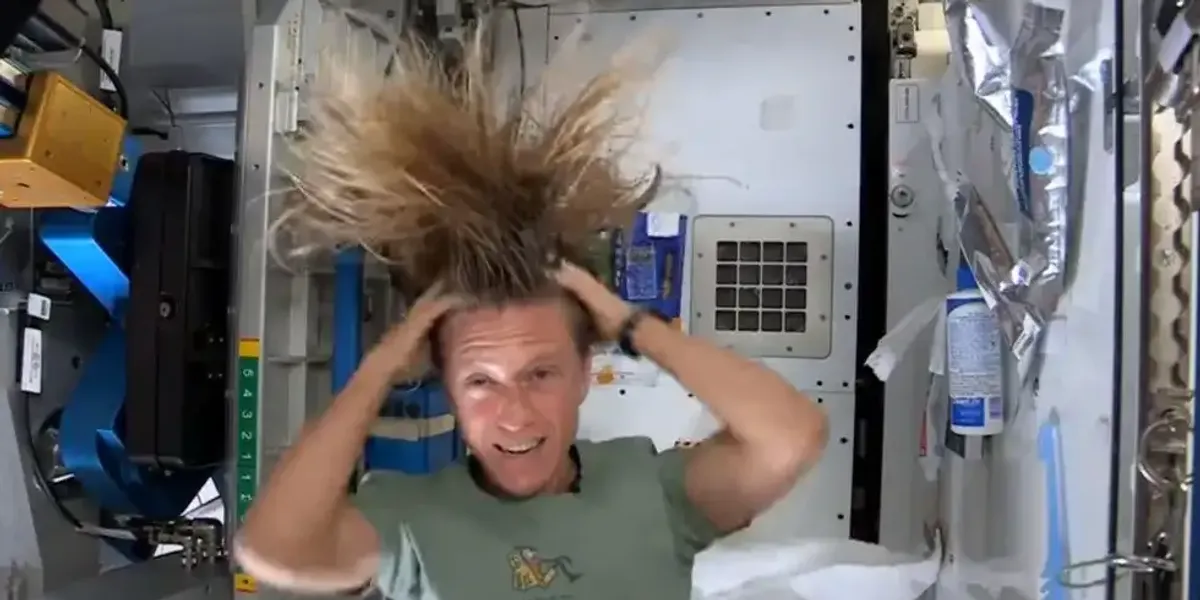
We've all heard the phrase 'I'm washing my hair tonight' - mostly in rather uninventive sitcom scripts. It's usually writer shorthand for; this character can't be bothered to go to the pub, or they're not actually interested in going on that date. The reason it never caught on was most likely because washing one's hair is a simple task - it doesn't take too long and it's certainly not something that would result in an evening wasted. In space however, it's a different story. Washing hair in zero gravity is a precarious business - but it needs to be done. It's become a particular point of interest given that NASA's Artemis II mission is about to see four astronauts head as far as the Moon for the first time in 50 years. Their mission, which is set to launch on 1 April 2026, is set to last 10 days, which, naturally, has people wondering how they'll complete daily tasks. Well, it's actually already been debunked. On a trip to the International Space Station in 2012, Expedition 36 astronaut Karen Nyberg demonstrated just how she and her colleagues keep their hair clean while floating around in orbit. As you can see in this video from Nasa, it's not entirely dissimilar to how we wash hair on Earth, except we don't have to catch the water as it floats away from us. They also have to use no rinse shampoo (we sincerely hope they are using the right shampoo) and a towel, rather than a hair-dryer, as they have limited supplies. Although it looks like a real ordeal, it's cool to know that astronauts are keeping themselves and their hair clean in outer space. If you weren't impressed already, Karen reveals that there is an even more fascinating aspect to cleaning hair on the ISS. In an extended video, Karen states that as her hair dries, the evaporated water is condensed by the space station and eventually turned into drinking water. How about that? We wonder if it tastes of shampoo? According to Nasa, Karen, who was on her second space mission at the time time, also took along sewing and sketching materials on the six-month long trip.
Chaos in major UK city as police chopper deployed and school locked down
A police helicopter has been spotted over East Bristol as an air ambulance lands at a park amid an ongoing incident. The air ambulance took off from Barton Fields near Speedwell and landed at Southmead Hospital before 2.30pm on Wednesday. A witness wrote on Facebook that police had also cordoned off part of New Queen Street - between Speedwell Road and Two Mile Hill. Police have been pictured at the scene as the cordon remains in place, BristolLive reports. There is also a police helicopter circling between Fishponds, Kingswood, and Eastville, remaining airborne for at least half an hour. The nature of the incident is not yet known.

Perplexity CEO Aravind Srinivas faces backlash after saying 'AI layoffs are fine because people hate their jobs, anyway'
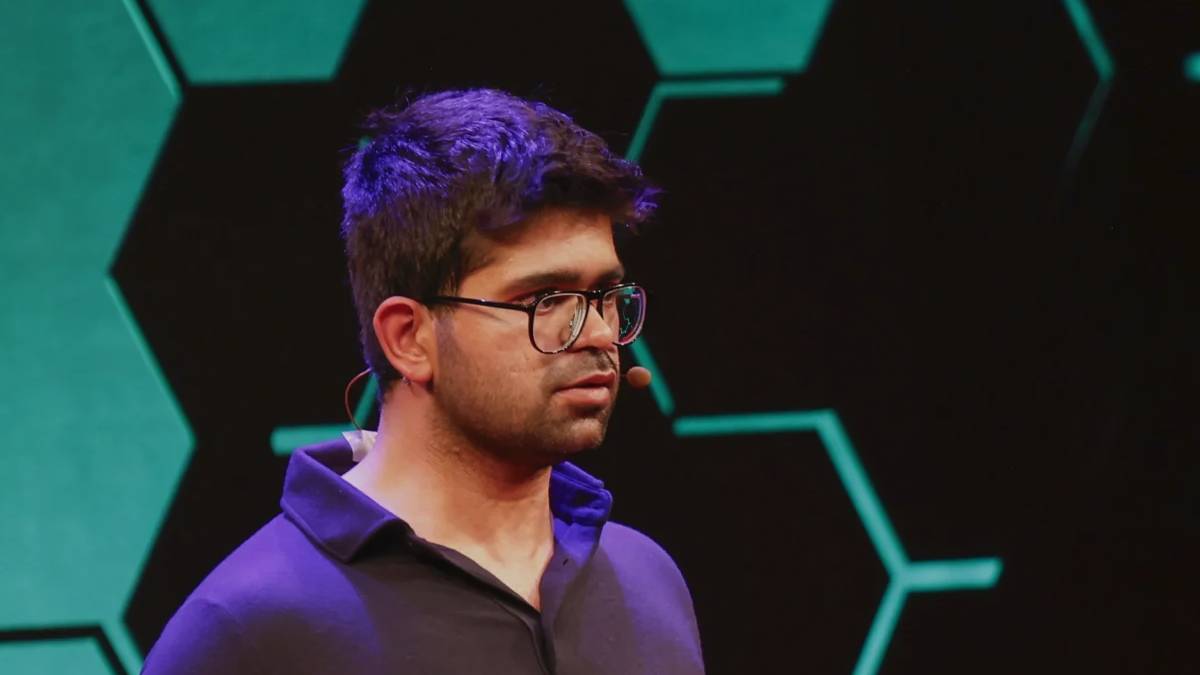
Aravind Srinivas, Perplexity AI CEO, is now under fire for advancing the opinion that people should embrace being replaced by artificial intelligence since they don't like their jobs anyway. The co-founder of Perplexity further added to the sardonic comment that the jarring shift in how work gets done will lead to a "glorious future" and everyone should be happy about. "The reality is most people don't enjoy their jobs," the executive said on the All-In podcast, in an episode that was published Monday. Listeners were quick to react to the controversial opinion and voice outrage. A leading voice among the critics argued that Srinivas was out of touch with everyday people who have been struggling to make ends meet after getting laid off. "A man worth millions just told the single mother who lost her job that she should be grateful because now she can start a business using his product and called her unemployment a glorious future," one commenter wrote on X. "This is what happens when you've never needed a paycheck to keep the lights on." Recent months have been marred by a number of large companies announcing brutal layoffs. The likes of companies such as Amazon and Block have blamed AI for driving such massive changes. Companies planning major job cuts in 2026 As per a report by Business Insider, Amazon plans to eliminate around 16,000 corporate roles globally. This marks the second round of layoffs from the Bezos-led brand. Last year, the company eliminated close to 14,000 roles. The affected employees were greeted with a cold memo stating that Amazon wanted to cut back on bureaucracy within the company. Citi Bank plans to cut more jobs this year, reducing its workforce by 10%. In a statement released on January 13, the bank said it would continue to reduce headcount in 2026. These plans were already established in the company's 2024 earnings report. Dell has decided to cut its workforce by 10% for the third year in a row. The tech giant revealed its plans in its annual filing with the SEC. As of January 31, 2026, the company had 97,000 employees, down from 111,000 in the same period last year. Amid such times, Srinivas's comments are far from the relief employees seek, especially given that he leads a tech company. Nevertheless, he had an army of supporters online. "He is kinda right though," one user wrote. "A few years ago, one person couldn't realistically run ops, marketing, support, and product all alone, but now they can - and some of them are making real numbers." A report released in February by Goldman Sachs economists said that AI was responsible for up to 10,000 monthly net job losses last year in some domestic countries. When asked for a comment on Tuesday, a Perplexity spokesperson told The Post: "Since Perplexity launched in December 2022, Americans have filed 16 million new business applications, contributing to the reversal of a 40-year decline and proving yet again that breakthrough technologies don't eliminate opportunity they create it."
)
AI giant Anthropic suffers strategic code hemorrhage -- RT World News
The highly confidential internal design of the Amazon-backed tech was published due to "human error" AI giant Anthropic has mistakenly published its own top secret internal code, triggering a viral wave of github rewrites and inflicting potentially catastrophic commercial damage on the Amazon-backed business model. The developer of the Claude chatbot described the incident as a release issue "caused by human error, not a security breach," according to US technology news website VentureBeat on Tuesday. Anthropic was designated a "risk to national security" by US Defense Secretary Pete Hegseth in February after disagreements with the Pentagon over the use of its artificial intelligence systems. The leak involved more than 500,000 lines of code linked to Claude Code, Anthropic's AI coding assistant, which helps users write and manage software through natural language commands, according to Axios and The Verge. The material included unreleased features, performance data, and developer notes. The code spread rapidly online, with versions of the code being placed on code-sharing platform GitHub and replicated thousands of times within hours, according to Ars Technica and The Verge. Anthropic moved to remove the material and issued takedown notices, but the material had already been widely copied and circulated, the reports said. According to VentureBeat, by exposing the "blueprints" of Claude Code, the leak may have given "bad actors" a "road map" to bypassing security checks or tricking the tool into running hidden commands or accessing data without the user's knowledge. A separate data leak reported in February exposed internal materials revealing details of Anthropic's unreleased model, known as Claude Mythos, after thousands of draft documents were left accessible in a public data cache. The model was described in the leaked material as the company's most powerful system to date which could pose "unprecedented cybersecurity risks" if deployed widely. The company has withheld its release due to concerns over its capabilities and potential misuse, according to US business magazine Fortune.

Anthropic's Claude Code source code got accidentally leaked
Anthropic accidentally exposed internal source code for its Claude Code AI coding tool after a debug file was mistakenly included in a public npm package update, Axios reported. The leak exposed roughly 500,000 lines of code across approximately 1,900 files, according to Fortune. "No sensitive customer data or credentials were involved or exposed," an Anthropic spokesperson said in a statement. "This was a release packaging issue caused by human error, not a security breach. We're rolling out measures to prevent this from happening again." An X $TWTR post linking to the exposed code had accumulated more than 21 million views within hours of being shared early Tuesday morning, CNBC reported. The incident is Anthropic's second significant data exposure in under a week. Earlier this month, Fortune reported that close to 3,000 files had been left in a publicly accessible data store on Anthropic's website, including a draft blog post describing a powerful upcoming model known internally as both "Mythos" and "Capybara." Anthropic attributed that earlier exposure to a configuration error in an external content management tool. The code that leaked in the latest incident belongs to what Fortune describes as Claude Code's "agentic harness" -- the software layer that wraps the underlying AI model and governs how it interacts with other tools. A cybersecurity professional who reviewed the leak for Fortune said the exposure could allow technically sophisticated actors to extract additional internal information from the codebase beyond the source code itself. Roy Paz, a senior AI security researcher at LayerX Security, told Fortune the mistake appeared to stem from someone bypassing normal release procedures -- uploading the full original source rather than only the compiled version intended for distribution. Anthropic said normal release safeguards were not bypassed. Paz added that the leaked code could reveal non-public details about internal APIs and system architecture, which in turn could inform attempts to circumvent existing safety guardrails. The code also contained further evidence of the forthcoming Capybara model, according to Paz, who said it appeared the company may release both a faster and a slower version based on what the code suggested about the model's context window. The leak hands competitors a detailed look at how Claude Code works behind the scenes. The tool is among Anthropic's most commercially significant products. Claude Code's annualized revenue had reached more than $2.5 billion as of February, according to CNBC, drawing competing products from OpenAI, Google $GOOGL, and xAI. The latest breach is not the first time Claude Code's internals have been inadvertently exposed. According to Fortune, an early version of the tool accidentally leaked similar details in February 2025, revealing how it connected to Anthropic's internal systems. Anthropic subsequently removed the software and took the public code down. Anthropic was founded in 2021 by former OpenAI executives and researchers, and is best known for its Claude family of AI models.

Is Perplexity in Firefox getting in the way? Here's how to remove or re-enable the AI
Not sure what Perplexity AI is doing in your Firefox browser? Learn how to use it, disable it, or delete it in a few quick steps. Perplexity is one of the most widely used AI chatbots. Mozilla has now integrated this AI into its Firefox browser. To use it, click the downward-pointing arrow next to the search icon in the browser's address bar, and then select "Perplexity." Then enter your prompt in the address bar -- in other words, what you want the AI to do. If you use Perplexity regularly, you'll be pleased with its integration into Firefox. However, if you are one of those users who view such add-ons as annoying bloatware, you can also disable the AI in Firefox or delete the entry. To do this, click on the three horizontal lines in the top right-hand corner of Firefox to open the browser menu. Click on "Settings," then on "Search" on the left-hand side of the following window, and scroll down to the "Search engine keywords" table. Here, uncheck the box next to "Perplexity." This will remove the chatbot from the list of search engines; incidentally, it can be reactivated at any time in the same way. To delete Perplexity completely, select the entry in the table and click the "Remove" button below it. To add the chatbot back to the list later, click the "Restore default search engines" button.

Anthropic leaked its own Claude Code source code by mistake
Anthropic is actively working to prevent future occurrences and stop the code's circulation, highlighting deployment challenges in AI software development. Anthropic has confirmed that it accidentally leaked the source code for its popular AI-powered coding tool Claude Code. The entire source code for Claude Code was accidentally exposed via a misconfigude .map file in its npm package. Over 500,000 lines of code were exposed, revealing all kinds of internal details and features that have never been made public. Among other things, Anthropic appears to be testing a new mode called "Proactive mode" where Claude Code can be used to code around the clock. There's also a "Dream" mode that involves Claude thinking and solving problems while you sleep or do something else. And then you have the interactive Tamagotchi-esque "Buddy" feature, which provides a kind of emotional support while you code. No sensitive customer data or login credentials were leaked. This was a packaging issue caused by human error, not a security breach. In a statement to BleepingComputer, Anthropic says it's doing what it can to make sure this is a one-time occurrence: "Earlier today, a Claude Code release included some internal source code. No sensitive customer data or credentials were involved or exposed. This was a release packaging issue caused by human error, not a security breach. We're rolling out measures to prevent this from happening again." The leaked source code has already been mirrored numerous times and continues to circulate online. Anthropic's lawyers are working hard to stop its spread, citing copyright laws. The leak comes at the absolute worst time: just as Anthropic has been enticing users over from other platforms like ChatGPT, just as the company has been surging in popularity and establishing itself as a major leader.

SpaceX IPO Faces Harsh Lesson From 2021 IPO Bust - Allbirds (NASDAQ:BIRD), BuzzFeed (NASDAQ:BZFD)
SpaceX IPO Would Test A Brutal Truth: Most IPOs Since 2021 Destroyed Value If SpaceX goes public, it won't just be the most anticipated IPO in years -- it will walk straight into a market still haunted by the class of 2021. Because the last time IPOs boomed, they didn't just disappoint. They destroyed value at scale. For Elon Musk, SpaceX could become the ultimate test of whether blockbuster IPOs can still deliver -- or just repeat 2021's mistakes. The IPO Graveyard As reported by The Information, many of the companies that went public during the 2021 frenzy have since collapsed. The pattern was clear: overvaluation, peak timing, and slowing growth -- often all at once. A Different Kind Of IPO That's what makes SpaceX different -- and risky in a different way. Unlike many 2021 names, SpaceX isn't coming public at peak hype with an unproven model. It's a scaled, revenue-generating business with global relevance. But that doesn't mean investors will forget what happened last time. If anything, it raises the bar. Trust, Not Just Demand The real question isn't whether SpaceX can attract demand. It's whether investors -- especially retail -- are willing to trust another high-profile IPO after years of underperformance. Because the lesson from 2021 wasn't subtle: growth stories can be compelling. Returns, less so. SpaceX may be the exception. But if it goes public, it will still have to prove one thing the last cycle couldn't: that IPO investors can actually win again. Image: Shutterstock Market News and Data brought to you by Benzinga APIs To add Benzinga News as your preferred source on Google, click here.

Is China's commercial rocket now cheaper than Elon Musk's SpaceX Falcon 9?
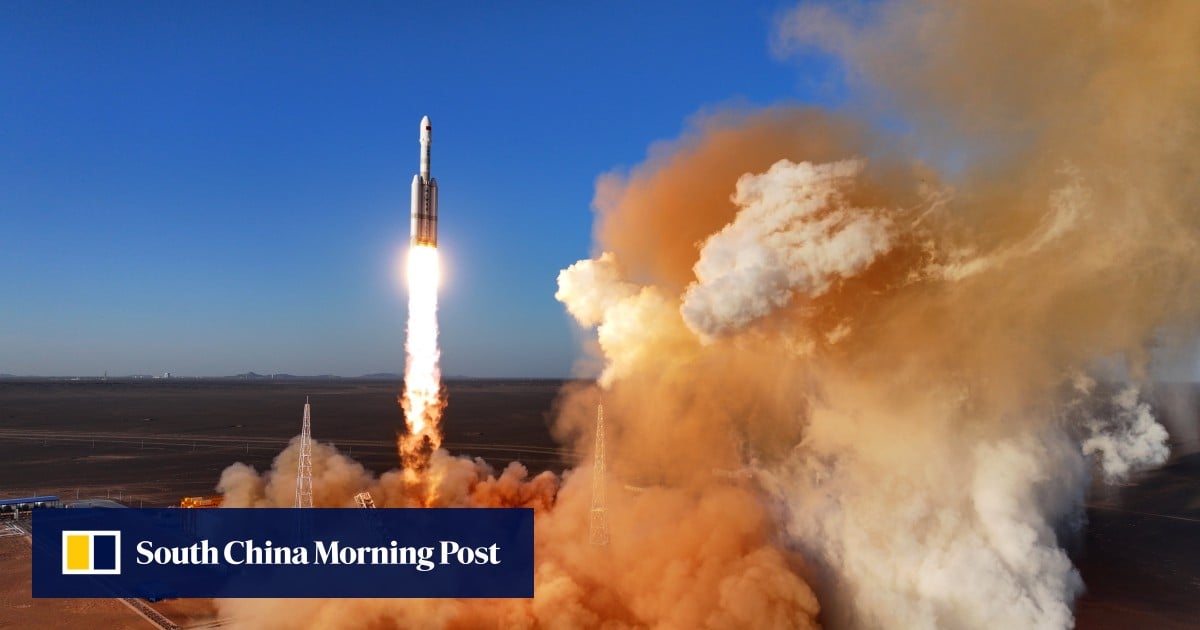
The Kinetica-2 Y1 carrier rocket, also known as the Lijian-2 Y1, took off on its inaugural flight on Monday before delivering three satellites into orbit, including a prototype commercial cargo spacecraft and a satellite to function as a mini-orbiting space lab. It cost 30,000 yuan (US$4,350) per kilogram of payload capacity to launch the Kinetica-2, according to Yang Haoliang, the firm's vice-president and chief commander of the rocket. Yang said on Monday that the craft's current non-reusable launch cost was about the same as Elon Musk's SpaceX Falcon 9 reusable rocket at US$5,000 per kg, according to Star Market Daily, a financial news subsidiary of the state-owned Shanghai Media Group.
Passengers Stranded as 76 Flights Canceled and 1,170 Delayed at Frankfurt, London Heathrow, Munich, Brussels, Amsterdam Schiphol International Airports, Causing Widespread Air Travel Chaos Across Europe
Published on March 30, 2026 Air travelers across Europe faced widespread disruptions today, with a massive 76 flight cancellations and over 1,170 delays reported at several of the continent's busiest international airports. These disruptions have caused significant delays in air travel, affecting passengers' schedules and the global flow of travelers. Among the worst-hit airports are Frankfurt International Airport, London Heathrow Airport, Munich International Airport, Brussels Airport, and Amsterdam Schiphol Airport. This travel nightmare unfolded today, leaving passengers stranded across multiple European hubs. Key European Airports Hit by Massive Disruptions Here is a table that describes the flight cancellations and delay data at each impacted airport: Multiple European international airports are grappling with the impact of today's disruptions. The airports facing the brunt of the delays and cancellations are some of the most crucial aviation hubs in Europe. Here's the breakdown of the total delays and cancellations at the affected airports: * Frankfurt International Airport (FRA) saw a staggering 340 delays and 31 cancellations. * London Heathrow International Airport (LHR) experienced 131 delays and 8 cancellations. * Munich International Airport (MUC) reported 81 delays and 6 cancellations. * Brussels Airport (BRU) faced 67 delays and 4 cancellations. * Amsterdam Schiphol International Airport (AMS) had 185 delays and 9 cancellations. * Zurich International Airport (ZRH) was hit with 95 delays and 7 cancellations. * Hamburg Airport (HAM) had 38 delays and 3 cancellations. * Keflavik International Airport (KEF) suffered 21 delays and 4 cancellations. * Charles de Gaulle/Roissy International Airport (CDG) saw 212 delays and 4 cancellations. This brings the total delays across these 9 airports to a combined 1,170, with 76 cancellations reported, affecting passengers traveling within, into, and out of Europe. This disruption marks a significant event for European air travel, particularly during the busy travel seasons. The Ripple Effect on Passengers and Travel Plans The ripple effect of such disruptions is vast, with travelers facing the brunt of flight cancellations and prolonged waiting times. Airlines are struggling to manage the aftermath, and many passengers have had to make last-minute adjustments to their travel plans. As the delays continue to mount, some passengers are forced to endure long hours at airports, with limited options for rebooking flights or accommodations. Many international flights have been particularly affected, with significant delays witnessed for travelers connecting between airports across Europe. For instance, a flight from Munich to Cologne/Bonn (CGN) that departed at 8:45 AM did not arrive at 9:57 AM, a delay of over an hour, showcasing the ongoing struggles faced by passengers. Airlines and Airports Respond to the Disruption As the day unfolds, airlines and airport authorities are working tirelessly to manage the disruptions and minimize inconvenience for affected passengers. Frankfurt Airport has been one of the hardest-hit locations, with delays cascading across its multiple terminals, severely affecting travelers heading to destinations worldwide. Airport authorities at London Heathrow have expressed regret for the delays and are working on logistical solutions to ensure smoother operations in the coming hours. Airlines are offering compensation and assistance to passengers, including meal vouchers, rebooking options, and in some cases, accommodation. Airline staff are stationed throughout the airports to guide stranded travelers and provide updates on flight statuses. How This Affects European Travel and Tourism The disruptions at these international airports have far-reaching implications for European tourism. With peak travel seasons approaching, such massive delays and cancellations are likely to deter travelers, affecting both leisure and business tourism across the continent. Tourists planning to visit popular European cities like London, Paris, Berlin, and Zurich could face delays or disruption in their itineraries. Additionally, the strain on flight schedules may influence how travelers choose to plan their trips, with many likely opting for alternate forms of transportation such as high-speed trains or regional flights. For the tourism industry, particularly during the spring and summer travel seasons, such disruptions could translate into a decline in bookings and potential revenue loss. Airlines and travel agencies will have to swiftly adjust to meet the growing demands of travelers who are now seeking more reliable options. What Affected Passengers Can Do Now For those stranded at the affected airports, there are a few steps they can take to manage the situation better. First, stay informed about flight statuses by checking online updates or the airline's mobile app. If your flight has been delayed or canceled, reach out to the airline's customer service for rebooking options. It's also wise to check for any compensation or travel vouchers offered by the airline for your inconvenience. For long delays, passengers should consider requesting meal vouchers or, if staying overnight, information about nearby hotels offering accommodation for the night. Additionally, keep your boarding pass and flight confirmation handy when discussing rebooking options with airline staff. Frankfurt International Airport(FRA): The Epicenter of the Chaos Frankfurt International Airport, one of Europe's busiest airports, was hit the hardest with a massive 340 delays and 31 cancellations today. As a key global hub, the delays at Frankfurt caused a ripple effect on global travel, disrupting connecting flights and causing passengers to miss important international connections. Germany's busiest airport is known for its high volume of both domestic and international travelers, and the ongoing disruptions have strained airport resources, affecting travelers across the world. London Heathrow International Airport (LHR): A Nightmare for Passengers Heading to the UK With 131 delays and 8 cancellations, London Heathrow International Airport also saw significant disruption. As one of the busiest airports in the world, Heathrow is a critical hub for both UK-bound and international flights. These delays have caused major headaches for travelers heading to the United Kingdom and beyond, as the UK's busiest airport faced long queues, crowded terminals, and frustrated passengers. The delays have put considerable strain on London's tourism industry, especially for travelers attending key events or business meetings in the city. Munich International Airport (MUC): Delay Woes for German Travelers Munich International Airport was not spared either, with 81 delays and 6 cancellations impacting both domestic and international travelers. Munich, known for its strong business connections and cultural tourism, saw its passengers' schedules thrown off track, leading to frustration and confusion. The disruptions affected travelers not just in Germany but also those connecting to international destinations. As Germany's second-largest airport, the delays had a significant impact on European travelers, causing them to miss crucial connecting flights. Brussels Airport (BRU): Disrupting European Connections Brussels Airport faced 67 delays and 4 cancellations today, impacting travelers heading to and from the Belgium capital. Brussels is an essential hub for European flights and intercontinental connections, and these disruptions created a knock-on effect throughout the European continent. The delays not only strained travelers on business trips but also jeopardized plans for tourists hoping to experience Belgium's culture. With Belgium's proximity to the heart of Europe, this chaos affected both short-haul and long-haul flights, leading to widespread concerns for travelers in the region. Amsterdam Schiphol International Airport (AMS): The Ripple Effect on the Netherlands With 185 delays and 9 cancellations, Amsterdam Schiphol International Airport saw significant disruption. As a vital hub for the Netherlands and an entry point for many travelers heading into Europe, the delays at Schiphol had serious consequences for both tourists and business travelers alike. Amsterdam, known for its thriving tourism sector, was faced with frustrated passengers who missed connections to cities across Europe and beyond. The disruption sent waves through the global tourism industry, as travelers were forced to adjust their travel plans on short notice. Zurich International Airport (ZRH): Swamped with Flight Delays Zurich International Airport experienced 95 delays and 7 cancellations, contributing to the growing travel nightmare. As a major Swiss hub, Zurich is crucial for travelers heading into Switzerland and the rest of Europe. The delays today created significant challenges for passengers who were looking to connect to Swiss destinations or other European cities. Zurich's global connectivity was deeply affected, leaving tourists and business travelers struggling to make alternate arrangements in the midst of the chaos. Hamburg Airport (HAM): Minor Disruption But Significant Impact Hamburg Airport, though not as large as other European airports, still faced 38 delays and 3 cancellations today. While the numbers were smaller, the disruptions were still felt by travelers aiming to connect through the German port city. Hamburg, a key city for both tourism and commerce, saw its travel plans affected, with passengers missing out on sightseeing opportunities or business appointments. The disruptions at Hamburg Airport showed how even mid-sized airports are impacted by broader air travel chaos. Keflavik International Airport (KEF): Iceland's Air Travel Woes The Keflavik International Airport, Iceland's main international gateway, was not immune to the widespread disruptions, with 21 delays and 4 cancellations reported. Iceland's isolated location in the North Atlantic means that Keflavik is a vital link for passengers traveling to and from Europe and North America. The delays left many passengers stranded, struggling to rebook their flights to Iceland or their connecting flights to other international destinations. Charles de Gaulle/Roissy International Airport (CDG): Struggling with Flight Congestion Charles de Gaulle/Roissy International Airport in Paris, one of Europe's busiest hubs, faced 212 delays and 4 cancellations. As the primary airport for France, the disruptions at CDG created serious delays for both tourists and business travelers hoping to reach the French capital. With Paris being one of the world's top tourist destinations, this chaos could have far-reaching effects on the city's tourism industry, especially for travelers who planned to experience France's culture, food, and landmarks. Analysis of Airline Passenger Satisfaction Amidst the Widespread Disruptions in Europe Airline passenger satisfaction is deeply affected by a variety of factors, including delays, cancellations, service quality, and overall travel experience. Today's massive disruptions, involving 76 flight cancellations and 1,170 delays at some of the busiest international airports across Europe, highlight the critical impact such events have on customer satisfaction. Airports like Frankfurt, London Heathrow, Munich, Amsterdam Schiphol, and Charles de Gaulle are crucial for global connectivity, and disruptions here have far-reaching effects on both travelers' emotional experiences and airline reputations. The Link Between Delays, Cancellations, and Passenger Satisfaction Disruptions like these create a cascade of problems for passengers, directly impacting their satisfaction levels. Passengers tend to experience high levels of frustration and inconvenience when flights are delayed or canceled, and it is well-documented that flight delays can lead to a decrease in customer loyalty and trust in airlines. Here's how the disruptions at the European airports mentioned above can affect airline passenger satisfaction: * Flight Cancellations: When flights are canceled, passengers face the inconvenience of rebooking flights, and in many cases, additional costs such as overnight stays, meals, or alternative transport. Cancellations lead to disruption of plans, causing travelers to feel helpless and unappreciated, leading to a significant drop in satisfaction. * Flight Delays: Even when flights are not canceled, delays can be equally frustrating. Long waiting times at the airport, limited communication from airlines, and lack of customer care during delays lead to dissatisfaction. Passengers often feel that their time is being disrespected, and that airlines do not provide the necessary support to mitigate the inconvenience. How Each Airport's Disruption Affects Passenger Satisfaction Let's examine how the disruptions at each major airport today affect passenger satisfaction: The Broader Implications for Airline Passenger Satisfaction The airline passenger satisfaction levels will likely plummet today across Europe due to these disruptions. Airlines are responsible for managing passenger expectations, especially during difficult times. Passengers facing long delays and cancellations expect clear communication, timely rebooking, and compensation. Unfortunately, failure to meet these expectations often results in decreased satisfaction. To ensure customer loyalty and maintain brand reputation, airlines must: * Invest in better communication channels to inform passengers about delays, cancellations, and alternative travel options. * Provide adequate compensation such as meal vouchers, overnight accommodations, and rebooking assistance. * Enhance staff training to improve customer service during disruptions. Today's massive flight delays and cancellations have undoubtedly impacted passenger satisfaction across European airports. As the air travel industry continues to recover from disruptions, airlines must prioritize customer service and efficiency to rebuild passenger trust and improve satisfaction levels. With passengers feeling the weight of these disruptions, airlines that respond quickly and effectively to passengers' needs will foster long-term loyalty and retain their customers' trust.The widespread disruptions at major European airports have global implications. With delays and cancellations affecting international flights, travelers across Europe, North America, and Asia are all feeling the ripple effect. The global tourism industry has already been shaken by these events, with tourists and business travelers alike struggling to get to their destinations. The affected airports play critical roles in maintaining the flow of international travel, and any disruption in their operations is bound to create massive ripple effects across the travel ecosystem.

Anthropic Confirms Rapid Depletion of Claude Code Quotas
Users of Claude Code, the AI-powered coding assistant from Anthropic, are facing significant challenges due to rapid token usage and unexpected depletion of quotas. This situation has disrupted daily workflows for many developers who rely on the service. Anthropic Acknowledges Quota Issues Anthropic has officially recognized the challenges users are facing. The company stated, "people are hitting usage limits in Claude Code way faster than expected. We're actively investigating... it's the top priority for the team." User Experiences on Social Platforms On platforms such as Discord and Reddit, numerous users have expressed frustration. One user, subscribed to the Claude Pro plan at $200 annually, noted, "it's maxed out every Monday and resets at Saturday." They reported limited access, stating they could only use Claude for 12 out of 30 days. Similarly, another developer shared their experience, revealing they used up their Max 5 plan, costing $100 per month, in just one hour of work. Potential Reasons for Increased Token Usage * Quota Reductions: Last week, Anthropic announced a reduction in quotas during peak hours, impacting approximately 7% of users. * Promotional Changes: The end of a promotion on March 28, which doubled usage limits outside peak hours, may also have contributed. * Software Bugs: Reports suggest bugs within Claude Code could be causing inflated token costs. A user mentioned finding two independent bugs leading to cost increases between 10-20 times. Strategies to Mitigate Usage Some users have found that downgrading to an earlier version of Claude Code significantly reduced their token usage. One user confirmed, "Downgrading to 2.1.34 made a very noticeable difference." Additionally, the documentation states that prompt caching is intended to lower processing times and costs for repetitive tasks. Caching Limitations However, the caching system currently has limitations. The cache lasts only five minutes, meaning brief pauses can result in increased costs upon resumption. Developers can extend the cache lifetime to one hour, but this incurs a higher token cost. Specifically, one-hour cache write tokens are twice the price of base input tokens. Lack of Clarity in Usage Limits Anthropic does not provide clear usage limits for its plans, which complicates the situation for developers. For instance, the Pro plan offers "at least five times the usage per session" compared to the free service, while the Standard Team plan claims "1.25x more usage per session than the Pro plan." Consequently, users must frequently check their dashboards to monitor their consumed quotas. The Broader Context of AI Tool Pricing These issues highlight an ongoing negotiation between users and providers regarding acceptable pricing and usage models for AI development. As users aim to manage costs, providers strive to maintain profitability. The disconnect between encouraging developers to integrate AI into various workflows and having a quota system that limits functionality is striking. A user pointed out that "rate-limit errors need to be caught explicitly," noting that unnoticed errors can quickly drain daily budgets. As these challenges continue, both users and developers hope for improvements that balance functionality and cost, ensuring that tools like Claude Code remain viable for everyday use.