News & Updates
The latest news and updates from companies in the WLTH portfolio.
Anthropic Launches Claude Design for Fast Visuals and Prototypes
Available exclusively to Claude Pro subscribers as Anthropic expands beyond conversational AI Racing to prepare investor slides with zero design skills? Anthropic's new Claude Design eliminates that familiar startup panic. This experimental feature transforms natural language descriptions into polished visuals, targeting founders and product managers who think "design" means choosing between Arial and Times New Roman. Natural conversation replaces complex design software for rapid prototyping. Claude Design operates like having a designer on speed dial. You describe your vision -- "prototype a serene mobile meditation app with calming typography" -- and the AI generates mockups instantly. Need tweaks? Ask for darker blues or additional features through simple follow-up prompts. The iterative process mirrors how you'd brief a human designer, minus the awkward creative direction meetings. This approach democratizes visual creation for the Figma-phobic. Product managers can prototype features during brainstorms rather than sketching stick figures on whiteboards. Founders can create pitch decks that don't scream "I made this in PowerPoint at 2 AM." The learning curve remains minimal -- if you can describe what you want, you can create it. Exports work seamlessly with existing design workflows and team systems. Rather than disrupting established workflows, Claude Design plugs into them intelligently. Outputs export as: Perfect for handoffs to actual designers. The system reads your team's codebase and design files, applying consistent brand guidelines across multiple projects like a digital style guide enforcer. This integration strategy feels refreshingly practical. You're not abandoning Canva or forcing designers to learn new tools. Instead, you're accelerating the messy early stages where ideas need visual form but professional polish can wait. Think of it as the Grammarly for visual communication -- making your rough concepts presentable enough for the next conversation. Research preview signals broader workplace AI expansion beyond chatbots. Available exclusively to Claude Pro, Max, Team, and Enterprise subscribers, the feature represents Anthropic's push beyond conversational AI into workplace productivity. This follows Claude Cowork's launch and aligns with the company's enterprise-focused trajectory. The timing makes strategic sense. As AI assistants mature from novelty to necessity, visual creation becomes the next logical frontier. For resource-strapped startups and design-light teams, Claude Design could prove as essential as email or Slack -- bridging the gap between brilliant ideas and their visual expression.
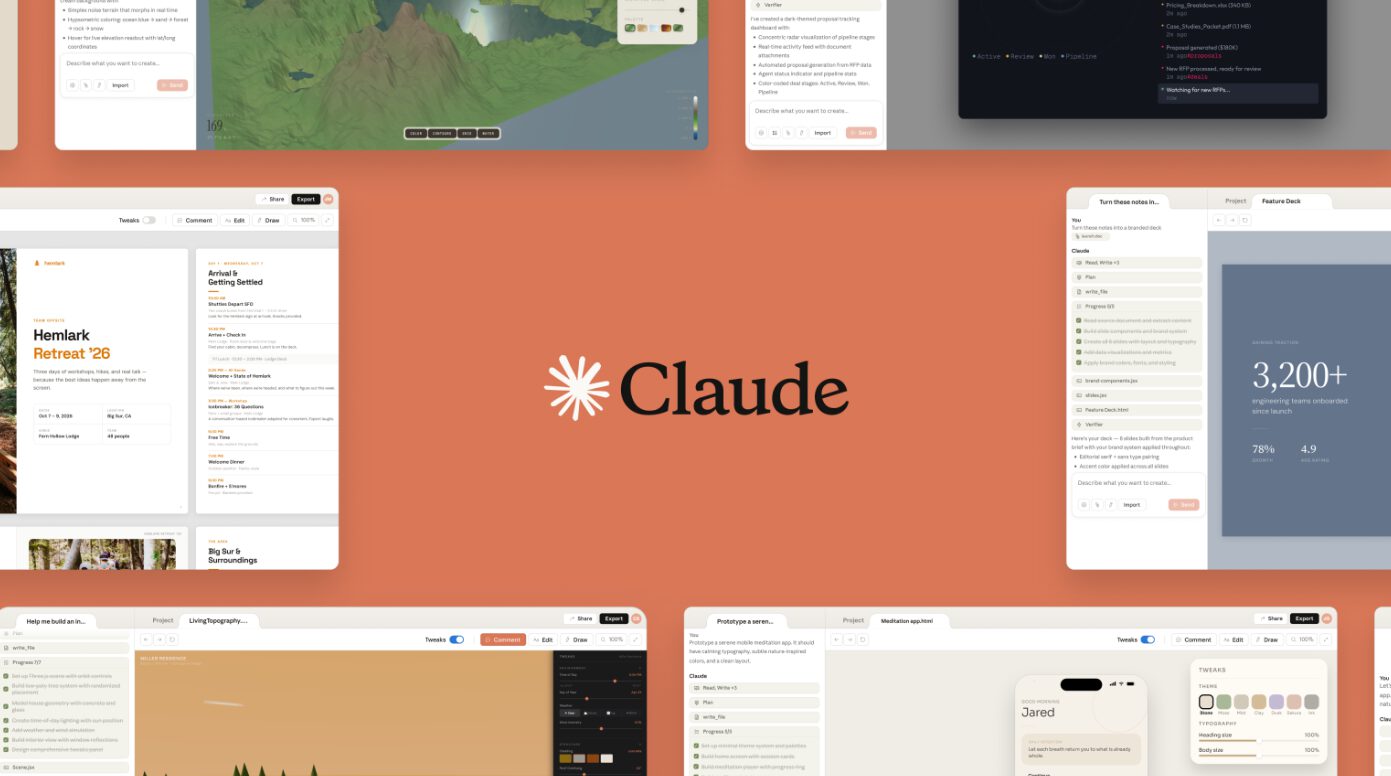
Anthropic launches Claude Design powered by new Opus 4.7 model
The research preview lets users create prototypes, slides, one pagers, and other visual assets, powered by Anthropic's recently launched Claude Opus 4.7 model. Anthropic on Friday launched Claude Design, a new Anthropic Labs product that allows users to work with Claude to create polished visual materials such as designs, prototypes, slides, and one-pagers. The company said the product is available in research preview for Claude Pro, Max, Team, and Enterprise subscribers, with access rolling out gradually through the day. The release comes one day after Anthropic introduced Claude Opus 4.7. Anthropic says Opus 4.7 is its most capable generally available model, built for complex reasoning and agentic coding, and the first Claude model to support high resolution images. The company also says the model supports a 1 million token context window, 128,000 max output tokens, and adaptive thinking. That backdrop matters for Claude Design because the new product is positioned as a visual creation layer on top of Opus 4.7's upgraded image and reasoning abilities. Anthropic said the tool can help designers explore more directions quickly while also giving non designers a way to turn ideas into usable visual work through prompts, inline comments, direct edits, and Claude generated sliders. Anthropic said teams are already using Claude Design for realistic prototypes, product wireframes, mockups, pitch decks, marketing collateral, and code powered prototypes involving voice, video, shaders, 3D, and built-in AI. The company also said Claude can ingest prompts, images, documents, and codebases, apply an organization's design system, and export finished work to Canva, PDF, PPTX, or standalone HTML files.

SpaceX plans California rocket launch this weekend. How to watch
For the fourth time in April, SpaceX will launch its Falcon 9 rocket from the Vandenberg Space Force Base in California. Getting off the ground from Santa Barbara County, the rocket will thunder into the sky to deliver another batch of the company's Starlink broadband commercial satellites into Earth orbit. And just like most rocket launches from the site, the mission is sure to draw crowds near and far who want to see the rocket climb into the sky. But for those who prefer to watch remotely, SpaceX will have you covered with a livestream of the mission. Here's everything to know about the latest SpaceX mission, and how to watch a webcast of the Falcon 9 launching in Santa Barbara County. Is there a rocket launch today? Next liftoff from California SpaceX is working toward a Saturday, April 18, launch from Southern California, with a four-hour launch window opening at 7 a.m. PT. The launch will take place from the Vandenberg Space Force Base in Santa Barbara County. A Federal Aviation Administration operations plan advisory suggests a backup opportunity is available the next day if the launch were to be postponed. What is launching from Vandenberg? Falcon 9 to deploy Starlink satellites SpaceX will launch its famous two-stage 230-foot Falcon 9 rocket, one of the world's most active, to deliver 25 Starlink satellites into low-Earth orbit, an altitude nearer Earth's atmosphere where they're able to circle the planet quickly. How to watch SpaceX launch livestream Californians, of course, have plenty of opportunities to see a rocket in person both near the launch site as it lifts off, and further away as it soars overhead. But SpaceX also provides a live webcast of its missions for those who prefer to watch from home or for those viewing the launch locally and looking for updates in real-time. As with most SpaceX missions, the launch will be available to stream on the company's website and its new X TV mobile app, beginning about five minutes before liftoff. SpaceX may also provide updates on social media site X. Does Elon Musk own SpaceX? What to know about rocket company SpaceX is the commercial spaceflight company that billionaire Elon Musk, the world's richest man, founded in 2002 and leads as the CEO. SpaceX is headquartered at Starbase in South Texas near the U.S.-Mexico border. The site, which is where SpaceX has been conducting routine flight tests of its 400-foot megarocket known as Starship, was recently voted by residents to become its own city. As a major government contractor, SpaceX serves as the launch service provider for a variety of government missions both civil and military. For the Department of Defense, SpaceX's Falcon 9 helps launch classified satellites and other payloads into space. And for NASA, Falcon 9 most often helps propel astronauts to the International Space Station on SpaceX's Dragon crew capsule - the only U.S vehicle capable of carrying NASA astronauts to orbit. What is Starlink? Starlink is SpaceX's internet satellite business. With more than 10,000 satellites in its growing orbital constellation, Starlink has become a lucrative part of Musk's business empire, serving millions of customers around the world. Eric Lagatta is the Space Connect reporter for the USA TODAY Network. Reach him at [email protected]

SpaceX plans California rocket launch this weekend. How to watch
For the fourth time in April, SpaceX will launch its Falcon 9 rocket from the Vandenberg Space Force Base in California. Getting off the ground from Santa Barbara County, the rocket will thunder into the sky to deliver another batch of the company's Starlink broadband commercial satellites into Earth orbit. And just like most rocket launches from the site, the mission is sure to draw crowds near and far who want to see the rocket climb into the sky. But for those who prefer to watch remotely, SpaceX will have you covered with a livestream of the mission. Here's everything to know about the latest SpaceX mission, and how to watch a webcast of the Falcon 9 launching in Santa Barbara County. Is there a rocket launch today? Next liftoff from California SpaceX is working toward a Saturday, April 18, launch from Southern California, with a four-hour launch window opening at 7 a.m. PT. The launch will take place from the Vandenberg Space Force Base in Santa Barbara County. A Federal Aviation Administration operations plan advisory suggests a backup opportunity is available the next day if the launch were to be postponed. What is launching from Vandenberg? Falcon 9 to deploy Starlink satellites SpaceX will launch its famous two-stage 230-foot Falcon 9 rocket, one of the world's most active, to deliver 25 Starlink satellites into low-Earth orbit, an altitude nearer Earth's atmosphere where they're able to circle the planet quickly. How to watch SpaceX launch livestream Californians, of course, have plenty of opportunities to see a rocket in person both near the launch site as it lifts off, and further away as it soars overhead. But SpaceX also provides a live webcast of its missions for those who prefer to watch from home or for those viewing the launch locally and looking for updates in real-time. As with most SpaceX missions, the launch will be available to stream on the company's website and its new X TV mobile app, beginning about five minutes before liftoff. SpaceX may also provide updates on social media site X. Does Elon Musk own SpaceX? What to know about rocket company SpaceX is the commercial spaceflight company that billionaire Elon Musk, the world's richest man, founded in 2002 and leads as the CEO. SpaceX is headquartered at Starbase in South Texas near the U.S.-Mexico border. The site, which is where SpaceX has been conducting routine flight tests of its 400-foot megarocket known as Starship, was recently voted by residents to become its own city. As a major government contractor, SpaceX serves as the launch service provider for a variety of government missions both civil and military. For the Department of Defense, SpaceX's Falcon 9 helps launch classified satellites and other payloads into space. And for NASA, Falcon 9 most often helps propel astronauts to the International Space Station on SpaceX's Dragon crew capsule - the only U.S vehicle capable of carrying NASA astronauts to orbit. What is Starlink? Starlink is SpaceX's internet satellite business. With more than 10,000 satellites in its growing orbital constellation, Starlink has become a lucrative part of Musk's business empire, serving millions of customers around the world. Eric Lagatta is the Space Connect reporter for the USA TODAY Network. Reach him at [email protected]
SpaceX plans California rocket launch this weekend. How to watch
For the fourth time in April, SpaceX will launch its Falcon 9 rocket from the Vandenberg Space Force Base in California. Getting off the ground from Santa Barbara County, the rocket will thunder into the sky to deliver another batch of the company's Starlink broadband commercial satellites into Earth orbit. And just like most rocket launches from the site, the mission is sure to draw crowds near and far who want to see the rocket climb into the sky. But for those who prefer to watch remotely, SpaceX will have you covered with a livestream of the mission. Here's everything to know about the latest SpaceX mission, and how to watch a webcast of the Falcon 9 launching in Santa Barbara County. Is there a rocket launch today? Next liftoff from California SpaceX is working toward a Saturday, April 18, launch from Southern California, with a four-hour launch window opening at 7 a.m. PT. The launch will take place from the Vandenberg Space Force Base in Santa Barbara County. A Federal Aviation Administration operations plan advisory suggests a backup opportunity is available the next day if the launch were to be postponed. What is launching from Vandenberg? Falcon 9 to deploy Starlink satellites SpaceX will launch its famous two-stage 230-foot Falcon 9 rocket, one of the world's most active, to deliver 25 Starlink satellites into low-Earth orbit, an altitude nearer Earth's atmosphere where they're able to circle the planet quickly. How to watch SpaceX launch livestream Californians, of course, have plenty of opportunities to see a rocket in person both near the launch site as it lifts off, and further away as it soars overhead. But SpaceX also provides a live webcast of its missions for those who prefer to watch from home or for those viewing the launch locally and looking for updates in real-time. As with most SpaceX missions, the launch will be available to stream on the company's website and its new X TV mobile app, beginning about five minutes before liftoff. SpaceX may also provide updates on social media site X. Does Elon Musk own SpaceX? What to know about rocket company SpaceX is the commercial spaceflight company that billionaire Elon Musk, the world's richest man, founded in 2002 and leads as the CEO. SpaceX is headquartered at Starbase in South Texas near the U.S.-Mexico border. The site, which is where SpaceX has been conducting routine flight tests of its 400-foot megarocket known as Starship, was recently voted by residents to become its own city. As a major government contractor, SpaceX serves as the launch service provider for a variety of government missions both civil and military. For the Department of Defense, SpaceX's Falcon 9 helps launch classified satellites and other payloads into space. And for NASA, Falcon 9 most often helps propel astronauts to the International Space Station on SpaceX's Dragon crew capsule - the only U.S vehicle capable of carrying NASA astronauts to orbit. What is Starlink? Starlink is SpaceX's internet satellite business. With more than 10,000 satellites in its growing orbital constellation, Starlink has become a lucrative part of Musk's business empire, serving millions of customers around the world. Eric Lagatta is the Space Connect reporter for the USA TODAY Network. Reach him at [email protected]
SpaceX plans California rocket launch this weekend. How to watch
For the fourth time in April, SpaceX will launch its Falcon 9 rocket from the Vandenberg Space Force Base in California. Getting off the ground from Santa Barbara County, the rocket will thunder into the sky to deliver another batch of the company's Starlink broadband commercial satellites into Earth orbit. And just like most rocket launches from the site, the mission is sure to draw crowds near and far who want to see the rocket climb into the sky. But for those who prefer to watch remotely, SpaceX will have you covered with a livestream of the mission. Here's everything to know about the latest SpaceX mission, and how to watch a webcast of the Falcon 9 launching in Santa Barbara County. Is there a rocket launch today? Next liftoff from California SpaceX is working toward a Saturday, April 18, launch from Southern California, with a four-hour launch window opening at 7 a.m. PT. The launch will take place from the Vandenberg Space Force Base in Santa Barbara County. A Federal Aviation Administration operations plan advisory suggests a backup opportunity is available the next day if the launch were to be postponed. What is launching from Vandenberg? Falcon 9 to deploy Starlink satellites SpaceX will launch its famous two-stage 230-foot Falcon 9 rocket, one of the world's most active, to deliver 25 Starlink satellites into low-Earth orbit, an altitude nearer Earth's atmosphere where they're able to circle the planet quickly. How to watch SpaceX launch livestream Californians, of course, have plenty of opportunities to see a rocket in person both near the launch site as it lifts off, and further away as it soars overhead. But SpaceX also provides a live webcast of its missions for those who prefer to watch from home or for those viewing the launch locally and looking for updates in real-time. As with most SpaceX missions, the launch will be available to stream on the company's website and its new X TV mobile app, beginning about five minutes before liftoff. SpaceX may also provide updates on social media site X. Does Elon Musk own SpaceX? What to know about rocket company SpaceX is the commercial spaceflight company that billionaire Elon Musk, the world's richest man, founded in 2002 and leads as the CEO. SpaceX is headquartered at Starbase in South Texas near the U.S.-Mexico border. The site, which is where SpaceX has been conducting routine flight tests of its 400-foot megarocket known as Starship, was recently voted by residents to become its own city. As a major government contractor, SpaceX serves as the launch service provider for a variety of government missions both civil and military. For the Department of Defense, SpaceX's Falcon 9 helps launch classified satellites and other payloads into space. And for NASA, Falcon 9 most often helps propel astronauts to the International Space Station on SpaceX's Dragon crew capsule - the only U.S vehicle capable of carrying NASA astronauts to orbit. What is Starlink? Starlink is SpaceX's internet satellite business. With more than 10,000 satellites in its growing orbital constellation, Starlink has become a lucrative part of Musk's business empire, serving millions of customers around the world. Eric Lagatta is the Space Connect reporter for the USA TODAY Network. Reach him at [email protected]
Canva Announces Anthropic Collaboration to Bring AI-Powered Design to Millions
Today's announcement marks the latest step in Canva's rapid expansion across the AI ecosystem, where the company is fast becoming the default destination for design. As AI accelerates the pace of content creation, millions of people are looking for ways to move beyond ideas and static outputs, turning generated content into real, usable designs. Since launching in March 2026, Canva's Magic Layers product, which breaks static images into fully editable components, has been used more than nine million times, highlighting strong demand to turn AI-generated content into adaptable, scalable work.
Cybertruck Sales "Propped Up" By SpaceX Buying Spree
Bloomberg is out with a new report saying Tesla's Cybertruck sales were "propped up" in the fourth quarter by purchases from companies inside Elon Musk's business empire. SpaceX accounted for 1,279 Cybertruck registrations, or about 18% of all U.S. Cybertruck registrations during the last quarter of 2025. The report went on to say that xAI, Boring Co., and Neuralink also purchased the stainless-steel EV during the period. "That means almost one in every five Cybertrucks registered during the period were delivered from one part of Musk's sprawling business empire to another," Bloomberg's Dana Hull noted. Hull added, "Without those sales to other Musk-run companies -- which included xAI, Boring Co. and Neuralink, in addition to SpaceX -- Cybertruck registrations in the fourth quarter would have fallen 51%." Hull quoted Sam Fiorani, vice president of global vehicle forecasting for advisory firm AutoForecast Solutions, who said, "Tesla is running out of buyers for the Cybertruck." Hull said the registration data was sourced from S&P Global Mobility and, in her words, suggests only that "demand for the pickup is fading just two years after launch." Cybertruck's struggles are not unique to Tesla. In fact, electric pickups have been a major bust across the U.S. EV market. Ford recently converted its electric F-150 Lightning production lines to extended-range hybrid vehicles. And we're sure in President Trump's war economy, autos will be converting EV lines or other production lines into making weapons (read report). Despite the continued downturn in EVs, Cox Automotive data show the Cybertruck was still the top-selling EV truck in the U.S. in the first quarter. High sticker price and elevated interest rates are likely major factors behind the Cybertruck's dismal sales. Bankrate data show the national average 60-month loan rate for new vehicles is still above 7%, down from 8% during the Biden years but still sharply higher than the sub-4% levels seen in 2021. Federal subsidies for EVs have also been cut under the Trump administration's second term.

Canva Announces Anthropic Collaboration to Bring AI-Powered Design to Millions
New collaboration brings Canva into Claude Design by Anthropic, turning AI-generated ideas into fully editable, on-brand designs SYDNEY -- Canva, the world's leading all-in-one visual communication platform, today announced the next chapter in its two-year strategic collaboration with Anthropic, bringing Canva directly into the newly launched Claude Design by Anthropic Labs, one day after unveiling... New collaboration brings Canva into Claude Design by Anthropic, turning AI-generated ideas into fully editable, on-brand designs SYDNEY -- Canva, the world's leading all-in-one visual communication platform, today announced the next chapter in its two-year strategic collaboration with Anthropic, bringing Canva directly into the newly launched Claude Design by Anthropic Labs, one day after unveiling Canva AI 2.0 to a crowd of 6,500 people at Canva Create in Los Angeles.. Canva is also today introducing HTML importing, a new capability that makes it easy to bring interactive content generated in tools like Claude into the Canva editor for drag-and-drop collaboration, refinement, and publishing. The collaboration makes it easier for Claude Design users to turn AI-generated drafts and ideas into fully editable designs in Canva, where they become collaborative, on-brand, and ready to scale and publish. It helps address one of the biggest gaps in today's AI landscape: turning AI-generated content into real, usable work. From AI-Generated Drafts to Fully Editable Designs Since launching the Canva MCP in Claude last July, millions of people have used Canva through Claude to create, resize, and summarise content using simple text prompts. Today's announcement builds on this momentum, making it even easier to move from drafts and ideas to presentations, documents, social posts, infographics, and more in Canva. Powered by Canva's Foundation Design Model, content exported from Claude Design is instantly turned into structured, fully editable designs in the Canva Editor, built for collaboration, iteration, and scale. Unlike traditional AI outputs that are static and fragmented, each design is ready to refine, share, and build on. Introducing HTML and Artifact Editing in Canva From landing pages to widgets and interactive experiences, AI tools are making it easier than ever to generate complex content using HTML. But these outputs are often locked in code, making them difficult to edit, refine, or adapt without starting over. To solve this, Canva is also launching HTML importing and editing, expanding its platform to support code and AI-generated artifacts within its simple drag-and-drop editor. This makes Canva the first platform to unify visual, document, and interactive content creation in a single collaborative editor. Now, Claude Artifacts can be brought directly into Canva and edited like any other design. Swap colours, layouts, and elements without regenerating code with each change. Then collect data with Canva Forms into Sheets, or publish your creation as an interactive website with a custom domain, all without leaving Canva. Expanding Canva's Role in the AI Ecosystem Today's announcement marks the latest step in Canva's rapid expansion across the AI ecosystem, where the company is fast becoming the default destination for design. As AI accelerates the pace of content creation, millions of people are looking for ways to move beyond ideas and static outputs, turning generated content into real, usable designs. Since launching in March 2026, Canva's Magic Layers product, which breaks static images into fully editable components, has been used more than nine million times, highlighting strong demand to turn AI-generated content into adaptable, scalable work. This growing demand has helped make Canva the third most-used AI platform in the world, and the fastest growing in customer spend on AI products among leading software companies, according to new research from venture capital firm Andreessen Horowitz. Canva now powers design for more than a quarter of a billion people every month, bringing more than 420 designs to life every second. The company's AI products and foundation models have been used more than 27 billion times to date. A New Era for Creativity Today's announcement builds on a momentous week for Canva. Yesterday, the company unveiled Canva AI 2.0, the most significant evolution of its platform since launching more than a decade ago. Announced at Canva Create in Los Angeles in front of more than 6,500 attendees and millions tuning in globally, this week marks a new era for Canva as the company expands beyond design generation to become the system at the centre of how work gets done.

Anthropic Labs launches Claude Design, challenging Figma and Adobe
Anthropic Labs launched Claude Design, a new tool powered by Claude Opus 4.7, on April 16. The market for "Claude 4.7 released by May 31" sits at YES, up from 38% a week ago. The confirmed release drove odds to near certainty across several date-specific markets. The April 30 market also reads YES, leaving traders no room for delay. The April 16 market closed at 99.9% YES, consistent with the actual release date. The market for release on April 17 dropped to 0.1% YES, again confirming April 16 as the date. That contract moved from 22% to 52% on April 16 before the announcement corrected the speculative spike. With the release confirmed, volatility in these markets is gone. The June 30 market also sits at YES. Claude Design positions Anthropic as a competitor to Figma and Adobe in design tooling. The market's move to 99.9% reflects full confidence in Anthropic's delivery timeline. For contrarian positions: buying NO at 1¢ pays $1 if any anomaly occurs, though the likelihood is slim unless Anthropic announces a major retraction. Watch for Anthropic communications about Claude 5. Any official mention could shift trader attention and open new market activity.

Federal agencies line up for Anthropic Mythos as White House eases standoff - Cryptopolitan
Anthropic said Mythos found thousands of serious vulnerabilities across major operating systems and web browsers. Anthropic is getting closer to a federal rollout after the U.S. government began preparing to grant access to a version of its Mythos model to major agencies. Bloomberg reported Thursday that the plan is now underway, even as officials inside and outside Washington worry that the tool could raise cybersecurity risks if it is not tightly controlled. Cryptopolitan previously reported that Mythos is limited to select groups and intended for defensive cyber work, not broad commercial use. Gregory Barbaccia, federal chief information officer at the White House Office of Management and Budget, told Cabinet department officials in a Tuesday email that OMB was setting up protections so agencies could begin using Mythos. Reportedly, the subject line of the message was "Mythos Model Access," and it read that: "We're working closely with model providers, other industry partners, and the intelligence community to ensure the appropriate guardrails and safeguards are in place before potentially releasing a modified version of the model to agencies." White House opens the door as Anthropic Mythos heads toward agency use That message landed while finance ministers, central bankers, and regulators were in Washington for the IMF and World Bank spring meetings, where senior financial officials warned that advanced AI from U.S. tech firms could expose weak spots in lenders' cyber defenses and put the wider banking system under pressure. Andrew Bailey, governor of the Bank of England and chair of the Financial Stability Board, said: "It is a very serious challenge for all of us. It reminds us how fast the AI world moves." Andrew then said regulators around the world would need to quickly assess the cyber risk that Anthropic's Claude Mythos Preview could pose to the financial system. Dan Katz, deputy head of the IMF, said: "The evolution of digital technology is posing immense risks from a cybersecurity perspective. This is really going to be absolutely essential on the international agenda for the next few months." Christine Lagarde, president of the European Central Bank, also pointed to Anthropic and Mythos as a case where a useful tool can become dangerous in the wrong hands. "The development we've seen with Anthropic and Mythos is a good example of a responsible company that is suddenly thinking, 'ah, that could be really good,' but if it falls in the wrong hands, it could be really bad." Global officials press for rules while Anthropic limits Opus 4.7 Some officials called for a coordinated international response after Anthropic said earlier this month that Mythos had found "thousands of high-severity vulnerabilities, including some in every major operating system and web browser." Anthropic also warned that capabilities like these may spread quickly and not remain in safe hands. The company said it would "not be long before such capabilities proliferate, potentially beyond actors who are committed to deploying them safely." It added: "The fallout for economies, public safety, and national security could be severe." Christine later told reporters that officials want a framework they can work within, but no real governance system is ready yet. She said: "Everybody is keen to have a framework within which to operate. I don't think there is a governance framework that's actually meant to mind those things. We need to work on that." Pip White, Anthropic's head for the UK, Ireland, and northern Europe, said interest from executives picked up quickly after the news around the model. In an interview, Pip said: "We are putting our own safeguards and our own limitations around this product because we know how powerful it can be." On Thursday, Anthropic also released Opus 4.7, a new model built to do better on software engineering tasks. The company said Opus 4.7 can handle some coding work that used to require closer supervision, follow instructions better than older models, and inspect higher-resolution images to catch details in dense charts and complex pictures. Even so, Anthropic said Opus 4.7 is less capable than Mythos, including in cyber use cases. During training, the company said it tested ways to "differentially reduce" the model's cyber ability.

Anthropic launches Claude design to simplify visual creation with AI
Anthropic has introduced a new AI-powered design tool called Claude Design, aimed at helping users create visual content such as prototypes, presentations, and marketing assets through simple conversational inputs. The product, developed under Anthropic Labs, is currently available in research preview for paid Claude subscribers and is being rolled out gradually. Claude Design is powered by the company's latest vision model, Claude Opus 4.7, and is positioned as a tool that bridges the gap between technical design expertise and everyday creative needs. A New Approach To Design Workflows The core idea behind Claude Design is to simplify the process of creating visual content. Instead of relying on traditional design tools that require manual input and expertise, users can describe what they need, and the AI generates an initial version. From there, designs can be refined through conversation, inline comments, direct edits, or adjustable controls. Recommended Videos The platform supports a wide range of use cases, including creating interactive prototypes, product wireframes, pitch decks, and marketing materials. It also allows teams to quickly explore multiple design directions without the time constraints typically associated with manual workflows. Built-In Design Systems And Collaboration One of the key features of Claude Design is its ability to automatically build and apply a company's design system. During onboarding, the tool can analyse existing design files and codebases to replicate brand elements such as colours, typography, and components. This ensures consistency across projects without requiring designers to manually enforce guidelines. Teams can also maintain multiple design systems and refine them over time. Collaboration is another major focus. Users can share designs within their organisation, grant editing access, and work together in real time. The platform also supports exporting projects to formats like PDF, PPTX, and HTML, or integrating with tools such as Canva for further refinement. Why This Matters For Creators And Teams Design work often involves multiple iterations, feedback loops, and coordination between teams. Claude Design aims to streamline this process by reducing the time required to move from idea to execution. For non-designers, the tool lowers the barrier to entry, making it easier to create professional-looking content. For experienced designers, it offers a way to explore more ideas quickly and focus on refinement rather than repetitive tasks. Early feedback highlighted in the announcement suggests that teams can move from concept to working prototypes in a single session, significantly reducing turnaround time. What It Means For Users For users, Claude Design represents a shift toward more accessible and collaborative creative tools. It allows individuals without formal design training to bring ideas to life, while also supporting advanced workflows for professionals. The integration with other tools and the ability to generate interactive prototypes without coding further expands its potential use cases across industries. What Comes Next Anthropic has indicated that additional integrations and features will be introduced in the coming weeks, making it easier to connect Claude Design with existing workflows and tools. As AI continues to reshape creative industries, tools like Claude Design highlight a growing trend toward conversational interfaces that simplify complex tasks. While still in early preview, the platform offers a glimpse into how design processes may evolve in the near future.

Anthropic CEO to meet White House chief of staff, Axios reports
STORY: Anthropic CEO Dario Amodei is due to meet White House chief of staff Susie Wiles on Friday (April 17). That's according to a report by Axios. It's a sign of a breakthrough in the startup's recent fallout with the Pentagon over AI use on the battlefield. Anthropic sued in a federal court after it was formally labeled a national security supply-chain risk by Defense Secretary Pete Hegseth. The report said Friday's potential meeting comes with authorities focused on Anthropic's new AI model, Mythos. It said the Trump administration has acknowledged the advanced abilities of the model. Especially for its sophisticated cybersecurity defense breaching abilities. The White House and Anthropic didn't immediately respond to requests for comment. Reuters could not independently verify the report. The New York Times' DealBook newsletter has also reported further government focus on Mythos. It said the Treasury and the State Departments have asked Anthropic for briefings on the model. Representatives for the Treasury and the State Departments couldn't immediately be reached for comment. Mythos was announced earlier this month and being deployed as part of Anthropic's "Project Glasswing" The controlled initiative allows select organizations to use the unreleased Claude Mythos Preview model for defensive cybersecurity purposes.

Kraken Parent Payward Eyes $550M Bitnomial Deal to Unlock U.S. Derivatives Market - Blockonomi
Acquisition strengthens Kraken's position in the regulated U.S. derivatives market. Kraken's parent company, Payward, has agreed to acquire Bitnomial in a deal valued at up to $550 million. The transaction combines cash and stock, positioning Payward to expand its regulated derivatives capabilities within the United States market. Details of the acquisition surfaced through a report shared by CoinDesk, later amplified by Wu Blockchain on X. The structure of the deal reflects a calculated expansion strategy rather than a defensive move. Payward is leveraging its valuation to secure critical infrastructure instead of building internally over time. The agreement places Payward's valuation at approximately $20 billion. This valuation provides the company flexibility to pursue acquisitions that support long-term positioning. The use of both cash and stock signals a balance between liquidity management and equity utilization. Bitnomial stands out due to its regulatory approvals. It operates with a Designated Contract Market, a Derivatives Clearing Organization, and a Futures Commission Merchant license. This combination is rare within the crypto sector, particularly among firms built within the industry. Bitnomial is the first crypto-native platform to secure all three licenses. These approvals enable a fully integrated derivatives operation under U.S. regulatory oversight. As a result, Payward gains immediate access to a compliant framework. This approach reduces the need for prolonged regulatory applications. Building such a structure independently often requires years of legal preparation and operational planning. By acquiring Bitnomial, Payward bypasses those delays and gains a ready-to-use system. The acquisition reflects a focused effort to expand within the United States derivatives market. This market remains tightly regulated, with strict entry requirements for both trading and clearing operations. Many crypto firms face challenges when attempting to meet these standards. With Bitnomial's licenses, Payward can operate within an established regulatory perimeter. This positions the company to compete with existing regulated entities. It also opens pathways for offering derivatives products to institutional participants. The CoinDesk report noted that the deal was shared exclusively with the publication. This approach indicates a controlled release of information aimed at a targeted audience. The messaging aligns with efforts to reinforce credibility within both crypto-native and institutional circles. Institutional demand for regulated crypto products continues to shape market strategies. Firms with compliant infrastructure are better placed to attract this segment. Payward's move reflects a broader shift toward structured and regulated offerings. Furthermore, the acquisition supports deeper liquidity development in compliant markets. Access to brokerage, clearing, and exchange functions within one framework creates operational efficiency. It also reduces reliance on third-party providers for critical services. The coverage framed the deal as a strategic step toward regulatory positioning. The emphasis remained on access, speed, and operational readiness. These factors contribute to Payward's ability to expand without extended delays. Overall, the transaction combines market access, licensing, and infrastructure within a single move. Payward secures a pathway into a regulated derivatives environment while maintaining its global presence. The acquisition aligns with a structured approach to scaling within the United States.
Broadcom's New AI Partnership With Google and Anthropic Could Supercharge the Next Leg of the Rally
Shares of Broadcom (NASDAQ:AVGO | AVGO Price Prediction) have been spiking alongside the rest of the market in recent weeks, and with new highs and a breakout in sight, questions linger as to whether it's time to get back into the custom silicon titan, as the benefits of in-housing AI chip designs become clearer with time. Undoubtedly, there's an inference boom on the horizon and, with that, the potential for significant efficiency gains. With Broadcom recently inking new supply deals with Google, whose parent company is Alphabet (NASDAQ:GOOG), and Anthropic, while recently expanding its partnership with Meta Platforms (NASDAQ:META) through 2029, it's becoming more apparent what's on the line as firms look to reduce their dependency on Nvidia (NASDAQ:NVDA) or any other third party, especially as AI demand continues rocketing higher. Amid the latest flurry of deals, I do think that the willingness to spend heavily to regain power and wane off Nvidia at a time when the GPU juggernaut may still not have enough new AI chips to go around. Whether it's the latest votes of confidence from Broadcom's peers in the mega-cap tech space or Anthropic, which has single-handedly applied considerable pressure to the software scene in recent months, I do think it's clear that there might be no stopping the continued ascent of the XPU. Up ahead, I think the three-way collab with Google and Anthropic is most exciting. In essence, Google is bringing its TPUs (Tensor Processing Units) to the table while Broadcom is stepping in with its infrastructure expertise to provide the massive 3.5 gigawatts (GW) worth of compute for Anthropic's incredible Claude models. That's an incredibly ambitious project, to say the least, but with three of the biggest forces in big tech backing it, I'd argue that such a project is bound to be a tremendous success. The big deal to provide Anthropic with next-level AI compute isn't going to be the last, either. At the end of the day, Broadcom stands out as the titan that's working hard behind the scenes to make such projects a reality. Though time will tell how many other model makers at the frontier are going to kick off more gigawatt-scale projects, I do think that there's a massive runway, especially as investors become a bit more trusting that big AI capital expenditures are far more than just a crapshoot. Arguably, Broadcom stock has already begun to break out, with shares up more than 22% in a month. But whether or not new highs can be reached remains the multi-trillion-dollar question. There's no question that the recent waves of AI deals have given a lift to the stock, and while the valuation is starting to get up there, the bullish analysts on Wall Street don't seem willing to back down. Indeed, the path of least resistance certainly does seem higher. But, of course, there are some that think shares are starting to get a tad stretched. Seaport Research Partners' Jay Goldberg thinks the big Anthropic project is going to cost Broadcom a fairly sizeable bill. He's not wrong. But as to whether the downgrade is warranted, though, is the big question. As fun and exciting as Anthropic's big build is, it might not take all too long before investors step back, take profits, and ask questions about who's going to have to spend the most on such a pursuit and the risks associated. If this is a massive supercycle (and Anthropic has certainly impressed us all with Mythos this month), I think the funding concern might be a bit overblown, especially since investors are now plowing money back into the AI plays. Could Broadcom be in for a bit of a margin hit and cash flow pressures at some point down the line? Sure, but if you're a believer in the AI revolution and Claude's elevated compute needs, I think the deal might be the catalyst the stock needs to keep going strong. Personally, I think Broadcom stock remains one of the best AI plays on the market if you can handle any CapEx-driven volatility.
Global Financial Watchdog to Share Insights on Anthropic's Mythos
New AI capabilities are increasing the speed at which vulnerabilities could be found and exploited, making it important for financial systems to have a mature and effective cyber program. The Financial Stability Board is gathering information from members about potential risks posed by Anthropic's Mythos model as it look to share such insights more broadly among its network of regulators and central bankers to help them judge the risks of autonomous cyber attacks. Bank of Canada Governor Tiff Macklem, who heads the FSB's key committee for monitoring risks, said officials have "work to do" as they assess the severity of the risks posed by the artificial intelligence model relative to other budding dangers like private credit and the global energy crisis. The topic has featured heavily in conversations at this week's International Monetary Fund and World Bank meetings. It was discussed at a meeting of FSB representatives on Wednesday amid concerns that financial systems beyond the US are disadvantaged because they have little access to the model created by San Francisco-based Anthropic. "The FSB is going to share the information that's available so that everybody is working with the right information," Macklem said, adding that the issue was still "developing." "New AI capabilities increase the speed at which vulnerabilities could be found and exploited," said Macklem. "That puts a real premium on having a really mature effective cyber program. There is no immediate cyber attack, there is no immediate crisis, but AI is changing the landscape and we got to get on top of that." The FSB is also closely monitoring risks from private credit and leveraged bets on sovereign bond markets. "Private credit is not suitable for everybody," Macklem added, pointing to the potential need for additional "guardrails" to ensure retail investors properly understand constraints on accessing their cash. Macklem said an upcoming FSB report on private credit vulnerabilities would be an "important step" though it will not be a magic bullet for dealing with a sector that officials judge too small to imperil financial stability, despite rising threatsBloomberg Terminal flagged by Bank of England Governor and FSB chair Andrew Bailey this week. "I think it's a bit early to start to start to get super prescriptive about solutions," Macklem said. "It's not going to answer all the questions." The FSB prioritized leveraged bets on sovereign bond markets in its first targeted attempt to deliver better data on the non-banking world, and has promised an update on that work by the middle of the year.
Base Marketing Lead Sarah Wolf Leaves Coinbase to Head Startup Marketing at Anthropic
Sarah Wolf leaves Coinbase after nearly five years to head startup marketing at Anthropic, shifting from Base Layer 2 builder to Claude's AI. Sarah Wolf, the marketing lead behind Coinbase's Base Layer 2 network, is departing after nearly five years at the exchange to head startup marketing at AI lab Anthropic. The move pulls one of crypto's most influential brand builders toward the rapidly expanding AI ecosystem forming around Anthropic's Claude models. Wolf confirmed the transition through a detailed post on X, thanking Base creator Jesse Pollak and outlining a new focus on founders and early-stage teams now building with Anthropic's models. Her jump comes amid Anthropic's aggressive commercial surge and the crypto industry's growing interest in its Mythos AI system. Visit: Securitize Case Study: How Securitize Turned RWA Tokenization Into a $4B Institutional Business Inside Wolf's Base Legacy From Pizza Meetup to Global Ecosystem Wolf joined Coinbase as its first builder marketer and helped launch Base alongside Jesse Pollak in 2023. What began as a small pizza meetup has scaled into a thriving builder community spanning 52 countries and has emerged as one of the leading blockchain ecosystems in the market today. Under her watch, Base partnered with Adidas and Coca-Cola, produced multiple Onchain Summers, and pioneered Coinbase's first livestream showcase through A New Day One. Her team also carried USDC payments into Shopify for millions of users and scaled BaseCamp from a "scrappy forest" gathering into a full builder summit. "This experience showed me that small teams can indeed change the course of a company and sometimes an entire industry," Wolf wrote, crediting Pollak for the trust placed in her through Base's buildout. She said the marketing team she hired would continue driving the network's creative strategy and builder outreach after her exit. Anthropic Move Lands Amid Claude Boom and Mythos AI Frenzy Wolf's next chapter places her inside Anthropic during one of its most intense operational stretches. "I'm especially excited to support the startup ecosystem forming around Claude," she wrote, adding that the time between having an idea and shipping a product has never been shorter for a new generation of builders. Her arrival follows Anthropic's annual recurring revenue surging from $9 billion at the start of 2026 to $30 billion, alongside a San Francisco federal court blocking the Pentagon's supply chain risk designation against the firm. The company has also come under increased attention from regulators and financial institutions over its latest AI model, reflecting broader Wall Street Anthropic AI scrutiny concerns around advanced AI systems and their rapid adoption. Crypto giants Coinbase and Binance are separately pursuing access to Mythos through Anthropic Anthropic Mythos AI access through Anthropic's Project Glasswing defense initiative, which enlists Amazon, Apple, Google, and NVIDIA to strengthen core software globally. Wolf invited founders and builders working with Claude to contact her directly, keeping her DMs wide open to new collaborations and partnerships.
Anthropic's Dario Amodei to meet with White House about Mythos
Anthropic CEO and co-founder Dario Amodei speaks during the 56th annual World Economic Forum meeting in Davos, Switzerland, Jan. 20, 2026. Anthropic CEO Dario Amodei is meeting with Susie Wiles, the White House chief of staff, on Friday to discuss the company's powerful new Mythos model that was announced earlier this month, CNBC confirmed. The meeting comes less than two months after President Donald Trump blacklisted Anthropic and declared that his administration would "not do business with them again." The artificial intelligence company appears to be inching back into the White House's good graces. Mythos excels at identifying weaknesses and security flaws within software, according to Anthropic, and the company has said it is engaging in "ongoing discussions" with U.S. government officials about its capabilities. Anthropic is rolling the model out to a select group of companies as part of a new cybersecurity initiative, and does not have plans to release it publicly. Anthropic declined to comment. Axios was first to report the meeting.

Scott Wedgewood stops 22 shots, Avs beat Kraken 2-0 to break franchise's single-season points mark
DENVER (AP) -- Nick Blankenburg scored a second-period goal, Scott Wedgewood made 22 saves for his fourth shutout of the season and the Colorado Avalanche beat the Seattle Kraken 2-0 on Thursday night to break the franchise's single-season points record. The Avalanche won the Presidents' Trophy with 121 points, eclipsing the total of 119 points set by the 2021-22 squad that went on to win the Stanley Cup.

Anthropic Launches Claude Design, A New Product For Creating Quick Visuals
Anthropic launches Claude Design, a new product for creating quick visuals - BERITAJA is one of the most discussed topics today. In this article, you will find a clear explanation, key facts, and the latest updates related to this topic, presented in a concise and easy-to-understand way. Read more news on Beritaja. Anthropic announced connected Friday that it's launching Claude Design, a caller experimental merchandise that lets users create visuals for illustration prototypes, slides, one-pagers, and much utilizing Claude. The institution says Claude Design is intended to thief group for illustration founders and merchandise managers without a creation inheritance stock their ideas much easily. With Claude Design, users picture what they want, and Claude will create an first version. From there, users could refine the visuals pinch nonstop edits aliases requests. For example, you could inquire Claude to "prototype a serene mobile meditation app. It should person calming typography, subtle nature-inspired colors, and a cleanable layout." You could past tweak the colors, the size of the typography, aliases inquire Claude to adhd a acheronian mode toggle. While Claude Design whitethorn initially look for illustration it's looking to compete pinch celebrated creation app Canva, which has conscionable expanded its ain AI capabilities, Anthropic told TechCrunch that it's intended to complement it alternatively than switch it. The institution said its caller merchandise is built for group who aren't starting from a creation instrumentality and request to get from an thought to thing ocular quickly. Once teams create position decks aliases prototypes, they could export them arsenic PDFs, URLs, PPTX files, aliases nonstop them to Canva. Once successful Canva, they are afloat editable and collaborative, Anthropic says. Claude Design could besides use a team's creation strategy to each task it creates truthful that the results are accordant pinch the company's wide ocular style. Anthropic says Claude Design is capable to do this by reference a company's codebase and creation files. Additionally, teams could refine these components and support much than 1 creation system. The caller merchandise is powered by Claude Opus 4.7 and is disposable successful investigation preview for Claude Pro, Max, Team, and Enterprise subscribers. The motorboat highlights Anthropic's ongoing push into the endeavor and prosumer categories, arsenic title intensifies about AI workplace tools. In January, Anthropic rolled retired Claude Cowork, an agentic adjunct built for analyzable tasks. A fewer weeks later, the institution brought agentic plug-ins to Cowork that are designed to automate specialized tasks wrong a company's various departments. Today's announcement comes a fewer days aft Bloomberg reported that VCs person been offering the institution a preemptive backing information that would value it astatine $800 cardinal aliases more, which would almost lucifer or even surpass its rival OpenAI. But truthful far, Anthropic isn't willing successful the latest offers, according to the report.
