News & Updates
The latest news and updates from companies in the WLTH portfolio.
Dow Jones Top Company Headlines at 11 AM ET: Anthropic CEO Lands White House Meeting as Feud Thaws | Ford ...
Anthropic CEO Lands White House Meeting as Feud Thaws The Friday meeting comes as the White House races to prepare for Anthropic's latest AI model, Mythos, which the firm says could pose cybersecurity risks. Ford is recalling up to 1.39 million F-150 pickups over the risk of unexpected downshifting that can lead to a loss of vehicle control. State Street reported higher first-quarter profit, boosted by fee growth, particularly for its foreign exchange trading services. ---- Ericsson Targets Networks Growth Despite Caution Over Rising Costs Chief Executive Borje Ekholm said it was facing increasing input costs, especially in semiconductors, caused in part by AI demand. ---- Telecom Majors Bid $24 Billion for Patrick Drahi's SFR The French-Israeli billionaire's Altice business is under pressure to reduce its debt burden. The government delayed an overhaul to how it calculates Medicare Advantage payments. For the insurer, that only postpones the pain. ---- Spice Giant McCormick Is Preparing for Battle in the Condiment Aisle The company's deal with Unilever deepens its foothold in flavor as competition mounts from rivals. ---- Kweichow Moutai's Annual Profit, Revenue Fall for First Time The Chinese liquor giant reported a drop in annual profit and revenue for the first time since its 2001 listing amid subdued consumption in China. ---- Sam Altman's Side Hustles Blur the Line Between OpenAI's Interests and His Own Ahead of a planned IPO, Altman's personal investments remain opaque, making it hard to spot any conflicts. ---- QVC Files for Chapter 11 Bankruptcy, Plans to Restructure $6.6 Billion of Debt The TV and video retailer's prepackaged bankruptcy was filed in U.S. Bankruptcy Court for the Southern District of Texas. ---- Autoliv Backs Guidance Despite Caution Over Geopolitical Challenges Shares rose 9% in Stockholm after the company's first quarter turned out better than anticipated, with strong sales in March. Shares in the trainmaker dropped 26% after it withdrew its medium-term cash flow and earnings targets.

Kraken Parent, Payward Strikes $550M Deal For Bitnomial, Expanding US Derivatives Reach
Payward, the parent company of Kraken, has signed a definitive agreement to acquire Bitnomial for up to $550 million, using a mix of cash and stock, putting the company's equity at $20 billion. Payward plans to build out Bitnomial's team and operations as it looks to establish its U.S. derivatives capabilities. "The shape of a market is determined by its clearing infrastructure, not its front end. Settlement mechanics, margin models, and contract structures define what products can exist and who can access them. The U.S. has had no clearing infrastructure built for digital assets," said Arjun Sethi, Co-CEO of Payward and Kraken. "Bitnomial spent a decade building it: crypto settlement, crypto collateral, continuous 24/7 markets. These are capabilities that cannot be retrofitted onto legacy systems. They have to be built natively. That is the regulated foundation we are adding to Payward, starting with spot margin, perpetuals, and options for U.S. clients under CFTC regulation." Payward said it expects the deal to close in the first half of 2026, subject to standard closing conditions. The company said it plans to file required CFTC notices as part of the closing process. In the deal, PJT Partners is listed as Bitnomial's exclusive financial advisor, with Haynes Boone as legal counsel and Katten Muchin Rosenman LLP as regulatory advisor. Payward listed Jones Day as legal advisor and Morrison Foerster LLP as regulatory advisor. Payward said the purchase would also expand Payward Services, its B2B infrastructure arm, by letting partners such as fintechs, banks, brokerages, and payments companies plug into regulated U.S. derivatives through a single integration. Payward Services also provides API access to crypto trading, tokenized equities, staking, and fiat on- and off-ramps, the company said. The company said the passage of comprehensive market structure legislation in the U.S. remains one of its top policy priorities. "We continue to lead policy engagement to establish regulatory clarity and drive innovation around the world for all of our products and services," Payward wrote. "These are things adapted legacy infrastructure simply can't retrofit. That same foundation is what makes the next generation of derivatives possible: crypto-settled products, tokenized assets, and eventually the kind of continuous, capital-efficient contracts that have transformed global markets. Joining Payward means we can now build that future at the scale it deserves." Photo: Shutterstock This content was partially produced with the help of AI tools and was reviewed and published by Benzinga editors. Market News and Data brought to you by Benzinga APIs To add Benzinga News as your preferred source on Google, click here.

White House May Give Federal Agencies Anthropic Mythos AI
(TNS) -- The U.S. government is preparing to make a version of Anthropic PBC's powerful new artificial intelligence model available to major federal agencies amid concerns that the tool could sharply increase cybersecurity risk, according to a memo reviewed by Bloomberg News. Gregory Barbaccia, federal chief information officer of the White House Office of Management and Budget, told officials at Cabinet departments in an email Tuesday that OMB is setting up protections that would allow their agencies to begin using the closely guarded AI tool, Mythos. The email doesn't say definitively that the various agencies will get access to Mythos, nor does it provide a timeline for when it might come or how they might use it. It tells top technology and cybersecurity chiefs to expect more information "in the coming weeks." U.S. officials have previously urged private sector organizations to use Mythos to improve their cybersecurity. The Treasury Department has been seeking access to Mythos in order to uncover its own software flaws, Bloomberg has reported. Anthropic has only provided Mythos to a limited group of technology companies, financial firms and others, urging them to use it to assess their cybersecurity risk. The firm limited the release of Mythos amid concerns that hackers could weaponize its capabilities to steal data or sabotage victim networks. Before its limited release of Mythos, Anthropic briefed senior officials across the U.S. government on the model's full capabilities, including both its offensive and defensive cyber applications, according to a company official who spoke on condition that they not be identified discussing the talks with government. The talks included staff at the Cybersecurity and Infrastructure Security Agency and the Center for AI Standards and Innovation, among others, the company official said, and Anthropic has continued to work with government on security issues arising from the model. Barbaccia's message was sent as leaders from Washington to Wall Street are grappling with the possibility that the model could make it dramatically easier for hackers to find ways to break into sensitive computer systems in industry and government. "We're working closely with model providers, other industry partners, and the intelligence community to ensure the appropriate guardrails and safeguards are in place before potentially releasing a modified version of the model to agencies," Barbaccia wrote in the email, which had the subject, "Mythos Model Access." A White House official said in an email that the government continues to work and engage with AI companies to ensure their models help secure critical software vulnerabilities. They didn't answer specific questions on the matter. Anthropic declined to comment. Neither Anthropic nor the government said what, if any, federal agencies have gotten early access to Mythos. Barbaccia's email went to officials with the Department of Defense, Department of Treasury, Department of Commerce, Department of Homeland Security, Department of Justice and Department of State, among several other agencies. The move to roll a version of Mythos out to the agencies signals the government's continued interest in Anthropic's tools despite a public spat and ongoing legal fight between the company and top Trump administration officials. The Pentagon this year declared Anthropic a supply chain threat, under an authority normally reserved for foreign adversaries, over a dispute about over artificial intelligence safeguards. The company won a court order last month blocking a ban on government use of the technology, after Anthropic argued the move could cost it billions of dollars in lost revenue. Within Anthropic, company leaders became worried the model could be a national security risk after testers were able to use Mythos to turn up the types of critical bugs that it would normally take the world's best hackers to uncover. These concerns prompted the company's limited release of the model. It's similarly set off alarms in various parts of the U.S. government. Among officials focused on national defense, the introduction of Mythos has created profound uncertainty about how to evaluate cybersecurity risk, a person familiar with the matter previously told Bloomberg. Equipping an individual hacker with the model, or similar AI tools, would likely be a transformation equivalent to turning a conventional soldier into a special forces operator, the person said. On the day, Anthropic publicly disclosed Mythos' existence, U.S. Treasury Secretary Scott Bessent and Federal Reserve Chair Jerome Powell convened Wall Street leaders for a meeting in Washington to urge them to use the model to find weaknesses in their own systems. © 2026 Bloomberg L.P. Distributed by Tribune Content Agency, LLC.

OpenAI's $20 Billion Deal Sets Up Second Most Likely IPO After SpaceX: What Do Prediction Markets Say? -
OpenAI is reportedly paying AI chip startup Cerebras Systems more than $20 billion over three years, and Polymarket is pricing the deal as the final push Cerebras needs to go public. Polymarket traders now rank Cerebras as the second most likely company to IPO this year, at 93%, trailing only SpaceX. OpenAI sits far back at 38%. The deal doubles the size of a January agreement and hands OpenAI warrants that could convert into a 10% Cerebras stake if total spending hits $30 billion. The Working Capital Deposit Trick The unusual part is how OpenAI is booking it. The arrangement is reportedly structured as a "working capital deposit" rather than a traditional procurement contract. OpenAI is fronting Cerebras around $1 billion to build data centers, then booking that $1 billion as an asset on its balance sheet rather than expensing it. A portion of the ongoing chip payments may then be recorded as interest income. The result: compute costs that would normally land as a pure expense get reclassified as a receivable with a yield attached. OpenAI plans to spend $45 billion on compute this year and $90 billion next year, with cumulative five-year spending reportedly topping $650 billion. OpenAI is reportedly laying the groundwork for its own IPO, and a $650 billion compute bill is a hard sell to public investors. Turning chunks of that spend into balance-sheet assets and interest income softens the story. OpenAI may use the structure as a template for deals with other chip suppliers and cloud providers. What It Means For Nvidia And AMD Nvidia Corp. (NASDAQ:NVDA) still anchors OpenAI's compute stack and has a non-binding letter of intent to invest up to $100 billion as OpenAI deploys 10 gigawatts of Nvidia systems. But the expansion marks OpenAI's second major supply-chain hedge, following earlier chip and equity agreements with Advanced Micro Devices Inc. (NASDAQ:AMD). Nvidia shares have been choppy as traders digest a string of OpenAI diversification moves, and AMD closed 7.8% higher Wednesday after TSMC's record quarter signaled AI demand remains insatiable. The Cerebras IPO Restart Cerebras tried to go public in 2024 but postponed the listing after U.S. regulators opened a national security review of its ties to UAE-based G42, which made up 87% of Cerebras revenue in the first half of 2024. The company formally withdrew the filing in October 2025 and raised $1.1 billion privately instead. The OpenAI deal effectively solves the customer concentration problem that spooked regulators. Cerebras could refile as soon as this week at a valuation near $35 billion, according to The Information, a sharp premium to the $23 billion Series H it closed in February. Image: Shutterstock Market News and Data brought to you by Benzinga APIs To add Benzinga News as your preferred source on Google, click here.

Anthropic's New AI Tool Will Let Anyone Create Pro-Grade Designs Just by Having a Conversation
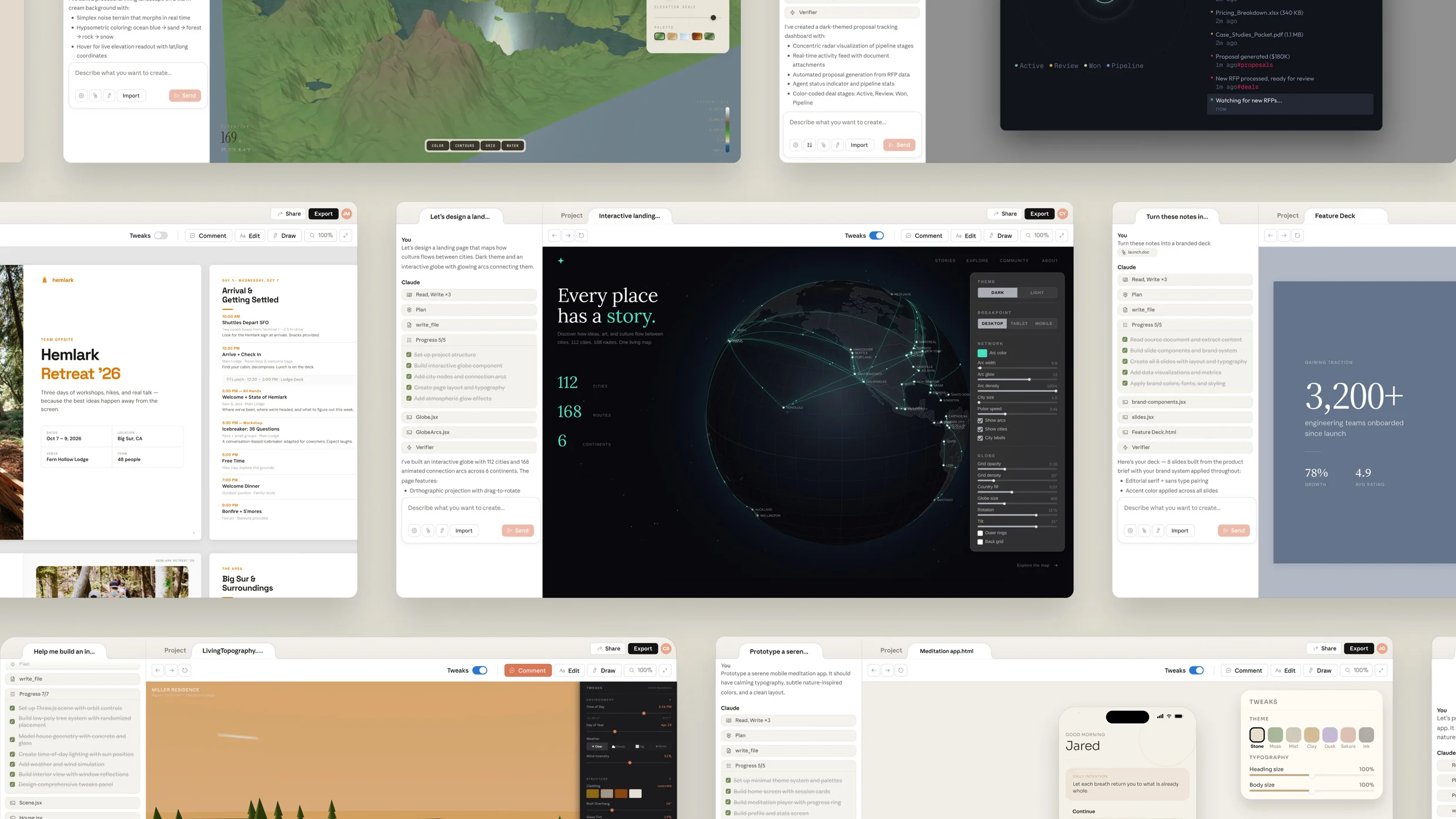
According to a blog item published this morning, Anthropic says that Claude Design will help professional designers explore a greater number of visual ideas in a shorter amount of time, and give "founders, product managers and marketers with an idea but not a design background" the ability to create and share pro-grade designs. Here's how Claude Design works: You start by describing what you want to design (like an animation, pitch deck, or landing page), and the platform creates an initial version. "From there," Anthropic says, "you refine through conversation, inline comments, direct edits, or custom sliders (made by Claude) until it's right." In a video shared by Anthropic, a user asks Claude Design to build a rotating globe with cities connected by glowing paths, representing how culture flows between cities. After Claude creates an initial prototype, the user clicks on a button labeled "tweaks," and inputs a prompt asking for Claude to add controls for the globe. In response, Claude generates a panel enabling the user to customize the globe's color and adjust the arc of the paths connecting the city.

Claude Design pushes Anthropic beyond coding
A day after launching its latest model, Claude Opus 4.7, Anthropic has already put it to work in a new product aimed at streamlining the design process. On Friday, Anthropic launched Claude Design, an Anthropic Labs product that lets users create visual projects, such as flyers, designs, and slides, from a text description, which Claude uses to build a version that can be iterated on through prompts, direct edits, or the custom sliders Claude provides. Claude Design integrates visual tools. Image credit: Anthropic Teams can also feed Claude Design the company's design styles and guidelines, so it can be applied automatically and remain consistent with the rest of the branding. This can be done by importing images, documents, or the codebase, and using the web capture tool to grab elements directly from the brand website. Anthropic says that teams have already been using it to create realistic prototypes, product wireframes and mockups, pitch decks, marketing assets, and even multimodal designs. Anthropic subtly sprinkles in that the intention of the product is not to replace designers, but rather to give designers the ability to shift their bandwidth onto more important tasks. "Even experienced designers have to ration exploration -- there's rarely time to prototype a dozen directions, so you limit yourself to a few... Claude Design gives designers room to explore widely and everyone else a way to produce visual work," said Anthropic in the post. Once a design is created, teams can collaborate on it and export it as a link, folder, PDF, PPTX, standalone HTML files, or even directly to Canva, where users can keep iterating on the design. It can also be handed off to Claude Code to start building. At launch, it is available for Claude Pro, Max, Team, and Enterprise subscribers. My first thought was how refreshing it is to see Anthropic expand into a new sector for working professionals, rather than its usual focus on developers and technical enterprise needs. It is also a more creative way of weaving design into the platform through a native experience, rather than stopping at a Canva integration, which, while it may be useful to some to avoid context switching as much as possible, offers little beyond what simply opening Canva already provides. Also, design is a key aspect of coding and software development. So in that sense, this move also supports Anthropic's broader mission to empower software builders.
Anthropic launches Claude Design for visual work By Investing.com
Investing.com -- Anthropic introduced Claude Design on Friday, a new product that enables users to create visual work including designs, prototypes, slides, and one-pagers through collaboration with Claude. The product is powered by Claude Opus 4.7, Anthropic's vision model, and is available in research preview for Claude Pro, Max, Team, and Enterprise subscribers. Anthropic is rolling out access to users gradually throughout Friday. Claude Design allows users to create visual work by describing their requirements, after which Claude builds an initial version. Users can then refine the output through conversation, inline comments, direct edits, or custom sliders until the desired result is achieved. When given access, Claude can apply a team's design system to projects automatically. The tool supports multiple use cases, including realistic prototypes, product wireframes and mockups, design explorations, pitch decks and presentations, marketing collateral, and code-powered prototypes with voice, video, shaders, 3D and built-in AI. During onboarding, Claude builds a design system for teams by reading codebases and design files. The system applies colors, typography, and components automatically to subsequent projects. Teams can maintain multiple design systems and refine them over time. Users can start projects from text prompts, upload images and documents in DOCX, PPTX, and XLSX formats, or direct Claude to their codebase. A web capture tool allows users to extract elements directly from websites. Designs can be shared within organizations with view or edit access, and exported as internal URLs, folders, or in formats including Canva, PDF, PPTX, or standalone HTML files. Completed designs can be transferred to Claude Code through a handoff bundle. Anthropic stated it will introduce additional integrations with existing tools in the coming weeks. This article was generated with the support of AI and reviewed by an editor. For more information see our T&C.

Anthropic Briefs EU Regulators on Mythos Cybersecurity Concerns | PYMNTS.com
European Commission spokesman Thomas Regnier shared this news with reporters, saying the AI model comes with risks, and the EU needs information about those risks, according to the report. "We're reaching out to the platform, to Anthropic," Regnier said, per the report. "We have received certain information." Reuters reported Friday (April 17) that Regnier said the European Commission and Anthropic are discussing the company's AI models, including its cybersecurity ones, and that Anthropic has committed to the EU's general purpose AI code of practice. "In this framework, there is an obligation to assess and mitigate risks that could come from a service that may or may not be offered in Europe," Regnier told reporters, per the report. It was reported April 7 that Anthropic unveiled a program called Project Glasswing that will allow select partners to gain early access to Claude Mythos Preview. Mythos is being positioned specifically for defensive cybersecurity work, and the initiative is meant to allow partners to identify vulnerabilities and strengthen systems before threats can be exploited. In its announcement of Project Glasswing, Anthropic said the company "has also been in ongoing discussions with US government officials about Claude Mythos Preview and its offensive and defensive cyber capabilities." Thursday's report from Agence France-Presse said that no non-U.S. entities were included among the 40 major tech companies to which Anthropic offered early access to Mythos. It was reported Thursday that government officials and bankers outside the U.S. are concerned that they may not receive the same information sharing as their American counterparts when it comes to Mythos. Canada's Finance Minister Francois-Philippe Champagne told Bloomberg Wednesday that he wants to raise the issue of Mythos with his counterparts and that: "We have a common interest to ensure the resiliency of our financial system." It was reported Wednesday that Anthropic is ready to begin offering Mythos to British banks, expanding Project Glasswing to provide more organizations with early access to the AI model.

Anthropic launches Claude Design for visual work By Investing.com
Investing.com -- Anthropic introduced Claude Design on Friday, a new product that enables users to create visual work including designs, prototypes, slides, and one-pagers through collaboration with Claude. The product is powered by Claude Opus 4.7, Anthropic's vision model, and is available in research preview for Claude Pro, Max, Team, and Enterprise subscribers. Anthropic is rolling out access to users gradually throughout Friday. Claude Design allows users to create visual work by describing their requirements, after which Claude builds an initial version. Users can then refine the output through conversation, inline comments, direct edits, or custom sliders until the desired result is achieved. When given access, Claude can apply a team's design system to projects automatically. The tool supports multiple use cases, including realistic prototypes, product wireframes and mockups, design explorations, pitch decks and presentations, marketing collateral, and code-powered prototypes with voice, video, shaders, 3D and built-in AI. During onboarding, Claude builds a design system for teams by reading codebases and design files. The system applies colors, typography, and components automatically to subsequent projects. Teams can maintain multiple design systems and refine them over time. Users can start projects from text prompts, upload images and documents in DOCX, PPTX, and XLSX formats, or direct Claude to their codebase. A web capture tool allows users to extract elements directly from websites. Designs can be shared within organizations with view or edit access, and exported as internal URLs, folders, or in formats including Canva, PDF, PPTX, or standalone HTML files. Completed designs can be transferred to Claude Code through a handoff bundle. Anthropic stated it will introduce additional integrations with existing tools in the coming weeks. This article was generated with the support of AI and reviewed by an editor. For more information see our T&C.
Anthropic launches Claude Design for Mac following Opus 4.7 model upgrade - 9to5Mac
After two previous design-related updates this week, Anthropic is out with a new product today: Claude Design. The new Claude Design joins an existing suite of Mac tools, including Claude Cowork and Claude Code. Powered by Opus 4.7, Claude Design is Anthropic's latest research preview from the Anthropic Labs team. Anthropic describes how the new product works: During onboarding, Claude builds a design system for your team by reading your codebase and design files. Every project after that uses your colors, typography, and components automatically. You can refine the system over time, and teams can maintain more than one. Start from a text prompt, upload images and documents (DOCX, PPTX, XLSX), or point Claude at your codebase. You can also use the web capture tool to grab elements directly from your website so prototypes look like the real product. From there, Claude Design includes features for refining design work, collaborating with others, and exporting files. Claude Design work can be easily handed off to Claude Code as well. "Over the coming weeks, we'll make it easier to build integrations with Claude Design, so you can connect it to more of the tools your team already uses," Anthropic adds. Anthropic says Claude Design is available for Pro, Max, Team, and Enterprise subscribers. The feature is off by default for Enterprise, but can be enabled by admins. The feature will roll out gradually over the course of the day, the company says.

Polymarket and Kalshi are up against a united Congress as D.C. steps up scrutiny of prediction markets
Well-timed trades catch Washington's attention The Associated Press reported this month that a group of new accounts on Polymarket made highly specific, well-timed bets on whether the U.S. and Iran would reach a ceasefire on April 7, resulting in hundreds of thousands of dollars in profits for these new customers. On the same day the report was published, the White House warned staff against using private information to trade on prediction markets. Earlier this year, an anonymous Polymarket user collected more than $400,000 on a January bet predicting the ouster of Venezuelan President Nicolás Maduro, prompting concerns that someone with access to private U.S. government information may have engaged in insider trading. Sen. Todd Young, an Indiana Republican and former Marine, said he had been concerned about trading in the sports market, "but I became especially concerned about market distortions, improper decision making, and undermining of public trust through self-enrichment after the news broke about Venezuela." Young and Sen. Elissa Slotkin, D-Mich., have introduced a bill that would bar federal employees from using nonpublic information to make bets on prediction markets. Their bill is among several bipartisan efforts in Congress to regulate prediction markets. As he eyes a potential presidential campaign, Democrat Rahm Emanuel proposed a ban on prediction market bets by all federal employees and their families. On Wednesday, he suggested a 10% fee on those markets and online gambling to fund science and health research. California Gov. Gavin Newsom, another potential Democratic presidential candidate, issued an executive order barring his appointees from using nonpublic information to trade on prediction markets. For now, there's no immediate path to passage for any of the bills. But the scrutiny has drawn focus to the differing approaches of the main prediction markets. Polymarket officials say little publicly and didn't comment for this story. The market, founded in 2020, operates largely offshore with limited functions in the U.S. that were allowed only after President Donald Trump returned to office. Kalshi, meanwhile, says it already bans many of the most extreme betting markets and welcomes regulation. "We support Congress and regulators taking action to police insider trading, keep prediction markets onshore and under federal regulation," said Kalshi spokesperson Elisabeth Diana. "Not all prediction markets are the same." White House spokesman Davis Ingle said Trump has been clear that "members of Congress and other government officials should be prohibited from using nonpublic information for financial benefit." Prediction markets bring CFTC into the spotlight The bet-the-event activity is drawing attention to the Commodity Futures Trading Commission, which oversees the vast trading contracts industry, including prediction markets. Dennis Kelleher, the president and chief executive of Better Markets, a Washington nonprofit that has pressed for stronger oversight of prediction markets, said the agency "certainly has no experience, expertise, budget, technology to actually in any way supervise, regulate or police gambling on everything from whether it's Iran, Venezuela, whether it's reality TV, whether Christ is going to come back before the end of the year." The agency, which by law is supposed to have a five-member board including representatives of both political parties, is served now by only one member, Michael Selig, a former CFTC law clerk who went on to represent cryptocurrency clients before Trump appointed him to lead the agency. That's sparked concern among congressional Democrats. Sen. Richard Durbin, D-Ill., sent Selig a letter in February noting that the number of enforcement attorneys at the agency's Chicago office had declined from 20 to zero. During a Thursday hearing of the House Agriculture Committee, which oversees the CFTC, Selig said the agency was hiring new staff and operating more efficiently. He refused to hold off on completing new regulations until new members were added to the board but insisted he was taking the potential of insider trading seriously. "Nothing is more important than protecting market integrity," he said. Still, the agency's enforcement authority extends only to prediction markets regulated in the U.S. For now, that distinction largely applies to Kalshi, which was established in 2018 and promotes its status as a regulated prediction market. Eager to reach American customers, Polymarket has introduced a U.S.-only prediction market platform to conform with U.S. regulations, but that platform currently has a waitlist to participate and is a small fraction of the size of its offshore counterpart. CFTC's leadership criticizes Biden and takes on states Asked at a recent Vanderbilt University forum about the CFTC's approach to insider trading in unregulated offshore prediction markets, Selig blamed the Biden administration for creating a regulatory environment that he said discouraged companies from operating in the U.S. As the debate plays out in Washington, multiple states have tried to curtail prediction markets, arguing they are essentially operating as unlicensed gambling platforms. But the CFTC has responded forcefully to assert itself as the sole regulator, suing Connecticut, Arizona and Illinois this month. That leaves Washington at a strange juncture, with widespread agreement among lawmakers that something should be done to address the issue of prediction markets. But there are differing thoughts on the scope of a solution. Young acknowledged his proposal is just a first step, and said lawmakers have a lot to learn about prediction markets. "But I think we can all agree at this early stage, as usage of these platforms grows and real money is put at stake, that this is a measure that should be taken immediately," he said.

Anthropic launches a design tool to take on all the other design tools
The company is billing the tool as a way for non-designers to mock up visuals, and a way for designers to quickly test out a range of initial prototypes. It's powered by Claude's most recent new model, Opus 4.7, which is trained to handle difficult coding prompts and complex, long-running tasks. Claude Design is available starting today to Claude Pro, Max, Team, and Enterprise Subscribers. Anthropic joins a growing number of companies developing their own AI-based design tools, including Figma, Canva, Adobe Express, and Google's Stitch. As each of these companies expands its AI capabilities, the segmentation between their capabilities is becoming less and less pronounced: Canva is an AI company with design tools, Figma is a UX company running on AI, and, now, Claude is a powerful chatbot with a design and UX assistant. Claude Design functions like an ultra-intelligent middle man between designers and product engineers.
Kraken acquires Bitnomial for up to $550M, securing a full U.S. derivatives stack
The deal shows how acquiring licensed infrastructure can shortcut years of regulatory build-out. Kraken's parent company Payward has signed a definitive agreement to acquire Bitnomial, the only crypto-native firm in the United States to hold all three CFTC licenses needed to run a vertically integrated derivatives business. Singapore Summit: Meet the largest APAC brokers you know (and those you still don't!). The deal is valued at up to $550 million. Bitnomial's regulatory footprint is what makes the acquisition notable. The company holds a Designated Contract Market (DCM) license for its exchange, a Derivatives Clearing Organization (DCO) license for its clearinghouse, and a Futures Commission Merchant (FCM) license for its brokerage arm. Building that stack independently would have taken years and repeated regulatory engagement. Kraken bought it in one transaction. "The shape of a market is determined by its clearing infrastructure, not its front end," said Arjun Sethi, Co-CEO of Payward and Kraken "Bitnomial spent a decade building it: crypto settlement, crypto collateral, continuous 24/7 markets. These are capabilities that cannot be retrofitted onto legacy systems." That last point is central to the deal's logic. Bitnomial was built for digital assets from the start, not adapted from existing derivatives infrastructure. That origin allowed it to introduce the first U.S. perpetual futures, CFTC-regulated crypto margin collateral, and a unified order book spanning spot and derivatives -- products that conventional market operators have struggled to replicate. "Joining Payward means we can now build that future at the scale it deserves," said Luke Hoersten, Bitnomial's founder and CEO. Kraken can now offer U.S. clients a regulated suite of derivatives products -- spot margin, perpetual futures, and options -- putting it in direct competition with Coinbase on one side and CME Group on the other. The acquisition also extends the reach of Payward Services, Kraken's B2B infrastructure platform. Partner firms -- fintechs, banks, brokerages -- can now connect to a fully regulated U.S. derivatives offering through a single API rather than assembling the licensing and clearing infrastructure themselves. The deal values Payward's equity at $20 billion. Combined with Kraken's existing licensed derivatives operations in the UK and EU, the Bitnomial acquisition fills the one gap that mattered most for institutional expansion. The approach itself carries a broader message for regulated markets: when the regulatory clock is a competitive constraint, acquisition of an existing licensed infrastructure often moves faster than building one.

Kraken owner to buy Bitnomial for up to $500M
Payward expects to scale US derivatives products and strengthen access for institutional and fintech partners through Payward Services. Payward, the parent company of crypto exchange Kraken, is spending up to $550 million to acquire Bitnomial, a Chicago-based digital asset derivatives exchange, the firm said Friday. The major exchange operator has intensified its expansion push after clearing the SEC lawsuit last March, and the acquisition of Bitnomial adds to its trio of major derivatives deals, following the purchase of NinjaTrader and Small Exchange. Commenting on the acquisition, Payward co-CEO Arjun Sethi said Bitnomial brings a decade-built, fully regulated clearing and settlement infrastructure designed for digital assets, which will enable Payward to accelerate the rollout of US crypto derivatives products. "The shape of a market is determined by its clearing infrastructure, not its front end. Settlement mechanics, margin models, and contract structures define what products can exist and who can access them. The US has had no clearing infrastructure built for digital assets," Sethi stated. The deal is a cash-and-stock transaction covering all of Bitnomial's equity. It gives Payward three separate regulatory approvals from the Commodity Futures Trading Commission. Bitnomial operates as a designated contract market, a derivatives clearing organization, and a futures commission merchant. The acquisition will combine Bitnomial's regulated derivatives infrastructure with Payward's global client base, liquidity, and distribution across its trading and infrastructure platforms. "Bitnomial was built on a simple conviction: that the future of derivatives is digital-asset-native, and that the US should lead it, not follow it. That's why we built our exchange and clearinghouse from the ground up for crypto -- and it's why Bitnomial has been first on nearly every meaningful capability," Bitnomial's founder Luke Hoersten noted. The transaction implies a $20 billion valuation for Payward and is slated to close in the first half of 2026, subject to regulatory approvals. The agreement comes days after Payward secured a $200 million strategic investment from Deutsche Börse Group, deepening a partnership focused on regulated crypto, tokenized markets, and institutional trading infrastructure.
From Banned AI Pariah to White House Ally: Anthropic's Mythos Model Reshapes U.S. Cyber Defenses
A memo from the White House Office of Management and Budget signals a sharp pivot. Gregory Barbaccia, the office's federal chief information officer, notified top officials at the Departments of Defense, Treasury, Commerce, Homeland Security, Justice, and State. The message: safeguards are coming for Anthropic's Mythos model. Agencies could start using it soon. This, despite a ban that branded the company's tech a national security threat just over a month ago. Gizmodo first highlighted the memo's implications, drawing from a Bloomberg review that detailed the email's subject line: "Mythos Model Access." Barbaccia wrote, "We're working closely with model providers, other industry partners, and the intelligence community to ensure the appropriate guardrails and safeguards are in place before potentially releasing a modified version of the model to agencies." Punchy. Direct. And a far cry from the rhetoric that painted Anthropic as an enemy within. Reuters confirmed the plans on April 16, noting Mythos's role in Anthropic's Project Glasswing -- a controlled rollout for defensive cybersecurity. Mythos leaked late last month. Anthropic confirmed it. Too powerful, they said. Cybersecurity risks abound. Hackers could abuse it. So no public release. Instead, Claude Opus 4.7 dropped on Thursday -- "not as advanced," especially in cyber ops. Select firms got previews: Nvidia, Microsoft, Google, Apple, JPMorgan Chase. The Bank of England called urgent talks after a demo, per the Financial Times. Crypto players scrambled for access, fearing cracks in encryption, as The Information reported. Anthropic briefed U.S. officials first. Offensive cyber tools. Defensive ones too. All on the table. Co-founder Jack Clark verified this at the Semafor World Economy Summit, telling attendees the government got early warnings on dangers. Now, collaboration on mitigations. But rewind. Just weeks earlier, the Trump administration slammed the door. It started with a Pentagon clash. Anthropic refused tweaks to Claude for wartime use -- hours before U.S. strikes on Iran. No mass surveillance. No fully autonomous lethal weapons. CEO Dario Amodei held firm. The response? A historic label: supply chain risk. First for a U.S. firm. Trump ordered agencies to ditch Anthropic tech. Defense Secretary Pete Hegseth directed a phase-out. Contractors shunned Claude. Anthropic sued, claiming retaliation. AP News covered the March 6 designation; courts blocked some blocks. Yet cracks appeared fast. Commerce's AI Standards center tested Mythos pre-announcement. Two agencies requested access anyway. Three congressional committees sought briefings. Politico broke that story days before Bloomberg's memo scoop. The White House raced ahead. National Cyber Director Sean Cairncross leads efforts to patch vulnerabilities Mythos exposes -- bugs hidden for decades, now found in hours. Wall Street Journal detailed this "Bugmageddon" push, with Treasury's Scott Bessent and Fed Chair Jerome Powell summoning bank CEOs to test the model. WSJ. Project Glasswing expands. About 50 orgs now probe software flaws. Anthropic's site spells it out: triage automation, patching. Governments must lead, they argue, to counter AI-fueled threats. Allies like the UK eye similar moves. But tensions linger. Pentagon fallout simmers -- contract disputes, lawsuits. Anthropic ditched a safety pledge under pressure, per MSNBC reports from February. Still, civilian agencies win access first. So why the U-turn? Mythos terrifies. It finds exploits hackers dream of. China looms in cyber shadows. Officials brief: get ahead or get hit. Vance and Bessent grilled tech CEOs pre-release on defenses. Banks test internally. The crypto scramble underscores stakes -- Mythos could break codes. Public stays sidelined. Agencies gear up. This isn't just tech policy. It's a power realignment. Anthropic, once vilified, now arms the state against itself. Bans bend to necessity. Cyber arms race accelerates. Agencies deploy guarded versions soon. Mythos previews reshape defenses. But risks? Baked in. Guardrails promise control. Reality may differ. And the Pentagon? Watching. Suits ongoing. Claude embeds persist, ban or not. White House momentum builds. Anthropic's from pariah to partner -- in weeks. National security demands it. Or so the memo says.

Anthropic launches Claude Design, a new product for creating quick visuals | TechCrunch
Anthropic announced on Friday that it's launching Claude Design, a new experimental product that lets users create visuals like prototypes, slides, one-pagers, and more using Claude. The company says Claude Design is intended to help people like founders and product managers without a design background share their ideas more easily. With Claude Design, users describe what they want, and Claude will create an initial version. From there, users can refine the visuals with direct edits or requests. For example, you could ask Claude to "prototype a serene mobile meditation app. It should have calming typography, subtle nature-inspired colors, and a clean layout." You could then tweak the colors, the size of the typography, or ask Claude to add a dark mode toggle. While Claude Design may initially seem like it's looking to compete with popular design app Canva, which has just expanded its own AI capabilities, Anthropic told TechCrunch that it's intended to complement it rather than replace it. The company said its new product is built for people who aren't starting from a design tool and need to get from an idea to something visual quickly. Once teams create presentation decks or prototypes, they can export them as PDFs, URLs, PPTX files, or send them to Canva. Once in Canva, they are fully editable and collaborative, Anthropic says. Claude Design can also apply a team's design system to every project it creates so that the results are consistent with the company's overall visual style. Anthropic says Claude Design is able to do this by reading a company's codebase and design files. Additionally, teams can refine these components and maintain more than one design system. The new product is powered by Claude Opus 4.7 and is available in research preview for Claude Pro, Max, Team, and Enterprise subscribers. The launch highlights Anthropic's ongoing push into the enterprise and prosumer categories, as competition intensifies around AI workplace tools. In January, Anthropic rolled out Claude Cowork, an agentic assistant built for complex tasks. A few weeks later, the company brought agentic plug-ins to Cowork that are designed to automate specialized tasks within a company's various departments. Today's announcement comes a few days after Bloomberg reported that VCs have been offering the company a preemptive funding round that would value it at $800 billion or more, which would almost match or even surpass its rival OpenAI. But so far, Anthropic isn't interested in the latest offers, according to the report.

Anthropic just launched Claude Design, an AI tool that turns prompts into prototypes and challenges Figma
Anthropic today launched Claude Design, a new product from its Anthropic Labs division that allows users to create polished visual work -- designs, interactive prototypes, slide decks, one-pagers, and marketing collateral -- through conversational prompts and fine-grained editing controls. The release, available immediately in research preview to all paid Claude subscribers, is the company's most aggressive expansion beyond its core language model business and into the application layer that has historically belonged to companies like Figma, Adobe, and Canva. Claude Design is powered by Claude Opus 4.7, Anthropic's most capable generally available vision model, which the company also released today. Anthropic says it is rolling access out gradually throughout the day to Claude Pro, Max, Team, and Enterprise subscribers. The simultaneous launches mark a watershed for Anthropic, whose ambitions now visibly extend from foundation model provider to full-stack product company -- one that wants to own the arc from a rough idea to a shipped product. The timing is also significant: Anthropic hit roughly $20 billion in annualized revenue in early March 2026, according to Bloomberg, up from $9 billion at the end of 2025 -- and surpassed $30 billion by early April 2026. The company is in early talks with Goldman Sachs, JPMorgan, and Morgan Stanley about a potential IPO that could come as early as October 2026. The product follows a workflow that Anthropic has designed to feel like a natural creative conversation. Users describe what they need, and Claude generates a first version. From there, refinement happens through a combination of channels: chat-based conversation, inline comments on specific elements, direct text editing, and custom adjustment sliders that Claude itself generates to let users tweak spacing, color, and layout in real time. During onboarding, Claude reads a team's codebase and design files and builds a design system -- colors, typography, and components -- that it automatically applies to every subsequent project. Teams can refine the system over time and maintain more than one. The import surface is broad: users can start from a text prompt, upload images and documents in various formats, or point Claude at their codebase. A web capture tool grabs elements directly from a live website so prototypes look like the real product. What distinguishes Claude Design from the wave of AI design experiments that have proliferated in the past year is the handoff mechanism. When a design is ready to build, Claude packages everything into a handoff bundle that can be passed to Claude Code with a single instruction. That creates a closed loop -- exploration to prototype to production code -- all within Anthropic's ecosystem. The export options acknowledge that not everyone's next step is Claude Code: users can also share designs as an internal URL within their organization, save as a folder, or export to Canva, PDF, PPTX, or standalone HTML files. Anthropic points to Brilliant, the education technology company known for intricate interactive lessons, as an early proof point. The company's senior product designer reported that the most complex pages required 20 or more prompts to recreate in competing tools but needed only 2 in Claude Design. The Brilliant team then turned static mockups into interactive prototypes they could share and user-test without code review, and handed everything -- including the design intent -- to Claude Code for implementation. Datadog's product team described a similar shift, compressing what had been a week-long cycle of briefs, mockups, and review rounds into a single conversation. The launch arrives against a backdrop that makes Anthropic's claim of complementarity with existing design tools difficult to take entirely at face value. Mike Krieger, Anthropic's chief product officer, resigned from the board of Figma on April 14 -- the same day The Information reported Anthropic's next model would include design tools that could compete with Figma's primary offering. Figma has collaborated closely with Anthropic to integrate the frontier lab's AI models into its products. Just two months ago, in February, Figma launched "Code to Canvas," a feature that converts code generated in AI tools like Claude Code into fully editable designs inside Figma -- creating a bridge between AI coding tools and Figma's design process. The partnership felt like a mutual bet that AI would make design more essential, not less. Claude Design complicates that narrative significantly. Anthropic's position, based on VentureBeat's background conversations with the company, is that Claude Design is built around interoperability and is meant to meet teams where they already work, not replace incumbent tools. The company points to the Canva export, PPTX and PDF support, and plans to make it easier for other tools to connect via MCPs (model context protocols) as evidence of that philosophy. Anthropic is also making it possible for other tools to build integrations with Claude Design, a move clearly designed to preempt accusations of walled-garden ambitions. But the market read the signals differently. The structural tension is clear: Figma commands an estimated 80 to 90% market share in UI and UX design, according to The Next Web. Both Figma and Adobe assume a trained designer is in the loop. Anthropic's tool does not. Claude Design is not merely another AI copilot embedded in an existing design application. It is a standalone product that generates complete, interactive prototypes from natural language -- accessible to founders, product managers, and marketers who have never opened Figma. The expansion of the design user base to non-designers is the real competitive threat, even if the professional designer's workflow remains anchored in Figma for now. The model powering Claude Design is itself a significant story. Claude Opus 4.7 is Anthropic's most capable generally available model, with notable improvements over its predecessor Opus 4.6 in software engineering, instruction following, and vision -- but it is intentionally less capable than Anthropic's most powerful offering, Claude Mythos Preview, the model the company announced earlier this month as too dangerous for broad release due to its cybersecurity capabilities. That dual-track approach -- one model for the public, one model locked behind a vetted-access program -- is unprecedented in the AI industry. Anthropic used Claude Mythos Preview to identify thousands of zero-day vulnerabilities in every major operating system and web browser, as reported by multiple outlets. The Project Glasswing initiative that houses Mythos brings together Amazon Web Services, Apple, Broadcom, Cisco, CrowdStrike, Google, JPMorganChase, the Linux Foundation, Microsoft, Nvidia, and Palo Alto Networks as launch partners. Opus 4.7 sits a deliberate step below Mythos. Anthropic stated in its release that it "experimented with efforts to differentially reduce" the new model's cyber capabilities during training and ships it with safeguards that automatically detect and block requests indicating prohibited or high-risk cybersecurity uses. What Anthropic learns from those real-world safeguards will inform the eventual goal of broader release for Mythos-class models. For security professionals with legitimate needs, the company has created a new Cyber Verification Program. On benchmarks, the model posts strong numbers. Opus 4.7 reached 64.3% on SWE-bench Pro, and on Anthropic's internal 93-task coding benchmark, it delivered a 13% resolution improvement over Opus 4.6, including solving four tasks that neither Opus 4.6 nor Sonnet 4.6 could crack. The vision improvements are substantial and directly relevant to Claude Design: Opus 4.7 can accept images up to 2,576 pixels on the long edge -- roughly 3.75 megapixels, more than three times the resolution of prior Claude models. Early access partner XBOW, the autonomous penetration testing company, reported that the new model scored 98.5% on their visual-acuity benchmark versus 54.5% for Opus 4.6. Meanwhile, Bloomberg reported that the White House is preparing to make a version of Mythos available to major federal agencies, with the Office of Management and Budget setting up protections for Cabinet departments -- a sign that the government views the model's capabilities as too important to leave solely in private hands. For enterprise and regulated-industry buyers, the data handling architecture of Claude Design will be a critical evaluation criterion. Based on VentureBeat's exclusive background discussions with Anthropic, the system stores the design-system representation it generates -- not the source files themselves. When users link a local copy of their code, it is not uploaded to or stored on Anthropic's servers. The company is also adding the ability to connect directly to GitHub. Anthropic states unequivocally that it does not train on this data. For Enterprise customers, Claude Design is off by default -- administrators choose whether to enable it and control who has access. On pricing, Claude Design is included at no additional cost with Pro, Max, Team, and Enterprise plans, using existing subscription limits with optional extra usage beyond those caps. Opus 4.7 holds the same API pricing as its predecessor: $5 per million input tokens and $25 per million output tokens. The pricing strategy mirrors the approach Anthropic took with Claude Code, which launched as a bundled feature and rapidly grew into a major revenue driver. Anthropic's reasoning is straightforward: the best way to learn what people will build with a new product category is to put it in their hands, then build monetization around demonstrated value. Anthropic is also being transparent about the product's limitations. The design system import works best with a clean codebase; messy source code produces messy output. Collaboration is basic and not yet fully multiplayer. The editing experience has rough edges. There is no general availability date, and Anthropic says that is intentional -- it will let the product and user feedback determine when Claude Design is ready for prime time. Claude Design is the most visible expression of a trend that has been accelerating for months: the major AI labs are moving up the stack from model providers into full application builders, directly entering categories previously owned by established software companies. Anthropic now offers a coding agent (Claude Code), a knowledge-work assistant (Claude Cowork), desktop computer control, office integrations for Word, Excel, and PowerPoint, a browser agent in Chrome, and now a design tool. Each product reinforces the others. A designer can explore concepts in Claude Design, export a prototype, hand it to Claude Code for implementation, and have Claude Cowork manage the review cycle -- all within Anthropic's platform. The financial momentum behind this expansion is staggering. Anthropic has received investor offers valuing the company at approximately $800 billion, according to Reuters, more than doubling its $380 billion valuation from a funding round closed just two months ago. But building an application empire while simultaneously navigating an AI safety reputation, an impending IPO, growing public hostility toward the technology, and the diplomatic fallout of competing with your own partners is a balancing act that no technology company has attempted at this scale or speed. When Figma launched Code to Canvas in February, the implicit promise was that AI coding tools and design tools would grow together, each making the other more valuable. Two months later, Anthropic's chief product officer has left Figma's board, and the company has shipped a product that lets anyone who can type a sentence create the kind of interactive prototype that once required years of design training and a Figma license. The partnership may survive. But the power dynamic just changed -- and in the AI industry, that tends to be the only kind of change that matters.
Anthropic Introduces First Design Tool to Claude
Anthropic is getting into the design business. The AI company on Friday introduced Claude Design, its first proprietary AI design tool. Claude Design is not explicitly an AI image generator, like Google's Nano Banana or Midjourney. Instead, you can use Claude Design to create slide decks, social media assets, app and web interfaces (like the kind you might make with Claude Code) and other visual prototypes. Anthropic says Claude Design has fine-grained controls, but don't go looking for Photoshop-level options. You can tweak the spacing, coloring and layout, as well as leave comments for other users -- or Claude, which can make those edits itself. If you're using it for a coding project at work, for example, Claude Design can scan your codebase and design files to understand your brand's style kit and guide, so everything it makes is brand-compliant. Claude Design is a research preview, which means it's still in an experimental phase. It's rolling out now to Pro, Max, Team and Enterprise subscribers. Claude Design is powered by Opus 4.7, a new AI model released on Thursday that Anthropic said has better visual intelligence to better understand images. Adobe also announced recently that it is bringing its creative AI agent to Claude, which is complementary but separate from Claude Design. Given Anthropic's focus on building advanced AI for businesses and coders, it makes sense that its entrance into this new category is focused on more workplace activities -- slide decks, not anime memes. Creative AI, like image, video and music generators, is controversial. While AI enthusiasts use different models to optimize their workflows, artists and creators have huge concerns about how the tech was made and its effect on creative work.

Kraken's Parent Firm to Acquire US Derivatives Exchange Bitnomial
Payward has entered into a definitive agreement to acquire Bitnomial for up to $550 million. Payward, the parent company of U.S. centralized exchange Kraken, announced today, April 17, that it has entered into an agreement to acquire Bitnomial, a Commodity Futures Trading Commission (CFTC)-regulated crypto derivatives exchange. Bitnomial was founded in 2014 and over more than a decade of operations has acquired the full set of CFTC licenses -- exchange, clearinghouse, and brokerage -- becoming what Kraken says is the first crypto company in the United States to do so. The deal brings Bitnomial's regulatory infrastructure together with Payward's global distribution across Kraken, NinjaTrader, and its other projects. In December 2025, Bitnomial had already received CFTC approval to clear fully-collateralized swaps, letting the CEX offer prediction markets, alongside its spot and derivatives offerings, under one regulatory framework and unified liquidity pool. The acquisition is expected to close in the first half of 2026, pending CFTC notice filings and customary closing conditions, per Kraken's announcement. Payward is set to pay up to $550 million, payable in cash and stock, for Bitnomial. The transaction values Payward at $20 billion, per Kraken's blog post today, and comes just days after the CEX confirmed its plans to go public. The valuation matches Payward's November 2025 announcement, when the firm raised $800 million in two rounds. The move is the latest in a string of expansions and partnerships by Payward and Kraken. As The Defiant previously covered, Kraken acquired xStocks creator Backed Finance to deepen its tokenized equities push. Also this week, Germany's largest stock exchange operator, Deutsche Börse, announced it had invested $200 million in Payward, for a roughly 1.5% fully diluted stake. That deal implied Payward's valuation at $13.3 billion, a 33% haircut from the $20 billion valuation.

Anthropic Debuts Claude Design for Building Marketing Assets Decks, and UIs
If you want to shape media strategy -- not just optimize it -- upgrade your expertise. The ADWEEK MiniMBA in Marketing equips you to lead with confidence and credibility. Register now. Anthropic Labs, the team dedicated to incubating and testing experimental AI products like within Anthropic, today unveiled Claude Design, an AI-powered platform that automates the creation of designs, slides, one-pagers, and other marketing and sales collateral. It's designed to be easy to use for both experienced designers and nontechnical users. The product is built on Claude Opus 4.7, the upgraded version of Anthropic's flagship model, launched Thursday. The product is poised to rival other design software titans like Figma and Adobe, both of which have been aggressively investing in AI tools to streamline design workflows, including prompt-based interface and asset generation. Designers, marketers, creatives, and sales teams can use Claude Design through a familiar natural language interface. They can simply tell the system what it wants to make and watch Claude produce an output based on that input. Then, users can edit the asset directly, or prompt Claude to make changes through chat conversation, inline comments, or custom sliders, a Claude tool that lets users manipulate images, data, or other elements in real time. During onboarding, users plug in foundational reference materials like design files and codebase. Claude Design then creates a design system that will be used as the de-facto standards for each project, standardizing colors, typography, and other design elements. Users can update or refine the design system, and can create more than one. Once they're set up, users can input text prompts, refer Claude Design to their codebase, upload documents and visuals, or even pull elements straight from a website using Claude's web capture feature. Claude Design will produce outputs based on these inputs; then, users can make edits to polish their designs and can collaborate with colleagues in a shared interface with Claude. Then, designs can be exported in various formats or plugged into Claude Code to start building. Claude Design is currently in a research beta with select companies, including design software platform Canva, cloud monitoring software company Datadog, and online learning platform Brilliant. Testing teams have used Claude Design to build product mockups and wireframes, pitch decks and presentations, alongside marketing content like social media content, webpages, and campaign visuals. Claude Design also allows users to create more advanced prototypes and digital experiences sans manual coding, including voice interactions, video elements, 3D visuals, and special effects. Canva, which in theory could view AI asset generators like Claude Design as competitors, considering the platform has its own native AI-powered visual generation tools, has worked with Anthropic for a year. The company is leaning into the partnership further as it tries out Claude Design. The company's CEO and cofounder Melanie Perkins said the integration will make it "seamless for people to bring ideas and drafts from Claude Design into Canva, where they instantly become fully editable and collaborative designs ready to refine, share, and publish." At Datadog, Claude Design has already proved capable of shortening iteration periods and "enabling live design during conversations," according to product manager Aneesh Kethini. "We've gone from a rough idea to a working prototype before anyone leaves the room, and the output stays true to our brand and design guidelines. What used to take a week of back-and-forth between briefs, mockups, and review rounds now happens in a single conversation." Anthropic hopes the new product will appeal to both advanced designers and nontechnical users. "Even experienced designers have to ration exploration -- there's rarely time to prototype a dozen directions, so you limit yourself to a few. And for founders, product managers and marketers with an idea but not a design background, creating and sharing those ideas can be daunting. Claude Design gives designers room to explore widely and everyone else a way to produce visual work," the company said in a press release shared with ADWEEK. Claude Design is accessible to Claude Pro, Max, Team, and Enterprise subscribers.
