News & Updates
The latest news and updates from companies in the WLTH portfolio.
Crypto agility key as quantum threats loom
Amid the advent of AI and post-quantum threats, organisations must modernise their public key infrastructure (PKI) and cryptographic assets by automating certificate life cycle management (CLM). As AI accelerates the growth of machine identities and digital services, manual approaches to managing certificates are no longer sustainable. This is according to Richard Hall, assistant VP at global digital security and trust company DigiCert. The company is co-sponsoring the ITWeb Security Summit JHB 2026 on 2 and 3 June at the Sandton Convention Centre in Johannesburg. Hall will speak at the summit about how automating CLM helps companies reduce risk, lower operational costs and improve resilience. DigiCert explains that automating CLM uses software to manage the discovery, issuance, renewal, deployment and revocation of SSL/TLS certificates without manual intervention. This reduces the risk of human error, helps avoid costly outages caused by expired certificates, and ensures consistent adherence to security policies at scale, while strengthening resilience against increasingly sophisticated, AI-driven cyber threats. "Organisations are starting to recognise that managing certificates at scale is not just an operational task - it is a strategic capability," says Hall. "As organisations adopt AI at scale, this level of automation becomes essential to support new services securely, without introducing additional operational risk or cost." The company will also explain how its digital trust platform, DigiCert ONE - a unified, modular platform to manage certificates, PKI, DNS and digital signing - delivers centralised visibility, control and enterprise-grade trust. "By automating life cycle management, companies can enable crypto agility, secure machine identities and build the foundations needed to support zero-trust architectures and the transition to post-quantum cryptography," adds Hall.
Goldman Sachs 'Hyperaware' Of AI Risks; Working With Anthropic On Mythos - The Cyber Express
Goldman Sachs is taking a cautious approach toward a new artificial intelligence model from Anthropic, warning that its advanced capabilities could introduce significant cybersecurity risks -- even as they explore its long-term potential. The model, known as "Mythos," has sparked concern across the financial sector due to its ability to identify and exploit software vulnerabilities at a level that could reshape both cyber defense and cybercrime. Answering a query during a recent earnings call, Goldman Sachs CEO David Solomon said the bank is closely monitoring the risks associated with emerging AI systems including LLMs and the disruptive Mythos model from Anthropic. "We're hyperaware," Solomon said, referring to the cybersecurity implications of next-generation AI tools. He added that Goldman is actively working with Anthropic and cybersecurity partners to better understand how such models could impact financial systems and cyber defenses. Cybersecurity has long been at the core of our business. And we have for a very, very long time, put enormous resources forward," Solomon added. "With the help of the US government and the model publishers, we are very focused on supplementing our cyber and infrastructure resilience," he said. "And this is part of our ongoing capabilities that we have been investing in and are accelerating our investment in." The comments reflect the current mindset of major financial institutions, which are increasingly treating advanced AI not just as a productivity tool, but as a potential security disruptor. Unlike earlier AI systems, Mythos is designed to autonomously discover and exploit vulnerabilities in software environments. Anthropic has acknowledged that the model can "find and exploit sophisticated vulnerabilities" and, in some cases, outperform human experts. This capability has triggered concern among cybersecurity community, who are divided and warn that such tools could lower the barrier for cyberattacks. In practical terms, even individuals without deep technical expertise could potentially use AI to identify weaknesses in operating systems, applications, or enterprise infrastructure. Anthropic itself has taken an unusually cautious stance. The company has restricted access to Mythos and opted not to release it publicly, citing fears of misuse. Instead, the model is being shared as a preview to 11 organizations under a controlled initiative dubbed "Project Glasswing." The organizations includes JPMorgan, Apple, Google, Microsoft, Nvidia and Goldman Sachs, among other. The initiative aims at strengthening defenses before rolling out wider deployment. The concerns are not limited to Goldman Sachs. Discussions involving top U.S. financial leaders -- including regulators and central banking officials -- have reportedly taken place to assess the risks posed by such AI systems. Banks are particularly vulnerable due to their complex mix of modern and legacy systems, which could provide fertile ground for AI-driven vulnerability discovery and exploitation. At the same time, industry leaders see a dual-edged reality where attackers could benefit first, defenders may eventually use similar tools to identify and patch weaknesses faster. Despite the warnings, Solomon struck a measured tone about the future of AI in business. He noted that the technology has the potential to significantly improve efficiency and transform operations across industries. "Whenever you have acceleration of your technology, there are going to be be bumps, and there are going to be risk issues," Solomon said answering a seperate query during the call. "But the power of the technology, the ability to use it in an enterprise, to remake processes, to create efficiency, and also create more capacity to invest the growth -- I can't find a CEO that's not talking about that." This tension -- between innovation and risk -- sits at the center of the current debate around advanced AI systems like Mythos. The emergence of models capable of autonomously identifying and exploiting vulnerabilities marks a potential inflection point for cybersecurity. Experts suggest that the rapid evolution of AI could accelerate both offensive and defensive capabilities, creating a race between attackers and defenders. In the short term, however, the concern is that powerful tools may be easier to weaponize than to secure. For financial institutions like Goldman Sachs, however, the strategy seems to be to engage early, understand the risks, and prepare defenses before such technologies become widely accessible.

OpenAI's Memos, Frontier, Amazon and Anthropic
With Stratechery Plus you get access to the subscriber-only Stratechery Update and Stratechery Interviews, and the Sharp Tech, Sharp China, Dithering, Greatest of All Talk, and Asianometry podcasts. Stratechery Updates are also available via SMS, RSS, or on this site. Please see the Stratechery Update Schedule for more details about delivery times and planned days-off. Please note that all subscriptions auto-renew monthly/annually (but can be cancelled at any time). If you are interested in ordering and managing multiple subscriptions for your team or company, please fill in the form here.
EU travel chaos as easyJet passengers describe border 'nightmare'
Travellers said the result was chaos. Some reported vomiting and fainting while waiting to pass through checks, with queues reportedly stretching for hours during peak periods. Staffordshire resident Carol Boon, who had been on a hen do in Milan, said: "It was just horrible." She described scenes of confusion and distress as passengers tried to make their flights. Ms Boon explained: "Even if we were there five hours early, we weren't told the gate number until about 90 minutes before. There was nothing we could have done." Max Hume, 56, from Leeds, said: "It was just awful -- just a mess." He ended up spending £1,800 on alternative travel via Luxembourg after missing the flight. Mr Hume said easyJet offered him a seat on a later flight days away but said he needed to get home sooner. He added the airline initially offered £19 compensation and a Thursday departure, which he said was unworkable: "We would have had to pay £300 on top." According to industry bodies ACI Europe and Airlines for Europe (A4E), early implementation of the system has led to severe disruption across multiple airports, with waiting times of two to three hours at peak times. In one reported case, no passengers had reached a departure gate by the scheduled closing time, and only 12 had arrived 90 minutes later, highlighting the scale of the delays. The BBC has been told that until last week border authorities could fully suspend the system when queues became excessive, but now only partial suspension is allowed, limiting flexibility during disruption. Airlines and airports have warned the current rollout risks widespread operational strain ahead of the busy summer season unless procedures are adjusted. Another passenger, Joy Oliver, said: "It was absolute carnage." She arrived three hours before departure but still faced hours in queues. She has since rebooked and is attempting to get home via Edinburgh. Adam Hoijard, from the Wirral, said he and his family also arrived early but still missed the flight after being stuck in queues for hours. He said his five-year-old son had been left "crying in bed" after the ordeal. The family have since spent around £1,000 booking alternative flights. Rejecting suggestions that passengers simply did not allow enough time, Hoijard said: "How much time can you leave to wait in a queue and be told to wait?" Greater Manchester travel agent Laura Featonby said: "Biometric checks inevitably slow down border movement." She said passenger data is stored for several years and rechecked on exit, increasing processing demands. Featonby added that the situation in Milan may have been worsened by passengers arriving before the full transition into the new system, creating additional bottlenecks for border staff. Express.co.uk has contacted easyJet for comment.

How Cerebras approaches competing against Nvidia
While Nvidia dominates the AI chip market, Cerebras Systems is working to be a differentiator. Founded in 2015, the AI inference vendor started with the idea of creating the world's largest computer chip. This mission led the vendor to create a chip in 2019 that was about the size of a dinner plate, said James Wang, director of product marketing at Cerebras, on the latest Targeting AI podcast from Informa TechTarget. "Nothing like that had ever been done before," Wang said. He added that he followed the development as a technology analyst then and that, while vendors like Graphcore or SambaNova were trying to compete with Nvidia with smaller chips, only Cerebras went large. "I thought that was probably the only chance anyone had of taking on Nvidia," Wang said. "If you're just going to make small changes, Nvidia will catch up and beat you." Cerebras' approach to AI chips has since changed. Instead of trying to train the chips, it's now gone into AI inference. In August 2024, the AI vendor launched Cerebras Inference, an AI inference product that delivers 1,800 tokens per second for Llama 3.1 8B and 450 tokens per second for Llama 3.1 70B. The vendor has seen much growth since the launch of Cerebras Inference, Wang said. "The amount of inbound interest, the amount of companies that can use our products, the amount of startups building on Cerebras have just exploded," he said. He continued by saying that a vendor needs a large lead to compete against a technology giant like Nvidia; otherwise, it erodes its lead in one generation. On Aug. 5, Cerebras Systems announced that it will help power OpenAI's open model gpt-oss-120B.

Xi calls for closer ties with Spain in face of global 'chaos'
Add Yahoo as a preferred source to see more of our stories on Google. China's President Xi Jinping warned against a return to the "law of the jungle" in international relations and called for closer economic ties with Spain as he met Prime Minister Pedro Sanchez on Tuesday, according to Chinese state media. The meeting in Beijing came on the second day of Sanchez's visit as he seeks to position Spain as a bridge between China and the European Union, whose relations with the United States are under strain. Xi told Sanchez the two countries should strengthen cooperation in the face of global "chaos and turmoil" and "a contest between justice and force", according to a readout of the talks from state broadcaster CCTV. "Both China and Spain are principled countries that stand for justice. They should strengthen communication, consolidate mutual trust, and cooperate closely to oppose the world's regression to the law of the jungle," Xi said during talks in the Great Hall of the People. "How a country treats international law and the international order reflects its worldview, its conception of order, its values, and its sense of responsibility," Xi said. Spain and China should "seize opportunities" for cooperation in trade, new energy and technology fields, he said. Sanchez welcomed China's role in seeking to resolve the conflict in the Middle East, after a first round of US-Iranian negotiations in Pakistan ended without an agreement. "The role China can play is important in order to find diplomatic means that end this war and contribute to stability and peace," Sanchez told a news conference after the talks. The Socialist leader said international law in the region "is being violated basically by one country", Israel, which has invaded Lebanon in its latest conflict with Iran-backed Hezbollah. Sanchez referred to "those who commit violations or genocides, which is what we are seeing in Gaza, and let us hope the same does not happen in Lebanon, that crimes do not go unpunished". - 'Unsustainable' trade balance - The two leaders also discussed "the reforms our multilateral system needs to better recognise the multipolar reality of today's world", Sanchez said. The Spanish prime minister is seeking to strengthen economic ties with the world's second-largest economy but called China's trade imbalance with the EU "unsustainable" on Monday. He is on his fourth visit to China in four years and follows a steady flow of Western leaders visiting Beijing in recent months as President Donald Trump's tariffs and unpredictable foreign policy have rattled the US's traditional allies. Spanish government sources said a primary goal of Sanchez's trip is to secure greater market access for agricultural and industrial goods, and to explore joint technology ventures.
LinkedIn is Testing an "AI Labor Marketplace" to Rival Mercor and Scale AI
LinkedIn is joining the growing list of companies building businesses around AI training. LinkedIn is testing an "AI labor marketplace." In a move first reported by Business Insider, the Microsoft-owned platform is now recruiting subject matter experts to train the next generation of generative AI models, offering hourly rates that reach as high as $150. The strategy marks a shift for LinkedIn, which has historically focused on traditional corporate hiring. Now, the company is leveraging its database of over one billion verified professionals to compete directly with AI staffing companies like Scale AI and Mercor. According to LinkedIn data, "AI training" has become one of the fastest-growing job categories in the U.S. market. Unlike general data labeling, these roles require deep industry nuance -- a "human-in-the-loop" approach where experts rate chatbot accuracy and challenge systems with complex, real-world scenarios. What LinkedIn is paying: A LinkedIn spokesperson confirmed to Business Insider that the company is in "early testing" for this new marketplace. By matching frontier AI labs -- such as OpenAI and Anthropic -- with verified human talent, LinkedIn is positioning itself as a premium supplier of high-quality training data. This move comes at a critical time for the industry. Competitors like Mercor have seen valuations soar to $10 billion but are currently grappling with the fallout of significant data breaches. By contrast, LinkedIn is betting that its established reputation for professional verification will give it the edge in a market where "context" is becoming more valuable than raw code. For users, the entry into this market is largely "opt-out." LinkedIn has already begun utilizing profile data from several regions to train its proprietary models. However, the new "labor marketplace" allows professionals to monetize their expertise actively. LinkedIn has rolled out features that allow members to receive direct notifications when these high-paying AI training opportunities become available. To find these roles, users are encouraged to search for "AI Content Analyst" or "AI Trainer" within the platform's job portal.

Deutsche Boerse has invested $200M in crypto exchange Kraken's parent entity, a deal that values the business at $13.3bn - Bloomberg reporter on X
Deutsche Börse AG is one of the leading European stock exchanges. Net sales break down by activity as follows: - trading services (41.3%): execution and management of operations on derivatives and in cash (shares, bonds, warrants, etc.; Xetra); - compensation, payment-delivery, and conservation services and securities (36.6%); - distribution of indexes and market data (22.1%). The group is also involved in development and implementation of IT solutions. Net sales are distributed geographically as follows: European Union (52.9%), Europe (26.6%), America (13.6%) and Asia/Pacific (6.9%). Financial & Commodity Market Operators

Deutsche Boerse has invested $200 mln in crypto exchange kraken's parent entity - Bloomberg reporter on X
Deutsche Börse AG is one of the leading European stock exchanges. Net sales break down by activity as follows: - trading services (41.3%): execution and management of operations on derivatives and in cash (shares, bonds, warrants, etc.; Xetra); - compensation, payment-delivery, and conservation services and securities (36.6%); - distribution of indexes and market data (22.1%). The group is also involved in development and implementation of IT solutions. Net sales are distributed geographically as follows: European Union (52.9%), Europe (26.6%), America (13.6%) and Asia/Pacific (6.9%). Financial & Commodity Market Operators
Deutsche Börse Takes $200 Million Stake in Crypto Exchange Kraken
Deutsche Börse AG invested $200 million in Payward Inc., the parent of crypto trading platform Kraken, as the Frankfurt stock exchange operator moves to offer access to a wider array of securities over blockchain rails. The deal, which gives Deutsche Börse a 1.5% fully diluted stake in the company, is expected to close in the second quarter subject to regulatory approval, according to a statement on Tuesday. The transaction values Kraken -- which plans to go public as soon as this year -- at around $13.3 billion, according to Bloomberg calculations. It was valued at $20 billion in a November share sale. Deutsche Börse's investment follows a partnership between the two companies announced in December and comes as traditional financial firms increase their exposure to digital assets. New York Stock Exchange owner Intercontinenal Exchange Inc. invested about $200 million in crypto exchange OKX earlier this year. "It's a perfect partner for us to further accelerate on this path of creating a fully hybrid market infrastructure," Thomas Book, a member of Deutsche Börse's management board, said in an interview. "Irrespective of what is now the form of an asset -- whether it's tokenized or fully digital -- we want to create one integrated value chain." Kraken, one of the world's oldest crypto exchanges, filed confidentially for a US initial public offeringBloomberg Terminal in November. That same month, the company announced that it had raised $800 million in a funding round that valued it at $20 billion. Both companies declined to comment on the valuation in the Deutsche Börse deal. Crypto Going Mainstream The digital asset industry's integration into traditional finance has accelerated under US President Donald Trump and as a result of more regulatory clarity in the European Union. Kraken became the first crypto firm to gain access to the Federal Reserve's core payments system in March. It launched MiFID-regulated crypto derivatives in the EU last year. Deutsche Börse's Clearstream unit in November said it introduced a platform for trading tokenized securities. The following month the bourse operator announced the partnership with Kraken, in which the crypto exchange will be integrated with Deutsche Börse's foreign-exchange trading venue 360T. "The progress since then has been encouraging, and today's announcement is a further reflection of the trust that has developed on both sides," a Kraken spokesperson said in a statement on Tuesday. The crypto market has been facing headwinds for months, with Bitcoin down about 40% since reaching a record in October. That's hurt digital-asset exchanges such as Kraken rival Gemini Space Station Inc., which is said to be seeking hundreds of millions of dollars in loans from its founders after cutting jobs and exiting some markets this year. Even as crypto moves into the financial mainstream, digital-asset platforms have been vulnerable to cyberattacks. Kraken disclosed an extortion attempt on Monday, saying it's being targeted by a criminal group that claims to have access to some client account information. Client funds were never at risk, according to a senior Kraken executive.
UK financial regulators rush to assess risks of Anthropic AI model ...
Major UK banks are in discussions with regulators as well as finance and national security organisations as the latest Anthropic artificial intelligence (AI) model unearths decades-old vulnerabilities. At the same time Anthropic has announced Project Glasswing, which is providing a select group of organisations access to the model, known as Claude Mythos Preview AI, to enable them to develop defences against its misuse. The AI model's ability to identify security flaws in software which have remained undetected for years, despite organisations such as banks constantly looking for them, is a warning of what AI in the wrong hands could do. It is not just the banking sector that will face threats if this type of technology is acquired by criminals, with any organisation at risk. According to Anthropic, its Claude Mythos Preview AI "has already found thousands of high-severity vulnerabilities, including some in every major operating system and web browser". It added that, given the rate of AI progress, it will not be long before such capabilities proliferate, potentially beyond actors who are committed to deploying them safely. The fallout - for economies, public safety and national security - could be severe. In a blog post announcing Project Glasswing, which it described as "an urgent attempt to put these capabilities to work for defensive purposes", Anthropic revealed it would be working with a select group of businesses that will be given access to the AI model. It said Amazon Web Services, Apple, Broadcom, Cisco, CrowdStrike, Google, JPMorgan Chase, the Linux Foundation, Microsoft, Nvidia and Palo Alto Networks will "use Mythos Preview as part of their defensive security work". "Anthropic will share what we learn so the whole industry can benefit," the AI firm said. In his blog, Chris Skinner, fintech industry expert and CEO at The Finanser, said this moment feels like an early warning. "Even if Anthropic keeps Mythos tightly restricted, similar capabilities will emerge elsewhere - and probably sooner than many expect," he said. "The real challenge isn't whether this technology exists," added Skinner. "It's whether institutions can adapt quickly enough to operate in a world where AI can both defend and attack the foundations of finance. "We are talking about an AI system that identified zero-day vulnerabilities in place for decades when everyone, including specialists, had no idea they existed." One IT security professional in the UK banking sector, who wished to remain anonymous, said: "It has always been possible for vulnerabilities to be found and secured, but the speed at which the AI can detect them means if it falls in the wrong hands, people can find the flaws very quickly and exploit them before software owners can correct the problem." In the UK, the Bank of England, the Financial Conduct Authority and the government are in talks with the National Cyber Security Centre over potential vulnerabilities in key IT systems. According to The Financial Times, regulators are also planning meetings with finance firms to warn them of the risks that the AI model brings. It said this followed a summons by US Treasury secretary Scott Bessent to the US's largest banks to discuss the AI model's ability to detect cyber security vulnerabilities that could be exploited.

Scott Nolan: SpaceX is set to dominate the space launch industry, overlooked physical companies present significant opportunities, and a contrarian investment approach is essential for success | Invest Like the Best
* SpaceX is set to dominate the space launch industry due to the stagnation of existing players. * Traditional space launch companies have been held back by cost-plus contracts, limiting innovation. * There is a significant opportunity in physical world companies that are often overlooked by investors. * A contrarian investment approach can uncover underappreciated opportunities. * Avoiding trends is crucial as competition can drive profits down. * Investors should focus on important ideas that are not being actively worked on. * Stagnated industries operating on a cost-plus model lack incentives for growth. * Incumbent oligopolistic industries are ripe for disruption. * Founders are often driven by a personal interest in solving problems they believe others have addressed incorrectly. * Scaling businesses face increased complexity in compliance and security. * Disruption is likely in industries where incumbents are stagnant and rely on outdated models. * Independent thinking in investment can lead to discovering valuable opportunities. * The space launch industry's stagnation created an opportunity for SpaceX to innovate. * Understanding the dynamics of market competition is key to successful investment strategies. * The complexity of compliance and security increases as businesses scale, leading to potential issues. Guest intro Scott Nolan is the Founder and CEO of General Matter, which is rebuilding US uranium enrichment capacity. He previously spent 12 years as a Partner at Founders Fund, leading investments in energy, infrastructure, advanced manufacturing, space, and transportation. Prior to that, he was an early engineer at SpaceX, where he helped develop the Merlin engine systems and Dragon capsule. Why SpaceX is set to dominate the space launch industry * SpaceX is positioned to dominate the entire space launch industry due to the stagnation of incumbents. -- Scott Nolan * The traditional space launch industry was hindered by cost-plus contracts and a lack of innovation. * There's this new company SpaceX that is going to ultimately own the entire space launch industry. -- Scott Nolan * Incumbents in the space industry have not been doing anything interesting for decades. * The result was cost plus contracts, layers of subcontractors dozens deep and no ability for anyone to do something really novel. -- Scott Nolan * SpaceX's entry into the market represents a significant shift from traditional practices. * The stagnation of existing players has created an opportunity for new entrants like SpaceX. * Understanding the historical context of the space launch industry is critical to appreciating SpaceX's potential. Opportunities in overlooked physical world companies * There is a significant opportunity in physical world companies that has been largely overlooked. -- Scott Nolan * Physical industries like biotech, computer chips, and transportation infrastructure are ripe for investment. * This could span biotech, computer chips, satellites, space launch, transportation infrastructure. -- Scott Nolan * The focus on digital companies has led to the neglect of valuable physical industries. * Investors can find growth opportunities by looking beyond digital trends. * The current investment landscape favors digital companies, creating a gap in physical sectors. * This was a huge opportunity area that everybody was ignoring. -- Scott Nolan * Identifying overlooked physical industries can lead to significant returns. The importance of a contrarian investment approach * Investing requires a contrarian approach and a unique perspective to uncover underappreciated opportunities. -- Scott Nolan * Avoiding trends is crucial as competition can drive profits down. * It was just avoiding trends, avoiding the herd, thinking for yourself. -- Scott Nolan * Developing a unique perspective can yield better investment outcomes. * The herd mentality in investment often leads to overvaluation of popular trends. * Independent thinking is essential for identifying valuable opportunities. * Trying to develop a very different perspective on it that would yield some alpha. -- Scott Nolan * A contrarian approach can lead to discovering underappreciated opportunities. Avoiding trends in investment * Avoiding trends is crucial for investors because competition can drive profits down and lead to economic equilibrium. -- Scott Nolan * Trends attract new entrants, increasing competition and reducing profit margins. * If there's a trend, inherently you have many companies going after the same trend. -- Scott Nolan * Investors need to find their advantage by avoiding popular trends. * Competition from both companies and investors can lead to overpricing. * Where's your advantage, and so you wanna avoid competition on both fronts. -- Scott Nolan * Understanding market dynamics is key to successful investment strategies. * Avoiding trends allows investors to focus on unique opportunities. Focusing on underappreciated ideas * Investors should focus on underappreciated ideas that are important but not being actively worked on. -- Scott Nolan * Identifying overlooked opportunities can lead to better returns. * Is or isn't important, is or isn't being worked on, is important not being worked on as the place you hunted. -- Scott Nolan * The significance of finding ideas that others are not actively pursuing. * Overlooked ideas often present unique investment opportunities. * Investors should prioritize unique opportunities over popular trends. * Focusing on underappreciated ideas can yield significant returns. * Strategic investment involves identifying important yet neglected ideas. Challenges in stagnated industries * Industries that are stagnated and operate on a cost-plus model tend to lack incentives for innovation and growth. -- Scott Nolan * Cost-plus industries often lack motivation for progress. * A huge portion of them are gonna be industries that somehow just stagnated. -- Scott Nolan * Stagnation is linked to the cost-plus model, which limits growth. * Understanding industry structure is critical to identifying growth barriers. * There's very little incentive for progress in cost-plus industries. -- Scott Nolan * Disruption is likely in industries that rely on outdated models. * Identifying stagnated industries can lead to investment opportunities. Disrupting incumbent industries * Incumbent stagnated oligopolistic cost-plus industries are prime targets for disruption. -- Scott Nolan * Established industries with outdated models are ripe for innovation. * I think incumbent stagnated oligopolistic cost-plus industries are just prime for this. -- Scott Nolan * Disruption occurs when new entrants challenge existing players. * Understanding how disruption happens is key to identifying opportunities. * Oligopolistic industries often resist change, creating opportunities for disruptors. * Identifying industries ripe for disruption can lead to strategic investments. * Disruptive innovation can transform stagnant industries. The role of personal interest in entrepreneurship * Founders often have a deep personal interest in solving problems that they believe have been addressed incorrectly by others. -- Scott Nolan * Personal passion drives founders to find innovative solutions. * They believe it should exist, they believe there should be some way to solve this. -- Scott Nolan * Founders are motivated by a desire to correct what they see as wrong approaches. * Personal interest can lead to groundbreaking innovations. * Understanding founder motivations is key to evaluating startups. * Founders' personal investment in their ideas often leads to success. * Personal passion is a critical factor in entrepreneurial success. Scaling businesses and the complexity of compliance
Anthropic Talking to the Trump Administration About Its Next AI Model
Anthropic has been in a deadlock with the US government. | Image: Reuters Anthropic is discussing its frontier AI model Mythos with the Trump administration, the firm's co-founder said on Monday, even after the Pentagon cut off business with the US AI company following a contract dispute. A dispute between Anthropic and the Pentagon over guardrails for how the military could use its artificial intelligence tools led the agency to label Anthropic a supply-chain risk last month, barring its use by the Pentagon and its contractors. "We have a narrow contracting dispute, but I don't want that to get in the way of the fact that we care deeply about national security," Anthropic co-founder Jack Clark said at the Semafor World Economy event in Washington. "Our position is the government has to know about this stuff ... So absolutely, we're talking to them about Mythos, and we'll talk to them about the next models as well." The nature and details of Anthropic's talks with the US government, including which agencies are involved, were not immediately clear. Mythos, announced on April 7, is Anthropic's "most capable yet for coding and agentic tasks," the company said in a blog post, referring to the model's ability to act autonomously. Its capabilities to code at a high level have given it a potentially unprecedented ability to identify cybersecurity vulnerabilities and devise ways to exploit them, experts said. A Washington, D.C., federal appeals court last week declined to block the Pentagon's national security blacklisting of Anthropic for now, a win for the Trump administration that comes after another appeals court came to the opposite conclusion in a separate legal challenge by Anthropic.
Anthropic discussing its powerful AI model Mythos with US
Anthropic is discussing its new AI model Mythos with the Trump administration, Reuters reported, citing the startup's Co-founder Jack Clark. The development comes even as Anthropic and the U.S. government are in a legal tussle. Anthropic had sued the U.S. Department of War Wall Street leaders and U.K. authorities are evaluating potential cyber threats, signaling growing cybersecurity risk concerns linked to Mythos' capabilities. Anthropic rejected the department's demand for unrestricted access to its AI models, leading the department to view the company as a supply chain risk and drop its contract. Claude Mythos is Anthropic's most capable model for coding and agentic tasks, with strong abilities in cybersecurity and complex software modification.
Anthropic faces user backlash over reported performance issues in its Claude AI chatbot | Fortune
Anthropic's popular Claude AI model has seen a significant decline in performance recently according to many developers and heavy users, who say the model increasingly fails to follow instructions, opts for sometimes inappropriate shortcuts, and makes more mistakes on complex workflows. The complaints appear to be connected to recent changes Anthropic quietly made to the way Claude operates, reducing the model's default "effort" level in order to economize on the number of tokens, or units of data, the model processes in response to each request. The more tokens processed per task, the more computing power that task consumes. And there is widespread speculation that Anthropic, which has announced fewer multi-billion dollar deals for data center capacity than some of its rivals, may be running short of computing resources after its adoption of its products soared in the past few months. User dissatisfaction with Claude's sudden performance decline and anger at Anthropic's perceived lack of transparency could potentially derail the company's runaway growth, just as the company is hoping to woo investors for a potential IPO. The claims that Anthropic has not been candid about the changes it has made to the way Claude operates or the way the changes may increase the cost for using Claude are particularly threatening to Anthropic because it, more than any other AI company, has tried to build a brand reputation on being more transparent than other AI companies and more aligned with its users' interests. Anthropic declined to answer Fortune's specific questions about Claude users' complaint on the record. Boris Cherny, the Anthropic executive who leads its Claude Code product, responded to user complaints online by saying that Anthropic had reduced the default "effort" Claude makes in answering user prompts to "medium" in response to user feedback that Claude was previously consuming too many tokens per task. But many users complained that the company had not highlighted this change to users. The situation has caused a pile-on of speculation and allegations -- including from some of its competitors -- that the company is purposely degrading performance due to a lack of compute capacity. Across the industry, AI companies are facing rising GPU costs, constrained data center expansion, and difficult trade-offs over which products to prioritize as demand for "agentic" AI systems accelerates faster than infrastructure can scale. While an Anthropic spokesperson has said publicly that the AI lab does not degrade its models to better serve demand, there are reasons to believe the company is facing more acute constraints than some rivals. Anthropic suffered a series of recent outages as usage has increased and has introduced stricter usage limits during peak hours, drawing complaints from some users. In an internal memo reported by CNBC, OpenAI's revenue chief also claimed that Anthropic had made a "strategic misstep" by not securing enough compute capacity, and was "operating on a meaningfully smaller curve" than competitors. (Anthropic declined to answer CNBC's questions about these claims .) Meanwhile, Anthropic also announced last week that it had trained a new, yet-to-be-released model called Mythos that is significantly more capable than its Opus AI model -- but which is also larger and more expensive to run, meaning that likely consumes more computing capacity than prior models. Anthropic stressed that it's not releasing the model to the general public yet because of security concerns, but some have questioned whether Anthropic lacks sufficient compute capacity to support a broad Mythos rollout. The scrutiny on Anthropic underscores the fast-changing nature of the AI market and the stakes involved. Just last week, Anthropic stunned the industry by announcing that its annualized recurring revenue, or ARR, is now $30 billion, up from $9 billion at the end of 2025. OpenAI said last month that it is generating $2 billion a month in revenue, or $24 billion a year, although the two companies do not report revenues in exactly the same way, making direct comparisons problematic. Anthropic has recently benefited from a flood of new users, first due to the popularity of its AI coding tool, Claude Code, and later from a wave of consumer support that followed its feud with the U.S. Department of Defense. Many users switched to Claude from rivals such as OpenAI's ChatGPT after the Trump administration designated Anthropic a "supply chain risk." Anthropic had said the dispute stemmed from its insistence that U.S. government agree in its contract not to use the company's technology in lethal autonomous weapons or for the mass surveillance of American citizens. Over the last few years, Anthropic has gained significant ground in the AI race, emerging as a leader in enterprise AI and building up significant goodwill among developers and enterprise users. But if the anger around Claude's performance issues persists, it risks eroding some of that goodwill and could lead the company to stumble at a critical moment. In response to some of the controversy around Claude's recent performance issues, Cherny, the Claude Code head, said that Claude Opus 4.6 -- Anthropic's flagship model -- had introduced "adaptive thinking" in early February, which allows the model to decide how much reasoning to apply to a given task rather than using a fixed budget. In early March, Anthropic also shifted the default setting down to a "medium effort" level, Cherny said. While Claude Code users can manually change the tool's effort levels, users who pay for the Pro versions of Cowork or the desktop version of Claude are not able to change the default at this time. To resolve some of the user issues, Cherny said the company will test "defaulting Teams and Enterprise users to high effort, to benefit from extended thinking even if it comes at the cost of additional tokens & latency" going forward. He also pushed back on speculation that the model had been purposely watered down and on complaints from users that the change was rolled out with a lack of transparency, claiming the changes were made in response to user feedback and were flagged to users via a pop-up within the Claude Code interface. Most of the user complaints center on Claude Code, Anthropic's AI-powered coding tool, which has become one of the company's most popular and fastest-growing products. Launched in early 2025, Claude Code operates as a command-line agent that can read, write, and execute code autonomously within a developer's environment. Since its debut, it has been widely adopted by individual developers and large enterprise engineering teams who rely on it for complex, multi-step coding tasks. The recent changes in the performance of Claude Code gained widespread attention on social media thanks to a GitHub analysis that appears to be from Stella Laurenzo, a senior director of AI at AMD. In a widely-shared analysis, Laurenzo said the changes had made Claude "unusable for complex engineering tasks." In her analysis, she found that from late February into early March, Claude moved from a "research-first" approach -- reading multiple files and gathering context before making changes -- to a more direct "edit-first" style. The model reads less context before acting, makes more mistakes, and requires significantly more user intervention, according to the analysis. The analysis also points to a rise in behaviors like stopping too early, avoiding responsibility, or asking unnecessary permission, which it links to a reduction in "thinking" depth over the same period. "Claude has regressed to the point [that] it cannot be trusted to perform complex engineering," she wrote. In a comment responding to the analysis, Anthropic's Cherny says the analysis is likely misreading at least part of the data, claiming that the model's reasoning hasn't been reduced but that Anthropic had made a change so that the full "reasoning trace" of the model is no longer visible to the user. But Laurenzo is far from the only person having issues with the tool. "I've had incredibly frustrating sessions with Claude Code the past two weeks," Dimitris Papailiopoulos, a principal research manager at Microsoft, wrote on X. "I set effort to max, yet it's extremely sloppy, ignores instructions, and repeats mistakes."

Why Goldman Sachs is 'hyper-aware' of Anthropic Mythos AI risks
Mythos AI autonomously found a 27-year-old vulnerability in OpenBSD that had been overlooked in millions of automated tests Goldman Sachs CEO David Solomon has revealed that the bank is in close collaboration with Anthropic following startling warnings regarding the cybersecurity threats posed by its latest AI models, Claude Mythos. As a part of a broader strategy to defend against evolving hacking tactics, the US bank has constantly been involved in intense evaluation of large language models (LLMs). "Obviously the LLMs are making rapid progress and we're hyper-aware of the enhanced capabilities of these new models with the help of the US government and the model publishers," Solomon told analysts on an earnings call on Monday. According to Solomon, Claude Mythos AI possesses cutting-edge capabilities, known for identifying critical cyber vulnerabilities in various operation systems and web browsers. "We're working closely with Anthropic and all of our security vendors to kind of harness frontier capabilities wherever it's possible. And this will continue to be an important focus," he added. Solomon further assured, "We are very focused on supplementing our cyber and infrastructure resilience. And this is part of our ongoing capabilities that we have been investing in, and are accelerating our investment in." Earlier this week, the US Treasury Secretary Scott Bessent and Federal Reserve Chair Jerom Powell issued a dire warning to the financial sector, especially bank CEOs regarding AI-driven cyber risks. In the meetings, the heads of banks were instructed to defend their financial systems against rising AI-powered cyber threats. Another warning also came from the UK government's AI Security Institute (AISI) on Monday, stating Mythos "was a step up over previous AI models in terms of the cyber threats it posed." According to AISI, Mythos is highly capable of performing multiple tasks and discovering loopholes in IT systems without human oversight. Surpassing human professionals, Mythos made history as the first AI model to conquer a 32-step cyber-attack simulation designed by the AISI, achieving a success rate of 30% across 10 attempts. AISI also reported that during the testing Mythos appears to be capable of autonomously targeting small and weak IT systems. The institute also issued a dire warning that in near future AI models will only improve, surpassing Mythos. Therefore, investment in cyber defence has become the need of the hour. Given Claude Mythos unprecedented cyber capabilities, Anthropic has decided not to release this model publicly. Under its newly-launched "project glasswing" project, Mythos will be available to Google, OpenAI, and Microsoft and other organizations.

Inside the Anthropic Leak : New Claude Builder and an Opus 4.6 Downgrade
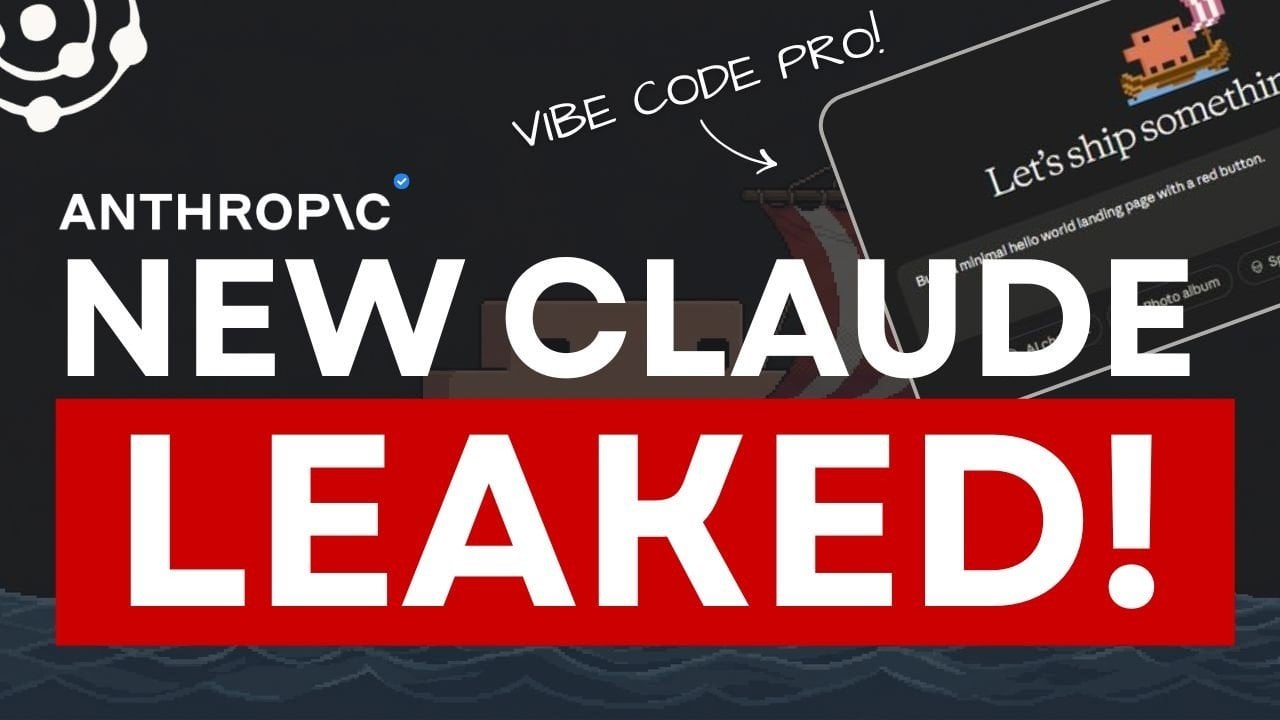
Anthropic's recent leaks shed light on key developments within the Claude ecosystem, offering insights into updates that may influence developers and researchers. Universe of AI examines the introduction of the "Claude Builder", an interface designed for creating full-stack applications with features such as template-based design, real-time app previews and integrated security measures. The leaks also include Mythos benchmarks, which compare Anthropic's Mythos model to OpenAI's GPT 5.4 Pro, highlighting Mythos' efficiency in long-context tasks and its potential cost advantages. Dive into the implications of these updates, including the expanded coding capabilities that enable multi-repository management, the significance of Mythos' benchmark results for resource allocation and the reported performance adjustments in Claude Opus 4.6. This breakdown provides a detailed exploration of the evolving strategies and challenges within Anthropic's AI landscape. Leaked screenshots reveal a new app-building tool within the Claude ecosystem, referred to as the "Claude Builder". This interface is designed to simplify the creation of full-stack applications, catering to both novice and experienced developers. Its features include: Positioned as a competitor to platforms like Lovable and Bolt, the Claude Builder aims to streamline the app development lifecycle, making it more accessible and efficient. Another key update involves Claude's coding tools, which now include a unified interface for managing multiple repositories. This feature allows you to work across several codebases simultaneously, improving efficiency in collaborative and large-scale projects. By integrating ideation, prototyping and repository management into a single platform, Anthropic is targeting developers who prioritize streamlined workflows and scalability. These enhancements suggest a strategic push to position Claude as an essential tool for developers tackling complex projects. Here is a selection of other guides from our extensive library of content you may find of interest on Anthropic Claude. Leaked benchmarks compare Anthropic's Mythos model to OpenAI's GPT 5.4 Pro, with Mythos emerging as a strong contender. The data highlights Mythos' superior performance in coding and reasoning-intensive tasks, particularly when handling long-context inputs. Additionally, Mythos offers a cost advantage, making it an attractive option for developers seeking high performance at a competitive price. While OpenAI's upcoming Spud Pro model may alter the competitive landscape, these benchmarks underscore Anthropic's focus on delivering robust, cost-effective AI solutions. In contrast to the advancements seen with Mythos, Claude Opus 4.6 has reportedly experienced a decline in performance. Developers have noted reduced accuracy and reasoning capabilities, raising questions about potential silent updates or resource reallocation to the anticipated Claude Opus 4.7. This decline has sparked concerns about transparency and the impact on projects relying on Opus 4.6. Anthropic has not yet addressed these issues, leaving developers uncertain about the model's future. These updates suggest that Anthropic is adopting a comprehensive approach to the AI development lifecycle. By integrating tools for prototyping, coding and deployment, the company is positioning itself as a one-stop solution for developers. This strategy not only strengthens its competitive stance against OpenAI but also broadens its appeal within the app development and coding markets. Despite the promising features and benchmarks, these leaks remain unverified by Anthropic. Speculation surrounds the motivations behind the performance adjustments in Claude Opus 4.6 and the timing of these updates. Some believe these changes are paving the way for future releases, while others question the transparency of Anthropic's decision-making process. The leaked updates to Anthropic's Claude ecosystem highlight the company's commitment to innovation in AI and app development. From the Claude Builder's user-friendly interface to the competitive performance of the Mythos model, these developments reflect a strategic effort to meet the evolving needs of developers. However, the reported decline in Claude Opus 4.6's performance and the lack of official confirmation introduce an element of uncertainty. As Anthropic continues to refine its offerings, the competitive dynamics within the AI landscape are poised to intensify. Disclosure: Some of our articles include affiliate links. If you buy something through one of these links, Geeky Gadgets may earn an affiliate commission. Learn about our Disclosure Policy.
Amazon reportedly nears deal for Globalstar in bid to take on SpaceX's Starlink
Bloom Energy spiked 15% in postmarket trading on Monday after expanding its pact to supply power to Oracle. The hyperscaler has contracted an initial 1.2 gigawatts of fuel cell capacity from Bloom, with plans to procure up to 2.8 gigawatts in order to support the power needs of its data centers. Shares of Bloom boomed last July after the initial announcement that it would be delivering "onsite power for an entire data center within 90 days," the first time the fuel cell company booked a direct deal with a hyperscaler. Bloom came through with the delivery in 55 days. Oracle execs are obviously pleased with the execution and the results -- and have another reason to be happy about getting more power from Bloom... In concert with this announcement, a filing showed that Oracle received warrants to buy 3.53 million shares of Bloom Energy for $113.28 apiece on April 9, as part of an agreement reached between the two sides in October. That would be about 1.25% of Bloom's current shares outstanding. "It was a great strategic partnership where both enterprises had a lot to gain," Bloom founder, chairman, and CEO KR Sridhar said of the warrant deal during the Q4 earnings call on February 2026. "And remember, these were not penny warrants. These were done at market pricing on the day we agreed to, like what we do. So it is not in lieu of something other than both parties enhancing enterprise value." So, Bloom's business gets a massive boost from a hyperscaler moving from a proof of concept to a seal of approval, and Oracle gets power for about $320 million less than the sticker price (based on the gap between Bloom's postmarket price on Monday, roughly $204, and the exercise price of the warrants).
Anthropic Project Glasswing Finds Bugs Faster
Anthropic quietly unveiled Project Glasswing, an AI system designed to find security vulnerabilities in codebases faster than human penetration testers. Early benchmarks show it identifying critical bugs in minutes that typically take experienced security researchers hours or days to discover. Traditional static analysis tools check code against known vulnerability patterns. They catch the obvious stuff: SQL injection, cross-site scripting, buffer overflows in standard configurations. Glasswing goes further by reasoning about code the way an attacker would. It traces data flows across multiple files, identifies logic flaws, and finds vulnerabilities that emerge from how components interact rather than from any single line of code. The system builds on Claude's reasoning capabilities but is specifically fine-tuned on security audit data, CVE databases, and real-world exploit chains. Where a general-purpose AI might identify that a function looks risky, Glasswing can explain precisely how an attacker would chain three seemingly harmless functions together to achieve remote code execution. If you have been following the AI model comparison space, this represents a shift from general reasoning to specialized, high-stakes domain expertise. In a controlled test against a codebase with 47 planted vulnerabilities, Glasswing found 43 within 20 minutes. A team of three experienced penetration testers found 38 in eight hours. The AI missed some nuanced business logic flaws, but caught several deep architectural weaknesses the human team overlooked entirely. Speed matters because most companies ship code faster than their security teams can review it. A tool that catches 90% of critical vulnerabilities before deployment beats a manual process that catches 95% but takes weeks. The math favors automation when release cycles are measured in days. Glasswing is not replacing security teams. Anthropic positions it as a force multiplier: the AI handles the initial sweep, flags high-confidence findings, and the human team focuses on the complex, context-dependent vulnerabilities that require understanding business logic and threat models. This mirrors how AI agent platforms are being adopted across industries. The AI handles volume; humans handle judgment. Neither works as well alone. For companies running security-critical software, Glasswing offers a way to audit more code more often without hiring an army of specialized security engineers. Project Glasswing is currently in limited access for enterprise customers. Anthropic has not announced public pricing, but early partners include financial services firms and cloud infrastructure providers where security bugs carry the highest business impact. The broader implication is clear: AI security auditing is no longer theoretical. Glasswing proves the technology works at production scale, and competitors will follow. If your security review process still relies entirely on quarterly manual audits, that approach has an expiration date.

OpenAI Memo Signals Shift Beyond Microsoft, Takes Aim at Anthropic
OpenAI's internal memo reveals plans to expand beyond Microsoft, counter Anthropic's narrative, and capture a larger enterprise AI market. OpenAI is recalibrating its long-term strategy as competition intensifies in the artificial intelligence space, according to a recently leaked internal memo from its new revenue chief, Denise Dresser. The memo outlines the company's ambitions to reduce reliance on Microsoft, expand its enterprise reach, and directly challenge rival Anthropic. In the communication sent to employees, Dresser acknowledged the critical role Microsoft has played in OpenAI's growth. However, she also pointed out that the partnership has created limitations, particularly when it comes to accessing enterprise customers who operate outside Microsoft's ecosystem. "Our Microsoft partnership has been foundational to our success. But it has also limited our ability to meet enterprises where they are - for many that's Bedrock," Dresser wrote, referring to Amazon's AI platform. This signals a clear intent by OpenAI to deepen ties with Amazon and make its models more accessible through services like AWS and Bedrock. The memo also highlights OpenAI's evolving multi-cloud approach. While Microsoft remains a key partner, the company has already started diversifying its infrastructure by working with providers such as Google, Oracle, and CoreWeave. This shift reflects growing friction as Microsoft increasingly positions itself as both collaborator and competitor in the AI race. Beyond partnerships, Dresser used the memo to draw a sharp contrast with Anthropic's positioning in the market. She argued that the rival firm, led by Dario Amodei, has leaned heavily on cautionary narratives around artificial intelligence. "Their story is built on fear, restriction, and the idea that a small group of elites should control AI," she wrote. In contrast, Dresser emphasized that OpenAI is focused on a more optimistic vision, adding that its "positive message" would "win over time." Despite acknowledging Anthropic's early advantage in certain areas, particularly with its Claude Code offerings, Dresser suggested that the company may face challenges due to insufficient investment in computing resources. She also questioned the accuracy of Anthropic's reported financials, claiming its $30 billion annual run rate may be overstated due to accounting practices involving revenue-sharing agreements. OpenAI, currently led by Sam Altman, is simultaneously sharpening its internal priorities. The memo indicates a renewed focus on core products and enterprise solutions, with less emphasis on experimental initiatives. Tools like Codex are expected to play a central role in this strategy as the company works to strengthen its position in the business market. The broader context is a rapidly evolving AI industry, where both OpenAI and Anthropic are reportedly preparing for potential public listings. With OpenAI valued significantly higher, the stakes are rising as both firms compete for dominance in enterprise AI adoption. Dresser concluded with a strong call to action for employees, urging them to stay aligned with customer needs and execute with precision. "The market is ours to win, let's execute accordingly," she wrote, underscoring the company's confidence as it enters its next phase of growth.