News & Updates
The latest news and updates from companies in the WLTH portfolio.
At a major AI conference, the consensus was clear: Anthropic is the new favorite in Silicon Valley
But with how quickly models are advancing, no one was ready to count OpenAI out. Thousands converged in downtown San Francisco this week for HumanX, one of the year's biggest AI conferences, proving people still prefer interacting with humans rather than AI agents. Talking to VCs and founders inside San Francisco's Moscone Center, the consensus was clear for most: Anthropic is the new Silicon Valley favorite. That sentiment is a sharp contrast with the first HumanX last year, held in a Las Vegas casino, where most VCs were placing their chips on OpenAI. "In Vegas last year, it felt like OpenAI was the clear winner, and now it seems like Anthropic is miles ahead," said Roseanne Winsek of Renegade Partners. "The Anthropic product is so good." Last year, Anthropic had not yet widely released Claude Code or Claude 4. Now, Claude Code is a phenomenon. Both companies are preparing to go public, and Anthropic is releasing models that are the envy of the industry. Valued at $380 billion, some VCs also see it as a better bargain compared to OpenAI's rich $852 billion valuation, especially with Anthropic announcing this week that its run-rate revenue surpassed $30 billion, up from $9 billion at the end of 2025. "They're crushing it," said Jared Quincy Davis, founder and CEO of Mithril, an AI cloud platform, referring to Anthropic. "It's pretty clear that the focus that they had on enterprise, on frontier capabilities, on coding, and making deliberate decisions not to go into some consumer use cases, were great decisions" OpenAI and Anthropic did not respond to requests for comment. While there was universal praise for Anthropic, it was hard to find anyone saying good things about OpenAI, whether because of bewilderment over its recent acquisition of the internet talk show TBPN or questions about CEO Sam Altman's deal with the Pentagon. Most founders and VCs were still reluctant to criticize OpenAI on the record. "There are quite a few people who have disagreed with Sam and what he's been doing," said Andy Chen, a former partner at Coatue and Kleiner Perkins, who is expecting a brain drain of talent from OpenAI. "And Anthropic has tripled its revenue in the past three months." As if Anthropic did not already have enough momentum, midway through the conference, it announced its latest model, Mythos, which it said is so powerful it cannot yet be unleashed upon the general public because of the risk of cyber attacks. "The Mythos model is a huge deal, said Tomasz Tunguz, founder and general partner of Theory Ventures. "There's a tremendous amount of excitement." This year's HumanX was twice as large as last year, with some 6700 attendees paying upward of $4,000 a ticket for a chance to rub shoulders with industry heavyweights like Lovable cofounder Anton Osika or billionaire venture capitalist Vinod Khosla. On a vast exhibition floor, startups building AI agenetic security startups and autonomous workflows handed out branded hoodies, water bottles, and notebooks. Each day, attendees received an AI-generated list of people they should have lunch with and which sessions to attend. (The list I got was not very helpful, as it spit out a list of other VC journalists to meet.) Robot humanoids and dogs roamed the floor, but nearby, the real dogs with their real fur at the "HumanX Dog Park" proved far more popular. There was also a "retro lounge" with a pinball machine and jukebox, a mock New York City bodega, and a wellness lounge offering massages. The non-AI attractions seemed designed to calm the nerves of anxious attendees worried about what the AI future might hold. "The mood I'm feeling is exuberance and existential terror," said Stefan Weitz, a former Microsoft executive who is co-founder and CEO of HumanX. "I can't reconcile the two." The rapid shift in sentiment from last year reflects the dizzying pace of AI advancement, leaving VCs exhausted. "Every day you wake up and something has meaningfully changed," said Tunguz. "Everyone is in a rush because everything is changing so fast. " With how quickly models are advancing, no one was ready to count OpenAI out. When HumanX returns to Las Vegas next year, the betting favorite could have changed. "These things change so fast," Winsek said. "OpenAI will probably be back."
Anthropic's Mythos AI can spot weaknesses in almost every computer on earth. Uh-oh.
Aimee Picchi is the associate managing editor for CBS MoneyWatch, where she covers business and personal finance. She previously worked at Bloomberg News and has written for national news outlets including USA Today and Consumer Reports. Anthropic's latest AI technology, called Mythos, is so powerful at revealing software vulnerabilities that the company is afraid to release the model publicly lest it fall into the hands of bad actors. The company, the developer behind the Claude AI chatbot, said in a post on its website this week that the new tool has already uncovered thousands of weak points in "every major operating system and web browser." Although that capability could prove to be a boon for protecting critical systems, it is also stirring concerns that hackers could exploit Mythos to attack the IT infrastructure at banks, hospitals, government systems and many other organizations. Rather than releasing Mythos to the public, Anthropic is sharing the tech with a select group of major companies, including Amazon, Apple, Cisco, JPMorgan Chase and Nvidia, so they can test the model and strengthen their own systems against cyberattacks. Called Project Glasswing, the effort is aimed at helping key companies harden their defenses before hackers get access to Mythos or similar AI models, according to Anthropic. At the same time, security experts said, the concerns around Mythos attest to the dangers of AI if it is weaponized for harm. "What we need to do is look at this as a wake-up call to say, the storm isn't coming -- the storm is here," Alissa Valentina Knight, CEO of cybersecurity AI company Assail, told CBS News. "We need to prepare ourselves, because we couldn't keep up with the bad guys when it was humans hacking into our networks. We certainly can't keep up now if they're using AI because it's so much devastatingly faster and more capable." Mythos' capabilities are also sparking concern among federal officials. Treasury Secretary Scott Bessent and Federal Reserve Chair Jerome Powell met with top bank CEOs in a closed-door meeting on Tuesday to discuss Mythos and other emerging cybersecurity risks stemming from AI. Anthropic also briefed senior U.S. government officials and key industry stakeholders on Mythos's capabilities, CBS News has learned. Separately, IMF Managing Director Kristalina Georgieva said in an interview set to air Sunday on "Face the Nation with Margaret Brennan" that the world does not have the ability "to protect the international monetary system against massive cyber risks." "The risks have been growing exponentially," Georgieva said. "Yes, we are concerned. We are very keen to see more attention to the guardrails that are necessary to protect financial stability in the world of AI." Anthropic didn't return a request for comment. In its post, however, the company underscored the risks of misusing tools like Mythos. "The fallout -- for economies, public safety, and national security -- could be severe," the company said. Such stark warnings mask another troubling reality: Hackers already have access to advanced AI models and are using them for a range of malign purposes, including to create autonomous "agents" capable of carrying out attacks without human intervention. Such attacks range from spreading malware and executing identity theft scams to producing deepfake videos and launching ransomware attacks, according to cybersecurity experts. "AI-enabled tooling has empowered even low-skilled threat actors to execute high-speed, high-volume operations, whilst advanced adversaries are using AI to sharpen precision, scale automation and compress attack timelines," PwC said in a recent report. "The time between the public release of a new capability by an AI company and its weaponization by threat actors shrank dramatically [in 2025], a trend we assess will likely accelerate in 2026," the management consulting firm added, Other AI tools, while not yet as effective as Mythos in exposing the soft underbelly in software, are already amplifying the risks to consumers, businesses and governments. For instance, hackers are tapping AI to sharpen so-called phishing attacks aimed at prying loose confidential information, said Zach Lewis, the chief information officer at the University of Health Sciences and Pharmacy in St. Louis. "It's been used to really script those dialogues, those conversations, those phishing emails, to specific people -- and really customize them to make them a lot more difficult to detect and identify if these are fake or not," he told CBS News. "Once [Mythos] drops, we're going to see a lot more vulnerabilities, probably a lot more attacks," Lewis said. "Cyberattacks are definitely going to increase until we get to a point where we're patching up all those vulnerabilities almost in real time." AI is more effective than humans at finding software bugs because it can quickly scan thousands of lines of code and detect problems, something people are not necessarily good at, Knight explained. "Humans are the weakest link in security," Knight noted. "Humans have the ability to make mistakes when we're writing code. It's possible for vulnerabilities in source code to have never been found by humans." Some security experts questioned the motives behind Anthropic's incremental approach to rolling out Mythos, speculating that the limited release could be aimed at stirring intrest from other prospective customers. Meanwhile, both Anthropic and rival OpenAI are expected to launch initial public offerings by the end of the year, according to the Wall Street Journal -- a possible incentive to drum up headlines, said Peter Garraghan, founder and Chief Science Officer at Mindgard, an AI security platform. "I suspect Anthropic may be using this as a marketing ploy, perhaps towards IPO," he said. Anthropic has sought to distinguish its brand from OpenAI and other rivals by publicly emphasizing AI safety, highlighting its guardrails for keeping the technology in line. Anthropic's decision to hold off on releasing Mythos and launching Project Glasswing aligns with that image, noted Columbia Business School marketing lecturer Malek Ben Sliman. "When facing the tough decisions, Anthropic has actually been true to its values," he said. Curating the release of Mythos "does allow them to look to be the protectors of this responsible AI, but it also is a great marketing and advertising tool."
2 sonic booms possible in California? Artemis II splashdown, SpaceX launch
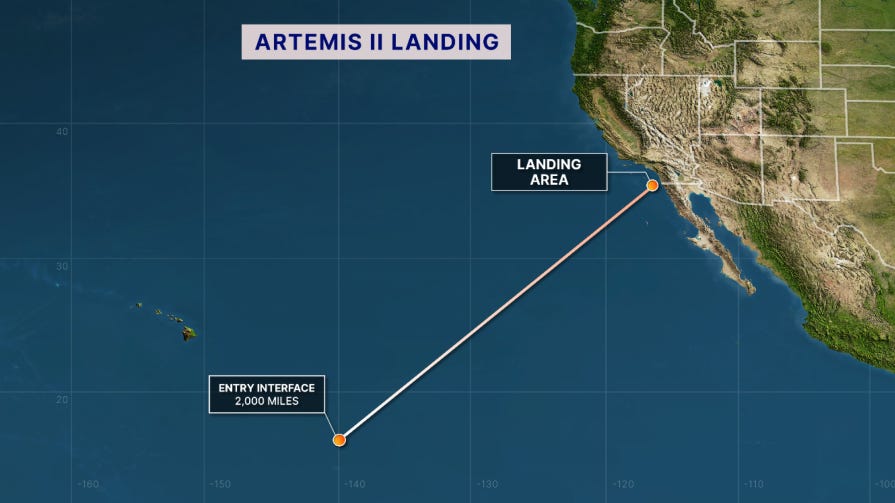
A sonic boom will herald the end of the record-setting Artemis II mission after a California splashdown. Hours later, there might be another one. The U.S. Geological Survey said to expect a sonic boom after NASA Artemis II's Orion capsule streaks through the atmosphere during its return to Earth in a planned water landing off the coast of San Diego. The thunderous vibration will likely take place between 5 p.m. and 5:15 p.m. Pacific Time, the USGS wrote in a post on X. The boom, USGS said, may be heard throughout Southern California as four astronauts complete a 10-day voyage to circle the moon and travel farther in space than anyone in history. The Orion spacecraft, carrying Reid Wiseman, Christina Koch, Victor Glover and Jeremy Hansen, is expected to splash down about 8:07 p.m. ET in the Pacific Ocean off the California coast, according to NASA. The USGS is asking anyone who hears the sonic boom to report it here or visit https://earthquake.usgs.gov/earthquakes/eventpage/tellus. Is there a SpaceX rocket launch today in California? Hours after the Artemis II astronauts are due to splash down off the coast of San Diego, California, SpaceX could launch a rocket about 200 miles north. A Falcon 9 rocket is due to get off the ground at 10:39 p.m. ET Friday, April 10, 2026, from Space Launch Complex 4-East (SLC-4E) at the Vandenberg Space Force Base in Santa Barbara County, California. The rocket will fly at a southern trajectory. After liftoff, the Falcon 9 will deploy 25 SpaceX Starlink broadband internet satellites into low-Earth orbit, an altitude nearer Earth's atmosphere where they're able to circle the planet quickly. The rocket's booster will then aim to land on a SpaceX drone ship, nicknamed "Of Course I Still Love You," in the Pacific Ocean. This allows for SpaceX personnel to recover the booster so it can be reused in future spaceflights. The launch window for the Friday, April 10, 2026, SpaceX Falcon 9 Starlink 17-21 mission is due to open shortly after the four Artemis II astronauts' planned splashdown in the Pacific Ocean. A Federal Aviation Administration operations plan advisory suggests a backup opportunity is available the next day if the SpaceX Falcon 9 rocket launch were to be postponed. What is a sonic boom? Will there be sonic booms from SpaceX Falcon 9 rocket launch in California? According to the U.S. Air Force, a sonic boom is caused by an object moving faster than sound - about 750 miles per hour at sea level. Residents of Santa Barbara County, San Luis Obispo County and Ventura County often stand to be the most likely to hear sonic booms, SpaceX said. The sonic booms - brief, thunder-like noises that are often heard from the ground when a spacecraft or aircraft travels faster than the speed of sound - could last for up to 10 minutes after liftoff, Vandenberg has added. "Areas local to Vandenberg Space Force Base will hear the initial low rumble of take-off," Vandenberg has also said. "An aircraft traveling through the atmosphere continuously produces air-pressure waves similar to the water waves caused by a ship's bow," according to the Air Force. "When the aircraft exceeds the speed of sound, these pressure waves combine and form shock waves which travel forward from the generation or 'release point.'" For the latest news and launch schedule from Cape Canaveral Space Force Station and NASA's Kennedy Space Center, visit floridatoday.com/space. Another easy way: Click here to sign up for our weekly Space newsletter.
Polymarket Investigation: Congress Acts
Congress is calling for a Polymarket investigation after at least 50 newly created accounts placed bets on a US-Iran ceasefire in the minutes before President Trump announced it on social media on April 9. The prediction market platform Polymarket is at the center of a congressional firestorm after the US-Iran ceasefire announcement. At least 50 newly created accounts placed bets on the outcome in the hours and minutes before President Trump posted about the deal, and most made no other bets before or since. According to NPR, at least 50 new accounts placed substantial bets on a US-Iran ceasefire in the hours and minutes before President Trump posted the deal on social media. The accounts had no prior betting history and made no other trades, raising immediate suspicion of insider activity. Rep. Ritchie Torres sent a letter to the CFTC demanding a formal investigation. Sen. Richard Blumenthal went further, calling Polymarket "an illicit market to sell and exploit national security secrets unlike any in history." This is not the first time suspicious betting has preceded a major geopolitical event. As crypto.news reported, six Polymarket accounts were previously accused of using insider information to profit from the timing of earlier US strikes on Iran, earning roughly $1 million and triggering the so-called DEATH BETS Act from Senator Adam Schiff. Analytics firm Bubblemaps had flagged newly created wallets placing timely bets just hours before those strikes commenced. The pattern has now repeated with greater speed: the latest bets were placed in the minutes before the announcement, not just hours. The CFTC issued an advance notice of proposed rulemaking on prediction markets in March 2026, with the comment window set to close on April 30. More than 10 anti-prediction market bills have been introduced in Congress since January. As crypto.news noted, six Democratic senators previously urged the CFTC to ban contracts that resolve on or correlate to an individual's death. Polymarket, which operates outside US jurisdiction and requires only a crypto wallet to trade, has not commented on the latest congressional demands.

Maddie Lightening speaks on misreported ROAS, account structure chaos & AI mistakes
Maddie Lightening shares lessons from a currency reporting error and legacy account structure challenges, and using AI effectively. Maddie Lightening, head of paid media at Hallam, joined me to talk through the mistakes, lessons and mindset shifts that have shaped her career in PPC. With more than a decade of experience across search, social, programmatic, digital out of home and ABM, she shared a candid look at the realities of leading paid media in a fast-moving industry. The reporting mistake that doubled performance One of Maddie's early mistakes involved misreporting performance due to account currency differences. Working with an Australian billing setup while reporting in GBP, she unknowingly halved the reported results because conversion values were being translated. The issue only surfaced after comparing platform data with CRM figures, revealing that performance was actually twice as strong as reported, highlighting how easily technical setup details can skew results. When legacy account structure becomes a problem A more complex challenge came from a travel client running an outdated, highly granular account structure with thousands of campaigns. While this "2016-style" setup had previously worked, it clashed with modern AI-driven bidding and data consolidation approaches, making it harder to optimize performance and diagnose issues when results began to decline. Why timing matters as much as strategy Maddie explained that although the team had planned to restructure the account, they delayed it to avoid disrupting peak season. When performance dropped in January, they were forced to make multiple changes quickly, which increased pressure and complexity. In hindsight, starting the restructure earlier would likely have reduced risk, showing that delaying necessary changes can sometimes be more damaging than acting sooner. The pressure of fixing performance in real time As performance declined during a critical period, the client became understandably concerned, especially given how much of their annual budget was tied to peak months. At the same time, audits and internal reviews added pressure, making it one of the most challenging moments of Maddie's career, but also reinforcing the importance of collaboration, support and staying focused on solutions rather than panic. How a max CPC cap helped reclaim control One key fix involved regaining control over rising CPCs by applying a max CPC cap through portfolio bidding strategies, even while using automated bidding. This approach reduced CPCs significantly without harming performance, demonstrating that advertisers can still guide AI-driven campaigns by applying the right constraints rather than relying on full automation alone. Why banning AI is the wrong move Maddie also highlighted a broader industry mistake: refusing to adopt AI altogether. She recalled working at an agency that banned AI tools and automation, which she believes limits growth and puts teams at a disadvantage. Instead of resisting AI, she argues that marketers should learn how to use it strategically while maintaining oversight. Better prompts lead to better AI outputs A key takeaway on AI usage is that results depend heavily on input quality. Maddie emphasized that vague prompts produce weak outputs, while detailed context -- such as goals, audience and structure -- leads to far more useful results. AI should be treated as a support tool that enhances human work, not replaces it. Why curiosity still matters in PPC Maddie stressed the importance of experimentation, encouraging teams to test ideas even when outcomes are uncertain. Her philosophy -- "test and learn" -- reflects the idea that even unsuccessful experiments provide valuable insights that can inform better decisions in the future. Small mistakes are not career-ending She also addressed everyday mistakes, such as sending the wrong report to a client, noting that while they may feel serious in the moment, they are usually easy to fix. The key is to take accountability, correct the issue quickly and keep perspective rather than overreacting. The bigger lesson for paid media teams Across all her examples, Maddie reinforced that success in PPC comes from adaptability, continuous learning and a willingness to challenge existing approaches. Whether dealing with account structure, automation or performance issues, the ability to evolve is what separates strong teams from the rest. Final takeaway Ultimately, Maddie's experience shows that mistakes, when handled correctly, can lead to stronger strategies and better performance, and that staying curious, proactive and open to change is essential for long-term success in paid media.

SpaceX Pre-IPO Goes On-Chain as Bitget Launches IPO Prime Market
Bitget opens private markets to retail users with SpaceX-linked pre-IPO token and OTC trading access. Crypto exchanges continue to push into private market exposure through tokenization. A new product from Bitget brings pre-IPO access closer to retail users. The offering centers on synthetic exposure tied to private companies rather than direct equity ownership. Bitget has rolled out IPO Prime, a new product offering tokenized exposure to companies ahead of public listings. The first asset under the program is preSPAX, which tracks SpaceX's economic performance. The token is tied to SpaceX's valuation on the Nasdaq Private Market, where private company shares trade. Users gain synthetic exposure to price movements, allowing participation in pre-IPO valuation shifts without holding actual shares. IPO Prime operates through a subscription model powered by Republic. Eligible users can apply for allocations, with limits determined by account tier. Higher-tier users receive larger allocation caps during the subscription phase. Once the subscription phase concludes, the allocated tokens move to an over-the-counter market on Bitget. There, the tokens can be traded freely. The setup introduces liquidity to assets that are typically locked until public listing events. According to the timeline, preSPAX is set to launch on April 21 at 12:00 UTC. Meanwhile, the subscription window opens on April 18 at 18:00 UTC and closes on April 21 at 18:00 UTC. Distribution will then take place later on launch day, between 18:00 and 22:00 UTC. CEO of Bitget Gracy Chen stated that the model changes how investors access early-stage growth opportunities. In addition, she noted that the structure expands participation beyond institutional players, offering retail traders earlier entry into companies such as SpaceX. Moreover, Bitget will also offer two rounds of airdrops for eligible VIP users ahead of trading. These incentives aim to increase early participation and improve initial market activity. However, the company clarified that preSPAX does not represent direct equity ownership in SpaceX. Instead, the token reflects a mirrored economic interest tied to potential future liquidity events. Notably, SpaceX has neither endorsed nor authorized the offering.

Wall Street Banks Try Out Anthropic's Mythos as US Urges
(Bloomberg) -- Wall Street banks are starting to test Anthropic PBC's Mythos model internally as Trump administration officials encourage them to use it to detect vulnerabilities. While JPMorgan Chase & Co. was the only bank named as part of an initiative to test the Mythos model, other major financial institutions have also gained access or expect to in the coming days, according to people familiar with the matter. Goldman Sachs Group Inc., Citigroup Inc., Bank of America Corp. and Morgan Stanley are among the banks testing the technology internally, the people said. Those firms either declined to comment or had no immediate response. During a meeting this week with Wall Street leaders, summoned by US Treasury Secretary Scott Bessent and Federal Reserve Chair Jerome Powell, executives were warned that they should take the Mythos model seriously and deploy its capabilities to detect vulnerabilities, the people said, asking not to be identified because the information isn't public. Government officials didn't raise any specific threat to financial institutions and more generally encouraged the banks to run the model against their own systems to improve their own defenses, they said. Bloomberg reported earlier that Bessent and Powell had assembled the group of banking executives on April 7 at Treasury's headquarters in Washington on short notice to ensure that banks were aware of possible risks raised by Anthropic's Mythos and similar models. The executives were in town already for a meeting of the Financial Services Forum, an advocacy group made up of the biggest lenders. A representative from the Treasury Department didn't respond to a request for comment. A Federal Reserve spokesperson declined to comment. The urging by Trump officials underscores the concern growing among regulators that a new breed of cyberattacks is one of the biggest risks facing the financial industry. All the banks summoned to the meeting are classified as systemically important by top regulators, meaning their stability is a priority for the global financial system. Anthropic has said that it has been in discussions prior to its recent release with US officials about Mythos and its "offensive and defensive cyber capabilities." The company has limited the release of Mythos to a few dozen firms initially. Those companies, which include JPMorgan, Amazon.com Inc. and Apple Inc., are part of what's being called "Project Glasswing," which will work to secure the most important systems before other similar AI models become available. In releasing Mythos to a very limited set of companies, Anthropic pointed to several vulnerabilities that the AI system was capable of both identifying and potentially exploiting during testing. None of the examples related specifically to financial institutions, but in one instance, the firm's security team said it was able to compromise a web browser so that a website set up by a hacker could read data from another website "e.g., the victim's bank."

Anthropic's Claude Code and Computer Use Driving Revenue for the AI Pioneer - Tekedia
Anthropic's revenue has seen explosive growth in 2025-2026, heavily driven by its agentic AI offerings, particularly Claude Code, an autonomous coding agent and tool, and related features like Computer Use which allows Claude to interact with a user's desktop, browser, files, and applications to complete tasks. January 2025: ~$1 billion ARR. Mid-2025: ~$4-5 billion. End of 2025: ~$9 billion. February 2026: ~$14 billion with Claude Code contributing significantly. March 2026: Surged to ~$19 billion. April 2026 recent reports: Exceeded $30 billion ARR, with some months adding billions in run-rate growth. This represents roughly 10x+ annual growth sustained over multiple years, and in some periods, multi-billion-dollar monthly increases. Enterprise deals including via AWS Bedrock and Google Cloud make up the vast majority -- often cited around 80% -- with over 500 customers now spending $1M+ annually and eight of the Fortune 10 using Claude. Claude Code launched to the public around May 2025 and quickly became a major growth engine: Reached $1 billion ARR in about six months. Hit $2.5 billion+ ARR by February 2026, more than doubling since the start of 2026. Business and enterprise subscriptions quadrupled in the early months of 2026. Enterprise usage now accounts for over half of Claude Code revenue. It has driven a notable share of overall growth; some estimates put it at ~20% or more of total revenue at certain points, with reports of 4%+ of all public GitHub commits authored by it in early 2026. Anthropic has also expanded agentic capabilities with: Computer use and browser agents; Claude controlling screens, apps, and workflows. Agent Teams and multi-agent coordination. Products like Claude Cowork for white-collar automation. These features emphasize tool use, long context, and autonomous execution, which boost usage-based pricing and enterprise adoption over pure chat interfaces. Perplexity's recent 50% monthly revenue jump to ~$450M ARR; post-agent pivot with Perplexity Computer and usage-based pricing is impressive for a smaller player but remains dwarfed by Anthropic's scale. Anthropic's agentic push especially in coding and computer control has fueled far larger absolute and relative gains, with Claude Code alone surpassing Perplexity's total ARR in velocity. This aligns with industry patterns: agentic systems command premium monetization because they deliver measurable productivity e.g., 20x faster development in some case studies, massive time savings in compliance or security workflows. However, challenges remain -- high compute costs can lead to negative margins on heavy usage, and scaling safely while maintaining reliability is key for Anthropic's constitutional AI focus. Anthropic's trends strongly validate the agents = higher revenue thesis seen at Perplexity. The company has moved from a safety-focused research outfit to a revenue powerhouse by productizing agentic tools that enterprises will pay heavily for, particularly in software engineering and workflow automation. Growth has been so steep that some analysts project even higher run rates potentially $100B+ annualized if momentum continues. Anthropic's own research on real-world Claude conversations estimates that AI assistance reduces task completion time by around 80% in many cases, with software developers seeing the largest contributions to overall labor productivity about 19% of AI-attributable gains. Internal Anthropic data shows engineers using Claude in ~60% of their work, reporting a 50% productivity boost up from 20% the prior year, including more output volume and the ability to tackle tasks that wouldn't have been done otherwise. Pull request merge rates have increased significantly in some cases. Developer reports and case studies often cite: 40% faster task completion in controlled evaluations of Claude-based copilots; strongest for mid-complexity scaffolding, glue code, debugging, and business logic rather than novel architecture. Up to 2x developer velocity, doubled pull request rates, or 164% increases in story completion for individual users. In enterprises: One fintech team achieved 2x velocity and +10% test coverage; another platform saw 95-99% R&D time reduction for non-technical users building tools. Broader estimates suggest current-generation models with adoption could boost U.S. labor productivity growth by 1.0-1.8% annually over a decade, with coding as a top area.
Céline Dion Paris Concerts: Ticket Chaos and Pricing Controversy - News Directory 3
The scramble for tickets has been marked by significant technical hurdles and pricing controversies. Céline Dion's return to the stage in Paris has triggered an unprecedented surge in ticket demand, leaving millions of fans unable to secure seats for the upcoming performances. Reports indicate that approximately 9 million people attempted to purchase tickets for a total capacity of only 480,000 seats. The sheer volume of interest has transformed the ticketing process into a digital battleground, with many fans describing the experience as a desperate struggle to access the venue. This overwhelming demand underscores the enduring global appeal of the Canadian vocalist and the high anticipation surrounding her live appearances. The scramble for tickets has been marked by significant technical hurdles and pricing controversies. As seats sold out almost instantly, the secondary market and certain primary ticketing platforms saw a dramatic spike in costs. Industry observers and media outlets, including RTL, have raised questions regarding the use of dynamic pricing. This practice allows ticket prices to fluctuate in real-time based on demand, a mechanism that critics argue has artificially inflated the cost of attendance for Dion's Paris shows. The situation has led to accusations that the event has been treated more as a financial opportunity than a musical homecoming, with some reports characterizing the ticketing operation as a machine à cash or cash machine. The volatility of the ticket market and the frustration of the fanbase have attracted the attention of French authorities. The Direction générale de la concurrence, de la consommation et de la répression des fraudes (DGCCRF) has launched an investigation into the practices of various online ticketing platforms. According to reporting from France Info, the government agency is specifically examining whether certain platforms engaged in unfair practices. The probe aims to determine if consumers were misled or if the ticketing systems were manipulated to drive prices higher through non-transparent means. This regulatory scrutiny comes amid a broader European conversation regarding the ethics of dynamic pricing and the prevalence of automated bots that scoop up tickets to resell them at exorbitant markups on the secondary market. For many fans, the inability to secure a ticket has resulted in profound disappointment. The intensity of the competition was compared by some to the Hunger Games, reflecting the high stakes and perceived cruelty of the digital queue systems. The demand for these concerts is not merely a result of Dion's stardom, but also the emotional weight of her return to the stage. After facing significant health challenges that impacted her vocal cords and public appearances, her decision to perform in Paris represents a pivotal moment in her career. The disparity between the 480,000 available tickets and the 9 million interested parties highlights a massive gap in supply and demand, ensuring that the remaining seats are among the most coveted in the current entertainment landscape. The Céline Dion ticketing crisis serves as a case study for the modern concert industry, where the intersection of global celebrity, limited venue capacity, and algorithmic pricing often creates friction between artists and their audiences. As the DGCCRF continues its investigation, the outcome may influence how future high-demand tours are managed in France, potentially leading to stricter regulations on dynamic pricing and more transparent ticket distribution methods to protect consumers from predatory pricing.

Anthropic's potent new AI model is a "wake-up call," security experts say
Anthropic's latest AI technology, called Mythos, is so powerful at revealing software vulnerabilities that the company is afraid to release the model publicly lest it fall into the hands of bad actors. The company, the developer behind the Claude AI chatbot, said in a post on its website this week that the new tool has already uncovered thousands of weak points in "every major operating system and web browser." That is stirring concern that hackers could exploit Mythos to attack banks, hospitals, government systems and other critical infrastructure. Preparing for the "storm" Rather than releasing Mythos to the public, Anthropic is sharing the tech with a select group of major companies, including Amazon, Apple, Cisco, JPMorgan Chase and Nvidia, so they can test the model and strengthen their own systems against cyberattacks. Called Project Glasswing, the effort is aimed at helping key companies harden their defenses before hackers get access to Mythos or similar AI models, according to Anthropic. "What we need to do is look at this as a wake-up call to say, the storm isn't coming -- the storm is here," Alissa Valentina Knight, CEO of cybersecurity AI company Assail, told CBS News. "We need to prepare ourselves, because we couldn't keep up with the bad guys when it was humans hacking into our networks. We certainly can't keep up now if they're using AI because it's so much devastatingly faster and more capable." Mythos' capabilities are also sparking concern among federal officials. Treasury Secretary Scott Bessent and Federal Reserve Chair Jerome Powell met with top bank CEOs in a closed-door meeting on Tuesday to discuss Mythos and other emerging cybersecurity risks stemming from AI. Anthropic also briefed senior U.S. government officials and key industry stakeholders on Mythos's capabilities, CBS News has learned. Separately, IMF Managing Director Kristalina Georgieva said in an interview set to air Sunday on "Face the Nation with Margaret Brennan" that the world does not have the ability "to protect the international monetary system against massive cyber risks." "The risks have been growing exponentially," Georgieva said. "Yes, we are concerned. We are very keen to see more attention to the guardrails that are necessary to protect financial stability in the world of AI." Anthropic didn't return a request for comment. In its post, however, the company underscored the risks of misusing tools like Mythos. "The fallout -- for economies, public safety, and national security -- could be severe," the company said. The weakest link Such stark warnings mask another troubling reality: Hackers already have access to advanced AI models and are using them for a range of malign purposes, including to create autonomous "agents" capable of carrying out attacks without human intervention. Such attacks range from spreading malware and executing identity theft scams to producing deepfake videos and launching ransomware attacks, according to cybersecurity experts. "AI-enabled tooling has empowered even low-skilled threat actors to execute high-speed, high-volume operations, whilst advanced adversaries are using AI to sharpen precision, scale automation and compress attack timelines," PwC said in a recent report. "The time between the public release of a new capability by an AI company and its weaponization by threat actors shrank dramatically [in 2025], a trend we assess will likely accelerate in 2026," the management consulting firm added, Other AI tools, while not yet as effective as Mythos in exposing the soft underbelly in software, are already amplifying the risks to consumers, businesses and governments. For instance, hackers are already tapping AI to sharpen so-called phishing attacks aimed at prying loose confidential information, said Zach Lewis, the chief information officer at the University of Health Sciences and Pharmacy in St. Louis. "It's been used to really script those dialogues, those conversations, those phishing emails, to specific people -- and really customize them to make them a lot more difficult to detect and identify if these are fake or not," he told CBS News. "Once [Mythos] drops, we're going to see a lot more vulnerabilities, probably a lot more attacks," Lewis said. "Cyberattacks are definitely going to increase until we get to a point where we're patching up all those vulnerabilities almost in real time." AI is more effective than humans at finding software bugs because it can quickly scan thousands of lines of code and detect problems, something people are not necessarily good at, Knight explained. "Humans are the weakest link in security," Knight noted. "Humans have the ability to make mistakes when we're writing code. It's possible for vulnerabilities in source code to have never been found by humans." On brand for Anthropic? Some security experts questioned the motives behind Anthropic's incremental approach to rolling out Mythos, speculating that the limited release could be aimed at stirring intrest from other prospective customers. Meanwhile, both Anthropic and rival OpenAI are expected to launch initial public offerings by the end of the year, according to the Wall Street Journal -- a possible incentive to drum up headlines, said Peter Garraghan, Founder and Chief Science Officer at Mindgard, an AI security platform. "I suspect Anthropic may be using this as a marketing ploy, perhaps towards IPO," he said. Anthropic has sought to distinguish its brand from OpenAI and other rivals by publicly emphasizing AI safety, highlighting its guardrails for keeping the technology in line. Anthropic's decision to hold off on releasing Mythos and launching Project Glasswing aligns with that image, noted Columbia Business School marketing lecturer Malek Ben Sliman. "When facing the tough decisions, Anthropic has actually been true to its values," he said. Curating the release of Mythos "does allow them to look to be the protectors of this responsible AI, but it also is a great marketing and advertising tool."

Vance, Bessent questioned tech giants on AI security before Anthropic's Mythos release, CNBC reports
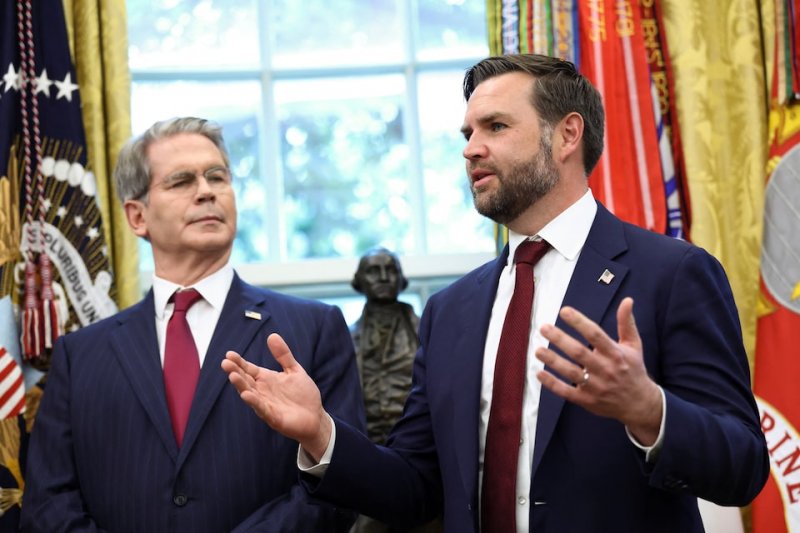
April 10 (Reuters) - U.S. Vice President JD Vance and Treasury Secretary Scott Bessent questioned leading tech CEOs about AI model security and how to respond to cyber attacks a week before Anthropic released its new Mythos model, CNBC reported on Friday. Anthropic's Dario Amodei, Alphabet's Sundar Pichai, OpenAI's Sam Altman, Microsoft's Satya Nadella and the heads of Palo Alto Networks and CrowdStrike were on the call, according to the report. Anthropic declined to comment, while Alphabet, OpenAI, Microsoft, Palo Alto and CrowdStrike did not immediately respond to Reuters' requests for comment. Earlier this week, Anthropic launched a powerful AI model but held off on releasing it widely over concerns that it could expose hidden cybersecurity vulnerabilities. Only a group of around 40 tech heavyweights, including Microsoft and Google, would have access to Anthropic's "Claude Mythos" model. The startup had said it had been in ongoing discussions with the U.S. government about the model's capabilities. (Reporting by Harshita Mary Varghese in Bengaluru; Editing by Leroy Leo)

2 sonic booms possible in California? Artemis II splashdown, SpaceX launch
A sonic boom will herald the end of the record-setting Artemis II mission after a California splashdown. Hours later, there might be another one. The U.S. Geological Survey said to expect a sonic boom after NASA Artemis II's Orion capsule streaks through the atmosphere during its return to Earth in a planned water landing off the coast of San Diego. The thunderous vibration will likely take place between 5 p.m. and 5:15 p.m. Pacific Time, the USGS wrote in a post on X. The boom, USGS said, may be heard throughout Southern California as four astronauts complete a 10-day voyage to circle the moon and travel farther in space than anyone in history. The Orion spacecraft, carrying Reid Wiseman, Christina Koch, Victor Glover and Jeremy Hansen, is expected to splash down about 8:07 p.m. ET in the Pacific Ocean off the California coast, according to NASA. The USGS is asking anyone who hears the sonic boom to report it here or visit https://earthquake.usgs.gov/earthquakes/eventpage/tellus. Is there a SpaceX rocket launch today in California? Hours after the Artemis II astronauts are due to splash down off the coast of San Diego, California, SpaceX could launch a rocket about 200 miles north. A Falcon 9 rocket is due to get off the ground at 10:39 p.m. ET Friday, April 10, 2026, from Space Launch Complex 4-East (SLC-4E) at the Vandenberg Space Force Base in Santa Barbara County, California. The rocket will fly at a southern trajectory. After liftoff, the Falcon 9 will deploy 25 SpaceX Starlink broadband internet satellites into low-Earth orbit, an altitude nearer Earth's atmosphere where they're able to circle the planet quickly. The rocket's booster will then aim to land on a SpaceX drone ship, nicknamed "Of Course I Still Love You," in the Pacific Ocean. This allows for SpaceX personnel to recover the booster so it can be reused in future spaceflights. The launch window for the Friday, April 10, 2026, SpaceX Falcon 9 Starlink 17-21 mission is due to open shortly after the four Artemis II astronauts' planned splashdown in the Pacific Ocean. A Federal Aviation Administration operations plan advisory suggests a backup opportunity is available the next day if the SpaceX Falcon 9 rocket launch were to be postponed. What is a sonic boom? Will there be sonic booms from SpaceX Falcon 9 rocket launch in California? According to the U.S. Air Force, a sonic boom is caused by an object moving faster than sound - about 750 miles per hour at sea level. Residents of Santa Barbara County, San Luis Obispo County and Ventura County often stand to be the most likely to hear sonic booms, SpaceX said. The sonic booms - brief, thunder-like noises that are often heard from the ground when a spacecraft or aircraft travels faster than the speed of sound - could last for up to 10 minutes after liftoff, Vandenberg has added. "Areas local to Vandenberg Space Force Base will hear the initial low rumble of take-off," Vandenberg has also said. "An aircraft traveling through the atmosphere continuously produces air-pressure waves similar to the water waves caused by a ship's bow," according to the Air Force. "When the aircraft exceeds the speed of sound, these pressure waves combine and form shock waves which travel forward from the generation or 'release point.'" For the latest news and launch schedule from Cape Canaveral Space Force Station and NASA's Kennedy Space Center, visit floridatoday.com/space. Another easy way: Click here to sign up for our weekly Space newsletter.
2 sonic booms possible in California? Artemis II splashdown, SpaceX launch
A sonic boom will herald the end of the record-setting Artemis II mission after a California splashdown. Hours later, there might be another one. The U.S. Geological Survey said to expect a sonic boom after NASA Artemis II's Orion capsule streaks through the atmosphere during its return to Earth in a planned water landing off the coast of San Diego. The thunderous vibration will likely take place between 5 p.m. and 5:15 p.m. Pacific Time, the USGS wrote in a post on X. The boom, USGS said, may be heard throughout Southern California as four astronauts complete a 10-day voyage to circle the moon and travel farther in space than anyone in history. The Orion spacecraft, carrying Reid Wiseman, Christina Koch, Victor Glover and Jeremy Hansen, is expected to splash down about 8:07 p.m. ET in the Pacific Ocean off the California coast, according to NASA. The USGS is asking anyone who hears the sonic boom to report it here or visit https://earthquake.usgs.gov/earthquakes/eventpage/tellus. Is there a SpaceX rocket launch today in California? Hours after the Artemis II astronauts are due to splash down off the coast of San Diego, California, SpaceX could launch a rocket about 200 miles north. A Falcon 9 rocket is due to get off the ground at 10:39 p.m. ET Friday, April 10, 2026, from Space Launch Complex 4-East (SLC-4E) at the Vandenberg Space Force Base in Santa Barbara County, California. The rocket will fly at a southern trajectory. After liftoff, the Falcon 9 will deploy 25 SpaceX Starlink broadband internet satellites into low-Earth orbit, an altitude nearer Earth's atmosphere where they're able to circle the planet quickly. The rocket's booster will then aim to land on a SpaceX drone ship, nicknamed "Of Course I Still Love You," in the Pacific Ocean. This allows for SpaceX personnel to recover the booster so it can be reused in future spaceflights. The launch window for the Friday, April 10, 2026, SpaceX Falcon 9 Starlink 17-21 mission is due to open shortly after the four Artemis II astronauts' planned splashdown in the Pacific Ocean. A Federal Aviation Administration operations plan advisory suggests a backup opportunity is available the next day if the SpaceX Falcon 9 rocket launch were to be postponed. What is a sonic boom? Will there be sonic booms from SpaceX Falcon 9 rocket launch in California? According to the U.S. Air Force, a sonic boom is caused by an object moving faster than sound - about 750 miles per hour at sea level. Residents of Santa Barbara County, San Luis Obispo County and Ventura County often stand to be the most likely to hear sonic booms, SpaceX said. The sonic booms - brief, thunder-like noises that are often heard from the ground when a spacecraft or aircraft travels faster than the speed of sound - could last for up to 10 minutes after liftoff, Vandenberg has added. "Areas local to Vandenberg Space Force Base will hear the initial low rumble of take-off," Vandenberg has also said. "An aircraft traveling through the atmosphere continuously produces air-pressure waves similar to the water waves caused by a ship's bow," according to the Air Force. "When the aircraft exceeds the speed of sound, these pressure waves combine and form shock waves which travel forward from the generation or 'release point.'" For the latest news and launch schedule from Cape Canaveral Space Force Station and NASA's Kennedy Space Center, visit floridatoday.com/space. Another easy way: Click here to sign up for our weekly Space newsletter.
2 sonic booms possible in California? Artemis II splashdown, SpaceX launch
A sonic boom will herald the end of the record-setting Artemis II mission after a California splashdown. Hours later, there might be another one. The U.S. Geological Survey said to expect a sonic boom after NASA Artemis II's Orion capsule streaks through the atmosphere during its return to Earth in a planned water landing off the coast of San Diego. The thunderous vibration will likely take place between 5 p.m. and 5:15 p.m. Pacific Time, the USGS wrote in a post on X. The boom, USGS said, may be heard throughout Southern California as four astronauts complete a 10-day voyage to circle the moon and travel farther in space than anyone in history. The Orion spacecraft, carrying Reid Wiseman, Christina Koch, Victor Glover and Jeremy Hansen, is expected to splash down about 8:07 p.m. ET in the Pacific Ocean off the California coast, according to NASA. The USGS is asking anyone who hears the sonic boom to report it here or visit https://earthquake.usgs.gov/earthquakes/eventpage/tellus. Is there a SpaceX rocket launch today in California? Hours after the Artemis II astronauts are due to splash down off the coast of San Diego, California, SpaceX could launch a rocket about 200 miles north. A Falcon 9 rocket is due to get off the ground at 10:39 p.m. ET Friday, April 10, 2026, from Space Launch Complex 4-East (SLC-4E) at the Vandenberg Space Force Base in Santa Barbara County, California. The rocket will fly at a southern trajectory. After liftoff, the Falcon 9 will deploy 25 SpaceX Starlink broadband internet satellites into low-Earth orbit, an altitude nearer Earth's atmosphere where they're able to circle the planet quickly. The rocket's booster will then aim to land on a SpaceX drone ship, nicknamed "Of Course I Still Love You," in the Pacific Ocean. This allows for SpaceX personnel to recover the booster so it can be reused in future spaceflights. The launch window for the Friday, April 10, 2026, SpaceX Falcon 9 Starlink 17-21 mission is due to open shortly after the four Artemis II astronauts' planned splashdown in the Pacific Ocean. A Federal Aviation Administration operations plan advisory suggests a backup opportunity is available the next day if the SpaceX Falcon 9 rocket launch were to be postponed. What is a sonic boom? Will there be sonic booms from SpaceX Falcon 9 rocket launch in California? According to the U.S. Air Force, a sonic boom is caused by an object moving faster than sound - about 750 miles per hour at sea level. Residents of Santa Barbara County, San Luis Obispo County and Ventura County often stand to be the most likely to hear sonic booms, SpaceX said. The sonic booms - brief, thunder-like noises that are often heard from the ground when a spacecraft or aircraft travels faster than the speed of sound - could last for up to 10 minutes after liftoff, Vandenberg has added. "Areas local to Vandenberg Space Force Base will hear the initial low rumble of take-off," Vandenberg has also said. "An aircraft traveling through the atmosphere continuously produces air-pressure waves similar to the water waves caused by a ship's bow," according to the Air Force. "When the aircraft exceeds the speed of sound, these pressure waves combine and form shock waves which travel forward from the generation or 'release point.'" For the latest news and launch schedule from Cape Canaveral Space Force Station and NASA's Kennedy Space Center, visit floridatoday.com/space. Another easy way: Click here to sign up for our weekly Space newsletter.
2 sonic booms possible in California? Artemis II splashdown, SpaceX launch
A sonic boom will herald the end of the record-setting Artemis II mission after a California splashdown. Hours later, there might be another one. The U.S. Geological Survey said to expect a sonic boom after NASA Artemis II's Orion capsule streaks through the atmosphere during its return to Earth in a planned water landing off the coast of San Diego. The thunderous vibration will likely take place between 5 p.m. and 5:15 p.m. Pacific Time, the USGS wrote in a post on X. The boom, USGS said, may be heard throughout Southern California as four astronauts complete a 10-day voyage to circle the moon and travel farther in space than anyone in history. The Orion spacecraft, carrying Reid Wiseman, Christina Koch, Victor Glover and Jeremy Hansen, is expected to splash down about 8:07 p.m. ET in the Pacific Ocean off the California coast, according to NASA. The USGS is asking anyone who hears the sonic boom to report it here or visit https://earthquake.usgs.gov/earthquakes/eventpage/tellus. Is there a SpaceX rocket launch today in California? Hours after the Artemis II astronauts are due to splash down off the coast of San Diego, California, SpaceX could launch a rocket about 200 miles north. A Falcon 9 rocket is due to get off the ground at 10:39 p.m. ET Friday, April 10, 2026, from Space Launch Complex 4-East (SLC-4E) at the Vandenberg Space Force Base in Santa Barbara County, California. The rocket will fly at a southern trajectory. After liftoff, the Falcon 9 will deploy 25 SpaceX Starlink broadband internet satellites into low-Earth orbit, an altitude nearer Earth's atmosphere where they're able to circle the planet quickly. The rocket's booster will then aim to land on a SpaceX drone ship, nicknamed "Of Course I Still Love You," in the Pacific Ocean. This allows for SpaceX personnel to recover the booster so it can be reused in future spaceflights. The launch window for the Friday, April 10, 2026, SpaceX Falcon 9 Starlink 17-21 mission is due to open shortly after the four Artemis II astronauts' planned splashdown in the Pacific Ocean. A Federal Aviation Administration operations plan advisory suggests a backup opportunity is available the next day if the SpaceX Falcon 9 rocket launch were to be postponed. What is a sonic boom? Will there be sonic booms from SpaceX Falcon 9 rocket launch in California? According to the U.S. Air Force, a sonic boom is caused by an object moving faster than sound - about 750 miles per hour at sea level. Residents of Santa Barbara County, San Luis Obispo County and Ventura County often stand to be the most likely to hear sonic booms, SpaceX said. The sonic booms - brief, thunder-like noises that are often heard from the ground when a spacecraft or aircraft travels faster than the speed of sound - could last for up to 10 minutes after liftoff, Vandenberg has added. "Areas local to Vandenberg Space Force Base will hear the initial low rumble of take-off," Vandenberg has also said. "An aircraft traveling through the atmosphere continuously produces air-pressure waves similar to the water waves caused by a ship's bow," according to the Air Force. "When the aircraft exceeds the speed of sound, these pressure waves combine and form shock waves which travel forward from the generation or 'release point.'" For the latest news and launch schedule from Cape Canaveral Space Force Station and NASA's Kennedy Space Center, visit floridatoday.com/space. Another easy way: Click here to sign up for our weekly Space newsletter.
2 sonic booms possible in California? Artemis II splashdown, SpaceX launch
A sonic boom will herald the end of the record-setting Artemis II mission after a California splashdown. Hours later, there might be another one. The U.S. Geological Survey said to expect a sonic boom after NASA Artemis II's Orion capsule streaks through the atmosphere during its return to Earth in a planned water landing off the coast of San Diego. The thunderous vibration will likely take place between 5 p.m. and 5:15 p.m. Pacific Time, the USGS wrote in a post on X. The boom, USGS said, may be heard throughout Southern California as four astronauts complete a 10-day voyage to circle the moon and travel farther in space than anyone in history. The Orion spacecraft, carrying Reid Wiseman, Christina Koch, Victor Glover and Jeremy Hansen, is expected to splash down about 8:07 p.m. ET in the Pacific Ocean off the California coast, according to NASA. The USGS is asking anyone who hears the sonic boom to report it here or visit https://earthquake.usgs.gov/earthquakes/eventpage/tellus. Is there a SpaceX rocket launch today in California? Hours after the Artemis II astronauts are due to splash down off the coast of San Diego, California, SpaceX could launch a rocket about 200 miles north. A Falcon 9 rocket is due to get off the ground at 10:39 p.m. ET Friday, April 10, 2026, from Space Launch Complex 4-East (SLC-4E) at the Vandenberg Space Force Base in Santa Barbara County, California. The rocket will fly at a southern trajectory. After liftoff, the Falcon 9 will deploy 25 SpaceX Starlink broadband internet satellites into low-Earth orbit, an altitude nearer Earth's atmosphere where they're able to circle the planet quickly. The rocket's booster will then aim to land on a SpaceX drone ship, nicknamed "Of Course I Still Love You," in the Pacific Ocean. This allows for SpaceX personnel to recover the booster so it can be reused in future spaceflights. The launch window for the Friday, April 10, 2026, SpaceX Falcon 9 Starlink 17-21 mission is due to open shortly after the four Artemis II astronauts' planned splashdown in the Pacific Ocean. A Federal Aviation Administration operations plan advisory suggests a backup opportunity is available the next day if the SpaceX Falcon 9 rocket launch were to be postponed. What is a sonic boom? Will there be sonic booms from SpaceX Falcon 9 rocket launch in California? According to the U.S. Air Force, a sonic boom is caused by an object moving faster than sound - about 750 miles per hour at sea level. Residents of Santa Barbara County, San Luis Obispo County and Ventura County often stand to be the most likely to hear sonic booms, SpaceX said. The sonic booms - brief, thunder-like noises that are often heard from the ground when a spacecraft or aircraft travels faster than the speed of sound - could last for up to 10 minutes after liftoff, Vandenberg has added. "Areas local to Vandenberg Space Force Base will hear the initial low rumble of take-off," Vandenberg has also said. "An aircraft traveling through the atmosphere continuously produces air-pressure waves similar to the water waves caused by a ship's bow," according to the Air Force. "When the aircraft exceeds the speed of sound, these pressure waves combine and form shock waves which travel forward from the generation or 'release point.'" For the latest news and launch schedule from Cape Canaveral Space Force Station and NASA's Kennedy Space Center, visit floridatoday.com/space. Another easy way: Click here to sign up for our weekly Space newsletter.
The AI Arms Race Just Went Public: What Anthropic's Project Glasswing Means for Every Security Team - Blog | Menlo Security
Anthropic just did something the cybersecurity industry has been quietly dreading: it announced that AI has crossed a threshold. Not in theory. Not in a research paper. In practice, with receipts. Project Glasswing, a closed, invite-only initiative launched this week with partners including AWS, Microsoft, Cisco, CrowdStrike, Google, and Palo Alto Networks, used an unreleased frontier model called Claude Mythos Preview to scan critical open-source software at scale. The results were striking. Thousands of high-severity vulnerabilities discovered across every major operating system and web browser. A 27-year-old flaw in OpenBSD, one of the most security-hardened operating systems in the world, found and patched before the public announcement. A 16-year-old bug in FFmpeg surfaced after automated tools had scanned the same line of code five million times without catching it. Let that sink in. Five million scans. One AI model. One conversation. Why Does the Speed of AI Discovery Matter More Than the Bugs Themselves? AI compresses the timeline between discovery and exploitation, and that changes the entire economics of cybersecurity. Security teams have always operated under a brutal constraint: finding flaws takes expert-level skill, time, and resources that most organizations simply don't have. Attackers have long understood that they only need to find one way in while defenders have to protect everything. That asymmetry has shaped the field for decades. Project Glasswing signals that the economics are changing. Fast. AI models capable of discovering previously unknown vulnerabilities autonomously, without human steering, compress the timeline between discovery and potential exploitation. CrowdStrike's CTO put it plainly in his statement: what once took months now happens in minutes. That's not hyperbole. That's the new baseline. For defenders, this is both an opportunity and an urgent warning. The same capabilities that helped partners in Glasswing patch decades-old bugs before attackers could exploit them are capabilities that adversaries are racing toward. Anthropic was explicit about this: the reason access to Mythos Preview is tightly restricted is precisely because this tool is being treated as sensitive. When a frontier AI lab rings that alarm bell, security teams should listen. Why Is Open-Source Software the Biggest Vulnerability in Your Supply Chain? Because it powers virtually everything and has historically been the least protected. One of the clearest signals in Project Glasswing is where it looked. The initiative explicitly targets open-source software and the supply chain that underpins modern enterprise infrastructure. That focus is deliberate, and it reflects a reality that enterprise security teams have been slow to fully internalize. Open-source components power virtually every enterprise application. They run your cloud infrastructure, your CI/CD pipelines, your web servers, your video conferencing tools. The maintainers responsible for their security have historically operated without access to sophisticated security resources. As the Linux Foundation's CEO noted in the Glasswing announcement, AI-augmented security has the potential to become a trusted sidekick for every maintainer, extending capabilities that previously only well-funded security teams could access. That's the defensive case. But here's the offensive corollary: if open-source software is where the vulnerabilities are concentrated, and AI is now capable of surfacing those vulnerabilities at scale, then the supply chain risk organizations have been warned about for years has just become substantially more real. How Should Security Teams Rethink Exposure in an AI-Accelerated Threat Landscape? By shifting focus from reactive patching to active containment. The traditional security response to vulnerability discovery is reactive: something is found, a patch is issued, organizations scramble to update. That loop has always had a lag. Sometimes days, sometimes months, sometimes years (see: the 27-year-old OpenBSD bug that Project Glasswing uncovered). AI shortens the discovery side of that loop dramatically, but it does not automatically shorten the patching side. And therein lies the danger. When AI compresses the gap between discovery and exploitation, the question for security teams shifts. It's no longer just "how quickly can we patch?" It's "what can an attacker actually do if they get through before we patch?" That is a fundamentally different posture. It requires thinking about containment, isolation, and blast radius reduction rather than perimeter defense alone. The question shifts from "where are the vulnerabilities?" to "what would an attacker be able to reach from the browser, from the endpoint, from the application layer, if they exploited one?" This is where the concept of isolation becomes more important, not less, in an AI-accelerated threat landscape. If attackers have AI-powered tools to find zero-days faster than defenders can close them, then reducing what an attacker can actually do once they're inside becomes a front-line defensive priority. What Does the Dual-Use Reality of AI Mean for the Security Industry? It means that every capability built for defense can eventually be turned toward offense. The industry needs to act on that reality now. Project Glasswing is, at its core, an attempt to get ahead of a dual-use problem that Anthropic saw coming and chose to address proactively rather than quietly. The partners involved represent much of the world's most critical infrastructure. The $100M in usage credits, the $4M in donations to open-source security organizations, and the restricted access model all signal that this is not a product launch. It is a coordinated response to something the lab believes is genuinely urgent. That seriousness should inform how enterprise security teams and their vendors think about the next 12 to 18 months. AI-powered vulnerability discovery is no longer theoretical. It is here, and it is capable. The version that gets into the wrong hands won't come with a press release. What Should Security Teams Do Now? Start by assuming the threat environment has already changed. Because it has. For organizations thinking about how to respond to the risk landscape Project Glasswing illuminates, three priorities stand out. First, get serious about open-source and supply-chain visibility. If your security stack is not giving you visibility into the open-source components running in your environment, and the vulnerabilities in those components, that gap is becoming more expensive by the day. Glasswing made clear that the open-source ecosystem is where AI-powered discovery will focus first. Second, accept that patching speed is no longer your primary line of defense. AI-assisted attack tooling will eventually reach adversaries. The question is not whether, it is when. Security architectures that depend on fast patching as the frontline defense against zero-days will face growing pressure in a world where discovery-to-exploitation windows are measured in minutes, not months. Third, invest in isolation and containment at the browser layer, where most enterprise activity actually happens. This is where Menlo Security's approach becomes directly relevant. When vulnerabilities in the software stack can be found faster than they can be patched, the ability to limit what an attacker can execute from a compromised entry point becomes a critical control. That means stopping threats before they reach the endpoint, and governing what AI agents, both sanctioned and unsanctioned, can access and act upon in the browser. That last point matters more than it might initially seem. As Anthropic's own announcement notes, open-source software is the foundation of "the very systems AI agents use to write new software." The attack surface extends to every AI agent now operating inside enterprise environments, accessing data, running code, and taking actions on behalf of users at machine speed. Menlo Agent Runtime Security (MARS), part of the Menlo Browser Security Platform, is purpose-built to address exactly this: providing runtime governance, observability, and data loss prevention for both human users and AI agents operating in the browser. Every agent transaction is governed, logged, and auditable before something goes wrong. Project Glasswing is a beginning, not an endpoint. Anthropic said as much: the work of defending the world's cyber infrastructure might take years, while AI capabilities will advance substantially in months. That mismatch is the problem the entire security industry needs to be organized around. The organizations that treat it that way, building defenses that assume faster discovery, faster exploitation, and shorter reaction windows, will be better positioned than those still operating on the old timeline. Menlo Security protects organizations from browser-based attacks, zero-day exploits, and AI-enabled threats by isolating web and AI activity before it can reach the endpoint. Learn more about Menlo Agent Runtime Security (MARS) and how the Menlo Browser Security Platform helps organizations limit exposure before a patch exists at https://www.menlosecurity.com/.
2 sonic booms possible in California? Artemis II splashdown, SpaceX launch
* Hours after Artemis II splashdown off the coast of San Diego, California, SpaceX could launch a rocket from Vandenberg Space Force Base. * What is a sonic boom? Brief, thunder-like noises often heard from the ground when a spacecraft or aircraft travels faster than the speed of sound. * NASA Artemis II splashdown will be about 8:07 pm ET Friday, April 10, 2026, off the coast of San Diego, California. A sonic boom will herald the end of the record-setting Artemis II mission after a California splashdown. Hours later, there might be another one. The U.S. Geological Survey said to expect a sonic boom after NASA Artemis II's Orion capsule streaks through the atmosphere during its return to Earth in a planned water landing off the coast of San Diego. The thunderous vibration will likely take place between 5 p.m. and 5:15 p.m. Pacific Time, the USGS wrote in a post on X. The boom, USGS said, may be heard throughout Southern California as four astronauts complete a 10-day voyage to circle the moon and travel farther in space than anyone in history. The Orion spacecraft, carrying Reid Wiseman, Christina Koch, Victor Glover and Jeremy Hansen, is expected to splash down about 8:07 p.m. ET in the Pacific Ocean off the California coast, according to NASA. The USGS is asking anyone who hears the sonic boom to report it here or visit https://earthquake.usgs.gov/earthquakes/eventpage/tellus. Is there a SpaceX rocket launch today in California? Hours after the Artemis II astronauts are due to splash down off the coast of San Diego, California, SpaceX could launch a rocket about 200 miles north. A Falcon 9 rocket is due to get off the ground at 10:39 p.m. ET Friday, April 10, 2026, from Space Launch Complex 4-East (SLC-4E) at the Vandenberg Space Force Base in Santa Barbara County, California. The rocket will fly at a southern trajectory. After liftoff, the Falcon 9 will deploy 25 SpaceX Starlink broadband internet satellites into low-Earth orbit, an altitude nearer Earth's atmosphere where they're able to circle the planet quickly. The rocket's booster will then aim to land on a SpaceX drone ship, nicknamed "Of Course I Still Love You," in the Pacific Ocean. This allows for SpaceX personnel to recover the booster so it can be reused in future spaceflights. The launch window for the Friday, April 10, 2026, SpaceX Falcon 9 Starlink 17-21 mission is due to open shortly after the four Artemis II astronauts' planned splashdown in the Pacific Ocean. A Federal Aviation Administration operations plan advisory suggests a backup opportunity is available the next day if the SpaceX Falcon 9 rocket launch were to be postponed. What is a sonic boom? Will there be sonic booms from SpaceX Falcon 9 rocket launch in California? According to the U.S. Air Force, a sonic boom is caused by an object moving faster than sound - about 750 miles per hour at sea level. Residents of Santa Barbara County, San Luis Obispo County and Ventura County often stand to be the most likely to hear sonic booms, SpaceX said. The sonic booms - brief, thunder-like noises that are often heard from the ground when a spacecraft or aircraft travels faster than the speed of sound - could last for up to 10 minutes after liftoff, Vandenberg has added. "Areas local to Vandenberg Space Force Base will hear the initial low rumble of take-off," Vandenberg has also said. "An aircraft traveling through the atmosphere continuously produces air-pressure waves similar to the water waves caused by a ship's bow," according to the Air Force. "When the aircraft exceeds the speed of sound, these pressure waves combine and form shock waves which travel forward from the generation or 'release point.'" For the latest news and launch schedule from Cape Canaveral Space Force Station and NASA's Kennedy Space Center, visit floridatoday.com/space. Another easy way: Click here to sign up for our weekly Space newsletter.

At one of AI's biggest events, the consensus was clear: Anthropic is the new favorite in Silicon Valley
Thousands converged in downtown San Francisco this week for HumanX, one of the year's biggest AI conferences, proving people still prefer interacting with humans rather than AI agents. Talking to VCs and founders inside San Francisco's Moscone Center, the consensus was clear for most: Anthropic is the new Silicon Valley favorite. That sentiment is a sharp contrast with the first HumanX last year, held in a Las Vegas casino, where most VCs were placing their chips on OpenAI. "In Vegas last year, it felt like OpenAI was the clear winner, and now it seems like Anthropic is miles ahead," said Roseanne Winsek of Renegade Partners. "The Anthropic product is so good." Last year, Anthropic had not yet widely released Claude Code or Claude 4. Now, Claude Code is a phenomenon. Both companies are preparing to go public, and Anthropic is releasing models that are the envy of the industry. Valued at $380 billion, some VCs also see it as a better bargain compared to OpenAI's rich $852 billion valuation, especially with Anthropic announcing this week that its run-rate revenue surpassed $30 billion, up from $9 billion at the end of 2025. "They're crushing it," said Jared Quincy Davis, founder and CEO of Mithril, an AI cloud platform, referring to Anthropic. "It's pretty clear that the focus that they had on enterprise, on frontier capabilities, on coding, and making deliberate decisions not to go into some consumer use cases, were great decisions" OpenAI and Anthropic did not respond to requests for comment. While there was universal praise for Anthropic, it was hard to find anyone saying good things about OpenAI, whether because of bewilderment over its recent acquisition of the internet talk show TBPN or questions about CEO Sam Altman's deal with the Pentagon. Most founders and VCs were still reluctant to criticize OpenAI on the record. "There are quite a few people who have disagreed with Sam and what he's been doing," said Andy Chen, a former partner at Coatue and Kleiner Perkins, who is expecting a brain drain of talent from OpenAI. "And Anthropic has tripled its revenue in the past three months." As if Anthropic did not already have enough momentum, midway through the conference, it announced its latest model, Mythos, which it said is so powerful it cannot yet be unleashed upon the general public because of the risk of cyber attacks. "The Mythos model is a huge deal, said Tomasz Tunguz, founder and general partner of Theory Ventures. "There's a tremendous amount of excitement." This year's HumanX was twice as large as last year, with some 6700 attendees paying upward of $4,000 a ticket for a chance to rub shoulders with industry heavyweights like Lovable cofounder Anton Osika or billionaire venture capitalist Vinod Khosla. On a vast exhibition floor, startups building AI agenetic security startups and autonomous workflows handed out branded hoodies, water bottles, and notebooks. Each day, attendees received an AI-generated list of people they should have lunch with and which sessions to attend. (The list I got was not very helpful, as it spit out a list of other VC journalists to meet.) Robot humanoids and dogs roamed the floor, but nearby, the real dogs with their real fur at the "HumanX Dog Park" proved far more popular. There was also a "retro lounge" with a pinball machine and jukebox, a mock New York City bodega, and a wellness lounge offering massages. The non-AI attractions seemed designed to calm the nerves of anxious attendees worried about what the AI future might hold. "The mood I'm feeling is exuberance and existential terror," said Stefan Weitz, a former Microsoft executive who is co-founder and CEO of HumanX. "I can't reconcile the two." The rapid shift in sentiment from last year reflects the dizzying pace of AI advancement, leaving VCs exhausted. "Every day you wake up and something has meaningfully changed," said Tunguz. "Everyone is in a rush because everything is changing so fast. " With how quickly models are advancing, no one was ready to count OpenAI out. When HumanX returns to Las Vegas next year, the betting favorite could have changed. "These things change so fast," Winsek said. "OpenAI will probably be back."
Vance and Bessent questioned tech giants on AI security before Anthropic's Mythos | News.az
U.S. Vice President JD Vance and Treasury Secretary Scott Bessent questioned top tech CEOs about AI model security and responses to cyberattacks, just one week before Anthropic unveiled its new Mythos model, CNBC reported on Friday. Anthropic's Dario Amodei, Alphabet's Sundar Pichai, OpenAI's Sam Altman, Microsoft's Satya Nadella and the heads of Palo Alto Networks and CrowdStrike were on the call, News.Az reports, citing foreign media. Anthropic declined to comment, while Alphabet, OpenAI, Microsoft, Palo Alto and CrowdStrike did not immediately respond to Reuters' requests for comment. Earlier this week, Anthropic launched a powerful AI model but held off on releasing it widely over concerns that it could expose hidden cybersecurity vulnerabilities. Only a group of around 40 tech heavyweights, including Microsoftand Google would have access to Anthropic's "Claude Mythos" model. The startup had said it had been in ongoing discussions with the U.S. government about the model's capabilities.