News & Updates
The latest news and updates from companies in the WLTH portfolio.
Anthropic's potent new AI model is a "wake-up call," security experts say
Add Yahoo as a preferred source to see more of our stories on Google. Anthropic's latest AI technology, called Mythos, is so powerful at revealing software vulnerabilities that the company is afraid to release the model publicly lest it fall into the hands of bad actors. The company, the developer behind the Claude AI chatbot, said in a post on its website this week that the new tool has already uncovered thousands of weak points in "every major operating system and web browser." That is stirring concern that hackers could exploit Mythos to attack banks, hospitals, government systems and other critical infrastructure. Preparing for the "storm" Rather than releasing Mythos to the public, Anthropic is sharing the tech with a select group of major companies, including Amazon, Apple, Cisco, JPMorgan Chase and Nvidia, so they can test the model and strengthen their own systems against cyberattacks. Called Project Glasswing, the effort is aimed at helping key companies harden their defenses before hackers get access to Mythos or similar AI models, according to Anthropic. "What we need to do is look at this as a wake-up call to say, the storm isn't coming -- the storm is here," Alissa Valentina Knight, CEO of cybersecurity AI company Assail, told CBS News. "We need to prepare ourselves, because we couldn't keep up with the bad guys when it was humans hacking into our networks. We certainly can't keep up now if they're using AI because it's so much devastatingly faster and more capable." Mythos' capabilities are also sparking concern among federal officials. Treasury Secretary Scott Bessent and Federal Reserve Chair Jerome Powell met with top bank CEOs in a closed-door meeting on Tuesday to discuss Mythos and other emerging cybersecurity risks stemming from AI. Anthropic also briefed senior U.S. government officials and key industry stakeholders on Mythos's capabilities, CBS News has learned. Separately, IMF Managing Director Kristalina Georgieva said in an interview set to air Sunday on "Face the Nation with Margaret Brennan" that the world does not have the ability "to protect the international monetary system against massive cyber risks." "The risks have been growing exponentially," Georgieva said. "Yes, we are concerned. We are very keen to see more attention to the guardrails that are necessary to protect financial stability in the world of AI." Anthropic didn't return a request for comment. In its post, however, the company underscored the risks of misusing tools like Mythos. "The fallout -- for economies, public safety, and national security -- could be severe," the company said. The weakest link Such stark warnings mask another troubling reality: Hackers already have access to advanced AI models and are using them for a range of malign purposes, including to create autonomous "agents" capable of carrying out attacks without human intervention. Such attacks range from spreading malware and executing identity theft scams to producing deepfake videos and launching ransomware attacks, according to cybersecurity experts. "AI-enabled tooling has empowered even low-skilled threat actors to execute high-speed, high-volume operations, whilst advanced adversaries are using AI to sharpen precision, scale automation and compress attack timelines," PwC said in a recent report. "The time between the public release of a new capability by an AI company and its weaponization by threat actors shrank dramatically [in 2025], a trend we assess will likely accelerate in 2026," the management consulting firm added, Other AI tools, while not yet as effective as Mythos in exposing the soft underbelly in software, are already amplifying the risks to consumers, businesses and governments. For instance, hackers are already tapping AI to sharpen so-called phishing attacks aimed at prying loose confidential information, said Zach Lewis, the chief information officer at the University of Health Sciences and Pharmacy in St. Louis. "It's been used to really script those dialogues, those conversations, those phishing emails, to specific people -- and really customize them to make them a lot more difficult to detect and identify if these are fake or not," he told CBS News. "Once [Mythos] drops, we're going to see a lot more vulnerabilities, probably a lot more attacks," Lewis said. "Cyberattacks are definitely going to increase until we get to a point where we're patching up all those vulnerabilities almost in real time." AI is more effective than humans at finding software bugs because it can quickly scan thousands of lines of code and detect problems, something people are not necessarily good at, Knight explained. "Humans are the weakest link in security," Knight noted. "Humans have the ability to make mistakes when we're writing code. It's possible for vulnerabilities in source code to have never been found by humans." On brand for Anthropic? Some security experts questioned the motives behind Anthropic's incremental approach to rolling out Mythos, speculating that the limited release could be aimed at stirring intrest from other prospective customers. Meanwhile, both Anthropic and rival OpenAI are expected to launch initial public offerings by the end of the year, according to the Wall Street Journal -- a possible incentive to drum up headlines, said Peter Garraghan, Founder and Chief Science Officer at Mindgard, an AI security platform. "I suspect Anthropic may be using this as a marketing ploy, perhaps towards IPO," he said. Anthropic has sought to distinguish its brand from OpenAI and other rivals by publicly emphasizing AI safety, highlighting its guardrails for keeping the technology in line. Anthropic's decision to hold off on releasing Mythos and launching Project Glasswing aligns with that image, noted Columbia Business School marketing lecturer Malek Ben Sliman. "When facing the tough decisions, Anthropic has actually been true to its values," he said. Curating the release of Mythos "does allow them to look to be the protectors of this responsible AI, but it also is a great marketing and advertising tool."

Anthropic's potent new AI model is a "wake-up call," security experts say
Aimee Picchi is the associate managing editor for CBS MoneyWatch, where she covers business and personal finance. She previously worked at Bloomberg News and has written for national news outlets including USA Today and Consumer Reports. Anthropic's latest AI technology, called Mythos, is so powerful at revealing software vulnerabilities that the company is afraid to release the model publicly lest it fall into the hands of bad actors. The company, the developer behind the Claude AI chatbot, said in a post on its website this week that the new tool has already uncovered thousands of weak points in "every major operating system and web browser." That is stirring concern that hackers could exploit Mythos to attack banks, hospitals, government systems and other critical infrastructure. Rather than releasing Mythos to the public, Anthropic is sharing the tech with a select group of major companies, including Amazon, Apple, Cisco, JPMorgan Chase and Nvidia, so they can test the model and strengthen their own systems against cyberattacks. Called Project Glasswing, the effort is aimed at helping key companies harden their defenses before hackers get access to Mythos or similar AI models, according to Anthropic. "What we need to do is look at this as a wake-up call to say, the storm isn't coming -- the storm is here," Alissa Valentina Knight, CEO of cybersecurity AI company Assail, told CBS News. "We need to prepare ourselves, because we couldn't keep up with the bad guys when it was humans hacking into our networks. We certainly can't keep up now if they're using AI because it's so much devastatingly faster and more capable." Mythos' capabilities are also sparking concern among federal officials. Treasury Secretary Scott Bessent and Federal Reserve Chair Jerome Powell met with top bank CEOs in a closed-door meeting on Tuesday to discuss Mythos and other emerging cybersecurity risks stemming from AI. Anthropic also briefed senior U.S. government officials and key industry stakeholders on Mythos's capabilities, CBS News has learned. Separately, IMF Managing Director Kristalina Georgieva said in an interview set to air Sunday on "Face the Nation with Margaret Brennan" that the world does not have the ability "to protect the international monetary system against massive cyber risks." "The risks have been growing exponentially," Georgieva said. "Yes, we are concerned. We are very keen to see more attention to the guardrails that are necessary to protect financial stability in the world of AI." Anthropic didn't return a request for comment. In its post, however, the company underscored the risks of misusing tools like Mythos. "The fallout -- for economies, public safety, and national security -- could be severe," the company said. Such stark warnings mask another troubling reality: Hackers already have access to advanced AI models and are using them for a range of malign purposes, including to create autonomous "agents" capable of carrying out attacks without human intervention. Such attacks range from spreading malware and executing identity theft scams to producing deepfake videos and launching ransomware attacks, according to cybersecurity experts. "AI-enabled tooling has empowered even low-skilled threat actors to execute high-speed, high-volume operations, whilst advanced adversaries are using AI to sharpen precision, scale automation and compress attack timelines," PwC said in a recent report. "The time between the public release of a new capability by an AI company and its weaponization by threat actors shrank dramatically [in 2025], a trend we assess will likely accelerate in 2026," the management consulting firm added, Other AI tools, while not yet as effective as Mythos in exposing the soft underbelly in software, are already amplifying the risks to consumers, businesses and governments. For instance, hackers are already tapping AI to sharpen so-called phishing attacks aimed at prying loose confidential information, said Zach Lewis, the chief information officer at the University of Health Sciences and Pharmacy in St. Louis. "It's been used to really script those dialogues, those conversations, those phishing emails, to specific people -- and really customize them to make them a lot more difficult to detect and identify if these are fake or not," he told CBS News. "Once [Mythos] drops, we're going to see a lot more vulnerabilities, probably a lot more attacks," Lewis said. "Cyberattacks are definitely going to increase until we get to a point where we're patching up all those vulnerabilities almost in real time." AI is more effective than humans at finding software bugs because it can quickly scan thousands of lines of code and detect problems, something people are not necessarily good at, Knight explained. "Humans are the weakest link in security," Knight noted. "Humans have the ability to make mistakes when we're writing code. It's possible for vulnerabilities in source code to have never been found by humans." Some security experts questioned the motives behind Anthropic's incremental approach to rolling out Mythos, speculating that the limited release could be aimed at stirring intrest from other prospective customers. Meanwhile, both Anthropic and rival OpenAI are expected to launch initial public offerings by the end of the year, according to the Wall Street Journal -- a possible incentive to drum up headlines, said Peter Garraghan, Founder and Chief Science Officer at Mindgard, an AI security platform. "I suspect Anthropic may be using this as a marketing ploy, perhaps towards IPO," he said. Anthropic has sought to distinguish its brand from OpenAI and other rivals by publicly emphasizing AI safety, highlighting its guardrails for keeping the technology in line. Anthropic's decision to hold off on releasing Mythos and launching Project Glasswing aligns with that image, noted Columbia Business School marketing lecturer Malek Ben Sliman. "When facing the tough decisions, Anthropic has actually been true to its values," he said. Curating the release of Mythos "does allow them to look to be the protectors of this responsible AI, but it also is a great marketing and advertising tool."
2 sonic booms possible in California? Artemis II splashdown, SpaceX launch
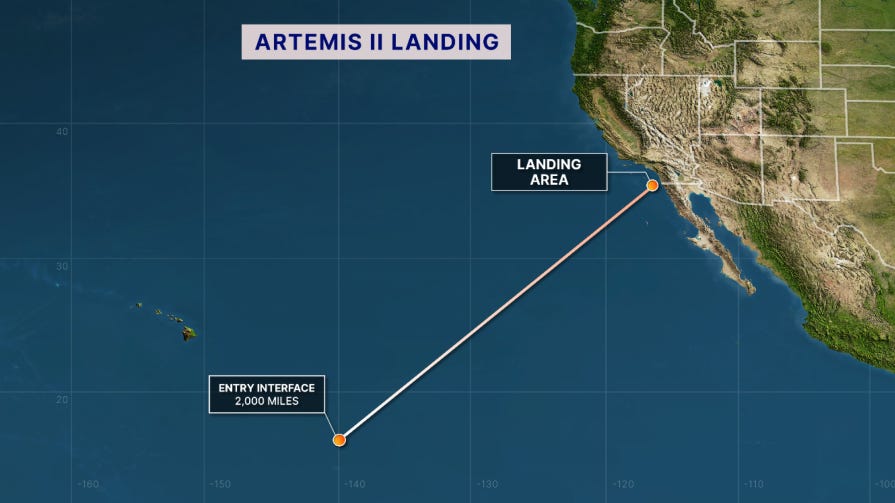
A sonic boom will herald the end of the record-setting Artemis II mission after a California splashdown. Hours later, there might be another one. The U.S. Geological Survey said to expect a sonic boom after NASA Artemis II's Orion capsule streaks through the atmosphere during its return to Earth in a planned water landing off the coast of San Diego. The thunderous vibration will likely take place between 5 p.m. and 5:15 p.m. Pacific Time, the USGS wrote in a post on X. The boom, USGS said, may be heard throughout Southern California as four astronauts complete a 10-day voyage to circle the moon and travel farther in space than anyone in history. The Orion spacecraft, carrying Reid Wiseman, Christina Koch, Victor Glover and Jeremy Hansen, is expected to splash down about 8:07 p.m. ET in the Pacific Ocean off the California coast, according to NASA. The USGS is asking anyone who hears the sonic boom to report it here or visit https://earthquake.usgs.gov/earthquakes/eventpage/tellus. Is there a SpaceX rocket launch today in California? Hours after the Artemis II astronauts are due to splash down off the coast of San Diego, California, SpaceX could launch a rocket about 200 miles north. A Falcon 9 rocket is due to get off the ground at 10:39 p.m. ET Friday, April 10, 2026, from Space Launch Complex 4-East (SLC-4E) at the Vandenberg Space Force Base in Santa Barbara County, California. The rocket will fly at a southern trajectory. After liftoff, the Falcon 9 will deploy 25 SpaceX Starlink broadband internet satellites into low-Earth orbit, an altitude nearer Earth's atmosphere where they're able to circle the planet quickly. The rocket's booster will then aim to land on a SpaceX drone ship, nicknamed "Of Course I Still Love You," in the Pacific Ocean. This allows for SpaceX personnel to recover the booster so it can be reused in future spaceflights. The launch window for the Friday, April 10, 2026, SpaceX Falcon 9 Starlink 17-21 mission is due to open shortly after the four Artemis II astronauts' planned splashdown in the Pacific Ocean. A Federal Aviation Administration operations plan advisory suggests a backup opportunity is available the next day if the SpaceX Falcon 9 rocket launch were to be postponed. What is a sonic boom? Will there be sonic booms from SpaceX Falcon 9 rocket launch in California? According to the U.S. Air Force, a sonic boom is caused by an object moving faster than sound - about 750 miles per hour at sea level. Residents of Santa Barbara County, San Luis Obispo County and Ventura County often stand to be the most likely to hear sonic booms, SpaceX said. The sonic booms - brief, thunder-like noises that are often heard from the ground when a spacecraft or aircraft travels faster than the speed of sound - could last for up to 10 minutes after liftoff, Vandenberg has added. "Areas local to Vandenberg Space Force Base will hear the initial low rumble of take-off," Vandenberg has also said. "An aircraft traveling through the atmosphere continuously produces air-pressure waves similar to the water waves caused by a ship's bow," according to the Air Force. "When the aircraft exceeds the speed of sound, these pressure waves combine and form shock waves which travel forward from the generation or 'release point.'" For the latest news and launch schedule from Cape Canaveral Space Force Station and NASA's Kennedy Space Center, visit floridatoday.com/space. Another easy way: Click here to sign up for our weekly Space newsletter.
2 sonic booms possible in California? Artemis II splashdown, SpaceX launch
A sonic boom will herald the end of the record-setting Artemis II mission after a California splashdown. Hours later, there might be another one. The U.S. Geological Survey said to expect a sonic boom after NASA Artemis II's Orion capsule streaks through the atmosphere during its return to Earth in a planned water landing off the coast of San Diego. The thunderous vibration will likely take place between 5 p.m. and 5:15 p.m. Pacific Time, the USGS wrote in a post on X. The boom, USGS said, may be heard throughout Southern California as four astronauts complete a 10-day voyage to circle the moon and travel farther in space than anyone in history. The Orion spacecraft, carrying Reid Wiseman, Christina Koch, Victor Glover and Jeremy Hansen, is expected to splash down about 8:07 p.m. ET in the Pacific Ocean off the California coast, according to NASA. The USGS is asking anyone who hears the sonic boom to report it here or visit https://earthquake.usgs.gov/earthquakes/eventpage/tellus. Is there a SpaceX rocket launch today in California? Hours after the Artemis II astronauts are due to splash down off the coast of San Diego, California, SpaceX could launch a rocket about 200 miles north. A Falcon 9 rocket is due to get off the ground at 10:39 p.m. ET Friday, April 10, 2026, from Space Launch Complex 4-East (SLC-4E) at the Vandenberg Space Force Base in Santa Barbara County, California. The rocket will fly at a southern trajectory. After liftoff, the Falcon 9 will deploy 25 SpaceX Starlink broadband internet satellites into low-Earth orbit, an altitude nearer Earth's atmosphere where they're able to circle the planet quickly. The rocket's booster will then aim to land on a SpaceX drone ship, nicknamed "Of Course I Still Love You," in the Pacific Ocean. This allows for SpaceX personnel to recover the booster so it can be reused in future spaceflights. The launch window for the Friday, April 10, 2026, SpaceX Falcon 9 Starlink 17-21 mission is due to open shortly after the four Artemis II astronauts' planned splashdown in the Pacific Ocean. A Federal Aviation Administration operations plan advisory suggests a backup opportunity is available the next day if the SpaceX Falcon 9 rocket launch were to be postponed. What is a sonic boom? Will there be sonic booms from SpaceX Falcon 9 rocket launch in California? According to the U.S. Air Force, a sonic boom is caused by an object moving faster than sound - about 750 miles per hour at sea level. Residents of Santa Barbara County, San Luis Obispo County and Ventura County often stand to be the most likely to hear sonic booms, SpaceX said. The sonic booms - brief, thunder-like noises that are often heard from the ground when a spacecraft or aircraft travels faster than the speed of sound - could last for up to 10 minutes after liftoff, Vandenberg has added. "Areas local to Vandenberg Space Force Base will hear the initial low rumble of take-off," Vandenberg has also said. "An aircraft traveling through the atmosphere continuously produces air-pressure waves similar to the water waves caused by a ship's bow," according to the Air Force. "When the aircraft exceeds the speed of sound, these pressure waves combine and form shock waves which travel forward from the generation or 'release point.'" For the latest news and launch schedule from Cape Canaveral Space Force Station and NASA's Kennedy Space Center, visit floridatoday.com/space. Another easy way: Click here to sign up for our weekly Space newsletter.
2 sonic booms possible in California? Artemis II splashdown, SpaceX launch
A sonic boom will herald the end of the record-setting Artemis II mission after a California splashdown. Hours later, there might be another one. The U.S. Geological Survey said to expect a sonic boom after NASA Artemis II's Orion capsule streaks through the atmosphere during its return to Earth in a planned water landing off the coast of San Diego. The thunderous vibration will likely take place between 5 p.m. and 5:15 p.m. Pacific Time, the USGS wrote in a post on X. The boom, USGS said, may be heard throughout Southern California as four astronauts complete a 10-day voyage to circle the moon and travel farther in space than anyone in history. The Orion spacecraft, carrying Reid Wiseman, Christina Koch, Victor Glover and Jeremy Hansen, is expected to splash down about 8:07 p.m. ET in the Pacific Ocean off the California coast, according to NASA. The USGS is asking anyone who hears the sonic boom to report it here or visit https://earthquake.usgs.gov/earthquakes/eventpage/tellus. Is there a SpaceX rocket launch today in California? Hours after the Artemis II astronauts are due to splash down off the coast of San Diego, California, SpaceX could launch a rocket about 200 miles north. A Falcon 9 rocket is due to get off the ground at 10:39 p.m. ET Friday, April 10, 2026, from Space Launch Complex 4-East (SLC-4E) at the Vandenberg Space Force Base in Santa Barbara County, California. The rocket will fly at a southern trajectory. After liftoff, the Falcon 9 will deploy 25 SpaceX Starlink broadband internet satellites into low-Earth orbit, an altitude nearer Earth's atmosphere where they're able to circle the planet quickly. The rocket's booster will then aim to land on a SpaceX drone ship, nicknamed "Of Course I Still Love You," in the Pacific Ocean. This allows for SpaceX personnel to recover the booster so it can be reused in future spaceflights. The launch window for the Friday, April 10, 2026, SpaceX Falcon 9 Starlink 17-21 mission is due to open shortly after the four Artemis II astronauts' planned splashdown in the Pacific Ocean. A Federal Aviation Administration operations plan advisory suggests a backup opportunity is available the next day if the SpaceX Falcon 9 rocket launch were to be postponed. What is a sonic boom? Will there be sonic booms from SpaceX Falcon 9 rocket launch in California? According to the U.S. Air Force, a sonic boom is caused by an object moving faster than sound - about 750 miles per hour at sea level. Residents of Santa Barbara County, San Luis Obispo County and Ventura County often stand to be the most likely to hear sonic booms, SpaceX said. The sonic booms - brief, thunder-like noises that are often heard from the ground when a spacecraft or aircraft travels faster than the speed of sound - could last for up to 10 minutes after liftoff, Vandenberg has added. "Areas local to Vandenberg Space Force Base will hear the initial low rumble of take-off," Vandenberg has also said. "An aircraft traveling through the atmosphere continuously produces air-pressure waves similar to the water waves caused by a ship's bow," according to the Air Force. "When the aircraft exceeds the speed of sound, these pressure waves combine and form shock waves which travel forward from the generation or 'release point.'" For the latest news and launch schedule from Cape Canaveral Space Force Station and NASA's Kennedy Space Center, visit floridatoday.com/space. Another easy way: Click here to sign up for our weekly Space newsletter.
2 sonic booms possible in California? Artemis II splashdown, SpaceX launch
A sonic boom will herald the end of the record-setting Artemis II mission after a California splashdown. Hours later, there might be another one. The U.S. Geological Survey said to expect a sonic boom after NASA Artemis II's Orion capsule streaks through the atmosphere during its return to Earth in a planned water landing off the coast of San Diego. The thunderous vibration will likely take place between 5 p.m. and 5:15 p.m. Pacific Time, the USGS wrote in a post on X. The boom, USGS said, may be heard throughout Southern California as four astronauts complete a 10-day voyage to circle the moon and travel farther in space than anyone in history. The Orion spacecraft, carrying Reid Wiseman, Christina Koch, Victor Glover and Jeremy Hansen, is expected to splash down about 8:07 p.m. ET in the Pacific Ocean off the California coast, according to NASA. The USGS is asking anyone who hears the sonic boom to report it here or visit https://earthquake.usgs.gov/earthquakes/eventpage/tellus. Is there a SpaceX rocket launch today in California? Hours after the Artemis II astronauts are due to splash down off the coast of San Diego, California, SpaceX could launch a rocket about 200 miles north. A Falcon 9 rocket is due to get off the ground at 10:39 p.m. ET Friday, April 10, 2026, from Space Launch Complex 4-East (SLC-4E) at the Vandenberg Space Force Base in Santa Barbara County, California. The rocket will fly at a southern trajectory. After liftoff, the Falcon 9 will deploy 25 SpaceX Starlink broadband internet satellites into low-Earth orbit, an altitude nearer Earth's atmosphere where they're able to circle the planet quickly. The rocket's booster will then aim to land on a SpaceX drone ship, nicknamed "Of Course I Still Love You," in the Pacific Ocean. This allows for SpaceX personnel to recover the booster so it can be reused in future spaceflights. The launch window for the Friday, April 10, 2026, SpaceX Falcon 9 Starlink 17-21 mission is due to open shortly after the four Artemis II astronauts' planned splashdown in the Pacific Ocean. A Federal Aviation Administration operations plan advisory suggests a backup opportunity is available the next day if the SpaceX Falcon 9 rocket launch were to be postponed. What is a sonic boom? Will there be sonic booms from SpaceX Falcon 9 rocket launch in California? According to the U.S. Air Force, a sonic boom is caused by an object moving faster than sound - about 750 miles per hour at sea level. Residents of Santa Barbara County, San Luis Obispo County and Ventura County often stand to be the most likely to hear sonic booms, SpaceX said. The sonic booms - brief, thunder-like noises that are often heard from the ground when a spacecraft or aircraft travels faster than the speed of sound - could last for up to 10 minutes after liftoff, Vandenberg has added. "Areas local to Vandenberg Space Force Base will hear the initial low rumble of take-off," Vandenberg has also said. "An aircraft traveling through the atmosphere continuously produces air-pressure waves similar to the water waves caused by a ship's bow," according to the Air Force. "When the aircraft exceeds the speed of sound, these pressure waves combine and form shock waves which travel forward from the generation or 'release point.'" For the latest news and launch schedule from Cape Canaveral Space Force Station and NASA's Kennedy Space Center, visit floridatoday.com/space. Another easy way: Click here to sign up for our weekly Space newsletter.
SpaceX to launch resupply mission to the ISS
CAPE CANAVERAL SPACE FORCE STATION -- SpaceX is preparing to launch more than 11,000 pounds of science and supplies to the International Space Station on Saturday morning. SpaceX stated it will send up the NG-24 mission from Cape Canaveral Space Force Station's Space Launch Complex 40. The launch window opens at 7:41 a.m. ET. The launch was supposed to happen on Tuesday, then Wednesday, Thursday, and even Friday before settling on Saturday. SpaceX did not say why the launch was pushed back. If the launch is scrubbed, the next attempt will be Sunday at 7:15 a.m. ET. This will be the seventh mission for the first-stage booster B1094. It has some impressive missions. After the stage separation, the first-stage rocket is scheduled to land on Landing Zone 40 at Cape Canaveral Space Force Station. Because the rocket will land on the ground, people can expect to hear sonic booms. NASA's Northrop Grumman Commercial Resupply Services 24 mission, or Northrop Grumman CRS-24, will send up more than 11,000 pounds (4,990 kilograms) of food, experiments, and supplies to the International Space Station. The Northrop Grumman company's Cygnus XL cargo spacecraft will send up the following: Here are some of the experiments that are going up. The Cygnus XL -- named after the late NASA astronaut Steven Nagel, who died in 2014 -- will also include the following hardware, stated NASA.
'This Man Likes Chaos': Trump Blows Up Kennedy Center Feud Over Renaming and Closure as the Situation Spirals and His Motives Come Under Fire
President Donald Trump infuriated much of the country when he slapped his name on the John F. Kennedy Center for the Performing Arts last year. Despite the Kennedy Center being created as a living memorial to the 35th president, who was assassinated in 1963, Trump fired several board members and replaced them with his so-called friends. The new board voted for the name change and to make the president the chairman of the board, and it's been nothing but chaos since. 'We've Got to Stop This': Maria Shriver, Kennedys Erupt After Trump Shuts Down the Kennedy Center -- and His New Insult Only Escalates the Fallout Only Congress has the authority to change the name, which is why the POTUS fired the board and replaced them, but the controversy over the matter doesn't end there. Trump even replaced Richard Grenell, his ally who served as interim head of the Kennedy Center, with Matt Floca, the center's vice president of facilities operations. This change followed a tumultuous year of dwindling ticket sales and planned renovations that no one wants. Former Kennedy Center board of trustees member Rep. Joyce Beatty is one of many outraged patrons who she seeks to put a stop to it all. Beatty filed a federal lawsuit requesting that his name be removed from the building on the grounds that Trump's actions were unlawful. The Democratic Ohio congresswoman also demands that his planned two-year shutdown for renovations be blocked because there was no expert consultation about the renovations, only Trump's say-so. "Can the Board of the Kennedy Center -- in direct contradiction of the governing statutes -- rename this sacred memorial to John F. Kennedy after President Donald J. Trump? The answer is, unequivocally, 'no,'" the lawsuit reads. "By renaming the Center -- in violation of the law -- Defendants have breached the terms of the trust and their most basic fiduciary obligations as trustees." Trump responded to the lawsuit with a court filing on April 6, and his attorneys defended the renaming and closure of the center. "Plaintiff has not alleged that she suffered any harm -- whether 'tangible,' like a 'physical' or 'monetary' harm, or 'intangible,' like a reputational harm -- stemming from the Board's decisions to adopt a secondary name and to close for renovation," states the document. "The Center is closing for renovation because a concentrated two-year project -- rather than a 'multi-year series of patchwork repairs' -- will enable the Board to fully execute required mechanical overhauls and to conduct invasive structural repairs in as short and cost-effective a timeframe as possible." Beatty responded to the filing by saying her legal team would respond in court, and she also made a dig at the twice-impeached president. "Consider just one damning fact," she said. "Donald Trump and his handpicked friends on the Board are now exposed for not doing their due diligence considering the now tragic consequences for the unlawful renaming of this treasured institution. Congress never authorized this vanity project which is defacing a sacred memorial to a fallen President, and I look forward to our day in court." Beatty appeared on Jake Tapper's show "The Lead" on CNN in March, and she explained why she brought the lawsuit. "I'm not against any renovations making it safe," she said. "But I'm against any and everything that is unlawful. They did not bring it before the United States Congress just as when Donald Trump put his name across the Kennedy Center. He did not get approval from the Congress to do that. And it's stated in the statute that he had to bring it before Congress." Users on social media reacted to Trump's obsession with the Kennedy Center by dragging him for his hubris. "He puts his name on something then it's garbage," wrote one user on Facebook. Several celebrities declined to perform at the Kennedy Center after Trump took over, and many users believe it's the true reason the president wants to close the performing arts facility. One user wrote, "Trump trying to save face. But, this will cost Americans." Another said, "The man likes chaos. He thrives on it. He lives for it. He will cause it with every breath he takes." Piling on for destroying history, one person added, "Trump is removing the Kennedy's legacy, I can't see why the [Robert F.] Kennedy (I don't know his first name) that is a part of his administration is not offended by this." Beatty also told Tapper that she was setting an example by standing up to Trump for democracy, and she referenced his illegal war in Iran. Trump attacked the country, also without the approval from Congress, on Feb. 28. "This is a democracy," she said. The Kennedy Center closure is currently scheduled for July 7.

2 sonic booms possible in California? Artemis II splashdown, SpaceX launch
A sonic boom will herald the end of the record-setting Artemis II mission after a California splashdown. Hours later, there might be another one. The U.S. Geological Survey said to expect a sonic boom after NASA Artemis II's Orion capsule streaks through the atmosphere during its return to Earth in a planned water landing off the coast of San Diego. The thunderous vibration will likely take place between 5 p.m. and 5:15 p.m. Pacific Time, the USGS wrote in a post on X. The boom, USGS said, may be heard throughout Southern California as four astronauts complete a 10-day voyage to circle the moon and travel farther in space than anyone in history. The Orion spacecraft, carrying Reid Wiseman, Christina Koch, Victor Glover and Jeremy Hansen, is expected to splash down about 8:07 p.m. ET in the Pacific Ocean off the California coast, according to NASA. The USGS is asking anyone who hears the sonic boom to report it here or visit https://earthquake.usgs.gov/earthquakes/eventpage/tellus. Is there a SpaceX rocket launch today in California? Hours after the Artemis II astronauts are due to splash down off the coast of San Diego, California, SpaceX could launch a rocket about 200 miles north. A Falcon 9 rocket is due to get off the ground at 10:39 p.m. ET Friday, April 10, 2026, from Space Launch Complex 4-East (SLC-4E) at the Vandenberg Space Force Base in Santa Barbara County, California. The rocket will fly at a southern trajectory. After liftoff, the Falcon 9 will deploy 25 SpaceX Starlink broadband internet satellites into low-Earth orbit, an altitude nearer Earth's atmosphere where they're able to circle the planet quickly. The rocket's booster will then aim to land on a SpaceX drone ship, nicknamed "Of Course I Still Love You," in the Pacific Ocean. This allows for SpaceX personnel to recover the booster so it can be reused in future spaceflights. The launch window for the Friday, April 10, 2026, SpaceX Falcon 9 Starlink 17-21 mission is due to open shortly after the four Artemis II astronauts' planned splashdown in the Pacific Ocean. A Federal Aviation Administration operations plan advisory suggests a backup opportunity is available the next day if the SpaceX Falcon 9 rocket launch were to be postponed. What is a sonic boom? Will there be sonic booms from SpaceX Falcon 9 rocket launch in California? According to the U.S. Air Force, a sonic boom is caused by an object moving faster than sound - about 750 miles per hour at sea level. Residents of Santa Barbara County, San Luis Obispo County and Ventura County often stand to be the most likely to hear sonic booms, SpaceX said. The sonic booms - brief, thunder-like noises that are often heard from the ground when a spacecraft or aircraft travels faster than the speed of sound - could last for up to 10 minutes after liftoff, Vandenberg has added. "Areas local to Vandenberg Space Force Base will hear the initial low rumble of take-off," Vandenberg has also said. "An aircraft traveling through the atmosphere continuously produces air-pressure waves similar to the water waves caused by a ship's bow," according to the Air Force. "When the aircraft exceeds the speed of sound, these pressure waves combine and form shock waves which travel forward from the generation or 'release point.'" For the latest news and launch schedule from Cape Canaveral Space Force Station and NASA's Kennedy Space Center, visit floridatoday.com/space. Another easy way: Click here to sign up for our weekly Space newsletter.
SpaceX Hints That It's Developing a Chip Module for Starlink Mobile
Our team tests, rates, and reviews more than 1,500 products each year to help you make better buying decisions and get more from technology. A new SpaceX job posting suggests the company is preparing to develop its own components for the Starlink Mobile satellite-to-phone service. The company is looking to hire an engineer specializing in radio-frequency front-end module design, a component used alongside the modem in a smartphone to transmit and process wireless signals. The RF front end -- consisting of antennas, signal tuners, and power amplifiers -- is designed to send and receive radio signals, efficiently amplifying them while filtering out potential noise. SpaceX's job posting specifically looks to hire an engineer to "develop cutting-edge RF modules for deployment into the Starlink Mobile network." This includes designing "multi-chip modules" containing the RF front-end components for 5G, LTE, and Wi-Fi applications. "Come join us and contribute to RF systems that will expand the performance and capabilities of Starlink Mobile," the posting adds. The job is likely connected to SpaceX's effort to upgrade Starlink Mobile using valuable radio spectrum it is acquiring from Boost Mobile's parent, EchoStar. SpaceX plans to harness the spectrum through next-generation satellites launching in mid-2027, with the goal of offering 5G connectivity to users on the ground, reaching up to 150Mbps -- up from the current 4Mbps. However, SpaceX CEO Elon Musk has mentioned needing a "two-year timeframe" for phone manufacturers to adopt new chipsets that support the EchoStar radio frequencies. Last month at MWC, a SpaceX executive added: "We're also working closely with device manufacturers and modem manufacturers to enable the [next-gen Starlink Mobile] service on as many devices as quickly as possible." Samsung has also been rumored to be working on a modem for the service. Interestingly, the new posting from SpaceX suggests the company will be involved in the RF front-end component production. The position calls for integrating the "RF modules into production PCBAs [Printed Circuit Board Assemblies]," and performing "yield analysis and implement design improvements for high-volume production." Currently, Starlink Mobile is available from T-Mobile mainly as a paid add-on, but it's free on the carrier's premium plans. Starlink Mobile will eventually expand to Boost Mobile, while prepaid carrier US Mobile has also said it will offer the satellite-to-phone service. Meanwhile, AT&T and Verizon are partnering with Texas startup AST SpaceMobile on their own rival satellite service.

FAA looks to unconventional source for new air traffic controllers: Gamers
A new air traffic controller hiring campaign from the Department of Transportation (DOT) is targeting gamers to address a longtime staffing shortage. The DOT's new ad shows clips of video games and tells potential applicants: "You've been training for this ... become an air traffic controller. It's not a game. It's a career." "To reach the next generation of air traffic controllers, we need to adapt," Transportation Secretary Sean Duffy said in a statement. "This campaign's innovative communication style and focus on gaming taps into a growing demographic of young adults who have many of the hard skills it takes to be a successful controller." How air traffic controllers keep US skies safe -- and how to become one The Federal Aviation Administration (FAA) said they're targeting young adults with transferable skills, like high cognitive functions, multitasking, spatial awareness, strategy and problem solving. In controller exit interviews, the FAA said, several controllers have pointed to gaming "as an influence on their ability to think quickly, stay focused, and manage complexity." The agency said only about 25% of controllers have a college degree, so they're targeting outreach to focus on people pursuing alternative career paths. Nick Daniels, president of the National Air Traffic Controller's Association, said in a statement: "Our union welcomes innovative approaches to expanding the candidate pool--including outreach to individuals with high-level aptitude skills such as gamers--so long as all pathways maintain the rigorous standards required of this safety-critical profession." American Airlines, Alaska Airlines join other carriers in raising bag fees amid rising fuel prices, Iran war The FAA has struggled with air traffic controller staffing in recent years. According to a Government Accountability Office report from late last year, the number of controllers declined by about 6% over the past 10 years. At the same time, flights increased by 10% and travel surged after the pandemic. Staffing shortages have also been fueled by several government shutdowns, the suspended and reduced training during the COVID-19 pandemic and high attrition in the workplace. The FAA said it currently has its highest ATC staffing level in six years, with almost 11,000 controllers in service and more than 4,000 trainees -- but that's still below a target of 14,500 that the agency needs to be fully staffed.

Community Rage Over Insider Trading Culminating to Massive Profits for Ceasefire Contracts on Polymarket - Tekedia
President Donald Trump announced a conditional ceasefire with Iran via Truth Social earlier in the week, following strain of direct US-Israeli military strikes on Iranian targets that began earlier in 2026. Iran's Supreme National Security Council accepted a two-week pause in direct hostilities, with conditions including a halt to attacks and steps toward reopening the Strait of Hormuz for shipping. The deal remains fragile as of April 9: Israel has continued operations in Lebanon which the US says are not covered by the truce, Iran has restricted Hormuz traffic in response, and negotiations are set to begin in Islamabad. Some markets on Polymarket now trade outcomes like ceasefire extensions or breakdowns. Polymarket saw over $170 million in volume on US-Iran ceasefire contracts, one of its largest geopolitical markets to date. Key examples of outsized gains include:One trader reportedly turned ~$13,200 into ~$477,000 roughly 3,500% return by betting on a ceasefire. Blockchain analytics firm Lookonchain flagged wallets profiting $194k, $200k+, and others, with three newly created accounts alone netting a combined ~$485k on a ceasefire by April 7 market. These wallets had no prior activity and placed large "Yes" bets hours before Trump's post e.g., as late as ~1:59 pm UTC on April 7, with the announcement around 10:32 pm UTC. Another cluster of accounts, some with a track record on prior Iran-related strikes identified by Bubblemaps made over $600k combined on the ceasefire, on top of $1.2M+ from correctly timing earlier military actions. Bets were placed when implied probabilities were low often single digits to low teens, then prices spiked as news broke. Prediction markets like Polymarket are decentralized, pseudonymous, and unregulated in the traditional sense for US users in many cases. This setup amplifies suspicions when:Newly created wallets with no history suddenly deploy significant capital on hyper-specific, low-probability outcomes right before major announcements. The timing is extremely tight -- sometimes hours or less before public news. Similar patterns occurred earlier in the Iran conflict. Analysts and lawmakers have noted it's highly unlikely these are all good-faith random trades. Polymarket has faced repeated scrutiny on events like Venezuelan political developments and prior Iran strikes, leading the platform to tighten some rules against suspicious activity. However, enforcement is limited without KYC or centralized oversight. Critics argue this could allow government and military insiders, journalists, or connected parties to monetize non-public info. Well-timed trades alone aren't proof of illegality. Sophisticated traders monitor news, sentiment, and on-chain signals; prediction markets often price in rumors faster than traditional media. Some profitable accounts had prior successful (publicly visible) bets on related events, suggesting skill or research rather than leaks. Polymarket resolutions can also spark disputes over exact definitions e.g., what counts as a ceasefireadding another layer of uncertainty. This isn't isolated -- prediction markets have boomed on geopolitics, elections, and crypto events, offering crowd-sourced probabilities that sometimes outperform polls or analysts. But high-stakes, low-liquidity geopolitical contracts invite both genuine edge and potential abuse. Regulators and Congress have eyed rules for these platforms, especially as volumes grow. The story highlights a tension: decentralized markets can aggregate information efficiently, but pseudonymity makes policing insider trading difficult. Whether these specific wins reflect leaks, exceptional analysis, or luck remains unproven publicly -- on-chain data shows the profits, not the source of the edge. Markets continue to trade related outcomes, with significant ongoing volume. Geopolitical events like this often produce volatility in oil, equities, and crypto alongside the betting action.

SpaceX Hints That It's Developing a Chip Module for Starlink Mobile
Our team tests, rates, and reviews more than 1,500 products each year to help you make better buying decisions and get more from technology. A new SpaceX job posting suggests the company is preparing to develop its own components for the Starlink Mobile satellite-to-phone service. The company is looking to hire an engineer specializing in radio-frequency front-end module design, a component used alongside the modem in a smartphone to transmit and process wireless signals. The RF front end -- consisting of antennas, signal tuners, and power amplifiers -- is designed to send and receive radio signals, efficiently amplifying them while filtering out potential noise. SpaceX's job posting specifically looks to hire an engineer to "develop cutting-edge RF modules for deployment into the Starlink Mobile network." This includes designing "multi-chip modules" containing the RF front-end components for 5G, LTE, and Wi-Fi applications. "Come join us and contribute to RF systems that will expand the performance and capabilities of Starlink Mobile," the posting adds. The job is likely connected to SpaceX's effort to upgrade Starlink Mobile using valuable radio spectrum it is acquiring from Boost Mobile's parent, EchoStar. SpaceX plans to harness the spectrum through next-generation satellites launching in mid-2027, with the goal of offering 5G connectivity to users on the ground, reaching up to 150Mbps -- up from the current 4Mbps. However, SpaceX CEO Elon Musk has mentioned needing a "two-year timeframe" for phone manufacturers to adopt new chipsets that support the EchoStar radio frequencies. Last month at MWC, a SpaceX executive added: "We're also working closely with device manufacturers and modem manufacturers to enable the [next-gen Starlink Mobile] service on as many devices as quickly as possible." Samsung has also been rumored to be working on a modem for the service. Interestingly, the new posting from SpaceX suggests the company will be involved in the RF front-end component production. The position calls for integrating the "RF modules into production PCBAs [Printed Circuit Board Assemblies]," and performing "yield analysis and implement design improvements for high-volume production." Currently, Starlink Mobile is available from T-Mobile mainly as a paid add-on, but it's free on the carrier's premium plans. Starlink Mobile will eventually expand to Boost Mobile, while prepaid carrier US Mobile has also said it will offer the satellite-to-phone service. Meanwhile, AT&T and Verizon are partnering with Texas startup AST SpaceMobile on their own rival satellite service.

2 sonic booms possible in California? Artemis II splashdown, SpaceX launch
A sonic boom will herald the end of the record-setting Artemis II mission after a California splashdown. Hours later, there might be another one. The U.S. Geological Survey said to expect a sonic boom after NASA Artemis II's Orion capsule streaks through the atmosphere during its return to Earth in a planned water landing off the coast of San Diego. The thunderous vibration will likely take place between 5 p.m. and 5:15 p.m. Pacific Time, the USGS wrote in a post on X. The boom, USGS said, may be heard throughout Southern California as four astronauts complete a 10-day voyage to circle the moon and travel farther in space than anyone in history. The Orion spacecraft, carrying Reid Wiseman, Christina Koch, Victor Glover and Jeremy Hansen, is expected to splash down about 8:07 p.m. ET in the Pacific Ocean off the California coast, according to NASA. The USGS is asking anyone who hears the sonic boom to report it here or visit https://earthquake.usgs.gov/earthquakes/eventpage/tellus. Is there a SpaceX rocket launch today in California? Hours after the Artemis II astronauts are due to splash down off the coast of San Diego, California, SpaceX could launch a rocket about 200 miles north. A Falcon 9 rocket is due to get off the ground at 10:39 p.m. ET Friday, April 10, 2026, from Space Launch Complex 4-East (SLC-4E) at the Vandenberg Space Force Base in Santa Barbara County, California. The rocket will fly at a southern trajectory. After liftoff, the Falcon 9 will deploy 25 SpaceX Starlink broadband internet satellites into low-Earth orbit, an altitude nearer Earth's atmosphere where they're able to circle the planet quickly. The rocket's booster will then aim to land on a SpaceX drone ship, nicknamed "Of Course I Still Love You," in the Pacific Ocean. This allows for SpaceX personnel to recover the booster so it can be reused in future spaceflights. The launch window for the Friday, April 10, 2026, SpaceX Falcon 9 Starlink 17-21 mission is due to open shortly after the four Artemis II astronauts' planned splashdown in the Pacific Ocean. A Federal Aviation Administration operations plan advisory suggests a backup opportunity is available the next day if the SpaceX Falcon 9 rocket launch were to be postponed. What is a sonic boom? Will there be sonic booms from SpaceX Falcon 9 rocket launch in California? According to the U.S. Air Force, a sonic boom is caused by an object moving faster than sound - about 750 miles per hour at sea level. Residents of Santa Barbara County, San Luis Obispo County and Ventura County often stand to be the most likely to hear sonic booms, SpaceX said. The sonic booms - brief, thunder-like noises that are often heard from the ground when a spacecraft or aircraft travels faster than the speed of sound - could last for up to 10 minutes after liftoff, Vandenberg has added. "Areas local to Vandenberg Space Force Base will hear the initial low rumble of take-off," Vandenberg has also said. "An aircraft traveling through the atmosphere continuously produces air-pressure waves similar to the water waves caused by a ship's bow," according to the Air Force. "When the aircraft exceeds the speed of sound, these pressure waves combine and form shock waves which travel forward from the generation or 'release point.'" For the latest news and launch schedule from Cape Canaveral Space Force Station and NASA's Kennedy Space Center, visit floridatoday.com/space. Another easy way: Click here to sign up for our weekly Space newsletter.
Bessent, Powell warn banks about new Anthropic model's cyber risks
HUNT VALLEY, Md. (TNND) -- Treasury Secretary Scott Bessent and Federal Reserve Chair Jerome Powell reportedly warned some of the biggest banks this week about cyber risks posed by the AI company Anthropic. The officials met with the chief executives of Bank of America, Citigroup, Wells Fargo, Goldman Sachs and Morgan Stanley in Washington on Tuesday, according to multiple outlets. JPMorgan Chase CEO Jamie Dimon was reportedly unable to join. Anthropic launched its Claude Mythos Preview model to select companies the same day. The program, which can perform cybersecurity tasks, poses risks that Anthropic has acknowledged. The National News Desk requested comment from Anthropic, each of the meeting's reported participants and JPMorgan Chase. The Federal Reserve, Citigroup, Wells Fargo and Goldman Sachs did not comment on the report when reached. A spokesman for the Treasury said Bessent convened the meeting to begin forming an approach to the "rapid" developments of AI. The attendees were already in Washington for previously scheduled events, the representative added. "President Trump and the Administration are continuing to engage on AI security in a thoughtful manner," the spokesman said.

2 sonic booms possible in California? Artemis II splashdown, SpaceX launch
A sonic boom will herald the end of the record-setting Artemis II mission after a California splashdown. Hours later, there might be another one. The U.S. Geological Survey said to expect a sonic boom after NASA Artemis II's Orion capsule streaks through the atmosphere during its return to Earth in a planned water landing off the coast of San Diego. The thunderous vibration will likely take place between 5 p.m. and 5:15 p.m. Pacific Time, the USGS wrote in a post on X. The boom, USGS said, may be heard throughout Southern California as four astronauts complete a 10-day voyage to circle the moon and travel farther in space than anyone in history. The Orion spacecraft, carrying Reid Wiseman, Christina Koch, Victor Glover and Jeremy Hansen, is expected to splash down about 8:07 p.m. ET in the Pacific Ocean off the California coast, according to NASA. The USGS is asking anyone who hears the sonic boom to report it here or visit https://earthquake.usgs.gov/earthquakes/eventpage/tellus. Is there a SpaceX rocket launch today in California? Hours after the Artemis II astronauts are due to splash down off the coast of San Diego, California, SpaceX could launch a rocket about 200 miles north. A Falcon 9 rocket is due to get off the ground at 10:39 p.m. ET Friday, April 10, 2026, from Space Launch Complex 4-East (SLC-4E) at the Vandenberg Space Force Base in Santa Barbara County, California. The rocket will fly at a southern trajectory. After liftoff, the Falcon 9 will deploy 25 SpaceX Starlink broadband internet satellites into low-Earth orbit, an altitude nearer Earth's atmosphere where they're able to circle the planet quickly. The rocket's booster will then aim to land on a SpaceX drone ship, nicknamed "Of Course I Still Love You," in the Pacific Ocean. This allows for SpaceX personnel to recover the booster so it can be reused in future spaceflights. The launch window for the Friday, April 10, 2026, SpaceX Falcon 9 Starlink 17-21 mission is due to open shortly after the four Artemis II astronauts' planned splashdown in the Pacific Ocean. A Federal Aviation Administration operations plan advisory suggests a backup opportunity is available the next day if the SpaceX Falcon 9 rocket launch were to be postponed. What is a sonic boom? Will there be sonic booms from SpaceX Falcon 9 rocket launch in California? According to the U.S. Air Force, a sonic boom is caused by an object moving faster than sound - about 750 miles per hour at sea level. Residents of Santa Barbara County, San Luis Obispo County and Ventura County often stand to be the most likely to hear sonic booms, SpaceX said. The sonic booms - brief, thunder-like noises that are often heard from the ground when a spacecraft or aircraft travels faster than the speed of sound - could last for up to 10 minutes after liftoff, Vandenberg has added. "Areas local to Vandenberg Space Force Base will hear the initial low rumble of take-off," Vandenberg has also said. "An aircraft traveling through the atmosphere continuously produces air-pressure waves similar to the water waves caused by a ship's bow," according to the Air Force. "When the aircraft exceeds the speed of sound, these pressure waves combine and form shock waves which travel forward from the generation or 'release point.'" For the latest news and launch schedule from Cape Canaveral Space Force Station and NASA's Kennedy Space Center, visit floridatoday.com/space. Another easy way: Click here to sign up for our weekly Space newsletter.
Form 13F WLTH Capital Management For: 10 April By Investing.com
Risk Disclosure: Trading in financial instruments and/or cryptocurrencies involves high risks including the risk of losing some, or all, of your investment amount, and may not be suitable for all investors. Prices of cryptocurrencies are extremely volatile and may be affected by external factors such as financial, regulatory or political events. Trading on margin increases the financial risks. Before deciding to trade in financial instrument or cryptocurrencies you should be fully informed of the risks and costs associated with trading the financial markets, carefully consider your investment objectives, level of experience, and risk appetite, and seek professional advice where needed. Fusion Media would like to remind you that the data contained in this website is not necessarily real-time nor accurate. The data and prices on the website are not necessarily provided by any market or exchange, but may be provided by market makers, and so prices may not be accurate and may differ from the actual price at any given market, meaning prices are indicative and not appropriate for trading purposes. Fusion Media and any provider of the data contained in this website will not accept liability for any loss or damage as a result of your trading, or your reliance on the information contained within this website. It is prohibited to use, store, reproduce, display, modify, transmit or distribute the data contained in this website without the explicit prior written permission of Fusion Media and/or the data provider. All intellectual property rights are reserved by the providers and/or the exchange providing the data contained in this website. Fusion Media may be compensated by the advertisers that appear on the website, based on your interaction with the advertisements or advertisers.

Stock Market Today, April 10: CoreWeave Jumps After Multi-Year AI Cloud Deal With Anthropic
AI-focused cloud infrastructure provider CoreWeave (NASDAQ:CRWV), closed Friday at $102, up 10.87%. The stock moved higher after news of a multi-year AI cloud deal with Anthropic. It also announced an expanded capacity agreement with Meta Platforms (NASDAQ:META) this week. Investors are watching how these contracts translate into sustained AI infrastructure demand and revenue growth. Trading volume reached 78.7 million shares, coming in about 190% above its three-month average of 27.1 million shares. CoreWeave IPO'd in 2025 and has grown 155% since going public. S&P 500 (SNPINDEX:^GSPC) slipped 0.10% to finish Friday at 6,818, while the Nasdaq Composite (NASDAQINDEX:^IXIC) added 0.35% to close at 22,903. Within technology infrastructure names, industry heavyweight Amazon (NASDAQ:AMZN) closed at $238.38, up 2.02%, while rival Microsoft (NASDAQ:MSFT) ended at $370.87, down 0.59%, underscoring mixed sentiment across large AI cloud providers. CoreWeave's latest announcement was a multi-year deal to power Anthropic's Claude AI models. Investors liked that it added customer diversification, especially on the heels of an expanded agreement with Meta that will provide AI cloud capacity through December 2032. While that $21 billion deal helped boost CoreWeave stock, investors are also monitoring the capital costs to provide customers the desired compute capacity. CoreWeave simultaneously announced it will raise $3.5 billion in capital through a convertible debt offering to fund AI infrastructure expansion. That served as a reminder that the company isn't yet generating cash, let alone profits. That's a balance investors need to remember when evaluating CoreWeave stock. Before you buy stock in CoreWeave, consider this: The Motley Fool Stock Advisor analyst team just identified what they believe are the 10 best stocks for investors to buy now... and CoreWeave wasn't one of them. The 10 stocks that made the cut could produce monster returns in the coming years. Consider when Netflix made this list on December 17, 2004... if you invested $1,000 at the time of our recommendation, you'd have $550,348!* Or when Nvidia made this list on April 15, 2005... if you invested $1,000 at the time of our recommendation, you'd have $1,127,467!* Now, it's worth noting Stock Advisor's total average return is 959% -- a market-crushing outperformance compared to 191% for the S&P 500. Don't miss the latest top 10 list, available with Stock Advisor, and join an investing community built by individual investors for individual investors.

Wall Street Banks Try Out Anthropic's Mythos as US Urges Testing
(Bloomberg) -- Wall Street banks are starting to test Anthropic PBC's Mythos model internally as Trump administration officials encourage them to use it to detect vulnerabilities. While JPMorgan Chase & Co. was the only bank named as part of an initiative to test the Mythos model, other major financial institutions have also gained access or expect to in the coming days, according to people familiar with the matter. Goldman Sachs Group Inc., Citigroup Inc., Bank of America Corp. and Morgan Stanley are among the banks testing the technology internally, the people said. Those firms either declined to comment or had no immediate response. During the meeting with Wall Street leaders, summoned by US Treasury Secretary Scott Bessent and Federal Reserve Chair Jerome Powell, executives were warned that they should take the Mythos model seriously and deploy its capabilities to detect vulnerabilities, the people said, asking not to be identified because the information isn't public. Government officials didn't raise any specific threat to financial institutions and more generally encouraged the banks to run the model against their own systems to improve their own defenses, they said. Bloomberg reported earlier that Bessent and Powell had assembled the group of banking executives on April 7 at Treasury's headquarters in Washington on short notice to ensure that banks were aware of possible risks raised by Anthropic's Mythos and similar models. The executives were in town already for a meeting of the Financial Services Forum, an advocacy group made up of the biggest lenders. A representative from the Treasury Department didn't respond to a request for comment. A Federal Reserve spokesperson had no immediate comment. The urging by Trump officials underscores the concern growing among regulators that a new breed of cyberattacks is one of the biggest risks facing the financial industry. All the banks summoned to the meeting are classified as systemically important by top regulators, meaning their stability is a priority for the global financial system. Anthropic has said that it has been in discussions prior to its recent release with US officials about Mythos and its "offensive and defensive cyber capabilities." The company has limited the release of Mythos to a few dozen firms initially. Those companies, which include JPMorgan, Amazon.com Inc. and Apple Inc., are part of what's being called "Project Glasswing," which will work to secure the most important systems before other similar AI models become available. In releasing Mythos to a very limited set of companies, Anthropic pointed to several vulnerabilities that the AI system was capable of both identifying and potentially exploiting during testing. None of the examples related specifically to financial institutions, but in one instance, the firm's security team said it was able to compromise a web browser so that a website set up by a hacker could read data from another website "e.g., the victim's bank."

Bessent, Powell warn banks about new Anthropic model's cyber risks
HUNT VALLEY, Md. (TNND) -- Treasury Secretary Scott Bessent and Federal Reserve Chair Jerome Powell reportedly warned some of the biggest banks this week about cyber risks posed by the AI company Anthropic. The officials met with the chief executives of Bank of America, Citigroup, Wells Fargo, Goldman Sachs and Morgan Stanley in Washington on Tuesday, according to multiple outlets. JPMorgan Chase CEO Jamie Dimon was reportedly unable to join. Anthropic launched its Claude Mythos Preview model to select companies the same day. The program, which can perform cybersecurity tasks, poses risks that Anthropic has acknowledged. The National News Desk requested comment from Anthropic, each of the meeting's reported participants and JPMorgan Chase. The Federal Reserve, Citigroup, Wells Fargo and Goldman Sachs did not comment on the report when reached. A spokesman for the Treasury said Bessent convened the meeting to begin forming an approach to the "rapid" developments of AI. The attendees were already in Washington for previously scheduled events, the representative added. "President Trump and the Administration are continuing to engage on AI security in a thoughtful manner," the spokesman said.
