News & Updates
The latest news and updates from companies in the WLTH portfolio.
Toronto transit head apologizes after subway spill sparks commuter chaos - Toronto | Globalnews.ca
The head of Toronto's transit agency apologized Tuesday morning after a hydraulic leak shuttered a key section of the subway in the city's west end. The spill took place overnight, shuttering several stations west of Jane Street and stopping a section of Line 2 from opening for the morning commute. TTC CEO Mandeep Lali apologized for the delays, which necessitated more than 50 shuttle buses to move stranded commuters along Bloor Street. "This morning, we let our customers down. I am truly sorry," he wrote in a statement. "We know many of you rely on TTC to get to work, school, and essential commitments. When we fall short, the impact is immediate and personal." Lali said the issue stemmed from overnight track work between Kipling and Keele stations, where a spill stopped the TTC from getting the subway open on time. "Our teams are on site with urgency to address the spill, conduct thorough inspections, and restore service as quickly and safely as possible," Lali wrote. "Multiple teams continue work on site to resolve the issue safely and efficiently." Lali said he had ordered a "comprehensive review" to ensure the mistake was not repeated.

Choices amid the chaos of war - Manila Standard
IRAN has granted safe passage to ships bearing the Philippine flags passing through the Strait of Hormuz. Foreign Minister Abbas Araghchi also assured our leaders of the unimpeded delivery of fertilizer and oil to the Philippines. Notwithstanding these diplomatic wins amid the Middle East crisis, the Philippines, being a small, fuel-importing country, saw a fresh round of oil price increases this week. The Philippine government, while initially refusing -- and wrongly so -- to call the situation a crisis, has made some decisive moves to ease the war's effects on Filipinos. Foremost, it has helped repatriate overseas Filipino workers trapped in sensitive places in the Middle East, bringing them to safety. President Ferdinand Marcos Jr. issued an executive order declaring a State of National Energy Emergency. EO 110 authorizes the Department of Energy to adopt measures to make the Philippines resilient amid the fuel crisis. Already, the Energy Department has acquired supply from Russia, with deliveries from other countries being finalized or discussed. Funds to the tune of P20 billion have also been allotted for oil procurement. But how desperate are we, really, in ensuring the supply of oil and making its prices affordable for many? In recent days there has been talk of conducting joint oil explorations with China in the West Philippine Sea. In an interview with Bloomberg last month, President Marcos said Beijing and Manila could reach an agreement on joint cooperation , with "initial exchanges" already being made. But such ventures could be dangerous. China has been even more relentless in its aggressive acts in the WPS, flexing its military might, threatening our soldiers and fisherfolk, and blatantly ignoring international law. Specifically, the month of March saw a record number of Chinese naval and coast guard vessels seen in what has been adjudged by the Permanent Court of Arbitration as Philippine territory. Indeed this war is hitting closer and closer to home. Beyond its impact on the livelihood of OFWs and on the price of fuel and of basic goods, now it is forcing us to suspend our assertion of our sovereignty as we talk with China for the possible joint exploration. Is not good faith a requisite in such agreements? Do not the evident need of the Philippines for new sources of energy on the one hand, and China's unabashed interest in our waters on the other, show that economic considerations could put on an unequal footing with a giant that claims to be a friend but acts in a hostile manner where it matters? We trust our leaders could help define boundaries and balance our need against our dignity. In the meantime, we can only hope that our traditional ally, the United States, could inject greater sensitivity, more care, and less ego into its decisions. It appears that the whims of one man is shaping the fate of the world. With the sophistication of the 21st century and the lessons we should have learned from previous tragedies, how are we still letting this happen?

Polymarket unlocks $54M annual revenue route with stablecoin launch - Cryptopolitan
Unlike Polymarket, users are deep in the red in terms of profitability. The big Polymarket upgrade expected to roll out over the next few weeks has many users excited, but according to the co-founder of Defillama, the operator of the largest on-chain prediction market might be the biggest winner of all as it is about to unlock a new revenue stream that could easily gross $54 million every year. The anonymous co-founder of the leading on-chain analytics platform called out the opportunity in response to an update by the Polymarket team teasing the plan to abandon its USDC.e era for a "new collateral token" - Polymarket USD. Cryptopolitan reported earlier that Polymarket is also redesigning its trading engine and adding a new order book as part of its "biggest change to date." Polymarket's new $54M a year side hustle According to 0xngmi, "there's roughly $1.25bn sitting on user wallets within polymarket," and the interest the platform could accrue on those funds could come to $54 million in annual revenue, based on current conditions. Currently, Polymarket does not have any native or governance tokens issued directly by the platform. It does not have its own blockchain either, with users having to bridge USDC to USDC.e on the Polygon network that it currently operates on. So, most of its revenue comes from fees charged on transactions. According to Defillama data, fees over the last year totaled $167 million, while revenue was around $126 million over the same period. That means Polymarket does not generate any additional revenue from the 393.68 million transactions initiated by its 2.49 million users on the Polygon network. Polymarket accounted for $1.08 million of the $1.57 million in fees the network earned over the last 24 hours, consistently reporting 2X to 4X its nearest competitor across terms volume stats. The new $54 million annual shortfall 0xngmi noted stems from a critical revenue stream that the new Circle USDC-backed Polymarket USD stablecoin unlocks for the prediction platform. The co-founder estimated about $1.25 billion in Polymarket user wallets, including open interest, total value locked, and funds sitting idly in accounts. As long as it's in Polymarket USD, the platform can earn yields and interest on the underlying assets backing those stablecoins. As for plans to launch its own blockchain, Cryptopolitan reported that a Polymarket team member indicated that an L2 network is now a priority after a Polygon downtime in December 2025. Polymarket is winning, users aren't For Polymarket, business is good, as the platform retains a strong lead over the competition in the on-chain prediction market category. It also outranks Kalshi as the largest prediction market platform in the world, based on metrics such as monthly transaction count. The story is the opposite for Polymarket users, who are deep in the red in terms of profitability. According to a report by author and researcher Andrey Sergeenkov, 84.1% of Polymarket traders are hemorrhaging money, with only 15.9% actually making money. Of that total, only 2% of 2.5 million traders have made more than $1,000 throughout their lifetime using the platform. That number dips to 0.32% for users that have earned more than $10,000 and 0.033% breaking the $100,000 ceiling. As of December 2025, another researcher who goes by DeFi Oasis in crypto circles reported profitability numbers at a 30:70 split between winners and losers, with a small 0.04% minority accounting for 70% of the $3.7 billion in winnings paid out by the platform at the time. While Polymarket has supplemental earning levers to pull, users don't, as it cannot even share yields with users, at least based on current CLARITY Act conversations. The prediction platform recently unveiled its latest $600 million from Intercontinental Exchange, part of the NYSE operator's previously announced plan to invest up to $2 billion in Polymarket.
OpenAI, Google, Anthropic Team Up to Block Chinese Scraping | BanklessTimes
Joseph is a content writer and editor who has actively participated in crypto for over 6 years. He enjoys educating others about Web3 and covering its updates, regulatory developments, and exciting stories. OpenAI, Anthropic, and Google are joining forces to stop Chinese rivals from copying their most advanced AI models. The rare alliance shows how seriously U.S. labs now treat model theft and what they call a growing national security risk. According to a Bloomberg report, the three companies are sharing threat intelligence through the Frontier Model Forum, an industry nonprofit they founded with Microsoft in 2023. They use that channel to flag attempts by China-based users to "distill" their models in ways that violate the platform's terms of service. In these cases, Chinese developers repeatedly query systems like ChatGPT, Claude, or Gemini, then use the outputs to train cheaper copycat models. U.S. officials estimate that these unauthorized distillation efforts cost Silicon Valley labs billions of dollars in lost profit each year. Distillation is a standard machine learning technique in which a smaller "student" model learns from a larger "teacher" model's outputs, often gaining similar capabilities at lower cost. OpenAI, Google, and Anthropic all use distillation internally to compress their systems, and they allow some outside use when it does not compete directly. The problem, they say, is "adversarial distillation," where outside labs hammer U.S. models with automated prompts to clone core behavior and safety research without investing in original training. OpenAI told U.S. lawmakers that Chinese firm DeepSeek tried to "free-ride on the capabilities developed by OpenAI and other U.S. frontier labs." Anthropic has also accused Chinese-linked companies, including DeepSeek, Moonshot, and MiniMax, of extracting capabilities from its Claude model and then stripping away safety guardrails. In response, the corporations are developing technologies to identify abnormal traffic patterns that may indicate attempts at automated cloning or scraping. They search for indications that a bot, not a regular user, is attempting to reconstruct the model, such as high-volume, organized searches and repeated prompts across accounts. To make copying more difficult, companies may cancel accounts, block IP ranges, or adjust rate limits and output formats. In a memo to Congress, OpenAI has already revised its terms of service and emphasized model extraction as a security and economic concern. After identifying numerous scraping efforts, Anthropic last year completely banned Chinese-controlled companies from using Claude.
Anthropic signs biggest compute deal with Google, Broadcom
Anthropic has signed its largest compute agreement to date with Google and Broadcom, securing multiple gigawatts of next-generation tensor processing unit capacity to support its rapidly expanding artificial intelligence operations. The capacity, expected to come online from 2027, will be delivered through Google Cloud infrastructure and powered by custom TPUs developed in partnership with Broadcom. The agreement includes access to roughly 3.5 gigawatts of compute, placing it among the largest AI infrastructure commitments disclosed by a model developer. The deal marks a major escalation in Anthropic's infrastructure strategy as demand for its Claude models accelerates across enterprise customers. Anthropic said its annualised revenue run rate has surpassed USD $30 billion in 2026, rising sharply from about USD $9 billion at the end of 2025. At the same time, the number of customers spending more than USD $1 million annually has doubled to over 1,000 within a matter of months. The new agreement deepens Anthropic's existing relationships with both Google Cloud and Broadcom. It builds on an earlier TPU expansion announced in 2025 and aligns with the company's broader plan to invest USD $50 billion in strengthening computing infrastructure in the United States, where most of the new capacity will be located. Infrastructure race The scale of the deal reflects intensifying competition among AI developers to secure compute resources as model sizes and usage continue to grow. Custom chips such as Google's TPUs have gained traction as an alternative to Nvidia's GPUs, which dominate the current AI training market and face pricing and supply constraints. Google has positioned its TPUs as a central part of its cloud growth strategy, using them to attract large AI customers and differentiate its infrastructure offerings. Broadcom plays a key role in that ecosystem, working with Google to co-develop successive generations of TPUs and supply networking components for AI data centres. The companies have extended their chip partnership through at least 2031, providing long-term visibility into supply for hyperscale deployments. For Anthropic, the arrangement secures access to a dedicated pipeline of high-performance compute without requiring the company to build its own semiconductor stack. Multi-cloud strategy Anthropic continues to run a diversified hardware strategy rather than relying on a single provider. The company uses a mix of Amazon Web Services Trainium chips, Google TPUs and Nvidia GPUs to train and deploy its Claude models. Amazon remains its primary cloud provider and training partner, even as the Google and Broadcom relationship expands. Claude is also distributed across multiple cloud platforms, including AWS, Google Cloud and Microsoft Azure, giving Anthropic broad reach across enterprise environments. That approach allows workloads to be distributed across different architectures, balancing cost, performance and availability as demand fluctuates. Enterprise demand Anthropic said the new compute capacity is needed to support what it described as exponential growth in usage of its models. "This groundbreaking partnership with Google and Broadcom is a continuation of our disciplined approach to scaling infrastructure: we are building the capacity necessary to serve the exponential growth we have seen in our customer base while also enabling Claude to define the frontier of AI development," said Krishna Rao, Chief Financial Officer, Anthropic. "We are making our most significant compute commitment to date to keep pace with our unprecedented growth," added Rao. The rapid increase in high-spending enterprise customers suggests that AI adoption is shifting from experimentation to production use, driving sustained demand for large-scale compute resources. At the same time, the reliance on partners such as Google and Broadcom highlights how the AI industry is evolving into a tightly linked ecosystem of model developers, cloud providers and chip designers. As competition intensifies, securing long-term access to compute at scale has become a defining factor in the race to build and deploy frontier AI systems.

CalMac issues major updates on 10 key ferries amid 'unprecedented' chaos
SCOTTISH ferry operator CalMac has issued a detailed update on its fleet amid "unprecedented" disruption that has put around one-third of all its boats out of service. It comes with the Glen Sannox, which only entered operation in January 2025, out of action indefinitely due to a fuel leak in the port main engine space. The MV Lord of the Isles, which had been due back in service, has also been pulled out due to an "issue with the starboard main engine". No date for its return has been set. And a third major vessel, the MV Isle of Arran, is to remain out of service indefinitely amid a struggle to find a replacement part due to the vessel's age. In total, CalMac - which operates on Scotland's west coast and is owned by the Scottish Government - has six major vessels and four small vessels currently out of service for planned maintenance or with unplanned outages. CalMac chief executive Duncan Mackison said: "Almost a third of our entire fleet is unavailable for service, creating a set of circumstances where significant disruption on multiple routes served by major and small vessels is unavoidable. "Though the situation appeared to be stabilising, emergent issues across major and small vessels means the unprecedented scenario we find ourselves in has worsened. "Everyone at CalMac is acutely aware of the level of disruption many islands on our network have faced recently, and I apologise for that. "The full service impact of the current issues is being reviewed, and plans will be shared with island communities tomorrow." The CalMac ferries out of action and their status: CalMac has issued the following updates about the 10 ferries which are currently out of service. MV Glen Sannox MV Glen Sannox has been out of service with a fuel leak in the port main engine space. Investigations into the root cause of this are ongoing, and any successful return to service will be subject to this being resolved and further sea trials. More broadly, we recognise that MV Glen Sannox has had persistent issues since returning from overhaul and this is undermining confidence in service. Due to this, we're going to keep MV Glen Sannox on the Clyde to operate alongside MV Caledonian Isles, ensuring that she is nearby to shore support and third-party expertise should it be required. MV Lord of the Isles MV Lord of the Isles was set to return to service but crew identified an issue with the starboard main engine. The vessel will now have to relocate to the Clyde for investigation into the root cause and repairs. We can only confirm her return to service when we begin the repair and get a fuller picture of the scope of work required, though we anticipate it could take up to a week from when the vessel arrives at a repair berth on Thursday this week. MV Isle of Arran Efforts to source two replacement couplings for the bow thruster have been ongoing for approximately two weeks. We sourced one in Europe, but due to the vessel's age and the coupling being unique to the component, we've struggled to source a second. At the same time we've been discussing the manufacture of a new coupling instead and waiting on timelines from a supplier to do this. The supplier was closed for Easter and we're working with them urgently to get confirmation of that timeline. MV Isle of Lewis MV Isle of Lewis was scheduled to complete annual overhaul over a month ago and be back in service on 4 March. Due to the need for steelwork, she's not expected to return to service on Barra until the end of May. MV Hebrides MV Hebrides remains in planned annual overhaul and is scheduled to return to service on Saturday 18 April on the Little Minch. MV Alfred MV Alfred has completed an annual overhaul and is transiting to the Clyde, where she'll arrive late tonight (Tuesday). A further update on her return to service will be provided tomorrow. MV Loch Bhrusda MV Loch Bhrusda reported an issue with her forward main engine and will transit to Mallaig for repairs. Repairs are expected to complete on Saturday 11 April and the vessel will return to service that day, or on Sunday 12 April. We've secured a passenger charter for the Sound of Harris from 1310 tomorrow. Unfortunately, no charters with vehicle space are available. We are liaising with customers and NHS Western Isles to try and support anyone booked to travel for urgent medical appointments. MV Loch Linnhe MV Loch Linnhe reported an oil leak and is due to arrive at Ardmaleish yard for repairs this afternoon. These are scheduled to take 48 hours, and then the vessel will undock and transit to return to service. MV Loch Portain MV Loch Portain is in planned annual overhaul and not due back in service until Tuesday 12 May. MV Loch Frisa MV Loch Frisa is undocking this afternoon following completion of her annual overhaul but is not due back on Oban-Craignure on Monday 13 April. This is due to further planned works and checks required following overhaul.

Kraken Robotics Demonstrates KATFISH Autonomous Launch And Recovery From SEFINE USV | Ocean News & Technology
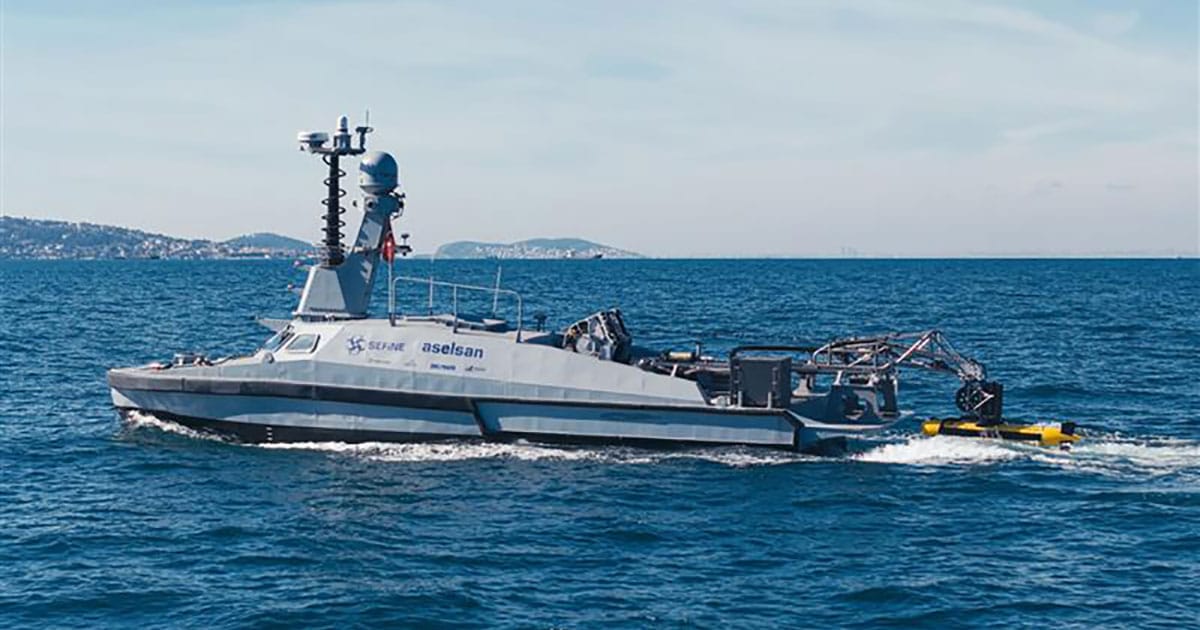
Kraken Robotics Inc. (Kraken) announced the successful integration and demonstration of its KATFISH towed synthetic aperture sonar and autonomous launch and recovery system (LARS) from SEFINE's RD-22 unmanned surface vessel (USV) in coordination with SEFINE SISAM (Strategic Unmanned Systems Research Center). The demonstration took place in Q1 2026 off the coast of İstanbul, Türkiye. "Recent developments underscore the importance of safeguarding critical maritime transit routes and underwater infrastructure, and autonomous mine countermeasure capabilities like KATFISH can play an important role in helping navies efficiently detect and classify mine-like objects," said Bernard Mills, Executive Vice President, Defense at Kraken Robotics. "By combining SEFINE's multi-role USV with Kraken's cutting-edge KATFISH and USV LARS, navies can deploy advanced technologies faster and more efficiently, strengthening defense and maritime security in increasingly complex environments." The demonstration focused on the rapid detection and classification of mine-like objects and critical underwater infrastructure and was attended by several navies and government organizations. KATFISH delivered 3 cm x 3 cm resolution data at a range of 200 meters per side, which was live-streamed to a command center onshore, enabling real-time classification of contacts by operators with SEFINE SISAM's mission planning software. The same KATFISH and USV LARS were demonstrated from a UK Royal Navy in-service 11-meter ARCIMS USV in November 2025. These joint integrations mark a major step forward in delivering agile, modular, and cost-effective mine countermeasure capabilities for modern naval operations. Kraken announced the successful integration and demonstration of its KATFISH towed synthetic aperture sonar and autonomous LARS. (Video credit: Kraken)
Anthropic ups Compute Deal With Google And Broadcom Amid Skyrocketing Demand
BERITAJA is a International-focused news website dedicated to reporting current events and trending stories from across the country. We publish news coverage on local and national issues, politics, business, technology, and community developments. Content is curated and edited to ensure clarity and relevance for our readers. AI investigation laboratory Anthropic announced Monday that it signed a new statement pinch Google and Broadcom for accrued processing and compute capacity to powerfulness its Claude AI models. This reworking of its compute deals comes arsenic request for its AI models continues to soar. The deals would grow Anthropic's usage of Google Cloud's tensor processing units, aliases TPUs, the company's precocious AI chips, and is an description of the woody the companies struck successful October 2025 for much than a gigawatt of compute capacity. This caller compute capacity will travel online successful 2027, Anthropic said successful a blog post. The institution did not springiness specifics for its compute description , but a caller Broadcom SEC filing shows the woody includes 3.5 gigawatts of compute. The mostly of this compute will beryllium housed successful the U.S. and will beryllium an hold of the company's $50 cardinal committedness to put successful U.S. compute infrastructure, Anthropic said successful the post. "This groundbreaking business pinch Google and Broadcom is simply a continuation of our disciplined attack to scaling infrastructure: we are building the capacity basal to service the exponential maturation we person seen successful our customer guidelines while besides enabling Claude to specify the frontier of AI development," Krishna Rao, CFO of Anthropic, said successful the property release. "We are making our about important compute committedness to day to support gait pinch our unprecedented growth." Anthropic did not respond to TechCrunch's petition for comment. The institution has seen request for its Claude models detonate successful caller months, buoyed by endeavor customers and contempt the U.S. Defense Departments's labeling of Anthropic a supply concatenation risk. Anthropic besides precocious closed a $30 cardinal Series G backing round that weighted the institution astatine $380 billion. The company's tally complaint gross is now $30 billion, the institution announced, marking a drastic jump from the $9 cardinal the institution recorded astatine the extremity of 2025. Anthropic besides has much than 1,000 business customers spending much than $1 cardinal connected an annualized basis.

As Intel joins SpaceX Terafab project, US chipmaker's CEO Lip Bu-Tan praises Elon Musk: 'This is exactly...'
Intel has officially joined forces with Elon Musk's 'mega company': SpaceX, Tesla and xAI, to help build "Terafab," a massive new semiconductor manufacturing project. As a part of the tie-up, the US chipmaker will bring its expertise in designing, fabricating and packaging high-performance chips to the table. Following the announcement, Intel CEO Lip Bu-Tan publicly praised Musk's ambitious vision for the future of chipmaking.Intel said that it hosted Musk at its facilities over the weekend to solidify the partnership. According to the US chipmaker, the collaboration will focus on "refactoring" how silicon fabrication works. The ultimate goal is to help Terafab achieve a production rate of 1 Terawatt (TW) of computing power per year, which will be used to fuel the next generation of artificial intelligence (AI) and robotics."Intel is proud to join the Terafab project with SpaceX, xAI, and Tesla to help refactor silicon fab technology. Our ability to design, fabricate, and package ultra-high-performance chips at scale will help accelerate Terafab's aim to produce 1 TW/year of compute to power future advances in AI and robotics. It was fun hosting Elon Musk at Intel this past weekend!" Intel said in a post on X.Bu-Tan shared Intel's announcement, and praises Musk for his "proven track record of reimagining entire industries," "This is exactly what is needed in semiconductor manufacturing today. Terafab represents a step change in how silicon logic, memory, and packaging will get built in the future. Intel is proud to be a partner and work closely with Elon on this highly strategic project," Lip Bu-Tan said in a post on X.Unveiled by Musk at a recent event in downtown Austin, Texas, Terafab is a joint venture operated by Tesla and SpaceX, with heavy support from Musk's artificial intelligence startup, xAI. Musk has previously described the vision as a "gigafactory, but way bigger." According to the company, the facility will begin as an advanced technology fabrication plant capable of producing and testing various types of chips."Even when we extrapolate the best-case scenario for chip production from our suppliers, it's still not enough," Musk noted during Tesla's Annual General Meeting last year, adding, "We either build the Terafab or we don't have the chips, and we need the chips, so we build the Terafab."When operational, the Terafab will be churn out massive quantities of Tesla's highly anticipated fifth-generation AI chip, known as the AI5, which Musk has said is specifically designed to be the "brain" behind Tesla's most advanced technologies.

Polymarket Becomes Top DeFi Fee Generator After Pricing Overhaul - Crypto Economy
The latest data shows Polymarket entering a new phase of growth, with the platform generating $7.1 million in fees during the first week of the second quarter. The surge follows a pricing overhaul that has pushed activity higher and positioned the prediction platform among decentralized finance's most profitable protocols. The March 30 pricing change lifted daily fees to around $1 million, a level that has held as trading volumes remain strong. The new structure has helped Polymarket reach an implied annualized run rate of roughly $365 million if current activity continues. The platform now captures 96.8% of onchain prediction market fees, placing it among the top revenue generators in the sector and ranking it alongside major issuers such as Circle and Tether and the derivatives venue Hyperliquid. Beyond fees, onchain data shows Polymarket maintaining a sizable presence across prediction markets. Total value locked reached more than $432 million on Tuesday, approaching the platform's November 2024 peak near $510 million during the US election cycle. The rising share of revenue within the prediction market category reflects continued demand for event‑driven trading and the platform's ability to sustain elevated engagement. Institutional interest has also intensified. Intercontinental Exchange, the owner of the New York Stock Exchange, completed a $600 million cash investment on March 27 as part of a broader $2 billion commitment. The agreement will allow ICE to distribute Polymarket's event‑driven data to institutional clients, signaling deeper integration between traditional financial infrastructure and onchain prediction markets. The investment underscores the platform's growing relevance within both crypto‑native and regulated financial environments. At the infrastructure level, Polymarket is replacing its bridged USDC.e collateral on Polygon with a new 1:1 USDC‑backed token called Polymarket USD. The token will serve as trading collateral in the platform's April exchange upgrade. The shift comes as the platform continues to launch heavily traded markets tied to geopolitical tensions, oil, inflation, and equities indices, even as regulatory scrutiny persists in regions including Hungary, Portugal, and Argentina.

SpaceX IPO boosts tiny space ETF with record surge in inflows
The looming market debut of Elon Musk's rocket company SpaceX has sparked a rush of capital into smaller space ventures with investors eager to find a way to hitch a ride onto what could be the biggest listing ever. The Procure Space ETF (ticker: UFO), a fund with a market value of about $415 million, pulled in nearly $175 million for the first quarter of the year, the largest inflows since its inception in 2019, according to data compiled by Bloomberg. The influx comes as investors search for ways into SpaceX, the space exploration, satellite and artificial intelligence company that has become the most eagerly anticipated initial public offering in years. "The euphoria around potentially tapping into a trillion-dollar IPO is really having an impact," said Philip Blancato, chief market strategist at Osaic Holdings, the 15th-largest institutional holder of the ETF. He added that his investment advisory firm was seeing strong demand from investors wanting access to SpaceX. Even five years ago, investing in the UFO ETF would have struck him as a "crazy" idea, Blancato said. However, that has changed as global government stimulus is expected to drive the sector higher, he added. A Bank of America Corp. basket of US stocks that are key players and potential beneficiaries of the space race has climbed 23% this year, compared to a 3.4% drop in the S&P 500 Index and a 4.2% decline in the Nasdaq 100. The biggest percentage gainer in the BofA basket is Satellogic Inc. The company, which uses satellites to map the earth, is backed by Steven Mnuchin's Liberty Strategic Capital and Cantor Fitzgerald LP -- the US investment bank run by the children of Commerce Secretary Howard Lutnick. The stock has jumped nearly 280% this year. Other large gainers include satellite communications company Iridium Communications Inc. and Planet Labs PBC. SpaceX's offering could take place as early as June, after the company filed confidentially for an IPO and boosted its target valuation above $2 trillion, according to people familiar with the matter. The offering comes as excitement for space exploration has been rising. A NASA crew of four astronauts aboard the Artemis II capsule took the first voyage toward the moon in more than 50 years. On Monday, they traveled further in space than anyone in history. Meanwhile, both the US and China are spending billions to put humans back on the moon, fueling investment across the sector. "We've got a real space race 2.0 going on as we speak, for who is going to start to build out a permanent presence first on the moon," said Andrew Chanin, chief executive officer at ProcureAM, which manages the UFO ETF. The fund already has some exposure to SpaceX through Charlie Ergen's satellite and internet services provider EchoStar Corp., which holds a small stake in the Musk venture. While space tourism -- with high profile efforts from Amazon.com Inc. founder Jeff Bezos' Blue Origin and Richard Branson-founded Virgin Galactic Holdings Inc. -- captured some investor interest several years back, the focus has moved to satellites, communications technology, and emerging areas such as space-based data centers and lunar infrastructure, Chanin said. Then there is the overlap with another industry that has steadily emerged as an investor favorite in recent years: defense. "You're not building guns and bomb anymore," Blancato said. "You're building satellites and drones that are very different than what we've done in the past." The primary contractors for NASA's Artemis II moon mission include Boeing Co., Lockheed Martin Corp., Northrop Grumman Corp. and L3Harris Technologies Inc. -- which are also major defense contractors for the US military. Still, market watchers largely pointed to SpaceX's imminent arrival to public markets and Musk's star power as the main drivers behind the surge in investor interest in the sector. "The fact that famous rich people are investing in the space sector is giving it the kind of attention it hasn't had in decades." said Matt Maley, chief market strategist at Miller Tabak + Co.

SpaceX IPO boosts tiny space ETF with record surge in inflows
The looming market debut of Elon Musk's rocket company SpaceX has sparked a rush of capital into smaller space ventures with investors eager to find a way to hitch a ride onto what could be the biggest listing ever. The Procure Space ETF (ticker: UFO), a fund with a market value of about $415 million, pulled in nearly $175 million for the first quarter of the year, the largest inflows since its inception in 2019, according to data compiled by Bloomberg. The influx comes as investors search for ways into SpaceX, the space exploration, satellite and artificial intelligence company that has become the most eagerly anticipated initial public offering in years. "The euphoria around potentially tapping into a trillion-dollar IPO is really having an impact," said Philip Blancato, chief market strategist at Osaic Holdings, the 15th-largest institutional holder of the ETF. He added that his investment advisory firm was seeing strong demand from investors wanting access to SpaceX. Even five years ago, investing in the UFO ETF would have struck him as a "crazy" idea, Blancato said. However, that has changed as global government stimulus is expected to drive the sector higher, he added. A Bank of America Corp. basket of US stocks that are key players and potential beneficiaries of the space race has climbed 23% this year, compared to a 3.4% drop in the S&P 500 Index and a 4.2% decline in the Nasdaq 100. The biggest percentage gainer in the BofA basket is Satellogic Inc. The company, which uses satellites to map the earth, is backed by Steven Mnuchin's Liberty Strategic Capital and Cantor Fitzgerald LP -- the US investment bank run by the children of Commerce Secretary Howard Lutnick. The stock has jumped nearly 280% this year. Other large gainers include satellite communications company Iridium Communications Inc. and Planet Labs PBC. SpaceX's offering could take place as early as June, after the company filed confidentially for an IPO and boosted its target valuation above $2 trillion, according to people familiar with the matter. The offering comes as excitement for space exploration has been rising. A NASA crew of four astronauts aboard the Artemis II capsule took the first voyage toward the moon in more than 50 years. On Monday, they traveled further in space than anyone in history. Meanwhile, both the US and China are spending billions to put humans back on the moon, fueling investment across the sector. "We've got a real space race 2.0 going on as we speak, for who is going to start to build out a permanent presence first on the moon," said Andrew Chanin, chief executive officer at ProcureAM, which manages the UFO ETF. The fund already has some exposure to SpaceX through Charlie Ergen's satellite and internet services provider EchoStar Corp., which holds a small stake in the Musk venture. While space tourism -- with high profile efforts from Amazon.com Inc. founder Jeff Bezos' Blue Origin and Richard Branson-founded Virgin Galactic Holdings Inc. -- captured some investor interest several years back, the focus has moved to satellites, communications technology, and emerging areas such as space-based data centers and lunar infrastructure, Chanin said. Then there is the overlap with another industry that has steadily emerged as an investor favorite in recent years: defense. "You're not building guns and bomb anymore," Blancato said. "You're building satellites and drones that are very different than what we've done in the past." The primary contractors for NASA's Artemis II moon mission include Boeing Co., Lockheed Martin Corp., Northrop Grumman Corp. and L3Harris Technologies Inc. -- which are also major defense contractors for the US military. Still, market watchers largely pointed to SpaceX's imminent arrival to public markets and Musk's star power as the main drivers behind the surge in investor interest in the sector. "The fact that famous rich people are investing in the space sector is giving it the kind of attention it hasn't had in decades." said Matt Maley, chief market strategist at Miller Tabak + Co.

SpaceX IPO boosts tiny space ETF with record surge in inflows
The looming market debut of Elon Musk's rocket company SpaceX has sparked a rush of capital into smaller space ventures with investors eager to find a way to hitch a ride onto what could be the biggest listing ever. The Procure Space ETF (ticker: UFO), a fund with a market value of about $415 million, pulled in nearly $175 million for the first quarter of the year, the largest inflows since its inception in 2019, according to data compiled by Bloomberg. The influx comes as investors search for ways into SpaceX, the space exploration, satellite and artificial intelligence company that has become the most eagerly anticipated initial public offering in years. "The euphoria around potentially tapping into a trillion-dollar IPO is really having an impact," said Philip Blancato, chief market strategist at Osaic Holdings, the 15th-largest institutional holder of the ETF. He added that his investment advisory firm was seeing strong demand from investors wanting access to SpaceX. Even five years ago, investing in the UFO ETF would have struck him as a "crazy" idea, Blancato said. However, that has changed as global government stimulus is expected to drive the sector higher, he added. A Bank of America Corp. basket of US stocks that are key players and potential beneficiaries of the space race has climbed 23% this year, compared to a 3.4% drop in the S&P 500 Index and a 4.2% decline in the Nasdaq 100. The biggest percentage gainer in the BofA basket is Satellogic Inc. The company, which uses satellites to map the earth, is backed by Steven Mnuchin's Liberty Strategic Capital and Cantor Fitzgerald LP -- the US investment bank run by the children of Commerce Secretary Howard Lutnick. The stock has jumped nearly 280% this year. Other large gainers include satellite communications company Iridium Communications Inc. and Planet Labs PBC. SpaceX's offering could take place as early as June, after the company filed confidentially for an IPO and boosted its target valuation above $2 trillion, according to people familiar with the matter. The offering comes as excitement for space exploration has been rising. A NASA crew of four astronauts aboard the Artemis II capsule took the first voyage toward the moon in more than 50 years. On Monday, they traveled further in space than anyone in history. Meanwhile, both the US and China are spending billions to put humans back on the moon, fueling investment across the sector. "We've got a real space race 2.0 going on as we speak, for who is going to start to build out a permanent presence first on the moon," said Andrew Chanin, chief executive officer at ProcureAM, which manages the UFO ETF. The fund already has some exposure to SpaceX through Charlie Ergen's satellite and internet services provider EchoStar Corp., which holds a small stake in the Musk venture. While space tourism -- with high profile efforts from Amazon.com Inc. founder Jeff Bezos' Blue Origin and Richard Branson-founded Virgin Galactic Holdings Inc. -- captured some investor interest several years back, the focus has moved to satellites, communications technology, and emerging areas such as space-based data centers and lunar infrastructure, Chanin said. Then there is the overlap with another industry that has steadily emerged as an investor favorite in recent years: defense. "You're not building guns and bomb anymore," Blancato said. "You're building satellites and drones that are very different than what we've done in the past." The primary contractors for NASA's Artemis II moon mission include Boeing Co., Lockheed Martin Corp., Northrop Grumman Corp. and L3Harris Technologies Inc. -- which are also major defense contractors for the US military. Still, market watchers largely pointed to SpaceX's imminent arrival to public markets and Musk's star power as the main drivers behind the surge in investor interest in the sector. "The fact that famous rich people are investing in the space sector is giving it the kind of attention it hasn't had in decades." said Matt Maley, chief market strategist at Miller Tabak + Co.

Trump's ultimatum sparks chaos: Iranians form a "human shield" on bridges VIDEO
The video shows a crowd of people unfurling a massive Iranian flag across the bridge, while participants in the march wave smaller flags. It is a symbolic, but also desperate action by citizens following a public call by Alireza Rahimi, Secretary of the National Youth Council, urging young people, students, athletes, and artists to form human shields around power plants and bridges across the country. U.S. President Donald Trump warned that "an entire civilization will die tonight" unless Tehran accepts an agreement that includes reopening the Strait of Hormuz. Trump threatened the complete destruction of Iranian power plants and bridges if traffic in the strait is not normalized. Although Trump left minimal room for a diplomatic solution in his statements, saying that "something incredibly beautiful and revolutionary might happen," the rhetoric has reached a boiling point.

Claude Cheat Sheet: A Complete Guide to Anthropic's AI
eWeek content and product recommendations are editorially independent. We may make money when you click on links to our partners. Learn More It started as a cautious alternative to ChatGPT. Now it codes your codebase, controls your computer, researches anything, and has landed its maker in a legal standoff with the Pentagon. Claude is writing code for developers, reading contracts for lawyers, automating spreadsheets for analysts, and now -- after a bruising legal fight with the Trump administration -- standing as one of the most politically visible AI products in the world. Whether you're picking it up for the first time or trying to get more out of it, this is the guide you need. Here's everything you need to know about Claude. What is Claude? Claude is a family of AI models developed by Anthropic for conversational, writing, research, coding, and analysis tasks. Like other large language models, Claude doesn't know things the way a person does -- it's a transformer-based model trained to predict the most useful sequence of words given its input. What sets it apart, according to Anthropic, is that it was designed from the start around "constitutional AI," a framework intended to make the model's responses more reliable and less harmful by baking in principles rather than relying entirely on human feedback to correct bad behavior. What the product actually looks like in 2026 has grown well beyond a chat window. Claude can browse the web, control a computer's mouse and keyboard, analyze uploaded files, generate interactive charts directly in chat, and power an expanding ecosystem of workplace integrations. It is, in short, considerably more than a text box. Who made Claude? Claude is the flagship product of Anthropic, an AI safety company founded in 2021 by Dario Amodei, Daniela Amodei, and several colleagues who previously worked at OpenAI. The company describes its mission as building AI that is safe, beneficial, and understandable, an emphasis reflected in its approach to model training and behavior. Anthropic has attracted significant investment from major technology players, with both Google and Amazon holding substantial financial stakes. The company employs more than 2,000 people and counts itself among the handful of organizations building what the industry calls "frontier models," the most capable AI systems in existence. The company has not been without controversy. In early 2026, a legal battle erupted with the Trump administration after contract negotiations for Pentagon AI soured. A federal judge ultimately blocked the government from banning federal agencies and contractors from using Claude, describing the move as unconstitutional retaliation against a company that had publicly disagreed with the government's contracting terms. The case is ongoing. What does Claude do? Claude handles a wide range of tasks. Its core strengths include writing assistance, code generation, document analysis, and multi-step reasoning. But the platform has expanded substantially in 2025 and 2026, and several newer capabilities are worth knowing about. Core capabilities at a glance * Chat: Question answering, brainstorming, planning, drafting text in, text out, across virtually any subject. * Write: Emails, reports, summaries, scripts, social media posts, and long-form content with adjustable tone and style. * Code: Writing, debugging, and explaining code across languages; building apps even for non-developers. The dedicated Claude Code terminal tool handles larger codebases. * Deep research: Claude crawls the web, gathers sources, and returns cited, structured reports on complex topics. * Analyze: Upload spreadsheets, PDFs, images, charts, and screenshots for Claude to interpret, extract, or summarize. * Artifacts: Claude can generate live, interactive content directly in the chat, such as charts, diagrams, and even small functional web apps, without needing a side panel. * Computer: Claude can control a computer's mouse, keyboard, and screen to carry out multi-step tasks across applications, in research preview for Pro and Max users on macOS. * Code review: Claude Code's new Code Review feature deploys multiple agents simultaneously to find bugs in a pull request and rank them by severity before you merge. * Voice mode: Real-time voice chat available in the mobile apps, with a selection of AI voices. * MCP (Model Context Protocol): A bridge that lets Claude connect directly to your data in Slack, Google Drive, or GitHub, so it can "read" your team's conversations and files in real-time. * Skills: A feature that allows users to save "folders" of specific brand guidelines, tones, or instructions that Claude automatically applies to new projects. * Long-context handling: Claude can process up to 20 files at a time, making it a powerhouse for analyzing long legal documents or massive codebases. One of the more significant recent additions is Claude Cowork, Anthropic's enterprise productivity platform. It allows companies to build private "plugin marketplaces" customized versions of Claude trained on their specific workflows and terminology, for departments ranging from legal to investment banking. Claude can now also hand off tasks between Excel and PowerPoint in a single session, running an analysis in one and building the presentation in the other without you having to re-explain anything. Where is Claude available? Claude is accessible across most major platforms, though some features are gated by subscription level or geography. * Web: claude.ai, accessible in any modern browser. * Mobile: iOS and Android apps with voice chat and file upload support. * Desktop: macOS and Windows apps. * IDEs: Integrations for VS Code, Cursor, and JetBrains, plus a terminal tool called Claude Code for developers. * Chrome: An official extension for all paid subscribers. * Enterprise cloud: Available through the Anthropic API, Amazon Bedrock, and Google Cloud Vertex AI for organizations building on top of Claude. Claude Cowork, the workplace productivity platform, connects Claude to widely used business software, including Google Workspace, DocuSign, FactSet, WordPress, and others. Companies, including Slack, S&P Global, and Apollo, have built plugins for joint customers. The platform also integrates with Excel and PowerPoint via downloadable add-ins. How much does Claude cost? Claude's pricing runs from free to $200 per month for individuals, with separate business and enterprise tiers. At the standard $20 Pro price, it is competitive with ChatGPT Plus and slightly cheaper on an annualized basis. * Free ($0 per month): Basic access to Sonnet model, daily rate limits, core features only. * Pro ($20 per month): All models, including Opus, deep research, Claude Code, Cowork, higher limits, Projects & Artifacts. * Max ($100 or $200/month 5× or 20× Pro usage): Priority access, early features, Chrome extension. * Team ($25 per user/month (5-seat min): Shared workspaces, admin controls, higher limits. Premium tier at $125/user/month. For developers using the API, pricing is token-based. As of April 2026: Claude Opus 4.6 costs $5 per million input tokens and $25 per million output tokens; Sonnet 4.6 runs $3 in and $15 out; Haiku 4.5 is the budget option at $1 in and $5 out. Prompt caching can cut costs by up to 90% for repeated contexts, and batch processing offers a 50% discount for asynchronous jobs. The Code Review feature in Claude Code carries a separate cost, typically $15 to $25 per pull request, depending on the size of the code change. It's available only to Team and Enterprise accounts. Which AI models power Claude? Claude runs on three model lines, each designed for a different balance of intelligence, speed, and cost. * Claude Opus 4.6 (Flagship): Complex agentic workflows, deep coding, large codebases, strategic reasoning, long-running tasks. Top-tier intelligence across the board. * Claude Sonnet 4.6 (Default): The default for free and Pro users. A strong everyday model that balances speed with strong coding, computer use, and knowledge work. * Claude Haiku 4.5 (Efficient): High-volume API use, fast responses where cost efficiency matters more than maximum capability. Both Opus 4.6 and Sonnet 4.6 were released in Feb. 2026. They share a focus on agentic tasks. A future model codenamed "Mythos" is reportedly under development and is expected to surpass Opus 4.6 in capabilities, though no release date has been confirmed as of the time of writing. What's new in Claude in 2026? The past twelve months have brought a wave of feature additions that shift Claude from a chatbot into something closer to an autonomous colleague. Here are the most significant changes. Computer use Claude can now navigate a computer on your behalf, clicking, typing, opening apps, and running tests using the screen, mouse, and keyboard. It first reaches for direct connectors (Slack, Google Calendar, etc.) and only drops to screen control when no connector is available. It requires explicit permission before entering each new application and can be stopped at any time. Currently available to Pro and Max subscribers on macOS, through Claude Cowork and Claude Code. Interactive visualizations in chat Claude now generates interactive charts, diagrams, and visualizations directly inside the chat window, not a side panel. These visuals appear mid-conversation, respond to follow-up questions, and can be adjusted or expanded on the fly. Ask something like "visualize how this changes over time" and a live interactive curve appears. The feature is on by default and available to free users. Code Review in Claude Code When a code change is opened for review, Code Review dispatches a team of agents to inspect it simultaneously. They cross-check each other's findings to filter false positives, then rank issues by severity, returning a single high-signal summary plus inline notes attached to the specific lines of concern. Internally, Anthropic says it raised the share of code submissions getting substantive review comments from 16% to 54%. It costs $15 to $25 per pull request and is available on Team and Enterprise plans. Claude Cowork expands Cowork, Anthropic's enterprise productivity platform, now supports private plugin marketplaces, letting organizations build custom Claude agents tailored to specific departments. New connectors include Google Workspace, DocuSign, FactSet, WordPress, and LegalZoom. Claude can now also move between Excel and PowerPoint in a single workflow, passing context between both without needing the user to re-explain the task. Privacy, data, and security Anthropic's privacy story has grown more complicated over time. Claude no longer stands out for having a user-friendly default data policy; the company now trains on user conversations by default, a change from its earlier stance. Users can opt out via settings, and an "Incognito chats" (temporary mode) is available for conversations that shouldn't be stored. The company holds SOC 2 and ISO 27001 certifications. Enterprise plans include customer-managed encryption keys, audit logs, and additional administrative controls. Business deployments can add isolation controls, including private cloud configurations, depending on the tier. Anthropic published a Threat Intelligence Report last year, flagging that criminal actors had misused Claude for cyberattacks, extortion, and AI-assisted fraud. In one case, a criminal operation used Claude Code to carry out large-scale data theft against hospitals, emergency services, and government agencies. Separately, North Korean IT operatives have used Claude-generated resumes and coding assistance to obtain remote jobs at American companies, funneling salaries back to Pyongyang. Anthropic says it banned the relevant accounts and implemented new safety measures, though it acknowledges that AI-assisted cybercrime is advancing faster than expected. As with any cloud-based platform, conversations with Claude can be subpoenaed and produced in legal proceedings. Users handling sensitive professional information should take that into account. What are Claude's competitors? The frontier AI market has consolidated around a small number of major players, with each staking out distinct strengths. * ChatGPT (OpenAI): The market leader by usage. GPT-5 family covers reasoning, coding, image generation, computer use, and real-time web search. More features than Claude out of the box. * Gemini (Google): Strong multimodal performance; deeply integrated into Google Workspace, Android, and Search. Best for users already in the Google ecosystem. * Microsoft Copilot: Runs on OpenAI models; built into Windows, Edge, Teams, and Office 365. The natural choice for Microsoft-heavy organizations. * Perplexity AI: Always cites its sources and links to search results. Superior for current-events research; weaker on creative tasks. No image generation. * Meta AI (Llama): Open-weight model available across Facebook, Instagram, WhatsApp, and the web. Popular for developers who want to self-host and avoid API costs. * xAI Grok: Positioned as a real-time social intelligence tool tightly integrated with X. Bundled with X Premium. * DeepSeek (China): Offers strong reasoning at low or no cost, creating a splash in early 2025. Raises data privacy concerns due to potential access by Chinese authorities. For coding tasks specifically, Claude Code is regarded as a serious competitor to other agentic coding tools, including Cursor and GitHub Copilot. OpenAI, Anthropic, and Google have reportedly been collaborating to combat unauthorized model "distillation" by Chinese AI labs. Criticisms, limitations, and open questions No AI product is without its shortcomings, and Claude is no exception. * Accuracy: Like all LLMs, Claude can generate confident and entirely incorrect information. Users must fact-check mission-critical outputs against reliable sources. * Features: Claude does not generate images or video, a meaningful gap compared to ChatGPT and Gemini, both of which include these capabilities. * Web search: Claude's web search is slightly slower than competitors, and its sourcing is less detailed than ChatGPT's, which highlights relevant text when you hover over a citation. * Privacy: Training on user data is now opt-out rather than opt-in, which may concern privacy-conscious users. * Misuse: Anthropic's own threat intelligence reports document criminal use of Claude for cyberattacks, extortion campaigns, and fraudulent employment schemes. * Legal: The ongoing federal dispute over Pentagon contracts introduces regulatory and reputational uncertainty for enterprise customers. How to get started with Claude Getting going takes about two minutes. Visit claude.ai, create a free account using your email address, Google, or Apple login, and start typing. A paid account isn't required to begin. For best results, write specific prompts. Tell Claude what format you want the response in, who the audience is, and how long or short you need it to be. For complex problems, ask it to work through the problem step by step before giving you an answer; this tends to produce more accurate results on technical or analytical tasks. To manage privacy, go to Settings and look for data controls. You can turn off chat history to prevent your conversations from being used to train future models. Memory -- Claude's ability to remember details across sessions -- can also be toggled on or off in Settings, and you can review everything it knows about you in a dedicated settings page. For developers, API access is set up through console.anthropic.com, where you can generate an API key and explore the documentation. Claude Code, the terminal-based agentic coding tool, is available on the Pro plan and above. Quick-start checklist ☐ Visit claude.ai and sign up for free. ☐ Install the iOS or Android app for voice chat. ☐ Upgrade to Pro for deep research, Opus access, and Claude Code. ☐ Connect Google Drive or Slack via Claude Cowork for workplace workflows. ☐ Adjust memory and data settings in Settings > Personalization. Also read: Better Claude prompts for AI images can make the difference between vague outputs and visuals that actually match your intent.
Arista Upgraded To Buy On Google, Anthropic Data Center Orders
Arista Networks (ANET) will top consensus estimates for 2026 revenue growth, boosted by new data center orders from Alphabet's (GOOGL) Google, said a Rosenblatt Securities analyst on Tuesday. Arista stock climbed despite a broad sell-off on the Nasdaq composite. Rosenblatt analyst Mike Genovese upgraded Arista, a maker of cloud computing network gear, to buy from hold. Genovese upped his price...

Anthropic ups compute deal with Google and Broadcom amid skyrocketing demand | TechCrunch
AI research lab Anthropic announced Monday that it signed a new agreement with Google and Broadcom for increased processing and compute capacity to power its Claude AI models. This reworking of its compute deals comes as demand for its AI models continues to soar. The deals would expand Anthropic's use of Google Cloud's tensor processing units, or TPUs, the company's advanced AI chips, and is an expansion of the deal the companies struck in October 2025 for more than a gigawatt of compute capacity. This new compute capacity will come online in 2027, Anthropic said in a blog post. The company did not give specifics for its compute expansion, but a recent Broadcom SEC filing shows the deal includes 3.5 gigawatts of compute. The majority of this compute will be housed in the U.S. and will be an extension of the company's $50 billion commitment to invest in U.S. compute infrastructure, Anthropic said in the post. "This groundbreaking partnership with Google and Broadcom is a continuation of our disciplined approach to scaling infrastructure: we are building the capacity necessary to serve the exponential growth we have seen in our customer base while also enabling Claude to define the frontier of AI development," Krishna Rao, CFO of Anthropic, said in the press release. "We are making our most significant compute commitment to date to keep pace with our unprecedented growth." Anthropic did not respond to TechCrunch's request for comment. The company has seen demand for its Claude models explode in recent months, buoyed by enterprise customers and despite the U.S. Defense Departments's labeling of Anthropic a supply chain risk. Anthropic also recently closed a $30 billion Series G funding round that valued the company at $380 billion. The company's run rate revenue is now $30 billion, the company announced, marking a drastic jump from the $9 billion the company recorded at the end of 2025. Anthropic also has more than 1,000 business customers spending more than $1 million on an annualized basis.
What if SpaceX's debut ends up wrecking the IPO market and TSLA for good? - Cryptopolitan
SpaceX plans an unusually big retail push, with up to 30% of shares for smaller investors and a 1,500-person retail event in June. SpaceX's blockbuster debut on the US stock market could value the company at as much as $2 trillion, putting it in territory no IPO has ever touched. The fear around Wall Street is that a deal that large can swallow money, analyst attention, bank resources, and media coverage all at once. For every company planning to list in 2026, that is a problem. And for SpaceX's sister company, Tesla, it could become a second problem at the exact same time. The IPO market is already weak, according to data from Reuters, which shows only 35 IPOs have priced so far this year, down 37.5% from a year earlier, even though bankers and analysts say the pipeline is one of the biggest seen in decades. Companies have been waiting for years for better conditions in the US IPO market, following a long freeze on new listings. Instead of getting a clean reopening, they are dealing with the war in Iran, higher oil prices, worries in private credit, and AI pressure hitting older software firms. SpaceX pulls money and attention away from the rest of the IPO market Reportedly, more than half a dozen analysts and industry experts expect SpaceX to take an outsized share of demand. May and June are usually the best months to get a deal done before summer slows everything down. Bankers widely expect SpaceX to hit in June, while OpenAI and Anthropic are reportedly targeting the second half of the year. PitchBook analyst Kyle Stanford said the pull from these giant offerings could push a broad IPO reopening into 2027. His report said that if SpaceX raises $50 billion to $75 billion, and OpenAI plus Anthropic bring in another $50 billion combined, that would be about equal to the total amount raised by U.S. venture-backed IPOs over the past decade. But that does not mean the market will hand over whatever price it wants. AJ Bell investment director Russ Mould pointed out that bull IPO markets often end when money runs out and too many new offerings leave sellers overwhelming buyers. And this is where the Saudi Aramco memory comes in, the largest IPO in the history of the world. The Saudi government-owned oil company first drew heavy attention in 2016, when Crown Prince Mohammed bin Salman said the plan was to sell 5% of the oil giant at a value of about $2 trillion. The deal stalled. Some analysts said the business was worth less than that. Before the IPO, rating agencies released financial details in April 2019, right before Aramco sold $12 billion in international bonds. When the IPO finally arrived in 2019, Aramco raised a record $25.6 billion by selling 3 billion shares, then increased the total to $29.4 billion through a greenshoe sale of 450 million extra shares. Tesla loses support as retail money lines up for SpaceX The SpaceX debut is also becoming a threat to Tesla's stock, which Elon Musk doesn't seem to mind. As you likely know, retail investors hold more of Tesla than Wall Street lords, and that worked nicely for Elon. Now, those same investors might be pulling out of the automaker to invest in the space company, something Jimmy Cramer noted on X, saying, "People are going to sell this one to buy SpaceX," referring to Tesla. To add to Tesla's pile, JPMorgan kept its underweight rating on Tesla and maintained a $145 price target, implying a 60% decline from Thursday's close. Analyst Ryan Brinkman said: "We advise investors approach TSLA shares with a high degree of caution. Although both technology and execution risk seem substantially less than was once feared, expansion into higher volume segments with lower price points seems fraught with greater risk relative to demand, execution, and competition." JPMorgan said unsold cars had hit a record and warned about demand, execution, competition, brand controversy, and a valuation that already assumes too much. Of the 54 analysts covering Tesla, only 10 have an underperform or sell rating, according to LSEG. The stock is down nearly 20% this year, though it is still up about 51% over the past 12 months.
Intel Partners with Tesla and SpaceX on Terafab
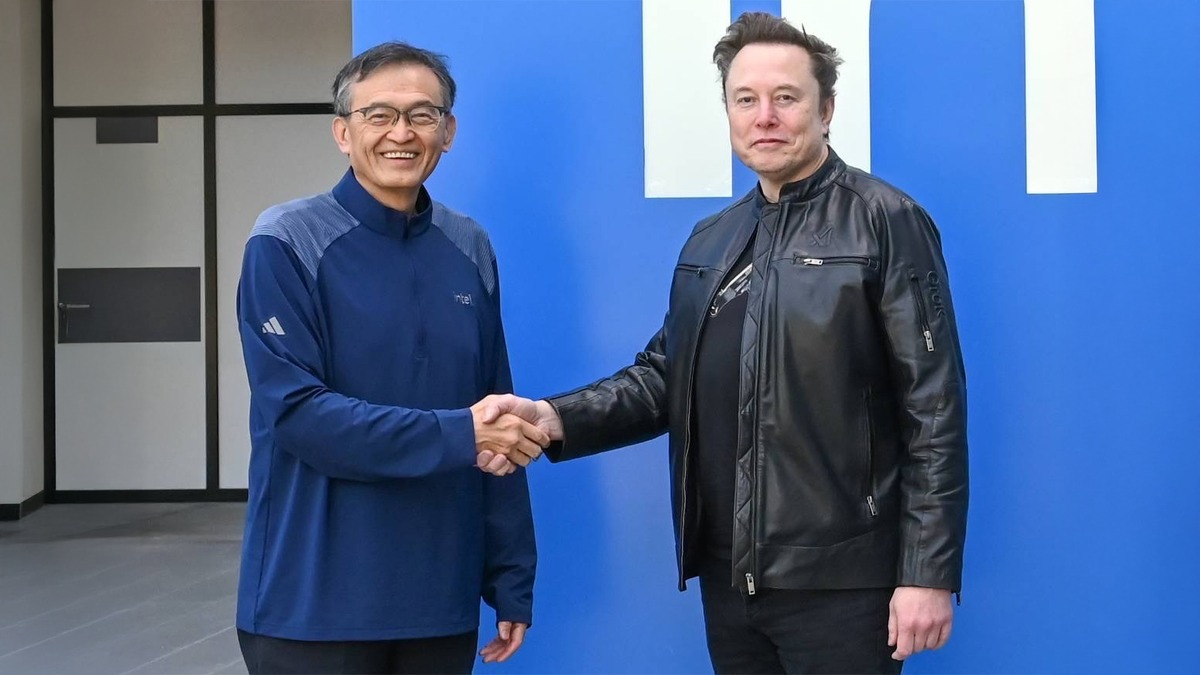
The goal is to produce ~1 TW/year of AI compute capacity -- enough to power billions of Optimus robots, FSD/robotaxi systems, Grok-level training, and space-hardened chips (e.g., D3 for orbital AI) -- far beyond what current foundries like TSMC or Samsung can supply at the needed scale and speed Intel's Role is to Help Remake Silicon Fab Technology Intel's will help refactor silicon fab technology by bringing its expertise in chip design, fabrication, and packaging at ultra-high scale. This directly supports Terafab's production targets and modernization of the overall process. Intel hosted Elon Musk at its facilities last weekend, signaling active, high-level engagement (a handshake photo from the meeting was shared in related posts).

Intel joins Tesla's TeraFab chip project with SpaceX and xAI to meet growing demand for AI and robotics
Tesla's TeraFab project is a joint venture between Tesla, SpaceX, and xAI, dubbed by Elon Musk as "the most epic chip-building exercise in history." Tesla claims its $25 billion Austin chip factory would roughly match 70% of TSMC's current global output. This would allow Tesla to reduce its reliance on foundries like TSMC and Samsung by building domestic semiconductor production lines capable of producing chips at volumes significantly larger than those of any other foundry. However, given that Tesla has no node IP or semiconductor industry experience, many were skeptical about how a car company, a rocket company, and an AI startup could develop 2nm-class process technology from scratch and scale it to 1 million. The most likely path forward was always a partnership with an existing foundry, and it appears Intel has now been chosen for that role. Intel confirmed its involvement in the TeraFab project on its official X page, stating that it aims to help TeraFab reach 1 trillion watts of compute per year for future AI and robotics workloads. Musk pitched TeraFab as a vertically integrated mega-facility that would combine design, lithography, fabrication, memory, advanced packaging, and testing under one roof. With Intel now in the picture, it is clear that the company will bring the process technology, manufacturing expertise, and advanced packaging capabilities needed to make such a facility viable. For Tesla, partnering with Intel makes sense, as existing foundries haven't expanded fast enough to meet future demand for Tesla's AI hardware. Even the best-case supply scenarios from TSMC and Samsung were not enough to cover the AI5, AI6, and Optimus chips the company needs. The Optimus robot program is the largest single driver of chip demand, estimated to require 20 million chips per year. That is approximately six times Tesla's current chip demand across its entire automotive business. This leaves Intel as one of the few companies capable of operating at advanced process nodes while also offering industry-leading packaging technologies such as Foveros 3D stacking and EMIB. It also aligns with Musk's preference for a US-based supply chain, making Intel a natural partner alongside Samsung and TSMC. Intel has not yet shared details about the process technology, packaging approach, or specific foundry model for TeraFab. However, the chipmaker's stock rose nearly 5% following the announcement of its partnership with Tesla, SpaceX, and xAI.