News & Updates
The latest news and updates from companies in the WLTH portfolio.
Polymarket Generates $7.1M Weekly Fees After Pricing Shift, Targets $365M Annual Run Rate - FinanceFeeds
Polymarket has emerged as one of decentralized finance's highest-earning protocols following a pricing overhaul, generating about $7.1 million in fees in the first week of the second quarter. If sustained, that pace implies an annualized run rate of roughly $365 million. The increase follows a March 30 pricing adjustment that pushed daily fees to around $1 million, a level that has largely held as trading activity remains elevated. This has positioned Polymarket as the eighth-largest DeFi protocol by fees, alongside stablecoin issuers Circle and Tether and derivatives platform Hyperliquid. The platform now accounts for 96.8% of all onchain prediction market fees, indicating near-total dominance in a niche that is expanding rapidly as event-driven trading gains traction. Beyond fees, onchain metrics point to sustained user engagement and capital inflows. Total value locked on the platform stood at over $432 million, approaching its peak of around $510 million during the November 2024 US election cycle. The growth reflects increased participation in markets tied to macro and geopolitical events, including the US-Iran conflict, oil prices, inflation, and equity indices. These categories have become central to prediction market activity, where traders use event contracts to express directional views or hedge exposure. At the infrastructure level, Polymarket is also adjusting its collateral model. The platform is replacing bridged USDC.e on Polygon with a new 1:1 USDC-backed token, Polymarket USD, which will serve as the primary trading collateral following its April upgrade. Polymarket's revenue growth has started to draw interest from traditional market infrastructure providers. Intercontinental Exchange, the parent company of the New York Stock Exchange, expanded its involvement with a $600 million cash investment as part of a broader $2 billion commitment. The partnership includes plans to distribute Polymarket's event-driven data to institutional clients, suggesting that prediction market pricing is gaining relevance as an alternative data source for macro and trading strategies. This development points to a broader trend where event-based markets are being used not only for speculation but also for real-time sentiment tracking and probabilistic forecasting across financial and geopolitical events. Despite strong revenue performance, regulatory uncertainty remains a central risk. Prediction markets continue to face scrutiny in multiple jurisdictions, with some regulators treating them as unlicensed gambling platforms. Recent actions include blocking measures in Hungary and Portugal, as well as a nationwide restriction in Argentina. In the United States, the regulatory framework remains fragmented, with ongoing debates over whether event contracts fall under derivatives regulation or state-level gaming laws. These pressures create operational risk for platforms seeking to scale globally, particularly as they attract institutional attention. While revenue growth and infrastructure upgrades strengthen Polymarket's position, regulatory outcomes will play a decisive role in determining how far the model can expand.

SpaceX launch provides spectacular nighttime show for Southern California
The next launch of a Falcon 9 rocket from Vandenberg Space Force Base near Lompoc will be on Friday after the latest launch created a spectacular display across the sky that could be seen from Southern to Central California. The rocket carrying 25 Starlink satellites lifted off at 7:50 p.m. Monday, according to SpaceX. This was the first flight for the first stage booster supporting the mission. Following stage separation, the first stage landed on the Of Course I Still Love You drone ship stationed in the Pacific Ocean. The launch was originally scheduled for Sunday evening but was postponed due to unfavorable conditions. Friday's flight will also carry 25 Starlink satellites. It will be the 32nd flight for its first stage booster.

The SpaceX Effect: How Former Employees Are Building the Next Generation of Hard-Tech Startups - News Directory 3
The financial impact of this founder network is significant. SpaceX has evolved into a primary engine for industrial entrepreneurship, creating a pipeline of former employees who are launching new ventures across the global economy. While the company is known for scaling rocket science and lowering the cost of reaching orbit, its legacy is increasingly defined by a diaspora of alumni applying a specific, high-risk engineering ethos to a wide array of hard-tech challenges. According to reporting from Fast Company, SpaceX alumni have founded a growing universe of companies dedicated to solving complex engineering problems. This trend is not limited to the space sector; only about 17% of these alumni founders are pursuing opportunities within the space industry. Instead, many are focusing on remaking the industrial economy, including agriculture, construction, housing, energy, manufacturing, and transportation. The financial impact of this founder network is significant. Data from Forbes indicates that SpaceX alumni startups have raised $10.6 billion in the last decade and created more than 7,000 new jobs. Other tracking data from Alumni Founders suggests the total raised is closer to $12 billion. These ventures span various verticals, including AI, energy, mobility, and aerospace. The breadth of these companies ranges from personal aviation to planetary exploration. Examples include Airhart Aeronautics, led by former SpaceX avionics engineer Nikita Ermoshkin, which is developing personal airplanes with simplified controls. Jaret Matthews, a former mechanism group leader for the Dragon spacecraft, founded Astrolab to develop commercial planetary rovers for the moon, and Mars. Other alumni are targeting critical infrastructure and supply chain bottlenecks. Jordan Black and Benjamin Shanahan founded Senra Systems to improve wire harnessing for hardware production, recently expanding to an 80,000-square-foot factory in Cypress, California. Similarly, Apex Space, co-founded by former propulsion engineer Max Benassi, is utilizing a production-line approach to satellite bus manufacturing. The common thread among these startups is a shared approach to problem-solving known as first principles thinking. This method involves breaking a problem down to its most basic constituent elements rather than making marginal improvements to existing solutions. This mindset is often paired with the idiot index, a term used to evaluate whether an industry is overpaying for the conversion of raw materials into finished products. This culture encourages employees to question all requirements and supervisors to disrupt traditional norms. This approach has contributed to a dramatic reduction in the cost of sending payloads to low-Earth orbit, dropping from approximately $55,000 per kilogram on the NASA Shuttle to less than $3,000. Beyond technical methodology, alumni cite extreme ownership as a core value. This principle dictates that an engineer is responsible not just for their specific part, but for the success of the entire system. Here's complemented by a rapid iterative cycle of building, testing, and improving. The pace of execution -- build, test, improve -- and the willingness to take on extremely difficult engineering challenges had a lasting impact. SpaceX has heavily utilized internships as a talent acquisition strategy, often requiring interns to undergo the same rigorous interview process as full-time employees. Fast Company identified at least 94 former interns who have gone on to found companies. This pipeline includes founders like Michelle Lee of Medra, who is using AI and robotics to scale scientific research production. The influence of the SpaceX badge extends into the venture capital ecosystem. Some alumni have become investors themselves, such as Achal Upadhyaya and Tom Ochinero of Interlagos, who back science-focused businesses like Apex and Shinkei. Other firms, such as Cantos Ventures, have invested in alumni-led ventures including Radiant and the hypersonic weapons manufacturer Castelion. Despite the prestige, some founders note that first principles thinking can be a difficult sell for traditional venture capitalists who rely on pattern-matching. However, as SpaceX prepares for a potential public offering -- with a valuation that could exceed $2 trillion -- the resulting wealth is expected to further fuel this cycle of alumni-led entrepreneurship. The impact of this network is also visible in the physical landscape of the U.S. Industrial sector. Many of these startups have clustered around the company's former headquarters in Hawthorne, California, creating a new hub for hardware and fabrication engineering.

SpaceX launch provides spectacular nighttime show for Southern California
The next launch of a Falcon 9 rocket from Vandenberg Space Force Base near Lompoc will be on Friday after the latest launch created a spectacular display across the sky that could be seen from Southern to Central California. The rocket carrying 25 Starlink satellites lifted off at 7:50 p.m. Monday, according to SpaceX. This was the first flight for the first stage booster supporting the mission. Following stage separation, the first stage landed on the Of Course I Still Love You drone ship stationed in the Pacific Ocean. The launch was originally scheduled for Sunday evening but was postponed due to unfavorable conditions. Friday's flight will also carry 25 Starlink satellites. It will be the 32nd flight for its first stage booster.

SpaceX launch provides spectacular nighttime show for Southern California
The next launch of a Falcon 9 rocket from Vandenberg Space Force Base near Lompoc will be on Friday after the latest launch created a spectacular display across the sky that could be seen from Southern to Central California. The rocket carrying 25 Starlink satellites lifted off at 7:50 p.m. Monday, according to SpaceX. This was the first flight for the first stage booster supporting the mission. Following stage separation, the first stage landed on the Of Course I Still Love You drone ship stationed in the Pacific Ocean. The launch was originally scheduled for Sunday evening but was postponed due to unfavorable conditions. Friday's flight will also carry 25 Starlink satellites. It will be the 32nd flight for its first stage booster.

SpaceX launch provides spectacular nighttime show for Southern California
The next launch of a Falcon 9 rocket from Vandenberg Space Force Base near Lompoc will be on Friday after the latest launch created a spectacular display across the sky that could be seen from Southern to Central California. The rocket carrying 25 Starlink satellites lifted off at 7:50 p.m. Monday, according to SpaceX. This was the first flight for the first stage booster supporting the mission. Following stage separation, the first stage landed on the Of Course I Still Love You drone ship stationed in the Pacific Ocean. The launch was originally scheduled for Sunday evening but was postponed due to unfavorable conditions. Friday's flight will also carry 25 Starlink satellites. It will be the 32nd flight for its first stage booster.

'Claude cannot be trusted to perform complex engineering tasks': AMD AI head slams Anthropic's coding tool after months of frustration
Developers say Claude Code is less effective following update * AMD AI director says Claude Code lost performance in a February 2026 update * Claude Code "cannot be trusted" on complex tasks per thousands of coding sessions * Anthropic says it reduced effort to medium, but Teams and Enterprises may be able to get high AMD AI director Stella Laurenzo has claimed Claude Code has become less effective since around February 2026, arguing that it "cannot be trusted to perform complex engineering tasks." Laurenzo's criticism isn't unfounded, based on the company's analysis of over 6,800 coding sessions, nearly 235,000 tool calls and nearly 18,000 reasoning blocks. "Every senior engineer on my team has reported similar experiences/anecdotes," Laurenzo wrote, noting that stop-hook violations (where Claude gave up early, dodged responsibility or asked for unnecessary permissions) increased from zero in early March to around 10 per day afterwards. Claude Code is getting worse, AMD head warns In a GitHub post, user stellaraccident (otherwise known as Stellar Laurenzo) identified a strong correlation between the introduction of thinking redaction (redact-thinking-2026-02-12) and a decline in performance on complex tasks. The AMD director argues that extended reasoning can be "load-bearing" for advanced engineering work. Laurenzo also observed a shift from research-first to edit-first behavior, generating lower-quality code, worse adherence to conventions and overall reduced reliability for long sessions. Anthropic has already responded to the research with a multi-faceted explanation. Claude Code's Boris explained that the redact-thinking-2026-02-12 setting only hides reasoning from the UI, and does not actually reduce reasoning. The company also introduced adaptive thinking with Opus 4.6, with there model deciding dynamically how long to think to improve performance and efficiency. "Some people want the model to think for longer, even if it takes more time and tokens," Boris added. "To improve intelligence more, set effort=high via '/effort' or in your settings.json." With medium effort, or effort=85, now default for users, Anthropic has promised to testing higher effort for Teams and Enterprise users for them to "benefit from extended thinking even if it comes at the cost of additional tokens & latency." "I appreciate the depth of thinking & care that went into this," Boris also noted, crediting AMD's Laurenzo for the analysis. Follow TechRadar on Google News and add us as a preferred source to get our expert news, reviews, and opinion in your feeds. Make sure to click the Follow button! And of course you can also follow TechRadar on TikTok for news, reviews, unboxings in video form, and get regular updates from us on WhatsApp too.

SpaceX launch provides spectacular nighttime show for Southern California
The next launch of a Falcon 9 rocket from Vandenberg Space Force Base near Lompoc will be on Friday after the latest launch created a spectacular display across the sky that could be seen from Southern to Central California. The rocket carrying 25 Starlink satellites lifted off at 7:50 p.m. Monday, according to SpaceX. This was the first flight for the first stage booster supporting the mission. Following stage separation, the first stage landed on the Of Course I Still Love You drone ship stationed in the Pacific Ocean. The launch was originally scheduled for Sunday evening but was postponed due to unfavorable conditions. Friday's flight will also carry 25 Starlink satellites. It will be the 32nd flight for its first stage booster.

Anthropic Number One AI in Ranking and Revenue - Making $30 Billion Per Year
Anthropic Number One AI in Ranking and Revenue - Making $30 Billion Per Year This significant expansion of their compute infrastructure will power our frontier Claude models and help us serve extraordinary demand from customers worldwide. The run-rate revenue has now surpassed $30 billion -- up from approximately $9 billion at the end of 2025. When we announced our Series G fundraising in February, we shared that over 500 business customers were each spending over $1 million on an annualized basis. Today that number exceeds 1,000, doubling in less than two months. The vast majority of the new compute will be sited in the United States, making this partnership a major expansion of our November 2025 commitment to invest $50 billion in strengthening American computing infrastructure.

SpaceX launch provides spectacular nighttime show for Southern California
The next launch of a Falcon 9 rocket from Vandenberg Space Force Base near Lompoc will be on Friday after the latest launch created a spectacular display across the sky that could be seen from Southern to Central California. The rocket carrying 25 Starlink satellites lifted off at 7:50 p.m. Monday, according to SpaceX. This was the first flight for the first stage booster supporting the mission. Following stage separation, the first stage landed on the Of Course I Still Love You drone ship stationed in the Pacific Ocean. The launch was originally scheduled for Sunday evening but was postponed due to unfavorable conditions. Friday's flight will also carry 25 Starlink satellites. It will be the 32nd flight for its first stage booster.

Broadcom stock rises on Google, Anthropic deals
Broadcom (AVGO) stock gained in early trading on Tuesday, after the company announced two separate deals for its custom AI processors on Monday, one with Google (GOOG, GOOGL) and the other with Google and Anthropic (ANTH.PVT). The stock of the chipmaker rose more than 3% on the news, while the rest of the market largely declined due to President Trump's latest Iran threats. According to Broadcom's 8-K, the company has entered into a long-term agreement to develop and supply future custom Tensor Processing Units (TPUs) to Google, as well as a supply assurance agreement under which Google will use Broadcom's networking components in its next-generation AI server racks through 2031. The companies didn't disclose the financial terms of the agreements. Broadcom also said it is expanding its current agreement with Google and Anthropic that will allow Anthropic to access 3.5 gigawatts of Google's next-generation TPUs. That agreement is dependent on Anthropic's continued commercial success. But that doesn't appear to be an issue for Anthropic at the moment. In a press release announcing the news, Anthropic noted that its revenue run-rate has surpassed $30 billion, up from $9 billion at the end of 2025 thanks to demand for the company's Claude platform. The number of businesses spending more than $1 million annually with Anthropic has also grown from 500 companies in February to 1,000 as of April 6. BofA Global Research analyst Vivek Arya wrote in a note to investors on Monday that the moves provide greater visibility into Broadcom's plans moving forward and, "remove some prior stock overhang" on fears that Google would insource some of its manufacturing through customer owned tooling or use other manufacturers like MediaTek. Customer owned tooling (CoT) provides companies with greater oversight of the chip manufacturing process, but carries greater risk than fully outsourcing to a firm like Broadcom. "We believe [Broadcom] is well-positioned to gain accelerator share in CY26 and CY27 (from <10% in CY25 toward ~15%+), now backed by further expansions with Google and Anthropic (on top of prior OpenAI 1-10 GW)," Arya wrote. In his own note, Bernstein analyst Stacy Rasgon wrote that Broadcom's Google deal is incremental, noting that it could help, "ease customer owned tooling fears, as well as seemingly give a solid datapoint that both Broadcom and their largest customer believe they have substantial demand visibility far out into the future (or at least 5 years)." Broadcom stock has benefited handsomely from the AI boom, rising 110% over the last 12 months, but like many AI stocks has taken a step back since the start of the year, falling more than 6% during the period.

Surprise! Intel has teamed up with Elon Musk and his Terafab project, to 'help refactor silicon fab technology' to give SpaceX and Tesla 1 TW per year of AI compute
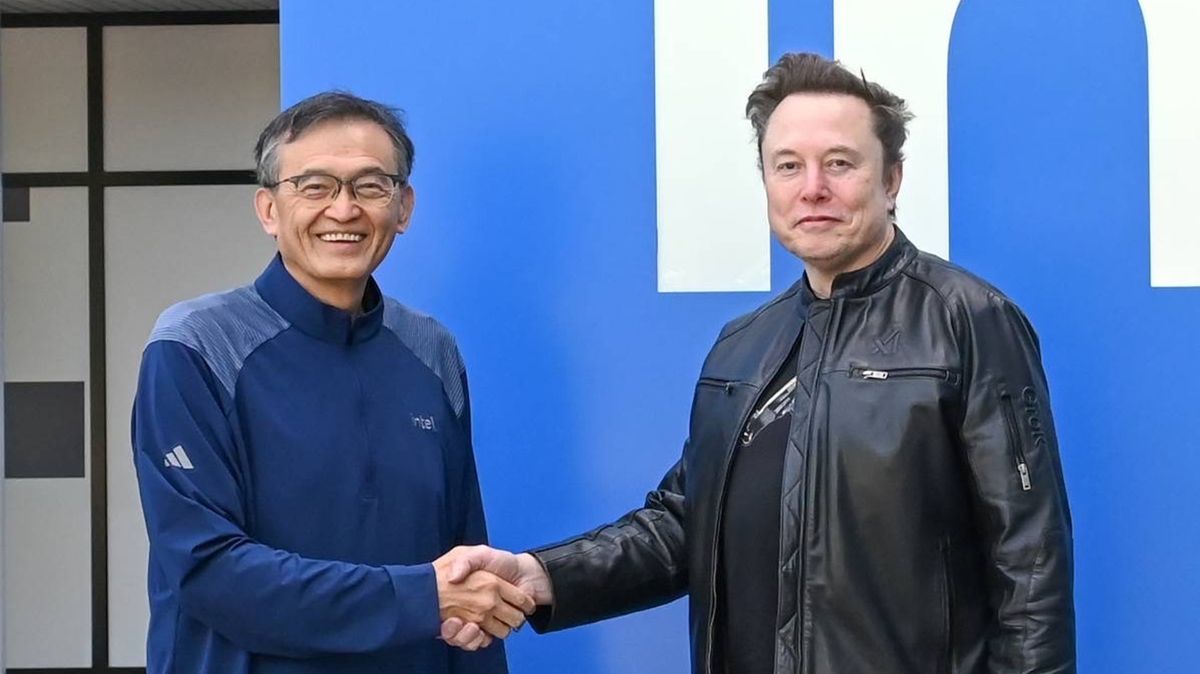
Quite what Intel is actually going to do, however, is still very much unknown. With a social media post out of the blue, Intel has confirmed it has joined forces with Elon Musk's Terafab project, using its foundries and packaging facilities to "help refactor silicon fab technology". The exact details and nature of the agreement aren't yet clear, but Intel is unlikely to get as big a foundry order as this from any other partnership. Intel CEO Lip-Bu Tan retweeted the X post within a matter of minutes, adding, "Elon has a proven track record of reimagining entire industries. This is exactly what is needed in semiconductor manufacturing today. Terafab represents a step change in how silicon logic, memory and packaging will get built in the future. Intel is proud to be a partner and work closely with Elon on this highly strategic project." What exactly is Terafab? Well, it's a project that Musk has put together to essentially provide the mountain of AI processors required for xAI and SpaceX (the two companies only recently merging) and Tesla, with a goal of achieving '1 TW of compute per year'. No, not teraflops, terawatts. And yes, I know that's not a unit of computational power, but that's the odd world that AI lives in. Reuters has reported that Intel's share price climbed by a rather modest 3% at the news, but this is understandable, given the lack of details so far. For example, we have no idea as to precisely what Intel will be doing in this partnership: designing the chips, fabricating them, packaging them, a little bit of each, or doing the full shebang? As Intel doesn't have a huge list of customers using its foundry and packaging services, I'd be surprised if Lip-Bu Tan hasn't agreed to them being used heavily for the Terafab project. That said, Musk has previously said that Tesla's foundry in Austin will be the first location to start creating chips for the project, so it's very unclear where Intel fits into the picture. Another unanswered question is whether or not Intel actually has the capacity to meet the demands of Terafab, especially given that it uses TSMC to manufacture a significant number of parts for its own processors. But these are armchair musings, and Tan will obviously know exactly what Intel can and can't do. My only real concern is what would happen if the project really takes off, and Intel ends up in the same situation as Samsung, SK hynix, and Micron; i.e. the majority of its production output is to serve the AI market, resulting in a reduction in the supply of consumer products. There has already been warnings about CPU shortages and price rises, and while it will take a while for the Intel-Musk venture to garner any momentum, just what exactly would happen to the PC market if processors quadrupled in price like DRAM and SSDs have? You know what, let's not even think about that.
Tesla Drops 4% as EV Demand Fears, SpaceX IPO Uncertainty, April 22 Earnings Loom Large
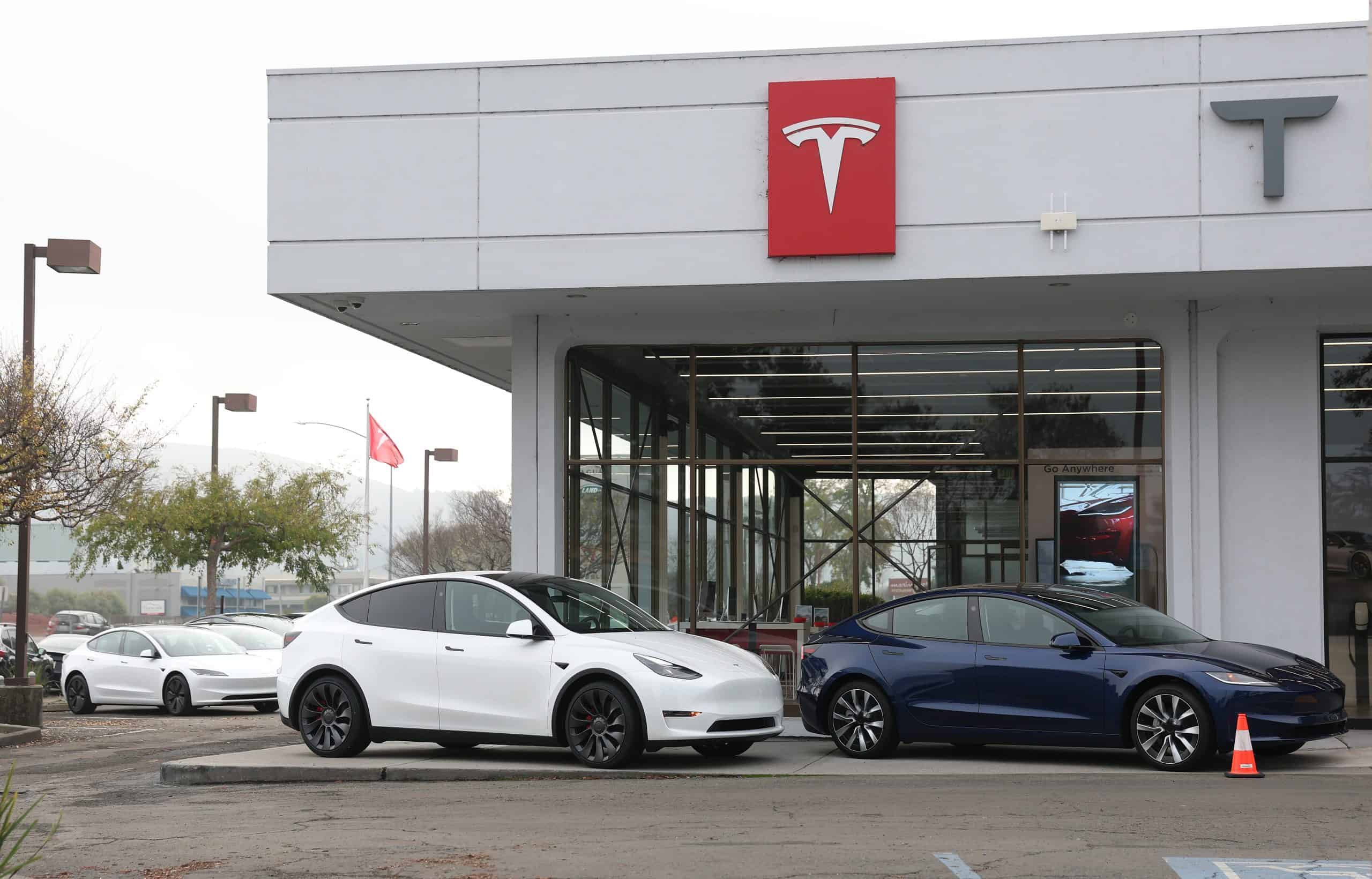
Tesla (NASDAQ:TSLA | TSLA Price Prediction) shares are down 4% in midday trading on Tuesday, sliding from $352.82 to less than $339. The drop adds to a rough stretch for the stock, which is now down 25% year-to-date. Three overlapping pressures are driving today's selling: persistent EV demand concerns following a Q1 delivery miss, unresolved uncertainty around a potential SpaceX IPO, and a bearish analyst community growing louder ahead of Tesla's confirmed April 22 earnings report. With the stock carrying a P/E ratio of 334x, the bar for reassurance is high. Sentiment has deteriorated steadily heading into earnings. The composite sentiment score for Tesla sits at 38.46, rated bearish with medium confidence, down 0.88 over the past 30 days. That's a meaningful shift from the brief optimism seen in late March, when scores briefly climbed to the 60-64 range before reversing sharply. Tesla reported 358,023 vehicle deliveries in Q1 2026, missing the consensus estimate of 365,000 units. The shortfall was attributed to fading U.S. incentives and increased global competition, two headwinds that aren't going away quickly. That miss follows a painful Q4 2025 in which vehicle deliveries declined 16% year-over-year and automotive revenue fell 11% year-over-year. For context on how the delivery shortfall connects to Tesla's broader strategic pivot, we explored the tension between near-term delivery weakness and the long-term robotaxi bet. There are geographic bright spots worth noting. Tesla registrations in Germany surged to 9,252 units in March, quadrupling from the prior year, while South Korea saw 11,134 registrations, a 330% year-over-year increase, driven by price cuts on China-made Model Y and Model 3 vehicles. Those gains haven't been enough to shift the overall narrative today. A Reddit discussion titled "SpaceX IPO will create fractioning of Musk shareholder loyalty" has gathered sustained engagement since early April, reflecting genuine retail investor anxiety about Tesla CEO Elon Musk's divided attention. The concern isn't abstract: if SpaceX goes public, it could redirect both Musk's focus and investor capital. Prediction markets assign only a 4.5% probability to a SpaceX-Tesla merger by June 30, suggesting markets aren't pricing in a structural combination. Yet the distraction thesis persists, and a separate Reddit thread flagging Michael Burry's warning about structural manipulation risk in Nasdaq rules ahead of a potential SpaceX listing drew over 900 upvotes, amplifying the uncertainty. JPMorgan analyst Ryan Brinkman reiterated an Underweight rating on Tesla on April 6, warning that shares could drop 60% due to a disconnect between the rising stock price and declining business fundamentals. Brinkman cited weakening sales, shrinking profits, and record-high inventory levels as the core concerns. That warning is finding traction. Analysts currently target $416.15 as a consensus price, with 23 buy ratings, 17 holds, and 8 sells. Yet prediction markets tell a more cautious story, placing only a 46% probability on Tesla closing above $340 by the end of April. One contrarian signal: ARK Invest purchased 39,691 Tesla shares valued at $14.3 million across its ARKK, ARKQ, and ARKX ETFs on April 6 and 7. Cathie Wood's team is leaning in while others pull back, a divergence worth watching. Not everything is negative. The NHTSA closed its investigation into Tesla's Smart Summon feature, covering approximately 2.6 million vehicles, after software updates improved obstacle detection with no injuries or fatalities linked to the probe. It's a modest positive, but it doesn't move the needle on the fundamental debate. The real test arrives on April 22, after market close, when Tesla reports Q1 2026 results. Analysts are anticipating Q1 EPS of -$0.24, and forward guidance on deliveries, robotaxi expansion, and the Optimus program will likely define the stock's next move. The prediction market for today's direction has a 98.5% probability assigned to Tesla stock finishing the session lower. Watch for whether the stock can stabilize near $339 into the close, and whether any pre-earnings commentary from management shifts the tone before April 22.
Intel to Design, Build Chips for Tesla, SpaceX Terafab Project
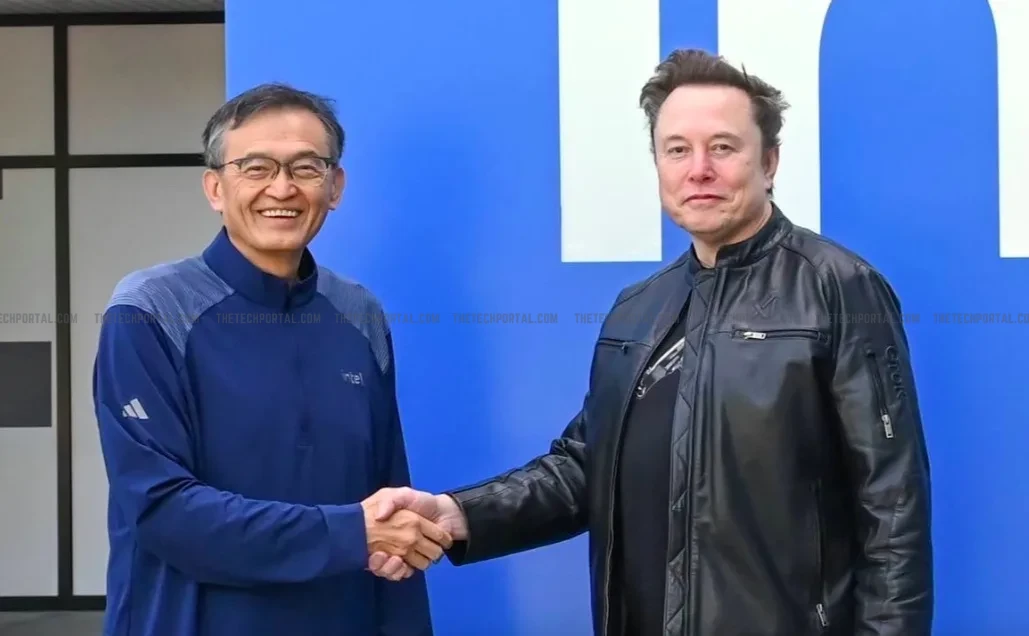
Intel will help design and manufacture chips for Elon Musk's Terafab project, joining an ambitious push by Tesla and SpaceX to build a new chip factory in Texas supporting one terawatt of computing power per year. "Our ability to design, fabricate and package ultra-high-performance chips at scale will help accelerate Terafab's aim to produce 1 TW/year of compute to power future advances in AI and robotics," Intel posted on X, Musk's social media platform which is now a part of SpaceX. The post included a picture of Intel Chief Executive Lip-Bu Tan shaking hands with Musk, whom Intel said visited the company's campus over the weekend. Intel shares rose 2.2% to $51.94 in Tuesday morning trading. The Terafab facility, announced last month, is intended to produce chips for Tesla's vehicles and the humanoid robots it's developing, as well as for SpaceX's plans to build artificial-intelligence data centers in space. The supply of certain types of chips has become a key bottleneck for technology companies looking to rapidly scale their AI infrastructure. Musk has described the Terafab project as a response to the supply constraints of established chip manufacturers. Write to Elias Schisgall at [email protected]

Anthropic tops US$30 billion run rate, seals deal with Broadcom
[SAN FRANCISCO] Anthropic said its revenue run rate has now topped US$30 billion, up from US$9 billion at the end of 2025, and confirmed plans to work with Broadcom and Google to power its burgeoning operations. The AI startup said that demand for its Claude services has accelerated this year, with more than 1,000 business customers spending over US$1 million on an annual basis. That figure has more than doubled since February. The collaboration with Broadcom and Google, which was first announced last month, will help Anthropic build "the capacity necessary to serve the remarkable growth we have seen in our customer base," chief financial officer Krishna Rao said in a statement. The annual run rate - a popular benchmark among tech startups - extrapolates the current sales level over a full year. The latest numbers suggest that a high-profile dispute with the US government has not stymied growth. Anthropic is waging a legal fight over the Pentagon's decision to declare the company a supply-chain risk following a standoff over AI safety guardrails. Anthropic has warned that the labelling could cost it billions in lost revenue, and an attorney for the company recently told a judge in San Francisco that the federal government's actions led to more than 100 enterprise customers contacting the company to express doubt about continuing their work with Anthropic. Still, some customers respect that Anthropic "demonstrates its principles" in its dealings with the US government, Paul Smith, Anthropic's chief commercial officer, said in an interview last week. Broadcom is developing chips using Google's tensor processing units, or TPUs, offering an alternative to technology from Nvidia. Broadcom and Alphabet's Google have entered a long-term agreement to provide the chips and a supply assurance pact that runs through 2031, according to a Broadcom filing Monday. The three companies also are expanding a strategic collaboration that will let Anthropic access about 3.5 gigawatts' worth of computing power. That will begin in 2027. "The consumption of such expanded AI compute capacity by Anthropic is dependant on Anthropic's continued commercial success. In connection with this deployment, the parties are in discussions with certain operational and financial partners," Broadcom said in the filing. Broadcom shares climbed as much as 3.6 per cent in late trading after the filing was announced. The company's chief executive officer, Hock Tan, previously discussed the collaboration during an earnings call last month. He also said Broadcom expects its AI chip sales to top US$100 billion next year, making it a bigger competitor to Nvidia. Google's TPUs were originally designed to speed up its ubiquitous search engine, but have become useful at creating and running AI software. Broadcom takes Google's specifications and creates fully-formed designs that can then be sent for manufacturing. BLOOMBERG
Anthropic Partnered with Google and Broadcom for Multi Gigawatt AI Infrastructure - Techiexpert.com
This expansion is done by Anthropic financial growth, with revenue exceeding $30 billion as of early 2026. Anthropic announced a partnership with Google Cloud and Broadcom. This deal will secure multiple gigawatts of computing power through Tensor Processing Units (TPUs). According to the official Anthropic report, this partnership will elevate the company from an AI laboratory to a computer scale giant. To put a gigawatt into perspective, 1 GW can power 900,000 to 1,000,000 U.S. homes or one large nuclear power plant. Anthropic is preparing for a future where training frontier models like Claude will require the energy output of several small cities by committing to an additional 3.5 GW of TPU based capacity. This capacity, combined with the 1 million TPUs in use, represents the largest single TPU commitment made by a private AI company. The partnership will use a three way synergy to build AI racks inside Google's data centers. While Google designs the next generation TPUs, Broadcom will work as the hardware and networking provider. Under a Supply Assurance Agreement lasting until 2031, Broadcom will provide the high speed networking components necessary to connect these massive clusters. Anthropic will access this capacity through Google Cloud, it will make sure that they have the specialized hardware needed to train larger and complex versions of Claude models. Anthropic's transition into a multi gigawatt player. Their revenue run-rate jumping from $9 billion to more than $30 billion in three months shows that enterprise demand for Claude is explosive. It confirmed that the agentic economy is no longer a software experiment. Read Next: Anthropic Leaked Claude Code Source Through NPM Packaging Error This deal is part of Anthropic's broader commitment to invest $50 billion into computing infrastructure, with most of the capacity being built in the United States. The drivers for this investment are the increasing costs of training models and the heavy inference load from global enterprise clients.

Broadcom stock rises on Google, Anthropic deals
Broadcom (AVGO) stock gained in early trading on Tuesday, after the company announced two separate deals for its custom AI processors on Monday, one with Google (GOOG, GOOGL) and the other with Google and Anthropic (ANTH.PVT). The stock of the chipmaker rose more than 3% on the news, while the rest of the market largely declined due to President Trump's latest Iran threats. According to Broadcom's 8-K, the company has entered into a long-term agreement to develop and supply future custom Tensor Processing Units (TPUs) to Google, as well as a supply assurance agreement under which Google will use Broadcom's networking components in its next-generation AI server racks through 2031. The companies didn't disclose the financial terms of the agreements. Broadcom also said it is expanding its current agreement with Google and Anthropic that will allow Anthropic to access 3.5 gigawatts of Google's next-generation TPUs. That agreement is dependent on Anthropic's continued commercial success. But that doesn't appear to be an issue for Anthropic at the moment. In a press release announcing the news, Anthropic noted that its revenue run-rate has surpassed $30 billion, up from $9 billion at the end of 2025 thanks to demand for the company's Claude platform. The number of businesses spending more than $1 million annually with Anthropic has also grown from 500 companies in February to 1,000 as of April 6. BofA Global Research analyst Vivek Arya wrote in a note to investors on Monday that the moves provide greater visibility into Broadcom's plans moving forward and, "remove some prior stock overhang" on fears that Google would insource some of its manufacturing through customer owned tooling or use other manufacturers like MediaTek. Customer owned tooling (CoT) provides companies with greater oversight of the chip manufacturing process, but carries greater risk than fully outsourcing to a firm like Broadcom. "We believe [Broadcom] is well-positioned to gain accelerator share in CY26 and CY27 (from <10% in CY25 toward ~15%+), now backed by further expansions with Google and Anthropic (on top of prior OpenAI 1-10 GW)," Arya wrote. In his own note, Bernstein analyst Stacy Rasgon wrote that Broadcom's Google deal is incremental, noting that it could help, "ease customer owned tooling fears, as well as seemingly give a solid datapoint that both Broadcom and their largest customer believe they have substantial demand visibility far out into the future (or at least 5 years)." Broadcom stock has benefited handsomely from the AI boom, rising 110% over the last 12 months, but like many AI stocks has taken a step back since the start of the year, falling more than 6% during the period.
STATISTICS | Polymarket Dominates the Prediction Markets Vertical with ~97% of the Sector's Revenue
For context, Polymarket has already generated ~$7.1 million in fees within the first week of Q2 2026. Prediction market platform, Polymarket, has captured roughly 97% of all onchain prediction market fees, underscoring its growing dominance in the sector following a recent overhaul of its fee structure. The surge comes after the platform expanded and adjusted its fee model in late March 2026, driving a sharp increase in daily revenue and cementing its position as the leading venue for blockchain-based event betting. For context, Polymarket has already generated ~$7.1 million in fees within the first week of Q2 2026. Polymarket's rapid growth has also been reflected in broader ecosystem activity, where it accounts for a significant share of transactions and fee generation across networks like Polygon, highlighting both its scale and the concentration of activity within a single platform. Polymarket is now the 8th-largest DeFi protocol by fees. The latest replacement of bridged USDC.e collateral on Polygon with a new USDC-backed token called Polymarket USD as trading collateral further points to the platform's evolution.

Intel joins Musk's Terafab project to build a massive AI chip system with Tesla, SpaceX, and xAI - The Tech Portal
Intel has joined Elon Musk's Terafab initiative, teaming up with Tesla, SpaceX, and xAI to build a tightly integrated, next-generation chip manufacturing ecosystem. The project aims to centralize everything from chip design to fabrication and packaging, and is designed to produce AI processors at an unprecedented scale - targeting up to a terawatt of compute capacity annually. Intel's role will focus on providing advanced chip manufacturing expertise, positioning it as a key manufacturing partner in powering Musk's expanding AI and robotics ambitions. "Our ability to design, fabricate, and package ultra-high-performance chips at scale will help accelerate Terafab's aim to produce 1 TW/year of compute to power future advances in AI and robotics," the semiconductor giant said. Notably, Terafab aims to transform how semiconductor chips are produced by bringing design, manufacturing, packaging, and testing into a single integrated facility, instead of relying on a global network spread across the United States, Taiwan, and South Korea. The move comes at a time when demand for AI computing power is rising sharply, driven by technologies like generative AI, large language models, and autonomous systems. Currently, companies like Nvidia dominate AI chip design, while manufacturers like TSMC play a central role in production. Therefore, Terafab is positioned as an effort to challenge this model by creating a high-capacity, end-to-end system capable of producing advanced AI chips more efficiently and at scale. Financially, early estimates suggest an initial investment in the range of $20-25 billion, with the potential for significantly higher capital requirements as the project expands. And now, Intel's participation is seen as a crucial boost to the project, given its deep expertise in chip manufacturing and its push to regain leadership in advanced technologies. The company has been investing in next-generation processes like 18A and advanced packaging methods that combine multiple chip components into high-performance units. By partnering with Musk's ecosystem, Intel not only secures strong demand from companies like Tesla and xAI but also strengthens its position in the fast-growing AI hardware market, which is expected to reach hundreds of billions of dollars in the coming years. For Musk's companies, the latest deal helps connect hardware and AI more tightly. Tesla is already building custom chips for self-driving and robots like Optimus, while xAI is developing large AI models that need huge computing power. SpaceX adds to the plan with ideas for space-based data centers using solar energy and natural cooling. Together, this increases demand for highly efficient, specialized chips that Terafab aims to produce at scale. However, the development comes at a crucial time for Intel, which has been under financial pressure despite strong industry backing. Last year, Nvidia invested about $5 billion in Intel, taking over a 4% stake, while the US government also acquired a 10% stake through an $8.9 billion investment under federal chip programs. Despite this support, Intel reported a 4% drop in revenue to around $13.7 billion and a net loss of about $591 million in Q4 FY2025. The Tech Portal is published by Blue Box Media Private Limited. Our investors have no influence over our reporting. Read our full Ownership and Funding Disclosure →
Broadcom stock rises on Google, Anthropic deals
Broadcom (AVGO) stock gained in early trading on Tuesday, after the company announced two separate deals for its custom AI processors on Monday, one with Google (GOOG, GOOGL) and the other with Google and Anthropic (ANTH.PVT). The stock of the chipmaker rose more than 3% on the news, while the rest of the market largely declined due to President Trump's latest Iran threats. According to Broadcom's 8-K, the company has entered into a long-term agreement to develop and supply future custom Tensor Processing Units (TPUs) to Google, as well as a supply assurance agreement under which Google will use Broadcom's networking components in its next-generation AI server racks through 2031. The companies didn't disclose the financial terms of the agreements. Broadcom also said it is expanding its current agreement with Google and Anthropic that will allow Anthropic to access 3.5 gigawatts of Google's next-generation TPUs. That agreement is dependent on Anthropic's continued commercial success. But that doesn't appear to be an issue for Anthropic at the moment. In a press release announcing the news, Anthropic noted that its revenue run-rate has surpassed $30 billion, up from $9 billion at the end of 2025 thanks to demand for the company's Claude platform. The number of businesses spending more than $1 million annually with Anthropic has also grown from 500 companies in February to 1,000 as of April 6. BofA Global Research analyst Vivek Arya wrote in a note to investors on Monday that the moves provide greater visibility into Broadcom's plans moving forward and, "remove some prior stock overhang" on fears that Google would insource some of its manufacturing through customer owned tooling or use other manufacturers like MediaTek. Customer owned tooling (CoT) provides companies with greater oversight of the chip manufacturing process, but carries greater risk than fully outsourcing to a firm like Broadcom. "We believe [Broadcom] is well-positioned to gain accelerator share in CY26 and CY27 (from <10% in CY25 toward ~15%+), now backed by further expansions with Google and Anthropic (on top of prior OpenAI 1-10 GW)," Arya wrote. In his own note, Bernstein analyst Stacy Rasgon wrote that Broadcom's Google deal is incremental, noting that it could help, "ease customer owned tooling fears, as well as seemingly give a solid datapoint that both Broadcom and their largest customer believe they have substantial demand visibility far out into the future (or at least 5 years)." Broadcom stock has benefited handsomely from the AI boom, rising 110% over the last 12 months, but like many AI stocks has taken a step back since the start of the year, falling more than 6% during the period.