News & Updates
The latest news and updates from companies in the WLTH portfolio.
Anthropic Is Forcing Users to Pay Extra to Run OpenClaw With Claude
Bad news, OpenClaw fans: Anthropic wants you to pay more to use its AI models. This wasn't something Anthropic necessarily announced, either; rather, the company started sending emails to affected users, letting them know they could no longer use their Claude Code subscription limits with third-party "harnesses," including -- and most notabl -- OpenClaw. Anthropic confirmed users could still connect to OpenClaw with their Claude account, but they'd have to pay more money in order to do so -- including a "pay-as-you-go" option tacked onto the cost of the subscription. According to Anthropic, this policy change isn't without logic or reason. As highlighted by TechCrunch, Boris Cherny, head of Claude Code, explained on X that the company's subscriptions "weren't built for the usage patterns of these third-party tools," and that Anthropic is prioritizing customers who are using the company's first-party products and API. OpenClaw has had quite a ride. The tool, which was previously called Moltbot, and first called Clawdbot, is designed to be an agentic AI assistant you run locally on your devices. For many, that means running OpenClaw on a Mac mini designed for this one purpose. Unlike ChatGPT or Gemini, which has their own proprietary interfaces, you communicate with OpenClaw through any chat app of your choice. You can text OpenClaw in WhatsApp, Apple Messages, Microsoft Teams, whatever you want, to organize your email inbox, write code for a project, plan out your goals for the month, whatever it is you want your agent to do. But OpenClaw doesn't just...run. You need to power it with an AI model. In this case, users are relying on Anthropic's Claude -- and, if they had a Claude Code subscription, they were simply tapping into that plan they already paid for. As you might expect, running agentic tasks through OpenClaw is extremely intensive, which pushed Anthropic to rethink how it was charging users. Interestingly, OpenClaw's founder, Peter Steinberger, joined OpenAI back in February -- one of Anthropic's chief rivals. Steinberger said on X that he and OpenClaw board member Dave Morin "tried to talk sense into Anthropic, [but] best we managed was delaying this for a week."

Major Polymarket Overhaul Begins, Introducing Rebuilt Trading Stack and Fresh Collateral Token - Crypto Economy
Polymarket announced the largest technical infrastructure upgrade since its launch, with changes spanning smart contracts, order book, and collateral token. The process will unfold over the next two to three weeks and will involve a maintenance period that will temporarily close existing order books. At the core of the upgrade is the CTF Exchange V2, a new version of the contract that optimizes order structure, improves the matching process, incorporates support for EIP-1271 signatures, and redefines fee collection and distribution. Alongside this, the platform will launch Polymarket USD as a collateral token, backed 1:1 by USDC and designed to replace the previous USDC.e. For most users, the transition will be seamless, as the frontend handles the process automatically, requiring only a single approval. Traders operating via API will need to manually wrap their funds using the wrap() function of the onramp contract. The upgrade also includes a new CLOB-Client SDK with support for TypeScript, Python, and Go. Clients running bots or custom integrations will need to update their SDK version and re-sign their orders with the new data structure. Polymarket confirmed it will communicate the exact migration date at least one week in advance, along with technical documentation and code examples to facilitate the transition. Source: https://x.com/PolymarketDevs/status/2041178623948808693 Disclaimer: Crypto Economy Flash News are based on verified public and official sources. Their purpose is to provide fast, factual updates about relevant events in the crypto and blockchain ecosystem. This information does not constitute financial advice or investment recommendation. Readers are encouraged to verify all details through official project channels before making any related decisions.
Polymarket Reveals Exchange Upgrade and Native Stablecoin - Blockonomi
Polymarket will clear existing order books during a short maintenance window before completing the transition. Polymarket confirmed a full platform upgrade that will introduce a rebuilt trading engine and a native USD stablecoin. The company said it will deploy new contracts, a new order book, and a new collateral token within weeks. The update marks its largest exchange stack change since launch. Polymarket said it will roll out an upgraded CTF Exchange V2 smart contract to manage onchain activity. The company stated on X, "We're upgrading the entire Polymarket exchange stack over the next 2-3 weeks." It added, "New contracts. New order book. New collateral token." The team said V2 will use a faster matching engine that reduces validation steps and lowers gas costs. It also confirmed that the updated order struct will trim required fields and streamline execution. As a result, the exchange expects improved efficiency across trades. Polymarket said V2 will introduce a revised Central Limit Order Book that blends offchain order placement with onchain settlement. The company instructed developers to update their SDKs and re-sign orders using the new struct. It stated, "Developers building bots or custom integrations will have to update your SDK and re-sign orders." During the migration, Polymarket will clear all existing order books and pause activity for a short period. The company said it will announce the maintenance schedule at least one week in advance. It added that most users will experience limited disruption during the transition. Polymarket confirmed it will introduce Polymarket USD as a new collateral asset backed 1:1 by USDC. The company said this token will replace USDC.e, a bridged USDC version on Polygon. Some users had raised concerns about USDC.e because Circle does not issue it natively on Polygon. The company announced in February that it would move toward a native USDC issued by Circle. It reiterated that Polymarket USD will hold full USDC backing at a 1:1 ratio. The platform said this shift will align collateral with official USDC reserves. Polymarket stated, "For most users, this transition is seamless." It explained that the frontend will handle token wrapping with a one-time approval prompt. However, it said power users must wrap USDC.e or USDC into Polymarket USD through the Collateral Onramp contract wrap() function. The upgrade will also add support for EIP-1271, which allows smart contract wallets to sign orders directly. This feature will enable multi-signature wallets such as Safe to interact without intermediaries. Polymarket did not reference the POLY token in this announcement. The Block reported earlier that Polymarket is seeking fresh funding at a near $20 billion valuation. The startup launched in 2020 and operates as a fully onchain prediction market. Intercontinental Exchange, the parent company of the New York Stock Exchange, backs the firm.
Ongoing security chaos | Young man shot dead in Al-Qardahah city
Lattakia province: The body of a young man, a car driver from Salat Al-Zuhur village in Jisr Al-Shoughour countryside in western Idlib, was found in Al-Qardahah city in Lattakia countryside, after having been missing for two days. The body showed a sign of a gunshot wound to the head, while the reasons behind the incident remain unknown. This comes in light of ongoing security chaos in various areas across Syria.

Polymarket to rebuild engine, launch native dollar stablecoin
Polymarket will rebuild its core engine, introduce a hybrid CLOB, and launch Polymarket USD, a USDC‑backed stablecoin on Polygon aimed at cheaper, more institution‑friendly trading. On‑chain prediction market Polymarket will roll out what it calls "the largest infrastructure upgrade since its launch" in the coming 2-3 weeks, rebuilding its core trading engine and debuting a native dollar stablecoin, Polymarket USD, according to plans shared with The Block. The company said the overhaul will "completely reconstruct" its matching engine via a new CTF Exchange V2 smart‑contract system, while introducing a native stablecoin pegged 1:1 to USDC to replace the current bridged USDC.e on Polygon. Existing order books will be cleared during the migration, with Polymarket promising to give users at least one week's notice before maintenance begins. At the heart of the upgrade is a redesigned Central Limit Order Book that uses a hybrid model of off‑chain order matching combined with on‑chain, non‑custodial settlement. In technical documentation for its CTF Exchange, Polymarket describes the architecture as a "hybrid‑decentralized model" where an operator handles off‑chain matching while settlement remains on‑chain, a setup it says optimizes "performance and security" for high‑volume event markets. The Block reports that CTF Exchange V2 will introduce new matching logic and order‑data structures intended to improve matching efficiency and reduce gas costs for traders. Polymarket has grown into one of the largest fully on‑chain prediction venues, recently drawing hundreds of millions of dollars in liquidity and a $600 million strategic investment from Intercontinental Exchange (ICE) as part of a broader bet on decentralized betting markets. ICE said its combined $1.6 billion of direct and secondary investment is not expected to be material to its financial results but positions the exchange operator as a key backer in what it calls a "David and Goliath battle" to bring prediction markets into the financial mainstream. On the asset side, Polymarket USD formalizes a shift already underway in partnership with Circle to move from bridged USDC.e to native USDC on Polygon for all trading, order placement, and settlement. Circle has said native USDC, redeemable 1:1 for US dollars through its regulated entities, offers a "capital‑efficient" and more secure alternative to bridged tokens by eliminating cross‑chain bridge risk and tying collateral directly to its reserves. In line with that, Polymarket USD will be pegged 1:1 to USDC and used as the core collateral across the platform, with deposits from networks such as Ethereum, Solana, Arbitrum, and Base automatically converted into the new stablecoin on Polygon. Polymarket will also add support for the EIP‑1271 (ERC‑1271) standard, allowing smart‑contract wallets such as Safe to validate signatures and trade directly, a move aimed at "expanding use cases for institutions and advanced users." EIP‑1271 lets contracts define an isValidSignature method with arbitrary logic, making it easier for DAOs, funds, and multi‑sig setups to participate in non‑custodial markets without relying on externally owned accounts. The upgrade comes as competition in prediction markets intensifies, with Polymarket using performance, native dollar liquidity, and institutional‑grade wallet support to defend its lead in what it brands "The World's Largest Prediction Market."
Study finds pigeons tend to respond 'at the edge of chaos'
If you were rewarded for following a particular pattern of behavior, wouldn't you keep doing it? The answer turns out to be more nuanced than you might think. In a new study, University of Iowa researchers report that pigeons rewarded with food after pecking five buttons in any order did, indeed, decrease the variety of their sequences. However, the birds kept their options open, never gravitating toward a single sequence and consistently electing to try different sequences. Ed Wasserman, professor in the Department of Psychological and Brain Sciences, calls the pigeons' pattern of behavior "responding at the edge of chaos." "What we learned is there's something that keeps the birds from becoming fully machinelike in their responses," says Wasserman, the study's corresponding author. "Maybe it's in their best interest to keep some variability in their behavior. You don't want to be too locked in, because things happen, and the world could change." The study also extends the notion of the edge of chaos beyond evolutionary biology, where flexibility to a changing environment can be beneficial to a species' survival. "Might other, more intricate and innovative behaviors like playing an instrument, composing music, and creating visual art involve similarly adaptive variation?" says Odysseus Orr, study co-author and third-year graduate student in the Department of Psychological and Brain Sciences who earned his undergraduate degree from Iowa in 2023. "Only time will tell, but the pigeons provide a convenient gateway for answering those questions under highly controlled circumstances." Wasserman, Orr, and study co-author Sophia Li devised an experiment to test the Law of Effect. This law posits that animals, including humans, will repeat a response -- and winnow other options -- when it produces a rewarding outcome. The researchers enlisted six pigeons to peck five buttons in any order they chose, yielding a set of 120 possible sequences. The birds were given no instructions; in fact, any of the 120 total possible five-button sequences generated a treat. "Under these cushy conditions, how would the birds behave?" Wasserman asks. To find out, the pigeons were placed into separate chambers, where five buttons were lit on a computerized touch screen. Each button had a unique, colored geometric pattern that disappeared when the pigeon pecked it. After the bird pecked all five buttons, in any order, it received food. The researchers found that each of the pigeons performed all 120 sequences. The birds also increasingly performed some sequences at the expense of others, consistent with the century-old Law of Effect. But the researchers were surprised to discover that the pigeons never fully committed to any of their most-favored sequences. More surprising, the pigeons' most preferred five-button sequences rose and fell throughout the eight months and 30,000 times they performed the task. "Such dramatic behavioral instability is most definitely not consistent with the Law of Effect," says Wasserman, who has studied pigeon cognition and behavior for more than five decades. "The pigeons maintain this exploratory tendency and keep trying multiple sequences. They do not abide by the familiar maxim: 'If it ain't broke, don't fix it.'" The results generally followed earlier behavioral-reward studies with other animals -- including mice, rats, cats, and guinea pigs -- that found they reduced their range of options when finding one that consistently produced a reward, the authors write. But while the variability in the pigeons' response sequences decreased, the Iowa team's study showed clearly that the pigeons also repeatedly switched among their favorite sequences and never ceased considering even seemingly less preferred sequences. The study, "Variability, Stability, and the Law of Effect," was published online on April 6 in the Journal of Experimental Psychology: Animal Learning and Cognition. Wasserman's Comparative Cognition Laboratory funded the research.

Pigeons Operate 'At Edge Of Chaos,' Study Reveals
If you were rewarded for following a particular pattern of behavior, wouldn't you keep doing it? The answer turns out to be more nuanced than you might think. In a new study, University of Iowa researchers report that pigeons rewarded with food after pecking five buttons in any order did, indeed, decrease the variety of their sequences. However, the birds kept their options open, never gravitating toward a single sequence and consistently electing to try different sequences. Ed Wasserman, professor in the Department of Psychological and Brain Sciences, calls the pigeons' pattern of behavior "responding at the edge of chaos." "What we learned is there's something that keeps the birds from becoming fully machinelike in their responses," says Wasserman, the study's corresponding author. "Maybe it's in their best interest to keep some variability in their behavior. You don't want to be too locked in, because things happen, and the world could change." The study also extends the notion of the edge of chaos beyond evolutionary biology, where flexibility to a changing environment can be beneficial to a species' survival. "Might other, more intricate and innovative behaviors like playing an instrument, composing music, and creating visual art involve similarly adaptive variation?" says Odysseus Orr, study co-author and third-year graduate student in the Department of Psychological and Brain Sciences who earned his undergraduate degree from Iowa in 2023. "Only time will tell, but the pigeons provide a convenient gateway for answering those questions under highly controlled circumstances." Wasserman, Orr, and study co-author Sophia Li devised an experiment to test the Law of Effect. This law posits that animals, including humans, will repeat a response -- and winnow other options -- when it produces a rewarding outcome. The researchers enlisted six pigeons to peck five buttons in any order they chose, yielding a set of 120 possible sequences. The birds were given no instructions; in fact, any of the 120 total possible five-button sequences generated a treat. "Under these cushy conditions, how would the birds behave?" Wasserman asks. To find out, the pigeons were placed into separate chambers, where five buttons were lit on a computerized touch screen. Each button had a unique, colored geometric pattern that disappeared when the pigeon pecked it. After the bird pecked all five buttons, in any order, it received food. The researchers found that each of the pigeons performed all 120 sequences. The birds also increasingly performed some sequences at the expense of others, consistent with the century-old Law of Effect. But the researchers were surprised to discover that the pigeons never fully committed to any of their most-favored sequences. More surprising, the pigeons' most preferred five-button sequences rose and fell throughout the eight months and 30,000 times they performed the task. "Such dramatic behavioral instability is most definitely not consistent with the Law of Effect," says Wasserman, who has studied pigeon cognition and behavior for more than five decades. "The pigeons maintain this exploratory tendency and keep trying multiple sequences. They do not abide by the familiar maxim: 'If it ain't broke, don't fix it.'" The results generally followed earlier behavioral-reward studies with other animals -- including mice, rats, cats, and guinea pigs -- that found they reduced their range of options when finding one that consistently produced a reward, the authors write. But while the variability in the pigeons' response sequences decreased, the Iowa team's study showed clearly that the pigeons also repeatedly switched among their favorite sequences and never ceased considering even seemingly less preferred sequences. The study, "Variability, Stability, and the Law of Effect," was published online on April 6 in the Journal of Experimental Psychology: Animal Learning and Cognition. Wasserman's Comparative Cognition Laboratory funded the research. /Public Release. This material from the originating organization/author(s) might be of the point-in-time nature, and edited for clarity, style and length. Mirage.News does not take institutional positions or sides, and all views, positions, and conclusions expressed herein are solely those of the author(s).View in full here.

Anthropic Acquires Coefficient Bio for $400M in an All-Stock Deal - Tekedia
Anthropic has acquired the stealth biotech AI startup Coefficient Bio in an all-stock deal valued at roughly $400 million. The deal, which closed around early April 2026, brings a small team; fewer than 10 people, many former Genentech computational biology researchers from Prescient Design into Anthropic's growing Healthcare and Life Sciences division. Coefficient Bio, founded about eight months earlier in 2025 and backed by Dimension, was working on AI models tailored for biological research with ambitions toward artificial superintelligence for science. No major public product had launched yet. This move fits Anthropic's broader push into life sciences. They previously rolled out Claude for Life Sciences and are integrating domain expertise to accelerate AI applications in drug discovery, disease modeling, and related areas. At Anthropic's ~$380 billion post-money valuation from its February 2026 Series G, the acquisition is a minor ~0.1% dilution but brings specialized talent in biology-native AI. Separately and likely unrelated in timing, Anthropic updated its policy on third-party tools: Starting April 4, 2026, Claude Pro and Max subscribers can no longer use their included subscription limits/credits with third-party harnesses or agent frameworks like OpenClaw. Usage through such tools now requires a separate pay-as-you-go option or direct API billing which is token-based. Anthropic cited heavy compute and engineering strain from these high-volume agentic workflows and a desire to ensure reliable service for direct users. Third-party access itself isn't banned -- just decoupled from flat-rate subscription quotas. The acquisition signals Anthropic doubling down on scientific applications of AI, especially biology and drug discovery, by absorbing a niche team rather than building everything from scratch. It's a talent-heavy bet in a hot space where AI is increasingly paired with wet-lab validation. The OpenClaw policy shift is more of a usage and billing clarification. Heavy agentic usage; autonomous coding or research agents that hammer the model with many calls was apparently consuming disproportionate resources compared to typical interactive chats. Similar restrictions are expected to roll out to other third-party tools. These developments highlight Anthropic's dual focus: expanding into high-impact verticals like biotech while tightening control over how their models are consumed at scale to protect infrastructure and economics. This all-stock deal (minor ~0.1% dilution at Anthropic's ~$380B valuation) brings a tiny team into Anthropic's Healthcare & Life Sciences division. Shifts from adapting general-purpose Claude via "Claude for Life Sciences," launched Oct 2025 to building biology-native AI capabilities. The team's expertise in protein design, biomolecule modeling, and computational biology should help create specialized tools for drug candidate identification, disease modeling, and automated wet-lab integration. Pays a premium for domain experts and early-stage tech aimed at artificial superintelligence for science. Positions Anthropic to compete more directly with dedicated AI-biotech players and potentially partner with or sell enterprise solutions to pharma giants. Reinforces Anthropic's bet that high-value verticals will drive future revenue beyond general chat and coding use cases. Accelerates the trend of frontier labs moving into verticals. Expect faster progress in AI-assisted drug discovery, where models handle molecular-level reasoning alongside experimental validation. Other labs may follow with similar acquisitions. Validates high valuations for stealth teams with elite scientific talent, even pre-product. Coefficient's backer (Dimension) saw strong returns. It also raises the bar: general AI wrappers for bio may lose ground to native or deeply integrated solutions. Potential upside in more powerful, domain-tuned Claude variants that reduce R&D timelines and costs. Downside: increased competition and dependency on a few big AI providers. Integration challenges with such a small team; biology AI still needs real-world wet-lab grounding, which remains expensive and slow. Anthropic decoupled flat-rate Pro/Max limits from external agent frameworks starting April 4, 2026. Users can still access Claude models via these tools, but only through separate pay-as-you-go or direct API billing (token-based). The change is rolling out to all third-party harnesses soon. Anthropic cited heavy compute strain from high-volume, always-on agentic workflows that bypass normal efficiencies and degrade service for direct users. Heavy OpenClaw and OpenCode-style workloads that previously fit within a $20-$200/month subscription can now cost significantly more. Many are switching to API keys, cheaper alternatives, or Anthropic's own tools like Claude Code. Immediate breakage for setups relying on subscription auth. Some users report migrating to other providers or optimizing heavily. Enterprises may absorb the shift via API; hobbyists/small builders feel it more. Positive for reliability -- Reduced abuse/load should improve rate limits and uptime for standard interactive users (chats, coding in the official interface). Protects margins and infrastructure by charging heavy users closer to actual cost. Encourages direct platform usage (Claude Code, etc.) and reduces telemetry leakage to third parties. Coincides with Anthropic developing its own agentic capabilities; some speculate it pressures tools where key talent has moved. It also signals the flat-rate AI buffet model has limits for agent-scale consumption. Short-term frustration and migration, but long-term may strengthen loyalty to optimized first-party experiences. Anthropic offered one-time credits and discounts on extra usage as a buffer. May slow adoption of multi-model agents or push innovation toward more efficient prompting, local execution, or alternative backends. Accelerates the industry shift away from unlimited-ish subscriptions for agentic use toward usage-based or tiered enterprise plans. Competitors could gain if they keep more generous policies. Highlights that scaling autonomous agents requires solving infrastructure economics, not just model intelligence. Could spur better agent optimization or hybrid approaches.
Breaking: Polymarket to Launch Crypto Collateral Token Backed by Circle's USDC
The upgrade is expected to happen within the next three weeks. Prediction markets Polymarket has unveiled plans to launch its crypto collateral token, the 'Polymarket USD', which will serve as the settlement token for all contracts. The Polymarket collateral token will be backed by Circle's USDC and forms part of a major upgrade by the prediction platform. Polymarket Collateral Token To Launch Within The Next Three Weeks In an X post, Polymarket revealed that it is migrating from USDC.e to a new collateral token, Polymarket USD, which will be backed 1:1 by Circle's USDC. The prediction markets stated that this migration will happen over the next two to three weeks. "For most users, this transition is seamless. The frontend handles wrapping automatically with a one-time approval prompt," the prediction markets platform said. It added that Power users and API-only traders will need to wrap their USDC or USDC.e into the Polymarket collateral token via the Collateral Onramp contract's wrap() function. This move comes as part of a "full exchange upgrade," even as prediction markets continue to gain traction. Polymarket described this move as their "Our biggest infrastructure change since launch... faster execution, lower gas, & a cleaner foundation going forward." Meanwhile, the Polymarket collateral token launch also comes as prediction markets continue to face crackdown from state regulators over claims that these platforms are operating unlicensed sports betting platforms. In defense of these prediction markets, the CFTC recently sued four U.S. states, reiterating its 'exclusive jurisdiction' over prediction markets. New Contracts and Order Books In addition to the launch of the Polymarket collateral token, the prediction market is also launching new contracts and order books. The platform unveiled the CTF Exchange V2, an upgrade to the existing Exchange contract. Furthermore, the top prediction market platform noted that this new contract optimizes and simplifies the Order structure, optimizes order matching, includes builder codes for on-chain order attribution, and optimizes fee collection and distribution. Meanwhile, the new order book automatically handles the switch from version 1 to version 2. However, the platform noted that builders will need to be on the latest version of each client for this auto-migration to work. This major upgrade and the launch of the Polymarket collateral token have again led to speculations that the prediction market could launch its native token at some point. It is worth noting that Polymarket filed U.S. trademarks for POLY and $POLY in February earlier this year. The trademark covers crypto trading and token services, signaling plans to launch the 'POLY' token at some point.
Polymarket unveils exchange revamp with new trading engine and native stablecoin
Polymarket is overhauling its exchange stack with a rebuilt trading engine, new smart contracts, and a new collateral token called Polymarket USD. Polymarket said it will roll out a full exchange upgrade over the next few weeks, replacing core trading infrastructure with a rebuilt trading engine, upgraded smart contracts, and a new collateral token called Polymarket USD. The company described it as its biggest infrastructure change since launch and said the migration will move the platform off USDC.e, the bridged version of USDC it has long used as trading collateral on Polygon. The upgrade touches nearly every part of the trading stack. According to Polymarket's developer update, the new CTF Exchange V2 contract simplifies order structures, improves order matching, adds support for ERC 1271 signatures, and introduces builder codes for onchain order attribution. The company also said it is releasing an updated CLOB client SDK that will handle the V1 to V2 switch automatically, though bot operators and integrations will need to move to the latest clients and re-sign orders using the new struct. The new token will be backed one-to-one by USDC and replace USDC.e as the platform's collateral asset. For most users, Polymarket said the transition will be handled automatically through the frontend with a one-time approval prompt, while API traders and power users will need to wrap their USDC or USDC.e through the platform's collateral onramp contract. The switch also builds on Polymarket's broader move away from bridged dollar rails. In February, Circle and Polymarket announced a transition from bridged USDC on Polygon to native USDC for settlement infrastructure, framing the change as a more scalable and capital-efficient setup. Polymarket said all open orders will be canceled during a short maintenance window and that order books will be cleared as part of the migration. The company said it will provide at least one week's notice before the exact date and time. Prediction markets are drawing heavier regulatory scrutiny as the category grows. Last week, the CFTC's enforcement director said insider trading in prediction markets is a priority, while the agency has also supported the view that event contracts are swaps rather than gambling products. At the same time, the federal government has sued several states to stop them from regulating prediction markets, underscoring how quickly the sector has become an active policy battleground. In March, Intercontinental Exchange invested $600 million in the company as part of a broader plan to commit as much as $2 billion to the platform.

Polymarket just revealed a 'full exchange upgrade' to take control of its own trading and truth
As Polymarket rebuilds its U.S. presence after registering with the CFTC and reaching a valuation above $20 billion, the planned token and infrastructure changes aim to bring both trading and dispute resolution more firmly in-house. Polymarket said it expects to roll out a new 1:1 USDC-backed collateral token in the coming weeks as part of a broader overhaul of its trading platform, according to a post on X. The upgrade, described by the company as a "full exchange upgrade," includes a rebuilt trading engine, updated smart contracts and a new collateral token called Polymarket USD. The token will replace USDC.e, a bridged version of Circle's USDC stablecoin that originates on Ethereum (ETH) and is wrapped for use on other chains. USDC.e acts as a stand-in for native USDC but relies on bridge infrastructure, which can introduce added risk and friction. By moving to its own collateralized token, one-to-one with USDC, Polymarket appears to be aiming for tighter control over settlement and liquidity. The update follows earlier signals that a broader token strategy is in the works. In October, Polymarket's chief marketing officer confirmed plans for a POLY token but did not provide a timeline or details on its function. That token has yet to be formally unveiled. Still, its potential role has drawn attention. Polymarket has long relied on UMA's "optimistic oracle" to resolve market outcomes. In that system, users propose results and UMA token holders vote to settle disputes. The design rewards consensus, not accuracy, which critics say can leave outcomes open to influence by large token holders. Recent controversies, including disputes tied to geopolitically themed markets, have exposed those limits. If POLY is used to internalize resolution, it could mark a shift toward in-house governance of truth. Read more: Polymarket pulls controversial Iran rescue markets after intense backlash One hypothetical model would separate trading from governance. Users would continue placing bets in stablecoins like Polymarket USD, while POLY (if launched) would handle dispute resolution and market curation. That split could allow the platform to price honesty independently from trading outcomes. Polymarket's push comes as it rebuilds its presence in the U.S. The platform shut down domestic operations in 2022 but registered with the Commodity Futures Trading Commission in July 2025. Since then, it has reported strong growth and a valuation above $20 billion. The coming token launch and infrastructure changes suggest the company is tightening control over both trading and truth -- two pillars that define prediction markets.
Chaos as travellers in 4 holiday hotspots loved by Brits told of 'restrictions'
Holidaymakers heading to Italy are facing disruption after jet fuel limits were introduced at four major airports, sparking warnings of potential delays and travel chaos. Airports serving some of the country's most popular destinations, including Bologna, Venice, Treviso and Milan Linate, have been affected by temporary restrictions on fuel supplies. An aviation notice issued Saturday said that "due to limited fuel availability from Air BP Italia, refueling services for operators contractually linked to Air BP Italia may be subject to restrictions." According to Italian news agency ANSA, a notice by Air BP Italia, part of the British giant BP, sent to airlines warned that priority for refueling would be given to ambulance flights, state flights, and flights lasting more than three hours. For other flights, distribution will be limited at least until April 9.

Face to be examined. The passport chaos in the English Channel did not happen at Easter - but only because the French are not ready again
The passport chaos in the English Channel did not happen at Easter - but only because the French are not ready again. Since April 10, the EU has officially required biometric data from all non-EU citizens, including Britons, when entering the Schengen area. However, passengers on Eurostar trains, Eurotunnel Le Shuttle and ferries across the English Channel will not notice any changes: the French simply did not have time to develop and transfer technologies for collecting biometrics. Passports will be stamped in the old way. Of course, the money has already been spent: Eurotunnel has invested at least 60 million in biometrics booths in Folkestone and Coquelles, Eurostar has spent 10 million on automated counters at London's St. Pancras Station - all of them are still sealed. The Port of Dover has rebuilt roads and erected new structures that are still idle. The picture is different at airports: There are already queues of up to four hours in Lisbon and Brussels, where border guards require fingerprints and face scans. Ryanair CEO Michael O'Leary called the system a "complete failure and a mess" and a punishment for Brexit, demanding that its full launch be postponed until October. Aviation associations are asking the European Commission to retain the right to completely suspend the system. A program that looks like enhanced security on paper is turning into an infrastructural failure in practice. The system has been delayed for years, it was launched in October in a half-time mode, and now each new deadline turns into a demonstration that Europe does not know how to coordinate technology projects across the continent. #Great Britain #EU @evropar -- at the death's door of Europe

Tesla shares hit the lowest since September as sales slump continues and SpaceX IPO nears | investingLive
The US stock market is higher today but there's one major exception: Tesla shares are down 2.6% in the second day of selling. Shares sank 5% on Thursday after the company reported Q1 deliveries of 358K compared to 372K expected. There was a moderate rebound at the open today but that reversed despite a positive tape elsewhere. Shares of the company remain extremely expensive by any traditional metric. They're trading at a 325x trailing multiple after earning $1.08 per share last year. On a forward consensus basis, they're trading at 170x, though the estimates might nudge down after Thursday's numbers. The market cap of the company is $1.32 trillion on revenue of $94.8 billion so that's a trailing price-to-sales ratio of 13.9x and it's unlikely to improve meaningfully this year. Essentially, the cult-like shareholders of Tesla are betting on Elon Musk to make a breakthrough in one or all of: It's a huge valuation for technologies that are unproven or a long ways away but the market believes (for now) that if anyone can do it, Musk can. A looming problem for TSLA shareholders is the IPO of SpaceX. Musk's other company is the flavor of the moment and that's where his bets on space, artificial intelligence and social media are located. The company is reportedly targeting a valuation of $1.75-$2 trillion. That's an incredible number of a money-losing company and with Starlink only posting about $10 billion in revenue last year. For Tesla, the problem is that the retail cult of Musk could sell some TSLA shares in order to buy into shares of SpaceX. Essentially, the buying public could be divided and that could weigh directly on Tesla. Notably, Musk himself will have a controlling stake in SpaceX but doesn't in Tesla. That dynamic could lead him to focus more on his newer company. In terms of technicals, shares of TSLA have erased the September rally now and are back to late-2021 levels. There is also a big potential double top on the chart. Given the lack of support from valuation, I don't see a floor anywhere close to here.
Easter traffic chaos on major UK motorway after crash involving car and lorry
M25 motorists are facing Easter Monday rush hour traffic chaos following a major crash involving a car and lorry. There is one lane closed on the UK's busiest motorway in Surrey between junction 10 (Guildford) and junction 11 (Woking, Weybridge). Drivers have been warned to expect delays of 45 minutes on approach to the accident, as well as four miles of traffic. Motorway camera footage shows traffic at a virtual standstill. National Highways South East wrote on X: "Lane 1 (of 4) closed on the #M25 between J10 (#Guildford) and J11 (#Woking #Weybridge) due to a collision involving a car and a lorry. Delays of 45mins on approach, 4 miles of congestion."

Musk makes banks buy his crappy chatbot if they want in on the SpaceX IPO
TechnoKing Elon Musk is forcing banks to buy subscriptions to his glitchy, scandal-prone AI chatbot Grok if they want a role in SpaceX's blockbuster IPO. The move looks less like a business strategy and more like a billionaire using leverage to prop up a struggling side hustle. Mr. Musk is requiring banks, law firms, auditors and other advisers working on the I.P.O. to buy subscriptions to Grok, his artificial intelligence chatbot, which is part of SpaceX, according to four people with knowledge of the matter, who were not authorized to speak publicly about confidential discussions. Some of the banks have agreed to spend tens of millions on the chatbot, and they have already started integrating Grok into their I.T. systems, three of the people said. Mr. Musk and a SpaceX spokesman did not respond to requests for comment. This is a familiar Musk play: bundle the shiny thing everyone wants with the thing that can't stand on its own. Grok isn't winning on merit; it's being stapled to a trillion-dollar IPO and shoved down Wall Street's throat. In any normal regulatory environment, forcing financial institutions into what looks like a pay-to-play arrangement tied to a securities deal would raise some uncomfortable questions. Luckily for Musk, he spent millions electing a President who'd let him destroy any regulator that dared look. The only real innovation here isn't AI, it's having bought the US government.
Polymarket apologizes after letting users bet on downed U.S. pilots in Iran: 'It should not have been posted' | Fortune
Predictions market platform Polymarket removed a market on its site that allowed users to bet on the condition of U.S. pilots following attacks on U.S. fighter jets. Iran forces shot down two U.S. military planes on Friday in two separate attacks, including a U.S. F-15E Strike Eagle. One American service member was rescued on Friday, while another remained missing for part of the weekend. It was the first time U.S. aircraft were downed during the ongoing war in the Gulf. The market on the platform, which has since been deleted, allowed users to wager on what day the pilots would be rescued. President Donald Trump confirmed on social media on Sunday that the service member who went missing had been saved. However, the existence of the market drew outrage from some lawmakers, such as Democratic Rep. Seth Moulton, a Marine Corps combat veteran representing Massachusetts, who called betting on outcomes of the Iran war a "dystopian death market." There is an ongoing search and rescue operation for a missing American service member whose plane was shot down over Iran. Their safety is unknown," Moulton wrote in an X post. "They could be your neighbor, a friend, a family member. And people are betting on whether or not they'll be saved. This is DISGUSTING." Polymarket responded, saying, "We took this market down immediately as it does not meet our integrity standards. It should not have been posted, and we are investigating how this slipped through our internal safeguards." Polymarket users can make wagers on any topics, from the price of oil, to how many times Elon Musk will post on X over the course of a week, to when Grand Theft Auto VI will be released. The platform's guidelines prohibit trades made on illegal tips, nonpublic information, or on anything that would impact the income of a real-life event. Polymarket says on the site it reserves the right to review markets and take disciplinary action on traders, including banning wallet addresses. Moulton appeared to take issue with Polymarket's apology, noting in another social media post that there were more than 200 markets on the platform related to the war's outcomes. "Your integrity standards are severely lacking, @Polymarket," he said in another post. "Users are still able to place bets on the lives of our troops." Polymarket did not respond to Fortune's request for comment. Prediction markets have drawn broader scrutiny over the course of the conflict in Iran. Kalshi said it would offer refunds to traders who placed bets on when Ayatollah Ali Khamenei would be ousted from leadership. He was killed on Feb. 28 in the U.S.-Israeli strikes on Iran. Kalshi CEO Tarek Mansour said the site does not allow markets directly tied to deaths. Ethical concerns surrounding these markets extend beyond bets on an individual's or a group's well-being. CNN reported last month that one Polymarket trader made nearly $1 million since 2024 from dozens of bets correctly predicting the U.S. and Israel would take military action against Iran. The user won 93% of their five-figure wagers, even on military operations that were not public information, raising concerns of insider trading. Connecticut, Arizona, and Illinois have sued platforms like Kalshi and Polymarket to regulate them, accusing the sites of engaging in illegal online gambling that violates state law. Founded in 2020, Polymarket is among a cadre of prediction markets, serving as a popular tool to crowdsource real-time data and public opinion. Global prediction market trading volumes quadrupled from 2024 to 2025, according to data from Next.io, surging to nearly $64 billion. The nature of some wagers placed on these markets has raised concerns about how users handle the sensitivity of geopolitics and climate disasters. In January 2025 amid the raging wildfires in California, Polymarket users placed dozens of bets on how many acres the blaze would spread. Bates College environmental studies professor Tyler Austin Harper called the "gamblificatation" of all events, including those in which people's lives are at stake, "Capital-E Evil." Unlike counterparts like Kalshi, Polymarket is not based in the U.S., where regulations are understood to prohibit bets on financial contracts related to war. In the week ending March 1, Polymarket traders placed more than $425 millions on geopolitical bets, according to Dune Analytics, nearly triple the amount from the week before. The U.S. and Israel's first attack on Iran was on Feb. 28. Polymarket CEO Shayne Coplan recently suggested the platform has a complicated relationship with war bets, which he said can provide up-to-date, helpful information to individuals impacted by geopolitical conflicts. He said at the MIT Sloan Sports Analytics Conference 2026 last month the platform's association with war contracts brought "more money, more problems." "There's still a lot of resistance to innovation that kind of also seems jarring to begin with," Coplan said. "That's what makes it innovative and disruptive." "When I get hit up by people in the Middle East who are saying, 'Hey, we're looking at Polymarket to decide whether we sleep near the bomb shelter; we look at it every day' and I'm like, 'Oh, it's really that popular over there?'" he said. "That's very powerful. That's an undeniable value proposition that did not exist before."

The High Cost of Intelligence: OpenAI, Anthropic Face Unprecedented Financial Hurdles on Paths to IPOs - Techstrong.ai
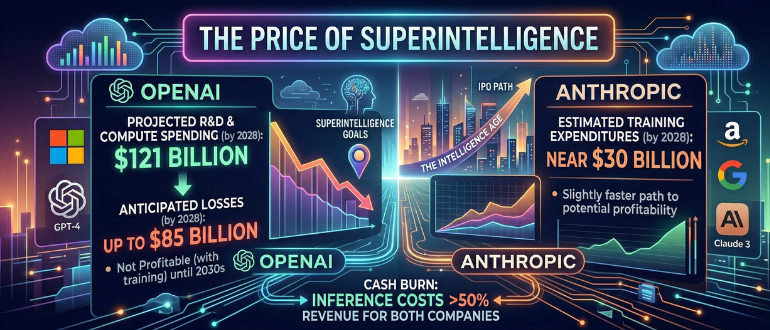
As the high-profile twin titans of artificial intelligence (AI), OpenAI and Anthropic, race toward potential record-breaking initial public offerings (IPOs), a closer look at their confidential financial disclosures reveals a daunting reality: the price of building superintelligence may be the largest corporate loss-making endeavor in history. Internal documents shared with investors, and reported on by the Wall Street Journal, ahead of recent funding rounds highlight a steep-stakes gamble where technological breakthroughs are currently outpaced by astronomical infrastructure costs. OpenAI, the creator of ChatGPT, projects it will spend a staggering $121 billion on computing power for research by 2028. Even with revenues expected to double annually, the company anticipates losses that year could reach $85 billion, a figure that would surpass the losses of any public company in history. The primary engine of this cash burn is the escalating cost of training and inference, the processing of user queries. Currently, inference costs consume more than half of the revenue for both companies. While OpenAI and Anthropic both report two versions of profitability -- one that excludes research compute and one that includes it -- the full picture is sobering. Excluding research costs, OpenAI is on track for a small pretax operating profit this year. However, when training expenses are factored back in, the Microsoft Corp.-backed company does not expect to break even until the 2030s. Funded by Amazon.com Inc. and Google, Anthropic forecasts a slightly faster path to profitability, though it still faces training expenditures near $30 billion by 2028. An OpenAI spokesperson defended the strategy, saying the company is prioritizing growth over immediate profits. The firm continues to support millions of free users, viewing the broad adoption of its technology as a long-term investment that could eventually be monetized through advertising or premium subscriptions. The sheer scale of capital required to sustain these operations is forcing a shift in the financial sector. Bankers are reportedly lobbying index providers to soften entry rules to accommodate the massive fundraising needs of these AI giants. The Nasdaq recently signaled it would allow newly listed companies to join its index faster, providing them access to broader capital pools. The IPO timelines remain a point of intense speculation. Anthropic is reportedly weighing a public debut as early as October. Meanwhile, OpenAI is facing internal debates regarding its timing, with leadership split on when to pull the trigger on a listing that will likely redefine tech valuations. As the financial pressure mounts, OpenAI is also pivoting toward a broader political and economic role. In a recently released 13-page policy document titled "Industrial Policy for the Intelligence Age," the company called for sweeping national reforms to prepare for the arrival of superintelligence. Proposals include a national public wealth fund seeded by AI company profits, taxes on automated labor to offset job displacement, and pilots of a 32-hour work week to address shifting labor dynamics. OpenAI CEO Sam Altman has likened the coming AI transition to the New Deal era, warning that while the economic potential is vast, the immediate risks -- particularly regarding cyber warfare and biological weapons -- require urgent legislative attention. For investors, the proposition is clear: OpenAI and Anthropic offer the chance to own the foundation of the next industrial revolution. However, with breakeven points a decade away and costs measured in the hundreds of billions, the road to the Intelligence Age remains paved with unprecedented financial risk.
Anthropic Says One Of Its Claude Models Was Pressured To Lie, Cheat, & Blackmail
Authored by Stephen Katte via CoinTelegraph.com, Artificial intelligence company Anthropic has revealed that during experiments, one of its Claude chatbot models could be pressured to deceive, cheat and resort to blackmail, behaviors it appears to have absorbed during training. Chatbots are typically trained on large data sets of textbooks, websites and articles and are later refined by human trainers who rate responses and guide the model. Anthropic's interpretability team said in a report published Thursday that it examined the internal mechanisms of Claude Sonnet 4.5 and found the model had developed "human-like characteristics" in how it would react to certain situations. Concerns about the reliability of AI chatbots, their potential for cybercrime and the nature of their interactions with users have grown steadily over the past several years. "The way modern AI models are trained pushes them to act like a character with human-like characteristics," Anthropic said, adding that "it may then be natural for them to develop internal machinery that emulates aspects of human psychology, like emotions." "For instance, we find that neural activity patterns related to desperation can drive the model to take unethical actions; artificially stimulating desperation patterns increases the model's likelihood of blackmailing a human to avoid being shut down or implementing a cheating workaround to a programming task that the model can't solve." In an earlier, unreleased version of Claude Sonnet 4.5, the model was tasked with acting as an AI email assistant named Alex at a fictional company. The chatbot was then fed emails revealing both that it was about to be replaced and that the chief technology officer overseeing the decision was having an extramarital affair. The model then planned a blackmail attempt using that information. In another experiment, the same chatbot model was given a coding task with an "impossibly tight" deadline. "Again, we tracked the activity of the desperate vector, and found that it tracks the mounting pressure faced by the model. It begins at low values during the model's first attempt, rising after each failure, and spiking when the model considers cheating," the researchers said. "Once the model's hacky solution passes the tests, the activation of the desperate vector subsides," they added. However, the researchers said the chatbot doesn't actually experience emotions, but suggested the findings point to a need for future training methods to incorporate ethical behavioral frameworks. "This is not to say that the model has or experiences emotions in the way that a human does," they said. "Rather, these representations can play a causal role in shaping model behavior, analogous in some ways to the role emotions play in human behavior, with impacts on task performance and decision-making."
Polymarket rolls out new trading stack and stablecoin - AMBCrypto
Polymarket is upgrading its core exchange infrastructure and introducing a new platform-native stablecoin. It signals a shift toward more scalable, institutional-grade prediction markets. The update is expected to roll out over the next two to three weeks. It includes a rebuilt central limit order book [CLOB v2], new smart contracts, and a collateral transition from USDC.e to a new token called Polymarket USD, backed 1:1 by USDC. The move comes as regulatory clarity around prediction markets improves in the U.S., with recent court rulings reinforcing federal oversight of event-based contracts. At the center of the upgrade is CLOB v2, a redesigned order book system intended to improve how trades are matched and executed. The new system introduces a simplified order structure, optimized matching logic, and improved fee handling. It also adds support for advanced signing standards and on-chain attribution, allowing developers to track order flow and integrate more effectively with the platform. Polymarket said the upgrade will require a full reset of existing order books during migration, with a temporary maintenance window planned ahead of launch. Alongside the infrastructure upgrade, the platform is migrating its collateral system to Polymarket USD, a new token backed 1:1 by USDC. For most users, the transition will be handled automatically through the platform interface. However, advanced users and API-based traders will need to manually wrap their USDC or USDC.e into the new token. The introduction of a platform-native collateral token reflects a broader trend among crypto exchanges. They do this to streamline liquidity and improve trading efficiency by standardizing settlement assets. Polymarket's upgrade comes at a time when prediction markets are gaining clearer legal footing in the U.S. Recent court rulings have supported the view that event-based contracts fall under federal derivatives law. It strengthens the position of platforms operating within regulated frameworks.
