News & Updates
The latest news and updates from companies in the WLTH portfolio.
J.P. Morgan Called a Potential Elon Musk SpaceX-Tesla Merger "Strategically Coherent"
Now that Elon Musk's rocket and satellite company Space Exploration Technologies (SPCX 4.51%) trades publicly, Wall Street has started hunting for the next best thing: stocks that can ride its coattails. The most eye-catching call came from J.P. Morgan, whose analysts described a possible combination of SpaceX and Tesla (TSLA +0.22%) as "strategically coherent on paper." That single phrase has revived a long-running fantasy among investors, and it's worth understanding what the analyst company actually means before treating any of these names as a back door into SpaceX. Why J.P. Morgan sees logic in a Tesla-SpaceX tie-up J.P. Morgan's argument is that Musk's companies already share engineering talent, an artificial intelligence ambition, and a common leader, so uniting them could let him run one integrated vision across cars, robots, energy, and space. The analysts also noted that SpaceX's blockbuster public debut gives Musk valuable stock to make a deal, and that his growing voting control at Tesla makes him better positioned to push one through. J.P. Morgan was careful, though, and so am I. It flagged real obstacles: securing regulatory approvals across many countries, especially China, where Tesla builds cars; the awkward gap between Musk's near-total control of SpaceX and his smaller stake in Tesla; and the likelihood that any deal would look like SpaceX swallowing Tesla rather than a merger of equals. "Coherent on paper" is a long way from "likely to happen." The other SpaceX-by-association plays Tesla isn't the only name catching the halo. Deutsche Bank started coverage of EchoStar (ECHO 2.00%) with a buy rating, framing it as a cheaper way to own SpaceX. EchoStar holds roughly $11 billion of SpaceX shares it received for handing over wireless spectrum, so the bank argues you're effectively buying SpaceX at a discount and getting EchoStar's other assets thrown in. The catch is serious: EchoStar's pay-TV subsidiary recently filed for bankruptcy, and the stock has tumbled. Then there's Charter Communications (CHTR 2.69%), which, according to Bloomberg, has held talks with SpaceX about a consumer mobile phone service that would route some traffic through Charter's network. It's a genuine strategic fit, but it's only talk for now. Here's my honest read. Buying a stock because it's linked to a hot company is a strategy built on hope, not fundamentals, and all three of these names are down this year for reasons of their own. A merger that's merely "coherent on paper," a spectrum stake wrapped around a bankruptcy, and a rumored partnership are not the same as durable businesses. If you like Tesla, EchoStar, or Charter, buy them for what they do today, and treat any SpaceX connection as a bonus rather than the thesis.

J.P. Morgan Called a Potential Elon Musk SpaceX-Tesla Merger "Strategically Coherent"
Now that Elon Musk's rocket and satellite company Space Exploration Technologies (NASDAQ: SPCX) trades publicly, Wall Street has started hunting for the next best thing: stocks that can ride its coattails. The most eye-catching call came from J.P. Morgan, whose analysts described a possible combination of SpaceX and Tesla (NASDAQ: TSLA) as "strategically coherent on paper." That single phrase has revived a long-running fantasy among investors, and it's worth understanding what the analyst company actually means before treating any of these names as a back door into SpaceX. Why J.P. Morgan sees logic in a Tesla-SpaceX tie-up J.P. Morgan's argument is that Musk's companies already share engineering talent, an artificial intelligence ambition, and a common leader, so uniting them could let him run one integrated vision across cars, robots, energy, and space. The analysts also noted that SpaceX's blockbuster public debut gives Musk valuable stock to make a deal, and that his growing voting control at Tesla makes him better positioned to push one through. Missed Nvidia in 2009? This Rare Signal Is Flashing Again. In 2009, a "Double Down" signal flashed for a little-known chipmaker called Nvidia. For the first time in years, that same "Total Conviction" signal is flashing for a company 1/100th the size of Nvidia. Continue " J.P. Morgan was careful, though, and so am I. It flagged real obstacles: securing regulatory approvals across many countries, especially China, where Tesla builds cars; the awkward gap between Musk's near-total control of SpaceX and his smaller stake in Tesla; and the likelihood that any deal would look like SpaceX swallowing Tesla rather than a merger of equals. "Coherent on paper" is a long way from "likely to happen." The other SpaceX-by-association plays Tesla isn't the only name catching the halo. Deutsche Bank started coverage of EchoStar (NASDAQ: ECHO) with a buy rating, framing it as a cheaper way to own SpaceX. EchoStar holds roughly $11 billion of SpaceX shares it received for handing over wireless spectrum, so the bank argues you're effectively buying SpaceX at a discount and getting EchoStar's other assets thrown in. The catch is serious: EchoStar's pay-TV subsidiary recently filed for bankruptcy, and the stock has tumbled. Then there's Charter Communications (NASDAQ: CHTR), which, according to Bloomberg, has held talks with SpaceX about a consumer mobile phone service that would route some traffic through Charter's network. It's a genuine strategic fit, but it's only talk for now.
Prediction: SpaceX Shares Can Reach $220 by End of 2026
Space Exploration Technologies (SPCX 4.51%) has become one of the market's most closely watched stocks after its rapid entry into the Nasdaq-100 index on July 7. Shares are trading close to $149 (as of July 10), still above its $135 IPO price, but nearly 34% below its post-IPO high of $225.60. This share price pullback has not ended investor interest in SpaceX, but it has changed the debate. Investors are now weighing the company's artificial intelligence (AI) compute opportunity, Starlink satellite internet network's room to expand in satellite communications, and progress on the next-generation reusable rocket system, Starship, as they assess where the stock could trade by the end of 2026. SpaceX has growth drivers for its revenue SpaceX is already demonstrating impressive financial momentum. Revenue rose 33% year over year to $18.7 billion in 2025. But the company still reported a net loss of $4.9 billion after merging with money-losing xAI. Starlink remains the key growth engine, supported by roughly 10.3 million users and 9,600 satellites. But AI infrastructure is also becoming the next major catalyst. Alphabet has agreed to pay SpaceX $920 million per month from October 2026 through June 2029 for access to about 110,000 Nvidia GPUs and related computing resources. Anthropic has also signed a major compute-access deal with SpaceX, securing use of SpaceX's Colossus 1 data center. Reuters reported that SpaceX's two deals are worth about $26 billion annually if fully realized. Although not all the AI revenue from these deals is expected to materialize in 2026, it still gives investors a reason to value SpaceX based on future revenue potential rather than solely on 2025 sales. SpaceX's valuation will fall, but remain expensive At the end of 2026, investors will likely be looking toward SpaceX's expected 2027 revenue, since the stock's valuation depends on how quickly Starlink, AI compute, and Starship can expand the company's sales base. SpaceX's market capitalization is close to $2 trillion. Analysts' 2026 revenue estimates range from $34.3 billion on the low end to $43.2 billion on the high end, with a base case estimate of about $38.9 billion. Hence, SpaceX is already trading at roughly 51.4 times base case 2026 sales. By the end of 2026, that multiple will most likely compress, as post-IPO excitement usually cools and investors demand evidence of execution. But it also does not need to collapse if SpaceX continues to show progress in Starlink, AI infrastructure, and Starship. A reasonable base-case assumption is that SpaceX's sales multiple compresses by about 20% to 25% from today's 51.4x 2026 sales multiple. That gives a forward price-to-sales (P/S) multiple range of roughly 38.5 to 41 times expected 2027 sales. Analysts expect SpaceX's 2027 revenue to range from $54.8 billion to $85 billion, with an average estimate of $72.4 billion. Applying a forward sales multiple of 38.5 to 41 times to the 2027 base case revenue estimate yields an implied market capitalization of about $2.79 trillion to $2.97 trillion. Using roughly 13.1 billion shares outstanding, that points to a share price in the range of $213 to $227 at the end of 2026. Hence, $220 is a reasonable base case estimate. It assumes that while SpaceX's valuation multiple compresses, revenue growth offsets the pressure enough to lift the share price.

Palantir CEO has a blunt verdict on OpenAI and Anthropic
Palantir posted the highest revenue growth rate in its history in the first quarter of fiscal year 2026. U.S. commercial revenue jumped 133%. The company raised its full-year guidance by 10 points. By any operational measure, things are going well. And yet Alex Karp walked onto CNBC's Squawk Box and started criticizing the entire foundation of the AI business model. He wasn't talking about Palantir's competitors in the traditional sense. He was talking about the companies whose technology his own platform runs on top of. "I'm not throwing shade at them," he told viewers, "but something has gone completely wrong." What Karp said about OpenAI and Anthropic on live television The problem, in Karp's telling, is tokens. The way OpenAI and Anthropic sell AI access, metered by token consumption, has created a dynamic he says enterprises are increasingly fed up with. "The basic view among enterprises in this country is I'm going to chillax and waste my time with tokens, I'm gonna get no value, and they're gonna get my IP," Karp told CNBC. When co-anchor Andrew Ross Sorkin said "that sounds like shade," Karp pushed back: "No, no. This is reporting." He said customers are shifting away from what he called "tokenmaxxing" toward open-weight models that deliver similar output at a fraction of the cost. The ROI conversation is changing. Enterprises are asking harder questions about what they are actually getting for what they are spending, and a lot of them are not liking the answer. Palantir's stock rose 8% that day. Before the interview, the company had published a 9-point "AI sovereignty" manifesto on X, setting the philosophical stage for what Karp was about to say publicly. Why Karp says data ownership is the real AI fight The deeper argument Karp made was about control. Enterprises and governments, he said, want to own their compute, their models, their data stack, and their alpha. The word he kept coming back to was ownership. "They want to know they own the means of production. It's not being transferred to someone else." That framing extended into territory that goes well beyond enterprise software. Karp said it would be "insane" to hand battlefield or government applications entirely over to AI labs, effectively outsourcing sensitive decisions to a small group of Silicon Valley companies operating by consensus. To illustrate where he thinks the market is going, Karp pointed to Palantir's expanded partnership with Nvidia, announced the same week, to build custom AI models for U.S. government agencies. "What aligns me with Nvidia... is what the technical customers want, which is control over their compute, their models, their data stack and their alpha," he said on CNBC. Palantir's Q1 2026 numbers and what they say about Karp's thesis Karp is making this argument from a position of real business momentum. Palantir's Q1 FY2026 revenue came in at $1.63 billion, up 85% year over year, the highest growth rate in company history. U.S. commercial revenue hit $595 million, up 133%. Adjusted operating margin expanded to 60% from 44% a year earlier. On the earnings call, Karp said Palantir's Rule of 40 score had hit 145%, which he called a feat matched only by Nvidia, Micron, and SK Hynix. Management raised annual revenue guidance to 71% growth, ten points above the prior quarter's forecast. U.S. commercial remaining deal value, meaning the potential value of contracted business yet to be recognized as revenue, reached $4.92 billion, up 112% year over year. Token-cost fatigue is showing up at real companies. Uber capped employee spending on agentic coding tools, including Claude Code and Cursor, at $1,500 per month after burning through its AI budget in four months, according to 24/7 Wall St. That is exactly the dynamic Karp is describing. The token model works until it doesn't, and for a growing number of enterprises, it has already stopped working. The Palantir valuation problem Karp's swagger can't quite solve The business is accelerating. The stock is down 28.67% year to date. Those two facts sitting next to each other tell you what the market's actual concern is, and it isn't whether enterprises want control of their data. Palantir closed at $126.79 on July 10 and trades at a forward P/E near 91. That multiple requires an enormous amount of future growth to be baked in and delivered. Even with 84.7% revenue growth, investors have spent most of 2026 asking whether that rate is sustainable or whether the stock got too far ahead of the business during last year's AI enthusiasm. Michael Burry disagrees. Scion Asset Management disclosed a put position tied to 5 million Palantir shares in its Q3 2025 13F, filed November 3, 2025. At the time, that represented an underlying notional of roughly $912 million, as TheStreet reported. 13Fs don't show strike prices, expiration dates, or whether the position is still open. But betting against $912 million worth of Palantir shares is not a casual trade. What Karp's OpenAI and Anthropic critique means for AI investors Karp's argument, if it holds up, has implications beyond Palantir's own stock. The token model underpins how OpenAI and Anthropic generate most of their enterprise revenue. If large customers are genuinely moving toward open-weight models and demanding more control over their infrastructure, that changes the growth assumptions for the closed-model AI companies more than the market has so far priced in. The counterargument is that Karp has an obvious commercial incentive to talk down token-based AI, since Palantir positions itself as the alternative. His numbers are real, but so is his motive. The enterprises he claims are frustrated may still be signing large contracts with OpenAI and Anthropic behind closed doors while also exploring Palantir's approach on the side. What July 1 made clear is that the business model debate inside the AI industry is getting louder, and the people doing the criticizing are no longer just academics or short sellers. They are CEOs running companies posting 84.7% revenue growth, with enough market credibility to move their own stock 8% with a single television appearance. The Arena Media Brands, LLC THESTREET is a registered trademark of TheStreet, Inc. This story was originally published July 12, 2026 at 4:37 PM.
Palantir CEO has a blunt verdict on OpenAI and Anthropic
Palantir posted the highest revenue growth rate in its history in the first quarter of fiscal year 2026. U.S. commercial revenue jumped 133%. The company raised its full-year guidance by 10 points. By any operational measure, things are going well. And yet Alex Karp walked onto CNBC's Squawk Box and started criticizing the entire foundation of the AI business model. He wasn't talking about Palantir's competitors in the traditional sense. He was talking about the companies whose technology his own platform runs on top of. "I'm not throwing shade at them," he told viewers, "but something has gone completely wrong." What Karp said about OpenAI and Anthropic on live television The problem, in Karp's telling, is tokens. The way OpenAI and Anthropic sell AI access, metered by token consumption, has created a dynamic he says enterprises are increasingly fed up with. "The basic view among enterprises in this country is I'm going to chillax and waste my time with tokens, I'm gonna get no value, and they're gonna get my IP," Karp told CNBC. When co-anchor Andrew Ross Sorkin said "that sounds like shade," Karp pushed back: "No, no. This is reporting." He said customers are shifting away from what he called "tokenmaxxing" toward open-weight models that deliver similar output at a fraction of the cost. The ROI conversation is changing. Enterprises are asking harder questions about what they are actually getting for what they are spending, and a lot of them are not liking the answer. Palantir's stock rose 8% that day. Before the interview, the company had published a 9-point "AI sovereignty" manifesto on X, setting the philosophical stage for what Karp was about to say publicly. Why Karp says data ownership is the real AI fight The deeper argument Karp made was about control. Enterprises and governments, he said, want to own their compute, their models, their data stack, and their alpha. The word he kept coming back to was ownership. "They want to know they own the means of production. It's not being transferred to someone else." That framing extended into territory that goes well beyond enterprise software. Karp said it would be "insane" to hand battlefield or government applications entirely over to AI labs, effectively outsourcing sensitive decisions to a small group of Silicon Valley companies operating by consensus. To illustrate where he thinks the market is going, Karp pointed to Palantir's expanded partnership with Nvidia, announced the same week, to build custom AI models for U.S. government agencies. "What aligns me with Nvidia... is what the technical customers want, which is control over their compute, their models, their data stack and their alpha," he said on CNBC. Palantir's Q1 2026 numbers and what they say about Karp's thesis Karp is making this argument from a position of real business momentum. Palantir's Q1 FY2026 revenue came in at $1.63 billion, up 85% year over year, the highest growth rate in company history. U.S. commercial revenue hit $595 million, up 133%. Adjusted operating margin expanded to 60% from 44% a year earlier. On the earnings call, Karp said Palantir's Rule of 40 score had hit 145%, which he called a feat matched only by Nvidia, Micron, and SK Hynix. Management raised annual revenue guidance to 71% growth, ten points above the prior quarter's forecast. U.S. commercial remaining deal value, meaning the potential value of contracted business yet to be recognized as revenue, reached $4.92 billion, up 112% year over year. Token-cost fatigue is showing up at real companies. Uber capped employee spending on agentic coding tools, including Claude Code and Cursor, at $1,500 per month after burning through its AI budget in four months, according to 24/7 Wall St. That is exactly the dynamic Karp is describing. The token model works until it doesn't, and for a growing number of enterprises, it has already stopped working. The Palantir valuation problem Karp's swagger can't quite solve The business is accelerating. The stock is down 28.67% year to date. Those two facts sitting next to each other tell you what the market's actual concern is, and it isn't whether enterprises want control of their data. Palantir closed at $126.79 on July 10 and trades at a forward P/E near 91. That multiple requires an enormous amount of future growth to be baked in and delivered. Even with 84.7% revenue growth, investors have spent most of 2026 asking whether that rate is sustainable or whether the stock got too far ahead of the business during last year's AI enthusiasm. Michael Burry disagrees. Scion Asset Management disclosed a put position tied to 5 million Palantir shares in its Q3 2025 13F, filed November 3, 2025. At the time, that represented an underlying notional of roughly $912 million, as TheStreet reported. 13Fs don't show strike prices, expiration dates, or whether the position is still open. But betting against $912 million worth of Palantir shares is not a casual trade. What Karp's OpenAI and Anthropic critique means for AI investors Karp's argument, if it holds up, has implications beyond Palantir's own stock. The token model underpins how OpenAI and Anthropic generate most of their enterprise revenue. If large customers are genuinely moving toward open-weight models and demanding more control over their infrastructure, that changes the growth assumptions for the closed-model AI companies more than the market has so far priced in. The counterargument is that Karp has an obvious commercial incentive to talk down token-based AI, since Palantir positions itself as the alternative. His numbers are real, but so is his motive. The enterprises he claims are frustrated may still be signing large contracts with OpenAI and Anthropic behind closed doors while also exploring Palantir's approach on the side. What July 1 made clear is that the business model debate inside the AI industry is getting louder, and the people doing the criticizing are no longer just academics or short sellers. They are CEOs running companies posting 84.7% revenue growth, with enough market credibility to move their own stock 8% with a single television appearance. The Arena Media Brands, LLC THESTREET is a registered trademark of TheStreet, Inc. This story was originally published July 12, 2026 at 4:37 PM.
Palantir CEO has a blunt verdict on OpenAI and Anthropic
Palantir posted the highest revenue growth rate in its history in the first quarter of fiscal year 2026. U.S. commercial revenue jumped 133%. The company raised its full-year guidance by 10 points. By any operational measure, things are going well. And yet Alex Karp walked onto CNBC's Squawk Box and started criticizing the entire foundation of the AI business model. He wasn't talking about Palantir's competitors in the traditional sense. He was talking about the companies whose technology his own platform runs on top of. "I'm not throwing shade at them," he told viewers, "but something has gone completely wrong." What Karp said about OpenAI and Anthropic on live television The problem, in Karp's telling, is tokens. The way OpenAI and Anthropic sell AI access, metered by token consumption, has created a dynamic he says enterprises are increasingly fed up with. "The basic view among enterprises in this country is I'm going to chillax and waste my time with tokens, I'm gonna get no value, and they're gonna get my IP," Karp told CNBC. When co-anchor Andrew Ross Sorkin said "that sounds like shade," Karp pushed back: "No, no. This is reporting." He said customers are shifting away from what he called "tokenmaxxing" toward open-weight models that deliver similar output at a fraction of the cost. The ROI conversation is changing. Enterprises are asking harder questions about what they are actually getting for what they are spending, and a lot of them are not liking the answer. Palantir's stock rose 8% that day. Before the interview, the company had published a 9-point "AI sovereignty" manifesto on X, setting the philosophical stage for what Karp was about to say publicly. Why Karp says data ownership is the real AI fight The deeper argument Karp made was about control. Enterprises and governments, he said, want to own their compute, their models, their data stack, and their alpha. The word he kept coming back to was ownership. "They want to know they own the means of production. It's not being transferred to someone else." That framing extended into territory that goes well beyond enterprise software. Karp said it would be "insane" to hand battlefield or government applications entirely over to AI labs, effectively outsourcing sensitive decisions to a small group of Silicon Valley companies operating by consensus. To illustrate where he thinks the market is going, Karp pointed to Palantir's expanded partnership with Nvidia, announced the same week, to build custom AI models for U.S. government agencies. "What aligns me with Nvidia... is what the technical customers want, which is control over their compute, their models, their data stack and their alpha," he said on CNBC. Palantir's Q1 2026 numbers and what they say about Karp's thesis Karp is making this argument from a position of real business momentum. Palantir's Q1 FY2026 revenue came in at $1.63 billion, up 85% year over year, the highest growth rate in company history. U.S. commercial revenue hit $595 million, up 133%. Adjusted operating margin expanded to 60% from 44% a year earlier. On the earnings call, Karp said Palantir's Rule of 40 score had hit 145%, which he called a feat matched only by Nvidia, Micron, and SK Hynix. Management raised annual revenue guidance to 71% growth, ten points above the prior quarter's forecast. U.S. commercial remaining deal value, meaning the potential value of contracted business yet to be recognized as revenue, reached $4.92 billion, up 112% year over year. Token-cost fatigue is showing up at real companies. Uber capped employee spending on agentic coding tools, including Claude Code and Cursor, at $1,500 per month after burning through its AI budget in four months, according to 24/7 Wall St. That is exactly the dynamic Karp is describing. The token model works until it doesn't, and for a growing number of enterprises, it has already stopped working. The Palantir valuation problem Karp's swagger can't quite solve The business is accelerating. The stock is down 28.67% year to date. Those two facts sitting next to each other tell you what the market's actual concern is, and it isn't whether enterprises want control of their data. Palantir closed at $126.79 on July 10 and trades at a forward P/E near 91. That multiple requires an enormous amount of future growth to be baked in and delivered. Even with 84.7% revenue growth, investors have spent most of 2026 asking whether that rate is sustainable or whether the stock got too far ahead of the business during last year's AI enthusiasm. Michael Burry disagrees. Scion Asset Management disclosed a put position tied to 5 million Palantir shares in its Q3 2025 13F, filed November 3, 2025. At the time, that represented an underlying notional of roughly $912 million, as TheStreet reported. 13Fs don't show strike prices, expiration dates, or whether the position is still open. But betting against $912 million worth of Palantir shares is not a casual trade. What Karp's OpenAI and Anthropic critique means for AI investors Karp's argument, if it holds up, has implications beyond Palantir's own stock. The token model underpins how OpenAI and Anthropic generate most of their enterprise revenue. If large customers are genuinely moving toward open-weight models and demanding more control over their infrastructure, that changes the growth assumptions for the closed-model AI companies more than the market has so far priced in. The counterargument is that Karp has an obvious commercial incentive to talk down token-based AI, since Palantir positions itself as the alternative. His numbers are real, but so is his motive. The enterprises he claims are frustrated may still be signing large contracts with OpenAI and Anthropic behind closed doors while also exploring Palantir's approach on the side. What July 1 made clear is that the business model debate inside the AI industry is getting louder, and the people doing the criticizing are no longer just academics or short sellers. They are CEOs running companies posting 84.7% revenue growth, with enough market credibility to move their own stock 8% with a single television appearance. The Arena Media Brands, LLC THESTREET is a registered trademark of TheStreet, Inc. This story was originally published July 12, 2026 at 4:37 PM.
SpaceX Went Nowhere for a Month, but It Easily Beat Other Space Stocks
* SpaceX (SPCX) trades near its $150 opening price, but a flat price performance is a relative win when the broader space sector is down sharply. * Virgin Galactic (SPCE) crashed 45% and Rocket Lab (RKLB) fell 22% over the past month as sector rotation hammered speculative space names hard. * SpaceX's $1.96 trillion market cap and Starlink's global reach anchor the bull case, but its surrendered IPO pop and rich valuation are real risks. * Act now: the analyst who called NVIDIA in 2010 just named his top 10 AI stocks -- and Rocket Lab didn't make the cut. Grab the names FREE today. Shares of SpaceX (NASDAQ:SPCX) are trading at $148 and change on Friday afternoon, essentially back where they opened one month ago. That flat tape looks dull on the surface, but against the rest of the space sector, it's the best performance in the group. SpaceX priced its debut at $135 but commenced trading at $150 on June 12, and has since round-tripped to basically the same price. That's disappointing, no doubt, but SpaceX's peers fared worse over the past month. The market cap of Elon Musk's space company sits at $1.96 trillion, making SpaceX one of the largest listings ever and by far the biggest name in the sector. That scarcity value may have helped to shield SPCX stock from the broader sector rotation. Peers Sold Off, SpaceX Held the Line It's been a challenging month for the space sector overall. Speculative, high-beta space names have been hit with profit-taking and cooling risk appetite over the past four weeks, though SpaceX evidently refused to participate on the downside. Over the trailing month, Virgin Galactic (NYSE:SPCE) is down 45%, Intuitive Machines (NASDAQ:LUNR) is down 40%, and Rocket Lab (NASDAQ:RKLB) is down 22%. AST SpaceMobile (NASDAQ:ASTS) is down 16%, and Planet Labs (NYSE:PL) is down 15%. Act now: the analyst who called NVIDIA in 2010 just named his top 10 AI stocks -- and Rocket Lab didn't make the cut. Grab the names FREE today. The takeaway isn't that SpaceX rallied, since it actually popped and dropped. Being flat versus the opening price still counts as a win in this hard-hit sector. The Space Sector Proxy Confirms the Rotation The Procure Space ETF (NYSEARCA:UFO) is down 10% over the same month, though it did cushion the space sector group's drawdowns with satellite operators and aerospace specialists. The UFO ETF is a narrow, volatile thematic fund with concentration risk, though it's not leveraged. The fund's top holdings include Planet Labs at 6% and Rocket Lab at 5%, both of which weighed on the UFO ETF.
Polymarket promo code ALCOM: A guaranteed $50 bonus allows you to trade McGregor vs. Holloway 2
Polymarket promo code ALCOM lets you turn tonight's McGregor vs. Holloway 2 main event into a high-upside trading opportunity from the opening bell. For UFC 329 McGregor vs. Holloway 2 markets you can claim $50 on a $20 deposit, click here to secure your $50 bonus and lock in your trades today. Polymarket promo code ALCOM: Grab a $50 sign-up bonus * Polymarket promo code: ALCOM * Sign-up bonus: $50 in bonus funds * Requirements: Register for an account and deposit $20 or more * Terms and conditions: 18+ and located in a U.S. state where Polymarket operates * Last verified: July 11, 2026 How Polymarket UFC 329 markets work for McGregor vs Holloway 2 Polymarket is an event prediction market, not a sportsbook. Here, traders will buy and sell contracts tied to specific events, such as Max Holloway shutting the Conor McGregor hype down and knocking him out this weekend at UFC 329. The share price will always be between $0.00 and $1.00 based on the chance of that event in the live market. A few weeks ago, I placed a trade on Diego Lopes to beat Steve Garcia at UFC Freedom 250 at $0.57 per share. After he got the emphatic knockout, Polymarket paid me $1.00 per share, resulting in a profit of $0.43 per share. With the Polymarket promo code ALCOM, you'll receive a $50 bonus when you deposit $20+. For more on Orderbook liquidity, advanced trading strategies and step-by-step guides on how to deposit funds, check out our in-depth Polymarket referral code review. How to claim the Polymarket promo code ALCOM Getting your Polymarket promo code ALCOM is very easy; just follow the basic step-by-step guide below. Step-by-step guide Polymarket UFC 329 preview: McGregor vs. Holloway 2 As International Fight Week descends upon Las Vegas, the prediction market traders are flocking to the Polymarket Orderbooks to capture early closing line value on a colossal welterweight rematch 13 years in the making. Heading into UFC 329, the market is pricing in severe ring rust for Conor McGregor, who hasn't competed since breaking his leg in 2021, while strongly backing an active Max Holloway at 68¢ (68% chance) as he makes his 170-pound debut, a stark contrast to their 2013 featherweight clash, where McGregor dominated with four takedowns and over six minutes of ground control. This wide pricing gap reflects a sharp trading community that is heavily weighing Holloway's sustained elite-level striking output against the physical uncertainty of McGregor's five-year layoff, while also anticipating a violent finish with the "Fight to go the distance" shares sitting at a lowly 22¢ (22% chance). Because these contracts yield immediate liquidity, the real strategic edge before the Octagon door locks lies in identifying whether the market is overcorrecting for McGregor's inactivity or underestimating how Holloway's chin and power will translate up at welterweight, allowing traders to build positions before tonight's walkouts reposition the entire Orderbook.

UFC 329 Prediction Market Promo Codes: Kalshi, Polymarket Lead McGregor Fight Offers
UFC 329 Prediction Market Promo Codes: Kalshi, Polymarket Lead McGregor Fight Offers originally appeared on The Sporting News. Add The Sporting News as a Preferred Source by clicking here. UFC 329 is bringing the heat with the highly anticipated rematch between Conor McGregor and Max Holloway. If you're feeling stuck with the same old moneyline bets and want to chase a real chance at a nice pay day, prediction markets are the perfect way to level up your strategy. To get you started, there are $145 in bonuses available right now when you use the latest UFC 329 prediction market promo codes. Specifically, the latest welcome offer allows new Kalshi customers to get a $15 sign-up bonus that is unlocked after making just $10 in trades. You can use this bonus on the McGregor vs. Holloway matchup, or any other bout on the card this week. Take a look at the heavy-hitting lineup of prediction market offers available for this week's fights: Start with Kalshi and Get the $15 Bonus New Kalshi customers can elevate the excitement of UFC 329 with an exclusive welcome promotion that gets you right into the action. By registering for an account here ahead of the main event, eligible users can secure a $15 bonus. Whether you want to trade on McGregor finding his vintage form or Holloway putting on a striking clinic, this offer provides a fantastic starting point for your trading journey. To take advantage of this promotion, you must be a new Kalshi customer, at least 18 years of age, and located in a state where Kalshi is available. Claiming the offer is straightforward: begin by making a first-time deposit of at least $1 into your new account. Once your account is funded, simply make $10 in trades on their prediction markets, and your $15 bonus will be officially unlocked. More UFC 329 Prediction Market Promo Codes If you really want to maximize your bankroll, diversifying your trades across multiple platforms is a savvy move. I'm placing these trades across the board to take advantage of the full slate of UFC 329 prediction market promo codes: Using Your Bonuses for McGregor vs. Holloway The main event at UFC 329 presents a compelling opportunity for prediction market traders. As a quick history lesson, McGregor won the first meeting by unanimous decision back in 2013. However, the prediction markets show a different story for the rematch today. Below are the current vig-free probabilities for the two possible match outcomes on Kalshi: Remaining UFC 329 Main Card We've got a stacked lineup to trade on. Here are the remaining bouts on the UFC 329 card:
UFC 329 Prediction Market Promo Codes: Kalshi, Polymarket Lead McGregor Fight Offers
UFC 329 Prediction Market Promo Codes: Kalshi, Polymarket Lead McGregor Fight Offers originally appeared on The Sporting News. Add The Sporting News as a Preferred Source by clicking here. UFC 329 is bringing the heat with the highly anticipated rematch between Conor McGregor and Max Holloway. If you're feeling stuck with the same old moneyline bets and want to chase a real chance at a nice pay day, prediction markets are the perfect way to level up your strategy. To get you started, there are $145 in bonuses available right now when you use the latest UFC 329 prediction market promo codes. Specifically, the latest welcome offer allows new Kalshi customers to get a $15 sign-up bonus that is unlocked after making just $10 in trades. You can use this bonus on the McGregor vs. Holloway matchup, or any other bout on the card this week. Take a look at the heavy-hitting lineup of prediction market offers available for this week's fights: Start with Kalshi and Get the $15 Bonus New Kalshi customers can elevate the excitement of UFC 329 with an exclusive welcome promotion that gets you right into the action. By registering for an account here ahead of the main event, eligible users can secure a $15 bonus. Whether you want to trade on McGregor finding his vintage form or Holloway putting on a striking clinic, this offer provides a fantastic starting point for your trading journey. To take advantage of this promotion, you must be a new Kalshi customer, at least 18 years of age, and located in a state where Kalshi is available. Claiming the offer is straightforward: begin by making a first-time deposit of at least $1 into your new account. Once your account is funded, simply make $10 in trades on their prediction markets, and your $15 bonus will be officially unlocked. More UFC 329 Prediction Market Promo Codes If you really want to maximize your bankroll, diversifying your trades across multiple platforms is a savvy move. I'm placing these trades across the board to take advantage of the full slate of UFC 329 prediction market promo codes: Using Your Bonuses for McGregor vs. Holloway The main event at UFC 329 presents a compelling opportunity for prediction market traders. As a quick history lesson, McGregor won the first meeting by unanimous decision back in 2013. However, the prediction markets show a different story for the rematch today. Below are the current vig-free probabilities for the two possible match outcomes on Kalshi: Remaining UFC 329 Main Card We've got a stacked lineup to trade on. Here are the remaining bouts on the UFC 329 card:
Elon Musk Accuses Sam Altman Of Stealing A Charity And Apple's Technology, While Vowing That SpaceX's AI1 Satellites Will Fly Next Year But That Altman Will Be In Jail By Then
Elon Musk was never the gracious sort to let an opportunity to take a jab against his fiercest opponent pass him by. And now that Apple has lobbed a figurative thermonuclear warhead on OpenAI in the form of a damning lawsuit, Musk is using the ensuing social media buzz to land a few choice punches on his nemesis number one, OpenAI's Sam Altman. Elon Musk now believes SpaceX will start deploying AI1 satellites by next year, but wonders if Sam Altman would be able to see the launch, strongly implying that OpenAI's CEO would be in jail by then While the tale of the legendary animosity between Elon Musk and Sam Altman is long and sordid, the latest bout of verbal jousting between the two began in the wake of a damning lawsuit filed by Apple against OpenAI, accusing it of stealing its proprietary technology, circuit designs, and component architecture for a slew of upcoming consumer-geared AI devices. Apple has tallied that over 400 of its former employees have ended up at OpenAI, with the iPhone maker's former VP of Design, Tang Tan, reportedly playing a pivotal role by encouraging Apple employees vying for a stint at OpenAI to bring actual Apple hardware components and samples for "show and tell" sessions. Of course, this development has come as a manna from heaven for Elon Musk, who then jabbed that Altman had taken scamming to a "whole new level." Altman then responded with a riposte, suggesting that Musk was "sellling public market investors on short-term space datacenters." Never one to leave a jab unanswered, Musk then tore a strip out of Altman by declaring: "We start flying them next year. Maybe you can come see them if your parole officer approves. After stealing an open source AI charity, you then stole all of Apple's phone technology! Wow. What do you plan for an encore? That's tough to beat." Basically, Musk has just declared that SpaceX's ambitious satellite-based data center project will enter its deployment phase next year, while strongly suggesting that Sam Altman would be in jail by then. For the benefit of those who might not be aware, SpaceX recently unveiled its first dedicated satellite design for AI compute. Dubbed the AI1 satellite, it can support up to 150kW of peak compute payload, replete with liquid radiators, meteoride shielding, a centralized compute module, and deployable solar arrays. These satellites will be manufactured at SpaceX's Gigasat facility in Texas. Coming back, as mentioned earlier, the bad blood between Musk and Altman is one for the history books. Their feud can be traced to the inception of OpenAI, when Musk was the primary financier of the-then non-profit. Unsatisfied with the pace of development at the non-profit, Musk tried to take over the control of OpenAI in 2018 but was rebuffed by Altman and the board. Musk then departed the non-profit in a fit of rage. Then, once Sam Altman began advocating for converting OpenAI into a for-profit enterprise, Musk took Altman and OpenAI to court, where the defendants were able to claim a victory on technical grounds, with the court ruling that Musk had waited too long to file his claims. Follow Wccftech on Google to get more of our news coverage in your feeds.

UFC 329 Prediction Market Promo Codes: Kalshi, Polymarket Lead McGregor Fight Offers
UFC 329 is bringing the heat with the highly anticipated rematch between Conor McGregor and Max Holloway. If you're feeling stuck with the same old moneyline bets and want to chase a real chance at a nice pay day, prediction markets are the perfect way to level up your strategy. To get you started, there are $145 in bonuses available right now when you use the latest UFC 329 prediction market promo codes. Specifically, the latest welcome offer allows new Kalshi customers to get a $15 sign-up bonus that is unlocked after making just $10 in trades. You can use this bonus on the McGregor vs. Holloway matchup, or any other bout on the card this week. Take a look at the heavy-hitting lineup of prediction market offers available for this week's fights: Start with Kalshi and Get the $15 Bonus New Kalshi customers can elevate the excitement of UFC 329 with an exclusive welcome promotion that gets you right into the action. By registering for an account here ahead of the main event, eligible users can secure a $15 bonus. Whether you want to trade on McGregor finding his vintage form or Holloway putting on a striking clinic, this offer provides a fantastic starting point for your trading journey. To take advantage of this promotion, you must be a new Kalshi customer, at least 18 years of age, and located in a state where Kalshi is available. Claiming the offer is straightforward: begin by making a first-time deposit of at least $1 into your new account. Once your account is funded, simply make $10 in trades on their prediction markets, and your $15 bonus will be officially unlocked. More UFC 329 Prediction Market Promo Codes If you really want to maximize your bankroll, diversifying your trades across multiple platforms is a savvy move. I'm placing these trades across the board to take advantage of the full slate of UFC 329 prediction market promo codes: * Polymarket: Use the Polymarket promo code TSNEWS here and score a $50 bonus to use on their massive peer-to-peer markets. * Novig: Register here with the Novig promo code TSNEWS50 and get $50 in Novig Coins for trades. * ProphetX: Sign up here with the ProphetX promo code TSNEWS and grab a $20 bonus following $10 in trades. * OG.com: Unlock the OG.com promo here and make $10 in trades for a $10 bonus. Using Your Bonuses for McGregor vs. Holloway The main event at UFC 329 presents a compelling opportunity for prediction market traders. As a quick history lesson, McGregor won the first meeting by unanimous decision back in 2013. However, the prediction markets show a different story for the rematch today. Below are the current vig-free probabilities for the two possible match outcomes on Kalshi: Remaining UFC 329 Main Card We've got a stacked lineup to trade on. Here are the remaining bouts on the UFC 329 card:

Polymarket Promo Code COVERS: Claim $50 Bonus for McGregor vs. Holloway, UFC 329 Prediction Markets
Polymarket promo code COVERS unlocks a $50 bonus. Trade on McGregor vs. Holloway 2 today! Use the Polymarket promo code COVERS to claim a $50 bonus on one of the best prediction market apps available right now. New users who sign up by July 11 can put that bonus to work trading on Conor McGregor vs. Max Holloway 2. A code is required, and a minimum deposit of $20 is needed to unlock the offer. Polymarket Promo Code: Get $50 to Trade McGregor vs. Holloway 2 The Polymarket promo code offer gives new users a $50 bonus after depositing a minimum of $20. This is a prediction market platform, so instead of placing traditional bets, you are trading on the likelihood of outcomes, including who wins the McGregor vs. Holloway 2 fight. The code required to unlock this offer is COVERS, entered during registration. Here are the key terms and conditions to keep in mind before signing up: * Available in all U.S. states except Nevada * You must be physically located in an eligible state * A minimum deposit of $20 is required to activate the bonus * Valid photo ID is required, including a selfie holding that ID * Social Security Number verification may also be required If you trade on McGregor to win and he does, your position pays out based on the market price at the time of your trade. If Holloway wins instead and your McGregor trade does not resolve in your favor, the $50 bonus gives you additional funds to continue trading on other markets. Polymarket also covers predictions on politics, entertainment, economics, and more, making it a versatile platform well beyond sports. Check out the best prediction market promos to compare what else is available before you decide. Use the correct Polymarket promo code for your state How to Claim Your Polymarket Bonus for McGregor vs. Holloway 2 Claiming the Polymarket welcome offer is straightforward. Follow these steps to get your account set up and start trading on McGregor vs. Holloway 2. Pages related to this topic

SpaceX vs. the Last 5 Biggest IPOs in History. How Did Those Stocks Perform a Year Later?
Two notable trends continue to bolster the capital markets landscape. Of course, investor appetite for businesses in artificial intelligence (AI) remains robust. The view is that this is a groundbreaking technology that will have a meaningful impact on the economy. Missed Nvidia in 2009? This Rare Signal Is Flashing Again. In 2009, a "Double Down" signal flashed for a little-known chipmaker called Nvidia. For the first time in years, that same "Total Conviction" signal is flashing for a company 1/100th the size of Nvidia. Continue " Additionally, the market is captivated by anything Elon Musk is working on. His grand visions drive excitement. These factors created the perfect backdrop for the most anticipated initial public offering (IPO) ever. On June 12, Space Exploration Technologies (NASDAQ: SPCX) went public. It raised $86 billion, after underwriters exercised their greenshoe option. The company currently sports a massive $2 trillion market capitalization. And the stock has traded 13% up from its opening price (as of July 9). The hype is hard to overstate. But how will SpaceX's shares perform over the 12-month period following its IPO? Investors can try to glean insights by looking at the five largest previous deals. A wide range of industries The five largest IPOs prior to SpaceX are ranked by the amount of capital raised. The list includes Saudi Arabian Oil ($26 billion raised in 2019), Alibaba Group ($22 billion in 2014), SoftBank Corp. (not the investment holding company) ($21 billion in 2018), NTT DoCoMo ($18 billion in 1998), and Visa ($18 billion in 2008). Investors will notice that these deals come from different industries. Whether it's energy, technology, communication services, or financial services, no single sector dominates. Their subsequent 12-month performances are a mixed bag. Saudi Aramco shares were down by a single-digit percentage. Alibaba's stock price tanked 30%. SoftBank's shares were up about 10%. NTT Mobile soared 68%. And Visa's stock was essentially flat one year later. These figures are all over the place. It's telling that these companies were able to raise such massive amounts of capital. However, the timing of their IPOs, as well as their competitive positions, management teams, and financial performance, all weighed on their respective stocks' performances. Based on these volatile numbers, investors can't come to a definitive conclusion about where SpaceX shares will be trading 12 months after its IPO. It's really a toss-up at this point.
'Stole all of Apple's phone technology': Inside fresh Elon Musk-Sam Altman feud, SpaceX CEO's 'parole officer' jab
The feud comes as OpenAI faces a new legal battle, with Apple accusing the AI firm of misusing confidential information related to its future hardware products. Musk's recent jab at Altman has gained widespread attention because of its timing; the SpaceX CEO has repeatedly questioned OpenAI's leadership and business practices in the past. Also Read | Candace Owens says Elon Musk, Sam Altman are 'hybrid,' suggests they aren't humans, 'It's something in the eyes...' Reposting it, Musk wrote of Altman, "He takes scamming to a whole new level". Altman soon fired back, telling Musk, "homeboy you're the one sellling public market investors on short-term space datacenters," referring to orbital data centers Musk has championed and plans on launching as a solution to AI energy limitations on Earth. Also Read | OpenAI's Sam Altman proposes giving Trump administration 5% equity stake: Report Musk then replied, "We start flying them next year. Maybe you can come see them if your parole officer approves. After stealing an open source AI charity, you then stole all of Apple's phone technology! Wow. What do you plan for an encore? That's tough to beat." Altman recently also suggested that one of his company's latest AI models, 5.6 Sol, was the "best model in the world right now," taking a jab at Musk after he accused him of scamming users. Altman wrote on X, "there are a lot of benchmarks that suggest 5.6 sol is the best model in the world right now, but the most reliable way to tell is that elon is obsessed with me again".

Total Prediction Market Volume Reaches New Highs as Polymarket Expands and Wall Street Responds
Prediction markets are experiencing a historic surge in activity, cementing their place as one of the fastest-growing sectors in finance and digital assets. Total trading volume across major platforms has climbed to new all-time highs, driven by growing interest in politics, macroeconomic events, sports, artificial intelligence, and cryptocurrency-related forecasts. Institutional finance is beginning to grapple with the implications of these markets, as evidenced by Goldman Sachs reportedly restricting employee participation in prediction market activities. The rise of prediction markets reflects a broader shift toward information-based financial products. Unlike traditional betting platforms, prediction markets aggregate collective intelligence by allowing participants to trade contracts tied to future events. Prices fluctuate based on perceived probabilities, effectively turning public sentiment into a real-time forecasting mechanism. Platforms such as Polymarket have become central players in this movement. Over the past year, user participation has expanded dramatically as traders increasingly rely on prediction markets to gauge election outcomes, central bank decisions, technological breakthroughs, and geopolitical developments. Many analysts now view prediction markets as complementary tools to traditional research, often providing faster and more dynamic insights than polling data or analyst reports. The growing popularity of these markets has also attracted scrutiny from major financial institutions. Goldman Sachs, one of the world's largest investment banks, has reportedly introduced restrictions on employee participation in prediction markets. The move highlights increasing concerns around compliance, conflicts of interest, insider information risks, and regulatory uncertainty. For large financial firms, employee involvement in markets tied to political outcomes or economic events can create complex legal and ethical questions. If prediction contracts are linked to events that employees may have privileged insights into, institutions must carefully manage potential reputational and regulatory risks. Goldman Sachs' cautious stance suggests that Wall Street recognizes prediction markets as increasingly significant financial instruments rather than niche speculative products. Meanwhile, Polymarket is taking major steps toward mainstream financial integration. The company has reportedly filed for a margin trading license in the United States, a move that could dramatically expand its product offerings and attract a broader class of sophisticated traders. A margin trading license would allow users to trade with borrowed capital, increasing leverage and potentially boosting market liquidity. Such functionality is commonplace in traditional financial markets and cryptocurrency exchanges but remains relatively new within prediction markets. If approved, the license could position Polymarket as a hybrid platform combining elements of derivatives trading, forecasting markets, and digital asset infrastructure. The filing also signals Polymarket's intention to operate within clearer regulatory frameworks in the United States. Regulatory compliance has become increasingly important as prediction markets move from the fringes of the internet into mainstream finance. Establishing a licensed and regulated structure could attract institutional capital that has thus far remained cautious due to legal uncertainties. The broader implications are substantial. Prediction markets are increasingly being viewed as powerful information engines capable of efficiently aggregating dispersed knowledge. Governments, corporations, investors, and researchers are paying closer attention to their forecasting accuracy. The sector faces challenges. Greater institutional participation will likely bring stricter compliance requirements, enhanced surveillance mechanisms, and more regulatory oversight. Questions regarding market manipulation, insider trading, and the classification of prediction contracts remain unresolved. The sector's momentum appears undeniable. Record trading volumes, institutional reactions from firms like Goldman Sachs, and Polymarket's push for advanced licensing collectively indicate that prediction markets are entering a new phase of maturity. What began as an experimental intersection of finance and collective intelligence is rapidly evolving into a significant component of modern market infrastructure. As adoption accelerates, prediction markets may increasingly influence how societies forecast and price future events.

Polymarket odds jump to 57.5% for Iran action on July 12 after Hormuz report
Polymarket Ladder Reprices After Hormuz-Linked U.S. Strike Reports Shift Timing Expectations Polymarket traders sharply repriced the ladder market on whether Iran will take military action against a Gulf state, with the leading July 12 strike at 57.5% and $252,734 matched. The move followed new reporting about U.S. strikes on Iran tied to a shipping incident in the Strait of Hormuz, and the market's repricing is visible across nearby date strikes. Key Takeaways * Prediction: The leading strike is July 12 at 57.5% Yes (42.5% No) on Polymarket's ladder. * Basis: After the Hormuz-related catalyst, the market jumped +42.3 percentage points to 57.5% with $252,734 matched, signaling a fast update in expected timing. * Timing: The market resolves by 2026-07-31 23:59 UTC; odds also show a steep drop-off for later July strikes. A report says the U.S. military began a third round of strikes against Iran after a civilian vessel in the Strait of Hormuz was hit and a Cyprus-flagged container ship suffered significant engine-room damage, with one civilian crew member missing. Iran said it considers the Strait of Hormuz closed again after warning shots at a ship it described as using an unauthorized route. The report also describes diplomatic contacts involving Oman and Iran about the strait and mentions Iranian statements about carrying out revenge tied to wartime events. Odds & Liquidity Snapshot: July 12 Leads at 57.5% Yes on $252,734 Matched as Later July Strikes Fade This is a price-ladder market: each date is its own Yes/No contract, where "Yes" means Iran takes military action against a Gulf state on that specific date (not a single market that settles to a date). The repricing is concentrated in the near-term strikes: July 12 trades 57.5% Yes / 42.5% No, while July 13 is near a coin flip at 51.5% Yes / 48.5% No; further out, July 16 is 33.5% Yes / 66.5% No and July 31 is 18.5% Yes / 81.5% No. That shape implies traders are expressing timing risk more than a blanket "yes eventually" view -- confidence decays quickly as the date moves later in July. On market efficiency signals, the leading strike jumped from 15.2% to 57.5% (+42.3pp) on $252,734 matched, and the historical summary flags strong bullish momentum with low volatility and stable consensus, suggesting the market moved decisively rather than whipsawing. The resolution window (by 2026-07-31 23:59 UTC) matters because these contracts are keyed to specific calendar days; small shifts in perceived timing will rotate pricing across adjacent strikes rather than simply pushing one continuous probability up or down. Watch whether pricing continues to concentrate on July 12-13 or migrates to later strikes (July 15-19) as traders express timing uncertainty; the steep gap between July 13 (51.5% Yes) and July 16 (33.5% Yes) is the key fault line to monitor into the 2026-07-31 resolution deadline. What Traders Watch Next on Polymarket: Timing-Risk Rotation Across July 12-19 Ladders and Related Macro/Crypto Volatilit Beyond the July 12-19 timing ladder, traders often rotate into adjacent Polymarket contracts that express the same risk through different settlement triggers and horizons. In the shipping lane bucket, 99.55% is on "Strait of Hormuz traffic returns to normal by July 15?" (leading "No") on $8,996,888 volume, while 93.5% backs "No" on "Strait of Hormuz traffic returns to normal by July 31?" with $15,356,070 traded. On the longer-dated political side, "Iran leader end of 2026?" has 79.85% on "Mojtaba Khamenei" with $23,138,158 volume, and "US announces blockade on Iran by...?" prices "December 31" at 55.0% on $2,056,034 -- contracts that can move on different headlines even when the near-term calendar markets stay rangebound. Odds Trend By the Numbers * Platform: Polymarket * Market: Iran military action against a gulf state on...? * Contract type: Price strike ladder: each rung has separate Yes/No; Yes means the spot price is above that USD strike at settlement. * Resolution window: Jul 31, 2026 (UTC) * Status: Active (open for trading) * Volume: ~$252,734 Top strike rungs +19 more strikes not shown

Polymarket odds show Vance leading 2028 field at 19.85%
predict.info -- Premium Domain For Sale Domain only: USD 200,000. Prediction platform technology priced separately. predict.info Polymarket Reprices the 2028 Field After "Democratic Socialist Primary Revolt" Narrative Shock Polymarket traders are pricing the 2028 US presidential field with JD Vance as the top outcome at 19.85% in a $655,785,234 market. The move is being watched alongside a fresh media take on a "Democratic Socialist primary revolt," with the contract's cross-candidate pricing showing how quickly narrative shocks get expressed as implied probabilities. Key Takeaways * Polymarket's leading implied outcome is JD Vance at 19.85% in the "Presidential Election Winner 2028" market. * A new commentary framing a "Democratic Socialist primary revolt" as a major intra-party force is a narrative catalyst traders can map into cross-candidate pricing, not a single-candidate binary move. * The market resolves on 2028-11-07, and recent odds action in the series shows a 24h/7d change of -3.15 pp with "bearish" trend and "low" volatility. A published analysis featuring CNN's Harry Enten argues that a "Democratic Socialist primary revolt" resembles "a new Tea Party, but it's on steroids." The piece frames the dynamic as an intensified intra-party insurgency with potential downstream implications for candidate coalitions and primary outcomes. 2028 Winner Market Snapshot: $655.8M Volume With Vance 19.85%, Rubio 13.8%, Newsom 11.65% and -3.15pp 24h Drift This is a multi-outcome Polymarket contract: each candidate is its own Yes/No proposition, and the displayed probability is the market-implied chance that specific candidate wins the 2028 election by the resolution date. At the top of the board, JD Vance sits at 19.85% (Yes 19.85% / No 80.15%), ahead of Marco Rubio at 13.8% (Yes 13.8% / No 86.2%) and Gavin Newsom at 11.65% (Yes 11.65% / No 88.35%), which signals a fairly dispersed "favorite" rather than a dominant consensus pick. The market's historical summary points to weakening pricing and a modest drift lower (change_24h -3.15 pp; avg_last_5 18.2 vs latest_odds 16.4) while still labeling volatility as low, consistent with traders updating incrementally rather than violently repricing the entire field. Because the contract is continuously traded, narrative catalysts like the "primary revolt" framing tend to show up as small, cross-candidate shifts (rotation among plausible nominees) rather than a slow, single headline-driven step change. Watch whether the top tier compresses or spreads: if Vance's lead holds near 19.85% while the next candidates (Rubio 13.8%, Newsom 11.65%) rise or fall together, that would indicate broad coalition re-pricing rather than a single name absorbing the narrative. Also monitor whether the weakening 24h/7d trend reverses without a jump in volatility, which would imply a steadier consensus rebuild rather than a one-off reaction. Cross-Contract Watchlist: How 2028 Candidate Rotations Spill Into Polymarket Macro and Crypto Outcome Markets Zooming out from the 2028 field itself, Polymarket traders often track how narrative rotations in one political slate echo into adjacent contracts and even risk-on/risk-off positioning elsewhere on the platform. Two nearby reads are 97.8% on "Next leader out of power before 2027? (No Orban)" (leading outcome: Starmer - UK PM; $64,196,525 volume) and 49.0% on "Republican Presidential Nominee 2028" (leading outcome: Robert F. Kennedy Jr.; $671,694,568 volume), where shifts in implied probabilities can act like a sentiment check on broader election-cycle expectations. Watching these side-by-side can help traders distinguish a single-market repricing from a cross-contract move that's influencing macro and crypto outcome positioning more generally. Odds Trend By the Numbers * Platform: Polymarket * Market: Presidential Election Winner 2028 * Contract type: Price strike ladder: each rung has separate Yes/No; Yes means the spot price is above that USD strike at settlement. * Resolution window: Nov 07, 2028 (UTC) * Status: Active (open for trading) * Volume: ~$655,785,234 Top strike rungs +33 more strikes not shown

S.F. protesters march on OpenAI, Anthropic and Google DeepMind to demand: 'Stop the AI race'
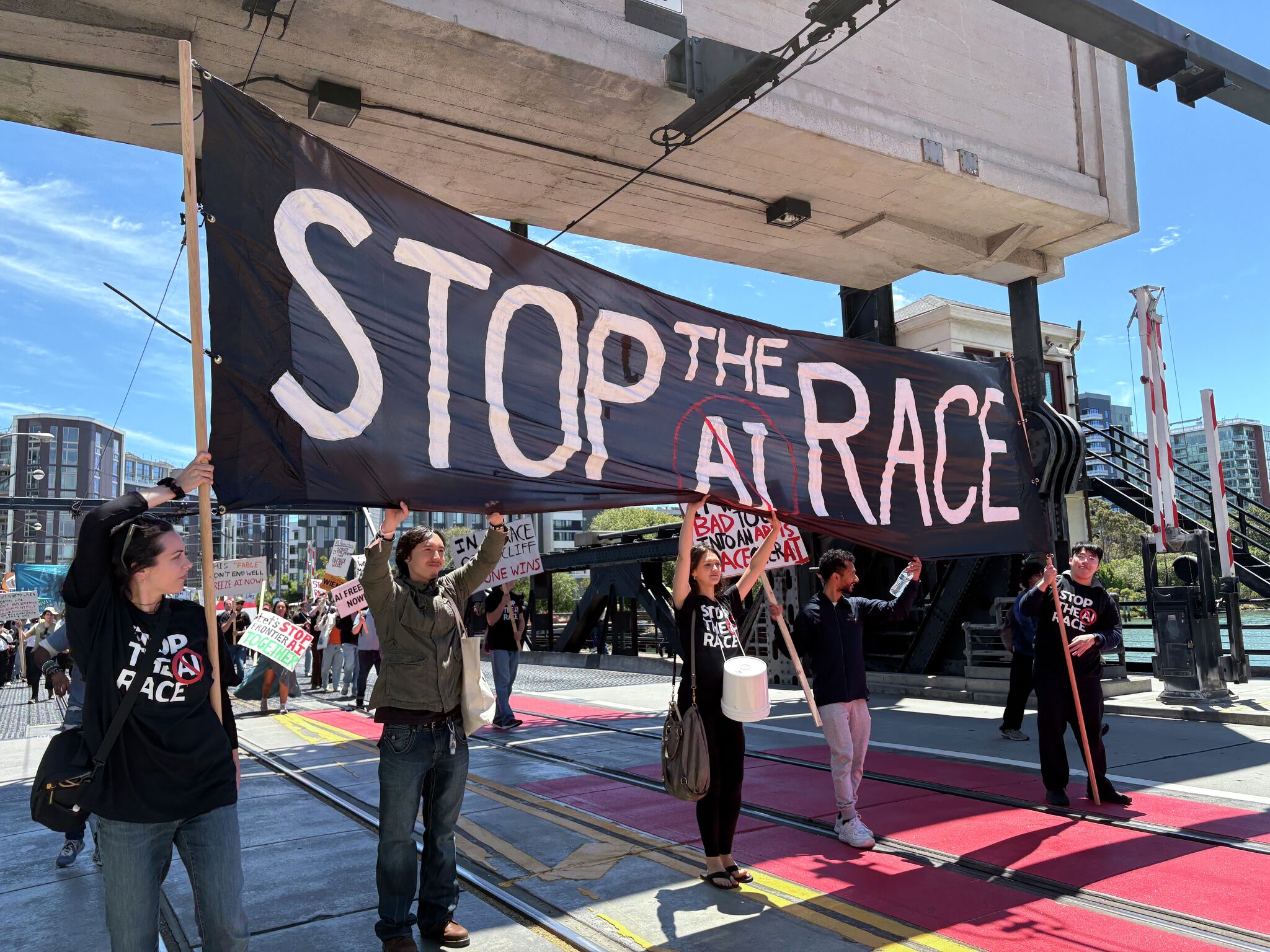
A crowd of protesters fiercely condemning artificial intelligence and the San Francisco companies that power the technology marched through the city -- the epicenter of AI development -- on Saturday to demand that the companies "stop the AI race." About 200 people carrying signs with messages like "stop slop," "it's not too late to regulate" and "in a race off a cliff no one wins," marched from offices of OpenAI to Anthropic and Google DeepMind to ask to their CEOs to collectively pause all new training of AI models. Protesters decried what they described as AI's role in rising rents, job losses and environmental damage, as well as existential threats to future generations. The rally was organized by Stop the AI Race, led by activist and former AI researcher Michaël Trazzi, who last year started a hunger strike outside Google DeepMind in London to draw attention to the demand to freeze AI development. (A parallel hunger strike took place outside Anthropic's office on Howard Street.) Protesters, who included students, people who work in AI and longtime San Franciscans, said they hoped their collective action would help increase public awareness and, in turn, ratchet up the pressure on AI companies to act. As they marched through downtown San Francisco, people in restaurants, on apartment balconies above the street or walking on the sidewalks stopped to take photos or videos. San Francisco Chronicle Logo See more S.F. Chronicle on Google Make us a Preferred Source to get more of our news when you search. Add Preferred Source "Protests can only do so much," said Aleesa Carbo, a Johns Hopkins University student and AI researcher. "But if we can make the public more aware, that can mobilize them to speak to their senators, speak to the government, to make their wishes known to the AI companies." Carbo is currently enrolled in MATS (Machine Learning Alignment & Theory Scholars), a prominent AI research fellowship whose graduates go on to found AI safety companies or work at companies such as Anthropic. She said she has pivoted her focus to AI safety. "I'm not against AI in principle, but I do think the way that companies are racing towards it is not in a very responsible manner," she said. "At the end of the day, these are dark boxes. Even us, the people who train these models, play with them, we don't fully understand them." Trazzi, who at one point led the crowd in chanting expletives against OpenAI CEO Sam Altman and Anthropic CEO Dario Amodei, said the stakes are high. "We are in an emergency," he told the crowd. "The problem is they can't stop the race, unless other people stop." His organization is advocating for a global agreement to pause AI development, including from China. This would, in practice, mean current models remain available, but with "no new training runs of larger or more general frontier models," the Stop the AI Race website reads. "The teams currently working on improving the capabilities of these models would move to narrow AI applications or alignment research instead." The companies have not responded directly to Stop the AI Race's demand -- though the group often points to a January interview in which a Bloomberg journalist asked DeepMind CEO Demis Hassabis if he would advocate for a collective pause on development, and he said, "I think so." He said he had long envisioned an AI version of CERN, the European Organization for Nuclear Research, "where all the best minds in the world would collaborate together and do the final steps in a very rigorous, scientific way." "Unfortunately," he said, "you need international collaboration, though, because even if one company ... or even the West decided to do that, it has no use unless the whole world agrees." Duncan Haldane, the CEO of a San Francisco startup that uses AI to design circuit boards, said he came to the protest -- with his two children, ages 1 and 5, in a stroller -- to pressure the heads of prominent AI labs to acknowledge the technology's risk and commit to the pause. Haldane's company has benefited from AI, but he said he sees the technology as an "existential threat to humanity." "What they can do now is actually phenomenally dangerous and is going to affect society tremendously," he said. Dean Preston, a former San Francisco supervisor, criticized the "devastating" effects AI companies have had on the city, including soaring rents and housing prices, job loss, environmental "havoc" and political influence. "These tech CEOs view San Francisco as a trophy," he said, "as something to be exploited." He pointed to examples of people pushing back against AI throughout California, from Pittsburg residents protesting in June the construction of a 300,000-square-foot data center from AI developer Avaio Digital (which moved forward despite the public backlash) while voters in Monterey Park in Southern California agreed to permanently ban data centers, becoming the first U.S. city to do so. Some protesters said that, short of a global development pause, they hoped to see more local and state regulation of the artificial intelligence industry. "I would like to see the mayor and our Board of Supervisors start to regulate AI in the city," said Kathe Burick, a resident of San Francisco for 50 years. "Shut them down if they need to, or demand a pause or they can't operate in town." She said the race toward AI without sufficient regulatory guardrails reminds her of the famous scene in the film "2001: A Space Odyssey," when astronaut Dave Bowman asks the HAL 9000 computer to open the pod bay doors after HAL discovers the crew's plan to disconnect him, and HAL responds, "I'm afraid I can't do that." In March, Burick went to a Stop the AI Race demonstration at OpenAI that she said drew only about 30 people. She was heartened by the larger turnout Saturday, especially seeing throngs of young people. "To see this gives me hope," she said.
SpaceX announces target date for 13th Starship launch
HARLINGEN, Texas (ValleyCentral) -- SpaceX has announced the target date for its thirteenth Starship test flight. The launch window is scheduled to open as early as 5:45 p.m. on Thursday, July 16, from Starbase. The thirteenth Starship test flight will be the second flight test of 2026. According to Starbase, the thirteenth Starship test flight aims to accomplish goals similar to those of the previous flight test, which included the debut of the third-generation Starship and Super Heavy vehicles. In addition to completing similar objectives, the flight will also carry the next-generation Starlink V3 satellites for the first time. SpaceX and local law enforcement have established a safety perimeter and coordinated temporary road closures along State Highway 4 and at Boca Chica Beach. SpaceX added that the target dates may change due to a variety of factors.
