News & Updates
The latest news and updates from companies in the WLTH portfolio.
Calls for change to bridge sign chaos in Cratloe
A lack of signage for a low railway bridge just outside of Cratloe is "causing chaos" for trucks and other road users. Cllrs Pat O'Gorman (FF) and John Crowe (FG) have called for improved signage for the Poulawilly Bridge on both the Sixmilebridge and Cratloe directions, as the "signage that is in place is not working". Both councillors brought motions about the railbridge, which only has a clearance height of 3.48 metres or 11ft 5in to the Shannon Municipal District meeting on Tuesday, March 24.

Microsoft lays claim to Crusoe's new 900 MW DC campus
Bitcoin farmer turned bit barn builder Crusoe revealed plans to add 900 megawatts of capacity to its Abilene Texas datacenter campus on Friday to support Microsoft's AI ambitions. The new campus will be located alongside the 1.2 gigawatt facility Crusoe is building for Oracle and OpenAI as part of its $500 billion Stargate initiative, announced early last year. Oracle and OpenAI had reportedly planned to lease the additional capacity until negotiations and financing fell through. Meta was expected to lay claim to the unbuilt and yet untapped datacenter expansion, but it seems Microsoft will now take up residence at the site instead. While Microsoft's relationship with OpenAI has certainly changed in recent years, its possible that Redmond could end up using the site to serve the model dev. The new campus will feature two new data halls along with an on-site power plant capable of delivering 900 MW of behind-the-meter energy to the facilities. The bit barns themselves will each support 336 megawatts of critical IT load. "By integrating 900 megawatts of new on-site power generation, we will continue building the industrial foundation for American AI - at a velocity the industry has never seen," Chase Lochmiller, Crusoe CEO said in a canned statement. According to Crusoe, this expansion will bring the site's capacity to 2.1 gigawatts, though "capacity" seems to be doing a lot of the heavy lifting here. Only about 200 megawatts of existing 1.2 gigawatt projects have actually been powered on. Crusoe says that the remaining gigawatt should come online throughout 2026. Work on the second campus, which Microsoft's AI models and services will call home, is currently in the "land-clearing and site preparation" phase. Crusoe doesn't anticipate the facilities will be operational until the middle of next year. Crusoe didn't elaborate on how its on-site power plants generate their power, but given the timeline, natural gas generators or fuel cells are the most likely candidates. We've reached out to Crusoe for comment; we'll let you know if we hear anything back. ®

Shipping chaos leaves cars stranded, disrupts Asia trade flows
SEOUL/YOKOHAMA: The war in the Middle East is disrupting Asia's used-car trade, leaving shipments stranded, delaying deliveries, and forcing exporters into costly workarounds. For Japan-based trader Umar Ali Hyder Ali, the impact was immediate. Days after the conflict began, a shipment of more than 500 vehicles that he had sent to Sri Lanka was stuck at sea due to congestion at the destination port, caused by diverted cargo from Dubai, preventing unloading. "The cars that we already shipped to Sri Lanka were kind of idling in the ocean, waiting to enter because there was no space," he said, adding the vehicles were eventually offloaded at Hambantota port more than 10 days late. The disruption highlights the broader fallout from the near-closure of the Strait of Hormuz, a key shipping route, which has thrown logistics into disarray for exporters in Japan and South Korea. The industry, largely made up of small businesses, relies heavily on stable maritime routes to ship vehicles to South Asia, the Middle East, and Africa. Port congestion has triggered uncertainty across the supply chain. Hyder Ali said some shipping companies cancelled bookings, while others suggested rerouting cargo to ports in Pakistan or China. One company demanded a US$5,000 deposit per car. Some shipments may even need to be returned to Japan. His company, Kobe Motor, exports about 18,000 vehicles annually, mainly to Sri Lanka. Currently, around 50 luxury vehicles, including Lamborghinis, Ferraris, and Rolls-Royces, are stranded in Sri Lanka and China after ships failed to reach Dubai, where buyers in the Middle East were waiting. Air freight remains an option for some customers, but high costs make it viable only for the wealthiest buyers. The scale of disruption is significant. Japan and South Korea exported a combined $19 billion worth of used cars last year, with Japan accounting for just over half. South Korea sent more than a third of its 883,000 exported vehicles to the Middle East, while the United Arab Emirates was Japan's largest single market, accounting for about 15 percent of exports. In South Korea, shipments have slowed sharply during what is typically the busiest period for used-car dealers. At Incheon port, where most vehicles are destined for the Middle East, more than 70 percent of cars are currently stuck in storage, according to shipping officials. "Whenever war breaks out, we have no choice but to go into a wait-and-hold mode," said Jin Jae-woong, president of used-car dealership Automobile International. Some vessels already at sea are pausing or diverting routes, while others are offloading cargo at alternative ports to avoid the Strait of Hormuz. Dealers say such decisions are largely controlled by shipping companies, leaving exporters scrambling to adjust. The uncertainty is also pushing up costs. Rising oil prices have increased freight rates, while delays have driven up storage costs. Jin said his company is paying about 40 million won per month to store unsold vehicles. Despite the disruption, some exporters are positioning for a rebound. Jin said he plans to pre-purchase cars at lower prices, betting demand will recover once the conflict eases. Still, alternatives are limited. "You can't just simply redirect shipments to Africa or Latin America," said Yun Seung-hyun, president at Ventus Auto. "There's effectively no solution right now," he said. With a large share of business tied to Middle Eastern markets, traders say prolonged disruption could have lasting impacts on the industry.

What's Starlink Standard 4 X? SpaceX Tips New Dish Names, Router Combos
Our team tests, rates, and reviews more than 1,500 products each year to help you make better buying decisions and get more from technology. SpaceX is changing the names of its standard Starlink dish and offering it via two bundles called Standard 4 and Standard 4 X. The new monikers appeared on Starlink.com and at third-party retailers yesterday. However, it's not a next-generation dish model. On a support page, SpaceX explains that it's trying to simplify the naming of its existing products. Using "4" appears to be a reference to V4, the model name for the current Starlink standard dish. Still, some confusion might ensue. Previously, the company offered new Starlink Residential customers a Starlink dish bundled with a Gen 3 router. Now it lists two configurations. Standard 4 is for customers who sign up for the cheapest Residential 100Mbps plan, which includes the standard Starlink dish and the smaller Router Mini with dual-band Wi-Fi 6. In contrast, Standard 4 X will be offered to customers who sign for the pricier Residential 200Mbps. The bundle includes the standard Starlink dish and the Gen 3 router, which supports tri-band Wi-Fi 6. (The company also seems to have renamed the Gen 3 router as Router 3.) Users who subscribe to the highest tier, Residential Max, will be offered the Standard 4 X package, too. But they'll also have the option to receive a Router Mini for free, giving them access to both routers. So far, SpaceX isn't selling the Standard 4 combo; it's only available as a rental to subscribers of the Residential 100Mbps plan. The Standard 4 X plan is also available as a free rental for the higher Residential service tiers. But in areas where Starlink faces congestion, new sign-ups need to pay $349 for Standard 4 X. The change is a little surprising, considering SpaceX launched the Router Mini last year, marketing it as an accessory to help existing subscribers build a mesh network in their homes and fill in Wi-Fi gaps. Now it looks like the company wants to use the Router Mini on the most affordable Residential plan, which caps download speeds at 100Mbps. Although the router offers less range, the dual-band Wi-Fi 6 capability should be more than adequate for Residential 100Mbps users and will likely help SpaceX save on costs. In addition, the Router Mini is more portable, fits in smaller spaces, and uses less power, making it a better fit for Residential 100Mbps users, given that SpaceX has been marketing the plan for "1-3 person households" with basic internet needs. One interesting wrinkle is how the two bundles seem to offer different power supplies. As you can see, the Standard 4 comes with a power supply with two PoE (Power of Ethernet) ports, letting you hook the Router Mini and dish to it. In contrast, the Standard 4 X offers a power supply designed to connect only to the Gen 3 Router via a barrel jack connector. The Gen 3 router can then be connected to the Starlink dish, all the while featuring two extra Ethernet LAN ports. The new power supply for Standard 4 is "both interesting and incredibly disappointing," according to Tim Belfall, a director at UK-based Starlink installer Westend WiFi. That's because he suspects the power supply only supports SpaceX's own proprietary Power over Ethernet (PoE) standard, since his own testing found the Router Mini doesn't "support active and passive PoE adapters" from other networking products. We'll have to wait and see if SpaceX releases more information about the mysterious new power supply. Still, it looks like both combinations support third-party Wi-Fi routers. SpaceX's setup guide notes that the Standard 4 packages let you use "3rd party hardware" to the Router Mini's extra Ethernet port.

Hegseth, Trump had no authority to order Anthropic to be blacklisted, judge says
"Classic First Amendment retaliation." That's how US District Judge Rita Lin described the Department of War's effort to blacklist Anthropic and designate it a supply-chain risk. By all appearances, "these measures appear designed to punish Anthropic," Lin wrote in an order granting Anthropic's request for a preliminary injunction. Officials seemingly had no authority to take such extreme actions without considering less restrictive alternatives or offering any evidence that Anthropic posed an urgent risk to national security, Lin said. Instead, "the Department of War's records show that it designated Anthropic as a supply chain risk because of its 'hostile manner through the press.'" "Punishing Anthropic for bringing public scrutiny to the government's contracting position is classic illegal First Amendment retaliation," Lin said. Anthropic's spokesperson told Ars the firm is "grateful to the court for moving swiftly, and pleased they agree Anthropic is likely to succeed on the merits." But Anthropic remains in a difficult position, still afraid that the fight will block it from competing for lucrative government contracts. In a blog earlier this month, Anthropic maintained that "Anthropic has much more in common with the Department of War than we have differences" and should be working together to deploy AI safely across government. Anthropic is still walking the same line in the aftermath of Lin's order. "While this case was necessary to protect Anthropic, our customers, and our partners, our focus remains on working productively with the government to ensure all Americans benefit from safe, reliable AI," Anthropic's spokesperson said. DoW official calls order a "disgrace" For Anthropic this fight could be existential. After the DoW's actions, three trade deals were promptly cancelled, while other potential partners delayed talks. The company showed it was already suffering irreparable harms that would only worsen the longer the blacklisting was upheld -- including losing potentially billions in private and government contracts the company expected to sign over the next five years, Lin noted. To prevent ongoing harms, Lin ordered a preliminary injunction blocking US agencies from complying with directives from Donald Trump and Secretary of War Pete Hegseth. However, she also granted the government's request for an administrative stay, which delays the injunction from taking effect for seven days. That gives the government a brief window to seek an emergency stay from an appeals court. Asked for comment, DoW pointed to statements on X from Under Secretary of War Emil Michael, who emphasized that the supply-chain risk designation still applies over the next week. Showing that Trump officials don't plan to back off the fight, Michael claimed that Lin's order was "a disgrace" and contained "factual errors" due to the judge's supposed rush to order the injunction. According to Michael, Lin did not fully consider how disrupting Hegseth's directive could "disrupt" how US military operations are conducted. However, Lin cited a brief filed in support of Anthropic from military leaders, who warned that letting the directive stand "will materially detract from military readiness and operational safety." Anthropic has argued that its technology is not ready to be used for mass surveillance of Americans or in fully autonomous lethal weapons, potentially posing civil rights risks if leveraged now. Lin noted that the case touched on "an important public debate," which is whether an AI company can dictate how the government uses its models. But it was not up to her to decide if AI firms or the government should be in charge of deciding what AI uses are safe for the public. Instead, she had to rule on whether government officials violated Anthropic's First Amendment rights, denied Anthropic due process, or acted arbitrarily or capriciously. And at this stage of the case, Anthropic has shown enough to prove it's likely to succeed on all claims, she said. DoW is not authorized to "designate a domestic vendor a supply chain risk simply because a vendor publicly criticized DoW's views about the safe uses of its system," Lin wrote. In fact, "that designation has never been applied to a domestic company and is directed principally at foreign intelligence agencies, terrorists, and other hostile actors," she said. "I don't know": Lawyer has no defense of Hegseth The DoW began using Anthropic's Claude in March 2025 and had been using it for the past year without ever raising any concerns that Anthropic's terms limiting certain uses posed a national security risk, Lin said. Rather, the government thoroughly vetted Claude before implementing it, praised Anthropic publicly, and planned to expand the partnership. The amicable nature of the partnership only changed, the judge said, after DoW sought to deploy Claude on a military platform and Anthropic ultimately agreed to do so with "two critical exceptions: mass surveillance of Americans and lethal autonomous warfare." Based on its testing, Anthropic could not guarantee that Americans' civil rights would not be infringed if Claude was used for these purposes, Anthropic said. If the government disliked the terms, Anthropic repeatedly said it would understand if another vendor was selected, simply bowing out to avoid compromising on AI safety principles that might "undercut Anthropic's core identity," Lin wrote. Calling out Anthropic for "utopian idealism," DoW officials blasted Anthropic for supposedly trying to get the government to let a private company decide how military operations go down. "You can't have an AI company sell AI to the Department of War and [then say] don't let it do Department of War things," Michael told the press. They accused Anthropic of trying to use the DoW dispute to spin up positive press, and Trump joined the chorus. On Truth Social, he labeled Anthropic a "radical left, woke company," allegedly putting their "selfishness" above national security. Following Trump's post, Hegseth took to X, writing that "Anthropic delivered a master class in arrogance and betrayal as well as a textbook case of how not to do business with the United States Government or the Pentagon." In both posts, officials claimed that orders to blacklist Anthropic were effective immediately, but neither cited what authority they had to do so. During oral arguments, a government lawyer later admitted that "he was not aware of any statute that gave Secretary Hegseth the authority to issue such a prohibition and agreed that the statement had 'absolutely no legal effect at all,'" Lin wrote. Further, "when asked why Hegseth made a public statement that had no legal effect and that did not reflect the immediate intent of DoW, counsel stated, 'I don't know.'" Perhaps most glaringly, Hegseth seemed to contradict himself when arguing that Anthropic at once "presented a grave threat to national security" requiring a supply-chain risk designation and also "Anthropic was essential to national security" and could be compelled to provide services under the Defense Production Act. The only reason that the government gave for labeling Anthropic a national security risk was that the company could supposedly update their products and compromise systems. They claimed that Anthropic would be motivated to sabotage the military as retaliation for the directives. But Lin didn't find that likely, either, since any other IT provider could potentially introduce the same risks. More importantly, Anthropic showed unrebutted evidence that it would be impossible to force updates or otherwise control the government's systems. To the judge, any national security risk could be foreclosed by simply ending the military's contract with Anthropic, which Anthropic had already agreed would be understandable. Lacking any statutory basis, it seemed clear from officials' statements that Anthropic was being punished for publicly criticizing the military's plans, the judge concluded. As Anthropic alleged, "defendants set out to publicly punish Anthropic for its 'ideology' and 'rhetoric,' as well as its 'arrogance' for being unwilling to compromise those beliefs," the judge said. "Secretary Hegseth expressly tied Anthropic's punishment to its attitude and rhetoric in the press." Anthropic retaliation "deeply troubling," judge says On top of rushing to shut down government contracts with Anthropic and influence its commercial deals with any business that also hoped to work with DoW, Hegseth also failed to give Anthropic an opportunity to defend itself from claims before taking action that the record shows wasn't urgent. Civil rights and public safety advocates had urged the court to block the government's actions or else risk a chilling effect preventing any AI firm from speaking up about unsafe government AI uses. Ultimately, Lin agreed that any time the government raised a red flag that a vendor was an "adversary," it was "deeply troubling." That could "chill open deliberation" and "professional debate" among those "best positioned to understand AI technology" and its potential for "catastrophic misuse," the judge wrote. As the government likely moves to try to block the preliminary injunction, their argument contends that Lin's order could force the government to pay for Anthropic products and never get that money back. They also claimed they were conducting an audit to see if any security risks currently exist that could justify the supply-chain risk designation. Lin doesn't see it that way, though. She wrote that "the preliminary injunctive relief that the Court authorizes does not require the government to continue to use Claude on its national security systems." She also noted that "the government 'cannot suffer harm from an injunction that merely ends an unlawful practice.'"

Why Last-Mile Agility Beats Speed-First Planning
Last-mile delivery is where static planning meets dynamic reality, and static planning is the wrong approach. Supply chain teams can forecast demand 6 months out with decent accuracy. They can model capacity constraints across distribution networks. They can optimize inventory positioning to within a percentage point of target service levels. But what they can't predict is when a driver will call in sick at 6 a.m., when a water main break will shut down three delivery routes at noon, or when a sudden order spike will exceed planned capacity by 40%. Last-mile delivery is where static planning meets dynamic reality, and static planning is the wrong approach. According to a recent Locus consumer survey, only 9% of consumers believe retailers consistently meet their fast delivery promises. Another 69% say those promises get kept "sometimes." The gap has less to do with capability, as most logistics operations can execute the plan they built. The gap is actually rooted in adaptability, or what happens when the plan meets real-world disruption. The supply chain profession spent decades getting better at forecasting when last-mile delivery requires a different skill: responding when conditions change faster than plans can keep up. The real disruptions supply chain teams face daily Last-mile disruptions cluster around three categories: capacity, communication, and coordination failures. Here's how: Driver no-shows create immediate route imbalance. A planned eight-hour route doesn't neatly split into two four-hour routes when a driver calls out, as delivery windows overlap, geographic clusters break apart, and vehicle capacity constraints shift. Mid-shift vehicle breakdowns have the same effect. Sudden order volume spikes that exceed planned capacity by 20-30% show how static plans can't absorb real-time variability. 2. Communication gaps The same Locus consumer survey found that 21% of shoppers cite missed delivery windows as their top frustration, 17% point to last-minute cancellations, and 11% flag inaccurate tracking. These issues point to customers learning about the problem after it has already happened. What customers call "delivery problems" are often visibility, not execution, failures. Ninety-three percent say proactive communication compensates for delays, and 96% say transparency builds trust. For supply chain teams, that means when a delivery runs into trouble, customers need to know before the window closes, not after. 3. Coordination failures across fulfillment channels Omnichannel fulfillment introduces a different type of disruption. When ship-from-store, BOPIS, and traditional DC fulfillment operate on separate systems, tactical decisions in one channel create downstream problems in another. Store teams prioritize in-store pickup to hit customer-facing service windows, which delays ship-from-store orders that share the same inventory pool and labor capacity. Peak season compounds the problem Nearly 51% of consumers in Locus's survey expect holiday shipping to match normal speeds. Peak season drastically increases volume while compressing reaction time. Supply chain teams can't plan their way out of December. They need to execute their way through it. Addressing these disruptions requires moving decision-making closer to execution. 3 operational principles for last-mile agility Agile last-mile operations share three characteristics that traditional planning systems don't support: Route optimization can't stop at morning dispatch. When a driver calls in sick or a rush order arrives at 2 p.m., the system needs to reroute automatically. That requires visibility across stores, distribution centers, and third-party carriers. Without it, tactical decisions in one part of the network cascade into failures elsewhere. 2. Constraint-aware planning from the start Build delivery plans that treat real-world variables as hard boundaries. Traffic patterns, delivery time windows, dock schedules, and vehicle capacity limits all need to shape the route before dispatch. They shouldn't get addressed as exceptions during execution. 3. Proactive exception management Automate customer alerts when delays become likely. When a delivery hits a problem, dispatch needs to know at the same moment customer-facing systems send the alert. This approach turns tracking into a tool that protects service levels instead of just reporting on failures. Delivery reattempt rates can be major profit killers. These principles improve first-attempt delivery success and lower customer service contact volume related to delivery issues, ultimately improving service levels and operational variability. What it takes to shift from static plans to adaptive execution Daily reviews need to focus on live execution issues, not just yesterday's metrics. Clear ownership for mid-route interventions matters -- who has the authority to reroute when a driver becomes unavailable? Who approves unplanned capacity additions? But not every disruption requires human decision-making. Increasingly, agentic systems can handle routine execution adjustments automatically, allowing dispatch teams to focus on edge cases that require human judgment. KPIs should measure response time to exceptions alongside end-of-day delivery rates. The implications extend beyond the last mile. As e-commerce grows, last-mile delivery accounts for a larger share of total logistics costs. Variability in last-mile execution creates ripple effects upstream, like returns processing backlogs, customer service demand spikes, and inventory availability issues. Supply chain leaders who treat last mile as a "just execute the plan" function miss where operational leverage actually lives. The plan is just the starting point. Last-mile delivery is where that principle matters most. What separates reliable delivery from broken promises is how quickly you respond when reality diverges from the forecast.

What's Starlink Standard 4 X? SpaceX Tips New Dish Names, Router Combos
Our team tests, rates, and reviews more than 1,500 products each year to help you make better buying decisions and get more from technology. SpaceX is changing the names of its standard Starlink dish and offering it via two bundles called Standard 4 and Standard 4 X. The new monikers appeared on Starlink.com and at third-party retailers yesterday. However, it's not a next-generation dish model. On a support page, SpaceX explains that it's trying to simplify the naming of its existing products. Using "4" appears to be a reference to V4, the model name for the current Starlink standard dish. Still, some confusion might ensue. Previously, the company offered new Starlink Residential customers a Starlink dish bundled with a Gen 3 router. Now it lists two configurations. Standard 4 is for customers who sign up for the cheapest Residential 100Mbps plan, which includes the standard Starlink dish and the smaller Router Mini with dual-band Wi-Fi 6. In contrast, Standard 4 X will be offered to customers who sign for the pricier Residential 200Mbps. The bundle includes the standard Starlink dish and the Gen 3 router, which supports tri-band Wi-Fi 6. (The company also seems to have renamed the Gen 3 router as Router 3.) Users who subscribe to the highest tier, Residential Max, will be offered the Standard 4 X package, too. But they'll also have the option to receive a Router Mini for free, giving them access to both routers. So far, SpaceX isn't selling the Standard 4 combo; it's only available as a rental to subscribers of the Residential 100Mbps plan. The Standard 4 X plan is also available as a free rental for the higher Residential service tiers. But in areas where Starlink faces congestion, new sign-ups need to pay $349 for Standard 4 X. The change is a little surprising, considering SpaceX launched the Router Mini last year, marketing it as an accessory to help existing subscribers build a mesh network in their homes and fill in Wi-Fi gaps. Now it looks like the company wants to use the Router Mini on the most affordable Residential plan, which caps download speeds at 100Mbps. Although the router offers less range, the dual-band Wi-Fi 6 capability should be more than adequate for Residential 100Mbps users and will likely help SpaceX save on costs. In addition, the Router Mini is more portable, fits in smaller spaces, and uses less power, making it a better fit for Residential 100Mbps users, given that SpaceX has been marketing the plan for "1-3 person households" with basic internet needs. One interesting wrinkle is how the two bundles seem to offer different power supplies. As you can see, the Standard 4 comes with a power supply with two PoE (Power of Ethernet) ports, letting you hook the Router Mini and dish to it. In contrast, the Standard 4 X offers a power supply designed to connect only to the Gen 3 Router via a barrel jack connector. The Gen 3 router can then be connected to the Starlink dish, all the while featuring two extra Ethernet LAN ports. The new power supply for Standard 4 is "both interesting and incredibly disappointing," according to Tim Belfall, a director at UK-based Starlink installer Westend WiFi. That's because he suspects the power supply only supports SpaceX's own proprietary Power over Ethernet (PoE) standard, since his own testing found the Router Mini doesn't "support active and passive PoE adapters" from other networking products. We'll have to wait and see if SpaceX releases more information about the mysterious new power supply. Still, it looks like both combinations support third-party Wi-Fi routers. SpaceX's setup guide notes that the Standard 4 packages let you use "3rd party hardware" to the Router Mini's extra Ethernet port.

What's Starlink Standard 4 X? SpaceX Tips New Dish Names, Router Combos
Our team tests, rates, and reviews more than 1,500 products each year to help you make better buying decisions and get more from technology. SpaceX is changing the names of its standard Starlink dish and offering it via two bundles called Standard 4 and Standard 4 X. The new monikers appeared on Starlink.com and at third-party retailers yesterday. However, it's not a next-generation dish model. On a support page, SpaceX explains that it's trying to simplify the naming of its existing products. Using "4" appears to be a reference to V4, the model name for the current Starlink standard dish. Still, some confusion might ensue. Previously, the company offered new Starlink Residential customers a Starlink dish bundled with a Gen 3 router. Now it lists two configurations. Standard 4 is for customers who sign up for the cheapest Residential 100Mbps plan, which includes the standard Starlink dish and the smaller Router Mini with dual-band Wi-Fi 6. In contrast, Standard 4 X will be offered to customers who sign for the pricier Residential 200Mbps. The bundle includes the standard Starlink dish and the Gen 3 router, which supports tri-band Wi-Fi 6. (The company also seems to have renamed the Gen 3 router as Router 3.) Users who subscribe to the highest tier, Residential Max, will be offered the Standard 4 X package, too. But they'll also have the option to receive a Router Mini for free, giving them access to both routers. So far, SpaceX isn't selling the Standard 4 combo; it's only available as a rental to subscribers of the Residential 100Mbps plan. The Standard 4 X plan is also available as a free rental for the higher Residential service tiers. But in areas where Starlink faces congestion, new sign-ups need to pay $349 for Standard 4 X. The change is a little surprising, considering SpaceX launched the Router Mini last year, marketing it as an accessory to help existing subscribers build a mesh network in their homes and fill in Wi-Fi gaps. Now it looks like the company wants to use the Router Mini on the most affordable Residential plan, which caps download speeds at 100Mbps. Although the router offers less range, the dual-band Wi-Fi 6 capability should be more than adequate for Residential 100Mbps users and will likely help SpaceX save on costs. In addition, the Router Mini is more portable, fits in smaller spaces, and uses less power, making it a better fit for Residential 100Mbps users, given that SpaceX has been marketing the plan for "1-3 person households" with basic internet needs. One interesting wrinkle is how the two bundles seem to offer different power supplies. As you can see, the Standard 4 comes with a power supply with two PoE (Power of Ethernet) ports, letting you hook the Router Mini and dish to it. In contrast, the Standard 4 X offers a power supply designed to connect only to the Gen 3 Router via a barrel jack connector. The Gen 3 router can then be connected to the Starlink dish, all the while featuring two extra Ethernet LAN ports. The new power supply for Standard 4 is "both interesting and incredibly disappointing," according to Tim Belfall, a director at UK-based Starlink installer Westend WiFi. That's because he suspects the power supply only supports SpaceX's own proprietary Power over Ethernet (PoE) standard, since his own testing found the Router Mini doesn't "support active and passive PoE adapters" from other networking products. We'll have to wait and see if SpaceX releases more information about the mysterious new power supply. Still, it looks like both combinations support third-party Wi-Fi routers. SpaceX's setup guide notes that the Standard 4 packages let you use "3rd party hardware" to the Router Mini's extra Ethernet port.

Discord Down for Thousands of Users, Downdetector Shows
Discord experienced a possible outage Friday, with thousands of users reporting issues, according to Downdetector.com. More than 2,000 users had reported problems with the platform as of 12:43 p.m. PT, according to Downdetector, which tracks outages by collecting status reports from multiple sources. Most users reporting issues say they're experiencing problems with the mobile application. -- Connect with Anthony W. Haddad on social media. Got a tip? Send an email.

Chaos in the Skies: TSA Pay Crisis Disrupts U.S. Airports | Politics
The U.S. Homeland Security Department is taking emergency measures to pay 50,000 TSA officers who have been unpaid since mid-February. Absenteeism has caused chaotic airport delays akin to the worst in TSA's history. Political and funding stalemates continue to exacerbate the crisis. The U.S. Homeland Security Department announced emergency measures on Friday to compensate 50,000 Transportation Security Administration officers who have not been paid since mid-February. The move comes amid widespread work absences leading to chaos and lengthy security lines at U.S. airports, creating a major disruption for travelers. President Donald Trump, on Thursday, vowed to take executive action to resolve the pay issue, authorizing payments by Friday. Absentee levels hit nearly 12% on Thursday, marking the most significant shortage since mid-February, according to TSA statistics. Reportedly, airport security lines stretched for several hours at major airports, with over 3,450 officers absent on Thursday alone. Many airports, including New York's JFK and facilities in Baltimore, Houston, and Atlanta, were severely impacted. The TSA warned of potentially more severe disruptions over the weekend if payment issues remain unresolved.

Shipping chaos leaves cars stranded, disrupts Asia trade flows
SEOUL/YOKOHAMA: The war in the Middle East is disrupting Asia's used-car trade, leaving shipments stranded, delaying deliveries, and forcing exporters into costly workarounds. For Japan-based trader Umar Ali Hyder Ali, the impact was immediate. Days after the conflict began, a shipment of more than 500 vehicles that he had sent to Sri Lanka was stuck at sea due to congestion at the destination port, caused by diverted cargo from Dubai, preventing unloading. "The cars that we already shipped to Sri Lanka were kind of idling in the ocean, waiting to enter because there was no space," he said, adding the vehicles were eventually offloaded at Hambantota port more than 10 days late. The disruption highlights the broader fallout from the near-closure of the Strait of Hormuz, a key shipping route, which has thrown logistics into disarray for exporters in Japan and South Korea. The industry, largely made up of small businesses, relies heavily on stable maritime routes to ship vehicles to South Asia, the Middle East, and Africa. Port congestion has triggered uncertainty across the supply chain. Hyder Ali said some shipping companies cancelled bookings, while others suggested rerouting cargo to ports in Pakistan or China. One company demanded a US$5,000 deposit per car. Some shipments may even need to be returned to Japan. His company, Kobe Motor, exports about 18,000 vehicles annually, mainly to Sri Lanka. Currently, around 50 luxury vehicles, including Lamborghinis, Ferraris, and Rolls-Royces, are stranded in Sri Lanka and China after ships failed to reach Dubai, where buyers in the Middle East were waiting. Air freight remains an option for some customers, but high costs make it viable only for the wealthiest buyers. The scale of disruption is significant. Japan and South Korea exported a combined $19 billion worth of used cars last year, with Japan accounting for just over half. South Korea sent more than a third of its 883,000 exported vehicles to the Middle East, while the United Arab Emirates was Japan's largest single market, accounting for about 15 percent of exports. In South Korea, shipments have slowed sharply during what is typically the busiest period for used-car dealers. At Incheon port, where most vehicles are destined for the Middle East, more than 70 percent of cars are currently stuck in storage, according to shipping officials. "Whenever war breaks out, we have no choice but to go into a wait-and-hold mode," said Jin Jae-woong, president of used-car dealership Automobile International. Some vessels already at sea are pausing or diverting routes, while others are offloading cargo at alternative ports to avoid the Strait of Hormuz. Dealers say such decisions are largely controlled by shipping companies, leaving exporters scrambling to adjust. The uncertainty is also pushing up costs. Rising oil prices have increased freight rates, while delays have driven up storage costs. Jin said his company is paying about 40 million won per month to store unsold vehicles. Despite the disruption, some exporters are positioning for a rebound. Jin said he plans to pre-purchase cars at lower prices, betting demand will recover once the conflict eases. Still, alternatives are limited. "You can't just simply redirect shipments to Africa or Latin America," said Yun Seung-hyun, president at Ventus Auto. "There's effectively no solution right now," he said. With a large share of business tied to Middle Eastern markets, traders say prolonged disruption could have lasting impacts on the industry.
House Republicans reject Senate bid to end US airport chaos
US House Republicans on Friday effectively shot down an effort by the Senate to end a budget standoff that has forced thousands of airport security staff to work without pay, likely extending the partial government shutdown. A lapse in federal funding has left Transportation Security Administration (TSA) staff -- who screen passengers, baggage and cargo -- working without pay since mid-February.
What's Starlink Standard 4 X? SpaceX Tips New Dish Names, Router Combos
SpaceX is changing the names around its standard Starlink dish and offering it via two bundles called Standard 4 and Standard 4 X. The new monikers appeared on Starlink.com and at third-party retailers yesterday. However, it's not a next-generation dish model. On a support page, SpaceX explains that it's trying to simplify the naming of its existing products. Using "4" appears to be a reference to V4, the model name for the current Starlink standard dish. Still, some confusion might ensue. Previously, the company offered new Starlink Residential customers a Starlink dish bundled with a Gen 3 router. Now it lists two configurations. Standard 4 is for customers who sign up for the cheapest Residential 100Mbps plan, which includes the standard Starlink dish and the smaller Router Mini with dual-band Wi-Fi 6. In contrast, Standard 4 X will be offered to customers who sign for the pricier Residential 200Mbps. The bundle includes the standard Starlink dish and the Gen 3 router, which supports tri-band Wi-Fi 6. (The company also seems to have renamed the Gen 3 router as Router 3.) Users who subscribe to the highest tier, Residential Max, will be offered the Standard 4 X package, too. But they'll also have the option to receive a Router Mini for free, giving them access to both routers. So far, SpaceX isn't selling the Standard 4 combo; it's only available as a rental to subscribers of the Residential 100Mbps plan. The Standard 4 X plan is also available as a free rental for the higher Residential service tiers. But in areas where Starlink faces congestion, new sign-ups need to pay $349 for Standard 4 X. The change is a little surprising, considering SpaceX launched the Router Mini last year, marketing it as an accessory to help existing subscribers build a mesh network in their homes and fill in Wi-Fi gaps. Now it looks like the company wants to use the Router Mini on the most affordable Residential plan, which caps download speeds at 100Mbps. Although the router offers less range, the dual-band Wi-Fi 6 capability should be more than adequate for Residential 100Mbps users and will likely help SpaceX save on costs. In addition, the Router Mini is more portable, fits in smaller spaces, and uses less power, making it a better fit for Residential 100Mbps users, given that SpaceX has been marketing the plan for "1-3 person households" with basic internet needs. One interesting wrinkle is how the two bundles seem to offer different power supplies. As you can see, the Standard 4 comes with a power supply with two PoE (Power of Ethernet) ports, letting you hook the Router Mini and dish to it. In contrast, the Standard 4 X offers a power supply designed to connect only to the Gen 3 Router via a barrel jack connector. The Gen 3 router can then be connected to the Starlink dish, all the while featuring two extra Ethernet LAN ports. The new power supply for Standard 4 is "both interesting and incredibly disappointing," according to Tim Belfall, a director at UK-based Starlink installer Westend WiFi. That's because he suspects the power supply only supports SpaceX's own proprietary Power over Ethernet (PoE) standard, since his own testing found the Router Mini doesn't "support active and passive PoE adapters" from other networking products. We'll have to wait and see if SpaceX releases more information about the mysterious new power supply. Still, it looks like both combinations support third-party Wi-Fi routers. SpaceX's setup guide notes that the Standard 4 packages let you use "3rd party hardware" to the Router Mini's extra Ethernet port.

House Republicans reject Senate bid to end US airport chaos
Unfortunately you've used all of your gifts this month. Your counter will reset on the first day of next month. US House Republicans on Friday effectively shot down an effort by the Senate to end a budget standoff that has forced thousands of airport security staff to work without pay, likely extending the partial government shutdown. A lapse in federal funding has left Transportation Security Administration (TSA) staff -- who screen passengers, baggage and cargo -- working without pay since mid-February.
House Republicans reject Senate bid to end US airport chaos
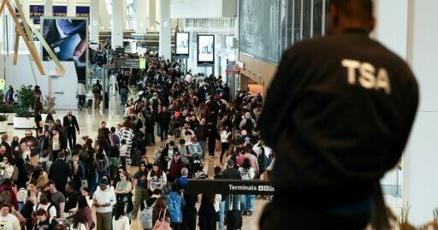
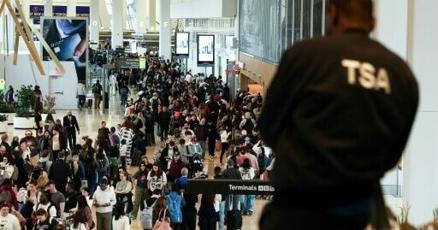
US House Republicans on Friday effectively shot down an effort by the Senate to end a budget standoff that has forced thousands of airport security staff to work without pay, likely extending the partial government shutdown. A lapse in federal funding has left Transportation Security Administration (TSA) staff -- who screen passengers, baggage and cargo -- working without pay since mid-February. The stalemate has led to long delays at several airports, where authorities have warned travelers to arrive hours earlier than usual because of long security lines. The funding dispute centered on demands by opposition Democrats for reforms of the Immigration and Customs Enforcement (ICE) authority, which has faced nationwide criticism of its aggressive tactics against immigrants and for the killings of two US citizens this year. Senators voted before dawn Friday to fund all of the Department of Homeland Security (DHS), the TSA's parent agency, except ICE and the Border Patrol, for 2026. The bill would provide funding for TSA, the US Coast Guard and the Federal Emergency Management Agency, among other operations. The compromise measure would have to now pass the House of Representatives, but many Republicans in the chamber warned Friday that it lacked sufficient support. "We're not accepting the garbage from the Senate," House Republican Chip Roy said on X, adding: "We'll send something back to stand with @CBP & @ICEgov," referring to US Customs and Border Patrol. The House's Republican leaders have indicated they instead will introduce a bill to extend funding for all of DHS for 60 days while a solution is worked out, but it appears unlikely that Democrats will accept such a proposal. Republicans hold a majority in both chambers of Congress, but due to Senate rules, a certain number of Democratic votes would be required to pass budget bills. And even if a new bill did clear the House, the Senate has adjourned for two full weeks, potentially meaning more dragged-out pain for air travelers and TSA workers. The political fight has deeply strained TSA services. More than 300 TSA staff have quit and unscheduled absences have surged since the partial shutdown began, leading to extended flight delays and airports struggling to screen travelers. The federal government began deploying ICE agents to assist in providing airport security, drawing sharp criticism from Democrats, rights activists and some Republicans, who warn ICE personnel are not trained for such work and that it risks escalating tensions in already stressed environments. President Donald Trump, who promised on Thursday to pay TSA personnel, previously said he would not sign a funding deal unless Congress also passes a contentious bill to overhaul how citizens register to vote in US elections.
House Republicans reject Senate bid to end US airport chaos
US House Republicans on Friday effectively shot down an effort by the Senate to end a budget standoff that has forced thousands of airport security staff to work without pay, likely extending the partial government shutdown. A lapse in federal funding has left Transportation Security Administration (TSA) staff -- who screen passengers, baggage and cargo -- working without pay since mid-February.

House Republicans reject Senate bid to end US airport chaos
US House Republicans on Friday effectively shot down an effort by the Senate to end a budget standoff that has forced thousands of airport security staff to work without pay, likely extending the partial government shutdown. A lapse in federal funding has left Transportation Security Administration (TSA) staff -- who screen passengers, baggage and cargo -- working without pay since mid-February.
House Republicans reject Senate bid to end US airport chaos
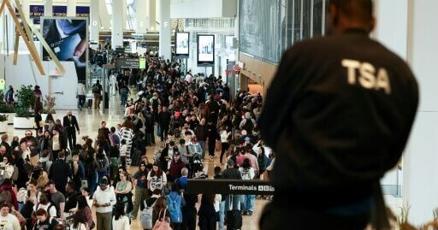
US House Republicans on Friday effectively shot down an effort by the Senate to end a budget standoff that has forced thousands of airport security staff to work without pay, likely extending the partial government shutdown. A lapse in federal funding has left Transportation Security Administration (TSA) staff -- who screen passengers, baggage and cargo -- working without pay since mid-February. The stalemate has led to long delays at several airports, where authorities have warned travelers to arrive hours earlier than usual because of long security lines. The funding dispute centered on demands by opposition Democrats for reforms of the Immigration and Customs Enforcement (ICE) authority, which has faced nationwide criticism of its aggressive tactics against immigrants and for the killings of two US citizens this year. Senators voted before dawn Friday to fund all of the Department of Homeland Security (DHS), the TSA's parent agency, except ICE and the Border Patrol, for 2026. The bill would provide funding for TSA, the US Coast Guard and the Federal Emergency Management Agency, among other operations. The compromise measure would have to now pass the House of Representatives, but many Republicans in the chamber warned Friday that it lacked sufficient support. "We're not accepting the garbage from the Senate," House Republican Chip Roy said on X, adding: "We'll send something back to stand with @CBP & @ICEgov," referring to US Customs and Border Patrol. The House's Republican leaders have indicated they instead will introduce a bill to extend funding for all of DHS for 60 days while a solution is worked out, but it appears unlikely that Democrats will accept such a proposal. Republicans hold a majority in both chambers of Congress, but due to Senate rules, a certain number of Democratic votes would be required to pass budget bills. And even if a new bill did clear the House, the Senate has adjourned for two full weeks, potentially meaning more dragged-out pain for air travelers and TSA workers. The political fight has deeply strained TSA services. More than 300 TSA staff have quit and unscheduled absences have surged since the partial shutdown began, leading to extended flight delays and airports struggling to screen travelers. The federal government began deploying ICE agents to assist in providing airport security, drawing sharp criticism from Democrats, rights activists and some Republicans, who warn ICE personnel are not trained for such work and that it risks escalating tensions in already stressed environments. President Donald Trump, who promised on Thursday to pay TSA personnel, previously said he would not sign a funding deal unless Congress also passes a contentious bill to overhaul how citizens register to vote in US elections.
House Republicans reject Senate bid to end US airport chaos
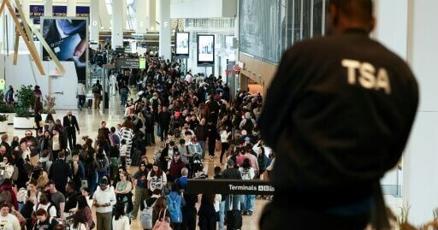
US House Republicans on Friday effectively shot down an effort by the Senate to end a budget standoff that has forced thousands of airport security staff to work without pay, likely extending the partial government shutdown. A lapse in federal funding has left Transportation Security Administration (TSA) staff -- who screen passengers, baggage and cargo -- working without pay since mid-February. The stalemate has led to long delays at several airports, where authorities have warned travelers to arrive hours earlier than usual because of long security lines. The funding dispute centered on demands by opposition Democrats for reforms of the Immigration and Customs Enforcement (ICE) authority, which has faced nationwide criticism of its aggressive tactics against immigrants and for the killings of two US citizens this year. Senators voted before dawn Friday to fund all of the Department of Homeland Security (DHS), the TSA's parent agency, except ICE and the Border Patrol, for 2026. The bill would provide funding for TSA, the US Coast Guard and the Federal Emergency Management Agency, among other operations. The compromise measure would have to now pass the House of Representatives, but many Republicans in the chamber warned Friday that it lacked sufficient support. "We're not accepting the garbage from the Senate," House Republican Chip Roy said on X, adding: "We'll send something back to stand with @CBP & @ICEgov," referring to US Customs and Border Patrol. The House's Republican leaders have indicated they instead will introduce a bill to extend funding for all of DHS for 60 days while a solution is worked out, but it appears unlikely that Democrats will accept such a proposal. Republicans hold a majority in both chambers of Congress, but due to Senate rules, a certain number of Democratic votes would be required to pass budget bills. And even if a new bill did clear the House, the Senate has adjourned for two full weeks, potentially meaning more dragged-out pain for air travelers and TSA workers. The political fight has deeply strained TSA services. More than 300 TSA staff have quit and unscheduled absences have surged since the partial shutdown began, leading to extended flight delays and airports struggling to screen travelers. The federal government began deploying ICE agents to assist in providing airport security, drawing sharp criticism from Democrats, rights activists and some Republicans, who warn ICE personnel are not trained for such work and that it risks escalating tensions in already stressed environments. President Donald Trump, who promised on Thursday to pay TSA personnel, previously said he would not sign a funding deal unless Congress also passes a contentious bill to overhaul how citizens register to vote in US elections.
House Republicans reject Senate bid to end US airport chaos
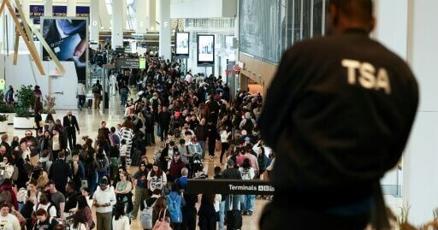
US House Republicans on Friday effectively shot down an effort by the Senate to end a budget standoff that has forced thousands of airport security staff to work without pay, likely extending the partial government shutdown. A lapse in federal funding has left Transportation Security Administration (TSA) staff -- who screen passengers, baggage and cargo -- working without pay since mid-February.
