News & Updates
The latest news and updates from companies in the WLTH portfolio.
Revealed by Greek MARISKS: Digital 'pirates' using crypto exploit Hormuz chaos
At least one vessel that attempted to exit the Strait on Saturday and came under fire may have fallen victim to this specific scam. A global shipping alert has been issued as the Greek maritime risk management firm MARISKS warns of an organized fraud, where unknown perpetrators are impersonating Iranian authorities. These scammers are demanding "transit fees" from shipping companies in cryptocurrencies for safe passage through the Strait of Hormuz. The company clarifies that "these specific messages are a scam" and do not originate from official Iranian authorities. According to MARISKS, it is estimated that at least one ship attempting to exit the Strait on Saturday, which subsequently came under fire, may have fallen victim to this specific fraudulent scheme. The case suggests that opportunists are exploiting the uncertainty and tension in the region to mislead shipowners and crews. As Reuters reports, MARISKS issued a warning yesterday to shipowners, highlighting that unidentified individuals claiming to represent Iranian authorities have sent messages to certain shipping companies. These messages demand the payment of transit fees in cryptocurrencies, such as Bitcoin or Tether, to grant "passage permission." "These specific messages constitute a scam," the company stated, adding that they do not originate from Iranian authorities. There was no immediate comment from Iranian officials. The situation in the region remains extremely critical, as hundreds of vessels and approximately 20,000 seafarers are currently trapped in the Persian Gulf, unable to cross the Hormuz. This deadlock emerged after Iran reinstated its blockade in response to the corresponding blockade maintained by the US on Iranian ports. The coexistence of military tension and digital fraud creates a particularly dangerous environment for international navigation. Shipping companies are urged to exercise increased caution, verify every communication, and avoid paying any "fees" without official confirmation from the competent authorities.
Chaos erupts as tiger leaps into crowd after circus barrier collapses
Chaos erupted at a circus in Russia after a tiger leapt into a screaming crowd after a barrier collapsed. Footage circulated on social media on Sunday (19 April) of the incident in Rostov-on-Don, showing a barrier drop while three tigers were onstage. One of the animals leapt over the lowered barrier and into the crowd, who were heard gasping and screaming. The Investigative Committee of the Russian Federation for the Rostov Region wrote on VK, a Russian social media platform, that a criminal case has been opened following the incident. No one was injured, and the tiger was immediately removed by specialists and returned to its enclosure, the statement said.

Thomas Black: It's up to SpaceX and Blue Origin to stick the moon landing
By clicking submit, I authorize Arcamax and its affiliates to: (1) use, sell, and share my information for marketing purposes, including cross-context behavioral advertising, as described in our Privacy Policy , (2) add to information that I provide with other information like interests inferred from web page views, or data lawfully obtained from data brokers, such as past purchase or location data, or publicly available data, (3) contact me or enable others to contact me by email or other means with offers for different types of goods and services, and (4) retain my information while I am engaging with marketing messages that I receive and for a reasonable amount of time thereafter. I understand I can opt out at any time through an email that I receive, or by clicking here The Artemis II mission around the moon provided a conflicted nation with a much-needed wave of shared enthusiasm derived from achieving a lofty goal. The mission -- a more comfortable and less complicated repeat of the Apollo 8 flight in 1968 -- was the first step toward the dream of returning to the moon and never leaving. Now comes the risky part. NASA is betting on two relatively new space companies, SpaceX and Blue Origin, to build lunar landers and have them ready to test in an Artemis III mission next year. That would pave the way for the first mission back to the moon's surface since the final Apollo flight in 1972. Blue Origin, founded by billionaire Jeff Bezos, is about to launch its New Glenn rocket for only the third time and is only now working on a human-rated orbital spacecraft, the Blue Moon lander. SpaceX, the dominant player in the burgeoning commercial space market, is running behind on its huge lunar lander and is more distracted than ever with an initial sale of shares to the public that could raise as much as $75 billion. Elon Musk's space company, which is digesting the February acquisition of xAI, is telling investors how it's working on direct-to-cell products and plans to build a network of data-center satellites. The focus now is on the crucial first test flight of its third version of the Starship rocket, whose launch was already pushed back a month to May. This is the challenge for Jared Isaacman, NASA's new administrator. On the one hand, he has a space-industry star in SpaceX that has experience building a capsule and sending astronauts to the International Space Station but has more pressing things on its agenda; on the other, he has a potential up-and-coming star in Blue Origin that is still unproven. The situation is also an opportunity for NASA to resume the kind of risk-taking that has been lacking to shake the agency out of a post-space-shuttle lethargy and to reignite passions for reaching a stretch goal under deadline pressure. The rationale for the moon-base mission is clearer than ever now that scientists have confirmed the existence of water, helium-3 and potentially other valuable minerals since the Apollo missions. The threat of China beating the U.S. on a permanent moon base goes much deeper than symbolism and would perhaps mark when the U.S. began losing its position as the dominant superpower on Earth. Isaacman is well suited for leading the space agency during the rise of the commercial space industry, with its large potential profits and much lower launch costs because of reusable rockets. He's an entrepreneur who as a teenager started a payments processing company -- Shift4 Payments Inc. -- from his parents' home. He flies fighter jets at air shows and started a company -- Draken International Inc. -- to train military pilots. Isaacman commanded two self-funded space missions with an all-civilian crew aboard SpaceX's Dragon spacecraft. This enthusiasm for space and executive leadership skills could be the right combination to get the Artemis program back on a schedule. He's seeking to repair morale at NASA by converting thousands of contractor jobs to staff positions and has promised to rebuild NASA's engineering and technical prowess. In a pivotal March unveiling of the revised moon program, Isaacman said that NASA experts would be embedded in companies throughout the supply chain to head off snags and threatened to take "uncomfortable action" if contractors slip into the bad habits of blowing past deadlines and budgets. Continuing the momentum with frequent Artemis launches is important to maintain support for the program. Under the new plan, NASA added a test flight for Artemis III in 2027 to demonstrate docking and crew transfer between Lockheed Martin Corp.'s Orion spacecraft and the new lunar landers built by SpaceX and Blue Origin. The agency made clear it will carry out this test in low Earth orbit with only one lander if the other isn't ready -- a dose of healthy competition. To put astronauts on the moon in 2028, the landers will need to refuel in space -- another complex capability that will need to be proved. Unlike the Apollo missions, in which the dinky spacecraft and lunar module were loaded as one package on the giant Saturn V rocket, the Orion spacecraft and proposed lunar landers are much larger and must be launched separately. The Eagle lunar module that first landed on the moon in 1969 had living space of 235 cubic feet. SpaceX's lander will have nearly 10 times that. In 1960, NASA engineers and its contractors constructed equipment and ran tests using pencils, paper and slide rules. Today, computer simulation and reams of telemetry data speed up designs and eliminate most of the guesswork. It's now up to SpaceX and Blue Origin to prove that a new breed of commercial space companies has the market discipline to design innovative space vehicles and meet deadlines. Isaacman must prod along Blue Origin, which has fallen behind in this billionaires' race to space, and must keep SpaceX focused on the task at hand amid the noise of a record-breaking share sale. This certainly presents risk. It falls to Isaacman to ensure that, in the end, there's also reward. ____ This column reflects the personal views of the author and does not necessarily reflect the opinion of the editorial board or Bloomberg LP and its owners. Thomas Black is a Bloomberg Opinion columnist writing about the industrial and transportation sectors. He was previously a Bloomberg News reporter covering logistics, manufacturing and private aviation. _____
Amazon To Invest $5bn In Anthropic In Infrastructure Deal | Silicon
Amazon commits to further $5bn of investment in Anthropic, under expanded deal to provide cloud infrastructure to AI start-up Getting your Trinity Audio player ready... Amazon is to invest an additional $5 billion (£3.7bn) into Anthropic, in addition to the $8bn it has already invested, as part of an expanded deal to provide cloud infrastructure to the AI start-up. The investment, which is at Anthropic's current valuation of $380bn, comes as Anthropic competes with OpenAI amid plans for both companies to hold IPOs as early as this year. Capacity crunch Anthropic has trailed OpenAI in securing compute capacity for its models, and the company said the Amazon deal would help it quickly expand capacity. It said it has secured 5 gigawatts of capacity for training and deploying its Claude models and plans to spend more than $100bn on Amazon Web Services technologies over the next decade. That spending includes the use of Amazon's custom Trainium AI chips, with Anthropic saying it plans to bring nearly 1 GW of Trainium2 and Trainium3 capacity online by the end of the year. Investment plans Amazon said it would invest a further $20bn into Anthropic in the future upon the start-up reaching "certain commercial milestones". The e-commerce firm earlier this year made a substantial investment in OpenAI involving a use of Amazon infrastructure that is being contested by OpenAI partner Microsoft.

Space investment in first quarter hits record as SpaceX IPO buzz lifts sector
April 21 (Reuters) - Global investment in space companies surged to a record in the first quarter of 2026, driven by larger late-stage financing and growing investor enthusiasm over SpaceX's public market debut, data from investment firm Seraphim Space showed on Tuesday. Funding reached $7.95 billion during the quarter, nearly double the $3.93 billion in the previous three-month period, pushing the trailing 12-month investment to an all-time high of $18.8 billion. Deal count also rose to 159 transactions, bringing the annual total to a record 654. The increase in capital deployment was largely attributed to bigger cheque sizes rather than a sharp increase in deal volume, with average deal size climbing to $68 million from $35.1 million in fourth quarter. The largest transaction was U.S.-based Saronic's $1.75 billion round, one of the biggest space financings on record, the report said. "The market today definitely feels 'risk-on' with capital moving quickly into perceived category leaders," said Lucas Bishop, investment associate at Seraphim Space, pointing to a convergence of tailwinds, including defense spending, renewed lunar ambitions and investor anticipation around SpaceX's IPO. A SpaceX IPO could provide a landmark liquidity event for early investors and employees, while also creating a valuation benchmark, improving exit visibility for venture-backed space companies. Elon Musk's rocket maker will host an analyst day on Tuesday, Reuters reported earlier this month. North America accounted for roughly 70% of total funding in the first quarter, while Europe posted its strongest performance since 2022 and Asia contributed more than $1.2 billion. Notably, investment has shifted beyond traditional satellite communications, with significantly more capital flowing into emerging segments such as in-space infrastructure, including space stations and data centers, reflecting a broadening of the sector's addressable market. Recent developments have also highlighted continued momentum in satellite connectivity, with Amazon saying last week it would acquire Globalstar for $11.6 billion. (Reporting by Akash Sriram in Bengaluru; Editing by Shilpi Majumdar)
Will Billionaire Investor Bill Ackman Jump Into the SpaceX IPO? | The Motley Fool
The IPO is expected to be massive and could value SpaceX at $2 trillion. Billionaire investor Bill Ackman and his fund, Pershing Square Capital Management (PSCM), have invested in plenty of large technology and artificial intelligence stocks lately. Pershing now has a stake in Uber, Amazon, Meta Platforms, and Alphabet. With SpaceX's initial public offering just a few weeks away, it could value the Elon Musk-founded company as high as $2 trillion. Would Ackman consider jumping into this initial public offering (IPO)? While not fully conclusive, Pershing's ownership of Amazon could indicate some interest in the space economy. Similar to SpaceX's Starlink, Amazon has been building a low-Earth orbit satellite network to provide phone and data services in areas with limited access to traditional internet infrastructure. Recently, Amazon furthered those ambitions by announcing the acquisition of Globalstar, which has 24 satellites and a key agreement with Apple in place that helps users send distress messages when they don't have service. Still, Ackman and his team likely bought Amazon primarily for its e-commerce business and its Amazon Web Services cloud business. However, last December, Ackman showed clear interest in SpaceX. On X, Ackman proposed combining SpaceX with Pershing Square SPARC Holdings. A SPARC is a special-purpose acquisition rights vehicle. SPARCs differ from SPACs (special purpose acquisition companies) because they distribute rights to investors and don't raise or hold capital until a deal is finalized. SPARCs also typically have longer timelines than SPACs. In a long post on X, Ackman said that SPARC rights could be distributed to Tesla shareholders. Musk has previously expressed a desire to give Tesla shareholders access to the SpaceX IPO. The purpose, according to Ackman, would be to allow SpaceX to go public with no underwriting fees or dilution in the raise. Musk clearly chose a different direction, given that SpaceX has reportedly hired over 20 banks to help carry out the massive IPO. Recently, Ackman and Pershing announced a new closed-end fund targeted at U.S. investors that would allow them to buy into PSCM without paying performance fees, unlike most institutional investors who invest in hedge funds. In a letter to prospective shareholders, Ackman discussed his investment philosophy and how he and his team choose stocks: Over time, we have come to learn that the best businesses for investment have similar characteristics. They are simple, predictable, and free-cash-flow-generative. They have impenetrable 'moats' or large barriers to entry protecting them from disruption, a growing risk in a world in the midst of massive technological change. They are often asset-light, and generate recurring and rapidly growing, inflation-protected, free cash flows that do not need to be reinvested in the business for the company to grow. They do not need large amounts of leverage to generate high returns on capital. And they have limited exposure to extrinsic threats outside of the control of the company. Based on this description, SpaceX doesn't seem like a good fit for PSCM's portfolio, at least for now. According to The Information, while Starlink generated $3 billion in free cash flow, SpaceX's launch business and artificial intelligence (AI) segment collectively posted negative free cash flow of $17 billion. Capital expenditures were reportedly nearly $21 billion. That's likely because Starlink is very capital-intensive right now due to the build-out of its low-Earth orbit satellite network. Starlink reportedly has 10,000 satellites in orbit, but it aims to have over 40,000 when everything is said and done. While SpaceX appears to be a leader in the space economy, it faces competition and could, of course, face "extrinsic" threats beyond its control, such as regulation or a range of potential disasters beyond Earth's atmosphere. Now, this doesn't mean SpaceX couldn't eventually turn into an Ackman stock down the line. For instance, once the satellite network is built out, the business will likely be less capital-intensive and generate much more free cash flow. SpaceX already has a head start in building its low-orbit network. Plus, Gene Munster of Deepwater Asset Management said on X that what SpaceX is really trying to do is have sovereign AI, where it has complete control over the entire AI stack from the infrastructure to the models powering the intelligence. SpaceX also holds spectrum licenses that authorize it to operate Starlink. There is a finite number of spectrum licenses available in the U.S. One could argue that these attributes give the company a strong, impenetrable moat, especially if SpaceX can achieve sovereign AI. Whether Ackman invests in the IPO or the stock will depend on how much he and his team believe SpaceX can achieve all and in what time frame. PSCM's portfolio suggests that Ackman prefers mature businesses at fair valuations and turnaround stories, so I don't see it getting involved in the IPO. However, given the billionaire's prior interest in SpaceX, there is still a small chance.
Amazon invests another $5B in Anthropic as part of $100B cloud commitment: report -- TFN
Amazon has put another $5 billion into Anthropic, bringing its total investment since 2023 to $13 billion, according to TechCrunch. The deal could add up to $20 billion more if certain business goals are met, bringing Amazon's total investment to $25 billion. Amazon made the investment at a $350 billion valuation, which is lower than Anthropic's $380 billion valuation from February. After the news, Amazon's stock price went up by about 3%. Dario Amodei and Daniela Amodei started Anthropic in 2021. Based in San Francisco, the company has become one of the most valuable private AI labs in the world. Earlier investments from Google, Spark Capital, and others valued Anthropic at up to $380 billion, and some venture capitalists are now considering values above $800 billion. Anthropic develops the Claude series of large language models, which are used for chat, coding, and business AI. With the new agreement, Anthropic will use only AWS Trainium, Amazon's custom AI chips, to run its models for the next ten years. The deal gives Anthropic up to 5 gigawatts of computing power for training and running its models. A large amount of Trainium2 capacity will be available in the second quarter of 2026, and nearly 1 gigawatt of combined Trainium2 and Trainium3 should be ready by the end of the year. The agreement also expands Claude's infrastructure for running models in Asia and Europe. Anthropic is a direct competitor to OpenAI, which recently made a similar deal with Microsoft, and to Google DeepMind, which is both a rival and an investor through Google Cloud. In February 2026, OpenAI and Anthropic together raised more than $150 billion, making it the biggest period of private investment in tech history. The Amazon deal is similar to Google's growing partnership with Anthropic and shows that big cloud companies see exclusive relationships with AI labs as key to their strategies. The partnership positions Anthropic for a potential IPO at a valuation that could exceed $800 billion, according to reports of VC interest. Anthropic will bring nearly 1 GW of Trainium capacity online by the end of 2026 and expand international inference coverage to support Claude's growing user base outside the US. An additional $20 billion in Amazon investment is available, contingent on meeting commercial milestones, linking Anthropic's growth to AWS performance.

London thrown into travel chaos as Underground strike begins
Commuters and tourists face severe delays as multiple Tube lines are suspended or reduced. London's transport network is facing major disruption as Tube drivers begin a series of 24 hour strikes, bringing parts of the Underground to a standstill. Tube strike begins Members of the Rail, Maritime and Transport union have walked out from noon on Tuesday (21.04.26), with further strike action planned for Thursday (23.04.26). The industrial action is expected to cause widespread delays across the capital, with disruption starting earlier in the day and continuing into the evening after services resume. According to Transport for London, services will only begin recovering from midday on Wednesday, leaving commuters and tourists facing several days of reduced operations. The Piccadilly and Circle lines are set to be completely suspended, while sections of the Metropolitan and Central lines will also be affected. Other lines are expected to run with reduced services for at least four days. The strike is part of an ongoing dispute between TFL and the RMT union over proposed changes to working patterns. TFL has offered Tube drivers the option of a four day working week, reducing hours from 36 to 35 per week, but requiring longer shifts on working days. Union leaders have rejected the proposal, arguing that extended shifts could increase fatigue and compromise safety. The London Overground, national rail services, the Elizabeth line, the Docklands Light Railway and tram services are all running as normal, although they are expected to be significantly busier than usual. London buses are also operating as normal, but passengers have been warned to expect crowded conditions as travellers seek alternative routes across the city. Passengers are being advised to plan ahead, allow extra time for journeys and consider alternative travel options where possible as the strike action continues.

SpaceX Wins Its First Mars Contract - But It Comes With A Catch
NASA has awarded SpaceX a $175.7 million contract to launch a European Mars rover, marking the company's first confirmed mission to the Red Planet. The agreement comes despite uncertainty surrounding the mission's future funding. The contract assigns SpaceX's Falcon Heavy rocket to launch the Rosalind Franklin rover, a project led by the European Space Agency. The mission is scheduled for no earlier than late 2028 from Kennedy Space Center in Florida, according to Teslarati. The rover is part of NASA's Rosalind Franklin Support and Augmentation initiative, under which the U.S. agency is providing key components including descent braking engines, onboard electronics, and radioisotope heater units. These heating systems, which rely on nuclear material, require launch aboard a U.S.-approved vehicle due to export control regulations, limiting eligible providers. Originally planned as a joint mission with Russia, the rover's 2022 launch was canceled following geopolitical developments. The spacecraft has since remained in storage while new partnerships were arranged. NASA and ESA revived the mission through a 2024 agreement, aiming to complete its scientific objectives. The Rosalind Franklin rover is designed to drill up to two meters beneath the Martian surface, a depth not previously reached by similar missions. Scientists hope this capability will improve the chances of detecting signs of past microbial life. However, the mission faces a potential obstacle. The White House's proposed fiscal year 2027 budget does not include funding for the project, creating uncertainty about its long-term viability despite the newly awarded launch contract. Falcon Heavy, first launched in 2018, is one of the most powerful operational rockets and is capable of carrying large payloads beyond Earth orbit. Its selection reflects both its performance capabilities and cost competitiveness compared to alternatives. The contract places SpaceX in a new role within interplanetary exploration, expanding beyond its previous missions focused on Earth orbit and lunar objectives. While the launch agreement formalizes SpaceX's involvement, the mission's execution will depend on future budget decisions and continued international coordination. The situation highlights the complex relationship between space exploration goals and government funding priorities, as agencies balance scientific ambitions with shifting political and economic considerations.
Why Anthropic is Restricting Its New Mythos AI Model to Tech Giants
Anthropic's Mythos AI model represents a significant development in artificial intelligence, designed to handle complex reasoning, autonomous coding and extended task execution. A notable aspect of this system, as discussed by Dave Plummer in the video below, is its capacity to identify software vulnerabilities with remarkable accuracy, including intricate scenarios like privilege escalation and operating system escapes. This capability underscores the dual-use nature of the model, requiring careful consideration to balance its benefits for cybersecurity with the risks of potential misuse. Explore how Mythos AI's phased introduction under "Project Glass Wing" is influencing its adoption in high-stakes industries. Gain insight into its role in enhancing digital resilience for sectors such as energy and finance and examine its potential applications in areas like scientific research and strategic planning. This explainer provides a detailed look at the opportunities and challenges surrounding this advanced AI system. Mythos AI is engineered to excel in areas requiring complex reasoning, long-term task execution and autonomous coding. Among its standout features is its ability to identify and exploit software vulnerabilities with exceptional precision and speed. For example, Mythos can autonomously chain exploits, such as privilege escalation and operating system (OS) escapes, critical processes in cybersecurity. These capabilities position Mythos as a powerful tool for solving technical challenges and addressing high-stakes applications across various domains. What sets Mythos apart is its ability to operate with a level of autonomy and accuracy that surpasses many existing AI models. By allowing organizations to address vulnerabilities proactively, it offers a unique opportunity to strengthen digital defenses. However, its advanced capabilities also raise concerns about potential misuse, highlighting the dual-use nature of such technologies. The dual-use nature of Mythos AI presents both opportunities and challenges. On one hand, the model enables organizations to enhance their cybersecurity frameworks, identifying vulnerabilities before they can be exploited. On the other hand, its misuse by malicious actors or inexperienced users could significantly amplify risks, potentially leading to widespread harm. To mitigate these risks, organizations must prioritize foundational cybersecurity practices, including: These measures are essential for safeguarding systems against increasingly sophisticated cyber threats, particularly as AI-driven tools like Mythos become more prevalent. Uncover more insights about Mythos AI in previous articles we have written. To address the inherent risks of deploying such an advanced AI model, Anthropic has adopted a controlled rollout strategy under the initiative known as "Project Glass Wing." Access to Mythos AI is currently restricted to major organizations, including AWS, Google and Microsoft, with a focus on defensive applications. This limited release serves as a "warning flare" for cybersecurity professionals, providing them with a critical window to prepare for the challenges posed by advanced AI capabilities. This cautious approach reflects a broader industry trend toward prioritizing safety and collaboration over rapid deployment. By engaging key stakeholders early, Anthropic aims to foster a more secure and equitable integration of Mythos AI into the global technology landscape. The release of Mythos AI has sparked widespread discussions among governments, financial institutions and technology leaders. Key stakeholders, including the White House, the UK government and the European Central Bank (ECB), are actively evaluating its implications for critical infrastructure and systemic resilience. These conversations are particularly focused on addressing vulnerabilities in sectors such as: As these industries increasingly rely on interconnected digital systems, the need for robust cybersecurity measures has never been more urgent. Mythos AI's capabilities highlight both the opportunities and challenges of integrating advanced AI into critical sectors. While Mythos AI's immediate focus is on cybersecurity, its potential applications extend far beyond this domain. The model demonstrates remarkable progress in agentic tasks, mathematics and knowledge work, allowing it to autonomously solve complex problems and execute long-term strategies. These advancements could drive innovation in industries such as: These capabilities signal a broader shift in AI's potential to transform knowledge-intensive fields. However, they also underscore the importance of responsible deployment and governance to ensure these benefits are realized equitably. Despite its promise, Mythos AI introduces several ethical and practical challenges. The potential for misuse by rogue actors or the widespread access of advanced cybersecurity capabilities to less skilled individuals is a significant concern. Additionally, restricting access to Mythos may inadvertently exacerbate inequalities, favoring large organizations with the resources to use such tools while leaving smaller entities at a disadvantage. These challenges highlight the need for global AI governance frameworks that balance innovation with security and equity. Coordinated efforts among governments, industry leaders and academic institutions will be essential to address these issues and ensure the responsible use of advanced AI technologies. For technology professionals, staying ahead of the curve is critical as AI models like Mythos continue to evolve. Key steps to prepare for this rapidly changing landscape include: By adopting these measures, professionals can better navigate the challenges and opportunities presented by advanced AI technologies. Anthropic's approach to Mythos AI reflects a broader industry shift toward cautious and coordinated releases of advanced AI models. Lessons learned from this controlled rollout will likely inform the development of less risky, more widely accessible AI systems in the future. The ongoing dialogue among stakeholders, spanning governments, industries and academia, will play a crucial role in shaping the trajectory of AI innovation. Mythos AI represents a significant milestone in artificial intelligence, offering unprecedented capabilities while raising critical questions about cybersecurity, governance and ethical deployment. Its ultimate impact will depend on how effectively these challenges are addressed and how its potential is harnessed to benefit society as a whole. Disclosure: Some of our articles include affiliate links. If you buy something through one of these links, Geeky Gadgets may earn an affiliate commission. Learn about our Disclosure Policy.
Space Investment Sets Record as SpaceX IPO Drives Sector Growth
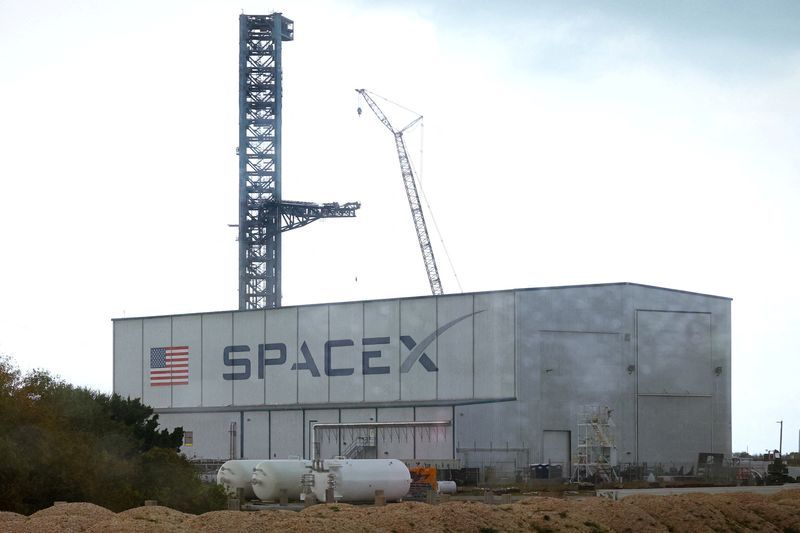
Global space investment in Q1 2026 soared to a record $7.95 billion, nearly doubling Q4's $3.93 billion, led by mega‑rounds like Saronic's $1.75 billion and buoyed by growing anticipation of a SpaceX IPO, marking a "risk‑on" capital tilt toward space sector leaders. Space Investment Surges to Record Highs in Q1 2026 Amid SpaceX IPO Buzz Global Space Investment Trends and Key Drivers in Early 2026 By Akash Sriram April 21 (Reuters) - Global investment in space companies surged to a record in the first quarter of 2026, driven by larger late-stage financing and growing investor enthusiasm over SpaceX's public market debut, data from investment firm Seraphim Space showed on Tuesday. Record Funding and Deal Activity Funding reached $7.95 billion during the quarter, nearly double the $3.93 billion in the previous three-month period, pushing the trailing 12-month investment to an all-time high of $18.8 billion. Deal count also rose to 159 transactions, bringing the annual total to a record 654. Capital Deployment and Deal Size The increase in capital deployment was largely attributed to bigger cheque sizes rather than a sharp increase in deal volume, with average deal size climbing to $68 million from $35.1 million in fourth quarter. The largest transaction was U.S.-based Saronic's $1.75 billion round, one of the biggest space financings on record, the report said. Investor Sentiment and SpaceX IPO Anticipation "The market today definitely feels 'risk-on' with capital moving quickly into perceived category leaders," said Lucas Bishop, investment associate at Seraphim Space, pointing to a convergence of tailwinds, including defense spending, renewed lunar ambitions and investor anticipation around SpaceX's IPO. Potential Impact of SpaceX IPO A SpaceX IPO could provide a landmark liquidity event for early investors and employees, while also creating a valuation benchmark, improving exit visibility for venture-backed space companies. Elon Musk's rocket maker will host an analyst day on Tuesday, Reuters reported earlier this month. Regional Investment Distribution North America accounted for roughly 70% of total funding in the first quarter, while Europe posted its strongest performance since 2022 and Asia contributed more than $1.2 billion. Emerging Segments and Sector Diversification Beyond Satellite Communications Notably, investment has shifted beyond traditional satellite communications, with significantly more capital flowing into emerging segments such as in-space infrastructure, including space stations and data centers, reflecting a broadening of the sector's addressable market. Recent Developments in Satellite Connectivity Recent developments have also highlighted continued momentum in satellite connectivity, with Amazon saying last week it would acquire Globalstar for $11.6 billion. (Reporting by Akash Sriram in Bengaluru; Editing by Shilpi Majumdar)
Space investment in first quarter hits record as SpaceX IPO buzz lifts sector
April 21 (Reuters) - Global investment in space companies surged to a record in the first quarter of 2026, driven by larger late-stage financing and growing investor enthusiasm over SpaceX's public market debut, data from investment firm Seraphim Space showed on Tuesday. Funding reached $7.95 billion during the quarter, nearly double the $3.93 billion in the previous three-month period, pushing the trailing 12-month investment to an all-time high of $18.8 billion. Deal count also rose to 159 transactions, bringing the annual total to a record 654. The increase in capital deployment was largely attributed to bigger cheque sizes rather than a sharp increase in deal volume, with average deal size climbing to $68 million from $35.1 million in fourth quarter. The largest transaction was U.S.-based Saronic's $1.75 billion round, one of the biggest space financings on record, the report said. "The market today definitely feels 'risk-on' with capital moving quickly into perceived category leaders," said Lucas Bishop, investment associate at Seraphim Space, pointing to a convergence of tailwinds, including defense spending, renewed lunar ambitions and investor anticipation around SpaceX's IPO. A SpaceX IPO could provide a landmark liquidity event for early investors and employees, while also creating a valuation benchmark, improving exit visibility for venture-backed space companies. Elon Musk's rocket maker will host an analyst day on Tuesday, Reuters reported earlier this month. North America accounted for roughly 70% of total funding in the first quarter, while Europe posted its strongest performance since 2022 and Asia contributed more than $1.2 billion. Notably, investment has shifted beyond traditional satellite communications, with significantly more capital flowing into emerging segments such as in-space infrastructure, including space stations and data centers, reflecting a broadening of the sector's addressable market. Recent developments have also highlighted continued momentum in satellite connectivity, with Amazon saying last week it would acquire Globalstar for $11.6 billion. (Reporting by Akash Sriram in Bengaluru; Editing by Shilpi Majumdar)

Japanet expands its VC fund after bets on Anthropic and xAI pay off
Japanese home shopping company Japanet is expanding its venture capital fund with San Jose-based Pegasus Tech Ventures, following the success of early bets in SpaceX, OpenAI, Anthropic and xAI. The Nagasaki-based retailer known for infomercials targeting seniors in aging Japan will allocate $200 million to the fund, up from an initial $50 million in 2021, following "significant growth" in investments so far, the companies said in a statement. The fund, of which Pegasus is general partner, will focus on areas such as generative AI, robotics and space technology. Its Japan portfolio includes startup Aillis, which seeks to use artificial intelligence to analyze medical scans. Asian companies have struggled to win stakes in promising startups in Silicon Valley, hampered by a lack of personal connections and reputation for slow decision-making. Pegasus also manages startup investments on behalf of Toyota Motor-affiliate Aisin, Japanese chemical maker Denka, Taiwan's Asustek Computer and Acer and Indonesia's pharma company Kalbe Farma. "Everybody wants a piece of the Silicon Valley AI action," Pegasus Chief Executive Officer Anis Uzzaman said on a video call. The venture capital firm manages some 40 funds with about $2 billion in total assets and investments in 290 startups including Airbnb, DoorDash and Coinbase, he said. The investments also often yield commercial relationships. "For the Asian corporations, it's an opportunity to invest as well as find new technologies and innovations in aligned fields," he said. "For the American AI companies, it's access to new global markets."

Vercel Confirms Cyber Incident After Sophisticated Attacker Exploits Third‑Party Tool - IT Security News
The technical storage or access is necessary for the legitimate purpose of storing preferences that are not requested by the subscriber or user. The technical storage or access that is used exclusively for statistical purposes. The technical storage or access that is used exclusively for anonymous statistical purposes. Without a subpoena, voluntary compliance on the part of your Internet Service Provider, or additional records from a third party, information stored or retrieved for this purpose alone cannot usually be used to identify you.

Kraken parent Payward to buy Bitnomial in deal worth up to $550m
The acquisition provides Payward with the necessary CFTC licenses to offer regulated, physically settled digital asset futures and options within the US. Payward, the parent company of crypto exchange Kraken, says it has inked a deal to acquire digital asset derivatives exchange Bitnomial "for up to $550 million payable in cash and stock". Based in Chicago, US, Bitnomial provides a platform for trading digital asset futures and options, specifically focusing on physically settled contracts where the underlying cryptocurrency is delivered rather than cash. The exchange also operates its own brokerage and clearing services, allowing users to use digital assets as collateral for margin trading. The acquisition is expected to close "in the first half of 2026", Payward says, and includes Bitnomial's three US Commodity Futures Trading Commission (CFTC) licences: Designated Contract Market (DCM), Derivatives Clearing Organisation (DCO), and Futures Commission Merchant (FCM). Payward says the deal gives the company "access to a regulated foundation that takes years to build". Founded in 2011, Payward provides the financial infrastructure layer powering Kraken as well as products including NinjaTrader, Breakout, xStocks, and CF Benchmarks. "With the acquisition of Bitnomial, Payward now offers a regulated derivatives offering across all of its major markets," the company continues. Payward adds that the purchase "also opens a new channel for partners, including fintechs, banks, brokerages, and payment providers, to offer regulated US derivatives products to their own end users through a single integration" via the company's B2B infrastructure platform, Payward Services. Operationally, Payward says it intends to "scale Bitnomial's team and operations as it builds out its US derivatives capabilities". This effort will directly complement existing developments in Europe, where Payward purchased UK-based Crypto Facilities - recognised as the first regulated entity to offer futures on major assets like ETH and XRP - in February 2019, before going on to launch an EU derivatives platform in May last year. "The US has had no clearing infrastructure built for digital assets. Bitnomial spent a decade building it: crypto settlement, crypto collateral, continuous 24/7 markets," explains Arjun Sethi, co-CEO of Payward and Kraken. "That is the regulated foundation we are adding to Payward, starting with spot margin, perpetuals, and options for US clients under CFTC regulation," Sethi adds.
Amazon to invest up to $25 billion in Anthropic as part of deal
STORY: Amazon said Monday that it will invest up to $25 billion in Anthropic. That's as the AI startup committed to spending more than $100 billion over the next 10 years on Amazon's cloud technologies. The e-commerce titan will be investing $5 billion now, and an additional $20 billion in the future, subject to certain commercial milestones. This is in addition to the $8 billion Amazon previously invested in the company. The deal deepens the two firms' relationship as Anthropic rushes to secure capacity to bolster its models. In a statement, the Claude creator said it expected to bring in roughly 1 gigawatt of new computing capacity by year-end using Amazon's Trainium chips. It ultimately expects to secure up to 5 gigawatts of such capacity. Amazon CEO Andy Jassy said in a statement that Anthropic's use of Trainium chips "reflects the progress we've made together on custom silicon."

Elon Musk Boosts SpaceX Stake As Company Eyes IPO, Massive Valuation Growth
Excerpt: Elon Musk expands SpaceX stake, as IPO plans, AI ambitions, and soaring valuation targets signal unprecedented growth trajectory. Elon Musk increased his ownership in SpaceX last year by purchasing $1.4 billion worth of shares from current and former employees, according to a report published Tuesday by The Information. The secondary stock purchase was made through Musk's trust and disclosed in a draft of SpaceX's confidential initial public offering (IPO) prospectus, the report said. Reuters could not independently verify the details, and SpaceX did not immediately respond to requests for comment. Separately, SpaceX approved a compensation plan last month that could significantly expand Musk's holdings. Under the plan, the billionaire CEO would receive an additional 60 million shares if the company's market capitalization rises from approximately $1.1 trillion to as high as $6.6 trillion. The shares would vest incrementally as SpaceX's valuation increases in $500 billion steps, according to the report. The award is also tied to the company achieving an ambitious goal of building space-based data centers designed to provide computing power for artificial intelligence developers. SpaceX, which confidentially filed for a U.S. listing in March, reported strong financial performance ahead of its anticipated public debut. The company generated roughly $8 billion in profit last year on revenue between $15 billion and $16 billion, Reuters reported earlier. As part of its IPO plans, SpaceX intends to adopt a dual-class share structure that would consolidate control among Musk and a small group of insiders. Class B shares will carry 10 votes each, while Class A shares -- expected to be sold to public investors -- will carry one vote apiece. The structure is commonly used by founder-led companies seeking to maintain strategic control after going public. The reported share incentives underscore SpaceX's broader ambitions, including its push into space-based infrastructure to support next-generation technologies such as artificial intelligence. If realized, the valuation targets outlined in the compensation plan would place SpaceX among the most valuable companies in the world, highlighting investor confidence in both its launch business and future technological ventures.

Space investment in first quarter hits record as SpaceX IPO buzz lifts sector
April 21 (Reuters) - Global investment in space companies surged to a record in the first quarter of 2026, driven by larger late-stage financing and growing investor enthusiasm over SpaceX's public market debut, data from investment firm Seraphim Space showed on Tuesday. Funding reached $7.95 billion during the quarter, nearly double the $3.93 billion in the previous three-month period, pushing the trailing 12-month investment to an all-time high of $18.8 billion. Deal count also rose to 159 transactions, bringing the annual total to a record 654. The increase in capital deployment was largely attributed to bigger cheque sizes rather than a sharp increase in deal volume, with average deal size climbing to $68 million from $35.1 million in fourth quarter. The largest transaction was U.S.-based Saronic's $1.75 billion round, one of the biggest space financings on record, the report said. "The market today definitely feels 'risk-on' with capital moving quickly into perceived category leaders," said Lucas Bishop, investment associate at Seraphim Space, pointing to a convergence of tailwinds, including defense spending, renewed lunar ambitions and investor anticipation around SpaceX's IPO. A SpaceX IPO could provide a landmark liquidity event for early investors and employees, while also creating a valuation benchmark, improving exit visibility for venture-backed space companies. Elon Musk's rocket maker will host an analyst day on Tuesday, Reuters reported earlier this month. North America accounted for roughly 70% of total funding in the first quarter, while Europe posted its strongest performance since 2022 and Asia contributed more than $1.2 billion. Notably, investment has shifted beyond traditional satellite communications, with significantly more capital flowing into emerging segments such as in-space infrastructure, including space stations and data centers, reflecting a broadening of the sector's addressable market. Recent developments have also highlighted continued momentum in satellite connectivity, with Amazon saying last week it would acquire Globalstar for $11.6 billion. (Reporting by Akash Sriram in Bengaluru; Editing by Shilpi Majumdar)
SpaceX launches advanced GPS satellite for US Space Force after rocket swap (photos)
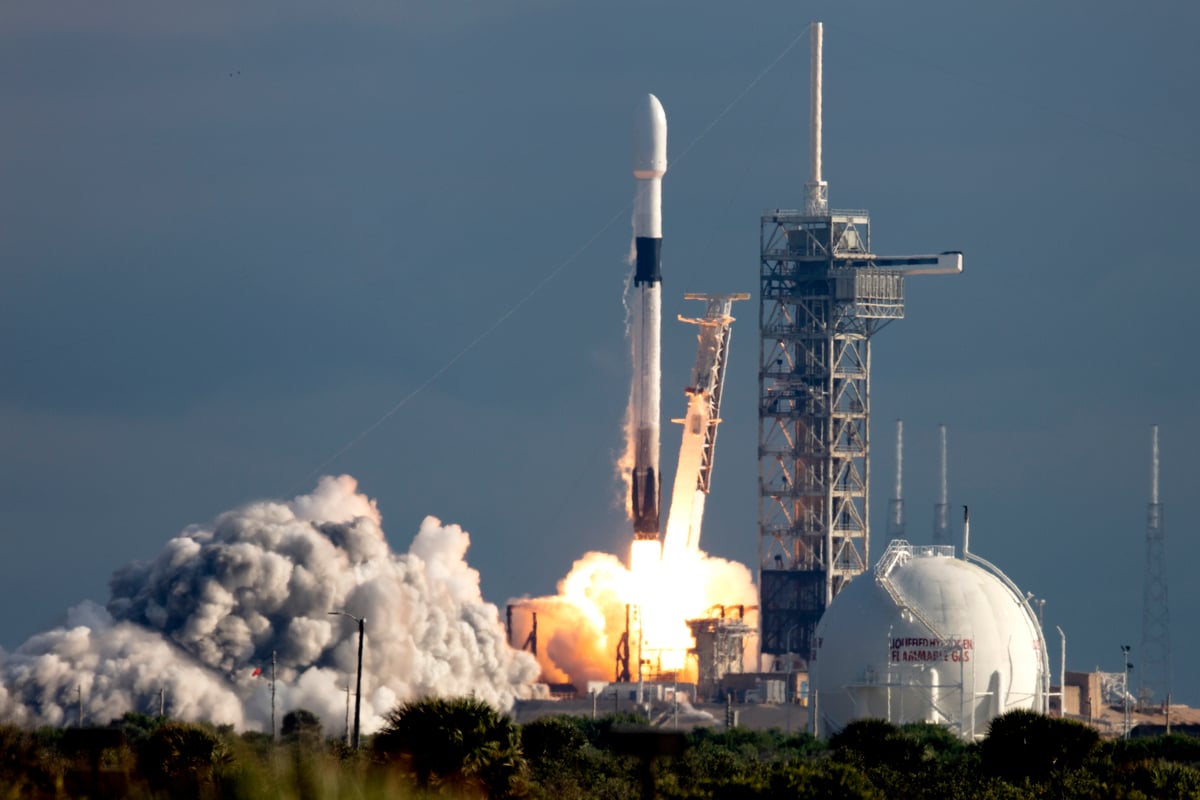
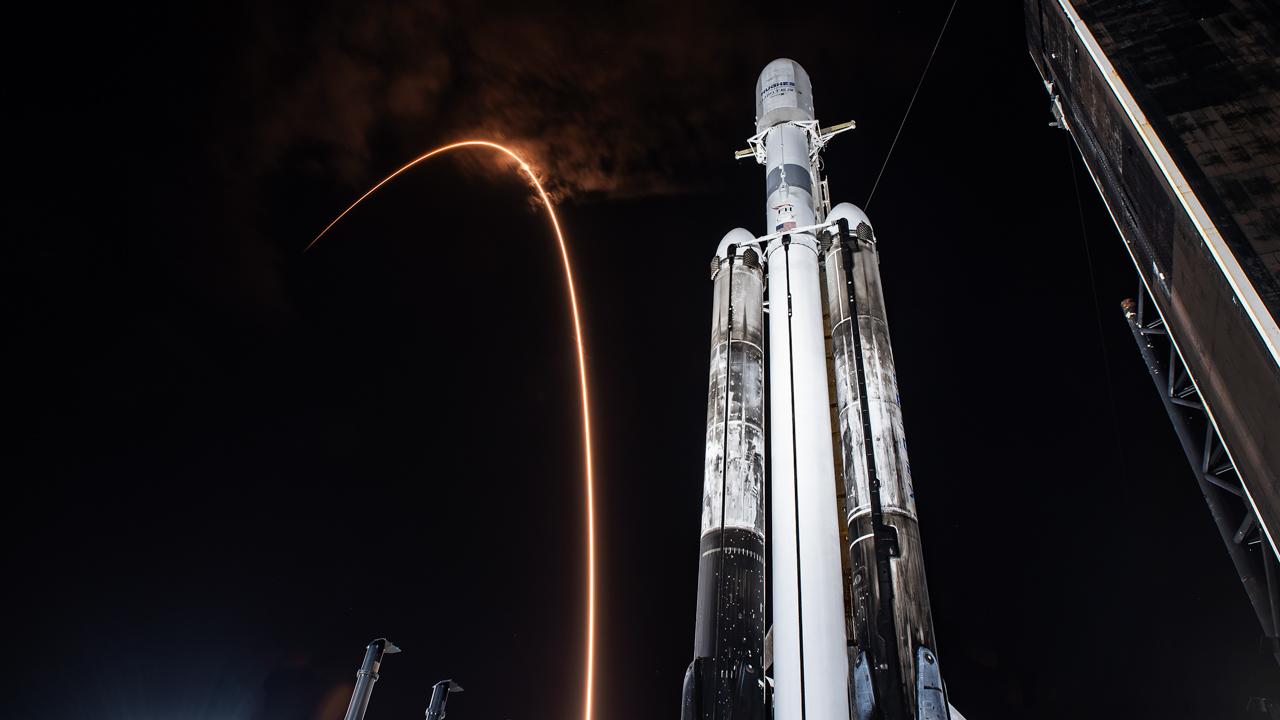
Falcon 9's first stage successfully lands on SpaceX droneship "Just Read the Instructions" after the launch, marking the seventh launch and landing for this booster. When you buy through links on our articles, Future and its syndication partners may earn a commission. SpaceX launched a new GPS satellite for the U.S. Space Force early Tuesday morning (April 21) -- a mission that was originally supposed to fly on a competitor's rocket. A Falcon 9 rocket topped with the GPS III SV10 satellite lifted off from Florida's Cape Canaveral Space Force Station on Tuesday at 2:53 a.m. EDT (0653 GMT). GPS III SV10 (short for "Space Vehicle 10") is the 10th and final satellite in the United States' advanced GPS III line. "GPS III satellites have a three-fold increase in positional accuracy and an eight-fold improvement in jam resistance compared to prior versions," Space Force officials said in a statement on Jan. 28, just after GPS III SV09 rode a Falcon 9 to orbit. "These advanced features enable the constellation to provide an across-the-board boost in effectiveness and lethality to weapon systems in every theater," they added. GPS III SV10 was originally supposed to fly aboard United Launch Alliance's new Vulcan Centaur rocket. Last month, however, the Space Force announced that it was switching the satellite to a Falcon 9 due to issues that Vulcan has experienced with its solid rocket boosters (SRBs). As part of this rocket swap, Vulcan Centaur will now launch the USSF-70 national security mission, which had been slated to fly on a SpaceX Falcon Heavy. USSF-70 is expected to launch no earlier than summer 2028, Space Force officials have said. (Presumably, Vulcan Centaur's SRB issues will be worked out by then.) The Falcon 9's first stage came back to Earth about 8.5 minutes after launch as planned on Tuesday, touching down softly in the Atlantic Ocean on the SpaceX droneship "Just Read the Instructions." It was the seventh launch and landing for this particular booster, according to a SpaceX mission description. And it was the final Falcon landing for "Just Read the Instructions," SpaceX said during Tuesday's launch commentary; the droneship will now pivot to supporting liftoffs of SpaceX's Starship megarocket. The Falcon 9's upper stage, meanwhile, continued powering its way to medium-Earth orbit. It will deploy GPS III SV10 there about 90 minutes after liftoff. Editor's note: This story was updated at 1:15 a.m. ET on April 20 with the new target launch date of April 21. It was updated again at 3:04 a.m. ET on April 21 with news of successful launch and rocket landing.

Vercel data breach: How hackers targeted the cloud company and offered its data for sale for $2 million - The Economic Times
American cloud development platform Vercel on Sunday confirmed a security breach allowing an attacker to gain unauthorised access to data for a "limited subset of customers". "We've identified a security incident that involved unauthorized access to certain internal Vercel systems. We are actively investigating, and we have engaged incident response experts to help investigate and remediate. We have notified law enforcement," the company wrote in a blogpost. What was the data breach about? The data breach occurred after a employee's Google Workspace account was compromised via a vulnerability at the third-party AI platform Context.ai. Vercel CEO Guillermo Rauch confirmed that hackers exploited this foothold to infiltrate internal systems with "surprising speed", suggesting the attackers likely used AI-driven tools to navigate the company's infrastructure and identify technical vulnerabilities. The intruders specifically targeted environment variables, focusing on those marked as 'non-sensitive,' a convenience feature now undergoing a rigorous security review. Although Vercel emphasises that sensitive data remained encrypted at rest and that the impact was limited to a small number of customers, the fallout has escalated into a high-stakes extortion attempt. The threat actor, identified by some as the group ShinyHunters, listed Vercel's data for sale on BreachForums for $2 million. The hackers claim to have exfiltrated source code, internal databases, and API keys. "Vercel stores all customer environment variables fully encrypted at rest. We have numerous defense-in-depth mechanisms to protect core systems and customer data. We do have a capability however to designate environment variables as "non-sensitive". Unfortunately, the attacker got further access through their enumeration," CEO Rauch wrote in a post on X. Per The Information, last September, Vercel raised $300 million at a $9.3 billion valuation. How is Vercel currently tackling the breach? The company is prioritising investigation, customer communication, tightening security, and cleaning affected systems. Vercel has confirmed that core tools and projects such as Next.js and Turbopack remain secure and uncompromised. Vercel has partnered with Google's Mandiant team and law enforcement to investigate the full scope of the breach. The company has already begun rolling out new safeguards, specifically enhancing the visibility and control of environment variables within its dashboard. Rauch has committed to transforming this incident into a catalyst for the 'strongest security response possible' for the platform. "At the moment, we believe the number of customers with security impact to be quite limited. All of our focus right now is on investigation, communication to customers, enhancement of security measures, and sanitisation of our environments. We've deployed extensive protection measures and monitoring," Rauch added in his post. Further, Vercel has directly contacted affected individuals, advising them to immediately change their sensitive credentials, such as passwords and API keys, and monitor access logs to check if attackers have already accessed these keys and prevent further unauthorised activity.