News & Updates
The latest news and updates from companies in the WLTH portfolio.
Kraken API Unlocked: momentum strategies on Kraken
Per-pair rate limits allow multi-pair momentum systems to operate independently. Momentum is one of the most studied phenomena in financial markets; how assets' directional trends tend to persist over time. The academic literature goes back decades, and crypto markets exhibit particularly strong momentum effects. But implementing momentum strategies in crypto is different than in traditional markets. Crypto markets exhibit higher volatility than traditional equities, which affects signal window selection. Markets run 24/7, so liquidity varies dramatically by hour of day. And false breakouts during low-volume periods are a persistent challenge. A typical momentum system has three components: signal generation (identifying directional moves), execution (opening positions when signals trigger), and position management (tracking fills and handling exits). The signal can be simple (moving average crossovers, breakout detection) or complex (ML models on order flow and funding rates). The specific signal matters less than the infrastructure: reliable real-time data, fast execution when conditions are met, and robust state management. Momentum systems need real-time price updates. REST polling introduces latency compared to persistent WebSocket connections and doesn't scale efficiently when monitoring multiple pairs. Kraken's WebSocket v2 ticker channel pushes updates as trades occur: Ticker versus OHLC channel: Ticker delivers price on each trade event. OHLC streams candlestick data as candles close. Ticker provides continuous updates as trades occur, while OHLC works well for strategies that operate on closed intervals (e.g., hourly crossovers). You don't need order book data for many momentum strategies unless position sizes are large enough that slippage matters. Momentum focuses on directional signals, not execution microseconds. Ticker is sufficient. Reliable execution is critical in momentum systems, particularly in volatile markets where timing and consistency directly impact outcomes. When signals trigger, you face a trade-off: pay spread for guaranteed fills (market orders) or save spread but risk no fill (limit orders). Limit orders with short expiry are a common pattern: This prevents stale orders from executing after signal conditions have changed. If the price moves away and your limit doesn't fill within 30 seconds, the order cancels automatically. Market orders work too if you prioritize speed over spread. The choice depends on how time-sensitive your signal is. Subscribe to WebSocket executions to get real-time fill notifications: This keeps your system's position state synchronized with the actual exchange state. Without it, you think you have positions you don't, or miss partial fills. Rate limits are per-pair. Activity on BTC/USD doesn't affect ETH/USD limits. This allows multi-pair momentum systems to operate independently across many pairs without throttling each other. Correlation during drawdowns: Cryptoassets often exhibit high correlation during volatility events. Multi-pair systems may accumulate correlated exposure during drawdowns. Some implementations cap total crypto exposure rather than per-pair limits to account for this. Keep signals simple. Signal complexity doesn't guarantee better performance. Infrastructure quality (data reliability, execution speed, state management) is a critical factor in system performance. Use historical depth. Testing on six months of data doesn't show how your system performs across different market cycles. Kraken's OHLCV data extends back to 2013 for major pairs, enabling backtesting across full bull/bear cycles provides more robust validation. Paper trade first. Run signals against live data without actual execution. This reveals issues with WebSocket handling, state management, and signal reliability before committing capital. Create your API keys now, or for institutional scale or FIX access, get in touch: How do you build a momentum trading strategy with Kraken's API? Start with a single pair like BTC/USD, subscribe to the WebSocket v2 ticker channel for real-time price updates, implement a signal such as moving average crossovers, RSI, or breakout detection, and use the REST API for order placement. Backtest on Kraken's historical OHLCV data before going live. Does Kraken's API support multi-pair momentum trading? Yes. Kraken's trading rate limits apply per currency pair rather than account-wide, so activity on BTC/USD doesn't affect rate limits on ETH/USD. This structure allows multi-pair momentum systems to operate independently across pairs. How far back does Kraken's historical price data go? Kraken's OHLCV data extends back to 2013 for major pairs like BTC/USD, covering multiple bull and bear cycles. This depth allows more robust backtesting than single-period optimization.
As Healthcare Costs Soar, Employers Search for Solutions -- Including Unconventional Ones
The Lockton 2026 National Benefits Survey finds cost has solidified its position as the defining problem in benefits strategy, and employers are casting a wider net than ever to find answers. KANSAS CITY, Mo. -- A striking new data point from the Lockton 2026 National Benefits Survey signals just how far employers are willing to go to manage rising healthcare costs: 46% of self-funded plan sponsors say they would consider international drug sourcing for pharmacy benefits -- an approach that remains complex and may expose plan sponsors to legal and compliance risks if not properly designed and administered, although the risk is unclear based on the lack of regulatory enforcement. That figure, drawn from 1,705 responses submitted by plan sponsors across industries, group sizes, and ownership structures, reflects a broader and more urgent shift in how U.S. employers are approaching benefits strategy. For the second consecutive year, reducing costs has emerged as the priority -- but now by a more dominant margin: 54% of employers now identify cost reduction as the most important factor shaping their benefits decisions, up sharply from 38% in 2025. Attracting and retaining talent, which has historically rivaled cost as the top priority, has now declined to 19%. "With projected cost trends, employers face sustained challenges heading into 2027 and beyond, as the imperative to reduce costs is increasingly dominant," stated Shannon Demaree, Executive Vice President, People Solutions Regional Executive at Lockton. "With the labor market softening, priority on attracting and retaining talent plummeted from 44% in 2023 to just 19% in 2026, how plan sponsors are thinking has decidedly shifted. It's a lot -- organizations are grappling with cost-management strategies, striving to maintain employee experiences, ensure quality care accessibility, and limit disruptions. Employers will need to rethink traditional approaches and reevaluate their role in the healthcare landscape." A Wide Range of Strategies -- With No Single Dominant Path The report explores four key areas where employers are actively evaluating spend: plan optimization, network solutions, eligibility management, and pharmacy benefits. Within each, employers are weighing options ranging from foundational approaches with minimal disruption to more progressive strategies designed to achieve greater savings. Among self-funded plan sponsors, who represent the majority of survey respondents and have the greatest flexibility to implement cost-saving measures, several tactics are already gaining traction: Cost Pressure Doesn't Mean Employee Impact Is Off the Table Despite the sharp pivot toward cost management, employee impact remains a key variable in how employers are making decisions. According to the survey, 81% of respondents said employee impact is still an important consideration when evaluating changes, a finding that points to the central tension employers are trying to navigate: controlling costs without undermining the value of their benefits package or the trust of their workforce. "The challenge for employers is not simply cutting spend," said Chris Bartnik, Senior Vice President, People Solutions Growth and Innovation Leader at Lockton. "It's finding sustainable ways to manage cost while maintaining a competitive and meaningful benefits offering. This year's survey shows that employers are looking for practical strategies that deliver savings without sacrificing trust, access, or outcomes." The data suggests employers are not converging around a single solution. Instead, they are searching across multiple dimensions simultaneously, balancing potential savings against disruption, compliance considerations, and member experience. About the Survey The Lockton National Benefits Survey helps employers benchmark their benefits strategies against peers, identify emerging trends, and discover new approaches to plan design. The 2026 report is based on 1,705 aggregated responses collected in January and February 2026. The data above includes selected results and analysis from the compiled survey data. The full report explores additional findings on access to quality care, wellbeing benefits, and communications strategies. What makes Lockton stand apart is also what makes us better: independence. Lockton's private ownership empowers its 13,000+ Associates doing business in more than 160+ countries to focus solely on clients' risk and insurance needs. With expertise that reaches around the globe, Lockton delivers the deep understanding needed to accomplish remarkable results. For more information, visit www.lockton.com.

ChatGPT maker OpenAI shifts its focus to business users amid Anthropic pressure
The same ChatGPT chatbot that gave OpenAI's chief financial officer Sarah Friar a tilapia recipe for a recent Sunday night dinner at home is also now doing her most mundane tasks at work like summarizing her emails and Slack messages. Friar and other company executives are banking OpenAI's future on more of the latter as it shifts its focus to business-oriented products while shedding some of its consumer offerings as a pathway to profitability. OpenAI says it will introduce a new artificial intelligence model for "high-value professional work" as the company faces heightened competition with rival Anthropic in attracting corporate customers to adopt AI assistants in their workplaces. "You'll see a new model coming from us in short order. We feel very excited about it," Friar said in an interview with The Associated Press. OpenAI boasts of more than 900 million weekly users of its core ChatGPT product, and Friar said about 95% of them "don't pay anything" for the popular chatbot. But while all those interactions build habits and reliance, they also strain the costly computing resources needed to power the company's AI systems and highlight the need for big business customers to help pay the bills. OpenAI, valued at $852 billion, and Anthropic, valued at $380 billion, both lose more money than they make, putting the privately-owned San Francisco-based AI research laboratories in a fierce competition to generate more revenue as they race toward becoming publicly traded on Wall Street. A push to improve performance and sales of OpenAI's business-oriented products -- already Anthropic's bread and butter -- has driven OpenAI to abandon some consumer initiatives, like the AI video generator app Sora. "I think it was a little heartbreaking, but we're like, OK, it's not the main event right now," Friar said. "We need to make sure that our new model that's coming has enough compute." Codenamed Spud, OpenAI says its "smartest model yet" offers "stronger reasoning, better understanding of intent and dependencies, better follow-through and more reliable output in production." It's part of OpenAI's answer to Anthropic's new Claude Mythos, which Anthropic claims is so "strikingly capable" that it is limiting its use to select customers because of its apparent ability to surpass human cybersecurity experts in finding or exploiting computer vulnerabilities. Friar, the former CEO of neighborhood social platform Nextdoor, said business customers accounted for about 20% of OpenAI's revenue when she was hired in 2024 as chief financial officer. She said it's now 40% and expected to account for half of OpenAI's sales by the end of the year. It's a sharp turnaround from late last year, when OpenAI co-founder and CEO Sam Altman was promoting a now-shuttered Sora partnership with Disney, launching a plan to sell ads on ChatGPT and floating the idea of letting ChatGPT engage in erotica with paid adult users. Altman said on the "Mostly Human" podcast earlier this month that a sharper focus was needed -- and Friar agrees. "Tech companies, when they're growing, it's just this natural thing that happens. There's so many cool things you could do," she said, adding that companies can end up doing "really badly" if they do too many things, while "great companies are very good at, in a reasonable period of time, kind of doing that winnowing down and refocusing and it's super painful." Signaling that shift was the hiring three months ago of Slack CEO Denise Dresser to be OpenAI's first chief revenue officer. Dresser said in a recent AP interview that she has been laser-focused on meeting with corporate leaders and positioning OpenAI as the go-to platform for workplaces employing AI agents to automate a variety of computer-based job tasks. "It's really clear to me that companies are past the experimentation phase and they're into using AI to do real work," Dresser said. "Leaders at companies are recognizing that AI is probably the most consequential shift of their lifetime." But those leaders also have a choice, namely Anthropic's Claude that has become widely used by software professionals. Founded in 2021 by a group of ex-OpenAI leaders who said they wanted to prioritize AI safety, Anthropic has positioned itself as the more responsible AI vendor. The distinction drew attention when President Donald Trump's administration punished the startup after a contract dispute over AI use in the military, and Altman used the opportunity to cement OpenAI's own deal with the Pentagon. Consumer interest in Anthropic surged and the company said its annualized revenues hit $30 billion, a higher number than what OpenAI has reported, though they measure it differently. Friar and Dresser declined to reveal OpenAI's latest sales but both have suggested that Anthropic's number is inflated because it doesn't account for revenue it must share with cloud computing providers Amazon and Google. Even so, it remains a tight competition that's also tied to the health of the stock market and the future of the economy. "They're likely quite close," said Luke Emberson, a researcher at nonprofit institute Epoch AI. "Certainly the trends show Anthropic is growing much faster than OpenAI. If that continues, they're likely to cross soon." The urgency led Dresser to send a memo to OpenAI employees on Sunday, first reported by The Verge, that asserted that Anthropic's coding focus "gave them an early wedge" but expressing confidence that OpenAI has the "real structural advantage" as AI usage expands beyond software developers and OpenAI builds enough computing capacity to operate its AI systems. "Their story is built on fear, restriction, and the idea that a small group of elites should control AI," Dresser's memo said of Anthropic. "Our positive message will win over time: build powerful systems, put in the right safeguards, expand access, and help people do more." But for skeptics of the financial viability of AI products like ChatGPT and Claude, the trajectory of both money-losing companies is alarming as smaller startups increasingly become dependent on their AI tools. Anthropic has already imposed rate limits on heavy users, forcing some to wait for hours to use Claude, and both companies have set up service tiers that reward premium payers, said author and AI critic Ed Zitron. "It's what I call the subprime AI crisis," Zitron said. "People built their lives and they built their businesses on top of these companies that, as they try and save money, will start turning the screws." One thing that both AI leaders and critics agree on is that it is an expensive technology, though whether it is worth the cost in electricity-hungry AI computers remains to be seen. "People will say, well, 'Once they go public, they're safe.' That's not true," Zitron said. "Public companies can and will die, especially ones that are dependent on $100 billion to $200 billion every year or so, just to keep breathing."
PROENERGY To Deliver Major Generating Equipment To Power Crusoe AI Factories
650-MW Power Generation Equipment Solution Includes 13x PE6000 Units Delivered by Summer 2027 Crusoe will install the equipment to power upcoming hyperscale datacenter projects. Like all PROENERGY solutions, equipment for Crusoe's hyperscale AI factories will be test-fit and quality-checked at the Sedalia manufacturing facility to arrive onsite ready to install. "Our equipment is made in-house for world-class reliability no matter the application," says Jeff Canon, PROENERGY President and CEO. "We appreciate that Crusoe trusts PROENERGY to deliver a solution on time and as promised." SOURCE PROENERGY Market News and Data brought to you by Benzinga APIs To add Benzinga News as your preferred source on Google, click here.

Charles Schwab Turned Market Chaos Into Record Q1 Profit
A volatile quarter drove record trading and strong client inflows, lifting revenue 16% and net income to $2.48 billion. Charles Schwab capped a choppy start to 2026 with a record Q1: revenue rose 16% to $6.48 billion and net income climbed to $2.48 billion. What does this mean? Volatility often gets investors moving - and Schwab cashed in as market swings intensified, especially in March. With clients reassessing everything from AI winners and losers to private credit risk, many chose to hedge, rebalance, or simply trade more. Schwab's daily average trades jumped 34% from a year ago to a record 9.9 million, helping trading revenue rise 20%. The firm also widened its footprint: clients opened 1.3 million new brokerage accounts and brought in $140 billion of net new assets, a si..

Anthropic Ready to Offer Mythos to British Banks | PYMNTS.com
By completing this form, you agree to receive marketing communications from PYMNTS and to the sharing of your information with our sponsor, if applicable, in accordance with our Privacy Policy and Terms and Conditions. The artificial intelligence (AI) startup is expanding "Project Glasswing," which offers select organizations early access to the AI, Bloomberg News reported Thursday (April 16). This came after Anthropic learned of Mythos' ability to spot -- and possibly exploit -- weaknesses in cyber defenses, the report added. "That is in the very near term, in the next week," said Pip White, Anthropic's head for the U.K., Ireland and northern Europe, told Bloomberg Television. "As you would expect, the engagement I have had from UK CEOs in the last week has been significant." Earlier this month, Anthropic said it would hold off on releasing Mythos to give cybersecurity experts the opportunity to test it. The company says testing by Mythos has uncovered thousands of "zero-day" vulnerabilities, including within every major web browser and operating system. The Glasswing program, the report added, initially included Big Tech companies like Amazon and Microsoft. After the program was announced, U.S. Treasury Secretary Scott Bessent and Federal Reserve Chair Jerome Powell convened a meeting with Wall Street banks to discuss Mythos and similar AI models. As Bloomberg notes, the lack of knowledge about Mythos has banks and government agencies worried. Bank of England Governor Andrew Bailey said this week that regulators need to rapidly evaluate the threat the model might present. "We are putting our own safeguards and our own limitations around this product because we know how powerful it can be," White said. PYMNTS wrote earlier this week about the contrast between Mythos and OpenAI's newly released GPT-5.4-Cyber. "Both models can find and exploit software vulnerabilities at a scale no human team can match," that report said. "What divides them is a fundamental disagreement about what to do with that power." Rather than assisting security teams, the report continued, Mythos works independently. Assigned a target and given a prompt asking it to spot a vulnerability, the model reads code, forms hypotheses, tests them against a running environment and produces a complete exploit with no additional human input. "Anthropic confirmed that these capabilities weren't explicitly trained into the model," the report said. "They emerged as a downstream consequence of general improvements in code, reasoning and autonomy. The same improvements that make the model more effective at patching vulnerabilities also make it more effective at exploiting them." GPT-5.4-Cyber is designed around a different premise, PYMNTS added. Instead of autonomous operation, it's built to remove the friction that security professionals encounter when employing standard AI tools.

ChatGPT maker OpenAI shifts its focus to business users amid Anthropic pressure
The same ChatGPT chatbot that gave OpenAI's chief financial officer Sarah Friar a tilapia recipe for a recent Sunday night dinner at home is also now doing her most mundane tasks at work like summarizing her emails and Slack messages. Friar and other company executives are banking OpenAI's future on more of the latter as it shifts its focus to business-oriented products while shedding some of its consumer offerings as a pathway to profitability. OpenAI says it will introduce a new artificial intelligence model for "high-value professional work" as the company faces heightened competition with rival Anthropic in attracting corporate customers to adopt AI assistants in their workplaces. "You'll see a new model coming from us in short order. We feel very excited about it," Friar said in an interview with The Associated Press. OpenAI boasts of more than 900 million weekly users of its core ChatGPT product, and Friar said about 95% of them "don't pay anything" for the popular chatbot. But while all those interactions build habits and reliance, they also strain the costly computing resources needed to power the company's AI systems and highlight the need for big business customers to help pay the bills. OpenAI, valued at $852 billion, and Anthropic, valued at $380 billion, both lose more money than they make, putting the privately-owned San Francisco-based AI research laboratories in a fierce competition to generate more revenue as they race toward becoming publicly traded on Wall Street. A push to improve performance and sales of OpenAI's business-oriented products -- already Anthropic's bread and butter -- has driven OpenAI to abandon some consumer initiatives, like the AI video generator app Sora. "I think it was a little heartbreaking, but we're like, OK, it's not the main event right now," Friar said. "We need to make sure that our new model that's coming has enough compute." Codenamed Spud, OpenAI says its "smartest model yet" offers "stronger reasoning, better understanding of intent and dependencies, better follow-through and more reliable output in production." It's part of OpenAI's answer to Anthropic's new Claude Mythos, which Anthropic claims is so "strikingly capable" that it is limiting its use to select customers because of its apparent ability to surpass human cybersecurity experts in finding or exploiting computer vulnerabilities. Friar, the former CEO of neighborhood social platform Nextdoor, said business customers accounted for about 20% of OpenAI's revenue when she was hired in 2024 as chief financial officer. She said it's now 40% and expected to account for half of OpenAI's sales by the end of the year. It's a sharp turnaround from late last year, when OpenAI co-founder and CEO Sam Altman was promoting a now-shuttered Sora partnership with Disney, launching a plan to sell ads on ChatGPT and floating the idea of letting ChatGPT engage in erotica with paid adult users. Altman said on the "Mostly Human" podcast earlier this month that a sharper focus was needed -- and Friar agrees. "Tech companies, when they're growing, it's just this natural thing that happens. There's so many cool things you could do," she said, adding that companies can end up doing "really badly" if they do too many things, while "great companies are very good at, in a reasonable period of time, kind of doing that winnowing down and refocusing and it's super painful." Signaling that shift was the hiring three months ago of Slack CEO Denise Dresser to be OpenAI's first chief revenue officer. Dresser said in a recent AP interview that she has been laser-focused on meeting with corporate leaders and positioning OpenAI as the go-to platform for workplaces employing AI agents to automate a variety of computer-based job tasks. "It's really clear to me that companies are past the experimentation phase and they're into using AI to do real work," Dresser said. "Leaders at companies are recognizing that AI is probably the most consequential shift of their lifetime." But those leaders also have a choice, namely Anthropic's Claude that has become widely used by software professionals. Founded in 2021 by a group of ex-OpenAI leaders who said they wanted to prioritize AI safety, Anthropic has positioned itself as the more responsible AI vendor. The distinction drew attention when President Donald Trump's administration punished the startup after a contract dispute over AI use in the military, and Altman used the opportunity to cement OpenAI's own deal with the Pentagon. Consumer interest in Anthropic surged and the company said its annualized revenues hit $30 billion, a higher number than what OpenAI has reported, though they measure it differently. Friar and Dresser declined to reveal OpenAI's latest sales but both have suggested that Anthropic's number is inflated because it doesn't account for revenue it must share with cloud computing providers Amazon and Google. Even so, it remains a tight competition that's also tied to the health of the stock market and the future of the economy. "They're likely quite close," said Luke Emberson, a researcher at nonprofit institute Epoch AI. "Certainly the trends show Anthropic is growing much faster than OpenAI. If that continues, they're likely to cross soon." The urgency led Dresser to send a memo to OpenAI employees on Sunday, first reported by The Verge, that asserted that Anthropic's coding focus "gave them an early wedge" but expressing confidence that OpenAI has the "real structural advantage" as AI usage expands beyond software developers and OpenAI builds enough computing capacity to operate its AI systems. "Their story is built on fear, restriction, and the idea that a small group of elites should control AI," Dresser's memo said of Anthropic. "Our positive message will win over time: build powerful systems, put in the right safeguards, expand access, and help people do more." But for skeptics of the financial viability of AI products like ChatGPT and Claude, the trajectory of both money-losing companies is alarming as smaller startups increasingly become dependent on their AI tools. Anthropic has already imposed rate limits on heavy users, forcing some to wait for hours to use Claude, and both companies have set up service tiers that reward premium payers, said author and AI critic Ed Zitron. "It's what I call the subprime AI crisis," Zitron said. "People built their lives and they built their businesses on top of these companies that, as they try and save money, will start turning the screws." One thing that both AI leaders and critics agree on is that it is an expensive technology, though whether it is worth the cost in electricity-hungry AI computers remains to be seen. "People will say, well, 'Once they go public, they're safe.' That's not true," Zitron said. "Public companies can and will die, especially ones that are dependent on $100 billion to $200 billion every year or so, just to keep breathing." News Nevada Top stories As a community mourns loss of its Sheriff, Churchill County leaders prepare for the next chapter Special Olympics Nevada to host circus-themed Lake Tahoe plunge in May Volunteers needed to repair bikes for children across Reno at FreeWheels 4 Kids event
Amazon Backed X-Energy Targets $800 Million IPO
This article first appeared on GuruFocus. Amazon (NASDAQ:AMZN) backed X-Energy is heading back to the public markets, this time aiming to raise up to $800 million as demand for power, especially from AI, keeps climbing. The plan is to sell around 42.9 million shares priced between $16 and $19, which would bring in roughly $814 million at the top end and put the company's valuation near $7.5 billion. What makes this story interesting is the timing. X-Energy is building small modular reactors and advanced nuclear fuel, right as data centers and electrification trends are driving a surge in electricity demand. Amazon has already backed the company with a $500 million investment and even committed to buying up to 5 gigawatts of power through 2039, which gives the business a clear long term customer. This IPO also feels like a second chance. X-Energy had tried to go public through a SPAC in 2023 but pulled back when market conditions turned. Now, with stronger interest in AI infrastructure, the setup looks different. Big banks like JPMorgan and Morgan Stanley are leading the deal, and Cathie Wood's firm is considering up to $105 million in shares.

Anthropic makes Claude users prove identity
Anthropic drew privacy-minded users after resisting Pentagon AI demands. Now some Claude users may need a passport and selfie, turning Claude's trust pitch into an identity checkpoint. Anthropic has begun asking some Claude users to verify their identity with a government photo ID and, in some cases, a live selfie, according to a new company help page that says the checks apply to selected capabilities, platform integrity reviews, and safety or compliance measures. The change lands less than two months after Claude drew a surge of users from OpenAI's ChatGPT during Anthropic's public fight with the Pentagon over mass surveillance and autonomous weapons. TechCrunch reported that Claude reached more than 1 million sign-ups per day in early March, while its mobile app passed ChatGPT in U.S. daily downloads on March 2, citing Appfigures and Anthropic. Now the company that benefited from privacy anxiety is asking part of that same audience to pass through an identity checkpoint. That is the real story. Anthropic is not abandoning its privacy pitch. It is narrowing it. The company is telling users that Claude will not train on their ID, will not store the images in Anthropic systems, and will not share them for marketing. But the new rule changes the emotional contract. Claude was sold, and recently rewarded, as the AI lab that would say no to surveillance. The passport prompt says the cost of safety may be the oldest surveillance token of all: your papers. Start with what Anthropic says. Its identity verification page says verification helps the company prevent abuse, enforce usage policies, and meet legal duties. The checks are not universal. Users may see them when accessing certain capabilities, during routine platform integrity checks, or under other safety and compliance measures. Anthropic told Decrypt the rule applies to "a small number of cases" tied to potentially fraudulent or abusive activity. The documents required are specific. Anthropic accepts a physical passport, driver's license, state or provincial ID, or national identity card from most countries. It rejects photocopies, screenshots, scans, mobile IDs, student IDs, employee badges, library cards, bank cards, and temporary paper IDs. A phone or computer camera may be needed for a live selfie. The company chose Persona Identities as its verification partner. Anthropic says it remains the data controller. Persona collects and holds the ID and selfie, processes them on Anthropic's instructions, encrypts the data in transit and at rest, and deletes it under retention limits set by Anthropic and applicable law. Anthropic says it does not copy or store the images itself, though it can access verification records through Persona's platform when needed, including for appeals. That distinction matters legally. It matters less emotionally. If you are the user staring at a camera with a passport in your hand, the custody diagram is not the point. The point is that the AI assistant now has a tollbooth. Anthropic earned this problem by winning the last fight. In February, CEO Dario Amodei said Anthropic could not accept Pentagon contract language that, in the company's view, failed to prevent Claude's use for mass surveillance of Americans or fully autonomous weapons. The Associated Press reported that the dispute put Anthropic at risk of losing its government contract, being labeled a supply-chain risk, or facing pressure under the Defense Production Act. Pentagon officials denied any plan to use AI for illegal domestic surveillance or human-free weapons. The public saw a simpler story. OpenAI, Google, and xAI were in the military network. Anthropic was the holdout. Users who already felt watched had a new place to go. TechCrunch reported Claude's mobile daily active users hit 11.3 million on March 2, up 183% from the start of the year, citing Similarweb. Anthropic said daily active users had more than tripled since the beginning of 2026 and paid subscribers had doubled. Growth like that brings abuse. It brings fraud. It brings banned regions, resellers, bots, account farms, minors, scammers, scraped credentials, and users trying to route around rules. Anthropic's March 2025 misuse report described influence operations, credential scraping, recruitment fraud, and malware development detected on Claude. A company with that record does not need to invent a reason for tougher controls. Still, the timing is brutal. Anthropic's brand just absorbed the hopes of users who wanted distance from state power. Then the company installed a mechanism that links Claude access to state-issued identity. The bridge lifted for the crowd that had just crossed it. This is not hypocrisy in the cheap sense. It is worse for Anthropic because it is operational tension. The company wants to be the safe lab, the privacy lab, the national-security skeptic, and the abuse-resistant platform. Those jobs pull against each other. Institutional caution says verify more people. Institutional fear says do not become the next platform blamed for fraud, minors, or foreign abuse. User trust says do not ask for passports unless there is no other way. Anthropic's strongest argument is that it is not building an internal ID vault. Persona handles the images. Persona's policy says it acts as a processor for customers that control the relationship with users. For identity checks, Persona may collect names, contact details, demographic data, government documents, identifiers, device data, public data, general location inferred from IP address, and ID and selfie images. It may compare facial geometry from the document with facial geometry from the selfie to confirm identity. Persona says it does not use personal data, including biometric data, for AI or model training. It says it does not sell or share that data for marketing. It says ID and selfie scan data are destroyed when identity services are complete or within three years of the user's last interaction, depending on the customer's instructions and legal process. Persona also says it may use cloud providers including AWS, Google Cloud, and MongoDB to process biometric data. That is a serious privacy stack. It is not a guarantee. Discord supplied the warning label in October. The company said a third-party customer service provider had been compromised, exposing data from users who contacted customer support or trust and safety teams. Discord said about 70,000 users may have had government-ID photos exposed, tied to age-related appeals. Discord stressed that it was not a breach of Discord itself. That did not make the IDs less exposed. The lesson is not that Persona is unsafe. The lesson is that outsourcing moves the blast radius. It does not erase it. Once a platform creates a reason for users to upload passports, it creates a class of data attackers want and users cannot rotate. You can replace a password. You cannot replace your face. Claude's passport prompt is not arriving alone. Anthropic's December 2025 user-wellbeing post said Claude.ai users must be 18 or older, must affirm their age at account setup, and may have accounts disabled if they self-identify as minors in conversation. Anthropic also said it was developing a classifier to detect subtler signs that a user might be underage. MediaNama reported this week that multiple users on Reddit and X said Anthropic wrongly flagged them as minors and suspended their Claude accounts. The reported Anthropic email said the team had found signals that the account was used by a child and offered a 30-day link to verify age. Some users said they were paying adults. One said project histories broke while the appeal played out. Treat those posts carefully. They are user reports, not audited error rates. But they point to the pressure that makes identity checks spread. A safety classifier flags a risk. A human review needs a rule. A rule needs proof. Proof becomes an ID flow. Soon the exception looks like infrastructure. That is the tollbooth problem. It rarely stays at the first lane. More than 400 security and privacy researchers warned in a March open letter, reported by MediaNama, that large age-assurance systems can collect biometrics, behavioral signals, and context data, produce false positives, exclude people without documents or compatible devices, and link online access to broader identity systems. Their warning was about age checks, not Claude alone. But Claude is now part of the same policy current. You do not need to think Anthropic is acting in bad faith to see the direction. Safety systems start as narrow gates. Abuse teams widen them when attackers adapt. Regulators widen them when harms make headlines. Product teams widen them when a checked account becomes more trusted than an unchecked one. Anthropic can survive this if the identity prompt stays rare, transparent, and tied to clear abuse signals. It will have a harder time if users experience it as random, vague, or punitive. The company should publish more than a help page. It should say which broad categories can trigger verification, how often it happens, how many appeals succeed, how long Persona keeps each class of data under Anthropic's instructions, and what users lose while an appeal is pending. It should publish false-positive ranges for age and fraud classifiers. It should state whether verification affects access to account history, Claude Code projects, billing, or export tools. That information would not help attackers much if it stays at category level. It would help users decide whether Claude still deserves the trust premium Anthropic spent the Pentagon fight earning. Right now, the company's line is technically coherent and politically fragile. It says: we refused mass surveillance, but we may ask for your passport; we do not store the image, but our vendor will hold it; we do not train on it, but it can be used for fraud prevention; we protect privacy, but our Trust and Safety team can access conversations when policy review requires it. Each sentence can be defended. Together, they sound like the voice of a company learning that safety at scale often looks like control. Anthropic did not lose the privacy crowd by adding a narrow ID check. Not yet. The test comes later, when the first wave of users cannot tell why the prompt appeared, when an appeal stalls, when a developer loses access to a project midstream, or when a regulator asks platforms to verify more categories of users. That is when the checkpoint stops looking temporary. Claude won converts by standing on the far side of the surveillance fight and waving people across. Now it has built a booth at the bridge. The next question is not whether Anthropic can explain the booth. It is whether users still feel like they are crossing into safer ground.

Kraken Robotics Reports 2025 Financial Results
Kraken Robotics Inc. ("Kraken" or the "Company") (TSX-V: PNG, OTCQB: KRKNF), announced it has filed its financial results for the fourth quarter and year ended December 31, 2025 ("Q4 2025"). Please refer to the audited consolidated financial statements of the Company for the fiscal years ended December 31, 2025 and 2024, management's discussion and analysis for the three and twelve months ended December 31, 2025 ("MD&A") and the annual information form of the Company for the year ended December 31, 2025, each filed on SEDAR+ at www.sedarplus.ca, for more information. Certain preliminary 2025 year-end results and 2026 guidance were already announced in the news release of the Company dated March 3, 2026 (the "March 3 News Release"), together with the Company's execution of a definitive agreement to acquire Covelya Group Limited ("Covelya Group"), a leading international provider of mission-critical underwater technology solutions, for total consideration of $615 million, subject to adjustment (the "Covelya Acquisition"). The Covelya Acquisition is expected to close during the second quarter of 2026, subject to the satisfaction of customary closing conditions and receipt of required regulatory approvals. For further details on the Covelya Acquisition, please see the March 3 News Release. Unless otherwise specified, all dollar amounts in this release are denominated in Canadian dollars. "We are pleased to report another year of strong financial results, driven by significant demand for our products and services across a growing base of customers," said Greg Reid, President and CEO of Kraken. "This momentum reflects the differentiated capabilities of our subsea sensor and power technologies and the growing adoption of autonomous underwater systems in both defence and commercial applications. We are excited about the expected Q2 closing of our strategic acquisition of Covelya Group, which we believe will significantly strengthen Kraken in terms of its product offering, technological capabilities, competitive position and financial outlook. The current macro environment is characterized by rising global instability that is fueling increased defence spending and a push for national energy security. This is driving significant growth in our (and Covelya's) core growth markets. Recent conflicts in Ukraine and the Middle East have demonstrated that uncrewed systems provide transformative, asymmetric capabilities. Simultaneously, the energy sector is adopting these systems to lower costs and enhance the monitoring of remote assets. This has created a surge in demand for maritime drones, as well as counter-drone technology. As both Kraken and Covelya products enable the essential control and automation for these platforms, both our companies are securing a record number of opportunities and orders and expect this growth trajectory to continue. Looking ahead for the full year 2026, we are excited about the strong new order activity that both Kraken and Covelya have had to start the year and the massive opportunity in front of us." As previously announced in the March 3 News Release, Kraken expects revenue in 2026 to be between $165 million and $175 million and Adjusted EBITDA to be between $40 million to $50 million, excluding any contribution from the Covelya Acquisition. The midpoint of guidance represents over 65% revenue growth and 80% Adjusted EBITDA growth in comparison to the prior year. The Company's strong outlook for 2026 is driven by both existing and expected purchase orders. It is also supported by expected growth in the commercial services business, including a full year contribution from LiDAR services, formerly 3D at Depth. Consistent with prior years, revenue in 2026 is expected to be weighted toward the second half of the year. Capital expenditures in 2026 are expected to range from $15 million to $18 million, down significantly from the prior year, given the completion of the new battery manufacturing facility. A summary table of the Company's 2026 guidance range and a comparison to 2025 results is provided below. Kraken plans to release updated 2026 guidance for the combined company upon closing of the Covelya Acquisition. CONFERENCE CALL DETAILS Kraken management will host a conference call today, April 16, 2026, starting at 8:30 a.m. ET to discuss the financial results. Participants can listen to this event at the webcast details below, or by dialing 1-833-752-3301 (North America) or 1-647-846-2734 (International) for operator assistance. A recording will also be made available following the call. Webcast Details: https://event.choruscall.com/mediaframe/webcast.html?webcastid=sLXYSQ25 NON-IFRS MEASURES The Company has included certain non-IFRS financial measures and non-IFRS ratios in this press release, including adjusted EBITDA, adjusted EBITDA margin, gross profit, gross profit margin, and working capital. Management believes that non-IFRS financial measures and non-IFRS ratios, when supplementing measures determined in accordance with IFRS, provide investors with an improved ability to evaluate the underlying performance of the Company. Non-IFRS financial measures and non-IFRS ratios do not have any standardized meaning prescribed under IFRS, and therefore they may not be comparable to similar measures employed by other companies. This data is intended to provide additional information and should not be considered in isolation or as a substitute for measures of performance prepared in accordance with IFRS. Adjusted EBITDA and Adjusted EBITDA Margin The Company believes that, in addition to conventional measures prepared in accordance with IFRS, Adjusted EBITDA is useful to securities analysts, investors and other interested parties in evaluating operating performance by presenting the results of the Company on a basis which excludes the impact of certain non-operational items which enables the primary readers of the press release to evaluate the results of the Company such that it was operating without certain non-cash and non-recurring items. Adjusted EBITDA is calculated as earnings before interest expense, interest income, income taxes, depreciation and amortization, stock-based compensation expense and non-recurring impact transactions, if any. Gross profit is defined as revenue less cost of total sales. Gross profit margin is defined as gross margin dividend by total sales. Kraken Robotics Inc. is transforming subsea intelligence through 3D imaging sensors, power solutions, and robotic systems. Our products and services enable clients to overcome the challenges in our oceans - safely, efficiently, and sustainably. Kraken's synthetic aperture sonar, sub-bottom imaging, and LiDAR systems offer best-in-class resolution, providing critical insights into ocean safety, infrastructure, and geology. Our revolutionary pressure tolerant batteries deliver high energy density power for UUVs and subsea energy storage. Kraken Robotics is headquartered in Canada with offices in North America, South America, and Europe, supporting clients in more than 30 countries worldwide. On March 3, 2026, Kraken announced the acquisition of Covelya Group, a leading international provider of mission-critical underwater technology solutions operating through its subsidiary companies: Sonardyne International Limited, EIVA A/S, Forcys Limited, Wavefront Systems Limited, Voyis Imaging Inc., and Chelsea Technologies Ltd. The Covelya Acquisition is expected to close during the second quarter of 2026, subject to the satisfaction of customary conditions and regulatory approvals. This news release contains statements that constitute "forward-looking information" as defined under applicable Canadian securities laws (collectively, "forward-looking statements"). When used in this news release, the words "may", "would", "could", "will", "intend", "plan", "anticipate", "believe", "seek", "propose", "estimate", "expect", and similar expressions, as they relate to the Company, are intended to identify forward-looking statements. In particular, this news release contains forward-looking statements with respect to, among other things: the closing of the Covelya Acquisition, and timing thereof; impacts of the Covelya Acquisition on the business and financial outlook of the Company; expected growth of the autonomous underwater systems industry; business objectives; expected growth of the Company; expected orders of products and services; maritime security matters and the expanding role of mine countermeasures; new product offerings; expectations regarding results of operations, performance, business projects and opportunities, and financial results; and 2026 guidance (including consolidated revenue, Adjusted EBITDA, Adjusted EBITDA margin, and capital expenditures/intangible assets) and financial estimates. These statements involve known and unknown risks, uncertainties and other factors that may cause actual results or events to differ materially from those anticipated in such forward-looking statements. Such statements reflect the Company's current views with respect to future events based on certain material factors and assumptions and are subject to certain risks and uncertainties, including without limitation, changes in market, competition, governmental or regulatory developments, general economic conditions, ability to complete the Covelya Acquisition, macroeconomic uncertainties and other factors set out in the Company's continuous disclosure materials filed from time to time with the Canadian Securities Administrators, including the Company's most recent annual information form under the section entitled "Risk Factors", quarterly and annual reports, and supplementary information, which are available under the Company's profile on SEDAR+ at www.sedarplus.ca. Additional risks and uncertainties not presently known to the Company or that Kraken believes to be less significant may also adversely affect the Company. Many factors could cause the Company's actual results, performance or achievements to vary from those described in this news release, including without limitation those listed above. These factors should not be construed as exhaustive. Should one or more of these risks or uncertainties materialize, or should assumptions underlying forward-looking statements prove incorrect, actual results may vary materially from those described in this news release and accordingly, forward-looking statements should not be unduly relied upon. Guidance for 2026 is provided as April 16, 2026 to assist analysts and shareholders in formalizing their respective views on the year ending December 31, 2026. The reader is cautioned that using this information for other purposes may be inappropriate. This information constitutes forward-looking statements, based on multiple estimates and assumptions about future events. Actual results may differ, and such differences may be material. Expectations are also subject to a number of risks and uncertainties as well as material assumptions contained in this press release and in Kraken's management's discussion and analysis ("MD&A") for the three and twelve months ended December 31, 2025 as filed on SEDAR+ at www.sedarplus.ca. Guidance for 2026 is based on management's current views, strategies, expectations, assumptions and forecasts, and has been calculated using accounting policies that are generally consistent with the Company's current accounting policies. The Company cautions that the assumptions used to prepare the 2026 outlook could prove to be incorrect or inaccurate. Accordingly, the Company's actual results could differ materially from the Corporation's expectations as set out in this press release. The Company's revenue for 2026 assumes the following: Product revenue guidance range is driven by growth in Kraken's battery, KATFISH and SAS portfolios, along with organic growth in its service business as well as a full year contribution of its 3D at Depth acquisition. Product revenue is supported by existing orders and expected orders related to identified opportunities. Service revenue growth is based on a stable to growing investment in offshore energy projects, both oil and gas and offshore renewables, and demand for critical underwater infrastructure inspection and repair. Revenue is expected to be weighted towards the second half of the year based on historical customer purchasing patterns. Adjusted EBITDA guidance assumes gross profit margins for its products and services consistent with prior year levels. Forward-looking statements speak only as of the date of this news release. The Company does not intend, and does not assume any obligation, to update these forward-looking statements, whether as a result of new information, future events or otherwise, except as required by securities laws. The forward-looking statements contained in this news release are expressly qualified by this cautionary statement. Neither the TSX Venture Exchange Inc. nor its Regulation Services Provider (as that term is defined in the policies of the TSX Venture Exchange) accepts responsibility for the adequacy or accuracy of this release, and the OTCQB has neither approved nor disapproved the contents of this press release. For further information: Erica Hasenfus, Director of Global Marketing [email protected] Shant Madian, Director of Capital Markets [email protected] Kraken Robotics Inc. +1 709-757-5757 or [email protected] _____________________________________________ Adjusted EBITDA is a non-IFRS financial measure with no standard meaning under IFRS, and may not be comparable to similar financial measures disclosed by other issuers. See "Non-IFRS Measures" in this press release. Gross profit is calculated as total revenue minus cost of sales. Gross profit margin is calculated as gross profit divided by total revenue. Adjusted EBITDA margin is a non-IFRS financial ratio based on Adjusted EBITDA, with no standardized meaning under IFRS and therefore may not be comparable to similar measures presented by other issuers. See "Non-IFRS Measures" in this press release. Adjusted EBITDA guidance is a non-IFRS financial measure, and Adjusted EBITDA margin guidance is a non-IFRS ratio based on Adjusted EBITDA, each of which is forward-looking. See "Non-IFRS Measures" and "Forward-Looking Statements" in this press release. A photo accompanying this announcement is available at https://www.globenewswire.com/NewsRoom/AttachmentNg/8062ec4f-e334-40a9-90bd-cfe1274999d4

Kraken Robotics Announces $28 Million in SeaPower Battery and Kraken SAS Orders
Kraken Robotics Inc. ("Kraken" or the "Company") (TSX-V: PNG, OTCQB: KRKNF) announces approximately $28 million in new orders to five clients including two new customers for its SeaPower™ batteries and Synthetic Aperture Sonar (SAS). "These orders include battery contracts from three large international defence companies and a SAS order from a new commercial uncrewed underwater vehicle (UUV) manufacturer," said Greg Reid, President and CEO of Kraken Robotics. "Our products are now integrated or being integrated into more than 30 different UUV platform types worldwide." ABOUT Kraken Robotics Inc. Kraken Robotics Inc. is transforming subsea intelligence through 3D imaging sensors, power solutions, and robotic systems. Our products and services enable clients to overcome the challenges in our oceans - safely, efficiently, and sustainably. Kraken's synthetic aperture sonar, sub-bottom imaging, and LiDAR systems offer best-in-class resolution, providing critical insights into ocean safety, infrastructure, and geology. Our revolutionary pressure tolerant batteries deliver high energy density power for UUVs and subsea energy storage. Kraken Robotics is headquartered in Canada with offices in North America, South America, and Europe, supporting clients in more than 30 countries worldwide. On March 3, 2026, Kraken announced the acquisition of Covelya Group Limited (the "Acquisition"), a leading international provider of mission-critical underwater technology solutions operating through its subsidiary companies: Sonardyne International Ltd., EIVA A/S, Forcys Ltd., Wavefront Systems Ltd., Voyis Imaging Inc., and Chelsea Technologies Ltd. The Acquisition is expected to close during the second quarter of 2026, subject to the satisfaction of customary conditions and regulatory approvals. Certain information in this news release constitutes forward-looking statements. When used in this news release, the words "may", "would", "could", "will", "intend", "plan", "anticipate", "believe", "seek", "propose", "estimate", "expect", and similar expressions, as they relate to the Company, are intended to identify forward-looking statements. In particular, this news release contains forward-looking statements with respect to, among other things, business objectives, expected growth, results of operations, performance, business projects and opportunities and financial results. These statements involve known and unknown risks, uncertainties and other factors that may cause actual results or events to differ materially from those anticipated in such forward-looking statements. Such statements reflect the Company's current views with respect to future events based on certain material factors and assumptions and are subject to certain risks and uncertainties, including without limitation, changes in market, competition, governmental or regulatory developments, general economic conditions and other factors set out in the Company's public disclosure documents. Many factors could cause the Company's actual results, performance or achievements to vary from those described in this news release, including without limitation those listed above. These factors should not be construed as exhaustive. Should one or more of these risks or uncertainties materialize, or should assumptions underlying forward-looking statements prove incorrect, actual results may vary materially from those described in this news release and such forward-looking statements included in, or incorporated by reference in this news release, should not be unduly relied upon. Such statements speak only as of the date of this news release. The Company does not intend, and does not assume any obligation, to update these forward-looking statements. The forward-looking statements contained in this news release are expressly qualified by this cautionary statement. Neither the TSX Venture Exchange Inc. nor its Regulation Services Provide (as that term is defined in the policies of the TSX Venture Exchange) accepts responsibility for the adequacy or accuracy of this release, and the OTCQB has neither approved nor disapproved the contents of this press release. For further information: Erica Hasenfus, Director of Global Marketing [email protected] Shant Madian, Director of Capital Markets [email protected] Kraken Robotics Inc. +1 709-757-5757 [email protected] A photo accompanying this announcement is available at https://www.globenewswire.com/NewsRoom/AttachmentNg/87a1d8ac-4b17-4fc1-b613-a0b14d4d8d4e
A Polymarket trader made $300,000 betting on Biden's pardons, a new analysis shows
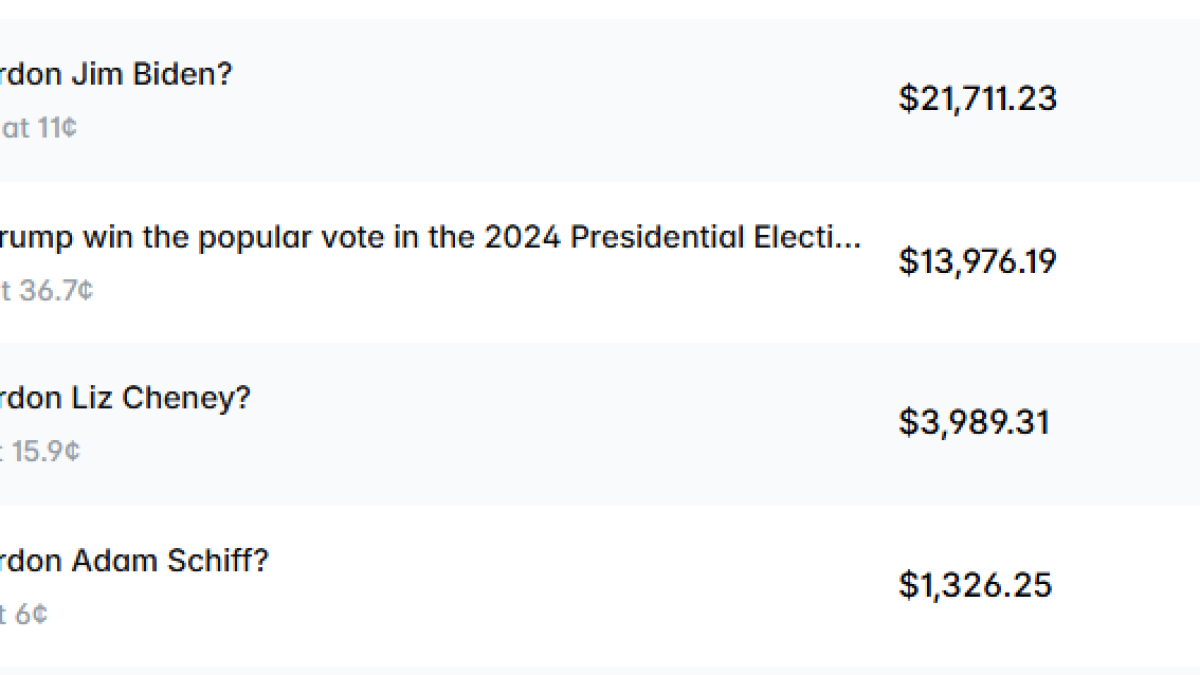
In the final hours of President Biden's term, a Polymarket trader made around $300,000 correctly betting on Biden's last-minute pardons, according to new data provided to NPR by an analytics firm that examines cryptocurrency transactions. As Biden issued a wave of pardons just hours before leaving the White House, the Polymarket trader bet big on four names, with the odds of those pardons occurring rapidly dropping to near zero on the prediction market site. The trader, whose identity is not publicly known, placed around $64,000 worth of bets that Biden would issue pre-emptive pardons for Jim Biden, the former president's brother, former Rep Liz Cheney, Sen. Adam Schiff, former Rep. Adam Kinzinger -- all prominent critics of President Trump. While none were ever charged with crimes, all four were given pardons to shield them against possible prosecution in Trump's second term. A month earlier, the same bettor placed a well-timed wager on Polymarket that Biden's son, Hunter, would receive a pardon over gun and tax charges. Together, those five bets netted the trader $316,346 in profits, according to an analysis by the Paris-based analytics company Bubblemaps, which shared its findings exclusively with NPR. "The odds of this happening by random chance are virtually zero," said Columbia Law School's Joshua Mitts, who advises the Department of Justice on insider trading cases. "The trader could've been a White House insider," he said. "But the trader could have possessed the information without being an insider," said Mitts, who published a paper last month estimating that $143 million in profits have been earned on Polymarket by bettors with insider information. The trades linked to Biden's pardons show that individuals could have been profiting from confidential government information before President Trump returned to office, when prescient bets related federal policy and military strikes on sites like Polymarket started to draw intense scrutiny. To piece together the suspicious trades related to Biden's pardons, Bubblemaps' forensic investigators looked at Polymarket trades using pattern-matching artificial intelligence software. They discovered two accounts had a perfect track record of betting on Biden pardons. "We looked at all the accounts trading on this one market and looked at their mutual transactions," Nick Vaiman, Bubblemap's founder, told NPR in an interview. "And we found a connection between two accounts, which was a shared deposit wallet." That means the analysts determined that both accounts were sending profits from Polymarket bets to the same cryptocurrency wallet on the site Kraken, a U.S.-based crypto exchange. "Exchanges like Kraken don't offer information on individual accounts," Vaiman said. "We've tried desperately, but they don't give up this information easily." Kraken has "know-your-customer" rules similar to a bank, requiring its customers to verify their identities before using the exchange. Yet it remains difficult to publicly identify a customer based on a crypto wallet alone. Federal prosecutors often find that crypto wallet-holders engaging in insider trading do so through other people or shell companies, said Mitts. "If the government subpoenas, and gets data back showing some entity did the trading that has no connections to the White House, that's where the trail runs cold." And even when a wallet on a cryptocurrency blockchain is connected to a person, a legal case of insider trading is far from open-shut, Mitts added. "If it was misappropriation of information, the problems for prosecutors begin there," he said. "Who was misappropriating? Could you prove it? Could you prove the conditions under which they got the information?" Prediction markets, like Polymarket and its main rival, Kalshi, have flourished in Trump's second term. The administration has embraced an industry once considered a pariah in Washington over fears that the markets could be ripe for abuse and manipulation. The investment firm Bernstein projects that in the next four years, prediction markets could become a $1 trillion industry, and the Trump family is getting in on the action. Donald Trump Jr., the president's son, is an adviser to both Kalshi and Polymarket. As millions of people turn White House announcements and geopolitical episodes into opportunities to make money, there have been a series of controversies over suspected insider trading. Hours before Venezuelan leader Nicolás Maduro was toppled by U.S. forces in January, a Polymarket trader placed a bet that netted $400,000. Likewise, an account trading under the username "Magamyman" made more than $500,000 after wagering on Polymarket that Iran's Ayatollah Ali Khamenei would soon no longer lead Iran. Not long after the bet was placed, an Israeli strike killed him. Most recently, a group of new accounts on Polymarket raked in hundreds of thousands of dollars in profits by betting that the U.S. and Iran would reach a ceasefire before the agreement had been unveiled. U.S. prosecutors have not announced any investigations or charges over potential insider trading. In Israel, authorities arrested several people in connection to a case alleging that military reservists traded on Polymarket using classified military intelligence. The largest U.S. prediction market, Kalshi, is regulated by the Commodity Futures Trading Commission, a status that is being contested in court by dozens of states. The CFTC prohibits betting on markets related to war, assassinations and terrorism, but otherwise has overseen the industry with a light touch, in contrast to the Biden administration, which prohibited most types of "event contracts" except those related to things that had clear public value, like the weather, oil futures and grain prices. Polymarket, too, has been welcomed by the Trump administration. Under Biden, the Federal Bureau of Investigation raided the home of Polymarket's CEO and forced the site to wind down in the U.S. It continues to operate mostly as an overseas exchange, with its largest site accessible by Americans only via virtual private network. Unlike Kalshi, Polymarket uses cryptocurrency, making it easier for traders to remain anonymous. But Trump's law enforcement agencies have taken a more hands-off approach to Polymarket's most controversial markets on everything from conditions in Gaza, war to the next nuclear detonation. "These markets are problematic," said Nizan Packin, a law professor at Baruch College. "If we want to offer this type of gambling about geopolitics and elections, we need to do this in a proper way, which means guardrails that we have created after we studied the consequences and the problems. This is not something that was done," said Packin, who co-authored a new paper in the the journal Science examining the risks of online prediction markets. "Without clear regulation, and clearer and stricter enforcement, the gray zone becomes larger and more questions should and will be asked," she said.
ChatGPT maker OpenAI shifts its focus to business users amid Anthropic pressure
The same ChatGPT chatbot that gave OpenAI's chief financial officer Sarah Friar a tilapia recipe for a recent Sunday night dinner at home is also now doing her most mundane tasks at work like summarizing her emails and Slack messages. Friar and other company executives are banking OpenAI's future on more of the latter as it shifts its focus to business-oriented products while shedding some of its consumer offerings as a pathway to profitability. Recommended Videos OpenAI says it will introduce a new artificial intelligence model for "high-value professional work" as the company faces heightened competition with rival Anthropic in attracting corporate customers to adopt AI assistants in their workplaces. "You'll see a new model coming from us in short order. We feel very excited about it," Friar said in an interview with The Associated Press. OpenAI boasts of more than 900 million weekly users of its core ChatGPT product, and Friar said about 95% of them "don't pay anything" for the popular chatbot. But while all those interactions build habits and reliance, they also strain the costly computing resources needed to power the company's AI systems and highlight the need for big business customers to help pay the bills. OpenAI, valued at $852 billion, and Anthropic, valued at $380 billion, both lose more money than they make, putting the privately-owned San Francisco-based AI research laboratories in a fierce competition to generate more revenue as they race toward becoming publicly traded on Wall Street. A push to improve performance and sales of OpenAI's business-oriented products -- already Anthropic's bread and butter -- has driven OpenAI to abandon some consumer initiatives, like the AI video generator app Sora. "I think it was a little heartbreaking, but we're like, OK, it's not the main event right now," Friar said. "We need to make sure that our new model that's coming has enough compute." Codenamed Spud, OpenAI says its "smartest model yet" offers "stronger reasoning, better understanding of intent and dependencies, better follow-through and more reliable output in production." It's part of OpenAI's answer to Anthropic's new Claude Mythos, which Anthropic claims is so "strikingly capable" that it is limiting its use to select customers because of its apparent ability to surpass human cybersecurity experts in finding or exploiting computer vulnerabilities. Friar, the former CEO of neighborhood social platform Nextdoor, said business customers accounted for about 20% of OpenAI's revenue when she was hired in 2024 as chief financial officer. She said it's now 40% and expected to account for half of OpenAI's sales by the end of the year. It's a sharp turnaround from late last year, when OpenAI co-founder and CEO Sam Altman was promoting a now-shuttered Sora partnership with Disney, launching a plan to sell ads on ChatGPT and floating the idea of letting ChatGPT engage in erotica with paid adult users. Altman said on the "Mostly Human" podcast earlier this month that a sharper focus was needed -- and Friar agrees. "Tech companies, when they're growing, it's just this natural thing that happens. There's so many cool things you could do," she said, adding that companies can end up doing "really badly" if they do too many things, while "great companies are very good at, in a reasonable period of time, kind of doing that winnowing down and refocusing and it's super painful." Signaling that shift was the hiring three months ago of Slack CEO Denise Dresser to be OpenAI's first chief revenue officer. Dresser said in a recent AP interview that she has been laser-focused on meeting with corporate leaders and positioning OpenAI as the go-to platform for workplaces employing AI agents to automate a variety of computer-based job tasks. "It's really clear to me that companies are past the experimentation phase and they're into using AI to do real work," Dresser said. "Leaders at companies are recognizing that AI is probably the most consequential shift of their lifetime." But those leaders also have a choice, namely Anthropic's Claude that has become widely used by software professionals. Founded in 2021 by a group of ex-OpenAI leaders who said they wanted to prioritize AI safety, Anthropic has positioned itself as the more responsible AI vendor. The distinction drew attention when President Donald Trump's administration punished the startup after a contract dispute over AI use in the military, and Altman used the opportunity to cement OpenAI's own deal with the Pentagon. Consumer interest in Anthropic surged and the company said its annualized revenues hit $30 billion, a higher number than what OpenAI has reported, though they measure it differently. Friar and Dresser declined to reveal OpenAI's latest sales but both have suggested that Anthropic's number is inflated because it doesn't account for revenue it must share with cloud computing providers Amazon and Google. Even so, it remains a tight competition that's also tied to the health of the stock market and the future of the economy. "They're likely quite close," said Luke Emberson, a researcher at nonprofit institute Epoch AI. "Certainly the trends show Anthropic is growing much faster than OpenAI. If that continues, they're likely to cross soon." The urgency led Dresser to send a memo to OpenAI employees on Sunday, first reported by The Verge, that asserted that Anthropic's coding focus "gave them an early wedge" but expressing confidence that OpenAI has the "real structural advantage" as AI usage expands beyond software developers and OpenAI builds enough computing capacity to operate its AI systems. "Their story is built on fear, restriction, and the idea that a small group of elites should control AI," Dresser's memo said of Anthropic. "Our positive message will win over time: build powerful systems, put in the right safeguards, expand access, and help people do more." But for skeptics of the financial viability of AI products like ChatGPT and Claude, the trajectory of both money-losing companies is alarming as smaller startups increasingly become dependent on their AI tools. Anthropic has already imposed rate limits on heavy users, forcing some to wait for hours to use Claude, and both companies have set up service tiers that reward premium payers, said author and AI critic Ed Zitron. "It's what I call the subprime AI crisis," Zitron said. "People built their lives and they built their businesses on top of these companies that, as they try and save money, will start turning the screws." One thing that both AI leaders and critics agree on is that it is an expensive technology, though whether it is worth the cost in electricity-hungry AI computers remains to be seen. "People will say, well, 'Once they go public, they're safe.' That's not true," Zitron said. "Public companies can and will die, especially ones that are dependent on $100 billion to $200 billion every year or so, just to keep breathing."

Top Low-Fee Platforms for Stock Futures Trading: MEXC vs Kraken
Choosing the right platform can directly affect your trading results, especially when comparing two well-known options. MEXC and Kraken are familiar names in the crypto market, and both often appear in 2026 comparisons regarding fees, futures features, and overall quality. A main feature of MEXC is its pricing, with spot maker fees starting at 0% and futures fees at 0% for makers and 0.02% for takers. On the other hand, Kraken is widely known as a regulated, trust-focused platform. For users looking to trade stock futures, the goal is finding the right balance between transaction costs, available tools, and reliable execution. Understanding the fee structure is a necessary step before deciding where to trade. The main difference between these two platforms is how they balance cost efficiency with a traditional, regulated environment. MEXC offers a fee model aimed at reducing transaction costs for active users. Recent data shows MEXC lists spot trading maker fees as low as 0%, and futures trading at 0% maker and 0.02% taker, which is a competitive rate in 2026. Key points: Kraken uses a more traditional and predictable fee system, particularly on Kraken Pro. While it is a reliable platform, its standard futures fees are generally higher than MEXC's. Here is a quick look at how the basic costs compare between the two exchanges. Your personal trading habits will determine which platform actually works better for you. MEXC is an exchange platform for users who make multiple trades a day and want to keep fees low. Its pricing structure is useful for those who enter and exit the market frequently. Why traders choose it: Kraken appeals to users who want a familiar, structured environment. Its main focus is on consistency and clarity rather than offering the lowest possible fees. Why traders choose it: Matching your strategy to the platform can save time and money. Base fees are important, but they are not the only expenses you will face. Other platform costs can affect your overall budget over time. Funding rates and spreads The cost of futures trading goes beyond the initial maker or taker fee. Funding rates apply to positions you hold open, and spreads impact the actual entry or exit price. You can check both platforms for these specific numbers before placing an order. Moving your money also costs money. A platform might have low trading fees but charge more when you want to withdraw your funds. It is helpful to check the withdrawal fees for the specific coins you plan to move, as this can change the overall cost efficiency of the platform. A good trading platform needs the right tools, not just a good price. MEXC and Kraken focus on different user needs regarding interface and functionality. MEXC trading tools MEXC provides a wide range of markets, including real-time data on PI price, and features designed for active trading. It focuses on offering a large selection of assets and tools for quick execution. Kraken focuses on delivering a smooth and professional trading experience. It is built to be stable and easy to navigate, even for complex orders. Highlights: Summarizing the strengths and weaknesses can make the final choice clearer. Both platforms serve their specific audiences well, depending on what the user values most. MEXC is a practical choice for stock futures-style trading if your main goal is to minimize fees. Kraken is a solid alternative if you prefer a highly regulated, long-standing exchange and do not mind paying slightly higher fees for that structure. For active, cost-conscious traders, MEXC offers the more direct financial advantage based on its current fee schedule. Here are some common questions traders have when comparing these two platforms. Yes, based on current standard rates, MEXC is generally cheaper for futures trading, particularly because of its 0% maker fee and low taker fee. Kraken has tiered pricing that gets cheaper as you trade more. However, for most standard users, it is not as cheap as MEXC. Kraken offers a structured, familiar environment that many beginners find easy to trust. However, MEXC is also suitable for beginners who want to start with minimal transaction costs. You should also look at funding rates, bid-ask spreads, and withdrawal fees, as these will affect your total expenses.
Anthropic announces major UK expansion amid Mythos testing
The news: AI lab Anthropic is expanding its presence in the UK with new office space for 800 people in the 'Knowledge Quarter' area of London, where OpenAI, Google DeepMind, Meta and other AI firms have set up shop. The company current has around 200 employees in London. The context: "London is already one of our most important research and commercial hubs outside the US, and our expansion in the Knowledge Quarter gives us the room to grow into," Pip White, Anthropic's head of EMEA north, said in a statement. "The UK combines ambitious enterprises and institutions that understand what's at stake with AI safety with an exceptional pool of AI talent -- we want to be where all of that comes together." White also said that the company is expanding its 'Project Glasswing' program in the UK, giving certain organisations early access to its new AI model 'Mythos' to give cybersecurity professionals a chance to test it against internal defences as it could exploit cyber vulnerabilities.

CoreWeave's April Shockwave -- Meta, Anthropic, Jane Street All Say Yes - CoreWeave (NASDAQ:CRWV), Meta Pl
Meta Doubles Down With $21B Expansion The streak began on April 9, when CoreWeave announced a major expansion of its partnership with Meta Platforms. In its official statement, the company confirmed that Meta added roughly $21 billion in new commitments running through 2032. That brings Meta's total contracted spend with CoreWeave to more than $35 billion. Anthropic Picks CoreWeave For Production Scale A day later, Anthropic signed a multi‑year production agreement with CoreWeave. Neither company disclosed financial terms, but CoreWeave described the deal as covering Anthropic's primary production workloads. Choosing CoreWeave for production‑grade capacity shows how aggressively the AI lab is optimizing for specialized, high‑performance compute. Jane Street Brings Capital -- And Credibility At the same time, Jane Street purchased $1 billion of CoreWeave Class A common stock at $109 per share, a 7% discount to the prior close. That investment immediately placed the firm among CoreWeave's five largest shareholders, with a stake valued around $1.44 billion. Jane Street also secured early access to Nvidia's Vera Rubin chips -- a major draw for quantitative models that increasingly resemble frontier‑scale AI systems. The New AI Bottleneck Isn't Just Big Tech Taken together, the Meta, Anthropic, and Jane Street deals point to a broader shift in the market. Demand for cutting‑edge compute is no longer concentrated among the hyperscalers. Wall Street, consumer‑tech giants, and frontier AI labs are all converging on the same bottleneck -- and CoreWeave has positioned itself directly in that flow. April isn't over yet, but CoreWeave has already delivered one of the most consequential deal streaks of the AI‑cloud era. As for CRWV stock, it's seeing a bit of a bump, with shares up over 50% since the beginning of April. Up over 190% over the past year, the stock still sits ~36% below its 52-week high. Photo: PJ McDonnell / Shutterstock Market News and Data brought to you by Benzinga APIs To add Benzinga News as your preferred source on Google, click here.

Starlink outage disrupts drone tests, exposes Pentagon's dependence on SpaceX for critical systems
Last August, US Navy officials carrying out a test of unmanned vessels realized they had hit a single point of failure: Starlink. A global outage across Elon Musk's satellite network affecting millions of Starlink users had left two dozen unmanned surface vessels bobbing off the California coast, disrupting communications and halting operations for almost an hour. The incident, which involved drones intended to bolster US military options in a conflict with China, was one of several Navy test disruptions linked to SpaceX's Starlink that left operators unable to connect with autonomous boats, according to internal Navy documents reviewed by Reuters and a person familiar with the matter. As SpaceX rockets toward a $2 trillion public offering this summer - expected to be the largest ever - the company has secured its position as the world's most valuable space company in part by being indispensable to the US government with an array of technologies spanning satellite communications to space launches and military AI. Starlink, in particular, has proved key to crucial programs - from drones to missile tracking - with a low-earth orbit constellation of close to 10,000 satellites, a scale that provides the military with a network resilient against potential adversary attacks. But the Navy's mishaps with Starlink for its autonomous drone program, which have not been previously reported, highlight the challenges of the US military's growing reliance on SpaceX and the risks it brings to the Pentagon. "If there was no Starlink, the US government wouldn't have access to a global constellation of low earth orbit communications," said Clayton Swope, a deputy director of the Aerospace Security Project at the Center for Strategic and International Studies. The Pentagon did not respond to questions about the drone test or SpaceX's work with the Navy. The Pentagon's chief information officer, Kirsten Davies, said the "Department leverages multiple, robust, resilient systems for its broad network." The Navy and SpaceX did not respond to requests for comment. Despite facing growing competition from Amazon.com, which announced an $11.6 billion agreement this week to acquire satellite maker Globalstar, SpaceX remains far ahead in low-earth orbit communications. Beyond drones, SpaceX has cemented a near-monopoly for space launches and provides satellite communications with Starlink and its national security-focused constellation, Starshield, generating billions of dollars for the company. Last month, US Space Force said it had reassigned its upcoming GPS launch to a SpaceX rocket for the fourth time, due to a glitch in the Vulcan rocket made by the Boeing and Lockheed Martin joint venture United Launch Alliance. Warnings about relying on SpaceX Democratic lawmakers have warned the Pentagon about the risks of its reliance on a single company led by the world's richest man to deliver crucial national security capabilities. More recently, the Defense Department's disagreements and blacklisting of AI startup Anthropic quickly revealed how an overreliance on one AI vendor could create problems should that vendor be dropped. Reuters reported last year that Musk unexpectedly switched off Starlink access to Ukrainian troops as they sought to retake territory from Russia, denting allies' trust in the billionaire. In Taiwan, SpaceX faced criticism over concerns it was withholding satellite communications to US service members based there, "possibly in breach of SpaceX's contractual obligations with the US government," according to a 2024 letter sent by then-US Representative Mike Gallagher to Musk, reported by Forbes at the time. SpaceX disputed the claim in a post on X. Reuters could not determine whether SpaceX has since provided Starlink service in Taiwan to US service members. The Pentagon and SpaceX did not respond to questions about Taiwan. "As a matter of operational security, we do not comment on or discuss plans, operations capabilities or effects," an official said in a statement. Starlink 'exposed limitations' SpaceX's Starlink broadband has been crucial to the Pentagon's drone program, providing connection to small unmanned maritime vessels that look like speedboats without seats, and include those made by Maryland-based BlackSea and Austin, Texas-based Saronic. In April 2025, during a series of Navy tests in California involving unmanned boats and flying drones, officials reported that Starlink struggled to provide a solid network connection due to the high data usage needed to control multiple systems, according to a Navy safety report of the tests reviewed by Reuters. "Starlink reliance exposed limitations under multiple-vehicle load," the report stated. The report also faulted issues linked to radios provided by Silvus and a network system provided by Viasat. In the weeks leading up to the global Starlink outage in August, another series of Navy tests was disrupted by intermittent connection issues with the Starlink network, Navy documents reviewed by Reuters show. The causes of the network losses were not immediately clear. Despite the setbacks, the upside of Starlink - a cheap and commercially available service - outweighs the risk of a potential outage disrupting future military operations, said Bryan Clark, an autonomous warfare expert at the Hudson Institute. "You accept those vulnerabilities because of the benefits you get from the ubiquity it provides," he said.

New citizen: The planet is in chaos! But Belarus is a place of peace
The life journey of Mohammed Muslem, who now lives and works in Gomel, is full of twists and turns. Of Palestinian descent, he was born in Egypt, then lived and studied in Yemen. His parents and sister now reside in Jordan. Hospitable and welcoming Belarus has become the place of strength, the true home that is a real fortress for him. On 15 April he became one of the 230 foreign citizens and stateless persons who had been granted Belarusian citizenship. In an interview with a BelTA reporter Mohammed Muslem, a dental surgeon at Gomel Oblast Clinical Polyclinic, spoke about how he began his journey in the land under white wings and what he is grateful to Belarus and the Belarusian people for. "I came to Belarus in 2017. I had to choose where to undergo residency training in maxillofacial surgery. I was told that Belarus provides good knowledge and has a high level of science. So I decided to come here," the interviewee recalled. He admits that the most difficult thing at the beginning of his journey was not speaking the language. "It is a completely different language. Complicated. At first it seemed impossible to learn it. I did not know a single letter. But I tried very hard to learn to speak it. The people around me helped. And now I speak normally more or less," Mohammed said while glad that the language barrier has now been overcome. He is also captivated by the melodiousness of the Belarusian language. "I know very few words myself. But when I listen to the TV, I understand quite well. My wife translates some words for me. For example, I was surprised that 'tykva' [pumpkin] is 'garbuz' [in Belarusian]," the new citizen of Belarus delved into linguistic nuances. The Belarusian climate has also become familiar to him. "The year I arrived, it was as cold as minus 30 degrees. I saw snow and felt such cold for the first time in my life. But now I know: when it is winter, one has to prepare warm clothes," the man smiles. After completing his residency, Mohammed decided to stay in Belarus. His family with his wonderful wife Tatiana was taking shape here, and there was no opportunity to return to Yemen: the situation over there was too dangerous. "I met Tatiana through mutual friends. We got used to each other and found common ground. She helped me a lot, supported me from the very beginning, including with document verification and when I was getting a job. Then we got married, and after some time our daughter Masha was born. She is very active, lively, energetic, and cheerful. On the children's playground she is always the leader. Would you like to see her photo?" the happy father and husband says, scrolling through the gallery on his mobile phone. Most of the pictures show a smiling girl with big brown eyes and charming curls. The photos also capture moments of family leisure and trips to nature. "I really like Belarusian nature. The forest gives me strength and helps me recover. It has such a calming energy. I haven't learned how to pick mushrooms yet, but I really enjoy breathing the forest air. We also like to visit eco-farms. Our daughter enjoys interacting with animals," Mohammed comments on the photos. One of the photos shows a delighted little girl with a bouquet of flowers as tall as she is. "That was for Women's Day," the father clarifies. "Yes, I already know all the holidays celebrated in Belarus: Easter, Women's Day. I am Muslim, my wife is Orthodox. And we respect each other's traditions. Culinary ones as well." Many Belarusian dishes have become Mohammed's favorites. "Draniki, casserole, borscht," he lists. He had a bit of difficulty with kvass, and the taste of cold sorrel soup also took some getting used to. "But now I eat cold sorrel soup just fine. Smoked and salted fish are also fine now," the interviewee laughs. "I taught my wife how to cook our pilaf. There are always falafel preparations in the freezer. We cook that all the time. I mean we combine both Belarusian and Arab dishes on the table." "On the whole, I feel very close to the traditions that are honored in Belarus. This includes respect for elders and neighbors, the traditional strong family, mutual assistance, and normal communication. Not like in Western Europe," the interviewee emphasized. "Look at what is happening all over the planet today! Belarus remains an island of peace. This is largely thanks to the president. The people here are very kind. It is completely calm, safe, and comfortable to live here. Anyone who wants to work is welcome to. There are opportunities for building or buying a home. You can achieve anything. You just need to try and work. But most importantly, I will say it again, the sky here is peaceful," Mohammed stressed. "And having received Belarusian citizenship, I feel proud. I want to continue to be useful to society and to people. I want to thank the Belarusian people, the country, and the leadership for accepting me. They welcomed me warmly at the initial stage, and then at work. And everything involves no problems. Belarus has become my native country, a true home. Here is my family. Here we bought a home - an apartment. We live and make plans for the future. I love our Gomel very much. It has magnificent nature, a unique park, and cozy public gardens. And, I repeat, people with very kind souls," the new citizen of Belarus emphasized. By the way, both his colleagues and patients call him a person with an open heart and a doctor with golden hands. "He is very responsible, a true professional, and a good-natured person. You understand: everyone comes to a dental surgeon's office with fear. But people leave Mohammed's office with a smile and thank the doctor for his professionalism, for his personal qualities," noted Yelena Ostapyuk, Chief Physician of Gomel Oblast Clinical Polyclinic. In support of her words the head of the institution read out kind reviews written by patients. "I am grateful for his attentive and professional attitude towards us, elderly people. Thank you for such an attitude in urgent cases," Vera Markovna expressed her gratitude. "Over a fairly long period I underwent a course of treatment with Mohammed Muslem. Fortunately, I encountered the excellent professional and human qualities of this amazing person. The doctor's tact, delicacy, and attentive attitude deserve immense gratitude, which I am pleased to express. I wish him and his family health, strength, and well-being. Yelena Ivanovna [Ostapyuk], if only you had more specialists like him," wrote Nelly Fyodorovna, a veteran of labor. BelTA reported earlier that on 15 April Belarusian citizenship was granted to 230 foreign citizens and stateless persons, including 13 minors. Belarus President Aleksandr Lukashenko signed the corresponding decree. People from 19 states have become the new citizens of Belarus. The number includes Russia, Moldova, Kazakhstan, Armenia, Syria, Latvia, Türkiye, and other countries. Most of them came from Ukraine. The individuals who have been granted Belarusian citizenship have lived in the country for five years or more, speak one of the state languages, and are occupied in various branches of the national economy. Photos from Mohammed Muslem's personal archive and taken by BelTA

A Polymarket trader made $300,000 betting on Biden's pardons, a new analysis shows
In the final hours of President Biden's term, a Polymarket trader made around $300,000 correctly betting on Biden's last-minute pardons, according to new data provided to NPR by an analytics firm that examines cryptocurrency transactions. As Biden issued a wave of pardons just hours before leaving the White House, the Polymarket trader bet big on four names, with the odds of those pardons occurring rapidly dropping to near zero on the prediction market site. The trader, whose identity is not publicly known, placed around $64,000 worth of bets that Biden would issue pre-emptive pardons for Jim Biden, the former president's brother, former Rep Liz Cheney, Sen. Adam Schiff, former Rep. Adam Kinzinger -- all prominent critics of President Trump. While none were ever charged with crimes, all four were given pardons to shield them against possible prosecution in Trump's second term. A month earlier, the same bettor placed a well-timed wager on Polymarket that Biden's son, Hunter, would receive a pardon over gun and tax charges. Together, those five bets netted the trader $316,346 in profits, according to an analysis by the Paris-based analytics company Bubblemaps, which shared its findings exclusively with NPR. "The odds of this happening by random chance are virtually zero," said Columbia Law School's Joshua Mitts, who advises the Department of Justice on insider trading cases. "The trader could've been a White House insider," he said. "But the trader could have possessed the information without being an insider," said Mitts, who published a paper last month estimating that $143 million in profits have been earned on Polymarket by bettors with insider information. The trades linked to Biden's pardons show that individuals could have been profiting from confidential government information before President Trump returned to office, when prescient bets related federal policy and military strikes on sites like Polymarket started to draw intense scrutiny. To piece together the suspicious trades related to Biden's pardons, Bubblemaps' forensic investigators looked at Polymarket trades using pattern-matching artificial intelligence software. They discovered two accounts had a perfect track record of betting on Biden pardons. "We looked at all the accounts trading on this one market and looked at their mutual transactions," Nick Vaiman, Bubblemap's founder, told NPR in an interview. "And we found a connection between two accounts, which was a shared deposit wallet." That means the analysts determined that both accounts were sending profits from Polymarket bets to the same cryptocurrency wallet on the site Kraken, a U.S.-based crypto exchange. "Exchanges like Kraken don't offer information on individual accounts," Vaiman said. "We've tried desperately, but they don't give up this information easily." Kraken has "know-your-customer" rules similar to a bank, requiring its customers to verify their identities before using the exchange. Yet it remains difficult to publicly identify a customer based on a crypto wallet alone. Federal prosecutors often find that crypto wallet-holders engaging in insider trading do so through other people or shell companies, said Mitts. "If the government subpoenas, and gets data back showing some entity did the trading that has no connections to the White House, that's where the trail runs cold." And even when a wallet on a cryptocurrency blockchain is connected to a person, a legal case of insider trading is far from open-shut, Mitts added. "If it was misappropriation of information, the problems for prosecutors begin there," he said. "Who was misappropriating? Could you prove it? Could you prove the conditions under which they got the information?" Prediction markets, like Polymarket and its main rival, Kalshi, have flourished in Trump's second term. The administration has embraced an industry once considered a pariah in Washington over fears that the markets could be ripe for abuse and manipulation. The investment firm Bernstein projects that in the next four years, prediction markets could become a $1 trillion industry, and the Trump family is getting in on the action. Donald Trump Jr., the president's son, is an adviser to both Kalshi and Polymarket. As millions of people turn White House announcements and geopolitical episodes into opportunities to make money, there have been a series of controversies over suspected insider trading. Hours before Venezuelan leader Nicolás Maduro was toppled by U.S. forces in January, a Polymarket trader placed a bet that netted $400,000. Likewise, an account trading under the username "Magamyman" made more than $500,000 after wagering on Polymarket that Iran's Ayatollah Ali Khamenei would soon no longer lead Iran. Not long after the bet was placed, an Israeli strike killed him. Most recently, a group of new accounts on Polymarket raked in hundreds of thousands of dollars in profits by betting that the U.S. and Iran would reach a ceasefire before the agreement had been unveiled. U.S. prosecutors have not announced any investigations or charges over potential insider trading. In Israel, authorities arrested several people in connection to a case alleging that military reservists traded on Polymarket using classified military intelligence. The largest U.S. prediction market, Kalshi, is regulated by the Commodity Futures Trading Commission, a status that is being contested in court by dozens of states. The CFTC prohibits betting on markets related to war, assassinations and terrorism, but otherwise has overseen the industry with a light touch, in contrast to the Biden administration, which prohibited most types of "event contracts" except those related to things that had clear public value, like the weather, oil futures and grain prices. Polymarket, too, has been welcomed by the Trump administration. Under Biden, the Federal Bureau of Investigation raided the home of Polymarket's CEO and forced the site to wind down in the U.S. It continues to operate mostly as an overseas exchange, with its largest site accessible by Americans only via virtual private network. Unlike Kalshi, Polymarket uses cryptocurrency, making it easier for traders to remain anonymous. But Trump's law enforcement agencies have taken a more hands-off approach to Polymarket's most controversial markets on everything from conditions in Gaza, war to the next nuclear detonation. "These markets are problematic," said Nizan Packin, a law professor at Baruch College. "If we want to offer this type of gambling about geopolitics and elections, we need to do this in a proper way, which means guardrails that we have created after we studied the consequences and the problems. This is not something that was done," said Packin, who co-authored a new paper in the the journal Science examining the risks of online prediction markets. "Without clear regulation, and clearer and stricter enforcement, the gray zone becomes larger and more questions should and will be asked," she said.

A Polymarket trader made $300,000 betting on Biden's pardons, a new analysis shows
In the final hours of President Biden's term, a Polymarket trader made around $300,000 correctly betting on Biden's last-minute pardons, according to new data provided to NPR by an analytics firm that examines cryptocurrency transactions. As Biden issued a wave of pardons just hours before leaving the White House, the Polymarket trader bet big on four names, with the odds of those pardons occurring rapidly dropping to near zero on the prediction market site. The trader, whose identity is not publicly known, placed around $64,000 worth of bets that Biden would issue pre-emptive pardons for Jim Biden, the former president's brother, former Rep Liz Cheney, Sen. Adam Schiff, former Rep. Adam Kinzinger -- all prominent critics of President Trump. While none were ever charged with crimes, all four were given pardons to shield them against possible prosecution in Trump's second term. A month earlier, the same bettor placed a well-timed wager on Polymarket that Biden's son, Hunter, would receive a pardon over gun and tax charges. Together, those five bets netted the trader $316,346 in profits, according to an analysis by the Paris-based analytics company Bubblemaps, which shared its findings exclusively with NPR. "The odds of this happening by random chance are virtually zero," said Columbia Law School's Joshua Mitts, who advises the Department of Justice on insider trading cases. "The trader could've been a White House insider," he said. "But the trader could have possessed the information without being an insider," said Mitts, who published a paper last month estimating that $143 million in profits have been earned on Polymarket by bettors with insider information. The trades linked to Biden's pardons show that individuals could have been profiting from confidential government information before President Trump returned to office, when prescient bets related federal policy and military strikes on sites like Polymarket started to draw intense scrutiny. To piece together the suspicious trades related to Biden's pardons, Bubblemaps' forensic investigators looked at Polymarket trades using pattern-matching artificial intelligence software. They discovered two accounts had a perfect track record of betting on Biden pardons. "We looked at all the accounts trading on this one market and looked at their mutual transactions," Nick Vaiman, Bubblemap's founder, told NPR in an interview. "And we found a connection between two accounts, which was a shared deposit wallet." That means the analysts determined that both accounts were sending profits from Polymarket bets to the same cryptocurrency wallet on the site Kraken, a U.S.-based crypto exchange. "Exchanges like Kraken don't offer information on individual accounts," Vaiman said. "We've tried desperately, but they don't give up this information easily." Kraken has "know-your-customer" rules similar to a bank, requiring its customers to verify their identities before using the exchange. Yet it remains difficult to publicly identify a customer based on a crypto wallet alone. Federal prosecutors often find that crypto wallet-holders engaging in insider trading do so through other people or shell companies, said Mitts. "If the government subpoenas, and gets data back showing some entity did the trading that has no connections to the White House, that's where the trail runs cold." And even when a wallet on a cryptocurrency blockchain is connected to a person, a legal case of insider trading is far from open-shut, Mitts added. "If it was misappropriation of information, the problems for prosecutors begin there," he said. "Who was misappropriating? Could you prove it? Could you prove the conditions under which they got the information?" Prediction markets, like Polymarket and its main rival, Kalshi, have flourished in Trump's second term. The administration has embraced an industry once considered a pariah in Washington over fears that the markets could be ripe for abuse and manipulation. The investment firm Bernstein projects that in the next four years, prediction markets could become a $1 trillion industry, and the Trump family is getting in on the action. Donald Trump Jr., the president's son, is an adviser to both Kalshi and Polymarket. As millions of people turn White House announcements and geopolitical episodes into opportunities to make money, there have been a series of controversies over suspected insider trading. Hours before Venezuelan leader Nicolás Maduro was toppled by U.S. forces in January, a Polymarket trader placed a bet that netted $400,000. Likewise, an account trading under the username "Magamyman" made more than $500,000 after wagering on Polymarket that Iran's Ayatollah Ali Khamenei would soon no longer lead Iran. Not long after the bet was placed, an Israeli strike killed him. Most recently, a group of new accounts on Polymarket raked in hundreds of thousands of dollars in profits by betting that the U.S. and Iran would reach a ceasefire before the agreement had been unveiled. U.S. prosecutors have not announced any investigations or charges over potential insider trading. In Israel, authorities arrested several people in connection to a case alleging that military reservists traded on Polymarket using classified military intelligence. The largest U.S. prediction market, Kalshi, is regulated by the Commodity Futures Trading Commission, a status that is being contested in court by dozens of states. The CFTC prohibits betting on markets related to war, assassinations and terrorism, but otherwise has overseen the industry with a light touch, in contrast to the Biden administration, which prohibited most types of "event contracts" except those related to things that had clear public value, like the weather, oil futures and grain prices. Polymarket, too, has been welcomed by the Trump administration. Under Biden, the Federal Bureau of Investigation raided the home of Polymarket's CEO and forced the site to wind down in the U.S. It continues to operate mostly as an overseas exchange, with its largest site accessible by Americans only via virtual private network. Unlike Kalshi, Polymarket uses cryptocurrency, making it easier for traders to remain anonymous. But Trump's law enforcement agencies have taken a more hands-off approach to Polymarket's most controversial markets on everything from conditions in Gaza, war to the next nuclear detonation. "These markets are problematic," said Nizan Packin, a law professor at Baruch College. "If we want to offer this type of gambling about geopolitics and elections, we need to do this in a proper way, which means guardrails that we have created after we studied the consequences and the problems. This is not something that was done," said Packin, who co-authored a new paper in the the journal Science examining the risks of online prediction markets. "Without clear regulation, and clearer and stricter enforcement, the gray zone becomes larger and more questions should and will be asked," she said.