News & Updates
The latest news and updates from companies in the WLTH portfolio.
Anthropic, Cursor Backer Accel Raises $5 Billion for Big AI Bets
, the venture capital firm that's backed artificial intelligence companies including Anthropic, Cursor and Perplexity, has raised $5 billion in new funds to keep up its big bets in the age of increasingly valuable artificial intelligence startups. The firm will dedicate $4 billion to its fifth Leaders fund, focused on writing large checks to late-stage startups around the world, Accel plans to announce Wednesday. The firm also raised $650 million for a so-called sidecar fund, which gives limited partners extra exposure to Accel's biggest investments by allowing it to selectively increase the size of certain bets, especially for investments in its existing portfolio, Accel partner

Adobe releases AI assistant for creative tools, says it will work with Anthropic's Claude By Reuters
SAN FRANCISCO, April 15 (Reuters) - Adobe said on Wednesday it was releasing a new artificial intelligence assistant designed to help users carry out tasks across its suite of software for editing photos, videos and other digital content. * The Firefly AI assistant is designed to take orders fromhuman creative professionals about what results they want for apiece of content and then autonomously tap into Adobe's softwaretools, such as Photoshop, Illustrator and Premiere Pro, to getthat outcome. * The new capabilities will also be available to users ofAnthropic's Claude AI model through a connector to Adobe, thoughAdobe did not disclose the financial arrangements between thefirms. * "There are parts of projects, or individual sections of animage, where you really care about getting into theindividual pixels, and we want to continue to support customersin doing that, but there are places where you would be happy tojust hand this stuff off to an agent or an assistant," said ElyGreenfield, chief technology officer at Adobe's creativity andproductivity business unit. * The Firefly AI assistant is the latest in a series ofAdobe investments since 2023 in proprietary AI tools that itsays are financially guaranteed as safe for use in corporatesettings. This is one of the ways Adobe is trying todifferentiate itself from lower-cost rivals as AI lowers thebarrier to entry for creating images and videos. * Adobe's longtime CEO said last month that he will stepdown after a successor is named, amid investor skepticism aboutwhen the company's AI investments will pay off. * Adobe did not disclose how much the new assistant willcost users, but said it expects the assistant to increase theirconsumption of what it calls AI credits, the main way thecompany currently charges for AI products.

Anthropic Shifts Claude AI to Pay-As-You-Go Pricing for Third-Party Tools Amid Surging Demand
SAN FRANCISCO -- Anthropic, the artificial intelligence company behind the popular Claude models, is introducing usage-based "pay-as-you-go" pricing for third-party tools and services connecting to its chatbot, marking a significant shift from its flat-rate subscription model as explosive demand strains computing resources. The change, which took effect April 4 for tools like OpenClaw and is expanding to other third-party harnesses, means Claude Pro and Max subscribers can no longer rely solely on their monthly fees for automated or high-volume external integrations. Instead, such usage will draw from a separate pay-as-you-go "extra usage" balance billed at standard API rates. Anthropic notified affected users via email that starting at noon Pacific on April 4, third-party harnesses would no longer consume subscription limits. Boris Cherny, head of Claude Code at Anthropic, explained on X that subscriptions "weren't built for the usage patterns of these third-party tools." The company aims to manage growth sustainably while prioritizing direct customers and API users. The move comes as Claude's popularity has skyrocketed, with usage reportedly overwhelming capacity in some cases. Heavy automated agent workloads through external frameworks were effectively subsidizing at flat subscription prices -- sometimes $20 for Pro or $100-$200 for Max tiers -- that did not reflect the true computational cost of continuous operation. To ease the transition, Anthropic offered a one-time credit equal to each subscriber's monthly plan cost, redeemable by April 17 and valid for 90 days. It also provided discounts of up to 30% on prepaid usage bundles. Users can still access Claude through the company's own interfaces, including claude.ai, Claude Code and Claude Cowork, under their existing subscription limits. Enterprise Shift to Consumption-Based Billing Beyond individual subscribers, Anthropic is revising enterprise pricing to emphasize usage-based charges. Reports indicate a move away from high fixed per-seat subscriptions toward lower base fees combined with mandatory consumption commitments. This addresses a broader "compute crunch" driven by rapid adoption across businesses. Enterprise customers now face structures such as $20 per month per technical seat plus pay-per-token usage, replacing older all-inclusive models. The change reflects the reality that some organizations were generating thousands of dollars in underlying compute value from subscriptions priced far lower. Industry analysts view the adjustments as part of a maturing AI market where providers move from subsidized "all-you-can-eat" plans to metered billing that better aligns costs with resource consumption. Similar trends have appeared at competitors, though Anthropic's focus on safety and constitutional AI has positioned it as a premium option. Impact on Developers and Agent Ecosystem The policy shift particularly affects users of agentic tools that automate complex workflows. OpenClaw, a prominent open-source framework, was among the first impacted. Its creator, Peter Steinberger, had recently joined OpenAI, adding intrigue to the competitive landscape. Developers now have options: enable extra usage for seamless continuation, switch to direct API keys for programmatic access, or purchase prepaid bundles. API pricing remains token-based, with rates varying by model -- for example, flagship models command higher per-million-token fees for input and output. Some users expressed frustration on forums like Reddit and Hacker News, noting that heavy agent usage could quickly exceed previous flat-rate economics. Others welcomed clearer cost transparency, arguing it prevents abuse and ensures broader availability. Anthropic emphasized that core subscription benefits remain intact for direct platform use. Pro users continue enjoying enhanced access within Claude's ecosystem, while Max tiers offer significantly higher limits for power users. Broader Industry Context The timing aligns with intense competition in generative AI. OpenAI, Google, Meta and others are also refining pricing as models grow more capable and expensive to run. Compute costs -- driven by GPU clusters and energy demands -- have become a central challenge for the sector. Anthropic, backed by Amazon and Google, has raised billions to fuel expansion while maintaining a cautious approach to deployment. The company has highlighted responsible scaling, and executives have warned that unchecked demand could compromise reliability for all users. For businesses integrating Claude into workflows, the new model encourages more deliberate usage and better cost forecasting. Smaller teams may stick to direct interfaces, while large-scale deployers shift fully to API contracts with committed spend. Reactions and Future Outlook Early feedback has been mixed. Power users running autonomous agents face higher potential bills, but many appreciate the one-time credit as a buffer. Enterprise sales teams are reportedly working with customers to restructure agreements around predictable consumption. Analysts predict this could set a precedent. As AI agents proliferate, flat subscriptions may prove unsustainable for backend providers. Metered pricing better reflects variable workloads, from occasional queries to 24/7 automation. Anthropic has not detailed further consumer plan changes but signaled ongoing evaluation. The company continues investing in efficiency improvements, larger context windows and new model releases to balance capability with accessibility. As the AI industry grapples with scaling economics, Anthropic's pivot underscores a key tension: delivering powerful tools affordably while covering skyrocketing infrastructure costs. For Claude users, the era of unlimited third-party usage under consumer subscriptions has ended, replaced by a more granular, consumption-aware approach. The full effects will unfold in coming weeks as the rollout expands and organizations adjust budgets. One thing is clear: in AI, as in other technology sectors, "pay as you go" is becoming the default for high-demand, resource-intensive services.
AI Weekly: Chipmakers earnings charge, Anthropic's cybersecurity fears
AI Weekly: Chipmakers earnings charge, Anthropic's cybersecurity fears From billions in earnings for chipmakers to Anthropic's cybersecurity concerns, Sean Hogan rounds up the latest stories from the AI revolution.

Adobe releases AI assistant for creative tools, says it will work with Anthropic's Claude
SAN FRANCISCO, April 15 (Reuters) - Adobe said on Wednesday it was releasing a new artificial intelligence assistant designed to help users carry out tasks across its suite of software for editing photos, videos and other digital content. * The Firefly AI assistant is designed to take orders fromhuman creative professionals about what results they want for apiece of content and then autonomously tap into Adobe's softwaretools, such as Photoshop, Illustrator and Premiere Pro, to getthat outcome. * The new capabilities will also be available to users ofAnthropic's Claude AI model through a connector to Adobe, thoughAdobe did not disclose the financial arrangements between thefirms. * "There are parts of projects, or individual sections of animage, where you really care about getting into theindividual pixels, and we want to continue to support customersin doing that, but there are places where you would be happy tojust hand this stuff off to an agent or an assistant," said ElyGreenfield, chief technology officer at Adobe's creativity andproductivity business unit. * The Firefly AI assistant is the latest in a series ofAdobe investments since 2023 in proprietary AI tools that itsays are financially guaranteed as safe for use in corporatesettings. This is one of the ways Adobe is trying todifferentiate itself from lower-cost rivals as AI lowers thebarrier to entry for creating images and videos. * Adobe's longtime CEO said last month that he will stepdown after a successor is named, amid investor skepticism aboutwhen the company's AI investments will pay off. * Adobe did not disclose how much the new assistant willcost users, but said it expects the assistant to increase theirconsumption of what it calls AI credits, the main way thecompany currently charges for AI products. (Reporting by Stephen Nellis in San Francisco; Editing by Jamie Freed)

Uber CTO Says Anthropic AI Spend Blew Past Budget, $3.4B R&D - Uber Technologies (NYSE:UBER)
Uber's Anthropic AI Push Hits A Wall -- CTO Says Budget Struggles Despite $3.4B Spend According to The Information, Chief Technology Officer Praveen Neppalli Naga said Uber is now "back to the drawing board" after a surge in the use of AI coding tools, particularly Anthropic's Claude Code, has blown past internal expectations. AI Usage Surge, Costs Follow Uber didn't hold back on AI adoption. Engineers were actively encouraged to use tools like Claude Code and Cursor, even ranking them on internal leaderboards based on usage. That push drove rapid adoption -- but also a sharp rise in costs. Naga noted that Claude Code has quickly become the dominant tool, with usage surging since late last year, while Cursor has plateaued. Uber is now preparing to test OpenAI's Codex as it expands its AI stack further. The financial pressure is already building. Uber's R&D expenses rose 9% to $3.4 billion in 2025, and the company expects that figure to keep climbing -- suggesting AI may be as much a cost driver as a productivity lever. AI Moves Into The Driver's Seat The payoff is starting to show. Around 11% of Uber's live backend code updates are now written by AI agents, up sharply in just a few months. These systems power everything from ride-matching to pricing and bug fixes. Naga said the longer-term vision goes further. He sees a shift toward "agent engineers" -- AI systems that don't just assist but fully handle coding, testing and deployment, with other AI tools supervising the process. Hiring hasn't slowed yet. But as AI takes on more of the workload, Uber's aggressive push raises a bigger question: how long before the engineers themselves start taking a back seat? Image via Shutterstock Market News and Data brought to you by Benzinga APIs To add Benzinga News as your preferred source on Google, click here.

Solana DEX volume hits $10.7B, surpasses Coinbase and Kraken
Solana DEX trading volume has hit $10.71 billion, outpacing Coinbase and Kraken. The market odds for Solana being above $40 on April 15 are at YES. Market reaction The current term structure shows consistent odds across all April 15 sub-markets, with no significant movement over the past 24 hours, pointing to strong consensus on Solana's price stability above $40. Combined 24-hour actual USDC traded is $39,973. Odds for Solana reaching $150 in April are lower than the April 15 market but still reflect positive sentiment. Why it matters The $10.71 billion in DEX volume exceeding two major centralized exchanges signals heavy on-chain activity on Solana. This surge coincides with US-Iran geopolitical tensions that have increased cryptocurrency market volatility. Solana's decentralized exchange maintained higher trading volumes than Coinbase and Kraken even under these conditions, which could support price levels. At the same time, the geopolitical situation cuts both ways: it may drive more users toward decentralized platforms, or it may create broader instability that drags prices down. What to watch Announcements from the Solana Foundation or significant shifts in US-Iran tensions could move Solana's market performance and alter investor sentiment. The gap between the near-certain $40 market and the lower-confidence $150 market is worth tracking as a measure of how bullish traders actually are beyond the floor. API CTA

Anthropic Draws $800 Bn Valuation Offers Amid AI Boom - BW CFO World
AI startup sees strong investor interest as revenue growth accelerates and enterprise adoption expands rapidly Anthropic PBC has been offered several investment proposals valuing the AI startup at approximately USD 800 billion or more, but it has not yet accepted these offers. The new valuations exceed the USD 350 billion pre-money valuation from its USD 30 billion fundraising round completed in February 2026. According to sources privy to the deliberations, the company is considering alternatives without the immediate need for new capital investment. The surge in investor interest is driven by the rapid growth of Anthropic's revenues, with annual run-rate revenue reaching USD 30 billion -- a significant increase from USD 19 billion a few months earlier and USD 9 billion at the end of 2025. More than 1,000 enterprise customers now spend over USD 1 million annually, a figure that has increased significantly in recent times. Advanced AI coding tools, agentic capabilities, as well as the Claude assistant used in both business and consumer applications are key products contributing to this growth. Investors such as GIC and Coatue helped Anthropic close its previous round at a valuation of $380 billion. Secondary market trading on platforms such as Caplight values shares at $688 billion, marking a 75 per cent increase over three months. Key investors Amazon and Alphabet (Google) are strategically positioned amid intensifying competition in the AI sector. The valuation of Anthropic at $800 billion places it close to the recent valuation of OpenAI at $852 billion. Discussions around a potential public listing have been underway since as early as October 2026, according to reports. While pre-emptive bids on high-profile startups are typically not accepted, the scale of these offers indicates strong demand in Silicon Valley. Anthropic has not confirmed the details, and the acceptance status remains unclear. This escalation in valuation highlights the capital-intensive nature of the AI sector, where private companies now rival public giants. The bids are driven by revenue momentum from enterprise adoption; however, regulatory scrutiny and market conditions may influence outcomes. Anthropic's restraint suggests a focus on scaling operations rather than pursuing immediate fundraising.
The Trump Empire: A Colossal Investment and Political Failure
Affinity Partners was founded July 2021 by Jared Kushner with initial funding coming at the behest of Bin Salman in the amount of $2 billion. The stated purpose was to initiate funding in American and Israeli projects and companies in Israel, India and Africa. As of 2024, despite the firm being given upwards of $6 billion, no profits had been generated at all. Investments include Phoenix Insurance Companies of Israel, EGYM, a fitness company in Germany, Emerging Markets Property Group in the UAE, Unibrands, a failed Amazon branded co based in Berlin and owned by Israeli, Revolut - a London fintech co, and QXO, Inc which sells roofing products. Total investments $1 billion, total US Investments = $-0-. Where is the rest? Over 99% of Affinity's capital reportedly comes from foreign sources, including sovereign wealth funds from Saudi Arabia, the United Arab Emirates, and Qatar. As of 2024, Affinity is under investigation by the Senate Finance Committee. The probe, led by Senator Ron Wyden, focuses on potential conflicts of interest, the firm's reliance on foreign funding and high management fees without reported returns. In addition, a FARA violation was filed with the Department of Justice. The fact that they only invested $1 billion of the $6 billion collected is worthy of interest. March 19, 2026, Ron Wyden and Robert Garcia, ranking member of the House Committee on Oversight and Government Reform, sent Kushner a request for specific information and documents with a deadline of April 2nd. It is unclear if that deadline was ever met. However, it raises even more questions as to why Kushner was chosen by Trump to run the various failed peace deals with Iran and Russia while under investigation. Will Trump try to pardon Kushner before he is found guilty by the Committee? Or is Kushner the one making millions on the sway in oil prices based on the daily fluctuating market that everyone is scrambling to understand? Is that why Trump chose him? Affinity's website is only available as an 'investor login'. As a private company, no financial information is available. Despite the controversies, Kushner is looking to open a second round of financing and buys as he continues his off the record market manipulations with failed peace negotiations. Oil prices fluctuating daily based on the war can see 8% to 10% daily rises and falls for day traders. But the fact remains, the Strait is still blocked for enemies of Iran while China is continuing its bold in-your-face to Trump. Oddly, while Trump has claimed to have the Navy blockading the mouth of the Persian Gulf which is 5,000 miles wide, JD Vance is claiming all goals America had for Iran have been met. Who is in charge? Ask the captains of the tankers and cargo ships sitting in the gulf for a month with nowhere to go and no clear direction from Trump or Israel as the rules change ten times a day. World Liberty Financial World Liberty Financial was established in 2024, on behalf of Eric Trump and Donald Junior, it is run by Witkoff's son, Zach as president and CEO. Witkoff is Trump's 'special envoy' and good friend. World Liberty was established as a crypto-finance venture releasing their stablecoin USD1 and marketed as a portal for traders to invest in cryptocurrency. Before Trump officially won the presidential election, the company was barely viable. In 2022, the FBI was investigating Justin Sun, a Chinese national crypto billionaire who founded TRON and other fintech companies. Sun and most of the other accused made a plea deal and paid 'fees' for their get out of jail free card. In 2023, the SEC opened an investigation into Sun and his various companies for unregistered securities and fraudulent activities. In 2025, Trump made a deal with Justin Sun in exchange for the SEC dropping their case and payment of a relatively small fee. Sun immediately invested $75 million in the near defunct World Liberty and become an advisor. As a direct result of Justin Sun, World Liberty generated $460 million for the Trump's during the first half of 2025. Yesterday, in posts on social media platform X, Justin Sun said, without offering evidence, that World Liberty had embedded what he described as a "backdoor blacklisting function" in the blockchain-based contracts used for the tokens. According to Sun, this backdoor gave World Liberty unilateral power to "freeze, restrict, and effectively confiscate the property rights" of any token holder, without cause and without recourse. Sun claims that World Liberty froze his own account last September. World Liberty responded with a tweet - "Justin's favorite move is playing the victim while making baseless allegations to cover up his misconduct." In September, Sun's tokens were worth $100 million. When he attempted to withdraw a portion of his account, World Liberty blacklisted his account and froze his tokens. Those tokens are now worth $43 million - a near 60% loss. Does World Liberty have ANY funds? Truth Social shares down 60%. Trump income up 100%. What if the reason for the Witkoff-Kushner team being called in to negotiate on behalf of America is really Witkoff-Kushner team negotiating for Trump? As in extortion for peace. What if, their job is to have Iran launder money through Trump's various entities including Affinity in exchange for a peace deal, aka no more bombing? What if, the reason for such scant and abrupt meetings is because Iran refuses to bite? What if, Trump's claim that the Strait of Hormuz will become the Strait of Trump and collect $3 million per passage would be money going to Trump? Otherwise, wouldn't he name it the Strait of America? Given Trump has admitted that the $12 billion for the Board of Peace is in an account under Trump's name, not the US Treasury - is Trump simply hopping around collecting on his accounts while establishing new sources of extortion? Given his businesses are NOT doing well - Gaza is years away from clearing and detoxifying - and his latest Trump Mobile failed to launch with problems with the prototypes, connectivity, billing, unauthorized charges, and no customer service... how exactly did Trump increase his wealth by $3.5 billion in 2025? * Click the share button below to email/forward this article. Follow us on Instagram and X and subscribe to our Telegram Channel. Feel free to repost Global Research articles with proper attribution. Helena Glass is Former CPA & Series 7, with emphasis in Real Estate and Financial Planning. Two brains in one: former Bronze Sculpter and Danseuse. Visit the author's blog. She is a regular contributor to Global Research. Featured image source Global Research is a reader-funded media. We do not accept any funding from corporations or governments. Help us stay afloat. Click the image below to make a one-time or recurring donation. Comment on Global Research Articles on our Facebook page Become a Member of Global Research

The Defection: Why Some of OpenAI's Biggest Backers Are Quietly Betting on Anthropic Instead
For years, OpenAI was the undisputed darling of Silicon Valley's AI funding circuit. The company behind ChatGPT commanded the kind of investor loyalty that made alternative bets feel almost disloyal. That's changing. A growing cohort of institutional investors and high-net-worth individuals who once wrote checks exclusively to OpenAI are now diversifying -- or outright shifting -- their AI portfolios toward Anthropic, the Claude-maker founded by former OpenAI executives. The trend, first reported in detail by TechCrunch, reflects something deeper than simple portfolio rebalancing. It signals genuine unease about OpenAI's strategic direction, governance structure, and competitive positioning at a moment when the AI race is anything but settled. The shift didn't happen overnight. But the pace has accelerated sharply in recent months. According to TechCrunch's reporting, multiple investors who participated in OpenAI's earlier funding rounds have either committed capital to Anthropic's latest raise or are in active discussions to do so. Some of these backers aren't abandoning OpenAI entirely -- they're hedging. Others, though, are making a more definitive statement with their dollars, expressing frustration with what they perceive as OpenAI's increasingly chaotic corporate governance and its controversial transition from nonprofit to for-profit status. The governance question has haunted OpenAI since the dramatic boardroom coup and reversal involving CEO Sam Altman in late 2023. That episode, which saw Altman briefly ousted and then reinstalled within days, exposed fault lines that many investors assumed would heal with time. They haven't. If anything, the subsequent restructuring efforts -- including the company's protracted and legally complicated attempt to convert into a fully for-profit entity -- have introduced new uncertainties. Investors don't like uncertainty. They especially don't like uncertainty wrapped in nonprofit bylaws and capped-profit structures that nobody fully understands. Anthropic, by contrast, presents a cleaner narrative. Founded in 2021 by Dario and Daniela Amodei, both former senior leaders at OpenAI, Anthropic was built from the start as a public benefit corporation with a straightforward corporate structure. Its safety-first branding, once dismissed by some in the industry as a marketing ploy or competitive differentiation tactic, has aged remarkably well. As regulators in Washington, Brussels, and Beijing tighten their scrutiny of AI systems, Anthropic's institutional emphasis on responsible development has become a genuine commercial asset -- not just a talking point. The company's flagship model, Claude, has also closed the technical gap with OpenAI's GPT series faster than most analysts predicted. Enterprise adoption of Claude has surged, particularly among customers in regulated industries like finance, healthcare, and government contracting, where Anthropic's safety commitments translate directly into procurement advantages. Amazon's massive investment in Anthropic -- totaling $4 billion across multiple tranches -- gave the company not just capital but distribution through AWS, a channel that OpenAI's Microsoft partnership was supposed to monopolize. And then there's the talent war. Anthropic has been quietly but aggressively recruiting top researchers and engineers, many of them from OpenAI itself. The brain drain, while not catastrophic for OpenAI, has been steady enough to raise eyebrows among investors tracking the quality of each company's research output. Several recent papers and model releases from Anthropic have demonstrated capabilities -- particularly in reasoning, instruction following, and long-context performance -- that rival or exceed what OpenAI has shipped. For investors who understand that AI companies are ultimately only as good as the people building their models, this talent migration matters enormously. The Money Follows the Conviction What makes the current investor migration particularly notable is the caliber of the participants. These aren't speculative retail investors chasing hype cycles. TechCrunch's sources describe seasoned institutional players -- venture firms, sovereign wealth funds, and family offices -- who conducted extensive due diligence on both companies before making allocation decisions. Several reportedly cited three specific concerns about OpenAI: the unresolved corporate restructuring, the growing complexity of its relationship with Microsoft, and what one investor described as a "cultural drift" away from technical rigor toward consumer product velocity. That last point deserves attention. OpenAI's consumer-facing success with ChatGPT has been extraordinary by any measure. The product reportedly generates billions in annualized revenue and has achieved a level of mainstream brand recognition that no other AI company can match. But some investors worry that the company's focus on shipping consumer features at breakneck speed has come at the expense of the foundational research that made it dominant in the first place. A few pointed to the departures of key safety researchers and the dissolution of OpenAI's superalignment team as evidence of misaligned priorities. Anthropic's revenue trajectory, while smaller in absolute terms, has impressed investors with its growth rate and margin profile. The company's enterprise-heavy customer base tends to generate stickier, higher-value contracts than consumer subscriptions. And Anthropic's API business has been growing at a rate that suggests it could reach meaningful scale faster than previously modeled. None of this means OpenAI is in trouble. Not yet. The company remains the largest and best-funded private AI firm in the world, with a valuation north of $300 billion after its latest funding round. Its partnership with Microsoft provides computing resources and distribution channels that no competitor can easily replicate. And ChatGPT's consumer dominance gives OpenAI a data flywheel -- user interactions that can inform model improvements -- that Anthropic lacks at comparable scale. But dominance and inevitability are different things. And the investor community is starting to recognize the distinction. The broader context matters here too. The AI sector has matured past the phase where a single company could plausibly claim to be the only serious player. Google DeepMind continues to produce world-class research. Meta's open-source Llama models have reshaped the competitive dynamics of the industry. Startups like Mistral, Cohere, and xAI are carving out niches. In this environment, the notion that OpenAI would inevitably capture the lion's share of AI value was always more narrative than analysis. Investors are now pricing that reality into their decisions. For Anthropic, the influx of capital from OpenAI's former backers is both validation and obligation. More money means more resources for training larger models, expanding infrastructure, and hiring talent. But it also means higher expectations. Investors who are leaving one AI bet for another aren't doing so with infinite patience. They'll want to see Anthropic convert its current momentum into durable market position -- through enterprise contracts, developer adoption, and continued model performance that justifies the premium valuation the company now commands. Dario Amodei has been characteristically measured in public statements, avoiding direct comparisons with OpenAI while emphasizing Anthropic's commitment to building AI systems that are "honest, harmless, and helpful." That framing, which might have sounded naive three years ago, now resonates with a market increasingly attuned to the regulatory and reputational risks of deploying AI systems that behave unpredictably. So where does this leave the competitive picture? In a word: fluid. The AI industry's center of gravity is shifting -- not from one company to another, but from a monopolar structure to a multipolar one. OpenAI remains the largest single force, but its gravitational pull on capital, talent, and customer loyalty is weakening at the margins. Anthropic is the primary beneficiary of that erosion, though not the only one. The investor migration reported by TechCrunch is a leading indicator, not a lagging one. Smart money doesn't wait for consensus. It moves early and accepts the risk of being wrong. For OpenAI, the message from its own investor base should be clarifying, even if it's uncomfortable. Governance matters. Corporate clarity matters. And no amount of consumer product success can substitute indefinitely for the trust that institutional capital requires. The company has the resources, the talent, and the brand to course-correct. Whether it will -- and whether it can do so quickly enough to stem the quiet exodus -- remains the most consequential open question in the AI industry today.

Adobe releases AI assistant for creative tools, says it will work with Anthropic's Claude
SAN FRANCISCO, April 15 (Reuters) - Adobe (ADBE.O), opens new tab said on Wednesday it was releasing a new artificial intelligence assistant designed to help users carry out tasks across its suite of software for editing photos, videos and other digital content. Reporting by Stephen Nellis in San Francisco; Editing by Jamie Freed Our Standards: The Thomson Reuters Trust Principles., opens new tab

Anthropic Valuation Could Hit $800 Billion With New Funding | PYMNTS.com
The artificial intelligence startup has gotten offers from investors for a new funding round that could bring its valuation to that figure, Bloomberg News reported Tuesday (April 14). So far, Anthropic has resisted these offers, the report said, citing sources familiar with the matter. If the round moved forward, it would more than double the $350 billion pre-money valuation from the company's $30 billion fundraise in February. The report notes that Anthropic's AI tools have seen strong adoption among business customers, ushering in a wave of revenue helping it compete with OpenAI. The company hasn't ruled out raising new funds in the months ahead, one of the sources said, though it's unclear whether Anthropic will agree to investors' terms or raise at an $800 billion valuation. Anthropic has also discussed going public, possibly later this year. PYMNTS has contacted Anthropic for comment but has not yet gotten a reply. Anthropic's revenue growth, especially among larger enterprises, has impressed inventors, the report added. The company recently said it had reached $30 billion in annual run-rate revenue, up from $19 billion only months earlier. In related news, PYMNTS wrote this week about the challenges larger businesses face when adopting AI. For these companies, the technology can promise a pathway to greater productivity and bigger profits. "But C-suites are often pushing for transformational AI implementation without agreeing on who owns the process or what success looks like," the report said. "That turns the process on its head. Instead of a straight line, enterprise AI can become a winding road with potholes and switchbacks. The moment the C-suite's AI conversation shifts from 'let's do it' to 'let's actually make this happen,' things get complicated." Introducing AI across a large enterprise means weaving the technology into dozens of workflows run by different teams, each with its own systems, goals, risk tolerance levels and definitions of "good." What might seem like a unified initiative from on high soon becomes a massive coordination effort across departments. "For most large enterprises, organizational readiness is still the bigger barrier than cost," Ben Schein, chief analytics officer, SVP of product at Domo, told PYMNTS. That's backed by PYMNTS Intelligence research showing that a little more than 70% of executives at companies with $1 billion or more in annual revenue think that organizational readiness is the main limitation on AI performance. Meanwhile, only 11% think that AI technology itself is the chief barrier.

SpaceX completes back-to-back Starlink satellite launches within 20 hours The Mainstream
In a rapid demonstration of launch capability, SpaceX successfully sent 2 batches of its Starlink satellites into orbit within a span of 20 hours, strengthening its global internet network. The first batch included 29 broadband internet relay units (Starlink group 10-24), launched from Cape Canaveral Space Force Station at around 5:23am EDT on Tuesday. Later the same day, a second batch of 25 satellites (group 17-27) was launched from Vandenberg Space Force Base. Both missions used Falcon 9 rockets, which successfully returned to Earth after launch. Around 1 hour after liftoff, the upper stage deployed the satellites, placing them on track to join SpaceX's low Earth orbit megaconstellation. The first-stage boosters also completed successful landings. Booster B1080 touched down on the droneship "Just Read the Instructions" in the Atlantic Ocean, marking its 26th flight. Booster 1082 landed on "Of Course I Still Love You" in the Pacific Ocean, reaching 21 flights, highlighting the reusability of the system. Following these missions, the Starlink network now has over 10,200 satellites in orbit. The Vandenberg launch marked SpaceX's 46th mission of the year and its 629th Falcon 9 launch since 2010. This double launch reflects SpaceX's ongoing efforts to expand global internet coverage through its Starlink project. Also read: Viksit Workforce for a Viksit Bharat Do Follow: The Mainstream LinkedIn | The Mainstream Facebook | The Mainstream Youtube | The Mainstream Twitter About us: The Mainstream is a premier platform delivering the latest updates and informed perspectives across the technology business and cyber landscape. Built on research-driven, thought leadership and original intellectual property, The Mainstream also curates summits & conferences that convene decision makers to explore how technology reshapes industries and leadership. With a growing presence in India and globally across the Middle East, Africa, ASEAN, the USA, the UK and Australia, The Mainstream carries a vision to bring the latest happenings and insights to 8.2 billion people and to place technology at the centre of conversation for leaders navigating the future.

Global Air Travel: Chaos Amid Middle Eastern Conflicts | Business
Air travel worldwide faces major disruptions due to the Iran war, impacting key airports such as Dubai, Doha, and Abu Dhabi. Various international airlines like Aegean, Air Canada, and Lufthansa have canceled or reduced flights to affected regions, causing widespread passenger frustration and travel delays. Global air travel has been severely disrupted as the conflict in Iran forces the closure of major Middle Eastern airports including Dubai, Doha, and Abu Dhabi. Many travelers have found their plans in disarray as major airlines cancel and reroute flights. Prominent airlines such as Aegean, Air Canada, and Lufthansa have announced significant cancellations and adjustments to their flight schedules due to safety concerns and restricted airspaces. This has left passengers facing extended delays and uncertain travel plans. Airlines are working to accommodate the surge in demand on alternate routes, with carriers like Cathay Pacific and Qantas adding additional flights to Europe. The situation continues to be dynamic as airlines reassess and update their operations regularly.

TrendAI™ Partners with Anthropic to Extend Leadership in AI Security
TrendAI™ Partners with Anthropic to Extend Leadership in AI Security PR Newswire DALLAS, April 15, 2026 Trend Micro's enterprise business accelerates its transformation as AI security category leader DALLAS, April 15, 2026 /PRNewswire/ -- TrendAI™, the enterprise cybersecurity business from Trend Micro Incorporated (TYO: 4704; TSE: 4704), today announced a strategic engagement with Anthropic, embedding Claude models across its platform to power agentic workflows, automation, AI-native security operations, and develop threat research to identify vulnerabilities in AI systems and infrastructure. TrendAI™ will use Claude to advance vulnerability discovery while ensuring coordinated action in real-world risk reduction. Rachel Jin, Chief Platform and Business Officer, Head of TrendAI™: "We launched TrendAI™ to define the AI security category. This next phase is about scaling that vision globally, with leading partners like Anthropic. Our broad, strategic collaboration across research, defense, and innovation will define how AI is secured moving forward." TrendAI™'s use of Claude spans threat research, real-world risk reduction, platform innovation, and global go-to-market execution. This will operate across the full AI security lifecycle, from vulnerability discovery to automated defense and AI-native operations. Ash Alhashim, Head of Cybersecurity GTM at Anthropic: "For 35 years, TrendAI™ has been at the forefront of cybersecurity. By using Claude to power TrendAI Vision One™ and initiatives like TrendAI™ Zero Day Initiative™ (ZDI) and Pwn2Own, TrendAI™ is advancing the next iteration of vulnerability discovery and reporting -- and tilting the scales toward defenders." Focus areas include: Advancing AI Threat Research: TrendAI™ is scaling its threat research to address the growing attack surface of AI, building on proven programs like Pwn2Own Berlin under TrendAI™ ZDI. This approach brings real-world vulnerability discoveries into AI systems, helping identify and address critical weaknesses before it reaches production environments. Driving AI-Native Innovation: Anthropic's Claude models will help power TrendAI™'s platform innovation, enhancing agentic workflows, automation, and AI-native security operations. This enables organizations to reduce noise, act faster, and scale security alongside AI adoption. The announcement comes as TrendAI™ prepares to welcome over 600 cybersecurity leaders to its Spark Leadership Exchange in Phoenix, Arizona in May. Anthropic will join TrendAI™ on stage at the event alongside other industry leaders, reinforcing a shared commitment to shaping the future of AI security and engaging directly with global enterprise leaders. To learn more about the Spark Leadership Exchange, visit: https://resources.trendmicro.com/spark-leadership-exchange.html About TrendAI™ TrendAI™, the global AI security leader and enterprise business unit of Trend Micro, empowers organizations with full AI visibility and consolidated security that inspires confidence, drives innovation, and eliminates risk. Trusted by the largest enterprises and governments across 185 countries, TrendAI™ secures the entire organization, from identities to infrastructure to data. Global Fortune 500 companies rely on TrendAI™ to cut risk and stop threats up to three months earlier, powered by world-leading threat and attack intelligence. Through deep ecosystem partnerships with market leaders like NVIDIA, Anthropic, AWS, Google, and Microsoft, TrendAI™ empowers your organization to securely drive forward at the speed of AI. AI Fearlessly. Learn more at trendaisecurity.com. View original content to download multimedia:https://www.prnewswire.com/news-releases/trendai-partners-with-anthropic-to-extend-leadership-in-ai-security-302742654.html

TrendAI™ Partners with Anthropic to Extend Leadership in AI Security
TrendAI™ Partners with Anthropic to Extend Leadership in AI Security PR Newswire DALLAS, April 15, 2026 Trend Micro's enterprise business accelerates its transformation as AI security category leader DALLAS, April 15, 2026 /PRNewswire/ -- TrendAI™, the enterprise cybersecurity business from Trend Micro Incorporated (TYO: 4704; TSE: 4704), today announced a strategic engagement with Anthropic, embedding Claude models across its platform to power agentic workflows, automation, AI-native security operations, and develop threat research to identify vulnerabilities in AI systems and infrastructure. TrendAI™ will use Claude to advance vulnerability discovery while ensuring coordinated action in real-world risk reduction. Rachel Jin, Chief Platform and Business Officer, Head of TrendAI™: "We launched TrendAI™ to define the AI security category. This next phase is about scaling that vision globally, with leading partners like Anthropic. Our broad, strategic collaboration across research, defense, and innovation will define how AI is secured moving forward." TrendAI™'s use of Claude spans threat research, real-world risk reduction, platform innovation, and global go-to-market execution. This will operate across the full AI security lifecycle, from vulnerability discovery to automated defense and AI-native operations. Ash Alhashim, Head of Cybersecurity GTM at Anthropic: "For 35 years, TrendAI™ has been at the forefront of cybersecurity. By using Claude to power TrendAI Vision One™ and initiatives like TrendAI™ Zero Day Initiative™ (ZDI) and Pwn2Own, TrendAI™ is advancing the next iteration of vulnerability discovery and reporting -- and tilting the scales toward defenders." Focus areas include: Advancing AI Threat Research: TrendAI™ is scaling its threat research to address the growing attack surface of AI, building on proven programs like Pwn2Own Berlin under TrendAI™ ZDI. This approach brings real-world vulnerability discoveries into AI systems, helping identify and address critical weaknesses before it reaches production environments. Driving AI-Native Innovation: Anthropic's Claude models will help power TrendAI™'s platform innovation, enhancing agentic workflows, automation, and AI-native security operations. This enables organizations to reduce noise, act faster, and scale security alongside AI adoption. The announcement comes as TrendAI™ prepares to welcome over 600 cybersecurity leaders to its Spark Leadership Exchange in Phoenix, Arizona in May. Anthropic will join TrendAI™ on stage at the event alongside other industry leaders, reinforcing a shared commitment to shaping the future of AI security and engaging directly with global enterprise leaders. To learn more about the Spark Leadership Exchange, visit: https://resources.trendmicro.com/spark-leadership-exchange.html About TrendAI™ TrendAI™, the global AI security leader and enterprise business unit of Trend Micro, empowers organizations with full AI visibility and consolidated security that inspires confidence, drives innovation, and eliminates risk. Trusted by the largest enterprises and governments across 185 countries, TrendAI™ secures the entire organization, from identities to infrastructure to data. Global Fortune 500 companies rely on TrendAI™ to cut risk and stop threats up to three months earlier, powered by world-leading threat and attack intelligence. Through deep ecosystem partnerships with market leaders like NVIDIA, Anthropic, AWS, Google, and Microsoft, TrendAI™ empowers your organization to securely drive forward at the speed of AI. AI Fearlessly. Learn more at trendaisecurity.com. View original content to download multimedia:https://www.prnewswire.com/news-releases/trendai-partners-with-anthropic-to-extend-leadership-in-ai-security-302742654.html

Anthropic rolls out KYC for Claude AI users, here is what you need
New Delhi: Anthropic has begun rolling out identity verification checks for some users and for some use cases of its Claude AI platform, marking a shift in how access to advanced AI tools is managed. The move comes as companies face growing pressure to track usage and prevent misuse of powerful systems. The company said the rollout is part of routine safety and compliance checks. Users may see verification prompts when trying to access certain features or during periodic platform reviews. Claude KYC rollout and purpose Anthropic has framed the move as a step towards responsible AI deployment. The company wrote, "Being responsible with powerful technology starts with knowing who is using it." The verification process is not universal at this stage. It is being applied to specific use cases, particularly where higher capability access or risk is involved. The aim is to ensure that users comply with platform policies and legal requirements. How the verification process works Users asked to verify their identity will need a government-issued photo ID and access to a camera for a live selfie. The process typically takes a few minutes to complete. Accepted documents include passports, driving licences, and national ID cards. Anthropic has clarified that photocopies, digital IDs, and non-government documents will not be accepted. Data protection and privacy controls Anthropic has partnered with Persona to handle identity verification. According to the company, verification data is processed securely and is not stored directly on its systems. The company said, "We only use your verification data to confirm who you are and not for any other purposes." It added that identity data is not used to train AI models and is protected through encryption during transfer and storage. Account actions and user impact Verification may fail if documents are unclear, expired, or if technical issues occur. Users are allowed to retry the process or contact support for further checks. In some cases, accounts may face restrictions or bans based on policy violations or other compliance issues. The company has provided an appeal mechanism for users who believe their accounts were wrongly affected.
Glasgow Airport flights GROUNDED as airline's six-day strike chaos hits passengers
Flights from Glasgow Airport have been cancelled today after staff at a major airline went on strike. Lufthansa pilots have been on strike since Monday in a dispute over pensions, with further walkouts announced by the union Vereinigung Cockpit (VC) for Thursday and Friday. The industrial action will mean there will have been six consecutive days of strike action by the end of this week and has led to the cancellation of hundreds of flights, including services to and from the UK. Over 200 flights leaving Frankfurt have been cancelled today, including the 2.45pm flight to Glasgow Airport. At Glasgow Airport, Lufthansa flights to Frankfurt at 9.50am and 5.30pm were also grounded. Andreas Pinheiro, president of VC, said: "The situation remains unchanged; there is absolutely no movement on the employers' side. "For us, this is not about political power struggles or egos, but about sustainable solutions." In a statement issued by Lufthansa earlier this week, they said: "Lufthansa and Eurowings are working intensively to keep the impact on passengers as low as possible. "We are trying to have as many flights as possible operated by other airlines within the Lufthansa Group and by partner airlines. "However, despite these efforts, flight cancellations are unavoidable. "Travelers who are affected by an irregularity will be informed accordingly, provided their contact details are stored in the booking. "We ask passengers to check the status of their flight before setting out on their journey. "We apologize for the inconvenience caused by the disproportionate and very short-notice strike announcement." The airline has advised passengers that if their flight is cancelled, they can rebook once free of charge or their ticket refunded. Disruption to tomorrow's flights from Glasgow has not yet been confirmed. Passengers are advised to check the status of their journey before travelling to the airport.

M8 chaos to continue as busy section of motorway shuts for full weekend
A busy stretch of Glasgow's M8 is set for a full weekend closure next month as long-running roadworks at Hillington Interchange cause more misery for drivers. The off-slip at junction 26 westbound will be shut from 9 pm on Friday, May 8, until 6 am on Monday, May 11, while bridge refurbishment works are carried out. The closure is part of a £10m programme of major repairs at junction 26, which began last year and is scheduled to run in phases until the spring. The project focuses on four bridges at Hillington - built in the late 1960s and now suffering from years of wear and tear, with potholes a particular problem. A full resurfacing is underway along with structural repairs, with work affecting both the eastbound and westbound carriageways on one of Scotland's busiest motorway stretches, used by around 150000 drivers a day. The scheme is being delivered over five phases and has already seen a series of closures, contraflow systems, reduced speed limits, and average speed cameras put in place through the interchange.

I ditched Claude, ChatGPT, NotebookLM, and Perplexity for these free open-source tools
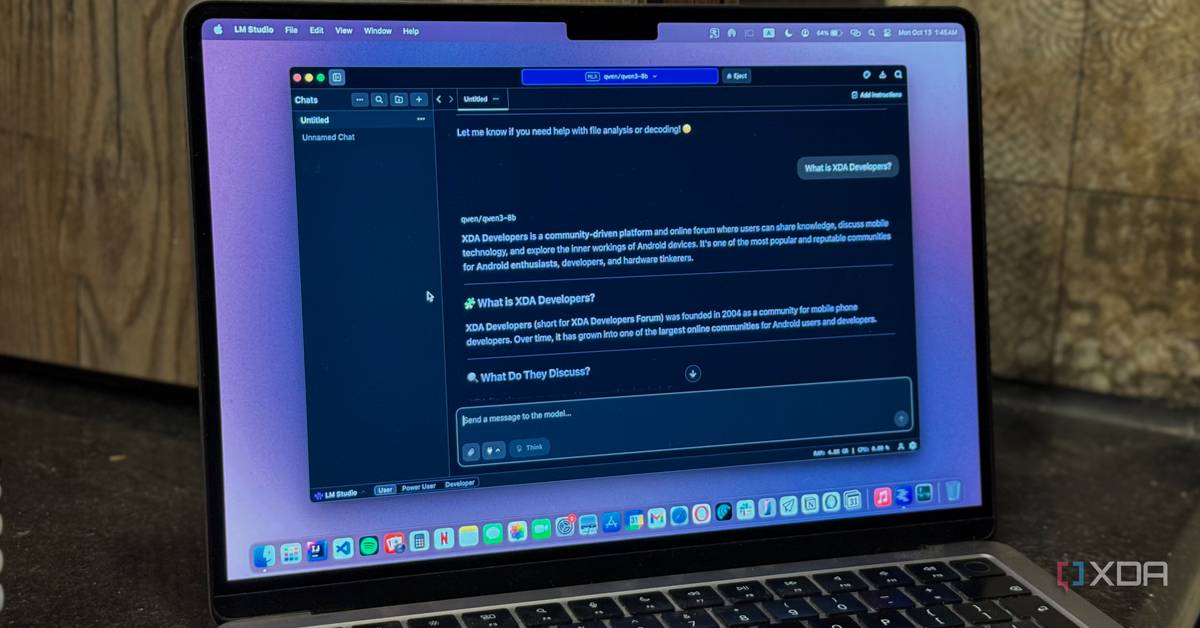
Up until a few years ago, an average person's subscription stack consisted of a music streaming app like Spotify or Apple Music, an entertainment app like Netflix or Amazon Prime, and some sort of cloud storage. Those were the basics, and then came in additional subscriptions like your fitness app, reading app, meditation app, maybe a second streaming service because that one show wasn't on the first one. And then OpenAI launched ChatGPT publicly, and before we know it, a new AI lab is popping up every other day and every single one of them wants around $20 a month from you. ChatGPT Plus. Claude Pro. Perplexity Pro. Gemini AI Pro. Cursor. Notion AI. The list goes on and on and on. As always, the open-source community has been working day and night to build alternatives to a lot of these tools. They're completely free to use, come with no rate limits, no usage caps, no sudden price hikes, your data lives on your own device, and did I mention: they're completely free to use. Here are a couple of open-source apps that I've been using to replace just about every AI subscription I pay for. Want to stay in the loop with the latest in AI? The XDA AI Insider newsletter drops weekly with deep dives, tool recommendations, and hands-on coverage you won't find anywhere else on the site. Subscribe by modifying your newsletter preferences! Ollama The easiest way to run AI models locally ChatGPT, Claude, Gemini, Perplexity, and so on are all cloud-based. Every prompt you type, every document you upload, everything all gets sent to a server somewhere. It gets processed, and then eventually makes its way back to you. So, your data is essentially living on someone else's computer. And for that privilege, you're paying $20 a month per app, dealing with usage caps and rate limits that just so happen to kick in right when you need the tool the most, and trusting that these companies are handling your conversations, your documents, and your ideas responsibly. With local LLMs, you get to escape all of that. Local LLMs are AI models that run directly on your computer's hardware, and you can use them at any time (even when you're offline), for free. No data leaves your machine, and you don't even need to bother dealing with creating accounts and APIs. Now, I'm not as well-acquainted with the self-hosting world as my colleagues at XDA. The very first time I self-hosted anything was a local LLM, and currently, I've been using Ollama. I've tried LM Studio too, and it lets you run any open-source model through a clean ChatGPT-like interface, but it isn't open source itself. Ollama is. It's MIT licensed, completely free, and runs on Mac, Windows, and Linux. The only trade-off is that it's CLI based, but given how much I've been using Claude Code, I'm pretty comfortable with it. This means you'll need to interact with it through your terminal instead of a fancy GUI. Past that though, I find Ollama the simplest way to run a local LLM. Once you've installed the Ollama app, you simply run a command like ollama run gemma3:4b in your terminal and that's it. The model downloads and you can begin chatting. There's a massive library of models to choose from, and they come in different sizes so you can pick one that fits your device's hardware. For instance, I'm running Gemma 3 4B on my device. Models like these are perfect for cleaning up text, drafting quick emails, writing small code snippets, and so on. If you want a more visual, traditional AI-chatbot-like experience instead, you can pair Ollama with open-source frontends like Open WebUI. Perplexica An open-source alternative to Perplexity Perplexity is a tool I've been using since it launched, and I tried an open-source alternative called Perplexica when it lost my trust a few months ago. Perplexity is an AI-powered search engine rather than a traditional AI chatbot where you ask questions and get an answer back, and its strength is searching the web in real-time. Perplexica is an AI search engine too, but it's completely open-source and works with local models through Ollama. The tool also supports AI providers like OpenAI, Anthropic, and Gemini. You can also mix and match models depending on what you're doing. Similar to Perplexity, Perplexica is designed to search the web in real-time and pull information from multiple sources. The tool uses SearxNG, a privacy-focused metasearch engine, to aggregate results. Once the results are retrieved, the LLM you've connected it to synthesizes everything into an answer. The tool also has specialized focus modes like a general web search, academic, and even Reddit search! You set it up through Docker, which sounds intimidating but is really just a couple of commands, and then you access it through your browser at localhost. Once it's running, the experience is genuinely close to perplexity, except your searches are private, your data stays local, and nobody's quietly sharing your queries with ad networks. Open Code The open-source coding agent for your terminal Claude Code, Anthropic's terminal-based agentic tool, is hands-down my favorite AI tool lately. It lets you interact with your LLM (in this case, Claude's models) directly from the terminal, and point it to your codebase so it can read, edit, and run files with full context of your project. The problem is, it's tied to Anthropic. Not only does this mean you need to be a paid Claude user to even try out the tool, but it's also tied to Claude's models exclusively. OpenCode is the open-source alternative, and it works almost the same way. It supports over 75 LLM providers including local models through tools like Ollama and LM Studio. The best part about OpenCode is that the entire experience is incredibly similar to Claude Code. Like Claude Code, it's a terminal-based AI coding agent and is fully capable of reading your codebase, analyzing it, editing files, running terminal commands, and more, all from your terminal. It also has all my favorite Claude Code features including Plan mode, which is a read-only mode that lets the tool think through the problem and come up with a full-fledged plan before writing a single line of code. Subscribe to the AI newsletter for hands-on tool guides Get more from open-source AI: subscribe to the XDA AI Insider newsletter for deep dives, tool recommendations and hands-on coverage that helps you discover, evaluate, and run the best local and privacy-focused AI tools. Get Updates By subscribing, you agree to receive newsletter and marketing emails, and accept our Terms of Use and Privacy Policy. You can unsubscribe anytime. It also has a range of slash commands and supports custom commands that you can create as Markdown files. So, if you have a prompt you use all the time, you save it once and reuse it with a single command. It also supports MCP, which means you can connect it to external tools and services just like you would with Claude Code. Open Notebook If you've read any of my coverage before, you likely know the tool that made me believe that AI has a place in productivity was NotebookLM. It's the first proper introduction I had to RAG-based tools, and the ability to interact with your own documents is a major catch for me. But again, it's cloud-based, powered by Google Gemini, has limits, and every document you upload is sitting on Google's servers. Open Notebook is the open-source alternative, and it follows the same concept. It lets you create notebooks for grounded querying, and lets you add a range of sources like URLs, PowerPoint, PDF, YouTube links, and more. The tool lets you take AI-powered notes, search through your notes, and even turn your notes into podcasts (just like NotebookLM). Of course, the biggest advantage is that you can choose your own AI provider. While it's still a relatively young project, it's already a very solid replacement for my NotebookLM workflow. There are endless tools Now, there are thousands of other open-source AI tools out there, and the ecosystem is growing every single day. The tools above are just the ones I've been personally using and can vouch for!