News & Updates
The latest news and updates from companies in the WLTH portfolio.
TrendAI™ Partners with Anthropic to Extend Leadership in AI Security
TrendAI™ Partners with Anthropic to Extend Leadership in AI Security PR Newswire DALLAS, April 15, 2026 Trend Micro's enterprise business accelerates its transformation as AI security category leader DALLAS, April 15, 2026 /PRNewswire/ -- TrendAI™, the enterprise cybersecurity business from Trend Micro Incorporated (TYO: 4704; TSE: 4704), today announced a strategic engagement with Anthropic, embedding Claude models across its platform to power agentic workflows, automation, AI-native security operations, and develop threat research to identify vulnerabilities in AI systems and infrastructure. TrendAI™ will use Claude to advance vulnerability discovery while ensuring coordinated action in real-world risk reduction. Rachel Jin, Chief Platform and Business Officer, Head of TrendAI™: "We launched TrendAI™ to define the AI security category. This next phase is about scaling that vision globally, with leading partners like Anthropic. Our broad, strategic collaboration across research, defense, and innovation will define how AI is secured moving forward." TrendAI™'s use of Claude spans threat research, real-world risk reduction, platform innovation, and global go-to-market execution. This will operate across the full AI security lifecycle, from vulnerability discovery to automated defense and AI-native operations. Ash Alhashim, Head of Cybersecurity GTM at Anthropic: "For 35 years, TrendAI™ has been at the forefront of cybersecurity. By using Claude to power TrendAI Vision One™ and initiatives like TrendAI™ Zero Day Initiative™ (ZDI) and Pwn2Own, TrendAI™ is advancing the next iteration of vulnerability discovery and reporting -- and tilting the scales toward defenders." Focus areas include: Advancing AI Threat Research: TrendAI™ is scaling its threat research to address the growing attack surface of AI, building on proven programs like Pwn2Own Berlin under TrendAI™ ZDI. This approach brings real-world vulnerability discoveries into AI systems, helping identify and address critical weaknesses before it reaches production environments. Driving AI-Native Innovation: Anthropic's Claude models will help power TrendAI™'s platform innovation, enhancing agentic workflows, automation, and AI-native security operations. This enables organizations to reduce noise, act faster, and scale security alongside AI adoption. The announcement comes as TrendAI™ prepares to welcome over 600 cybersecurity leaders to its Spark Leadership Exchange in Phoenix, Arizona in May. Anthropic will join TrendAI™ on stage at the event alongside other industry leaders, reinforcing a shared commitment to shaping the future of AI security and engaging directly with global enterprise leaders. To learn more about the Spark Leadership Exchange, visit: https://resources.trendmicro.com/spark-leadership-exchange.html About TrendAI™ TrendAI™, the global AI security leader and enterprise business unit of Trend Micro, empowers organizations with full AI visibility and consolidated security that inspires confidence, drives innovation, and eliminates risk. Trusted by the largest enterprises and governments across 185 countries, TrendAI™ secures the entire organization, from identities to infrastructure to data. Global Fortune 500 companies rely on TrendAI™ to cut risk and stop threats up to three months earlier, powered by world-leading threat and attack intelligence. Through deep ecosystem partnerships with market leaders like NVIDIA, Anthropic, AWS, Google, and Microsoft, TrendAI™ empowers your organization to securely drive forward at the speed of AI. AI Fearlessly. Learn more at trendaisecurity.com. View original content to download multimedia:https://www.prnewswire.com/news-releases/trendai-partners-with-anthropic-to-extend-leadership-in-ai-security-302742654.html

Anthropic Switches to Usage-Based Billing for Enterprise Customers | PYMNTS.com
By completing this form, you agree to receive marketing communications from PYMNTS and to the sharing of your information with our sponsor, if applicable, in accordance with our Privacy Policy and Terms and Conditions. That's according to a report Tuesday (April 14) from The Information, which characterizes the change as the latest sign of how the startup is handling the surge in popularity for its artificial intelligence (AI) coding and agent offerings. The new pricing system means customers of Claude Enterprise -- its product suite for large companies -- will have to pay for the amount of computing capacity they use as well as a flat monthly $20 per user fee. Those customers had been paying up to $200 a month for each licensed user, getting a set amount of discounted token usage, Fredrik Filipsson, co-founder of Redress Compliance, told The Information. Flipsson, whose company helps businesses negotiate software licensing agreements, estimated that the pricing changes will double or even triple the cost for heavy users of Claude Enterprise. The Information said it spoke with several IT executives who said they are monitoring whether pricing changes -- which have gone into effect in recent weeks -- will lead to substantially higher bills from Anthropic. A company spokesperson told the publication that the pricing changes don't apply to businesses that pay for free than 150 users. Writing about AI adoption last week, PYMNTS CEO Karen Webster argued that tools like Claude are able to gain ground as consumers encounter new AI models on the job. "ChatGPT expands outward from the consumer, earning trust in low-stakes, high-frequency tasks and carrying that trust into the workplace. The habit comes first; the enterprise follows," Webster wrote. "Claude follows the opposite path. It is encountered in the context of work, where precision matters and the cost of getting it wrong is higher. Contract analysis, code review and complex research are not entry points for casual use. They are reasons to adopt something new. In this case, the enterprise is not the endpoint but the starting point." In related news, PYMNTS wrote earlier this week about the factors that hinder AI adoption at larger companies. "For most large enterprises, organizational readiness is still the bigger barrier than cost," Ben Schein, chief analytics officer and senior vice president of product at Domo, told PYMNTS. That's backed by research from PYMNTS Intelligence's "The Enterprise AI Benchmark Report," which shows that 71% of executives at companies with at least $1 billion in annual revenue believe that organizational readiness is the chief limitation on AI performance. Only 11% said they think that AI technology itself is the primary barrier.
Kraken Moves Toward IPO as Valuation Falls to $13.3B
Kraken secured direct access to U.S. payment rails via a Federal Reserve master account while also disclosing two insider incidents that led to an extortion attempt. Kraken has confidentially filed a draft registration statement for an initial public offering (IPO), the crypto exchange said in a blog post, with co-CEO Arjun Sethi confirming the move Tuesday at the Semafor World Economy conference in Washington. An April funding round priced Kraken at $13.3 billion, down from a reported $20 billion peak in late 2025. Funding Round Signals Repricing Amid Market Headwinds The latest capital raise included participation from Citadel Securities and other investors. While Kraken did not disclose additional terms, the reduced valuation reflects softer trading volumes and weaker asset prices that have weighed on the sector more broadly. Kraken had previously shelved IPO plans during the downturn, as public market appetite for crypto listings cooled. Several recent digital asset-related debuts have struggled to maintain strong post-listing performance, reinforcing a cautious approach among issuers. Despite those headwinds, Kraken appears to be positioning itself for eventual entry into public markets. Sethi emphasized a longer-term strategy focused on expanding access to sophisticated trading tools for retail users, drawing comparisons to capabilities typically associated with firms like Jane Street and JPMorgan Chase. Deutsche Börse Deepens Strategic Relationship Separately, Deutsche Börse confirmed plans to invest $200 million in Kraken via a secondary share purchase. The transaction will give the German exchange operator a 1.5% fully diluted stake in Payward, Kraken's parent company, and is expected to close in the second quarter of 2026. The investment builds on a partnership announced in December 2025, with both firms collaborating on regulated crypto trading infrastructure, derivatives offerings, tokenized assets, and institutional liquidity solutions. Direct Fed Access Marks Infrastructure Milestone Kraken has also secured a master account with the Federal Reserve Bank of Kansas City, granting it direct access to U.S. payment rails, including Fedwire. The account enables Kraken to settle U.S. dollar transactions without relying on intermediary banks, a notable development as crypto firms seek greater independence within traditional financial systems. However, the account does not provide access to Federal Reserve lending facilities or interest on reserves. Even so, it represents an incremental expansion of Kraken's financial infrastructure as it scales operations. Insider Incidents Trigger Extortion Attempt Alongside its strategic and financial developments, Kraken disclosed two insider-related incidents involving support staff who accessed limited client data. The company said approximately 2,000 accounts, around 0.02% of its user base, were affected. Kraken emphasized that no client funds or core trading systems were compromised. However, the incidents led to an extortion attempt by a criminal group claiming to possess internal videos. The exchange said it refused to comply with the demand. In response, Kraken revoked access, identified those involved, notified affected users, and engaged law enforcement. The firm added that it is strengthening internal controls to mitigate future risks. The disclosure comes amid broader security challenges in the sector. Galaxy Digital recently reported unauthorized access to a development environment in a separate incident, though it similarly stated that no client funds or data were impacted. Kraken's latest moves illustrate a dual-track strategy: advancing toward a potential public listing while reinforcing institutional partnerships and core infrastructure. At the same time, the lower valuation and security disclosures highlight the operational and market pressures still shaping the crypto industry's next phase.
Kraken Co-CEO Confirms Confidential IPO Filing Amid Market Volatility
Kraken has confirmed that it filed for a confidential initial public offering (IPO) with the U.S. Securities and Exchange Commission (SEC). Co-CEO Arjun Sethi shared this news at the Semafor World Economy Summit on April 14, 2026, in Washington, D.C. Future of Capitalism | Semafor World Economy 2026 Sethi's announcement responds to recent speculation about when Kraken might go public. In March 2026, some reports said Kraken had paused its IPO plans because of a weaker crypto market and less investor interest. While Sethi did not mention this pause, he confirmed the company is still moving ahead with its confidential filing. Accompanying the IPO news, German stock exchange operator Deutsche Börse announced a $200 million investment in Kraken's parent company, Payward. This deal grants Deutsche Börse a 1.5% stake, valuing the exchange at approximately $13.3 billion. This figure represents a notable decrease from the $20 billion valuation Kraken achieved during an $800 million funding round in late 2025. RELATED: Deutsche Börse Expands Into Crypto With $200M Investment in Kraken Kraken has been aggressively diversifying beyond its core digital asset exchange. In late 2025, the firm introduced commission-free equities trading. Since then, it has expanded to include access to tokenized stocks and exchange-traded funds (ETFs). Sethi noted that the company's vision is set on the long term, rather than reacting to quarterly market shifts. The exchange's path to the public market follows a broader trend of crypto-native firms seeking traditional capital. DeFi Planet has previously highlighted how corporate adoption of digital assets and regulatory clarity are critical drivers for the industry. A successful listing would position Kraken alongside Coinbase and potentially other firms like Circle, which are also pursuing public offerings. Still, the timing of Kraken's IPO depends on how quickly the SEC reviews its filing and how crypto-related stocks perform. Keeping the filing confidential gives Kraken more flexibility as it watches global financial conditions. Meanwhile, Bitpanda's Vision Chain and Tether's tether.wallet launch mark significant milestones in digital asset adoption, bridging traditional finance and blockchain. Vision Chain connects EU banks with tokenized assets, while tether. wallet expands access to digital dollars, enhancing financial inclusion and infrastructure. Take control of your crypto portfolio with DEFI PLANET PRO, DeFi Planet's suite of analytics tools.

TrendAI™ Partners with Anthropic to Extend Leadership in AI Security
Trend Micro's enterprise business accelerates its transformation as AI security category leader DALLAS, April 15, 2026 /PRNewswire/ -- TrendAI™, the enterprise cybersecurity business from Trend Micro Incorporated (TYO: 4704; TSE: 4704), today announced a strategic engagement with Anthropic, embedding Claude models across its platform to power agentic workflows, automation, AI-native security operations, and develop threat research to identify vulnerabilities in AI systems and infrastructure. TrendAI™ will use Claude to advance vulnerability discovery while ensuring coordinated action in real-world risk reduction. Rachel Jin, Chief Platform and Business Officer, Head of TrendAI™: "We launched TrendAI™ to define the AI security category. This next phase is about scaling that vision globally, with leading partners like Anthropic. Our broad, strategic collaboration across research, defense, and innovation will define how AI is secured moving forward." TrendAI™'s use of Claude spans threat research, real-world risk reduction, platform innovation, and global go-to-market execution. This will operate across the full AI security lifecycle, from vulnerability discovery to automated defense and AI-native operations. Ash Alhashim, Head of Cybersecurity GTM at Anthropic: "For 35 years, TrendAI™ has been at the forefront of cybersecurity. By using Claude to power TrendAI Vision One™ and initiatives like TrendAI™ Zero Day Initiative™ (ZDI) and Pwn2Own, TrendAI™ is advancing the next iteration of vulnerability discovery and reporting -- and tilting the scales toward defenders." Focus areas include: Advancing AI Threat Research: TrendAI™ is scaling its threat research to address the growing attack surface of AI, building on proven programs like Pwn2Own Berlin under TrendAI™ ZDI. This approach brings real-world vulnerability discoveries into AI systems, helping identify and address critical weaknesses before it reaches production environments. Driving AI-Native Innovation: Anthropic's Claude models will help power TrendAI™'s platform innovation, enhancing agentic workflows, automation, and AI-native security operations. This enables organizations to reduce noise, act faster, and scale security alongside AI adoption. The announcement comes as TrendAI™ prepares to welcome over 600 cybersecurity leaders to its Spark Leadership Exchange in Phoenix, Arizona in May. Anthropic will join TrendAI™ on stage at the event alongside other industry leaders, reinforcing a shared commitment to shaping the future of AI security and engaging directly with global enterprise leaders. To learn more about the Spark Leadership Exchange, visit: https://resources.trendmicro.com/spark-leadership-exchange.html About TrendAI™ TrendAI™, the global AI security leader and enterprise business unit of Trend Micro, empowers organizations with full AI visibility and consolidated security that inspires confidence, drives innovation, and eliminates risk. Trusted by the largest enterprises and governments across 185 countries, TrendAI™ secures the entire organization, from identities to infrastructure to data. Global Fortune 500 companies rely on TrendAI™ to cut risk and stop threats up to three months earlier, powered by world-leading threat and attack intelligence. Through deep ecosystem partnerships with market leaders like NVIDIA, Anthropic, AWS, Google, and Microsoft, TrendAI™ empowers your organization to securely drive forward at the speed of AI. AI Fearlessly. Learn more at trendaisecurity.com. View original content to download multimedia:https://www.prnewswire.com/news-releases/trendai-partners-with-anthropic-to-extend-leadership-in-ai-security-302742654.html

The Invisible Firewall: Why Identity-Based Access is the New Standard for Industrial Agility
Can You Secure Without Slowing Down? In 2026, the question is no longer whether organizations should implement Zero Trust, but how to do so without introducing latency. As ransomware increasingly targets OT systems, the "air-gap" myth has largely been retired. The challenge is building a security layer robust enough to stop a breach while remaining "invisible" enough to keep millisecond-sensitive production lines moving. The Zero Trust Imperative Zero Trust operates on one core principle: Never trust, always verify. In the HMI and SCADA environment, this means every request -- from a remote tablet or a local panel -- must be authenticated. ARC Advisory Group research confirms that as OT-IT convergence accelerates, traditional perimeter-based defenses are no longer sufficient. Organizations are increasingly adopting micro-segmentation to help ensure that a breach in one sensor does not disrupt the entire production line. Speed Meets Security A common misconception is that verification creates network bottlenecks. However, the modern 2026 technology stack demonstrates otherwise: * Identity-Based HMI: By integrating Identity and Access Management (IAM) directly into HMI software, suppliers can enable least-privilege access. Operators view only the information necessary for their role, reducing risk without introducing unnecessary complexity. * MQTT Sparkplug B: This protocol can reduce network traffic significantly, helping create the bandwidth headroom needed to support additional security overhead. * Hardware Acceleration: Modern edge gateways and HMI panels increasingly use dedicated chips for encryption, allowing security checks to be performed in microseconds. The Bottom Line Zero Trust is no longer viewed as a burden on productivity; it is increasingly becoming a business enabler. For suppliers, it serves as an important competitive differentiator. For end users, it provides a stronger foundation for digital scaling. As organizations move toward more autonomous operations, "invisible security" helps ensure that speed and safety can coexist. Ready to make your security invisible? Explore ARC's Secure Connectivity Solutions to learn more.

Sat Images Reveal 'Chaos' During US Rescue Mission In Iran; Troops Landed Close To Nuke Site
Tehran: Latest high-resolution satellite images from Iran have revealed the chaos that prevailed during the US mission to rescue and airman who went missing after Tehran downed an F-15E Strike Eagle fighter jet earlier this month. The images, released by Soar Atlas, show wreckage of multiple US aircraft at an abandoned dirt airstrip near Shahreza in the Isfahan province, which houses Iran's key nuclear complex. As the images got circulated, fresh questions have been raised on Washington's real objective during that mission in which 155 aircraft were deployed, as reported by India Today. US president Donald Trump called it "one of the most daring rescue operations", but officials provided scant details of its losses during the mission. The remote airstrip is located around 40 km from the Isfahan nuclear complex, which apparently holds Iran's primary stockpile of highly enriched uranium, key to making nuclear weapons. Iran has been alleging that it was a "failed" US operation to seize Uranium. Tehran maintains that the area where the American airman was downed in Kohgiluyeh and Boyer-Ahmad province was far from where the US troops landed to rescue him. Even if the US is to be believed, the rescue mission for the weapons systems officer (WSO) ran into major challenges beyond enemy lines. The satellite images now show wreckage of at least two US C-130 Hercules transport aircraft, and possibly two MH-6 "Little Bird" helicopters on the right side of the airfield. Trump had admitted that the two C-130 aircraft, which ferried around 100 elite US forces, had to be blown up after they got stuck in the sandy desert terrain. This was done to prevent sensitive technology or equipment from falling into Iranian hands - a standard practice in combat. No details were provided about the MH-6 helicopters that were possibly deployed to provide close air support to the landing force. Considering that the US troops landed deep inside Iran, the helicopters were likely transported by the C-130 aircraft. Iran has, however, claimed it struck the two US helicopters during the operation. The helicopters could have been destroyed by the US troops, as there might not have been enough time or room load them onto the replacement aircraft. These helicopters have a maximum flight range of 420 km. The nearest US military base is around 400 km away near the Iraq border. Considering the risks, the US might have decided to destroy the helicopters at the site. The images also reveal that in the days following the operation, Iran appears to have moved quickly to secure the airstrip. The images show a dirt security perimeter around the destroyed aircraft. Additionally, piles of dirt have been placed throughout the runway, rendering it unusable for any future aircraft landings or operations.

Did Anthropic Just Crown CrowdStrike and Palo Alto Networks the AI Cybersecurity Stock Winners?
As artificial intelligence (AI) advances, so will the need for more powerful cybersecurity solutions. Earlier this month, Anthropic dropped its most advanced artificial intelligence (AI) model, Claude Mythos. However, because the company said it can easily identify and exploit software vulnerabilities, Anthropic said it will not release it to the public. Instead, it will give access to the large language model (LLM) to a select group of about 50 leading tech companies. Called Project Glasswing, the goal is for these companies to improve their cybersecurity defenses. Anthropic said Mythos has already found thousands of vulnerabilities across every major web browser and operating system. It noted it won't be long before bad actors look to use AI to exploit these vulnerabilities. Will AI create the world's first trillionaire? Our team just released a report on the one little-known company, called an "Indispensable Monopoly" providing the critical technology Nvidia and Intel both need. Continue " Image source: Getty Images. Anthropic will provide participants with a total of $100 million in usage credits. Afterwards, the Claude Mythos will be available at a cost of $25 per million input tokens and $125 per million output tokens. Two of the 12 leading members of the project will be cybersecurity companies CrowdStrike (NASDAQ: CRWD) and Palo Alto Networks (NASDAQ: PANW). This is important, because it shows that Anthropic is looking to cybersecurity providers to play a big role in AI protection going forward and is not developing its own solution. Wedbush analysts called the announcement big for CrowdStrike and Palo Alto, noting this will help them become an AI enforcement layer, not an AI casualty. The capabilities of Claude Mythos, meanwhile, suggest cybersecurity will become all the more important in the age of AI. AI cyber solutions will be needed to fight against AI cybersecurity attacks, which is why CrowdStrike and Palo Alto becoming two of the leading members of Project Glasswing is so important. Gaining access to Claude Mythos will help give them an edge moving forward, allowing them to remain at the forefront of cybersecurity. Both companies are also taking a more platform-oriented approach, which, together with growing cybersecurity threats, will continue to expand their market opportunity. While spending on AI is important for companies, spending on cybersecurity to protect against AI threats will have to be at the top of organizations' priorities. Meanwhile, using disparate point solutions that don't work together could soon become a thing of the past, given the risk of rogue AI agents that could soon be on the horizon. CrowdStrike and Palo Alto were the two leading cybersecurity companies before the Project Glasswing announcement, and it just cemented them as the leaders in the space. With both stocks down on the year, now could be a time to scoop them up. Before you buy stock in CrowdStrike, consider this: The Motley Fool Stock Advisor analyst team just identified what they believe are the 10 best stocks for investors to buy now... and CrowdStrike wasn't one of them. The 10 stocks that made the cut could produce monster returns in the coming years. Consider when Netflix made this list on December 17, 2004... if you invested $1,000 at the time of our recommendation, you'd have $556,335!* Or when Nvidia made this list on April 15, 2005... if you invested $1,000 at the time of our recommendation, you'd have $1,160,572!* Now, it's worth noting Stock Advisor's total average return is 975% -- a market-crushing outperformance compared to 193% for the S&P 500. Don't miss the latest top 10 list, available with Stock Advisor, and join an investing community built by individual investors for individual investors. Geoffrey Seiler has no position in any of the stocks mentioned. The Motley Fool has positions in and recommends CrowdStrike. The Motley Fool recommends Palo Alto Networks. The Motley Fool has a disclosure policy.

AI Weekly: Chipmakers earnings charge, Anthropic's cybersecurity fears
From billions in earnings for chipmakers to Anthropic's cybersecurity concerns, this is AI Weekly. Meta is expanding its deal with chip designer Broadcom to build several generations of custom processors to power AI features across its apps. The deal announced Tuesday extends their partnership through 2029. It includes an initial commitment of more than one gigawatt of computing capacity - enough to power roughly 750,000 U.S. homes. :: ASML The world's largest supplier of chipmaking tools, ASML reported stronger-than-expected first-quarter earnings on Wednesday (April 15). It hit around $3.2 billion - up from the same period a year ago. The Dutch company also raised its revenue outlook for the year. :: TSMC Fellow chipmaker TSMC saw a 35% surge in first-quarter revenue. The world's largest contract chipmaker said January to March income hit just over $35.7 billion. The number beat market forecasts and came from huge demand for AI applications. Analysts raised their forecasts for April to June revenue despite concerns over possible supply disruption caused by the Middle East conflict. China's chip industry is also showing strong growth momentum as a global sprint to build AI infrastructure creates a demand explosion. Semiconductor industry executives said higher capital spending and capacity expansion has chipmakers racing to keep up. China's manufacturing capacity for chips used in cars, smartphones and electronics is projected to reach 42% of global output by 2028 according to one industry executive. U.S. Treasury Secretary Scott Bessent and Federal Reserve Chair Jerome Powell held an urgent meeting with major bank CEOs, warning of cybersecurity risks linked to Anthropic's latest AI model. That's according to two sources familiar with the matter. Anthropic launched its powerful new "Mythos" model but stopped short of a broad release, citing concerns it could expose previously unknown cybersecurity vulnerabilities.
Rare 'God of chaos' asteroid will be visible to naked eye in historic flyby, says NASA
The asteroid will pass within 20,000 miles of Earth, which is 12 times closer than the moon Astronomers have issued an interesting update for skygazers: a rare asteroid will soon be visible to the naked eye. Asteroid 99942 Apophis, named after the Egyptian deity of chaos, darkness, and fire is expected to safely pass close to Earth on April 13, 2029. It is anticipated that asteroid Apophis will pass within 20,000 miles of Earth, which is 12 times closer than the moon and nearer than many geosynchronous satellites. The event will be visible to the naked eye for observers in the Eastern Hemisphere, provided weather conditions are clear. NASA characterizes this as one of the closest approaches ever recorded for an object of this size. Despite early fears from its 2004 discovery, NASA is now confident Apophis poses no risk of hitting Earth for at least the next 100 years. Earth's gravity may slightly alter the asteroid's path or orbital period during the flyby, but it will not increase the risk of a future collision. Space agencies are seizing the chance to study the relic; NASA had redirected a spacecraft for a rendezvous, and the ESA is sending its own mission to study it. Apophis is a 4.6-billion-year-old relic of the early solar system, made of leftover material that never formed into a planet. It has a mean diameter of roughly 1,115 feet, with its longest axis reaching at least 1,480 feet. Named after the Egyptian god of chaos, it was discovered in 2004 by astronomers at the Kitt Peak National Observatory. Following the 2029 flyby, it will officially join the Apollo group of Earth-crossing asteroids.

Traffic chaos as protesters block UK's busiest motorway leaving it totally empty
Fuel protests appear to have reached England, with tractors and lorries reportedly blocking one stretch of the M25. Pictures taken on Wednesday afternoon show one side of the M25 near Dartford Crossing being totally empty. The unusual sight would be the result of protesters taking to the area to voice their unhappiness at the rising cost of fuel in light of the war in Iran. This comes as Essex Police said it is aware of social media posts suggesting demonstrations could take place at the key Thurrock-Kent route and has reassured residents it is ready to respond to any disruption.

OpenAI unveils restricted cybersecurity AI model after Anthropic Mythos -- Who gets access?
Anthropic Claude Mythos flagged as powerful AI model due to unprecedented cyber capabilities OpenAI has recently unveiled its latest cybersecurity model, following the release of Anthropic's powerful Claude Mythos model, capable of identifying the critical vulnerabilities in operating systems and web browsers. Like Claude Mythos, OpenAI's newly-released model will be available to a limited number of partners with an aim to prevent the misuse of powerful AI models. Named GPT‑5.4‑Cyber, the model is specifically designed for defensive security tasks. Equipped with permissive nature, the model possesses a "lower refusal boundary", highlighting that it will not block sensitive security requests that general models might flag as risky. When it comes to the features, the programme consists of "thousands of verified individual defenders and hundreds of teams responsible for defending critical software." It includes new features like binary reverse engineering, allowing defenders to analyze compiled software for malware and vulnerabilities without needing the original source code. OpenAI's model will be available to "the highest tiers" of people and organizations, including vetted security vendors, organizations, and researchers in its Trusted Access for Cyber (TAC) scheme. Higher-tier access may require users to waive "Zero-Data Retention" (ZDR) so OpenAI can maintain visibility into how the model is being used. "This is particularly true for developers and organizations accessing our models through third-party platforms where OpenAI may have less direct visibility into the user, the environment, or the purpose of the request," OpenAI wrote in its blogpost. The launch of GPT‑5.4‑Cyber model is based on certain guiding principles. The first principle is based on democratization access, making tools available to legitimate actors of all sizes through objective criteria. OpenAI also aims to build ecosystem resilience by supporting the broader community through grants, such as $10 million program and open-source initiatives like Codex Security. OpenAI classifies GPT‑5.4 as a "high" cyber capability model under its Preparedness Framework. "We believe the class of safeguards in use today sufficiently reduce cyber risk enough to support broad deployment of current models. We expect versions of these safeguards to be sufficient for upcoming more powerful models," OpenAI wrote.

TrendAI™ Partners with Anthropic to Extend Leadership in AI Security
Trend Micro's enterprise business accelerates its transformation as AI security category leader DALLAS, April 15, 2026 /PRNewswire/ -- TrendAI™, the enterprise cybersecurity business from Trend Micro Incorporated (TYO: 4704;TSE: 4704), today announced a strategic engagement with Anthropic, embedding Claude models across its platform to power agentic workflows, automation, AI-native security operations, and develop threat research to identify vulnerabilities in AI systems and infrastructure. TrendAI™ will use Claude to advance vulnerability discovery while ensuring coordinated action in real-world risk reduction. Rachel Jin, Chief Platform and Business Officer, Head of TrendAI™: "We launched TrendAI™ to define the AI security category. This next phase is about scaling that vision globally, with leading partners like Anthropic. Our broad, strategic collaboration across research, defense, and innovation will define how AI is secured moving forward." TrendAI™'s use of Claude spans threat research, real-world risk reduction, platform innovation, and global go-to-market execution. This will operate across the full AI security lifecycle, from vulnerability discovery to automated defense and AI-native operations. Ash Alhashim, Head of Cybersecurity GTM at Anthropic: "For 35 years, TrendAI™ has been at the forefront of cybersecurity. By using Claude to power TrendAI Vision One™ and initiatives like TrendAI™ Zero Day Initiative™ (ZDI) and Pwn2Own, TrendAI™ is advancing the next iteration of vulnerability discovery and reporting--and tilting the scales toward defenders." Focus areas include: Advancing AI Threat Research: TrendAI™ is scaling its threat research to address the growing attack surface of AI, building on proven programs like Pwn2Own Berlin under TrendAI™ ZDI. This approach brings real-world vulnerability discoveries into AI systems, helping identify and address critical weaknesses before it reaches production environments. Driving AI-Native Innovation: Anthropic's Claude models will help power TrendAI™'s platform innovation, enhancing agentic workflows, automation, and AI-native security operations. This enables organizations to reduce noise, act faster, and scale security alongside AI adoption. The announcement comes as TrendAI™ prepares to welcome over 600 cybersecurity leaders to its Spark Leadership Exchange in Phoenix, Arizona in May. Anthropic will join TrendAI™ on stage at the event alongside other industry leaders, reinforcing a shared commitment to shaping the future of AI security and engaging directly with global enterprise leaders. To learn more about the Spark Leadership Exchange, visit: https://resources.trendmicro.com/spark-leadership-exchange.html About TrendAI™ TrendAI™, the global AI security leader and enterprise business unit of Trend Micro, empowers organizations with full AI visibility and consolidated security that inspires confidence, drives innovation, and eliminates risk. Trusted by the largest enterprises and governments across 185 countries, TrendAI™ secures the entire organization, from identities to infrastructure to data. Global Fortune 500 companies rely on TrendAI™ to cut risk and stop threats up to three months earlier, powered by world-leading threat and attack intelligence. Through deep ecosystem partnerships with market leaders like NVIDIA, Anthropic, AWS, Google, and Microsoft, TrendAI™ empowers your organization to securely drive forward at the speed of AI. AI Fearlessly. Learn more at trendaisecurity.com. View original content to download multimedia:https://www.prnewswire.com/news-releases/trendai-partners-with-anthropic-to-extend-leadership-in-ai-security-302742654.html
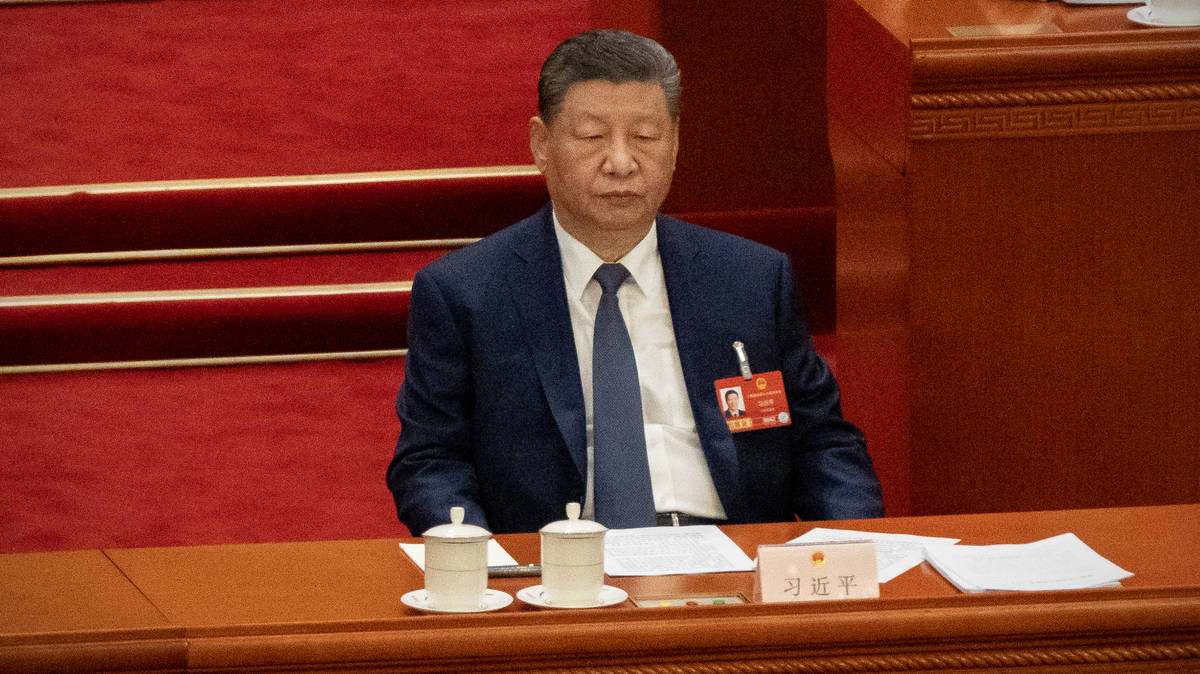
China's President Xi warns world order is 'crumbling into disarray' amid chaos over Strait of Hormuz | LBC
China's President Xi Jinping has warned that the world order is 'crumbling into disarray' after the US stepped up its blockade on the Strait of Hormuz. President Xi said in "today's world, chaos abounds, and the international order is crumbling into disarray" during a meeting with Spain's Prime Minister Pedro Sanchez in Beijing. Britain's Chancellor Rachel Reeves is set to meet her US counterpart after he said "a small bit of economic pain" caused by the Iran war was worth it to prevent Tehran getting a nuclear weapon. The comments by US treasury secretary Scott Bessent put him at odds with the Chancellor, who has gone public with her anger and frustration at the "folly" of America's actions in the Middle East and its financial fallout on families. The pair were due to hold face-to-face talks in Washington DC on Wednesday during the spring meetings of the International Monetary Fund, which will be dominated by the ongoing crisis in the Gulf, which has inflicted a global economic shock and sent energy prices soaring. Prior to the Chancellor heading stateside, the influential financial body slashed Britain's economic growth forecast as a result of the conflict and warned a worldwide recession could be a "close call" in a severe scenario. However, despite the "large" jolt to the global economy, Bank of England governor Andrew Bailey said the UK was much better placed to deal with it because of its resilient banking system, forged in the wake of the 2007-09 financial crisis. Meanwhile, President Donald Trump has said a second round of talks between the US and Iran could happen "over the next two days", after negotiations at the weekend collapsed. In an interview which is due to be broadcast on Wednesday, Mr Trump told the Fox Business Network he viewed the conflict as nearing completion and said Iran was keen to make a deal. "If I pulled up stakes right now, it would take them 20 years to rebuild that country," he said "And we're not finished. We'll see what happens. I think they want to make a deal very badly." Tehran's nuclear ambitions were a key sticking point. Diplomats have been working behind the scenes as the US imposed its blockade of Iranian ports and Tehran threatened retaliatory strikes across the region, amid a shaky ceasefire. At the same time Prime Minister Sir Keir Starmer is seeking to co-ordinate international efforts to ensure the strategic Strait of Hormuz can remain open to shipping after hostilities end. The critical waterway, used to move one fifth of the world's oil and gas supplies, has become a major flashpoint in the conflict, with its effective closure by Iran hiking the cost of fuel, food and other basic goods. However, responding to the spike in prices, Mr Bessent said "a small bit of economic pain for a few weeks is worth taking off the incalculable tail risk of either a nuclear Iran or a nuclear Iran that uses that weapon". He insisted "there is nothing more transient than what we are seeing now", and added: "So the conflict will end, prices will come down, and then headline inflation will come down, and with that, gasoline prices will come down." Mr Bessent made his remarks after Ms Reeves told the Mirror newspaper: "I feel very frustrated and angry that the US went into this war without a clear exit plan, without a clear idea of what they were trying to achieve." She branded it a "folly" that impacted households in the UK and around the world. James Murray, who as chief secretary to the Treasury is effectively Ms Reeves' deputy, defended his boss' remarks on Wednesday morning. "I think what the Chancellor was expressing is her views, views shared by many of us and people across the country, that it was not a decision that we wanted to take to get involved with the conflict in Iran when there is no clear exit plan and no clear strategy for what was supposed to be achieved there," he told the Press Association. Mr Trump has defended the blockade aimed at putting pressure on Iran, arguing its control of the strait amounted to blackmail and extortion. He has warned that any hostile Iranian boats approaching American warships would be "immediately eliminated". US Central Command, which directs military operations in the Middle East, said no vessels have so far run the blockade. Among those ships being barred include Chinese tankers. In response, the country's president Xi Jinping said nations should "oppose the world's retrogression to the law of the jungle".
OpenAI Unveils GPT-5.4-Cyber in Direct Response to Anthropic's Controversial Mythos Model - Blockonomi
Ramp payment data reveals roughly 33% of American companies subscribed to Anthropic services in March OpenAI has unveiled a specialized artificial intelligence system tailored exclusively for cybersecurity applications. Dubbed GPT-5.4-Cyber, this new model is currently accessible to a carefully screened user base. The platform became available on Tuesday, April 15. This debut arrives exactly seven days after Anthropic introduced its competing security-focused system, Mythos, through a controlled rollout. GPT-5.4-Cyber represents what the company characterizes as a "more permissive" variant of GPT-5.4. The system features reduced content restrictions specifically for cybersecurity operations that OpenAI classifies as authorized defensive activities. Current availability is restricted to members of OpenAI's Trusted Access for Cyber initiative. This verification program debuted in February and mandates comprehensive identity confirmation for all participants seeking model access. The company outlined intentions to scale participation from several hundred early testers to thousands of authenticated security professionals over the next several weeks. OpenAI emphasized that mandatory identity verification will remain in place throughout this expansion. The development of cyber-oriented protective measures for OpenAI's systems commenced in 2025. This past March saw the introduction of Codex Security, designed to detect and remediate software security flaws. Anthropic's Mythos system has already captured the attention of senior U.S. government officials. During the previous week, Treasury Secretary Scott Bessent alongside Federal Reserve Chair Jerome Powell cautioned financial industry executives to seriously consider the potential dangers associated with Mythos, Bloomberg reported. Anthropic deliberately restricted Mythos distribution to approximately 40 major corporations to strengthen their cybersecurity infrastructure. This selective approach stems from apprehensions about unauthorized access to the technology. The director of Ireland's National Cyber Security Centre testified before a parliamentary committee on April 14, stating that adversarial actors are expected to deploy models with comparable capabilities to Mythos before year's end. Jack Clark, co-founder at Anthropic, predicted that competing organizations will introduce comparable systems within the coming months. He further projected that open-weight Chinese models possessing these capabilities could emerge within 12 to 18 months. OpenAI has intensified its concentration on business clients, a sector where Anthropic has rapidly established significant market presence. Analytics from payments platform Ramp indicate that approximately one-third of American enterprises paid for Anthropic's services during March. OpenAI has been scaling back initiatives with lower profit margins. The organization has suspended development of an adult-oriented ChatGPT version and temporarily halted its Stargate UK initiative. Microsoft, serving as OpenAI's primary investor, has committed to leasing data center infrastructure at a location initially designated for the Stargate Norway development. A separate partnership arrangement with British AI infrastructure company Nscale similarly collapsed. OpenAI revealed plans to establish its inaugural permanent London headquarters in 2027, accommodating over 500 employees. The facility will function as the company's most extensive research center beyond American borders. The company has additionally unveiled a new "superapp" concept influenced by Anthropic's approach, and introduced specialized healthcare AI capabilities shortly following Anthropic's deployment of its medical-oriented Claude functionalities.
Did Anthropic Just Crown CrowdStrike and Palo Alto Networks the AI Cybersecurity Stock Winners? | The Motley Fool
As artificial intelligence (AI) advances, so will the need for more powerful cybersecurity solutions. Earlier this month, Anthropic dropped its most advanced artificial intelligence (AI) model, Claude Mythos. However, because the company said it can easily identify and exploit software vulnerabilities, Anthropic said it will not release it to the public. Instead, it will give access to the large language model (LLM) to a select group of about 50 leading tech companies. Called Project Glasswing, the goal is for these companies to improve their cybersecurity defenses. Anthropic said Mythos has already found thousands of vulnerabilities across every major web browser and operating system. It noted it won't be long before bad actors look to use AI to exploit these vulnerabilities. Anthropic will provide participants with a total of $100 million in usage credits. Afterwards, the Claude Mythos will be available at a cost of $25 per million input tokens and $125 per million output tokens. Two of the 12 leading members of the project will be cybersecurity companies CrowdStrike (CRWD 0.93%) and Palo Alto Networks (PANW 0.57%). This is important, because it shows that Anthropic is looking to cybersecurity providers to play a big role in AI protection going forward and is not developing its own solution. Wedbush analysts called the announcement big for CrowdStrike and Palo Alto, noting this will help them become an AI enforcement layer, not an AI casualty. The capabilities of Claude Mythos, meanwhile, suggest cybersecurity will become all the more important in the age of AI. AI cyber solutions will be needed to fight against AI cybersecurity attacks, which is why CrowdStrike and Palo Alto becoming two of the leading members of Project Glasswing is so important. Gaining access to Claude Mythos will help give them an edge moving forward, allowing them to remain at the forefront of cybersecurity. Both companies are also taking a more platform-oriented approach, which, together with growing cybersecurity threats, will continue to expand their market opportunity. While spending on AI is important for companies, spending on cybersecurity to protect against AI threats will have to be at the top of organizations' priorities. Meanwhile, using disparate point solutions that don't work together could soon become a thing of the past, given the risk of rogue AI agents that could soon be on the horizon. CrowdStrike and Palo Alto were the two leading cybersecurity companies before the Project Glasswing announcement, and it just cemented them as the leaders in the space. With both stocks down on the year, now could be a time to scoop them up.

Anthropic Briefed the Trump White House on Its Most Powerful AI Model. What Happens Next Could Define the Industry.
Anthropic, the San Francisco-based artificial intelligence company founded by former OpenAI researchers, confirmed this week that it briefed senior officials in the Trump administration on its latest and most capable AI system -- an internal model code-named Mythos. The disclosure, first reported by TechCrunch, came directly from Anthropic co-founder Daniela Amodei during a live interview at a technology conference in Washington, D.C. The briefing marks a significant escalation in how leading AI companies are engaging with the federal government -- not merely lobbying on regulation, but actively presenting frontier capabilities to policymakers before public release. It also raises sharp questions about the increasingly tangled relationship between Silicon Valley's AI elite and the current White House, which has shown a preference for voluntary industry cooperation over binding legislation. Amodei offered few specifics about the substance of the briefing. She confirmed it took place in March, involved members of the National Security Council and the Office of Science and Technology Policy, and covered both the capabilities and the safety profile of Mythos. She did not say whether the model had been demonstrated live or whether administration officials had been given access to it. "We think it's the responsible thing to do," Amodei said, according to TechCrunch. "When you're building systems this capable, government should not be surprised by what's coming." That framing -- proactive transparency rather than regulatory compliance -- is deliberate. Anthropic has long positioned itself as the safety-conscious alternative among frontier AI labs, a reputation it has cultivated since Dario Amodei and his sister Daniela left OpenAI in 2021 to start the company. But this latest move goes beyond publishing research papers and responsible scaling policies. It puts Anthropic in direct conversation with an administration that has, until now, shown limited appetite for constraining AI development. The Model Behind the Briefing What exactly is Mythos? Anthropic hasn't released a technical paper or public benchmark results. But based on statements from company insiders and reporting from multiple outlets, Mythos appears to represent a significant leap beyond Claude 4, Anthropic's current publicly available model. Sources familiar with the system describe it as a multimodal model with substantially improved reasoning capabilities, longer and more reliable context windows, and -- critically -- the ability to take autonomous actions across software environments with minimal human oversight. That last feature is what apparently prompted the White House briefing. Autonomous AI agents capable of executing multi-step tasks without human approval represent a different category of risk than chatbots that generate text in response to prompts. Anthropic has been testing agentic capabilities in Claude for months, rolling out features like computer use and tool integration to enterprise customers. Mythos, from what's known, takes this further. Significantly further. The company hasn't confirmed a release timeline. But the fact that it's briefing government officials suggests deployment isn't far off -- or that Anthropic wants to establish a track record of consultation before any public launch. This isn't the first time an AI company has engaged the federal government on frontier capabilities. OpenAI briefed officials on GPT-4 before its release in 2023, and Google DeepMind has maintained ongoing relationships with national security agencies in both the U.S. and the U.K. But Anthropic's approach with Mythos appears more structured. More intentional. And more politically calculated. The Trump administration's AI policy, articulated primarily through executive orders signed in early 2025, has emphasized American competitiveness and deregulation. The White House revoked the Biden-era executive order on AI safety almost immediately upon taking office, replacing it with directives focused on removing "barriers to innovation" and ensuring U.S. dominance over China in AI development. Within that framework, a company voluntarily briefing the government on safety risks occupies an interesting position -- it demonstrates cooperation without conceding to regulation. "Anthropic is threading a very specific needle," said Sarah Myers West, managing director of the AI Now Institute, in comments to reporters this week. "They're showing they take safety seriously while operating in an environment where the government isn't going to force them to do anything." That needle is even more specific when you consider Anthropic's investor base. The company has raised more than $15 billion, with major backing from Google, Salesforce, and a group of sovereign wealth funds. Its valuation reportedly exceeds $60 billion. These are not investors who want their portfolio company to invite regulatory constraints. But they also don't want a catastrophic safety incident that could trigger a political backlash against the entire industry. The Politics of Voluntary Disclosure The timing of Amodei's confirmation is itself notable. It came just days after a bipartisan group of senators -- led by Todd Young of Indiana and Martin Heinrich of New Mexico -- introduced legislation that would require AI companies to notify the federal government before deploying models above a certain capability threshold. The bill, known as the Frontier AI Disclosure Act, wouldn't give the government veto power over releases, but it would formalize the kind of briefing Anthropic conducted voluntarily. Anthropic's preemptive move could be read two ways. Charitably, it's evidence that leading AI labs will self-regulate without legislation. Less charitably, it's an attempt to make the case that mandatory disclosure is unnecessary because responsible companies already do it. The lobbying implications are obvious. And the company is far from alone in working Washington. OpenAI has built a substantial government affairs operation and has been aggressively pursuing contracts with the Defense Department and intelligence community. Google has long-standing relationships across the national security apparatus. Meta has taken a different approach, open-sourcing its Llama models and arguing that broad access is itself a safety strategy. Anthropic occupies a middle position. It's not open-source. It's not chasing defense contracts with the same intensity as OpenAI. But it's also not staying quiet. The Mythos briefing signals that Anthropic wants a seat at the table -- and wants to be seen as the kind of company that deserves one. Industry observers have noted a broader pattern. As AI capabilities accelerate, the frontier labs are increasingly behaving like defense contractors or pharmaceutical companies -- industries where government relationships aren't optional but are woven into the business model itself. The difference is that defense contractors operate under decades of regulatory infrastructure. AI companies are building the plane while negotiating the flight plan. "There's a real question about whether voluntary briefings create accountability or just the appearance of it," said Meredith Whittaker, president of the Signal Foundation and a longtime AI policy researcher. "A briefing is not an audit. It's not oversight. It's a presentation." That critique carries weight. Anthropic controls what information it shares in these sessions. There's no independent verification of its safety claims, no requirement to disclose test results it might prefer to keep private, and no mechanism for the government to demand changes before deployment. The briefing is, in structural terms, a courtesy. But courtesies matter in Washington. And Anthropic appears to be betting that establishing a norm of pre-deployment consultation will serve its interests whether or not formal regulation arrives. If legislation passes, Anthropic can point to its track record. If it doesn't, the company still gets credit for good behavior. So where does this leave the broader AI industry? In a strange place. The most powerful technology being built today is being shown to government officials in private meetings, with no public disclosure requirements, no standardized evaluation criteria, and no binding commitments from either side. The companies are choosing what to share. The government is choosing whether to act. And the public is largely watching from the outside. Anthropic's competitors are paying close attention. An OpenAI spokesperson declined to comment on whether the company had conducted similar briefings on its forthcoming models. Google DeepMind referred questions to its public policy blog, which makes no mention of recent government consultations on specific models. Meta did not respond to requests for comment. The silence is telling. If Anthropic's disclosure sets an expectation that frontier labs should brief the government, companies that don't participate will face uncomfortable questions. That's a dynamic Anthropic may well be counting on -- using transparency as a competitive weapon, forcing rivals to either match its approach or explain why they won't. Dario Amodei, Anthropic's CEO, has been publicly vocal about what he sees as the transformative -- and potentially dangerous -- nature of advanced AI. In a lengthy essay published last year, he described a future in which AI systems could accelerate scientific research, reshape economies, and create novel security risks within a compressed timeframe. He has argued that the window for establishing safety norms is narrow and closing. The Mythos briefing is consistent with that worldview. Whether it amounts to meaningful safety governance or sophisticated public relations is a question that won't be answered by the briefing itself. It'll be answered by what comes after. By whether the government develops the technical capacity to evaluate what it's being shown. By whether other companies follow suit. And by whether the public ever gets a clear picture of what these systems can actually do before they're deployed at scale. For now, Anthropic has made its move. The White House has been briefed. The rest of the industry is watching. And the most consequential technology of the decade continues to be developed behind closed doors, shared with governments on terms set by the companies building it. That arrangement may hold. But it probably shouldn't be mistaken for oversight.

TrendAI™ Partners with Anthropic to Extend Leadership in AI Security
Trend Micro's enterprise business accelerates its transformation as AI security category leader DALLAS, April 15, 2026 /PRNewswire/ -- TrendAI™, the enterprise cybersecurity business from Trend Micro Incorporated (TYO: 4704; TSE: 4704), today announced a strategic engagement with Anthropic, embedding Claude models across its platform to power agentic workflows, automation, AI-native security operations, and develop threat research to identify vulnerabilities in AI systems and infrastructure. TrendAI™ will use Claude to advance vulnerability discovery while ensuring coordinated action in real-world risk reduction. Rachel Jin, Chief Platform and Business Officer, Head of TrendAI™: "We launched TrendAI™ to define the AI security category. This next phase is about scaling that vision globally, with leading partners like Anthropic. Our broad, strategic collaboration across research, defense, and innovation will define how AI is secured moving forward." TrendAI™'s use of Claude spans threat research, real-world risk reduction, platform innovation, and global go-to-market execution. This will operate across the full AI security lifecycle, from vulnerability discovery to automated defense and AI-native operations. Ash Alhashim, Head of Cybersecurity GTM at Anthropic: "For 35 years, TrendAI™ has been at the forefront of cybersecurity. By using Claude to power TrendAI Vision One™ and initiatives like TrendAI™ Zero Day Initiative™ (ZDI) and Pwn2Own, TrendAI™ is advancing the next iteration of vulnerability discovery and reporting -- and tilting the scales toward defenders." Focus areas include: Advancing AI Threat Research: TrendAI™ is scaling its threat research to address the growing attack surface of AI, building on proven programs like Pwn2Own Berlin under TrendAI™ ZDI. This approach brings real-world vulnerability discoveries into AI systems, helping identify and address critical weaknesses before it reaches production environments. Driving AI-Native Innovation: Anthropic's Claude models will help power TrendAI™'s platform innovation, enhancing agentic workflows, automation, and AI-native security operations. This enables organizations to reduce noise, act faster, and scale security alongside AI adoption. The announcement comes as TrendAI™ prepares to welcome over 600 cybersecurity leaders to its Spark Leadership Exchange in Phoenix, Arizona in May. Anthropic will join TrendAI™ on stage at the event alongside other industry leaders, reinforcing a shared commitment to shaping the future of AI security and engaging directly with global enterprise leaders. To learn more about the Spark Leadership Exchange, visit: https://resources.trendmicro.com/spark-leadership-exchange.html About TrendAI™ TrendAI™, the global AI security leader and enterprise business unit of Trend Micro, empowers organizations with full AI visibility and consolidated security that inspires confidence, drives innovation, and eliminates risk. Trusted by the largest enterprises and governments across 185 countries, TrendAI™ secures the entire organization, from identities to infrastructure to data. Global Fortune 500 companies rely on TrendAI™ to cut risk and stop threats up to three months earlier, powered by world-leading threat and attack intelligence. Through deep ecosystem partnerships with market leaders like NVIDIA, Anthropic, AWS, Google, and Microsoft, TrendAI™ empowers your organization to securely drive forward at the speed of AI. AI Fearlessly. Learn more at trendaisecurity.com.
Deutsche Börse acquires 1.5% stake in Kraken for $200m
Germany's Deutsche Börse Group has acquired a 1.5% fully diluted stake in Payward Inc, the parent company of cryptocurrency exchange Kraken, for $200 million. The transaction is expected to close in the second quarter of this year, pending regulatory approval. The deal, conducted through a secondary share acquisition, values Kraken at around $13.3 billion. This marks a decline in valuation compared to the $20 billion figure Kraken achieved last November, when Citadel Securities invested $200 million in the crypto exchange as part of a wider $800 million funding round. Deutsche Börse's investment builds on its growing partnership with Kraken. In what was described as the "first phase" of their collaboration announced late last year, Kraken is integrating directly with 360T, Deutsche Börse's foreign-exchange trading subsidiary. According to a statement from Deutsche Börse, the partnership also aims to "unlock a new range of enhanced products and services" across areas including custody, settlement, trading, collateral management, and tokenised assets. This latest investment comes as Kraken continues its preparations for a potential public listing in the US. Last November, Payward Inc confidentially submitted a draft registration statement on Form S-1 with the US Securities and Exchange Commission (SEC). Details regarding the timing, share allocation, and price range for the IPO have yet to be finalised. Meanwhile, for Deutsche Börse, the strategic investment comes a few months after it agreed a €5.3 billion deal to acquire B2B wealthtech platform Allfunds.
NAACP sues xAI, alleging unlawful operation of gas turbines in Southaven
SOUTHAVEN, Miss. (WMC) - The National Association for the Advancement of Colored People (NAACP) alleges that xAI violated the Clean Air Act by operating dozens of methane gas turbines in Southaven, Mississippi, before an air permit was granted. The Southern Environmental Law Center (SELC) and Earthjustice, representing the civil rights group, filed a lawsuit against the tech company and its subsidiary MZX Tech on Tuesday. The groups announced their intent to sue over xAI's power plant in Southaven back in February. In March, the Mississippi Department of Environmental Quality granted an air permit for xAI's 27 gas-powered turbines at the facility, which powers the Colossus 2 data center in South Memphis. The lawsuit filed Tuesday says that xAI violated the Clean Air Act by operating the turbines before the permit was granted. NAACP officials say the plant's turbines "have the potential to emit a staggering amount of smog-forming nitrogen oxides (NOx), likely making the facility the largest industrial source of NOx in the 11-county Memphis metropolitan area." The NAACP is also among several activist groups appealing the Mississippi Department of Environmental Quality's decision to grant the air permit preemptively. "xAI's continued operation of these turbines without a permit and without adequate pollution controls is not only illegal, it's an insult to families living nearby who for months have expressed serious concerns about how air pollution from the company's personal power plant could impact their health and well-being," SELC Senior Attorney Ben Grillot said. "xAI must be held accountable for its reckless, unlawful actions -- and that's exactly what this lawsuit aims to do." The NAACP is asking the court to declare that xAI has violated the Clean Air Act, force xAI to stop operating unpermitted turbines at its Southaven facility, order xAI to install "the best available control technology" on the plant, and assess financial penalties to xAI for every day it violated federal law. "xAI has been pumping illegal pollution into this community in its rush to power the 'Colossus 2' data center. No company - and no industry - has a free license to pollute our air," said Laura Thoms, the director of enforcement for Earthjustice. "xAI isn't above the law, and we're filing this lawsuit to hold them accountable." Click here to sign up for our newsletter! Click here to report a spelling or grammar error. Please include the headline.