News & Updates
The latest news and updates from companies in the WLTH portfolio.
U.S. Air Force Successfully Deploys a Pilot with Actelis' Technology to Modernize Mission Critical Networks Generating Over 85% Cost Savings Compared to SpaceX's StarShield and 5G
Rapid Deployment Over Existing Infrastructure Positions Actelis as a Cost-Effective Solution for Mission-Critical Defense Networks Sunnyvale, Calif., April 14, 2026 (GLOBE NEWSWIRE) -- Actelis Networks, Inc. (OTC: ASNS) ("Actelis" or the "Company"), a market leader in cyber-hardened, rapid-deployment networking solutions for IoT and broadband applications, today announced that its hybrid-fiber Ethernet technology has been successfully deployed in a pilot by the U.S. Air Force ("USAF") at an undisclosed base, delivering over 85% in combined upfront and recurring cost savings. The deployment supports mission-critical sensors in remote and hard-to-reach environments, where traditional approaches would have required new infrastructure buildouts, extended timelines, and substantially higher costs. These types of deployments are increasingly central to U.S. defense strategy, as the Department of the Air Force emphasizes the need for resilient, adaptive, and secure connectivity to support real-time operations across air, cyber, and space domains.1 As part of its evaluation process, the U.S. Air Force assessed multiple connectivity options, including satellite-based solutions such as SpaceX's StarShield, microwave systems, and 5G. In this technical validation and cost analysis, the Air Force determined a solution incorporating Actelis' technology is a superior one compared to other alternatives, highlighting its ability to deliver fiber-grade connectivity over existing infrastructure with compelling economic and deployment advantages-particularly in scenarios where cyber-safety, speed, cost, and operational flexibility are critical. By leveraging existing copper and fiber assets, -Actelis enabled USAF to avoid the need for costly trenching or new construction. This aligns with broader U.S. Department of Defense priorities to modernize installation communications infrastructure, which has been identified as requiring significant upgrades in capacity, scalability, and resiliency to support next-generation operations. Get the latest news delivered to your inbox Sign up for The Manila Times newsletters By signing up with an email address, I acknowledge that I have read and agree to the Terms of Service and Privacy Policy. "This successful implementation with the USAF is a clear example of how defense organizations are rethinking network architecture in an increasingly complex global environment," said Tuvia Barlev, Chairman and CEO of Actelis. "The U.S. Air Force evaluated a range of alternatives, including satellite-based solutions, and ultimately determined that the approach that delivers immediate operational capability with significantly lower cost includes our solution. As defense agencies accelerate investments in resilient and adaptive infrastructure - supported by large-scale programs such as the Air Force's Base Infrastructure Modernization initiative, which carries a contract ceiling of up to $12.5 billion2, we believe Actelis is well positioned to play an expanding role in the evolving defense networking market." Key expected outcomes of the deployment include: Advertisement * Millions in total cost savings, including capital and ongoing operational expenses * Expanded utilization of existing infrastructure across multiple sites, further enhancing efficiency * Moving to modern, cyber-hardened infrastructure as soon as possible Actelis' hybrid networking technology supports a wide range of environments, including legacy copper (Cat3, Cat5/6), coaxial, and fiber networks, enabling seamless integration across complex infrastructure systems typical in defense and government applications. Actelis Networks is certified for use in secure military environments, including NIPR and SIPR networks, and is listed on the U.S. Department of Defense Information Network (DoDIN) Approved Products List (APL). About Actelis Networks, Inc. Actelis Networks, Inc. (OTC: ASNS) is a market leader in hybrid fiber, cyber-hardened networking solutions for rapid deployment in wide-area IoT applications, including government, ITS, military, utility, rail, telecom, and campus networks. Actelis' innovative portfolio offers fiber-grade performance with the flexibility and cost-efficiency of hybrid fiber-copper networks. Through its "Cyber Aware Networking" initiative, Actelis also provides AI-based cyber monitoring and protection for all edge devices, enhancing network security and resilience. For more information, please visit www.actelis.com. Advertisement Forward-looking Statements This press release contains certain forward-looking statements within the meaning of the safe harbor provisions of the Private Securities Litigation Reform Act of 1995. These statements are identified by the use of the words "could," "believe," "anticipate," "intend," "estimate," "expect," "may," "continue," "predict," "potential," "project" and similar expressions that are intended to identify forward-looking statements. All forward-looking statements speak only as of the date of this press release. You should not place undue reliance on these forward-looking statements. Although we believe that our plans, objectives, expectations and intentions reflected in or suggested by the forward-looking statements are reasonable, we can give no assurance that these plans, objectives, expectations or intentions will be achieved. Forward-looking statements involve significant risks and uncertainties (some of which are beyond our control) and assumptions that could cause actual results to differ materially from historical experience and present expectations or projections. Actual results may differ materially from those in the forward-looking statements and the trading price for our common stock may fluctuate significantly. Forward-looking statements also are affected by the risk factors described in the Company's filings with the U.S. Securities and Exchange Commission. Except as required by law, we undertake no obligation to update or revise publicly any forward-looking statements, whether as a result of new information, future events or otherwise, after the date on which the statements are made or to reflect the occurrence of unanticipated events.

SpaceX launches more Starlink satellites from Cape Canaveral
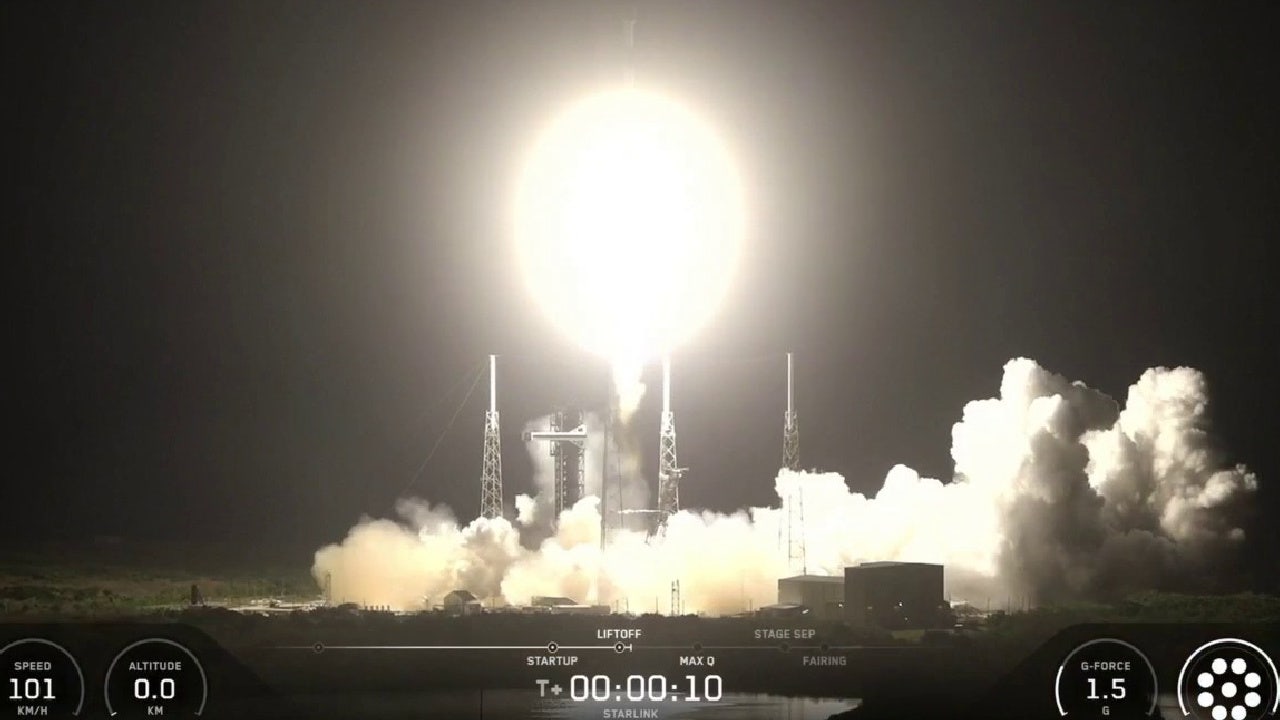
BREVARD COUNTY, Fla. - SpaceX has added more satellites to its massive Starlink constellation. The company launched another batch of 29 satellites on Tuesday. CLICK TO DOWNLOAD THE FOX LOCAL APP The satellites were on board a Falcon 9 rocket, which blasted off around 5:33 a.m. EDT from Space Launch Complex 40 at Cape Canaveral Space Force Station. The first stage booster completed its 26th flight and its 19th Starlink mission. It successfully landed on the droneship "Just Read the Instructions," which was positioned in the Atlantic Ocean. SIGN-UP FOR FOX 35'S BREAKING NEWS, DAILY NEWS NEWSLETTERS SInce 2019, SpaceX has launched thousands of Starlink satellites into low Earth orbit. The satellite network provides low-cost broadband internet to remote parts of the world.
Anthropic Just Triggered a Frenzied Selloff in Fastly Stock. Should You Buy the Dip?
Businessman work with ai for economy analysis financial result by digital augmented reality graph by Natee K Jindakum via Shutterstock Edge-cloud platform stocks like Fastly (FSLY) experienced a massive drop after popular AI company Anthropic announced its Claude Managed Agents. The company's stock dropped 21.7% intraday on Apr. 10 on the news, after a 10.1% drop on Apr. 9. It must be mentioned that the stock has surged robustly over the past year before this dip. The optimism surrounding the U.S.-Iran ceasefire that lifted the market dipped when Anthropic announced its advanced AI model, Mythos, with an exclusive Project Glasswing last week, thereby adding pressure on software names. Mythos's ability to autonomously identify and exploit software vulnerabilities has raised questions about Fastly's edge security model, as AI tools can now bypass traditional safeguards. In addition, Claude Managed Agents are seen as a direct infrastructure competitor to Fastly's platform. However, AI might not be as big a threat as investors are anticipating. Given this situation, should you consider capitalizing on Fastly's dip? Fastly is a cloud infrastructure company that operates a global edge platform designed to help businesses deliver digital experiences faster, more securely, and closer to end users. Fastly's core business is built on a programmable network that caches and routes content through distributed points of presence worldwide, reducing latency and improving performance. And, the company offers security products, including web application firewalls, DDoS protection, bot mitigation, and API security, all integrated into a single platform. Fastly's operations are tied to usage on its network, so customers pay for the traffic, security coverage, and compute resources they consume. Headquartered in San Francisco, California, it has a market capitalization of $3.50 billion. The company's stock has skyrocketed over the past year due to strong financial performance and high revenue visibility. Furthermore, Fastly appears to be benefiting from strategic initiatives and expanding market presence in the edge cloud and security space. Over the past 52 weeks, the stock has gained a whopping 344.71%, while it is up 139.39% year-to-date (YTD). The shares reached a 52-week high of $34.82 on Apr. 8, but are down 30% from that level. Fastly's stock has been trading above its 50-day moving average since mid-February. However, its 14-day RSI of 46.30 indicates slightly bearish momentum. On a forward-adjusted basis, its price-to-earnings (non-GAAP) ratio of 96.92 times is considerably higher than the industry average of 21.64 times. For the fourth quarter of fiscal 2025, Fastly reported record results, which lifted investor sentiment. The company's revenue increased 22.8% year-over-year (YOY) to a record $172.61 million, exceeding the $161.40 million that Wall Street analysts had expected. Its non-GAAP gross margin grew from 57.5% in Q4 2024 to 64% in Q4 2025. Also, the company reported quarterly non-GAAP operating income of $21.23 million, a significant turnaround from an operating loss in the prior-year period. Fastly reported non-GAAP EPS of $0.12, beating the $0.06 Street analysts had expected. There's greater visibility into its revenue, with a $354 million remaining performance obligation (RPO), up 55% from $228 million in Q4 2024. Wall Street analysts have a positive view about Fastly's bottom line trajectory. For the first quarter (to be reported on May 6, after the market closes), its loss per share is expected to decline by 52.2% YOY to $0.11. For fiscal 2026, the company's loss per share is projected to decrease by 29.9% annually to $0.47, followed by a 21.3% improvement to a $0.37 loss per share in fiscal 2027. Recently, Wall Street analysts have overwhelmingly reaffirmed their neutral stance on Fastly's stock. This month, experts at Piper Sandler kept a "Neutral" rating on the stock but raised the price target from $14 to $30. This was done after a reassessment of the stock, which left analysts incrementally more positive but not enough to turn the rating positive. In March, RBC Capital analysts raised the price target from $12 to $20, while keeping a "Sector Perform" rating and noting the company's improved execution and potential expansion. Citigroup analyst Fatima Boolani maintained a "Neutral" rating on Fastly's stock but raised the price target from $10 to $13 in February, which is essentially in line with other analysts. Fastly is still a sound favorite on Wall Street, with analysts awarding it a consensus "Moderate Buy" rating. Of the 11 analysts rating the stock, three analysts have rated it a "Strong Buy," while seven analysts are playing it safe with a "Hold" rating, and one analyst rated it "Moderate Sell." The consensus price target of $16 represents a 34.4% downside from current levels. However, the Street-high price target of $30 indicates a 23% upside. Fastly's growth trajectory has been laudable. However, the stock has been volatile. With analysts recently taking a neutral stance, especially amid the AI threat, it might be wise to monitor the stock for potential upside triggers before getting into it.
/AI%20(artificial%20intelligence)/Businessman%20work%20with%20ai%20for%20economy%20analysis%20financial%20result%20by%20digital%20augmented%20reality%20graph%20by%20Natee%20K%20Jindakum%20via%20Shutterstock.jpg)
NRG Energy Commences Secured And Unsecured Notes Offering
WASHINGTON (dpa-AFX) - NRG Energy, Inc. (NRG), Tuesday announced the commencement of concurrent offerings of senior secured first lien notes due 2031 and senior unsecured notes due 2034 and 2036. The energy company intends to use proceeds alongside a $900 million term loan for credit facility repayment and tender offers. The company added that the notes will be guaranteed by each of NRG's current and future wholly-owned U.S. subsidiaries that guarantee the term loans under NRG's credit agreement. NRG is trading at $172.07, up 1.07 percent before the bell on the New York Stock Exchange. Copyright(c) 2026 RTTNews.com. All Rights Reserved Copyright RTT News/dpa-AFX© 2026 AFX News

EU travel chaos 'warning sign that cannot be ignored' as passengers miss flights
Travel firms are calling on EU border authorities to make entry rules more flexible after more than 100 Manchester-bound easyJet passengers were left stranded in Italy after missing their flight. On Sunday, a total of 122 passengers were reportedly unable to board the flight from Milan Linate to Manchester because of delays at passport desks caused by the ramp-up of the EU's Entry Exit System (EES). The 11am departure was held for 59 minutes before departing with the majority of seats empty. Under the EES, people from third-party countries such as the UK having their fingerprints registered and photographs taken to enter the Schengen Area, which consists of 29 European countries, mainly in the EU. For most UK travellers, the process is done at foreign airports. Get MEN Premium now for just £1 HERE - or get involved in our WhatsApp group by clicking HERE. And don't miss out on our brilliant selection of newsletters HERE. In theory EES checks can be reduced and even deactivated where there is the threat of long queues at passport controls. But that does not seem to be happening universally, with reports of passengers also missing flights in Faro, Pisa and Venice last weekend because of EES delays. Representative body Airports Council International recently revealed that EES was causing delays of up to three hours, with airports in Spain, Portugal, France and Italy among the worst affected. Julia Lo Bue-Said, chief executive of Advantage Travel Partnership, a network of independent travel agents, told the Press Association that what happened in Milan is "a warning sign that cannot be ignored". She said: "Even isolated incidents at Schengen borders are having serious knock-on effects, with passengers missing flights, facing long waits and navigating processes that are unclear and inconsistent. That is simply not good enough." She claimed some airports have the "physical infrastructure to handle demand but are simply not deploying the staff to match it", which "demands explanation". She added: "We have consistently called for a pause in EES registration during peak travel periods and at times of high passenger volumes, to minimise disruption and protect the customer experience." Luke Petherbridge, director of public affairs at travel trade organisation Abta, said: "While for many the travel experience remains smooth, we're disappointed and frustrated to see some passengers being caught up in delays due to EES. "Abta has been warning destinations and the (European) Commission for some time about the need for proactive steps to be taken to avoid delays, including the full use of contingency measures to stand down biometric checks at busier times, and adequate staffing especially at peak times." Among those affected was easyJet passenger Kiera, 17, from Oldham, Greater Manchester, who said she and her boyfriend touched down at Milan Linate airport at 7.30am on Sunday. She told the BBC: "We got to Border Control and it was a massive queue of people. I wasn't feeling great anyway because I think I'd got food poisoning. "At about 10.50am they brought some water over for people, and when we got to the front of the queue someone asked us if we were going to Manchester, and told us our flight had just gone." Vicky Chapman, 26, from Wirral, Merseyside, had been booked on the flight alongside her family, including her five-year-old son. She told the Liverpool Echo they had arrived at the airport "with more than enough time" but were "refused entry through passport control". She went on to say: "We were then told that we are a 'no show' on our flight because we did not get to the gate on time, even though passport control had issues and they would not let us through. We were passed from pillar to post for three hours and no-one helped us. "It was so hot in the airport, people were vomiting, people were almost passing out. We're being told that Tuesday is the earliest we can get back, and that we have to fly to Gatwick. We've had to pay out of pocket for an Airbnb." An easyJet spokesman said: "Due to delays in EES processing by border authorities, some passengers departing from Milan Linate on Sunday experienced very long waiting times at passport control. We held flight EJU5420 from Milan to Manchester for nearly an hour to give passengers extra time but it had to then depart due to crew reaching their safety regulated operating hours. "Customers who missed the flight have been offered a free flight transfer. We continue to urge border authorities to ensure they make full and effective use of the permitted flexibilities, for as long as needed while EES is implemented, to avoid these unacceptable border delays for our customers. While this is outside of our control, we are sorry for any inconvenience caused."

Kraken Lands $200 Million Investment From Deutsche Börse | PYMNTS.com
By completing this form, you agree to receive marketing communications from PYMNTS and to the sharing of your information with our sponsor, if applicable, in accordance with our Privacy Policy and Terms and Conditions. The deal, announced Tuesday (April 15), gives Deutsche Börse a 1.5% stake in Kraken parent Payward and expands on an existing partnership between the two groups to combine traditional financial markets and digital assets. "Spanning trading, custody, settlement, collateral management, and tokenized assets, the partnership will unlock a new range of enhanced products and services that deliver frictionless access to both ecosystems, creating a holistic experience for institutional clients," Deutsche Börse said in a news release. A report by Bloomberg News calculated that the transaction values Kraken at $13.3 billion. The company was valued at $20 billion in a share sale in November. Kraken had filed confidentially for an initial public offering (IPO) last fall, part of a group of crypto companies looking to go public. The company has since then reportedly paused its IPO plans as a downturn in the crypto market has made companies more cautious about listing on the stock market. In other Kraken news, the company said this week it was the target of an extortion attempt. Kraken Chief Security Officer Nick Percoco said in a post X that a criminal group had threatened to release videos of the company's internal systems with client data shown if Kraken does not comply with their demands. "It's important to start with the most important points: our systems were never breached; funds were never at risk; we will not pay these criminals; we will not ever negotiate with bad actors," Percoco said in the post. The videos in question were taken during two instances of inappropriate access to a limited amount of Kraken's client support data, with both instances being identified and shut down by Kraken, the post added. Elsewhere from the digital asset space, new Federal Reserve data shows that the wide majority of stablecoins aren't part of the real economy, but are rather sitting idle or circulating within crypto markets rather than being used as a payment method. Those findings line up with research by PYMNTS Intelligence showing that while more than four in 10 middle market firms report say they have at least discussed or tested stablecoins, just 13% report actual use. "The gap between awareness and implementation underscores a persistent hesitation among finance leaders," PYMNTS wrote last week. "Stablecoins are regarded as potentially useful, but not yet embedded in standard financial operations."

Elon Musk's xAI Hits Colorado With Lawsuit Over New AI Rules
Elon Musk's artificial intelligence company, xAI, has filed a lawsuit against the state of Colorado, escalating tensions over how AI technologies should be regulated in the United States. The legal move targets a newly introduced state law aimed at curbing risks tied to rapidly advancing AI systems. Colorado faces lawsuit from Elon Musk's xAI xAI filed the lawsuit against Colorado Attorney General Phil Weiser, asking a court to block enforcement of a 2024 law. The legislation targets "high-risk" AI systems and requires developers to actively prevent algorithmic discrimination in sectors such as housing, education, and employment. As a result, companies must monitor outputs and adjust systems to meet compliance standards. However, xAI strongly opposes the measure. The company argues that the law places heavy burdens on developers and limits how AI tools can be built and deployed. It also claims the rules violate First Amendment protections. In its filing, xAI states that the law could force its chatbot, Grok, to reflect what it calls a "politicized viewpoint," instead of maintaining neutrality. Therefore, the company believes the regulation interferes with both innovation and expression. Meanwhile, the case arrives at a time when AI faces growing scrutiny worldwide. Regulators have raised concerns about bias, misinformation, and harmful outputs. At the same time, tech leaders continue to warn that strict or inconsistent rules could slow progress and create barriers for companies operating across multiple states. The lawsuit also highlights a larger policy divide. Some lawmakers support state-level regulation, while others push for a single federal framework. Donald Trump supported a unified approach. He stated, "There must be only One Rulebook if we are going to continue to lead in AI." Colorado officials have not issued a public response yet. As the case moves forward, it could shape how other states approach AI regulation and influence the broader national strategy.

Bitget Launches New Pre-IPO Product With SpaceX As First Listing
Bitget, the world's largest Universal Exchange (UEX), has launched IPO Prime, introducing a new market structure that enables users to access and trade pre-IPO exposure to global unicorn companies such as SpaceX. Powered by Republic, the launch marks an expansion beyond traditional secondary market trading, enabling participation in value creation before companies enter public markets, a phase historically limited to institutional investors and private capital networks. Through IPO Prime, Bitget extends its Universal Exchange framework into primary market access, bridging a long-standing gap between private and public market participation. IPO Prime operates through a subscription-based model, where eligible users can apply for allocations in tokenized offerings tied to specific companies. Allocation limits are determined based on user tier, with higher participation thresholds available to elevated VIP levels. Following the subscription phase, these digital assets transition into an over-the-counter market on Bitget, enabling continuous pricing, trading and circulation within a structured environment. The first offering under IPO Prime is preSPAX, a digital asset designed to mirror the economic performance of SpaceX following its potential public listing. As one of the most closely watched private companies globally, SpaceX represents the type of high-growth opportunity that has traditionally remained inaccessible to retail investors. According to CEO of Bitget, Gracy Chen, "Since the beginning of financial markets, access to pre-IPO opportunities has been defined by exclusivity, IPO Prime allows users to participate earlier in a company's growth cycle, with the flexibility of continuous trading. This shifts how and when investors can engage with emerging companies, which gives retailers and new investors a chance to buy-in early. This is part of our greater shift towards building an UEX, democratizing access to financial equality." "To mark the launch, Bitget will introduce two rounds of preSPAX token airdrops for eligible VIP users, on April 13, 2026 at 10:00 (UTC), providing early participants with additional exposure as the platform begins onboarding its first offering. The official preSPAX token launches on April 21, 2026 at 12:00 (UTC), with the commitment period starting April 18, 2026, 18:00 and ending April 21, 2026, 18:00 (UTC). Distribution period runs from April 21, 2026 18:00 till April 21, 2026, 22:00 (UTC). "The introduction of IPO Prime is a new route to traditional financial opportunities being structured and accessed. As boundaries between asset classes continue to blur, platforms are expanding beyond traditional and crypto trading to include early-stage market participation. Within Bitget's Universal Exchange model, IPO Prime moves towards integrating diverse financial opportunities into a single, unified environment," she said.

Kraken is actively being extorted by criminals threatening to release the top crypto exchange's internal data | featured Exchanges | CryptoRank.io
- Kraken says two support staff improperly accessed limited customer data (flagged Feb 2025 and later); ~2,000 accounts (~0.02% of clients) potentially viewed, extortion demands followed, access revoked and affected users notified. - No breach of wallets or trading systems, but the incident highlights the support-layer attack surface and insider recruitment risk (reported offers $3,000-$15,000); precedent: Coinbase 2025 insider extortion affected ~70,000 customers. - Market reaction contained (BTC ≈ $71,806, +0.41% 24h) yet expect higher compliance costs, tighter access controls, more support friction and reputational risk for CEXes; Kraken handled 7,957 law‑enforcement requests in 2025 (↑16.5%) across 13,082 accounts in 74 countries. Kraken says it is being extorted by a criminal group threatening to release internal material after two support staff members improperly accessed limited customer data. In a security update published by chief security officer Nick Percoco on X, the crypto exchange said it identified two cases of inappropriate access to client support data, revoked access, notified affected users, and later received demands tied to videos allegedly showing internal systems with customer information visible. Kraken said its core systems were never breached, funds were never at risk, and roughly 2,000 accounts, or about 0.02% of clients, were potentially viewed. Even so, the incident sharpens a growing problem for crypto platforms. The highest-value security failure is not always a wallet exploit or infrastructure breach. It can begin inside the support layer, where limited customer context is enough to make the next message, call, or verification request feel legitimate. That distinction changes the nature of the threat. The issue is less about direct theft from exchange infrastructure and more about whether authentic internal access can be turned into a trust weapon against users. The exposed information may have included some client account data, though Kraken has not publicly detailed the full field-level scope. In crypto, a small amount of real support information can be operationally valuable to criminals even when the exchange's trading and custody systems remain secure. The broader backdrop gives that risk more weight. In its 2025 Transparency Report, released on March 19, Kraken said it handled 7,957 law enforcement and regulatory data requests in 2025, up 16.5% year over year, spanning 13,082 accounts across 74 countries. That report was part of a larger trust narrative around compliance, operational maturity, and financial-system integration. Days later, the conversation changed. The issue has moved from how often outside authorities ask for data to how securely internal access is controlled in the first place. For users, the concern is straightforward. The exchange may have secured wallets and core systems, yet the path to harm can still run through support, where a criminal only needs enough context to sound real. Kraken's phrasing is precise. The company said there was no breach of its systems and no risk to funds. It also said two insiders had inappropriately accessed limited client support data, one linked to an incident flagged in February 2025 and another tied to a more recent video showing similar activity. Across both incidents, Kraken says about 2,000 accounts were potentially viewed. Soon after access was terminated, the company says it began receiving extortion demands threatening disclosure to media outlets and on social media. The attack chain described here is operational rather than cinematic. Someone inside a support environment sees information they should not be using that way, records or shares evidence of access, and a criminal group uses that material as leverage. That sequence suggests a repeatable attack path. A code exploit often depends on a specific bug. Insider recruitment scales through incentives, pressure, and weak access design. Check Point Research said in late 2025 that cybercriminals were openly seeking insiders at major crypto exchanges including Coinbase, Binance, Kraken, and Gemini, with typical offers ranging from $3,000 to $15,000 for access or information. Kraken's own statement says the company has been collaborating with partners and law enforcement to investigate insider recruitment efforts affecting other sectors as well, including gaming and telecoms. That places the exchange inside a larger pattern where customer-service and support operations have become a common pressure point across industries that rely on high-trust interactions and large pools of personal data. Crypto has already seen what that pattern can look like once it moves from access to exploitation. In May 2025, Coinbase disclosed that overseas support agents had been bribed to copy customer information, with attackers then attempting to impersonate the company and trick users into transferring funds. CryptoSlate later reported that law enforcement made an arrest tied to the Coinbase insider extortion case, which affected nearly 70,000 customers. Kraken's disclosure is much smaller by account count, yet the significance lies elsewhere. The incident reinforces the same mechanism. User-facing danger often arrives after the initial access event, when criminals begin contacting customers armed with real names, internal-looking references, and enough background to engineer urgency. The support layer has a special role inside crypto because it sits at the point where users are already vulnerable. Locked accounts, delayed withdrawals, tax forms, identity checks, device changes, and password resets create conditions where customers expect to be asked for confirming details. That is exactly why compromised support access is so valuable. It gives attackers the ability to mimic a legitimate workflow rather than invent one from scratch. For people with Bitcoin exposure and little interest in security jargon, the practical takeaway is direct. A serious risk can arrive as a convincing support interaction, built on authentic internal context, even while the exchange's wallets and matching systems remain secure. Bitcoin's market behavior suggests traders are treating this as a contained exchange-security issue rather than a system-wide shock. As of press time, CryptoSlate's Bitcoin page shows BTC at $71,806, up 0.41% over 24 hours, up 7.43% over seven days, and up 3.45% over 30 days, with $39.82 billion in daily volume and 59% market dominance. Bitcoin continues to trade inside a broader macro and flow regime where ETF positioning, liquidity conditions, and risk appetite are carrying more weight than a single exchange's internal security event. Price resilience, however, should not be confused with irrelevance. Some consequences show up first in operations and user behavior, then feed into reputation, acquisition costs, and compliance overhead later. The strongest near-term consequence is a trust tax on support interactions. Exchanges facing this class of threat typically respond by narrowing access privileges, increasing verification friction, segmenting internal tooling, and documenting more activity across help desks and vendor relationships. Those steps are rational. They also make the user experience slower and more rigid. A customer trying to restore access or confirm account activity may end up facing more questions, longer delays, and fewer discretionary workarounds from support agents. That is where a security event becomes tangible for a mainstream user. The damage is measured less by a one-day move in BTC and more by a gradual decline in how natural and safe exchange interactions feel. The wider cyber backdrop supports that interpretation. In its April 2026 release, the FBI said Americans reported more than $11 billion in cryptocurrency-related losses in 2025, while phishing, spoofing, and extortion remained among the most common complaint categories. Separately, Mandiant's M-Trends 2026 report said global median attacker dwell time rose to 14 days from 11 days a year earlier, with cyber espionage and North Korean IT-worker cases showing a median dwell time of 122 days. Those figures do not map one-to-one onto Kraken's case, yet they point in the same direction. The operating environment favors patient intrusions, social engineering, and access monetization. Crypto exchanges are operating inside that same environment while also carrying the added burden of irreversible transactions and a user base accustomed to phishing attempts. That leaves Bitcoin in a familiar position. The asset itself can stay resilient while the rails around it face renewed scrutiny. Centralized platforms remain a major access point for buying, selling, and storing BTC, especially for newer users. When support functions become a recognized attack surface, confidence in those rails weakens even if confidence in Bitcoin itself holds steady. That distinction grows more important as exchanges continue trying to present themselves as mature financial infrastructure. Kraken has been expanding beyond crypto, including into equities and ETFs, and its transparency report was part of a broader effort to show institutional-grade discipline. Incidents like this one pull the market back to a more basic question, whether the human layer is being secured with the same intensity as the balance sheet and wallet architecture. Kraken says affected users have already been notified, access has been terminated, and the company believes there is sufficient evidence to support identification and arrest of those responsible. If no leaked videos surface, no further data appears, and no visible wave of impersonation attempts emerges, the incident may settle into the category of a narrow but instructive security disclosure. That outcome would still leave an imprint on how exchanges think about support operations, outsourced labor, and privileged access. ANOT possibility is escalation through downstream fraud. This path deserves the closest attention because it is where user harm can widen quickly. Once criminals have real support context, even from a limited number of accounts, they gain material for convincing follow-up messages. That can include references to account issues, location data, identity checks, or service cases, depending on what was visible. Every exposed field does not need to be itemized to grasp the point. Authentic fragments make impersonation stronger. Coinbase's experience in 2025 already showed how insider access can become the starting point for a broader social-engineering campaign aimed directly at customers. Kraken's disclosure revives that concern, especially because the company itself tied the incident to broader insider recruitment efforts across sectors. There is also a third layer that deserves close coverage over time, the reputational and structural response. If insider recruitment is becoming a durable criminal market, exchange defenses will shift toward tighter role segmentation, more surveillance inside support tools, stronger contractor controls, and stricter outbound communication rules. That will affect staffing models and vendor relationships across the sector. It could also create a clearer divide between exchanges that treat support as a low-margin operational necessity and those that treat it as a core trust function. For public-facing crypto businesses, that difference may shape everything from user retention to institutional partnerships. A platform that secures reserves and internal wallets while leaving support exposed is still leaving a critical flank open. For now, Kraken's disclosure works best as a warning about where the next wave of crypto security failures may surface. The image of a hacker breaking through code still dominates public imagination. A more realistic threat in many cases looks quieter, more human, and more scalable. A recruited insider, a support console, a short clip of internal access, and an extortion note can move the risk from infrastructure to trust in a matter of hours. Bitcoin's price can keep climbing while that shift unfolds. Users, exchanges, and the companies trying to turn crypto platforms into mainstream financial utilities still face the same conclusion.

Deutsche Börse takes $200m stake in crypto platform Kraken
Deutsche Börse Group is expanding its push into digital assets with a $200m investment in Kraken. Through a secondary share purchase, the exchange operator will acquire a 1.5% stake in Kraken's parent company, Payward, Inc. Kraken is one of the largest and most established crypto trading platforms globally. Headquartered in San Francisco, it provides institutional and retail investors with access to a wide range of digital assets, alongside services including trading, custody and staking. Its focus on regulation, infrastructure and institutional clients has made it a key player in the global crypto ecosystem. The two firms first announced a partnership in December 2025. The collaboration spans the full value chain, including trading, custody, settlement, collateral management and tokenised assets. The aim is to offer institutional investors seamless access across both traditional and digital markets. The new investment deepens this partnership. The move underlines Deutsche Börse's digital asset strategy, which centres on building a hybrid market infrastructure capable of handling both traditional securities and blockchain-native tokens within a single liquidity pool. The transaction remains subject to regulatory approvals and is expected to close in Q2. The investment forms part of a broader acquisition drive by Deutsche Börse Group. The firm recently invested $15m in US index provider MerQube, alongside private markets specialist 7RIDGE, taking a minority stake in the rules-based index and passive solutions provider. In parallel, Deutsche Börse Group is advancing the digitalisation of a key market segment through its post-trade arm Clearstream, in partnership with Euroclear. From 2026, Eurobonds will be issued in fully dematerialised form, supported by a new unified data standard (IPT) that also enables the integration of blockchain technology. The aim is to make the €14trn Eurobond market more efficient, secure and automated - with faster settlement, lower costs and a foundation for future tokenised bond issuance. The conversation surrounding how to tokenise traditional assets is also gaining momentum across the asset management industry more broadly. On the same day as Deutsche Börse's recent move, Legal & General Investment Management announced it had brought one of its liquidity funds on-chain in partnership with fund back office technology provider Calastone. Fund units can now be issued as digital tokens, enabling faster trading, transfer and settlement - in some cases close to real time.

Fury over price hikes erupts as tractors spark chaos on roads
A slow-moving convoy of tractors has sparked huge traffic disruption in Northern Ireland, as several fuel protests are expected to be held in the region today. The local health minister Mike Nesbitt has asked protesters not to block roads, warning that the lives of those seeking medical treatment could be put at risk. Traffic clogged up on the Sydenham bypass near Belfast City Airport around noon, and tractors travelled down the bypass in the direction of Bangor towards City Airport, with some cars undercutting them on the cycle route to get past on the inside. The Belfast disruption comes after similar demonstrations south of the border disrupted fuel supplies, port operations and traffic in city centres and on motorways for a week. The war in Iran has seen the cost of oil skyrocketing, particularly after Iran started blocking the Strait of Hormuz, through which 20% of oil supplies transit.

'Valorant' 12.07 Patch Notes Add Major Discord Integration
The Valorant 12.07 patch notes have been released, and while there aren't any major balance changes to discuss, there is a very cool new Discord integration that should make life a lot easier when it comes to playing with pals. Starting in Brazil with the release of the 12.07 patch, Discord integration will be added to Valorant. If you link your Discord and Riot Games account, you will be able to invite friends from Discord directly through the Valorant menus, meaning you no longer have to alt-tab out to Discord. You can also copy your Valorant lobby link and share it directly in Discord, and you can see which of your Discord pals are playing Valorant. These Discord features will be opened up to players in the US and Canada on April 21, with a global rollout expected, assuming everything goes to plan, with patch 12.08 on April 29. The addition of Discord integration is a nice step when it comes to the social side of Valorant, and should be a major quality of life improvement for a lot of players. With Discord being the most popular communication tool for PC gamers, it makes sense to have it directly integrated into Valorant. However, with the recent questionable policy choices by Discord that will likely see them enforce age verification through ID in the near future, many users have moved away from the platform for self hosted alternatives. Elsewhere in the world of Valorant, the 12.07 patch notes bring a lot of bug fixes to cosmetics and the store itself, and there are some quality of life updates in the settings menu options. While this is not a major Valorant patch, the game is actually in a fairly good state right now and isn't in need of massive balance changes. The launch of new agent Miks has gone down well with players, and many of the recent balance changes have got the game to a state where there aren't too many outliers when it comes to overall strength. Of course there are some things the community would like to see changed, and sooner or later there will need to be some big changes or new content added to the game to keep things fresh. But for now, Valorant is in a good state on both PC and console, and there is no real reason to disrupt that.

U.S. Air Force Successfully Deploys a Pilot with Actelis' Technology to Modernize Mission Critical Networks Generating Over 85% Cost Savings Compared to SpaceX's StarShield and 5G | Taiwan News | Apr. 14, 2026 21:00
Rapid Deployment Over Existing Infrastructure Positions Actelis as a Cost-Effective Solution for Mission-Critical Defense Networks Sunnyvale, Calif., April 14, 2026 (GLOBE NEWSWIRE) -- Actelis Networks, Inc. (OTC: ASNS) ("Actelis" or the "Company"), a market leader in cyber-hardened, rapid-deployment networking solutions for IoT and broadband applications, today announced that its hybrid-fiber Ethernet technology has been successfully deployed in a pilot by the U.S. Air Force ("USAF") at an undisclosed base, delivering over 85% in combined upfront and recurring cost savings. The deployment supports mission-critical sensors in remote and hard-to-reach environments, where traditional approaches would have required new infrastructure buildouts, extended timelines, and substantially higher costs. These types of deployments are increasingly central to U.S. defense strategy, as the Department of the Air Force emphasizes the need for resilient, adaptive, and secure connectivity to support real-time operations across air, cyber, and space domains.1 As part of its evaluation process, the U.S. Air Force assessed multiple connectivity options, including satellite-based solutions such as SpaceX's StarShield, microwave systems, and 5G. In this technical validation and cost analysis, the Air Force determined a solution incorporating Actelis' technology is a superior one compared to other alternatives, highlighting its ability to deliver fiber-grade connectivity over existing infrastructure with compelling economic and deployment advantages -- particularly in scenarios where cyber-safety, speed, cost, and operational flexibility are critical. By leveraging existing copper and fiber assets, -Actelis enabled USAF to avoid the need for costly trenching or new construction. This aligns with broader U.S. Department of Defense priorities to modernize installation communications infrastructure, which has been identified as requiring significant upgrades in capacity, scalability, and resiliency to support next-generation operations. "This successful implementation with the USAF is a clear example of how defense organizations are rethinking network architecture in an increasingly complex global environment," said Tuvia Barlev, Chairman and CEO of Actelis. "The U.S. Air Force evaluated a range of alternatives, including satellite-based solutions, and ultimately determined that the approach that delivers immediate operational capability with significantly lower cost includes our solution. As defense agencies accelerate investments in resilient and adaptive infrastructure - supported by large-scale programs such as the Air Force's Base Infrastructure Modernization initiative, which carries a contract ceiling of up to $12.5 billion2, we believe Actelis is well positioned to play an expanding role in the evolving defense networking market." Key expected outcomes of the deployment include: Millions in total cost savings, including capital and ongoing operational expensesExpanded utilization of existing infrastructure across multiple sites, further enhancing efficiencyMoving to modern, cyber-hardened infrastructure as soon as possible Actelis' hybrid networking technology supports a wide range of environments, including legacy copper (Cat3, Cat5/6), coaxial, and fiber networks, enabling seamless integration across complex infrastructure systems typical in defense and government applications. Actelis Networks is certified for use in secure military environments, including NIPR and SIPR networks, and is listed on the U.S. Department of Defense Information Network (DoDIN) Approved Products List (APL). About Actelis Networks, Inc. Actelis Networks, Inc. (OTC: ASNS) is a market leader in hybrid fiber, cyber-hardened networking solutions for rapid deployment in wide-area IoT applications, including government, ITS, military, utility, rail, telecom, and campus networks. Actelis' innovative portfolio offers fiber-grade performance with the flexibility and cost-efficiency of hybrid fiber-copper networks. Through its "Cyber Aware Networking" initiative, Actelis also provides AI-based cyber monitoring and protection for all edge devices, enhancing network security and resilience. For more information, please visit www.actelis.com. Forward-looking Statements This press release contains certain forward-looking statements within the meaning of the safe harbor provisions of the Private Securities Litigation Reform Act of 1995. These statements are identified by the use of the words "could," "believe," "anticipate," "intend," "estimate," "expect," "may," "continue," "predict," "potential," "project" and similar expressions that are intended to identify forward-looking statements. All forward-looking statements speak only as of the date of this press release. You should not place undue reliance on these forward-looking statements. Although we believe that our plans, objectives, expectations and intentions reflected in or suggested by the forward-looking statements are reasonable, we can give no assurance that these plans, objectives, expectations or intentions will be achieved. Forward-looking statements involve significant risks and uncertainties (some of which are beyond our control) and assumptions that could cause actual results to differ materially from historical experience and present expectations or projections. Actual results may differ materially from those in the forward-looking statements and the trading price for our common stock may fluctuate significantly. Forward-looking statements also are affected by the risk factors described in the Company's filings with the U.S. Securities and Exchange Commission. Except as required by law, we undertake no obligation to update or revise publicly any forward-looking statements, whether as a result of new information, future events or otherwise, after the date on which the statements are made or to reflect the occurrence of unanticipated events. Investor Relations Contact: Arx Investor Relations North American Equities Desk [email protected] 1 https://www.dafcio.af.mil/Portals/64/DAF%20Network%20of%20the%20Future%20Strategy_vF.pdf 2 https://www.aflcmc.af.mil/NEWS/Article-Display/Article/3909048/eitaas-bim-services-awarded-a-125b-agreement/
Deutsche Börse acquires 1.5% stake in Kraken crypto exchange - CoinJournal
The deal strengthens an already existing partnership that was first announced in late 2025. Deutsche Börse has taken a 1.5% stake worth $200 million in Kraken, marking another clear step in the steady convergence between traditional finance and the crypto industry. The deal gives Deutsche Börse a 1.5% fully diluted stake in Kraken's parent company, acquired through a secondary share purchase. That means no new shares were issued, and Kraken itself does not directly receive fresh capital from this transaction. Based on the size of the investment, the deal implies a valuation in the range of roughly $13-15 billion for Kraken. That places the exchange firmly among the most valuable private players in the digital asset space. However, the size of the stake is not the main story here. A 1.5% holding does not offer control or significant influence on its own. What matters is how this investment strengthens an already existing partnership between the two firms. That partnership, first announced in late 2025, focuses on building infrastructure that connects traditional financial systems with crypto markets. To understand why this move matters, it helps to look at what Deutsche Börse already does best. The company is not just a stock exchange. It operates across the full financial value chain: trading platforms, derivatives markets, clearing services, and settlement systems. It also generates significant revenue from financial data and analytics. This integrated structure allows it to capture value at multiple points in every transaction. More importantly, it gives the company a strong position in areas like clearing and data, which tend to generate stable, recurring income. Now, with crypto markets maturing and attracting institutional interest, Deutsche Börse is extending this model into digital assets. Kraken plays a key role in that expansion. By working with an established crypto platform, Deutsche Börse gains access to technology, liquidity, and market expertise that would take years to build internally. At the same time, Kraken benefits from Deutsche Börse's regulatory experience and institutional network. The goal is straightforward: create a system where traditional assets and digital assets can operate side by side. One of the most important ideas behind this deal is the concept of a "hybrid" financial system. Instead of treating crypto as a separate market, Deutsche Börse is positioning itself for a future where all asset classes, equities, derivatives, and tokenised assets can be traded, cleared, and settled within a unified framework. This approach could allow institutions to move seamlessly between traditional and digital markets using familiar infrastructure. For example, Deutsche Börse already operates major platforms in foreign exchange and derivatives. Integrating crypto into that ecosystem opens the door to new products, including tokenised securities and crypto-linked derivatives. At the same time, its post-trade businesses, particularly clearing and settlement, could play a critical role in bringing more structure and trust to crypto markets. These are areas where traditional finance has a clear advantage. By aligning itself with Kraken, the company is effectively laying down the rails for a financial system that blends traditional and digital assets. If that vision materialises, the value of this partnership could extend far beyond the initial $200 million investment.

Palantir Drops After Anthropic Warning -- Bull Case Remains Intact
Palantir Technologies Inc. NASDAQ: PLTR may be proof that there's no such thing as bad publicity. The stock sold off sharply on April 9. The reason of the day was that Michael Burry, who had taken out millions in put options on PLTR earlier this year, was back at it. This time, Burry alleged that Anthropic is "eating Palantir's lunch." Here's the background. Anthropic posted an impressive jump in annual recurring revenue (ARR) from $9 billion to $30 billion in a matter of months. Burry's conjecture is that it took Palantir 20 years to get to $5 billion in ARR, and that businesses will choose Anthropic's cheaper, more intuitive solution. That would leave Palantir with its relatively low-margin government business. Like many things, at the surface level, the bear case makes sense. Palantir will need years of outperformance to justify its current valuation. If Anthropic threatens that growth, it would be problematic at best. Anthropic Vs. Palantir: Why the Comparison May Miss the Mark But the operative word is "if." And when you look at the business models of each company, the case gets much shakier. Simply put, Anthropic and Palantir are only the same in that they both are artificial intelligence (AI) companies. But whereas Anthropic builds AI models, Palantir enables other companies to deploy them at scale. Enterprise customers are choosing Palantir because they are working with sensitive data, and the stakes are massive. Those companies aren't looking for cheap and easy. That's why, as Wedbush's Dan Ives has frequently remarked, Palantir is the first call many of these companies make. Geopolitical Catalysts Highlight Palantir's Strategic Value The world can be grateful that a ceasefire was announced between the United States and Iran. However, in the 24 hours leading up to that announcement, PLTR jumped to over $150 per share. The reason was simple. Palantir's technology has been proven to be effective in the prosecution of the air campaign against Iran. That was supported by a social media post from President Trump on April 10 praising the "war fighting capabilities and equipment" of the company. If that campaign were to continue, it would be bullish for PLTR. Underscoring that point, PLTR was up over 4% in early trading on April 13 after the news that talks between the two countries broke down. That's a real-world example of Palantir's business model. And while it doesn't necessarily refute Burry's argument, it illustrates the difference between Palantir and Anthropic. Palantir is entrenched within the U.S. Department of War. That relationship isn't going to change anytime soon. There's more than an economic cost of switching; it's about protecting the lives of U.S. service members. Liquidity, Volatility, and the Real Reason Behind the Sell-Off So, there's Michael Burry's assertion against geopolitical concerns. That sets up the reality that this has been a liquidity event. Investors have been looking for ways to access cash quickly. That means selling shares of stocks that are highly liquid. And that means PLTR. It's frustrating for investors, and even more so for traders. But it doesn't change the long-term outlook for the company or the stock. It just reiterates that this is a volatile stock that will be prone to outsized moves in both directions. Speaking of timing, it's worth noting that Burry, as is his habit, took down his social media post shortly after it was posted. Yet, the assertion made is still being given as a reason for the stock to move lower. Analyst Price Targets Undermine Valuation Concerns The most logical bearish argument against Palantir has to do with valuation. Even after a correction of over 25% in the three months ending April 10, PLTR is still valued at over 200x earnings and over 70x sales. Using the efficient market hypothesis, those numbers mean that Palantir will have to continue delivering blockbuster results for years to come. But markets aren't efficient, and in the case of PLTR, institutional investors were late to arrive, but now have little choice but to play catch-up. In recent years, institutional buying in terms of dollars has outpaced selling by nearly 3:1. Analysts agree. For all the concerns over valuation, the consensus price target for PLTR is $197.77. That's a gain of nearly 50% from where the stock trades as of this writing. Wedbush reiterated its Outperform rating on PLTR as well as its $220 price target. That's more than 10% above the consensus target. Skeptics could make the counterpoint that only about 45% of Palantir stock is owned by institutions. That hasn't moved much in the last year despite the stock's inclusion in the S&P 500 and the NASDAQ 100. And with PLTR down about 25% in 2026, that stance could be justified. However, the stock appears to have found support around $130. The ceiling may remain low, and with so much uncertainty in the market, PLTR could drop further. But if you can handle the volatility inherent in the stock, this could be an entry point for starting a position. Should You Invest $1,000 in Palantir Technologies Right Now? Before you consider Palantir Technologies, you'll want to hear this. MarketBeat keeps track of Wall Street's top-rated and best performing research analysts and the stocks they recommend to their clients on a daily basis. MarketBeat has identified the five stocks that top analysts are quietly whispering to their clients to buy now before the broader market catches on... and Palantir Technologies wasn't on the list. While Palantir Technologies currently has a Moderate Buy rating among analysts, top-rated analysts believe these five stocks are better buys.
Upstate residents capture pictures of SpaceX launch
(WSPA) -- A SpaceX Falcon 9 rocket launched 29 Starlink satellites into low Earth orbit at 5:23 a.m. Tuesday from Space Launch Complex 40 at Cape Canaveral Space Force Station in Florida. This mission marked the 26th flight for the first-stage booster supporting the launch. Residents in the Upstate of South Carolina captured pictures and video of the early-morning launch. The Falcon 9 carried 29 Starlink satellites into orbit. The first-stage booster used for this mission had previously supported six other missions. These included Ax-2, Euclid, Ax-3, CRS-30, SES ASTRA 1P, and NG-21. It has now also supported 20 Starlink missions.

Deutsche Börse Takes 1.5% Stake in Kraken Through $200M Deal
The partnership aims to build a hybrid financial system combining traditional and tokenized assets. Germany's largest stock exchange operator, Deutsche Börse AG, has invested $200 million in Payward Inc., the parent company of crypto exchange Kraken, acquiring a 1.5% fully diluted stake that values the exchange at roughly $13.3 billion. As reported by Bloomberg, the valuation marks a roughly 33% markdown from the $20 billion Kraken commanded in its November 2024 funding round, reflecting broader pressure on crypto-exchange valuations since bitcoin's October 2025 peak. The transaction is expected to close in the second quarter of 2026, subject to regulatory approval. The deal deepens a commercial partnership first announced in December 2025 and fits a growing pattern of legacy exchange operators taking equity positions in crypto platforms. In early 2026, Intercontinental Exchange Inc. (ICE) -- owner of the New York Stock Exchange -- made a similarly sized $200 million investment in crypto exchange OKX. Thomas Book, a member of Deutsche Börse's management board, described Kraken as a central partner in building what he called a "fully hybrid market infrastructure" that combines traditional and tokenized assets within a single integrated system. "Irrespective of what is now the form of an asset -- whether it's tokenized or fully digital -- we want to create one integrated value chain," Book said. Kraken, one of the longest-standing crypto exchanges, has been actively expanding its institutional footprint. The company filed confidentially for a U.S. IPO in November and raised $800 million in the same month, at a $20 billion valuation. It has also made regulatory strides, becoming the first crypto firm to gain access to the Federal Reserve's core payments system in March. In Europe, Kraken launched MiFID-regulated crypto derivatives last year, signaling its intent to operate within established financial frameworks. Deutsche Börse has been quietly building out its own blockchain stack. Its Clearstream post-trade unit launched a platform for trading tokenized securities in November 2025, followed a month later by the integration of Kraken into 360T, Deutsche Börse's FX trading platform. The $200 million investment cements what had been a commercial partnership into a capital relationship, giving Deutsche Börse both equity exposure and a deeper operational tie to one of the most established names in crypto. The investment comes against a difficult market backdrop. Bitcoin is trading roughly 40% below its October 2025 peak, and exchange revenues across the sector have contracted alongside falling trading volumes. Rival exchange Gemini has reportedly approached investors for fresh capital after scaling back operations, according to industry reports. Security risks also remain front and center. Kraken recently disclosed an attempted extortion attack by a criminal group that claimed to have obtained certain client account data. The exchange said no customer funds were compromised and declined to pay the ransom. The deal is another data point in a rapidly shortening list of distinctions between traditional finance and crypto -- a trend accelerated by the European Union's MiCA framework and growing regulatory clarity in the United States. For Kraken, the Deutsche Börse investment delivers both capital and legitimacy ahead of its anticipated public listing. For Deutsche Börse, it secures a foothold in a market segment that several of its European peers have been slower to embrace. Key milestones now include regulatory approval of the stake, expected in the second quarter of 2026; further disclosures on Kraken's IPO timeline; and whether other European exchange operators -- notably Euronext and the London Stock Exchange Group -- respond with their own crypto-infrastructure investments.
Deutsche Börse invests $200M in Kraken at $13.3B value: Bloomberg
Germany's largest exchange group, Deutsche Börse, has agreed to invest $200 million in Payward Inc., the parent firm of crypto exchange Kraken, according to a report by Bloomberg. The investment will give Deutsche Börse an approximately 1.5% stake in Kraken on a fully diluted basis, valuing the U.S.-based cryptocurrency exchange at around $13.3 billion. The move highlights growing institutional confidence in digital asset platforms as traditional financial firms deepen their exposure to the crypto sector. Kraken, one of the longest-standing crypto exchanges, has been expanding its global footprint and product offerings, including derivatives trading and institutional services. The latest funding round reflects continued investor interest despite ongoing regulatory scrutiny across major markets. For Deutsche Börse, the investment aligns with its broader strategy to integrate digital assets into its existing financial infrastructure. The exchange operator has been actively exploring blockchain-based solutions and digital asset custody services, aiming to position itself at the forefront of financial innovation. The partnership also signals a convergence between traditional finance and the crypto industry, as established institutions increasingly seek strategic stakes in leading digital asset firms. Analysts view such investments as a way for legacy financial players to gain exposure to crypto markets without directly holding volatile assets. While the stake acquired is relatively small, the deal provides Deutsche Börse with a strategic foothold in a major global exchange. It may also pave the way for future collaborations in areas such as tokenized assets, trading infrastructure, and institutional-grade crypto services. The valuation of $13.3 billion underscores Kraken's standing as a key player in the digital asset ecosystem, even as competition intensifies among global exchanges.

OpenAI's Internal War Plan: A Leaked Memo, a Price War, and a Direct Assault on Anthropic
A leaked internal memo from OpenAI has laid bare a corporate strategy that reads less like a technology roadmap and more like a battle plan. The document, authored by OpenAI's Chief Marketing Officer Dane Vahey, explicitly names rival Anthropic as the company's primary competitive target and outlines a coordinated campaign to undercut its business -- starting with price. The memo, first reported by Gizmodo, was sent to OpenAI staff and details a multi-pronged approach: slash API pricing, accelerate product releases, and reposition OpenAI's brand to recapture enterprise customers who have drifted toward Anthropic's Claude models. It's an unusually candid look inside a company that has, until recently, tried to present itself as mission-driven rather than market-driven. That pretense appears to be over. Vahey's memo describes Anthropic not merely as a competitor but as an existential threat to OpenAI's commercial ambitions. The document reportedly identifies Anthropic's growing share of enterprise API usage as the single most urgent problem facing OpenAI's business. And the prescribed remedy is blunt: attack on price, attack on product, attack on narrative. The pricing component is already visible. OpenAI has been aggressively reducing the cost of its API access over the past several months, a strategy that has squeezed margins but kept developers on its platform. The memo suggests this isn't a temporary promotion. It's a sustained pressure campaign designed to make Anthropic's pricing untenable. OpenAI, backed by Microsoft's billions and fresh capital from its recent funding rounds -- including a massive $40 billion raise announced earlier this year -- can afford to bleed on margins in ways that Anthropic, despite its own significant funding from Amazon and Google, may not be able to match indefinitely. The logic is familiar to anyone who has watched platform wars in technology. Amazon did it with AWS. Google did it with cloud storage. Uber did it with ride-hailing. The playbook: use superior capital reserves to price below cost, capture market share, and force competitors into a defensive posture where they must either match prices and burn cash or cede ground. OpenAI appears to be running this exact play against Anthropic in the AI model API market. But the memo goes beyond pricing. Vahey reportedly outlines a communications strategy aimed at shifting the public and enterprise perception of Anthropic's safety-first branding. For months, Anthropic has positioned itself as the responsible AI company -- the one that prioritizes alignment research and cautious deployment. This framing has resonated with enterprise customers in regulated industries like healthcare, finance, and government contracting, where the appearance of safety carries real procurement weight. OpenAI's internal response, according to the leaked document, is to reframe that narrative. The memo suggests messaging that positions OpenAI as both capable and responsible, while subtly casting Anthropic's caution as a limitation rather than a virtue. The implication: Anthropic moves slowly because it has to, not because it chooses to. It's a sharp rhetorical move. And a risky one. OpenAI has spent the last two years weathering criticism over its own safety practices. The dramatic boardroom crisis of November 2023, which saw CEO Sam Altman briefly ousted and then reinstated, was rooted in disagreements about how quickly the company was commercializing its technology. Several prominent safety researchers have departed the company, including co-founder Ilya Sutskever and former alignment lead Jan Leike, both of whom left citing concerns about the company's priorities. Leike joined Anthropic. So for OpenAI to now position itself as the safety-conscious alternative requires a degree of corporate amnesia -- or at least a bet that enterprise buyers care more about capability benchmarks than organizational drama. The memo seems to suggest the latter. Vahey's strategy reportedly emphasizes product performance and developer experience as the primary selling points, with safety framed as a feature rather than a mission. The competitive dynamics between OpenAI and Anthropic have intensified considerably in 2025. Anthropic's Claude 4 models, released in recent months, have performed strongly on independent benchmarks and earned praise from developers for their instruction-following capabilities and reduced hallucination rates. The company has also secured significant enterprise contracts, including a reported expansion of its partnership with Amazon Web Services that gives Claude models preferred placement within AWS's Bedrock platform. OpenAI, meanwhile, has been pushing its own enterprise offerings hard. The company's GPT-4.1 and its reasoning-focused o-series models have maintained strong positions in the market, and the company's ChatGPT product continues to dominate consumer AI usage. But the enterprise API market -- where the real revenue lies -- has become genuinely contested territory. Developers and companies now routinely evaluate Claude, GPT, and Google's Gemini models side by side, often switching between them based on price, performance, and specific use-case fit. This is the market reality that Vahey's memo appears to be responding to. The era of OpenAI's unchallenged dominance in commercial AI is finished. The question now is whether the company can maintain its position through aggressive competitive tactics or whether the market is fragmenting in ways that no single player can control. The leaked memo also reportedly addresses OpenAI's product release cadence. Vahey calls for accelerating the timeline on several upcoming releases, including new model versions and developer tools, to maintain what the memo describes as "narrative momentum." The phrase is telling. In a market where technical differentiation between top models is narrowing, the ability to dominate the news cycle and shape developer expectations has become a competitive weapon in its own right. OpenAI has been effective at this. The company's product announcements reliably generate enormous media coverage, and Altman's personal brand -- love it or loathe it -- ensures that OpenAI stays at the center of the AI conversation. Anthropic CEO Dario Amodei has cultivated a more understated public presence, which appeals to a certain segment of the market but doesn't generate the same volume of attention. The memo appears to identify this asymmetry as an advantage worth pressing. There's a broader context here that makes this internal strategy document more significant than typical corporate positioning. The AI industry is entering a phase where the foundational technology -- large language models -- is becoming increasingly commoditized. The performance gap between the top three or four model providers has shrunk dramatically. What used to be a clear hierarchy, with OpenAI at the top, has become something closer to a tight cluster. In commoditizing markets, competition shifts from product differentiation to price, distribution, and brand. That's precisely what the Vahey memo describes. OpenAI isn't just trying to build better models. It's trying to win on business strategy -- on pricing, on go-to-market speed, on narrative control. This is a mature competitive playbook being applied to an industry that is barely three years old in its commercial form. The implications for Anthropic are significant. The company raised $8 billion from Amazon and has additional backing from Google, giving it substantial resources. But OpenAI's war chest is larger. Microsoft has committed more than $13 billion to OpenAI, and the company's recent equity round valued it at $300 billion. If OpenAI is willing to engage in a sustained price war, Anthropic will need to find ways to differentiate that go beyond model quality -- perhaps through vertical-specific solutions, deeper cloud integrations, or enterprise features that justify a price premium. Anthropic has not publicly responded to the leaked memo. The company has historically avoided engaging in direct competitive rhetoric, preferring to let its products and research speak for themselves. Whether that restraint holds in the face of an explicit campaign to undermine its market position remains to be seen. For enterprise customers, the intensifying rivalry is largely good news. Prices are falling. Products are improving. And the competitive pressure is forcing both companies to invest heavily in developer tools, documentation, and support -- areas where the AI industry has historically lagged behind more mature software markets. But there are risks too. A price war funded by venture capital and corporate investment can distort markets in ways that become painful when the subsidies end. Companies that build their products on deeply discounted AI APIs may find themselves facing steep price increases once the competitive dynamics settle. It's a pattern that has played out repeatedly in technology, from cloud computing to food delivery to streaming video. The leaked memo also raises questions about OpenAI's organizational culture and information security. Internal strategy documents leaking to the press is never a good sign, and it suggests either deliberate action by someone inside the company or a level of carelessness that should concern leadership. OpenAI has dealt with leaks before -- the company's transition from nonprofit to capped-profit to full for-profit structure has been accompanied by a steady stream of internal information reaching journalists -- but a detailed competitive strategy memo is a particularly sensitive category of document to lose control of. Sam Altman has not publicly commented on the memo. OpenAI's official communications in recent weeks have focused on product updates and partnerships rather than competitive positioning. But the gap between the company's public messaging -- still heavy on themes of beneficial AI and human progress -- and the bare-knuckled competitive language of the internal memo is striking. Not surprising. But striking. The AI industry's center of gravity is shifting from research breakthroughs to market execution. The leaked Vahey memo is a clear signal that OpenAI understands this shift and is reorganizing itself accordingly. Whether that reorganization succeeds will depend on factors the memo can't control: the pace of Anthropic's own product development, Google's willingness to compete aggressively with Gemini, the regulatory environment in the U.S. and Europe, and the fundamental question of whether large language models will continue to improve at rates that justify the tens of billions being invested in them. What the memo does make clear is that the collegial, research-community atmosphere that once characterized relationships between AI labs is gone. OpenAI and Anthropic were founded by many of the same people. They share intellectual DNA. And now, according to OpenAI's own internal communications, they are at war.

Viewers share photos of SpaceX rocket launch
The North Carolina attorney general is warning people to be on the lookout for scammers taking advantage of the coronavirus pandemic. “At a time when we should be focusing on taking necessary health precautions and staying safe, some bad actors are focusing on taking people’s hard-earned money,” said Attorney General Josh Stein. “I want North Carolinians to protect their health and their wallets.
