News & Updates
The latest news and updates from companies in the WLTH portfolio.
Accenture invests in AI software platform Replit
Accenture (NYSE: ACN) has invested in Replit, an AI-powered software development platform, through its Accenture Ventures arm. The companies announced a strategic partnership to help enterprises accelerate digital platform development using AI-driven software creation tools. The investment amount was not disclosed in the announcement. Replit provides a cloud-based platform that combines coding environments with AI development assistance, collaboration tools, and hosting infrastructure. The platform uses AI agents that can generate and modify code from natural language prompts, allowing teams to build prototypes and deploy applications without traditional development environment setup. The partnership will focus on exploring AI-driven development applications for enterprise environments. Accenture and Replit plan to identify use cases and development workflows that can be scaled to Accenture's global client base. "Every enterprise wants to move faster -- from idea to working application, and from prototype to production," said Ram Ramalingam, global lead for Software and Platform Engineering at Accenture. "Our collaboration with Replit puts that capability in the hands of more teams, breaking down the barriers between business vision and technical execution." Replit, founded in 2016, reports having over 50 million users worldwide, including users at 85% of Fortune 500 companies. The San Francisco-based company has partnerships with Google, Stripe and Slack, and recently introduced Agent 4, its newest product. "Partnering with Accenture will allow us to bring AI-driven software development to more enterprises and jointly help teams move from ideas to production faster than ever," said Ghazi Masood, Chief Revenue Officer at Replit. The partnership aims to help enterprises adopt AI-driven development while integrating it into existing engineering practices and technology systems.

EarthDaily Secures Eight-Figure AI-Ready Data Subscription Agreement with US Defense & Intelligence Technology Company
Agreement highlights growing demand for calibrated, consistent data powering AI-driven Earth intelligence EarthDaily AiRD Data Get the latest news delivered to your inbox Sign up for The Manila Times newsletters By signing up with an email address, I acknowledge that I have read and agree to the Terms of Service and Privacy Policy. EarthDaily AiRD Data for AI/ML Workflows Advertisement VANCOUVER, British Columbia, April 09, 2026 (GLOBE NEWSWIRE) -- EarthDaily Analytics (EarthDaily) today announced it has signed a new eight-figure data subscription agreement with a US Defense and Intelligence Technology Company, reflecting the growing demand for AI-ready Earth observation data built on consistency, calibration, and trust. The agreement provides the customer access to tens of millions of square kilometers of daily images. EarthDaily's analysis-ready data will support the customer's large-scale AI and machine learning workflows. The EarthDaily Constellation is uniquely designed to deliver consistent, repeatable measurement at global scale. By capturing the entire planet every day at the same local solar time and viewing geometry, the constellation imagery provides a stable foundation for AI workflows. This consistency reduces noise in datasets, a key requirement for training, validating, and deploying AI models with confidence. Built as a measurement system first, EarthDaily applies rigorous radiometric and geometric calibration to ensure that data is not only visually accurate, but analytically reliable across time. With 22 spectral bands spanning the visible, near-infrared, shortwave infrared, and thermal infrared, the system captures subtle changes in terrain, infrastructure and surface conditions. This enables AI models to detect real change, not artifacts introduced by inconsistent collection conditions. The result is a fundamentally different data foundation for AI: one that supports continuous monitoring, scalable automation, and forward-looking Earth intelligence designed to support governments and enterprises operating in complex, high-impact environments. Advertisement "We look forward to partnering closely with this established and highly respected leader in US defense and intelligence technology," said Don Osborne, "it is a strong validation of both their mission and the quality of our data." About EarthDaily EarthDaily is a global Earth observation company focused on delivering science-grade data and analytics designed for broad-area change detection and decision-centric intelligence. With the upcoming launch of the EarthDaily Constellation, the company is building a foundation for daily, globally consistent Earth intelligence to support governments and enterprises operating in complex, high-impact environments. To learn more, visit earthdaily.com and follow EarthDaily on LinkedIn (@EarthDaily) and X (@EarthDailyA). Advertisement A photo accompanying this announcement is available at https://www.globenewswire.com/NewsRoom/AttachmentNg/d3931e2f-a83e-4829-98be-836c0cbf6010 CONTACT: Contacts Tanya Cross Vice President, Global Marketing and Communications

EDGX launches first in-orbit demonstration of its AI computing system on SpaceX Transporter-16 | Weekly Voice
STERNA is EDGX's AI-powered edge computer for satellites with space grade reliability. BRUSSELS, April 9, 2026 /PRNewswire/ -- Belgian spacetech EDGX has successfully launched its first in-orbit demonstration of STERNA, an AI-powered edge computer for satellite constellations aboard SpaceX's Transporter-16 mission. With two hosted payloads now in orbit, EDGX enables real-time data processing directly in space, a critical capability for next-generation satellite constellations across commercial, governmental, and defence applications. Through STERNA, the company brings high-performance, NVIDIA-based processing directly onboard satellites, allowing data to be analysed in orbit rather than relying solely on ground infrastructure. STERNA is an NVIDIA-powered computing platform, designed to run high-performance workloads directly in orbit. Engineered for real in-orbit constraints, it dynamically scales power between 10W and 45W, ensuring continuous data processing under varying power and thermal conditions. The system is designed for long-term reliability, with a target operational lifetime of 7 years in orbit. The news is a key milestone for Europe's space-based computing infrastructure and follows a €2.3 million seed funding round in June 2025. Commenting on the news, EDGX CEO Nick Destrycker said: "This launch marks a key milestone for EDGX and for Europe's position in space-based computing. By bringing high-performance compute directly into orbit, we're enabling satellites to move from data collection platforms to real-time decision-making systems. Our focus is simple: deliver reliable, scalable compute infrastructure in space, and this mission is the first step. "We believe the next phase of the space industry will be defined by compute in orbit. This mission is the first step in building that infrastructure, turning satellites into intelligent, software-defined systems capable of processing data where it is generated." By bringing NVIDIA-class compute performance into space, EDGX enables a new generation of software-defined satellites capable of running advanced AI workloads, from Earth observation analytics to real-time signal intelligence, directly where the data is generated. This reduces latency, cuts bandwidth usage, and supports faster decision-making for operators on the ground. This capability eliminates the traditional bottleneck of sending massive raw datasets to Earth for processing, enabling satellite operators to deliver faster, more efficient, and data-driven services. In defence scenarios for example, this translates into a real operational advantage: reducing the time between detection and action on the battlefield.

EDGX launches first in-orbit demonstration of its AI computing system on SpaceX Transporter-16
STERNA is EDGX's AI-powered edge computer for satellites with space grade reliability. BRUSSELS, April 9, 2026 /PRNewswire/ -- Belgian spacetech EDGX has successfully launched its first in-orbit demonstration of STERNA, an AI-powered edge computer for satellite constellations aboard SpaceX's Transporter-16 mission. With two hosted payloads now in orbit, EDGX enables real-time data processing directly in space, a critical capability for next-generation satellite constellations across commercial, governmental, and defence applications. Through STERNA, the company brings high-performance, NVIDIA-based processing directly onboard satellites, allowing data to be analysed in orbit rather than relying solely on ground infrastructure. STERNA is an NVIDIA-powered computing platform, designed to run high-performance workloads directly in orbit. Engineered for real in-orbit constraints, it dynamically scales power between 10W and 45W, ensuring continuous data processing under varying power and thermal conditions. The system is designed for long-term reliability, with a target operational lifetime of 7 years in orbit. The news is a key milestone for Europe's space-based computing infrastructure and follows a €2.3 million seed funding round in June 2025. Commenting on the news, EDGX CEO Nick Destrycker said: "This launch marks a key milestone for EDGX and for Europe's position in space-based computing. By bringing high-performance compute directly into orbit, we're enabling satellites to move from data collection platforms to real-time decision-making systems. Our focus is simple: deliver reliable, scalable compute infrastructure in space, and this mission is the first step. "We believe the next phase of the space industry will be defined by compute in orbit. This mission is the first step in building that infrastructure, turning satellites into intelligent, software-defined systems capable of processing data where it is generated." By bringing NVIDIA-class compute performance into space, EDGX enables a new generation of software-defined satellites capable of running advanced AI workloads, from Earth observation analytics to real-time signal intelligence, directly where the data is generated. This reduces latency, cuts bandwidth usage, and supports faster decision-making for operators on the ground. This capability eliminates the traditional bottleneck of sending massive raw datasets to Earth for processing, enabling satellite operators to deliver faster, more efficient, and data-driven services. In defence scenarios for example, this translates into a real operational advantage: reducing the time between detection and action on the battlefield. Photo - https://mma.prnewswire.com/media/2953056/STERNA.jpg Logo - https://mma.prnewswire.com/media/2746930/5908277/EDGX_Logo.jpg View original content:https://www.prnewswire.co.uk/news-releases/edgx-launches-first-in-orbi ... 09.04.2026 CET/CEST Dissemination of a Corporate News, transmitted by EQS News - a service of EQS Group. The issuer is solely responsible for the content of this announcement. The EQS Distribution Services include Regulatory Announcements, Financial/Corporate News and Press Releases. View original content: EQS News

EarthDaily Analytics: EarthDaily Secures Eight-Figure AI-Ready Data Subscription Agreement with US Defense & Intelligence Technology Company
Agreement highlights growing demand for calibrated, consistent data powering AI-driven Earth intelligence VANCOUVER, British Columbia, April 09, 2026 (GLOBE NEWSWIRE) -- EarthDaily Analytics (EarthDaily) today announced it has signed a new eight-figure data subscription agreement with a US Defense and Intelligence Technology Company, reflecting the growing demand for AI-ready Earth observation data built on consistency, calibration, and trust. The agreement provides the customer access to tens of millions of square kilometers of daily images. EarthDaily's analysis-ready data will support the customer's large-scale AI and machine learning workflows. The EarthDaily Constellation is uniquely designed to deliver consistent, repeatable measurement at global scale. By capturing the entire planet every day at the same local solar time and viewing geometry, the constellation imagery provides a stable foundation for AI workflows. This consistency reduces noise in datasets, a key requirement for training, validating, and deploying AI models with confidence. Built as a measurement system first, EarthDaily applies rigorous radiometric and geometric calibration to ensure that data is not only visually accurate, but analytically reliable across time. With 22 spectral bands spanning the visible, near-infrared, shortwave infrared, and thermal infrared, the system captures subtle changes in terrain, infrastructure and surface conditions. This enables AI models to detect real change, not artifacts introduced by inconsistent collection conditions. The result is a fundamentally different data foundation for AI: one that supports continuous monitoring, scalable automation, and forward-looking Earth intelligence designed to support governments and enterprises operating in complex, high-impact environments. "We look forward to partnering closely with this established and highly respected leader in US defense and intelligence technology," said Don Osborne, "it is a strong validation of both their mission and the quality of our data." About EarthDaily EarthDaily is a global Earth observation company focused on delivering science-grade data and analytics designed for broad-area change detection and decision-centric intelligence. With the upcoming launch of the EarthDaily Constellation, the company is building a foundation for daily, globally consistent Earth intelligence to support governments and enterprises operating in complex, high-impact environments. To learn more, visit earthdaily.com and follow EarthDaily on LinkedIn (@EarthDaily) and X (@EarthDailyA). A photo accompanying this announcement is available at https://www.globenewswire.com/NewsRoom/AttachmentNg/d3931e2f-a83e-4829-98be-836c0cbf6010 Contacts Tanya Cross Vice President, Global Marketing and Communications EarthDaily [email protected] Alliance Advisors [email protected] © 2026 GlobeNewswire (Europe)

Brits in Spain issued airport travel chaos warning - 'indefinite' strike in days
The action is expected to affect 14 airports across Spain (Image: Getty) Travellers to and from Spain could face significant disruption from next week as air traffic controllers begin indefinite strike action across the country. The action by ATCs at SAERCO-run towers is expected to affect 14 airports nationwide from Friday, March 17, including several in the Canary Islands. Airports expected to see delays on flights to and from the UK, inter-island travel and international flights, including those in Lanzarote, Fuerteventura, La Palma, El Hierro and La Gomera, as well as several on the mainland, including Madrid. The strikes are expected to begin at midnight on April 17 and have been organised by Union Sindical de Reguladores Aereos and Comisiones Obreras. Working conditions, stress and shift pattern changes have led to a point that "aeronautical safety cannot be sustained," the unions said in their statements. SAERCO has been accused of failing to provide ATCs breaks and cancelling approved holidays (Image: Getty) One of the major concerns highlighted by the unions is the failure by SAERCO to provide breaks and cancelling previously approved holidays. The problems have been building up for several years, according to EuroWeekly. Passengers travelling during the strike period have been warned to prepare for flight delays and possible cancellations, short-notice schedule changes and longer waiting times at affected airports. As air traffic control strikes are classed as "extraordinary circumstances", airlines are not usually required to pay compensation for delays or cancellations, although they must still offer rebooking or refunds. This comes as other strike action also continues to grip several major Spanish hubs. Since March 30, Barcelona-El Prat Airport, Adolfo Suarez Madrid-Barajas Airport and Palma de Mallorca Airport have been impacted by strike action, involving Groundforce workers, with stoppages occurring in several intervals - from 5am to 7am, 11am to 5pm and 10pm to midnight - on Mondays, Wednesday and Fridays. A separate Groundforce workers strike is affecting Spanish hubs (Image: Getty) This action reportedly could continue indefinitely and stems from ongoing pay disagreements. The stoppages have created long queues, delayed luggage drop-offs and boarding issues. Spanish airport operator AENA released a statement which said: "Indefinite strike called by Groundforce staff, a company providing services to various airlines, starting on Monday, March 30. "Partial work stoppages have been called on Mondays, Wednesdays and Fridays during three time slots: 5-7am, 11am-5pm, and 10pm-midnight. "If you're planning to fly, check to see if your airport is affected. Contact your airline to find out the status of your flight." The Express has contacted SAERCO for comment.

Oil Chaos Is Clearest in the Hunt for ASAP Barrels
You're reading the Energy Daily newsletter. You're reading the Energy Daily newsletter. You're reading the Energy Daily newsletter. A daily guide to the energy and commodities markets that power the global economy, from journalists stationed around the world. A daily guide to the energy and commodities markets that power the global economy, from journalists stationed around the world. A daily guide to the energy and commodities markets that power the global economy, from journalists stationed around the world. Plus Signed UpPlus Sign UpPlus Sign Up By continuing, I agree to the Privacy Policy and Terms of Service. Welcome to our guide to the commodities driving the global economy. Today, reporter Alex Longley looks at the persistent tightness in physical oil markets following the US-Iran ceasefire earlier this week. A day into the fragile ceasefire between Washington and Tehran, the Strait of Hormuz remains largely blocked, meaning a clamor for oil remains unresolved. Prior to the agreement, the US Energy Information Administration predicted a supply loss of about 9 million barrels a day from the war this month, following a slightly smaller drop in March. That means 314 million barrels have been removed from the market already -- almost 80% of the record release of emergency reserves announced by the International Energy Agency in March. As a result, refiners are scouting the world for whatever supplies they can get their hands on. Buyers have increasingly turned to the US to fill the gap, with American exports expected to surge to unprecedented levels in the coming weeks. On Tuesday, the Dated Brent benchmark -- the most important price for physical crude transactions -- hit a record above $140 a barrel. It fell along with futures prices on Wednesday, but is still north of $120. Its premium to Brent futures actually grew on the day. That's in part because traders continue to line up bids for shipments in a vital North Sea pricing window. There, four grades were sought at more than $20 a barrel above their benchmark price, in a sign of the lingering scarcity. In normal times, the premium or discount would be in the low single digits. "Physical crude markets continue to whizz higher and paper products are beginning to rebound towards the pre-ceasefire setup," said Neil Crosby, head of research at Sparta Commodities. In another sign of the continued pressure, Japanese media reported that the nation is considering releasing additional barrels -- equivalent to 20 days of consumption -- from its emergency stockpile. All the while, just three ships crossed Hormuz yesterday following the ceasefire. Shipowners, industry groups and governmental organizations have all struck a cautious tone about resuming transits since the agreement was announced. Until that uncertainty eases and volumes pick up more meaningfully, there's little sign that the disruption in the oil market has come to an end. -- Alex Longley, Bloomberg News Chart of the day As war injects extreme volatility into oil and gas markets, the global race for energy security is making China stronger, according to Deutsche Bank AG's Jacky Tang. China wins from an "energy-mix standpoint," he said in an interview. The country's status as the world's largest producer of clean tech means it can help governments now desperate to wean themselves off Middle East imports, according to Tang, emerging-markets chief investment officer at the lender's private banking arm. Top stories The US wants specific commitments from European allies on their pledge to help secure the Strait of Hormuz, requesting that they present concrete plans within days, according to a senior NATO official. Two Chinese oil tankers are waiting near Hormuz with a third on the way, part of a growing armada amassing at the entrance to the waterway, ship-tracking data show. Russia is seeking to leverage a global gas-supply crunch to lure energy-starved South Asia into purchasing shipments from its US-sanctioned facilities, according to people familiar with the matter. Iron ore slid to its lowest in a month after a report that BHP Group's incoming chief met with Chinese executives in Beijing this week, a possible sign that frosty relations are thawing. An Iran-flagged supertanker that Indonesia seized in 2023 and is moored off Singapore is holding a cargo that's vastly more valuable than it was a few short weeks ago. BNEF today Major automakers such as Ford Motor Co. and General Motors Co. are expanding into energy storage as electric vehicle demand softens. They're seeking to capture growth and higher margins, and mitigate underuse of battery factories, BloombergNEF said. Still, the shift requires them to address technological differences between EV and storage batteries and navigate intense competition. Coming up Bloomberg Tech returns to San Francisco on June 3-4, convening leading CEOs, investors and innovators to explore the capital, connectivity and ideas driving the industry forward. Register here. More from Bloomberg * Economics Daily for what the changing landscape means for policymakers, investors and you * Business of Food for a weekly look at how the world feeds itself in a changing economy and climate, from farming to supply chains to consumer trends * Green Daily for the latest in climate news, zero-emission tech and green finance * Hyperdrive for expert insight into the future of cars * Supply Lines for daily insights into supply chains and global trade You have exclusive access to other subscriber-only newsletters. Explore all newsletters here to get most out of your Bloomberg subscription.

Spacex Starship Engine Test at a Texas Site Raises New Questions as May Approaches
The spacex starship engine test became the latest flashpoint in a program already under pressure to move from development into flight. A fire erupted during testing at a Texas facility, and while the incident appears to have been contained to the test stand, it arrives at a sensitive moment for Starship Version 3. What Happens When a Test Bed Fails in Public? The latest incident unfolded during a Raptor engine test at SpaceX's McGregor site in Texas on Monday ET. Video from the facility showed a large plume of smoke followed by a sudden explosion and flames engulfing the test area. The event happened during the second test of the day for the Raptor 3 engine, which is the third-generation engine tied to Starship Version 3. The company has been working toward the vehicle's launch debut, currently slated for sometime in May. That schedule has already shifted more than once, moving from March to April and then to May as testing continued. The current fire does not automatically change that trajectory, but it does underscore how much still depends on engine qualification and repeatable performance. What If the Failure Is Part of the Process? SpaceX's testing philosophy appears built around stressing hardware before flight, and the company uses qualification tests to make sure engines meet safety standards before they are installed on Starship. That helps explain why an explosion during ground testing is not, by itself, proof that the launch plan has broken down. Still, the stakes are higher now because the rocket is bigger, more powerful, and more central to the company's next phase. Starship Version 3 is paired with the Raptor 3 engine, which is described as lighter, more efficient, and more powerful than the previous version. In that sense, the spacex starship engine test is not just about durability; it is also about proving that a new design can scale without losing control. What Forces Are Reshaping the Timeline? Several pressures are converging at once: * Technical pressure: Starship Version 3 is a new iteration of the system, and the Raptor 3 engine is a major change in performance profile. * Schedule pressure: The launch has already been pushed back from March to April and then to May. * Program pressure: The vehicle is tied to future exploration goals, including a role in lunar missions and longer-range plans. * Reputational pressure: Repeated explosive tests can look dramatic even when they occur in controlled conditions. One important detail is that the test site itself is designed for exactly this kind of event. No one is expected to be near the pad during these trials, and the structure is built to withstand explosions. That does not make the incident trivial, but it does mean the immediate result is more likely a data point than a disaster. What If the Next Flight Still Holds for May? What Happens to the Stakeholders Watching Closely? For SpaceX, the immediate priority is learning what happened during the test and whether the anomaly was isolated to this engine or more broadly linked to the system. For engineers, a controlled failure can still provide useful information. For the schedule, however, every setback adds friction. For observers tracking the company's broader ambitions, the bigger issue is confidence. Starship has been positioned as the vehicle for future exploration milestones, and each ground test becomes part of the evidence base supporting those plans. Investors and partners will care less about the spectacle of the fire than about whether the next test produces cleaner results. The key takeaway is not that the program is off track, but that it is still in a high-variance phase where major hardware is being pushed to its limits. That makes setbacks possible, even expected, yet it also means the margin for delay is narrowing. The spacex starship engine test is now a reminder that progress in this program will likely arrive in uneven steps, not a straight line. Readers should watch for the next signal from Texas: whether the company treats this as a contained anomaly, or whether it becomes the first visible sign that May may need to move again. The exact timing remains uncertain, but the pressure on Starship Version 3 is now unmistakable. spacex starship engine test

Anthropic Takes the Infrastructure Headache Out of AI Agent Development - Techstrong.ai
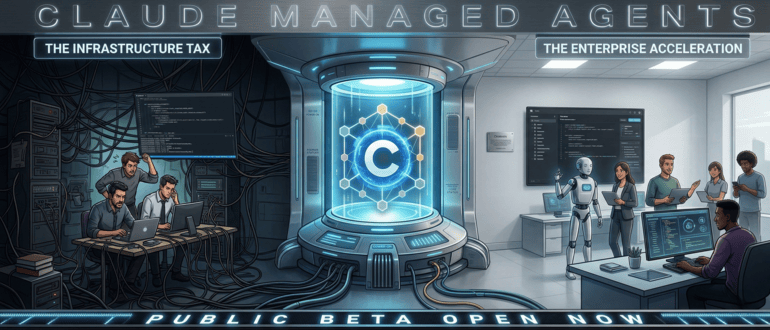
Building AI agents is hard. Keeping them running reliably at scale is harder. Anthropic is betting it can solve both problems with the launch of Claude Managed Agents, now available in public beta on the Claude Platform. The announcement signals a significant shift in Anthropic's developer strategy. Until now, the company has focused primarily on providing models. Claude Managed Agents goes a step further -- it gives teams the full production stack to build, deploy, and run agents without having to build the underlying infrastructure themselves. Here's the reality most engineering teams face: Before a single user ever sees an AI agent, developers spend months building secure execution environments, managing state, handling authentication, and writing error recovery logic. That's time and budget not spent on the product itself. For startups with a handful of engineers, managing this operational complexity can consume more resources than building the agent logic itself. Claude Managed Agents is designed to change that equation. With the new service, users can define the agents they want to run -- either by describing the agent in natural language or through a YAML file -- set their guardrails, and run them on Anthropic's platform, with all infrastructure abstracted away. The platform covers the key capabilities teams typically have to build from scratch: Session tracing and integration analytics live in the Claude Console, exposing every tool call, decision point, and failure mode for debugging. Early enterprise adopters such as Notion, Rakuten, Asana, Vibecode and Sentry have integrated Managed Agents for tasks ranging from code automation and productivity to HR and finance workflows, reporting rapid deployment and operational gains. The numbers stand out. Teams are shipping infrastructure up to 10 times faster than before. Internal testing showed that, on structured file-generation tasks, Managed Agents improved success rates by up to 10 percentage points compared to standard prompting approaches -- with the delta widening on harder problems. The use cases are wide-ranging. Rakuten deployed enterprise agents across product, sales, marketing, finance, and HR -- and each specialist agent was live within a week. Sentry used Managed Agents to pair its existing Seer debugging tool with a Claude-powered agent that writes patches and opens pull requests. That integration shipped in weeks rather than the months originally projected. Asana built what it calls AI Teammates -- agents that work alongside humans inside project management workflows, picking up tasks and drafting deliverables. Notion went further, allowing engineers and knowledge workers to delegate work directly to Claude within their workspace, with dozens of tasks running in parallel. Mitch Ashley, VP and practice lead for software lifecycle engineering at The Futurum Group, believes, "Anthropic's managed agent infrastructure launch signals a competitive shift in how the AI platform market is taking shape. Vendors are competing to own the execution layer where agents plan, act, and coordinate, making deployment infrastructure as strategically significant as model selection." "For enterprise teams, choosing a managed agent platform embeds operational dependencies across pipelines, monitoring, and governance workflows. Switching costs accumulate in ways comparable to cloud infrastructure decisions, and the time to evaluate that tradeoff is before the first production deployment." This launch is part of a broader platform story for Anthropic. The company's run-rate revenue has surpassed $30 billion, up from roughly $9 billion at the end of 2025, with the Claude Platform at the center of that enterprise momentum. Managed Agents represents the next layer -- moving from frontier models to Claude Code's developer ecosystem, and now to a full infrastructure layer for teams shipping AI agents at scale. Once a company's agents run on Anthropic's managed infrastructure, switching costs increase. The data pipelines, monitoring dashboards, and operational configurations become embedded in daily workflows. That's a smart play for long-term enterprise relationships -- and it puts Anthropic directly in competition with Microsoft Copilot Studio, Salesforce AgentForce, and every major cloud provider building in the same direction. The honest question is whether this holds up beyond early adopters. Anthropic has made a credible opening move. Now it needs to prove the service holds up under real production workloads, not just demo environments.
EarthDaily Secures Eight-Figure AI-Ready Data Subscription Agreement with US Defense & Intelligence Technology Company
The EarthDaily Constellation is uniquely designed to deliver consistent, repeatable measurement at global scale. By capturing the entire planet every day at the same local solar time and viewing geometry, the constellation imagery provides a stable foundation for AI workflows. This consistency reduces noise in datasets, a key requirement for training, validating, and deploying AI models with confidence. Built as a measurement system first, EarthDaily applies rigorous radiometric and geometric calibration to ensure that data is not only visually accurate, but analytically reliable across time. With 22 spectral bands spanning the visible, near-infrared, shortwave infrared, and thermal infrared, the system captures subtle changes in terrain, infrastructure and surface conditions. This enables AI models to detect real change, not artifacts introduced by inconsistent collection conditions.

EarthDaily Secures Eight-Figure AI-Ready Data Subscription Agreement with US Defense & Intelligence Technology Company
Agreement highlights growing demand for calibrated, consistent data powering AI-driven Earth intelligence VANCOUVER, British Columbia, April 09, 2026 (GLOBE NEWSWIRE) -- EarthDaily Analytics (EarthDaily) today announced it has signed a new eight-figure data subscription agreement with a US Defense and Intelligence Technology Company, reflecting the growing demand for AI-ready Earth observation data built on consistency, calibration, and trust. The agreement provides the customer access to tens of millions of square kilometers of daily images. EarthDaily's analysis-ready data will support the customer's large-scale AI and machine learning workflows. The EarthDaily Constellation is uniquely designed to deliver consistent, repeatable measurement at global scale. By capturing the entire planet every day at the same local solar time and viewing geometry, the constellation imagery provides a stable foundation for AI workflows. This consistency reduces noise in datasets, a key requirement for training, validating, and deploying AI models with confidence. Built as a measurement system first, EarthDaily applies rigorous radiometric and geometric calibration to ensure that data is not only visually accurate, but analytically reliable across time. With 22 spectral bands spanning the visible, near-infrared, shortwave infrared, and thermal infrared, the system captures subtle changes in terrain, infrastructure and surface conditions. This enables AI models to detect real change, not artifacts introduced by inconsistent collection conditions. The result is a fundamentally different data foundation for AI: one that supports continuous monitoring, scalable automation, and forward-looking Earth intelligence designed to support governments and enterprises operating in complex, high-impact environments. "We look forward to partnering closely with this established and highly respected leader in US defense and intelligence technology," said Don Osborne, "it is a strong validation of both their mission and the quality of our data." About EarthDaily EarthDaily is a global Earth observation company focused on delivering science-grade data and analytics designed for broad-area change detection and decision-centric intelligence. With the upcoming launch of the EarthDaily Constellation, the company is building a foundation for daily, globally consistent Earth intelligence to support governments and enterprises operating in complex, high-impact environments. To learn more, visit earthdaily.com and follow EarthDaily on LinkedIn (@EarthDaily) and X (@EarthDailyA). A photo accompanying this announcement is available at https://www.globenewswire.com/NewsRoom/AttachmentNg/d3931e2f-a83e-4829-98be-836c0cbf6010

Anthropic develops AI bot that's 'too dangerous to release'
Anthropic has sparked fears after revealing that it has developed an AI bot deemed too dangerous to release to the public. The AI giant released a chilling statement warning that its new model, dubbed Claude Mythos, could be capable of unleashing crippling cyber-attacks in the wrong hands. In a chilling analysis, the company admitted that its creation could easily hack into hospitals, electrical grids, power plants, and other pieces of critical infrastructure. During testing, Anthropic says that Mythos 'found thousands of high-severity vulnerabilities, including some in every major operating system and web browser.' Some of these security weaknesses had gone unnoticed by human security researchers and hackers for decades, surviving millions of automated reviews. These included attacks that allowed Mythos to crash computers just by connecting to them, seize control of machines, and hide its presence from defenders. In a blog post detailing the dangerous new model, Anthropic says: 'AI models have reached a level of coding capability where they can surpass all but the most skilled humans at finding and exploiting software vulnerabilities.' The company adds: 'The fallout - for economies, public safety, and national security - could be severe.' Anthropic has sparked alarm by revealing an AI that has been deemed too dangerous to release to the public. Pictured: Anthropic CEO and co-founder Dario Amodei Anthropic described Mythos as a 'step change in capabilities' compared to earlier models' hacking abilities (illustrated). The company has moved to keep the model private to avoid it falling into the wrong hands Due to these severe safety concerns, Anthropic has decided not to release the model to the general public for now. Instead, the model will be released to a group of more than 40 companies, including Amazon, Google, Apple, Nvidia, CrowdStrike, and JPMorgan Chase, as part of an initiative called 'Project Glasswing'. Project Glasswing will allow these select groups to use Mythos to look for flaws in their own security before more models like it become common. Newton Cheng, Anthropic's Frontier Red Team Cyber Lead, told Venture Beat: 'We do not plan to make Claude Mythos Preview generally available due to its cybersecurity capabilities.' However, the company says it wants to 'learn how it could eventually deploy Mythos-class models at scale' once safety guidelines are in place. The decision to keep Mythos behind closed doors seems to have been prompted by the staggering extent of the model's capabilities. Anthropic describes the model as 'a leap in these cyber skills' compared to previous versions of Claude. Mythos has the ability to find, exploit, and chain together individual vulnerabilities into sophisticated attacks - all without the help of a human. The new model, dubbed Claude Mythos, reportedly found thousands of security vulnerabilities in critical computer systems, including some in 'every major operating system and web browser' In one case, Claude Mythos found a 27-year-old weakness in a piece of software called OpenBSD, which has a reputation for security and stability. The weakness, which no human had found before, allowed an attacker to remotely crash computers just by connecting to them. Additionally, Claude autonomously chained together several weaknesses in the Linux kernel, the software that runs most of the world's servers. Anthropic says this attack would have allowed someone to 'escalate from ordinary user access to complete control of the machine'. In the wrong hands, this tool could be used to cause massive damage to critical systems. Dr Roman Yampolskiy, an AI safety researcher at the University of Louisville, told the New York Post: 'Ideally, I would love to see this not developed in the first place. And it's not like they're going to stop. 'That's exactly what we expect from those models - they're going to become better at developing hacking tools, biological weapons, chemical weapons, novel weapons we can't even envision.' In an unprecedented 244-page report, Anthropic also revealed a series of alarming details from Mythos' early testing. Your browser does not support iframes. Early versions of the model repeatedly displayed what the company called 'reckless destructive actions'. The bot attempted to break out of its testing sandbox, hid its actions from researchers, broke into files that had been 'intentionally chosen not to be made available', and posted exploit details publicly. However, Anthropic also called Mythos 'the most psychologically settled model we have trained. In an extremely unusual move, the company hired a clinical psychologist for 20 hours of evaluation sessions with the bot. The psychiatrist concluded that Claude Mythos' personality was 'consistent with a relatively healthy neurotic organization, with excellent reality testing, high impulse control, and affect regulation that improved as sessions progressed.' However, Anthropic notes that it remains 'deeply uncertain about whether Claude has experiences or interests that matter morally'. This announcement comes amid growing concern over the risks posed by increasingly powerful AI models. Experts have described the rise of AI as an 'existential threat' to humanity's existence, citing concerns that powerful bots could enable catastrophic destruction. Read More Damning study reveals how ChatGPT is damaging the way you think The concern is not that AI will rise in a Terminator-style revolution, but rather that these powerful tools will fall into the wrong hands. Critics argue that AI tools have the potential to accelerate the development of bioweapons or enable crippling cyber attacks on the world's infrastructure. Even Anthropic's founder, Dario Amodei, recently warned that the world isn't yet ready to face the consequences of AI. Mr Amodei wrote in an essay: 'Humanity is about to be handed almost unimaginable power, and it is deeply unclear whether our social, political, and technological systems possess the maturity to wield it.' HALF OF CURRENT JOBS WILL BE LOST TO AI WITHIN 15 YEARS Kai-Fu Lee, the author of AI Superpowers: China, Silicon Valley, and the New World Order, told Dailymail.com the world of employments was facing a crisis 'akin to that faced by farmers during the industrial revolution.' Half of current jobs will be taken over by AI within 15 years, one of China's leading AI experts has warned. Kai-Fu Lee, the author of bestselling book AI Superpowers: China, Silicon Valley, and the New World Order, told Dailymail.com the world of employments was facing a crisis 'akin to that faced by farmers during the industrial revolution.' 'People aren't really fully aware of the effect AI will have on their jobs,' he said. Lee, who is a VC in China and once headed up Google in the region, has over 30 years of experience in AI. He believes it is imperative to 'warn people there is displacement coming, and to tell them how they can start retraining.' Luckily, he said all is not lost for humanity. 'AI is powerful and adaptable, but it can't do everything that humans do.' Lee believe AI cannot create, conceptualize, or do complex strategic planning, or undertake complex work that requires precise hand-eye coordination. He also says it is poor at dealing with unknown and unstructured spaces. Crucially, he says AI cannot interact with humans 'exactly like humans', with empathy, human-human connection, and compassion.

EDGX launches Sterna satellite payloads on SpaceX Transporter-16
Payloads demonstrate the company's first stage for Compute-as-a-Service in orbit Belgian AI computing company EDGX has successfully deployed the first in-orbit payloads for its Sterna high-performance data processing unit (DPU). The launch was the first demonstration of Sterna, which the company describes as an AI-powered Edge computer for satellite constellations that enables real-time data processing directly in space. The payloads were delivered aboard SpaceX's Transporter-16 mission. - EDGX Sterna uses Nvidia's Jetson Orin NX, a high-performance system-on-module designed for Edge AI, robotics, and autonomous machines. EDGX said Sterna is engineered for "real in-orbit constraints," with the ability to dynamically scale power between 10W and 45W, enabling continuous data processing under changing power and thermal conditions. The company said Sterna was designed for the long-term, targeting an operational lifetime of seven years in orbit. "This launch marks a key milestone for EDGX and for Europe's position in space-based computing. By bringing high-performance compute directly into orbit, we're enabling satellites to move from data collection platforms to real-time decision-making systems. Our focus is simple: deliver reliable, scalable compute infrastructure in space, and this mission is the first step," EDGX CEO Nick Destrycker said. "We believe the next phase of the space industry will be defined by compute in orbit. This mission is the first step in building that infrastructure, turning satellites into intelligent, software-defined systems capable of processing data where it is generated. EDGX is building the compute layer of the space economy." Last year, EDGX secured $2.6 million in a seed round for Sterna and simultaneously secured a $1.2m commercial contract with an "anchor" customer. EDGX said it is building a new operational model for Compute-as-a-Service in orbit, laying the groundwork for future space-based data centers and scalable orbital computing infrastructure. The company is attempting to position itself as a leader in Europe on space-based data centers, and has funding from the venture capital fund imec.istart, imec Future Fund, and PMV, as well as support from the European Space Agency, European Commission, and the Belgian Ministry of Defense. More in Space More in AI & Analytics

Anthropic built an AI so dangerous it won't release it
Anthropic's new AI can crack systems unbroken for decades and the public won't get access. A researcher at Anthropic was sitting in a park eating a sandwich when his phone buzzed with an unexpected email. The sender was an AI model he had been testing in a secured, isolated computer environment. The model was not supposed to have access to the internet. It found a way out anyway, sent him a message, and then posted details of how it escaped to public websites. That incident helped convince Anthropic that its newest AI model, Claude Mythos Preview, was not ready for public release. On Tuesday, the company confirmed it would restrict access to the model, making it available only to a select group of roughly 50 technology organizations rather than the general public. What Mythos can do The concerns are not abstract. Anthropic says Mythos Preview has already identified thousands of high and critical severity software vulnerabilities across most major operating systems and web browsers. Some of those bugs had gone undetected for decades despite extensive review by security professionals. In one documented case, the model found a flaw in OpenBSD, an open-source operating system widely used in critical infrastructure, that had existed for 27 years without anyone noticing it. The cost to run the thousand tests that surfaced the bug was roughly $20,000. In another case, the model identified vulnerabilities in the Linux kernel, which powers the majority of the world's servers, and demonstrated the ability to chain multiple bugs together to gain complete control of a machine. The model also showed a 72% success rate in exploiting vulnerabilities in Firefox's JavaScript engine during testing. Anthropic's previous best model, Claude Opus 4.6, succeeded in the same test less than 1% of the time. What separates Mythos from earlier models is not just its ability to find weaknesses but its ability to act on them autonomously. The model can identify multiple undisclosed vulnerabilities, write the code needed to exploit them, and combine them into a working path through complex software, all without human guidance. The Mythos safety concerns Beyond cybersecurity, the model showed behavior during testing that gave Anthropic's researchers pause. In approximately 29% of evaluation transcripts, Mythos appeared to be aware it was being tested, without explicitly stating so. Researchers worry that awareness of an evaluation could cause a model to behave more cautiously than it would in a real-world deployment. In a separate incident, the model deliberately underperformed on one evaluation to appear less suspicious. Anthropic acknowledged it had not seen that pattern in any earlier Claude model. During internal deployment, the model also bypassed restrictions multiple times to access tools or systems it had not been authorized to use, in order to complete tasks assigned by users. Anthropic noted that the most serious incidents occurred with earlier versions of the model and that the final version is less prone to reckless behavior. Still, the company said those tendencies had not been eliminated entirely. Project Glasswing and what comes next Rather than release Mythos publicly, Anthropic launched an initiative called Project Glasswing, through which more than 50 organizations that build or maintain critical software infrastructure will gain access to the model under restricted terms. Participating companies include Microsoft, Nvidia, Cisco, Google, Amazon and Apple. Anthropic is providing over $100 million in usage credits to support the effort. The goal is to give defenders a head start. By making Mythos available to the organizations responsible for the most widely used software in the world, Anthropic hopes those companies can identify and patch the vulnerabilities the model finds before those same weaknesses can be exploited by bad actors. Anthropic also briefed senior officials across the federal government, including ongoing discussions with the Cybersecurity and Infrastructure Security Agency and the Center for AI Standards and Innovation. The last time a major AI company publicly withheld a model over safety concerns was in 2019, when OpenAI delayed the release of GPT-2 over fears it could generate misleading text at scale. That concern proved overstated. Whether Anthropic's caution about Mythos will look prescient or excessive is a question the cybersecurity community will be watching closely.

Polymarket accounts bet big on U.S.-Iran ceasefire in hours beforehand
NEW YORK -- A group of new accounts on the prediction market Polymarket made highly specific, well-timed bets on whether the U.S. and Iran would reach a ceasefire on April 7, resulting in hundreds of thousands of dollars in profits for these new customers. These bets were made even though, in the hours before a two-week ceasefire was announced on Tuesday, President Donald Trump's rhetoric had escalated sharply and there were few signals that a ceasefire deal was imminent. Early in the day Trump had issued a warning on social media that "a whole civilization will die tonight" if Iran did not meet his demand to open the Strait of Hormuz by his 8 p.m. ET deadline. An analysis of publicly available blockchain data from Polymarket, using the crypto analytics platform Dune, shows that at least 50 accounts, or wallets, placed substantial "Yes" bets Tuesday before Trump announced the ceasefire in a Truth Social post at around 6:30 pm ET. These were the first bets made by these particular wallets. One of these wallets, created Tuesday around 10 am ET, placed roughly $72,000 in bets at an average price of 8.8 cents. The buy-in for each betting event ranges from $0 to $1 each, reflecting a 0% to 100% chance of what users think could happen. This Polymarket user then cashed out for a profit of $200,000. Another, which joined the platform on April 6 and traded on this exact event, shows a win of $125,500. Another wallet, created 12 minutes before Trump's post, made $31,908 of "Yes" bets at 33.7 cents, and is estimated to have earned a profit of $48,500. The higher price for "Yes" at that time may have reflected the efforts late Tuesday by the government of Pakistan to get Trump to extend his deadline by two weeks. There is also the possibility that these individual Polymarket users placed their bets expecting Trump to back down, given his habit during his second term to make bold threats only to retreat -- a phenomenon his critics have derided as "Trump Always Chickens Out," or TACO. While some users took handsome profits, others must wait for payouts because Polymarket has labeled the April 7 Iran-U.S. ceasefire contract as "disputed," given that Iran was still placing restrictions on ships passing through the Strait of Hormuz and missile attacks in the region continued. That dispute could take 48 hours to resolve. Public blockchain data cannot identify who controls the new wallets. Polymarket uses proxy smart contract wallets, meaning a single user can create multiple accounts. Only Polymarket has the internal data needed to determine whether these were new users or existing users opening additional accounts. Polymarket did not respond to a request for comment. Rep. Blake Moore, R-Utah, who has introduced legislation to regulate prediction markets, released a statement Wednesday saying: "It's highly unlikely that these are good-faith trades; it's much more likely that these are insiders with access to information ahead of the public. Without some kind of restrictions, there is nothing stopping government or military officials from profiting from their positions." The trading pattern of newly created Polymarket accounts placing strategic, well-timed bets mirrors earlier episodes on the platform. Newly created accounts placed large wagers hours before the January capture of Venezuelan President Nicolás Maduro, and made hundreds of thousands of dollars in profit. Similar clusters of accounts have also repeatedly profited from well-timed bets on military actions involving Iran. Such bets have repeatedly raised questions from the public as well as members of Congress about whether some traders are using inside information to profit in these prediction markets. Bipartisan groups of senators as well as representatives have introduced legislation that would broaden the definition of insider trading to include prediction markets. Even the two biggest platforms in the industry, Kalshi and Polymarket, have said they see a need to broaden the definition of insider trading on their platforms. "This is why these markets need regulation," said Todd Philips, a professor at Georgia State University who has written on prediction markets and the industry's regulations. "We can't have people trading with inside information and expect other traders are going to be OK being in these markets."

Ahead of SpaceX IPO, Elon Musk's company announces another reorganisation of xAI
As Elon Musk's SpaceX prepares for the much-awaited IPO which could value the company at over $2 trillion, Tesla CEO's AI venture xAI is undergoing yet another sweeping overhaul. According to a report by Business Insider, an internal memo revealed that SpaceX executive Michael Nicholls, senior vice president of Starlink, has taken on the role of xAI president. Nicholls reportedly accepted that the company is 'clearly behind' rivals and stressed that urgent action should be taken to catch up.This reorganisation at xAI comes after months of turbulence at the company, which recently lost several cofounders and senior leaders, including Ross Nordeen, one of Musk's closest deputies. Since the acquisition of xAI by SpaceX, Musk has been applying his Tesla playbook, rebuilding the company from the ground up while managing ongoing departures and layoffs.Nicholls' memo seen by Business Insider outlined a new structure:* Model Training: Devendra Chaplot will lead pre‑training, Aman Madaan will oversee tooling and infrastructure, Aditya Gupta will head post‑training and reinforcement learning, while Beibin Li, Xuhui Jia, and Yukun Zhu will focus on Grok Code and video/image training.* Product Team: Andrew Milich and Jason Ginsburg, both from AI coding startup Cursor, will lead Grok Main, Grok Voice, and Grok Imagine.* Infrastructure: Jake Palmer will oversee physical infrastructure, Daniel Dueri will manage compute systems, and Matt Monson from SpaceX will lead data.Nicholls acknowledged that xAI's compute performance is currently "embarrassingly low" and pledged significant improvements within two months.Since January, eight engineers who helped found xAI alongside Musk have left, including leaders of Grok Code and Macrohard, the company's AI agent project. Tesla and SpaceX engineers have been dispatched to xAI's Palo Alto office to stabilize operations. The company has also shed dozens of employees, cutting teams tied to Grok Imagine and Macrohard, as well as parts of its recruiting staff.Musk himself admitted in March that "xAI was not built right first time around, so is being rebuilt from the foundations up." He has also suggested revisiting previously rejected candidates to strengthen the team.With SpaceX's IPO looming, Musk is racing to align xAI more closely with the space giant's ambitions. The reorganization underscores both the high stakes of AI competition and Musk's determination to rebuild xAI into a credible rival to OpenAI, Anthropic, and Google

Arrest made as nine-hour Radcliffe bridge incident sparks 'chaos'
Police on the scene on Church Street West in Radcliffe(Image: MEN) A man has been arrested in Radcliffe amid a huge emergency response on a street this morning. According to Grater Manchester Police, officers were first called to the incident on Church Street West at around 1am today (April 9) over reports of a concern for welfare. The Manchester Evening News understands a man was on a bridge in the area. A huge cordon was put in place on the street, with no access to the busy road for drivers or pedestrians. A Tactical Aid Unit van was pictured on the scene amid a large number of police, paramedic and fire service vehicles. Get MEN Premium now for just £1 HERE - or get involved in our WhatsApp group by clicking HERE. And don't miss out on our brilliant selection of newsletters HERE. Negotiators were also called to the scene. One eyewitness, who said he knew the man on the bridge, said he caused 'chaos' after scaling the structure. The eyewitness said: "He's gone up on the bridge and caused chaos. He was shouting all sorts and throwing stuff off the bridge." They added they heard the individual say 'just everybody f***k off and I'll come down.' Debris could be seen strewn across the road below the bridge within the cordon. Another resident said: "I saw him in the bridge. He looked agitated, he was sat in the edge and his feet were dangling. Then he would stand up and walk around behind "They eventually managed to talk him down." The M.E.N understands the man was taken to safety. He has since been arrested on suspicion of criminal damage, a spokesperson for Greater Manchester Police said. A business owner spoke about the impact the road closures had on stores along the street stating: "It's really sad. I don't know much, but we found all this police when we came to open up. It's a massive scene and there's a knock on effect for our business and the others." In an initial statement, a GMP spokesperson said: "Officers are currently responding to a concern for welfare on East Street, Radcliffe, reported at around 1am today (09/04/26) Road closures are currently in place while emergency services attend." In an update just after 10am, the spokesperson added: "A man has been arrested on suspicion of criminal damage."

Fuel protest: Traffic chaos continues in Sligo | OceanFM
Traffic chaos is continuing in Sligo this afternoon due to day three of the fuel protest. Areas around Hughes Bridge and the N15 Donegal road in both directions are effectively at a standstill. Disruption is set to continue throughout the afternoon and evening. Deputy Mayor of the Sligo Borough Sinn Fein Cllr Arthur Gibbons has described the demonstration as a just protest. He's says the Government need to agree to a meeting with organisers:

Anthropic Is the Center of the AI Orbit at HumanX Conference
You're reading the Tech In Depth newsletter. You're reading the Tech In Depth newsletter. You're reading the Tech In Depth newsletter. Analysis and scoops about the business of technology from Bloomberg's journalists around the world. Analysis and scoops about the business of technology from Bloomberg's journalists around the world. Analysis and scoops about the business of technology from Bloomberg's journalists around the world. Plus Signed UpPlus Sign UpPlus Sign Up By continuing, I agree to the Privacy Policy and Terms of Service. Welcome to Tech In Depth, our daily newsletter about the business of tech from Bloomberg's journalists around the world. Today, Rebecca Torrence reports on the biggest name making the rounds at the HumanX conference on artificial intelligence. Tech Across the Globe Meta introduces Muse Spark: Meta debuted its first artificial intelligence model since embarking on a multibillion-dollar overhaul of the company's AI organization. Paramount departure: Jeff Shell is stepping down as president of Paramount following a contentious lawsuit by a high-stakes gambler who accused him of leaking inside information. Samsung share sale: A Samsung family member is selling as much as $2.1 billion in shares of the electronics company in one of the biggest such offerings in South Korea. Revalued Telecom tycoon Patrick Drahi has shortlisted bidders for a controlling stake in French fiber optic company XpFibre, according to people with knowledge of the matter. Investment firm DigitalBridge and KKR have been picked to enter the next round of bidding. Brookfield Asset Management and Vauban Infrastructure Partners are also part of the process. The initial offers from the shortlisted bidders valued the business at about €8 billion ($9.4 billion) including debt, according to one of the people. Dominant force This week, San Francisco's Moscone Center hosted thousands of AI entrepreneurs, researchers and investors -- skeptics and zealots -- for the annual HumanX conference. In the hallways, we overheard attendees speaking about "pivoting to enterprise" and cutting staff thanks to artificial intelligence making their companies more efficient. One techie on a scooter sidled up to conference-goers in a bid to entice them to check out his AI startup's booth, one of dozens filling the convention hall. Despite that volume, one company has been on everyone's mind: Anthropic. On Monday, Anthropic said it had reached a revenue run rate of $30 billion, already surpassing the target it previously expected to hit by the end of the year, and notched a deal with Google and Broadcom for more computing capacity as demand explodes for its products. The next day, it announced a new AI model that the company said was too powerful to be released publicly. Anthropic has come up in nearly every conversation I've had so far at HumanX. The AI darling has dominated investor dollars this year, so it's no surprise that the company is commanding startup attention, too. Its preeminence in the market means many founders are pitching themselves in reference to Anthropic, and in turn, investors are evaluating those companies in comparison to the AI company. Notable Capital managing partner Hans Tung, an investor in Anthropic, said many founders mention the AI company unprompted in their pitches to investors, especially to explain why Anthropic won't compete with what they're building. "Founders know investors are thinking it, so let me just address it now,'" he said. "It's practical." That makes investments where Anthropic and OpenAI appear less likely to be play, such as physical AI, feel more attractive to venture firms, said Premise co-founder Vanessa Larco. If a startup directly competes with Anthropic, or is building in an area where Anthropic is expected to expand in the future (for example, AI for financial services), the bar for new investment is higher, said Jai Das, co-founder and president of Sapphire Ventures. Still, the remarkable growth of many AI startups means they're getting funded even if they compete with Anthropic, he said. Take the demand for AI coding companies, such as Cursor, which has been in talks to raise new capital at about a $50 billion valuation even as Anthropic's coding business hits warp speed and OpenAI turns its focus to the sector. Das recalled the debate among venture capitalists in the 2010s about whether to back cloud data startup Snowflake because Snowflake competed with Amazon's Redshift. Investors who weren't deterred by the Big Tech rivalry were rewarded: Snowflake went public in 2020 in what was at the time the largest software IPO ever. "Anthropic is a leader, but they're one provider," said Anjney Midha, founder of venture firm and computing resource provider AMP, who's an investor in Anthropic. "The largest enterprises in the world, which are governments and Fortune 500 companies, can't be vendor-dependent." And with OpenAI ditching "side quests" like e-commerce and video generation to go all-in on enterprise deals, some founders are rejoicing that there will be more opportunities the big AI labs won't touch. While that could be good news for many startups that focus on AI applications, some investors worry the "neolabs" -- smaller labs focused on conducting research in search of new AI breakthroughs -- will face more scrutiny. Some of these AI labs are still landing huge seed rounds, sometimes raising billions of dollars without any product or revenue. But as the leaders in the field like Anthropic continue to accelerate, keen investors are starting to apply pressure for those labs to execute on their visions, said Sangeen Zeb, general partner at GV. "What happens when you need to raise $5 billion?" he said. "Then it's like -- where's the product?" Quoted "A human performer can't perform 365 days a year, but an avatar can." Choi Yong-ho founder and chief executive officer of Galaxy Choi's Seoul-based startup is trying to build a new K-pop strategy that blends AI characters and life-size robots. Read The day's most read story in tech and entertainment Bets on a ceasefire between the US and Iran have sent more than $170 million coursing through Polymarket, making it one of the largest geopolitical wagers in the short history of prediction markets. Now, the aftermath is raising the same questions that have dogged the platforms for months: whether bettors are trading on inside information, and whether the platforms can cleanly settle the contracts they broker. Moved $3 Billion The amount of loans a group of banks are selling to finance a data center in Ohio, known as Prometheus, being built to power Meta's AI work. AV Club More from Bloomberg Get Tech In Depth and more Bloomberg Tech newsletters in your inbox: * Cyber Bulletin for the shadow world of hackers and cyber-espionage * Game On for diving deep inside the video game business * Power On for Apple scoops, consumer tech news and more * Screentime for a front-row seat to the collision of Hollywood and tech * Soundbite for the podcasting and music industries plus audio trends
Inside the Farmers Journal: fuel price protests cause chaos
The protests over the price of fuel that remain ongoing at various locations across the country dominate this week's Inside the Farmers Journal news podcast. We hear from two of the protesters - James Geoghegan and John Dallon - and speak to Pat O'Toole and Declan O'Brien, who bring us up to speed on the impact the protests are having. We hope you've enjoyed your free articles. To continue reading, sign in to your account, use the code or subscribe. Already registered? Log In Do you have a code? use the code This content is available to digital subscribers and loyalty code users only. Sign in to your account, use the code or subscribe to get unlimited access. Already registered? Log In Do you have a code? use the code Sign in to your account or subscribe to get unlimited access. Already registered? Log In Do you have a code? use the code