News & Updates
The latest news and updates from companies in the WLTH portfolio.
Court Denies Anthropic Request to End Defense Department Punishment
A federal appeals court denied Anthropic's request for relief from the Defense Department's supply-chain risk designation. WASHINGTON -- A federal appeals court on Wednesday denied Anthropic's request for relief from the Defense Department declaring the company a supply-chain risk, complicating the legal battle between the U.S. government and one of the country's leading artificial-intelligence companies. While Anthropic has sustained financial harm from the Pentagon's actions, the appeals court said that it didn't feel strongly enough to override the government on a matter of national security. A separate court in California recently granted Anthropic a preliminary injunction to stop President Trump's broader ban on all federal agencies using the company's Claude models. Wednesday's decision means that the Defense Department's designation of Anthropic as a security threat stands, so the company will continue to be excluded from new contracts and Pentagon systems. In late February, Trump gave the Defense Department six months to transition away from Claude, which is being used in the war in Iran. "On one side is a relatively contained risk of financial harm to a single private company. On the other side is judicial management of how, and through whom, the Department of War secures vital AI technology during an active military conflict," the appeals court said in its decision. The case will now proceed alongside the government's appeal of the California court ruling, creating legal uncertainty for companies that work with both Anthropic and the government. Some companies have said that they would stop using Claude in their government work to avoid any potential issues. "The D.C. Circuit's denial will prolong ambiguities regarding whether political considerations can drive federal procurement," said Matt Schruers, chief executive of the Computer & Communications Industry Association. The Pentagon applied the supply-chain risk designation against Anthropic using two different statutes, one of which is under the jurisdiction of the Washington appeals court. Defense Secretary Pete Hegseth designated the company a supply-chain risk after attempts to renegotiate its contract with Anthropic fell apart. Anthropic had sought assurances that its models wouldn't be used in fully autonomous weapons or for domestic surveillance. The Pentagon countered that such prohibitions were unnecessary because military policies or laws already restricted such uses, and pushed for an agreement in which the military could use the AI in all legal applications. "Today's D.C. Circuit stay allowing the government to designate Anthropic as a supply chain risk is a resounding victory for military readiness," said Todd Blanche, the acting attorney general. The supply-chain risk designation is normally used on companies from U.S. adversaries such as China that pose security threats, making the Defense Department's move against Anthropic nearly unprecedented. Some of Anthropic's competitors including OpenAI and Elon Musk's xAI have since agreed to Pentagon's terms. The company has said it could lose revenue and investors because of the government's actions, arguments that the appeals court acknowledged in its decision. "We're grateful the court recognized these issues need to be resolved quickly and remain confident the courts will ultimately agree that these supply-chain designations were unlawful," an Anthropic spokeswoman said. "While this case was necessary to protect Anthropic, our customers, and our partners, our focus remains on working productively with the government to ensure all Americans benefit from safe, reliable AI." The risks posed by AI were illustrated again on Tuesday, when Anthropic said it is making a preview version of its new AI model available to about 50 companies and organizations that maintain critical infrastructure, including U.S. tech giants, before releasing it publicly. The company said it worried that releasing it now could cause widespread disruptions online.

Anthropic Accidentally Leaked the Source Code of Claude Code, and You Can Run It Right Now Using...
Member-only story Anthropic Accidentally Leaked the Source Code of Claude Code, and You Can Run It Right Now Using Google Antigravity The complete TypeScript soul of the most powerful AI coding agent on the planet sat exposed on npm for hours. Here is your guided tour of the ghost in the machine. On March 31, 2026, a researcher named Chaofan Shou posted four words on X that set the developer internet on fire. "Claude code source code has been leaked via a map file in their npm registry!" I was sitting at my desk when the notification hit. I almost scrolled past it, assuming it was another breathless AI headline that would turn out to be nothing. But then I clicked. And I kept reading for three hours straight. The flaw was almost insultingly simple. Claude Code is built on Bun, which Anthropic acquired in late 2025. Bun generates source maps by default. Someone on the release team failed to add *.map to .npmignore, and the resulting cli.js.map file, shipped with @anthropic-ai/claude-code version 2.1.88, contained a sourcesContent JSON array holding every original TypeScript file: readable, commented, and complete. The funniest part is that there is an entire system inside Claude Code called "Undercover Mode," specifically designed to prevent Anthropic's internal information from...

US says it's in compliance with injunction blocking Anthropic risk designation | MLex | Specialist news and analysis on legal risk and regulation
( April 8, 2026, 23:29 GMT | Official Statement) -- MLex summary: The US government submitted a status report to US District Judge Rita F. Lin, describing the steps it has taken to comply with her March 26 preliminary injunction order blocking a supply chain risk designation against Anthropic. The Department of Defense issued a memorandum to senior leadership on April 2, and other federal agencies have "notified and distributed a copy of the Preliminary Injunction" to their personnel. Defense will "continue to transition from Anthropic to other AI providers," the report states.See attached file. ... Prepare for tomorrow's regulatory change, today MLex identifies risk to business wherever it emerges, with specialist reporters across the globe providing exclusive news and deep-dive analysis on the proposals, probes, enforcement actions and rulings that matter to your organization and clients, now and in the longer term. Know what others in the room don't, with features including: * Daily newsletters for Antitrust, M&A, Trade, Data Privacy & Security, Technology, AI and more * Custom alerts on specific filters including geographies, industries, topics and companies to suit your practice needs * Predictive analysis from expert journalists across North America, the UK and Europe, Latin America and Asia-Pacific * Curated case files bringing together news, analysis and source documents in a single timeline Experience MLex today with a 14-day free trial.

Irving-Based Fluor Partners With X‑Energy on Advanced Nuclear Project in South Texas
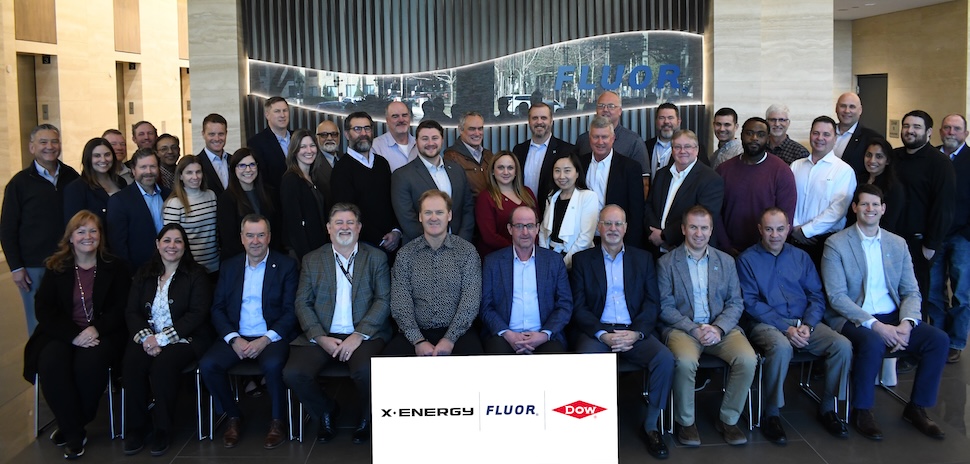
Irving-based Fluor Corporation (NYSE: FLR) has entered into a contract with Maryland's X-energy to support the company's proposed advanced nuclear project at Dow's UCC Seadrift Operations in South Texas. Under the agreement, Fluor will initially deliver Front-End Loading Stage 2 (FEL-2) services, Fluor said. FEL-2 focuses on project definition, strategic planning, feasibility assessment, cost control, and risk mitigation. The X-energy project is slated to develop four 80-megawatt small modular reactor (SMR) units to supply Dow's Seadrift site with "safe, reliable, carbon-free electricity and industrial steam, replacing aging energy and steam infrastructure," Fluor said. The project is supported by the U.S. Department of Energy's Advanced Reactor Demonstration Program, which accelerates the commercialization of advanced nuclear technologies through cost-shared partnerships with industry, Fluor said. A construction permit application for the project was submitted in March 2025 and is currently under review by the U.S. Nuclear Regulatory Commission. Pierre Bechelany, Fluor's business group president of energy solutions, said X‑energy's technology "offers a powerful pathway for small modular reactors to deliver safe, reliable and fit-for-purpose baseload power in an industrial setting." "With eight decades of nuclear experience, Fluor brings the proven expertise and disciplined execution required to help advance this landmark project," he added in a statement. X-energy was selected by the DOE in 2020 to develop, license and build its XE-100 advanced SMR and a first TRISO-X fuel fabrication facility, Fluor noted. Since then, the company has completed engineering and preliminary reactor design, advanced development, and licensing of its fuel facility in Oak Ridge, Tennessee. Fluor said the Seadrift project is expected to become "the first grid-scale advanced nuclear reactor deployed to serve an industrial facility in North America." Dow's UCC Seadrift Operations span 4,700 acres and produce more than 4 billion pounds of materials annually for applications including food packaging, footwear, wire and cable insulation, solar cell components, and medical and pharmaceutical packaging, Fluor noted. Track Dallas-Fort Worth's business and innovation landscape with our curated news in your inbox Tuesday-Thursday.
Irving-Based Fluor Partners With X‑Energy on Advanced Nuclear Project in South Texas
Irving-based Fluor Corporation (NYSE: FLR) has entered into a contract with Maryland's X-energy to support the company's proposed advanced nuclear project at Dow's UCC Seadrift Operations in South Texas. Under the agreement, Fluor will initially deliver Front-End Loading Stage 2 (FEL-2) services, Fluor said. FEL-2 focuses on project definition, strategic planning, feasibility assessment, cost control, and risk mitigation. The X-energy project is slated to develop four 80-megawatt small modular reactor (SMR) units to supply Dow's Seadrift site with "safe, reliable, carbon-free electricity and industrial steam, replacing aging energy and steam infrastructure," Fluor said. The project is supported by the U.S. Department of Energy's Advanced Reactor Demonstration Program, which accelerates the commercialization of advanced nuclear technologies through cost-shared partnerships with industry, Fluor said. A construction permit application for the project was submitted in March 2025 and is currently under review by the U.S. Nuclear Regulatory Commission. Pierre Bechelany, Fluor's business group president of energy solutions, said X‑energy's technology "offers a powerful pathway for small modular reactors to deliver safe, reliable and fit-for-purpose baseload power in an industrial setting." "With eight decades of nuclear experience, Fluor brings the proven expertise and disciplined execution required to help advance this landmark project," he added in a statement. X-energy was selected by the DOE in 2020 to develop, license and build its XE-100 advanced SMR and a first TRISO-X fuel fabrication facility, Fluor noted. Since then, the company has completed engineering and preliminary reactor design, advanced development, and licensing of its fuel facility in Oak Ridge, Tennessee. Fluor said the Seadrift project is expected to become "the first grid-scale advanced nuclear reactor deployed to serve an industrial facility in North America." Dow's UCC Seadrift Operations span 4,700 acres and produce more than 4 billion pounds of materials annually for applications including food packaging, footwear, wire and cable insulation, solar cell components, and medical and pharmaceutical packaging, Fluor noted. Track Dallas-Fort Worth's business and innovation landscape with our curated news in your inbox Tuesday-Thursday.
Anthropic Completes Tender Offer, But Employees Hold Onto Shares
Anthropic employees have sold some equity to investors, wrapping up a secondary share sale that started earlier this year, according to people familiar with the matter. But some investors weren't able to pick up as many shares as they planned because of the limited number that employees were willing to sell. The tender offer took place at the same value as the company's most recent fundraising in February, said the people, who asked not to be identified discussing private information. The company was valued at $350 billion in its latest deal, not including the $30 billion it raised. Anthropic declined to comment. The total value of the share sale, which closed last week, could not be learned -- but it fell short of the amount that investors had lined up, which was as much as $6 billion, some of the people said. Current and former employees wanted to hold more of their shares ahead of Anthropic's upcoming initial public offering, expected as soon as this year. Some investors were able to get their full allocation in the deal, while others were only able to deploy some of the capital that they had set aside for the tender offer. The smaller-than-expected transaction suggests that employees are optimistic about the company's prospects as its annualized revenue climbs, one of the people said. Last month, the company surpassed $19 billion in annualized run-rate revenue. By April, Anthropic announced it surpassed $30 billion in run-rate revenue.
Anthropic's Mythos raises questions for cybersecurity startup valuations - PitchBook
Anthropic says its new model has identified threats that decades of cyber researchers have failed to detect. Will some startups' moats disintegrate? Anthropic's Mythos Preview frontier model, formally announced this week, is expected to be a boon for startups in some cybersecurity categories and a competitive threat to others. The Mythos Preview model has, according to Anthropic, identified thousands of high-severity vulnerabilities "in every major operating system and browser." It is a major revelation for the cybersecurity industry, and is expected to have immediate implications for more mature startups whose products can be rendered obsolete by Anthropic. Alongside Mythos, Anthropic unveiled Project Glasswing, an initiative to secure critical systems that already includes Amazon, Cisco, Apple and others as partners to help identify novel threats to their operating systems and to understand what guardrails the Mythos model needs. For application security startups working on vulnerability management and code security, valuations just got a whole lot harder to justify, according to Sid Trivedi, partner at Foundation Capital. "In the near to mid-term, the greatest threat [of Mythos] is to the vulnerability management companies," he said. Stock prices of publicly traded vulnerability management companies -- which identify gaps in cybersecurity infrastructure before an attack occurs -- have fallen as markets have learned more about Mythos' capabilities. The stock price of Qualys is down by nearly 10% over the past month, with much of the drop happening since Fortune reported the existence of Mythos on March 26. Competitor Tenable has seen its stock price drop by almost 15% in the same period, with a notable decrease since the initial reports. So, is Anthropic's latest tool going to eat everyone's lunch? Not necessarily. Much of the cybersecurity market will likely benefit from more advanced threat detection technology. As for the future underwriting for many startups in that area, it will hinge, at least in part, on whether Anthropic expands into more cybersecurity use cases beyond vulnerability management. "Is there a risk that Anthropic and other AI labs will play deeper in cybersecurity? Yes, possibly," Trivedi said. And for the startups able to provide threat detection and remediation tools outside of what Anthropic and other front AI labs ultimately focus on, Mythos is likely to be a boon for their already-growing businesses. With investor expectations that AI would usher in a new era of cybersecurity enforcement, application security startups have fared relatively well in the past few years. In 2025, VCs invested a total of $2.66 billion across 186 deals, a 45% increase year-over-year, according to PitchBook's Q4 2025 Cybersecurity Trends report. Flagship cybersecurity exits, including Alphabet's acquisition of Wiz and Palo Alto Networks' acquisition of CyberArk, have also been a huge pull for valuation growth over the last few years. While Anthropic has no plans to release Mythos to the public, it's likely that Glasswing partners will want newer and more powerful cybersecurity tools. Anthropic's flagship software engineering model, Claude Code, is already a popular tool for detecting cybersecurity threats, and the AI company says Mythos is a step above in its capabilities. Either way, the scale and speed of vulnerability management will inevitably escalate, said John Brennan, a cybersecurity investor who runs solo fund Holly Ventures. "From a seed perspective, I'm not sure the underwriting changes too much -- but growth investors will have to think a lot about how this impacts growth trajectories and future valuations," Brennan said.

Newly created Polymarket accounts bet big on US-Iran ceasefire in hours before Trump's announcement
NEW YORK (AP) -- A group of new accounts on the prediction market Polymarket made highly specific, well-timed bets on whether the U.S. and Iran would reach a ceasefire on April 7, resulting in hundreds of thousands of dollars in profits for these new customers. These bets were made even though, in the hours before a two-week ceasefire was announced on Tuesday, President Donald Trump's rhetoric had escalated sharply and there were few signals that a ceasefire deal was imminent. Early in the day Trump had issued a warning on social media that "a whole civilization will die tonight" if Iran did not meet his demand to open the Strait of Hormuz by his 8 p.m. ET deadline. An analysis of publicly available blockchain data from Polymarket, using the crypto analytics platform Dune, shows that at least 50 accounts, or wallets, placed substantial "Yes" bets Tuesday before Trump announced the ceasefire in a Truth Social post at around 6:30 pm ET. These were the first bets made by these particular wallets. One of these wallets, created Tuesday around 10 am ET, placed roughly $72,000 in bets at an average price of 8.8 cents. The buy-in for each betting event ranges from $0 to $1 each, reflecting a 0% to 100% chance of what users think could happen. This Polymarket user then cashed out for a profit of $200,000. Another, which joined the platform on April 6 and traded on this exact event, shows a win of $125,500. Another wallet, created 12 minutes before Trump's post, made $31,908 of "Yes" bets at 33.7 cents, and is estimated to have earned a profit of $48,500. The higher price for "Yes" at that time may have reflected the efforts late Tuesday by the government of Pakistan to get Trump to extend his deadline by two weeks. There is also the possibility that these individual Polymarket users placed their bets expecting Trump to back down, given his habit during his second term to make bold threats only to retreat -- a phenomenon his critics have derided as "Trump Always Chickens Out," or TACO. While some users took handsome profits, others must wait for payouts because Polymarket has labeled the April 7 Iran-U.S. ceasefire contract as "disputed," given that Iran was still placing restrictions on ships passing through the Strait of Hormuz and missile attacks in the region continued. That dispute could take 48 hours to resolve. Public blockchain data cannot identify who controls the new wallets. Polymarket uses proxy smart contract wallets, meaning a single user can create multiple accounts. Only Polymarket has the internal data needed to determine whether these were new users or existing users opening additional accounts. Polymarket did not respond to a request for comment. The trading pattern of newly created Polymarket accounts placing strategic, well-timed bets mirrors earlier episodes on the platform. Newly created accounts placed large wagers hours before the January capture of Venezuelan President Nicolás Maduro, and made hundreds of thousands of dollars in profit. Similar clusters of accounts have also repeatedly profited from well-timed bets on military actions involving Iran. Such bets have repeatedly raised questions from the public as well as members of Congress about whether some traders are using inside information to profit in these prediction markets. Bipartisan groups of senators as well as representatives have introduced legislation that would broaden the definition of insider trading to include prediction markets. Even the two biggest platforms in the industry, Kalshi and Polymarket, have said they see a need to broaden the definition of insider trading on their platforms. "This is why these markets need regulation," said Todd Philips, a professor at Georgia State University who has written on prediction markets and the industry's regulations. "We can't have people trading with inside information and expect other traders are going to be OK being in these markets."

Elon Musk's SpaceX prepares for public offering
SpaceX, Elon Musk's spacecraft and satellite communications company, is preparing to go public after reportedly filing paperwork with the Securities and Exchange Commission (SEC). After months of speculation, the company has confidentially filed for an initial public offering (IPO) and is aiming for a June listing, according to multiple outlets. Bloomberg reported that it is targeting a record-breaking $1.75 trillion valuation. SpaceX, which Musk founded in 2002, was most recently estimated to be worth $1.25 trillion following its February acquisition of the tech mogul's AI company xAI. Musk touted the newly merged company at the time as "the most ambitious, vertically-integrated innovation engine on (and off) Earth," while focusing heavily on the prospect of building data centers in space. It marked the latest merger between the billionaire's sprawling network of companies. Last March, xAI acquired X in a deal valuing the AI firm at $80 billion and the social media company at $33 billion. Musk purchased X, previously known as Twitter, for $44 billion in 2022. Even as investors await the SpaceX IPO, some have their sights set on yet another Musk company merger. "We continue to believe that SpaceX and Tesla will eventually merge into one company in 2027 with the groundwork already in place for both operations to become one organization," Wedbush Securities analyst Dan Ives wrote in a note last week, as reports emerged about the public offering. "Musk wants to own and control more of the AI ecosystem and step by step the holy grail could be combining SpaceX and Tesla in some way to give the connected tissue between both disruptive tech stalwarts looking to lead the AI Revolution," he added. The SpaceX filing also kicks off what is expected to be a series of major AI-related IPOs, as investors anticipate public offerings from OpenAI and Anthropic as well.

Anthropic Fails for Now to Halt US Label as a Supply-Chain Risk
A federal appeals court declined for now Anthropic PBC's request to pause a declaration by the Pentagon that the artificial intelligence company poses a risk to the US supply chain, even as plans for a broader government ban on its technology remain blocked by a California judge. In its decision Wednesday, the three-judge panel in Washington, DC, said it would work quickly to review the case because Anthropic is likely to "suffer some irreparable harm" as the legal action plays out. The court set oral arguments in the case for May 19. The ruling leaves in place a US Defense Department declaration that was the legal basis for the Trump administration's plan to sever all ties to the company, which claims it could face billions of dollars in lost revenue. The government announced the ban after a dispute with Anthropic over how its AI technology would be used by the military. "On one side is a relatively contained risk of financial harm to a single private company," the court wrote in explaining why it rejected the request for an immediate pause. "On the other side is judicial management of how, and through whom, the Department of War secures vital AI technology during an active military conflict." Anthropic welcomed an expedited schedule for its lawsuit. "While this case was necessary to protect Anthropic, our customers, and our partners, our focus remains on working productively with the government to ensure all Americans benefit from safe, reliable AI," the company said in a statement. The Claude chatbot maker has been fighting back on two fronts. It asked the appeals court on March 9 to review the Pentagon's declaration, calling it "arbitrary, capricious and an abuse of discretion." The same day, Anthropic sued in San Francisco federal court to challenge the ban, which could mean billions in lost revenue. On March 27, a judge in that case blocked the government following through while the lawsuit proceeds. The Trump administration is appealing. The Defense Department's declaration that Anthropic posed a supply-chain risk escalated a high-stakes dispute. The company demanded assurances that its AI wouldn't be used for mass surveillance of Americans or autonomous weapons deployment. The government rejected any restrictions, citing national security. In the San Francisco lawsuit, Anthropic claims it is being shut out for disagreeing with the administration. The company said the legal principles at stake affect every federal contractor whose views the government dislikes. The case is Anthropic v. US Department of War, 26-01049, US Court of Appeals, District of Columbia Circuit (Washington).
Anthropic, OpenAI Try to Ease Public Anxiety
Artificial intelligence firms spent years hyping their software as world-changing; now they're scrambling to convince people it won't quietly wreck their lives. OpenAI this week rolled out a policy wish list aimed squarely at public anxiety over jobs and inequality, floating ideas like a four-day workweek and a public wealth fund seeded with AI profits and paid out to citizens. Rival Anthropic, meanwhile, has been signing deals with consulting and software firms whose share prices have been hammered by fears they'll be automated away -- moves that have helped lift some tech stocks and turned threatened workers into AI promoters. Both companies are also courting private-equity firms that own businesses in automation-vulnerable industries, the Wall Street Journal reports, pitching "AI transformation" as a way to survive the shift.

XAI reorganizes its engineering team ahead of SpaceX IPO
Several xAI cofounders left the company after it was acquired by SpaceX in February. As Elon Musk's xAI merges more closely with SpaceX ahead of the space giant's blockbuster IPO, the AI company is undergoing yet another major overhaul to its engineering team, according to a memo viewed by Business Insider. SpaceX executive Michael Nicholls said the company is "clearly behind" the competition and is taking action to catch up as quickly as possible. Nicholls, the senior vice president of Starlink at SpaceX, has taken on the title of xAI president, a person with knowledge of the change told Business Insider. SpaceX, which acquired xAI earlier this year, is expected to file an initial public offering this year, which could value it at over $2 trillion, according to some reports. As it merges with SpaceX, xAI has undergone a series of organizational shake-ups while racing to keep pace with AI rivals OpenAI, Anthropic, and Google. The company has lost several cofounders and senior leaders, most recently Ross Nordeen, formerly one of Musk's closest deputies. Now, Musk is using the Tesla playbook to rebuild the company from the ground up, even as it navigates ongoing departures and layoffs. The stakes couldn't be higher: xAI is pushing toward an IPO that could value the company in the trillions. Devendra Chaplot, a former researcher at Facebook and Thinking Machines Labs, who joined the xAI last month, will lead pre-training, the initial phase in which a model learns general patterns from massive datasets, such as text, images, or code. Aman Madaan will oversee model factory and tooling, including the infrastructure, data pipelines, and training workflows used to develop and improve AI models. Aditya Gupta will head post-training and reinforcement learning, the final stage in which the model is fine-tuned, aligned with human preferences, and optimized for real-world use cases like chat or coding assistance. Beibin Li, a former researcher at Microsoft and Meta, will lead post-training for Grok Code. Xuhui Jia, who previously worked at Google DeepMind, along with Yukun Zhu, will lead video and image training. The company's product team will be led by Andrew Milich and Jason Ginsburg. The two engineers joined the company from AI coding giant Cursor in March. The product team will oversee Grok Main, Grok Voice, and Grok Imagine. Physical infrastructure will be led by Jake Palmer, and compute infrastructure by Daniel Dueri, who is the director of software engineering at SpaceX, according to LinkedIn. Other SpaceX employees have also taken on leadership roles. Matt Monson, the director of Starlink software at SpaceX, will also be leading data at xAI. On the compute team, the training performance of xAI's compute is "embarrassingly low," Nicholls said in the memo, and the company plans to improve it significantly in the next two months. A spokesperson for xAI did not immediately respond to a request for comment. Nicholls said in the internal memo that the changes are effective immediately and the company is working on giving staff titles that better describe their work. Musk first reorganized the company in February, after xAI was acquired by SpaceX. Since January, eight of the engineers who helped found the company alongside Elon Musk have left the company, including cofounders Nordeen, Guodong Zhang, and Manuel Kroiss, who led Grok Code, and Toby Pohlen, who helped lead Macrohard, the company's computer use agent project. In the wake of the cofounder departures, the company's structure has been in a near-constant state of flux, with Musk at times managing dozens of direct reports. Tesla and SpaceX engineers have also come into the company's Palo Alto office to assist with the changes, people with knowledge of the issue said. XAI has shed dozens of employees since February, Business Insider previously reported. The company cut portions of its teams working on its video and image generation tool, Grok Imagine, and Macrohard, its AI agent project, earlier this year, Business Insider also previously reported. More recently, the company has cut several members of its recruiting team, according to people with knowledge of the cuts. In March, Musk said on X that "xAI was not built right first time around, so is being rebuilt from the foundations up." He has also said that the company is looking back through old xAI candidates to bring in new people. "Many talented people over the past few years were declined an offer or even an interview @xAI," Musk wrote on X.
Newly Created Polymarket Accounts Bet Big on US-Iran Ceasefire in Hours Before Trump's Announcement
NEW YORK (AP) -- A group of new accounts on the prediction market Polymarket made highly specific, well-timed bets on whether the U.S. and Iran would reach a ceasefire on April 7, resulting in hundreds of thousands of dollars in profits for these new customers. These bets were made even though, in the hours before a two-week ceasefire was announced on Tuesday, President Donald Trump's rhetoric had escalated sharply and there were few signals that a ceasefire deal was imminent. Early in the day Trump had issued a warning on social media that "a whole civilization will die tonight" if Iran did not meet his demand to open the Strait of Hormuz by his 8 p.m. ET deadline. An analysis of publicly available blockchain data from Polymarket, using the crypto analytics platform Dune, shows that at least 50 accounts, or wallets, placed substantial "Yes" bets Tuesday before Trump announced the ceasefire in a Truth Social post at around 6:30 pm ET. These were the first bets made by these particular wallets. One of these wallets, created Tuesday around 10 am ET, placed roughly $72,000 in bets at an average price of 8.8 cents. The buy-in for each betting event ranges from $0 to $1 each, reflecting a 0% to 100% chance of what users think could happen. This Polymarket user then cashed out for a profit of $200,000. Another, which joined the platform on April 6 and traded on this exact event, shows a win of $125,500. Another wallet, created 12 minutes before Trump's post, made $31,908 of "Yes" bets at 33.7 cents, and is estimated to have earned a profit of $48,500. The higher price for "Yes" at that time may have reflected the efforts late Tuesday by the government of Pakistan to get Trump to extend his deadline by two weeks. There is also the possibility that these individual Polymarket users placed their bets expecting Trump to back down, given his habit during his second term to make bold threats only to retreat -- a phenomenon his critics have derided as "Trump Always Chickens Out," or TACO. While some users took handsome profits, others must wait for payouts because Polymarket has labeled the April 7 Iran-U.S. ceasefire contract as "disputed," given that Iran was still placing restrictions on ships passing through the Strait of Hormuz and missile attacks in the region continued. That dispute could take 48 hours to resolve. Public blockchain data cannot identify who controls the new wallets. Polymarket uses proxy smart contract wallets, meaning a single user can create multiple accounts. Only Polymarket has the internal data needed to determine whether these were new users or existing users opening additional accounts. Polymarket did not respond to a request for comment. The trading pattern of newly created Polymarket accounts placing strategic, well-timed bets mirrors earlier episodes on the platform. Newly created accounts placed large wagers hours before the January capture of Venezuelan President Nicolás Maduro, and made hundreds of thousands of dollars in profit. Similar clusters of accounts have also repeatedly profited from well-timed bets on military actions involving Iran. Such bets have repeatedly raised questions from the public as well as members of Congress about whether some traders are using inside information to profit in these prediction markets. Bipartisan groups of senators as well as representatives have introduced legislation that would broaden the definition of insider trading to include prediction markets. Even the two biggest platforms in the industry, Kalshi and Polymarket, have said they see a need to broaden the definition of insider trading on their platforms. "This is why these markets need regulation," said Todd Philips, a professor at Georgia State University who has written on prediction markets and the industry's regulations. "We can't have people trading with inside information and expect other traders are going to be OK being in these markets." _____ Keller reported from Albuquerque, N.M.

Newly created Polymarket accounts bet big on US-Iran ceasefire in hours before Trump's announcement
An analysis of publicly available blockchain data from Polymarket, using the crypto analytics platform Dune, shows that at least 50 accounts, or wallets, placed substantial "Yes" bets Tuesday before Trump announced the ceasefire in a Truth Social post at around 6:30 p.m. ET. These were the first bets made by these particular wallets. One of these wallets, created Tuesday around 10 a.m. ET, placed roughly $72,000 in bets at an average price of 8.8 cents. The buy-in for each betting event ranges from $0 to $1 each, reflecting a 0% to 100% chance of what users think could happen. This Polymarket user then cashed out for a profit of $200,000. Another, which joined the platform on April 6 and traded on this exact event, shows a win of $125,500. Another wallet, created 12 minutes before Trump's post, made $31,908 of "Yes" bets at 33.7 cents, and is estimated to have earned a profit of $48,500. The higher price for "Yes" at that time may have reflected the efforts late Tuesday by the government of Pakistan to get Trump to extend his deadline by two weeks. There is also the possibility that these individual Polymarket users placed their bets expecting Trump to back down, given his habit during his second term to make bold threats only to retreat -- a phenomenon his critics have derided as "Trump Always Chickens Out," or TACO. While some users took handsome profits, others must wait for payouts because Polymarket has labeled the April 7 Iran-U.S. ceasefire contract as "disputed," given that Iran was still placing restrictions on ships passing through the Strait of Hormuz and missile attacks in the region continued. That dispute could take 48 hours to resolve. Public blockchain data cannot identify who controls the new wallets. Polymarket uses proxy smart contract wallets, meaning a single user can create multiple accounts. Only Polymarket has the internal data needed to determine whether these were new users or existing users opening additional accounts. Polymarket did not respond to a request for comment. The trading pattern of newly created Polymarket accounts placing strategic, well-timed bets mirrors earlier episodes on the platform. Newly created accounts placed large wagers hours before the January capture of Venezuelan President Nicolás Maduro, and made hundreds of thousands of dollars in profit. Similar clusters of accounts have also repeatedly profited from well-timed bets on military actions involving Iran. Such bets have repeatedly raised questions from the public as well as members of Congress about whether some traders are using inside information to profit in these prediction markets. Bipartisan groups of senators as well as representatives have introduced legislation that would broaden the definition of insider trading to include prediction markets. Even the two biggest platforms in the industry, Kalshi and Polymarket, have said they see a need to broaden the definition of insider trading on their platforms. "This is why these markets need regulation," said Todd Philips, a professor at Georgia State University who has written on prediction markets and the industry's regulations. "We can't have people trading with inside information and expect other traders are going to be OK being in these markets."

New Polymarket accounts bet big on U.S.-Iran ceasefire hours before Trump announcement
NEW YORK -- A group of new accounts on the prediction market Polymarket made highly specific, well-timed bets on whether the U.S. and Iran would reach a ceasefire on April 7, resulting in hundreds of thousands of dollars in profits for these new customers. These bets were made even though, in the hours before a two-week ceasefire was announced on Tuesday, U.S. President Donald Trump's rhetoric had escalated sharply and there were few signals that a ceasefire deal was imminent. Early in the day Trump had issued a warning on social media that "a whole civilization will die tonight" if Iran did not meet his demand to open the Strait of Hormuz by his 8 p.m. ET deadline. An analysis of publicly available blockchain data from Polymarket, using the crypto analytics platform Dune, shows that at least 50 accounts, or wallets, placed substantial "Yes" bets Tuesday before Trump announced the ceasefire in a Truth Social post at around 6:30 pm ET. These were the first bets made by these particular wallets. One of these wallets, created Tuesday around 10 am ET, placed roughly US$72,000 in bets at an average price of 8.8 cents. The buy-in for each betting event ranges from $0 to $1 each, reflecting a zero to 100 per cent chance of what users think could happen. This Polymarket user then cashed out for a profit of $200,000. Another, which joined the platform on April 6 and traded on this exact event, shows a win of $125,500. Another wallet, created 12 minutes before Trump's post, made $31,908 of "Yes" bets at 33.7 cents, and is estimated to have earned a profit of $48,500. The higher price for "Yes" at that time may have reflected the efforts late Tuesday by the government of Pakistan to get Trump to extend his deadline by two weeks. There is also the possibility that these individual Polymarket users placed their bets expecting Trump to back down, given his habit during his second term to make bold threats only to retreat -- a phenomenon his critics have derided as "Trump Always Chickens Out," or TACO. While some users took handsome profits, others must wait for payouts because Polymarket has labeled the April 7 Iran-U.S. ceasefire contract as "disputed," given that Iran was still placing restrictions on ships passing through the Strait of Hormuz and missile attacks in the region continued. That dispute could take 48 hours to resolve. Public blockchain data cannot identify who controls the new wallets. Polymarket uses proxy smart contract wallets, meaning a single user can create multiple accounts. Only Polymarket has the internal data needed to determine whether these were new users or existing users opening additional accounts. Polymarket did not respond to a request for comment. The trading pattern of newly created Polymarket accounts placing strategic, well-timed bets mirrors earlier episodes on the platform. Newly created accounts placed large wagers hours before the January capture of Venezuelan President Nicolás Maduro, and made hundreds of thousands of dollars in profit. Similar clusters of accounts have also repeatedly profited from well-timed bets on military actions involving Iran. Such bets have repeatedly raised questions from the public as well as members of Congress about whether some traders are using inside information to profit in these prediction markets. Bipartisan groups of senators as well as representatives have introduced legislation that would broaden the definition of insider trading to include prediction markets. Even the two biggest platforms in the industry, Kalshi and Polymarket, have said they see a need to broaden the definition of insider trading on their platforms. "This is why these markets need regulation," said Todd Philips, a professor at Georgia State University who has written on prediction markets and the industry's regulations. "We can't have people trading with inside information and expect other traders are going to be OK being in these markets." Ken Sweet And Christopher L. Keller, The Associated Press

Newly created Polymarket accounts bet big on US-Iran ceasefire in hours before Trump's announcement
NEW YORK (AP) -- A group of new accounts on the prediction market Polymarket made highly specific, well-timed bets on whether the U.S. and Iran would reach a ceasefire on April 7, resulting in hundreds of thousands of dollars in profits for these new customers. These bets were made even though, in the hours before a two-week ceasefire was announced on Tuesday, President Donald Trump's rhetoric had escalated sharply and there were few signals that a ceasefire deal was imminent. Early in the day Trump had issued a warning on social media that "a whole civilization will die tonight" if Iran did not meet his demand to open the Strait of Hormuz by his 8 p.m. ET deadline. An analysis of publicly available blockchain data from Polymarket, using the crypto analytics platform Dune, shows that at least 50 accounts, or wallets, placed substantial "Yes" bets Tuesday before Trump announced the ceasefire in a Truth Social post at around 6:30 pm ET. These were the first bets made by these particular wallets. One of these wallets, created Tuesday around 10 am ET, placed roughly $72,000 in bets at an average price of 8.8 cents. The buy-in for each betting event ranges from $0 to $1 each, reflecting a 0% to 100% chance of what users think could happen. This Polymarket user then cashed out for a profit of $200,000. Another, which joined the platform on April 6 and traded on this exact event, shows a win of $125,500. Another wallet, created 12 minutes before Trump's post, made $31,908 of "Yes" bets at 33.7 cents, and is estimated to have earned a profit of $48,500. The higher price for "Yes" at that time may have reflected the efforts late Tuesday by the government of Pakistan to get Trump to extend his deadline by two weeks. There is also the possibility that these individual Polymarket users placed their bets expecting Trump to back down, given his habit during his second term to make bold threats only to retreat -- a phenomenon his critics have derided as "Trump Always Chickens Out," or TACO. While some users took handsome profits, others must wait for payouts because Polymarket has labeled the April 7 Iran-U.S. ceasefire contract as "disputed," given that Iran was still placing restrictions on ships passing through the Strait of Hormuz and missile attacks in the region continued. That dispute could take 48 hours to resolve. Public blockchain data cannot identify who controls the new wallets. Polymarket uses proxy smart contract wallets, meaning a single user can create multiple accounts. Only Polymarket has the internal data needed to determine whether these were new users or existing users opening additional accounts. Polymarket did not respond to a request for comment. The trading pattern of newly created Polymarket accounts placing strategic, well-timed bets mirrors earlier episodes on the platform. Newly created accounts placed large wagers hours before the January capture of Venezuelan President Nicolás Maduro, and made hundreds of thousands of dollars in profit. Similar clusters of accounts have also repeatedly profited from well-timed bets on military actions involving Iran. Such bets have repeatedly raised questions from the public as well as members of Congress about whether some traders are using inside information to profit in these prediction markets. Bipartisan groups of senators as well as representatives have introduced legislation that would broaden the definition of insider trading to include prediction markets. Even the two biggest platforms in the industry, Kalshi and Polymarket, have said they see a need to broaden the definition of insider trading on their platforms. "This is why these markets need regulation," said Todd Philips, a professor at Georgia State University who has written on prediction markets and the industry's regulations. "We can't have people trading with inside information and expect other traders are going to be OK being in these markets." Ken Sweet And Christopher L. Keller (), The Associated Press
Anthropic denied emergency stay of DoD supply chain risk designation | MLex | Specialist news and analysis on legal risk and regulation
( April 8, 2026, 22:40 GMT | Official Statement) -- MLex Summary: A three-judge panel of the US Court of Appeals for the DC Circuit has denied Anthropic's motion for an emergency stay of the Trump administration's designation of the company as a supply chain risk. "In our view, the equitable balance here cuts in favor of the government. On one side is a relatively contained risk of financial harm to a single private company. On the other side is judicial management of how, and through whom, the Department of War secures vital AI technology during an active military conflict," said a three-judge panel made up of US Circuit judges Karen LeCraft Henderson, Gregory G. Katsas and Neomi Rao.See attached document.... Prepare for tomorrow's regulatory change, today MLex identifies risk to business wherever it emerges, with specialist reporters across the globe providing exclusive news and deep-dive analysis on the proposals, probes, enforcement actions and rulings that matter to your organization and clients, now and in the longer term. Know what others in the room don't, with features including: * Daily newsletters for Antitrust, M&A, Trade, Data Privacy & Security, Technology, AI and more * Custom alerts on specific filters including geographies, industries, topics and companies to suit your practice needs * Predictive analysis from expert journalists across North America, the UK and Europe, Latin America and Asia-Pacific * Curated case files bringing together news, analysis and source documents in a single timeline Experience MLex today with a 14-day free trial.
Towards better XAI : Improving Shapley Values and Federated LearningInterpretability
Sammanfattning: The use of Artificial Intelligence (AI) in various areas has resulted in significant progress. However, it has also raised concerns about how transparent, understandable, and reliable AI models are. Explainable Artificial Intelligence(XAI) has become an important area of study because it makes AI systems easier for people to understand. XAI also aims to create trust, accountability, and transparency in AI systems, especially in vital areas such as healthcare, finance, and autonomous systems. Furthermore, XAI helps detect biases, improve model debugging, and enable the discovery of new insights from data.With the increasing focus on the XAI field, we have developed a framework called Field's Evolution Graph (FEG) to track the evolution of research within the XAI field. This framework helps researchers identify key concepts and their interrelationships over time. Different approaches have been developed in XAI, and Shaply values are among the most well-known techniques. We further examine this method by evaluating its computational cost and analyzing various characteristic functions. We have introduced EcoShap, a computationally efficient method for calculating Shapley values to identify the most important features. By focusing calculations on a few of the most important features, EcoShap significantly reduces the computational cost, making it feasible to apply Shapley values to large datasets.The thesis is extended by analyzing different characteristic functions used in Shapley value calculations theoretically and practically. We examine how feature importance rankings are reliable and how considering various characteristic functions, like accuracy and F1-score metrics, affects those rankings.Additionally, Federated Learning (FL) is a machine learning paradigm that is able to train global models from different clients while keeping data decentralized. Similar to other machine learning paradigms, XAI is needed in this context. To address this need, we have proposed a method to use Incremental Decision Trees as an inherently interpretable model within the FL framework, offering an interpretable alternative to black-box models. The objective is to employ inherently explainable models instead of trying to explain black-box models. Three aggregation strategies have been presented to combine local models into a global model while maintaining interpretability and accuracy.In summary, the research in this thesis contributes to the field of XAI by introducing new methods to improve efficiency, analyzing existing methods to assess the reliability of XAI techniques, and proposing a solution for utilizing more intrinsically explainable models in the Federated Learning framework.

Newly created Polymarket accounts bet big on US-Iran ceasefire in hours before Trump's announcement
NEW YORK (AP) -- A group of new accounts on the prediction market Polymarket made highly specific, well-timed bets on whether the U.S. and Iran would reach a ceasefire on April 7, resulting in hundreds of thousands of dollars in profits for these new customers. These bets were made even though, in the hours before a two-week ceasefire was announced on Tuesday, President Donald Trump's rhetoric had escalated sharply and there were few signals that a ceasefire deal was imminent. Early in the day Trump had issued a warning on social media that "a whole civilization will die tonight" if Iran did not meet his demand to open the Strait of Hormuz by his 8 p.m. ET deadline. An analysis of publicly available blockchain data from Polymarket, using the crypto analytics platform Dune, shows that at least 50 accounts, or wallets, placed substantial "Yes" bets Tuesday before Trump announced the ceasefire in a Truth Social post at around 6:30 pm ET. These were the first bets made by these particular wallets. One of these wallets, created Tuesday around 10 am ET, placed roughly $72,000 in bets at an average price of 8.8 cents. The buy-in for each betting event ranges from $0 to $1 each, reflecting a 0% to 100% chance of what users think could happen. This Polymarket user then cashed out for a profit of $200,000. Another, which joined the platform on April 6 and traded on this exact event, shows a win of $125,500. Another wallet, created 12 minutes before Trump's post, made $31,908 of "Yes" bets at 33.7 cents, and is estimated to have earned a profit of $48,500. The higher price for "Yes" at that time may have reflected the efforts late Tuesday by the government of Pakistan to get Trump to extend his deadline by two weeks. There is also the possibility that these individual Polymarket users placed their bets expecting Trump to back down, given his habit during his second term to make bold threats only to retreat -- a phenomenon his critics have derided as "Trump Always Chickens Out," or TACO. While some users took handsome profits, others must wait for payouts because Polymarket has labeled the April 7 Iran-U.S. ceasefire contract as "disputed," given that Iran was still placing restrictions on ships passing through the Strait of Hormuz and missile attacks in the region continued. That dispute could take 48 hours to resolve. Public blockchain data cannot identify who controls the new wallets. Polymarket uses proxy smart contract wallets, meaning a single user can create multiple accounts. Only Polymarket has the internal data needed to determine whether these were new users or existing users opening additional accounts. Polymarket did not respond to a request for comment. The trading pattern of newly created Polymarket accounts placing strategic, well-timed bets mirrors earlier episodes on the platform. Newly created accounts placed large wagers hours before the January capture of Venezuelan President Nicolás Maduro, and made hundreds of thousands of dollars in profit. Similar clusters of accounts have also repeatedly profited from well-timed bets on military actions involving Iran. Such bets have repeatedly raised questions from the public as well as members of Congress about whether some traders are using inside information to profit in these prediction markets. Bipartisan groups of senators as well as representatives have introduced legislation that would broaden the definition of insider trading to include prediction markets. Even the two biggest platforms in the industry, Kalshi and Polymarket, have said they see a need to broaden the definition of insider trading on their platforms. "This is why these markets need regulation," said Todd Philips, a professor at Georgia State University who has written on prediction markets and the industry's regulations. "We can't have people trading with inside information and expect other traders are going to be OK being in these markets."

Anthropic loses appeals court bid to pause supply chain risk label
Anthropic's lawyers had warned the D.C. Circuit that the label had already caused the company to lose money, and that the reputational hit could drag down its broader business. They urged the judges to issue an emergency injunction that would pause the supply chain risk designation until courts could reach a decision on the merits. But in a four-page ruling, the judges wrote that the "equitable balance here cuts in favor of the government." "On one side is a relatively contained risk of financial harm to a single private company," the panel wrote. "On the other side is judicial management of how, and through whom, the Department of [Defense] secures vital AI technology during an active military conflict." The judges added that they agreed with Anthropic that the company "will likely suffer some irreparable harm," and that an expedited decision is warranted. An Anthropic spokesperson said the company is "grateful the court recognized these issues need to be resolved quickly and remain confident the courts will ultimately agree that these supply chain designations were unlawful." A DOD spokesperson did not immediately respond to a request for comment. Two of the judges on the panel, Gregory Katsas and Neomi Rao, both Trump appointees, have taken expansive views of the government's national security powers in past cases. In August, they threw out a lower court ruling that sought to hold Trump administration officials in criminal contempt for sending 130 Venezuelan men to a prison in El Salvador. The D.C. Circuit's decision represents an inflection point in the nearly two-month clash between the Pentagon and Anthropic over the company's attempt to restrict how the government uses its products. In February, Anthropic CEO Dario Amodei told Defense Secretary Pete Hegseth that he would not allow the Pentagon to use the company's Claude AI model to empower autonomous weapons or surveil American citizens en masse. The high-stakes standoff culminated in Hegseth and Trump labeling Anthropic a supply chain risk.