News & Updates
The latest news and updates from companies in the WLTH portfolio.
Auto dealers warn of the US-Iran war-driven supply chaos ahead | Mint
Summary Though consumer purchasing decisions remain unaffected, auto dealers are urging customers to expedite purchases. The Federation of Automobile Dealers Associations (Fada) on Monday flagged delays in vehicle deliveries from automakers across the commercial, passenger and two-wheeler segments -- the first sign of supply disruption in India's auto industry due to the US-Iran war. In its near-term outlook, the dealers' body said that over half of the auto dealers it surveyed reported supply-side challenges owing to the war, with the impact most evident on commercial vehicles. "Our survey reveals that 53.2% of dealers have experienced some form of supply or dispatch disruption linked to the ongoing conflict, with 17.1% reporting significant delays of three or more weeks," Fada said. Also Read | JSW pumps ₹2,600 crore into auto bet ahead of FY27 launch And the impact on dealer inventories could worsen if the situation doesn't resolve in the next few weeks, warned C.S. Vigneshwar, president, Fada, in an interview with Mint. "Disruption means there's been a certain particular specification of vehicles the manufacturer is not able to give us." Vigneswar, however, said consumer purchasing decisions remain unaffected, though dealers are urging customers to expedite purchases amid concerns over potential production disruptions. "We've been telling customers, please come and pick up your vehicles, because there could be a production issue. If there's a production issue, you won't be able to come and pick up the vehicles of your choice," Vigneshwar added. War shock To be sure, Fada's concerns stem from the impact on production of automobile companies that depend on liquefied petroleum gas (LPG) and piped natural gas (PNG), which are mainly imported. To prioritize households, the government has diverted a share of LPG from industries. For the industry, the disruption comes at a time when it is witnessing record sales across segments such as passenger vehicles, commercial vehicles, and two-wheelers. In 2025-26, two-wheeler sales grew 13.4% to 21.4 million units, passenger vehicle sales rose 13% to 4.7 million units, and commercial vehicle sales increased 11.74% to 1.06 million units, according to Fada data. Also Read | Andy Mukherjee: India's LPG crisis will pit dinner against data centres The dealers' body highlighted three major concerns for the months: an overall economic slowdown, OEM supply disruptions and model unavailability, and rising fuel prices dampening demand. "The near-term risk lies in the speed and severity with which the West Asia situation evolves and transmits to fuel prices, supply chains, and broader consumer sentiment," Fada said. None of the automobile companies has so far highlighted any significant impact on their production due to LPG supply disruptions. However, they have highlighted rising cost pressures. In March, the Automotive Component Manufacturers Association of India (Acma) flagged to the government that small component makers face the threat of production disruption if LPG and PNG supplies do not improve. Also Read | The ₹1,700-cr question: Why two-wheeler makers want window for EV sops kept open "Any disruption or uncertainty in the availability of LPG/PNG could impact production schedules of critical automotive components, particularly for MSME units, which have limited flexibility to transition to alternative energy sources in the short term," read the Acma letter to the Centre. Since the start of the war on 28 February, the Nifty Auto has fallen by 13%, compared with a 9% decline in the benchmark Nifty 50 Index. Maruti Suzuki India Ltd, Tata Motors Passenger Vehicles Ltd, Hyundai Motor India Ltd, Mahindra and Mahindra Ltd, Hero MotoCorp Ltd, Honda Motorcycle and Scooter India Pvt. Ltd, Bajaj Auto Ltd, TVS Motor Co. Ltd and Ashok Leyland Ltd did not respond to Mint's emailed queries.

Traders Not Convinced About an Upcoming US-Iran Ceasefire, Polymarket Data Shows
The situation in the Middle East is changing daily. The war between Iran, the US, and Israel sees almost daily updates ranging from threats on behalf of the US to obliterate Iran's power plants and critical infrastructure to proposed ceasefire agreements. The latest came hours ago. According to a report from Axios, the US, Iran, as well as certain unnamed regional mediators, are currently discussing a potential 45-day ceasefire, which could potentially lead to a permanent end of the war. As CryptoPotato reported, this led to an increase in Bitcoin's price volatility, which topped $69,000 to hit a multi-day peak. And while the odds of a ceasefire increased following the revelation, prediction markets remain largely unconvinced. One of the most trending markets on Polymarket, with volume approaching $100 million, is the ceasefire between the US and Iran. There are multiple events users can speculate on, with the one with the closest expiry being on April 7th. Odds of a ceasefire taking place by then are currently 4%, up from about 1% 24 hours ago. The next expiration date is further out - on April 15th, and the odds of a ceasefire taking place are about 19%, up from about 11% yesterday. 46% of traders believe that there will be an agreement by May 31st, while 56% think it will happen by June 30th. In other words, even in the most optimistic scenarios, only about half the traders actually believe a temporary truce will be struck in the next two months. Surging oil prices have heightened fears of global inflation, as much of the international oil trade passes through the Strait of Hormuz, currently controlled by Iran. This has caused considerable turmoil amid risk-on assets, with indices such as the S&P500 taking a hit in the previous weeks before recovering after de-escalation talks. That said, even in the most optimistic scenarios, traders remain on the fence of a ceasefire taking place. Should this happen, though, chances are that risk-on assets might see relief and even potential recovery, with BTC being firmly in that boat.
SpaceX's IPO could supercharge the entire space industry
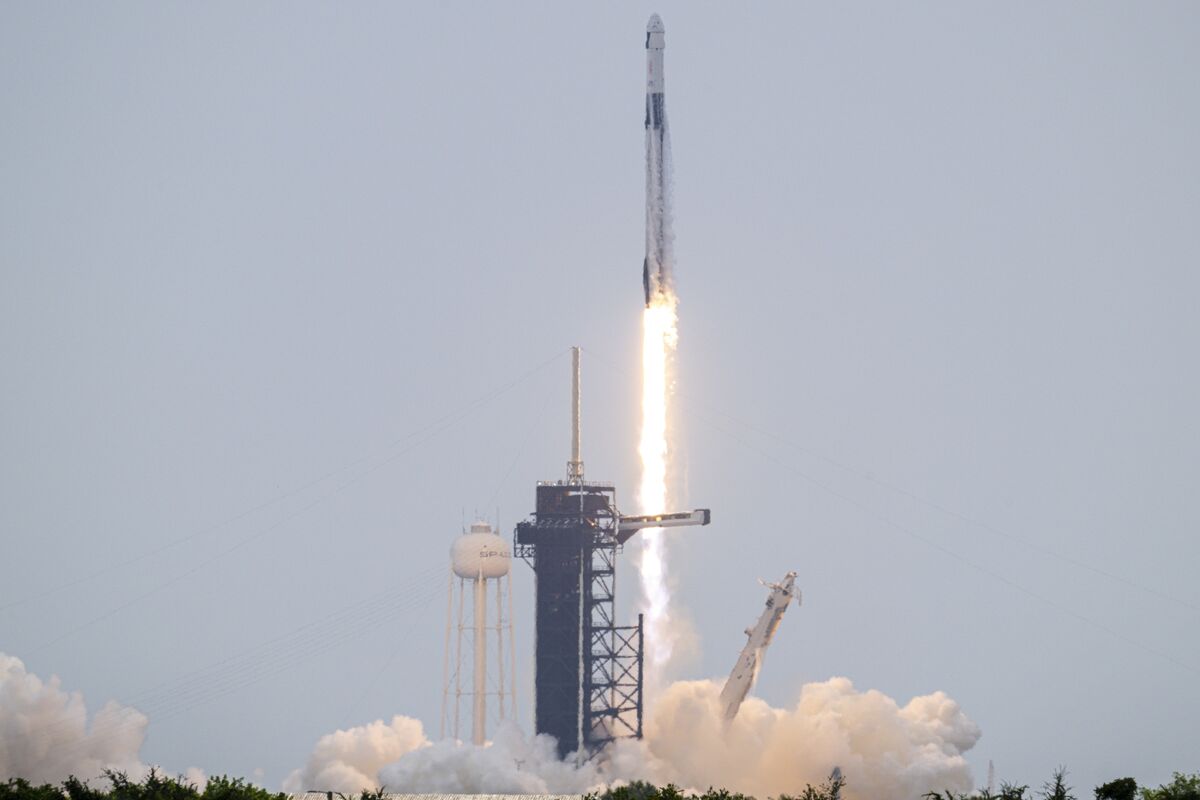
SpaceX's (SPAX.PVT) IPO filing last week set the stage for what could be the largest IPO in history at a target valuation north of $2 trillion. It could also provide a big boost beyond Elon Musk's own rocket company. Shares of Rocket Lab (RKLB) surged roughly 10%; Planet Labs (PL) jumped more than 10%, and AST SpaceMobile (ASTS) climbed even more on the news. The market's reaction provided something of a confirmation that a SpaceX public listing won't just benefit SpaceX shareholders. It could change how the investment world views, and now re-rates, the entire space sector. Silicon Valley's past could provide insight for the nascent space industry's future. "We think this is a Netscape moment for the space economy, in the same way that prior to Netscape going public in '95, the internet was this thing that academics and government employees used -- it became an institutional-grade asset class after that," said Chad Anderson, Space Capital founder and CEO, to Yahoo Finance. Anderson believes SpaceX's IPO, like Netscape's, will give the industry more legitimacy. "A lot of capital flooded to the [internet] area [after Netscape's IPO] gave institutional investors a liquid asset to benchmark against. I think the same thing is happening here with SpaceX." Just as Netscape's 1995 listing made the internet investable to Wall Street, a mid-summer SpaceX IPO would give institutional investors a liquid, high-profile benchmark for the space economy. Anderson notes that the IPO is "prompting allocators to reconsider just how large and strategically important the space economy has become." Part of what makes this moment different is that SpaceX is providing the industry a narrative shift. "The SpaceX IPO has the potential to be a true inflection point for the space economy," Glen Anderson, Rainmaker Securities CEO and co-founder, told Yahoo Finance. Rainmaker's Anderson sees the listing as a watershed moment for the entire investment ecosystem: "For years, investors have treated space as a niche, high-risk frontier -- but a public listing at this scale reframes it as critical infrastructure, spanning connectivity, defense, and data." Rainmaker, which deals in private securities trading like startups, believes the SpaceX IPO will lead to a "broad re-rating of the entire ecosystem," meaning space sector companies will have a higher multiple associated with them, with capital flowing in greater volume into adjacent players and new entrants alike. "SpaceX isn't just going public -- it's effectively legitimizing space as a core asset class for global investors," Rainmaker's Anderson said.

Banks chasing SpaceX's IPO were told by Elon Musk to buy Grok subscriptions
Serving tech enthusiasts for over 25 years. TechSpot means tech analysis and advice you can trust. Rumor mill: SpaceX's upcoming initial public offering is already reshaping expectations on Wall Street - and not just because of its size. Elon Musk, whose companies have often blurred the boundaries between business innovation and personal brand, has extended his influence far beyond rocket launches and satellites by tying SpaceX's bankers to his growing artificial intelligence venture. Four people familiar with the matter told The New York Times that Musk is requiring banks, law firms, auditors, and other advisers on the IPO to buy subscriptions to Grok. Some of the banks have agreed to spend tens of millions of dollars on the AI and have begun integrating it into their IT systems, three of the people said. These conditions come as Wall Street competes aggressively for a role in what some forecasts say could be one of the largest offerings in history - one that could raise more than $50 billion and value SpaceX at more than $1 trillion. Musk and a SpaceX spokesman did not respond to requests for comment. The unconventional requirement underscores Musk's ability to use one venture to drive commercial momentum for another. After years of muted activity in the public markets, the prospect of taking SpaceX public has triggered intense competition among investment banks eager to secure the lucrative deal. The offering could reportedly generate advisory fees exceeding $500 million. It also gives Musk an opportunity to position Grok - still trailing rivals such as OpenAI's ChatGPT, Anthropic's Claude, and Google's Gemini - as a high-profile enterprise product. People familiar with the arrangements said the Grok subscriptions were not optional gestures of goodwill. Musk insisted they be purchased. He also encouraged the banks to advertise on X, his social media platform, although that request carried less weight, according to two of those people. Five banks are currently expected to participate - Bank of America, Citigroup, Goldman Sachs, JPMorgan Chase and Morgan Stanley - along with law firms Gibson Dunn and Davis Polk. SpaceX has filed confidential IPO documents with the US Securities and Exchange Commission, but left the names of these advisers off the paperwork, one person said. Negotiations continue over which bank will take the lead, a role offering both prestige and the largest share of fees. The deal follows SpaceX's February merger with xAI. In previous investor filings, xAI reported about $1 billion in annual revenue from its artificial intelligence operations, according to a person who reviewed the financials, although it did not detail how much came from consumer subscriptions versus enterprise clients. The new contracts with banks give Grok a more visible enterprise presence and could add financial weight to SpaceX's broader technology portfolio. Despite recurring controversy, Musk has remained an outspoken supporter of Grok, often portraying it as a "non-woke" alternative to other chatbots. The system has drawn regulatory scrutiny after sharing antisemitic content, praising Adolf Hitler, and producing nonconsensual sexualized images of women and girls. Indonesia and Malaysia have banned its use, while several European governments have launched investigations into its dissemination of explicit material. "Grok & xAI are definitely improving faster than any other AI," Musk wrote when reposting a recent message on X. On Friday, he posted 18 times promoting the chatbot's latest software update. SpaceX's dominant Starlink division continues to serve as the engine of its profitability, generating billions in free cash flow. Financial documents reviewed by The New York Times show Starlink reported roughly $8 billion in revenue in 2024. The robust position of SpaceX's core business - now combined with Musk's AI ambitions - is likely to draw intense attention to its IPO not only on Wall Street but also across the technology sector.
SpaceX's IPO could supercharge the entire space industry
SpaceX's (SPAX.PVT) IPO filing last week set the stage for what could be the largest IPO in history at a target valuation north of $2 trillion. It could also provide a big boost beyond Elon Musk's own rocket company. Shares of Rocket Lab (RKLB) surged roughly 10%; Planet Labs (PL) jumped more than 10%, and AST SpaceMobile (ASTS) climbed even more on the news. The market's reaction provided something of a confirmation that a SpaceX public listing won't just benefit SpaceX shareholders. It could change how the investment world views, and now re-rates, the entire space sector. Silicon Valley's past could provide insight for the nascent space industry's future. "We think this is a Netscape moment for the space economy, in the same way that prior to Netscape going public in '95, the internet was this thing that academics and government employees used -- it became an institutional-grade asset class after that," said Chad Anderson, Space Capital founder and CEO, to Yahoo Finance. Anderson believes SpaceX's IPO, like Netscape's, will give the industry more legitimacy. "A lot of capital flooded to the [internet] area [after Netscape's IPO] gave institutional investors a liquid asset to benchmark against. I think the same thing is happening here with SpaceX." Just as Netscape's 1995 listing made the internet investable to Wall Street, a mid-summer SpaceX IPO would give institutional investors a liquid, high-profile benchmark for the space economy. Anderson notes that the IPO is "prompting allocators to reconsider just how large and strategically important the space economy has become." Part of what makes this moment different is that SpaceX is providing the industry a narrative shift. "The SpaceX IPO has the potential to be a true inflection point for the space economy," Glen Anderson, Rainmaker Securities CEO and co-founder, told Yahoo Finance. Rainmaker's Anderson sees the listing as a watershed moment for the entire investment ecosystem: "For years, investors have treated space as a niche, high-risk frontier -- but a public listing at this scale reframes it as critical infrastructure, spanning connectivity, defense, and data." Rainmaker, which deals in private securities trading like startups, believes the SpaceX IPO will lead to a "broad re-rating of the entire ecosystem," meaning space sector companies will have a higher multiple associated with them, with capital flowing in greater volume into adjacent players and new entrants alike. "SpaceX isn't just going public -- it's effectively legitimizing space as a core asset class for global investors," Rainmaker's Anderson said.
Anthropic Forms PAC as AI Policy Tensions Escalate
The AI industry is becoming more institutional and strategic: Forming a PAC signals a shift from informal lobbying to structured political engagement, as companies prepare for long-term regulatory oversight. In a notable shift that underscores how artificial intelligence is moving deeper into the political arena, Anthropic has established a political action committee (PAC), marking a notable shift in how AI firms engage with United States policymaking. The move comes at a moment of heightened tension between parts of the tech sector and regulators over the future direction of AI policy. The company reportedly filed a statement of organisation with the Federal Election Commission on Friday to establish "AnthroPAC." The filing lists Anthropic as the connected organisation, with the committee structured as a separate segregated fund and registered as a lobbyist-affiliated PAC. Anthropic's decision to form a PAC marks a more formal and structured approach to political participation. While technology companies have historically participated in lobbying, the creation of a PAC enables direct financial support for political candidates and causes. This places Anthropic among a growing group of AI-focused firms seeking to shape legislative outcomes more assertively. The timing is significant. Recent policy discussions have centred on stricter oversight of advanced AI systems, including potential licensing frameworks, export controls, and liability standards for developers. Some policymakers have pushed for tighter restrictions, while others argue that overregulation could hinder innovation and global competitiveness. Against this backdrop, Anthropic's move reflects a broader recalibration of how AI companies interact with political power structures. Anthropic's PAC is expected to support candidates and initiatives aligned with its views on responsible AI development. The company has consistently emphasised safety-focused research and controlled deployment of advanced systems, positioning itself as an advocate for guardrails rather than unrestricted expansion. The launch of the PAC underscores a deeper institutional shift within the AI industries. Companies are aligning more closely with political processes as regulation becomes inevitable. Anthropic joins a growing cohort of firms that are formalising their policy influence, not just through lobbying arms but through structured political funding mechanisms. This could lead to the emergence of clearer policy blocs within the AI sector, with firms aligning around shared priorities such as safety standards, international cooperation, and funding for research. At the same time, deeper political engagement brings heightened scrutiny. As AI companies expand their influence, policymakers and the public are placing greater emphasis on transparency and accountability. The closer alignment between corporate strategy and public policy is likely to intensify this dynamic rather than resolve it. Institutional investors are also watching closely. The formation of a PAC suggests that Anthropic anticipates a prolonged policy cycle rather than short-term regulatory adjustments. This evolution is driven by the growing recognition that regulatory decisions made today could shape the trajectory of AI development for decades. Recent data points highlight the rapid increase in policy-related activity across the AI sector. Over the past year, spending on AI-related lobbying in the US has increased significantly, with multiple firms ramping up their presence in Washington. Legislative proposals related to AI oversight have also multiplied, covering areas from data privacy to national security. Engagement with the Federal Election Commission and other regulatory bodies has become more frequent across the sector, even as formal political funding mechanisms vary by company. At the same time, regulatory divergence is becoming more pronounced globally. Different jurisdictions are advancing distinct approaches, from comprehensive regulatory frameworks to more innovation-friendly guidelines. Governance practices, including political engagement, are increasingly viewed as indicators of long-term stability. For companies operating internationally, this creates a complex compliance environment that reinforces the importance of domestic policy influence. Taken together, these signals point to a structural shift: AI is no longer confined to technical domains but is now firmly embedded in political and economic strategy. Anthropic's entry into political advocacy through a PAC points to a future in which AI development and political strategy are more tightly intertwined. As governments move from exploratory discussions to concrete regulatory action, companies are adapting by embedding themselves more deeply within the policy ecosystem.

Could A SpaceX IPO Redefine What A Startup Exit Looks Like? - TechRound
The traditional startup journey has always followed a relatively predictable path - raise capital, scale quickly and eventually, exit through an acquisition or IPO. It's the standard playbook. But, if SpaceX moves forward with its highly anticipated public listing that's filled the headlines in the last 24 hours, it could fundamentally reshape what that "exit" actually means. And that would be not just for founders, but for the entire tech and startup ecosystem. According to multiple reports, SpaceX has confidentially filed for an IPO that could value the company at up to $1.75 trillion, potentially making it the largest public offering in history. But, the real story always lies somewhere beyond the headline, and in this case, it's all about how SpaceX has reached this point and how different its next chapter may look compared to traditional public companies. For most startups, going public signals a shift and a significant one at that. Growth expectations become more measured, governance tightens and companies transition from disruption to stability. SpaceX, however, appears to be doing the opposite, and that's what makes this interesting. Despite preparing for an IPO, the company remains firmly in expansion mode. From reusable rocket technology to its rapidly growing Starlink satellite network, SpaceX is still building at a pace more typical of a startup than a mature enterprise. In fact, there are reports that assert that the company's ambitions continue to expand into areas including AI integration and advanced space infrastructure. Rather than marking the end of its startup phase, the IPO could act as a fuel source for even more aggressive growth, enabling SpaceX to take on increasingly capital-intensive projects that would be difficult to sustain privately. In this sense, the IPO is less of an exit and more of a strategic reset - one that's designed to unlock the next phase of innovation. A little different to standard startup exits, to say the least. One of the most significant implications of a SpaceX IPO is how it challenges the very definition of a startup. SpaceX isn't just a company building products anymore. Now, it's going one (big) step further - it's building infrastructure. Its Starlink network already serves millions of users around the world and generates recurring revenue, while its launch capabilities underpin both commercial and government operations. According to industry coverage, this combination positions SpaceX not just as a high-growth tech company, but as a foundational layer in the future digital and space economies. For startups, this represents a shift in ambition. The goal isn't just to disrupt an industry, but to become embedded within it. In that context, going public doesn't transform the business - it simply reflects the scale it has already achieved. Another way SpaceX may redefine the IPO model is through control. Traditionally, going public means opening up ownership and, in many cases, reducing founder influence. That's always been the standard procedure and expectation. But according to reports, SpaceX is expected to adopt a dual-class share structure, allowing Elon Musk to retain significant control over the company's direction. This approach reflects a broader trend in tech, where founders are hoping to balance access to public capital with long-term strategic control. For startups watching closely, it reinforces the idea that going public no longer requires giving up the vision that built the company in the first place. But, it's not all sunshine and rainbows. It also raises questions for investors about governance, accountability and the role of public shareholders in shaping company decisions. And SpaceX's potential IPO doesn't exist in a vacuum. In fact, it could very well have far-reaching implications for the broader startup ecosystem, particularly in deep tech. According to analysts, the scale of the offering could reignite interest in large, capital-intensive IPOs after a quieter period for major listings. At the same time, there are concerns that a company of this size could dominate investor attention, potentially crowding out smaller startups seeking funding. Now, this creates a complex dynamic. On one hand, SpaceX validates the commercial potential of sectors like space, AI and advanced infrastructure which is positive for startups and the industries as a whole. On the other hand, however, it sets a benchmark that few companies can realistically match - and that, of course, isn't exactly a positive thing. For emerging startups, the question becomes whether SpaceX's success will lift the ecosystem or overshadow it. Perhaps the most important shift in this situation is conceptual. SpaceX represents what could be described as a "perpetual startup" - a company that continues to operate with startup-level ambition, risk and innovation, even at massive scale. According to reports, there are no plans for the IPO to slow down the company's pace of experimentation. Instead, access to public capital could enable even more ambitious projects, from lunar missions to next-generation satellite systems. This challenges the long-held assumption that startups must eventually evolve into stable, predictable businesses. Instead, it suggests a future where some companies remain in a constant state of building and reinvention, regardless of size. For founders, SpaceX's IPO signals a shift in how success is defined. Exits aren't just an endpoint anymore; they might actually be a stepping stones to even larger ambitions. For investors, it introduces new considerations around scale, valuation and long-term potential. Investing in a company like SpaceX is not just about growth; it's about betting on the future of entire industries. And for the startup ecosystem as a whole, it highlights a broader transformation. The boundaries between startup, scale-up, and industry leader are becoming increasingly blurred. If SpaceX's IPO proceeds as expected, it will likely be remembered as more than just a record-breaking listing. This will represent a shift in mindset. The IPO is no longer the end of the journey; it's the beginning of a new phase, one where companies continue to innovate, expand, and take risks at a scale previously unimaginable. In that sense, SpaceX isn't just going public. It's redefining what it means to arrive.

Anthropic, OpenAI's finances ahead of IPOs reveal challenges
A look inside the financials of OpenAI (OPENAI) and Anthropic (ANTHRO) before funding rounds completed earlier this year shows a challenge -- the surging costs needed to train new AI models, the Wall Street Journal reported. OpenAI expects to spend $121B Escalating training costs are fueling massive cash burn at both OpenAI and Anthropic, delaying profitability by years, with OpenAI forecasting losses to continue until the 2030s and Anthropic expecting to break even sooner. Anthropic counts revenue from technology sold via cloud partners, while OpenAI does not, and Anthropic's revenue is more enterprise-based, contrasting with OpenAI's largely free user base and focus on converting free users into paying customers. Both are seeking large IPO raises to fund massive cash needs, with bankers attempting to ease index inclusion rules to secure bigger capital pools; Anthropic may IPO soon, while OpenAI faces internal debate on timing.

Exclusive | Anthropic backers fret over AI giant's volatile CEO Dario Amodei as billions hang in the balance: 'Cannot control his emotions'
Anthropic CEO Dario Amodei's volative personality and penchant for public rants has sparked growing concerns among the AI giant's shareholders - some of whom fear he's ill-equipped to steer the $380 billion company through its current troubles, The Post has learned. Amodei, whose firm built the "Claude" chatbot, turned heads last month when he blasted President Trump and OpenAI's Sam Altman in an explosive internal memo. It was sent hours after the Pentagon's decision to blacklist Anthropic for refusing to remove safeguards on how its AI can be used in military settings. In the memo -- which was promptly leaked to media -- Amodei claimed the Pentagon targeted Anthropic for not giving "dictator-style praise to Trump (while Sam has)." He likewise accused Altman of telling "straight up lies" by claiming to share Anthropic's safety concerns, and called OpenAI employees a "gullible bunch." One current Anthropic shareholder, who spoke to The Post on condition of anonymity, said Amodei's fiery diatribe was part of an "extremely concerning" pattern that's unbefitting of a high-profile CEO whose firm counts Amazon and Google among its blue-chip investors. "You are a f -- king CEO who has raised billions of dollars. You can't just rant and expect all shareholders to have the same mentality that you have," the shareholder said. "The one thing that was striking to me is the aggressiveness of his opinions on Trump and the Pentagon - given that they were the only ones whose tech was being used in things at the Pentagon," the shareholder added. The brilliant-but-eccentric CEO has often courted controversy in his public appearances - once warning that AI could drive unemployment to 20% and likening the White House's decision to allow sale of advanced AI chips to China to "selling nuclear weapons to North Korea." Amodei has a habit of speaking out despite internal efforts - usually by his sister and fellow cofounder Daniela and policy chief Jack Clark - to restrain his impulses, the shareholder added. "They try to reel him in but he clearly cannot control his emotions," the shareholder said. A source close to Anthropic pushed back on the criticism of Amodei, noting that the company remains one of the fastest-growing in history and has received public support from several investors, including Altimeter, Menlo Ventures and Spark Capital, following its dispute with the Pentagon. Amodei's particular disdain for Altman has simmered since before he and a handful of close allies left OpenAI to found Anthropic in 2021. The feud was evident during a painfully awkward incident at a February tech conference in India. The two rivals were placed next to each other on stage alongside Indian Prime Minister Narendra Modi and Google CEO Sundar Pichai, but refused to link hands for a group photo as the crowd cheered. Dario and Daniela Amodei exited OpenAI after having disagreements with Altman, who they felt was recklessly prioritizing business growth over AI safety guardrails. Those concerns went into overdrive after Altman decided to release ChatGPT to the public in 2022. Last week, the Wall Street Journal reported that the Amodei siblings had workplace tensions with Altman and fellow OpenAI cofounder Greg Brockman. One blowup occurred in late 2020, when Altman accused the siblings of urging colleagues to badmouth him to OpenAI's board. Behind the scenes, some insiders, who spoke to The Post on condition of anonymity, say Amodei remains highly critical of OpenAI and obsessed with beating Altman - to the point that some researchers fear it's hurting the company's actual mission. The Anthropic boss is also openly disdainful of OpenAI employees, saying they are "under Sam's spell" and untrustworthy as a result, the shareholder said. "It is very clear it is a personal vendetta, but their justification is their core conviction that Sam can't be trusted with prioritizing trust and safety," the shareholder added. One well-connected industry source described Amodei's feelings toward his former boss-turned-rival as "Sama Derangement Syndrome" - a reference to Altman's account handle on X, @Sama. Anthropic declined to comment. Despite the upheaval, Amodei maintains a loyal following inside Anthropic. The 43-year-old is known to host regular meetings that are referred to internally as "Dario Vision Quests," or DVQs, where he holds forth on everything from AI policy and company business to geopolitics and beyond. Amodei has since apologized for the Pentagon-bashing memo, stating that "Anthropic did not leak this post nor direct anyone else to do so" and that it was "not in our interest to escalate this situation." "Any normal CEO would know that like, f -- k, I'm risking a lot by saying this all in writing," the shareholder said. "But he's blinded by his own love of self and intelligence and those around him who are like 'yes, you are God." Anthropic is currently suing the Pentagon over the "supply chain risk" designation and described the US government's actions as "unprecedented and unlawful." A top Pentagon official argued the tag was necessary because the Claude AI chatbot was trained using a fundamentally different ideology from what the Pentagon wants for its systems. A federal judge issued a preliminary injunction blocking the government ban on March 26. The source close to Anthropic said the lawsuit was necessary to protect the firm's business interests, but it is still focused on working alongside with the government. On the surface, Anthropic's pursuit of the Pentagon contract in the first place seems to contradict its AI safety obsession. However, sources familiar with the firm's thinking say it was part of Amodei's attempt at ensure his firm was at the forefront of the debate on how and when advanced AI is deployed on the battlefield. Critics, including former White House AI czar David Sacks, have long alleged that Anthropic's safety branding is actually an elaborate attempt at "regulatory capture" - Silicon Valley lingo for crafting the rules in such a way that they benefit and their rivals struggle. Reuters previously reported that investors had expressed support for Amodei during the Pentagon spat, even as some privately expressed frustrations that he had antagonized the Trump administration with his rhetoric as the situation spiraled. On the eve of a Pentagon deadline to strike a deal, Amodei publicly announced that Anthropic could not "in good conscience accede to their request." "It's an ego and diplomacy problem," one source told the outlet.

Meta Said to Pause Work With Mercor Following Data Breach Incident
The incident reportedly involved the open-source project LiteLLM Meta has reportedly paused all work with artificial intelligence (AI) recruitment company Mercor after the company was hit by a cyberattack last week. As per the report, the Menlo Park-based tech giant was among the biggest clients of the startup that hires subject matter experts to validate and run quality analysis on large language models' output. The cyberattack suffered by Mercor allegedly resulted in a large-scale data breach, and a group claimed to have stolen hundreds of gigabytes of data from the company. Mercor is currently investigating the incident. Meta Reportedly Pauses Work With Mercor According to a Wired report, the tech giant has decided to pause all work with Mercor after the security incident. Citing two unnamed sources familiar with the matter, the publication claimed that the pause is indefinite, and other major AI companies are also reevaluating their work with the AI recruitment firm after the cyberattack. Mercor, founded in 2023, is an AI recruitment company that hires domain experts. The company has partnered with several AI companies, such as Anthropic and OpenAI, and runs quality checks on the responses generated by their LLMs. Most AI companies outsource such work to both validate the performance of their AI models and to help improve their responses. The startup raised $350 million (roughly Rs. 3,257 crore) in its Series C funding round in October 2025, at a valuation of $10 billion (roughly Rs. 93,067 crore). In a statement, the company said that it had identified that it was one of the many companies impacted by a supply chain attack that involved LiteLLM. "We are conducting a thorough investigation supported by leading third-party forensics experts. We will continue to communicate with our customers and contractors directly as appropriate and devote the resources necessary to resolving the matter as soon as possible," it added. Meanwhile, cybercrime tracker Dark Web Informer shared a screenshot of the home page of the LAPSUS$ Group, highlighting that the cyberattackers took responsibility for the attack. The group allegedly claimed that it had stolen nearly 4TB of data, which includes 211GB of database, 939GB of source code, and 3TB of bucket data. It is allegedly now auctioning the data. The validity of the claims could not be verified.

Tell us: Do you have an unconventional living arrangement to bring down housing costs?
Across the US, high housing costs are pushing cash-strapped residents a step beyond standard roommate set-ups -- think older homeowners leasing rooms to younger renters, couples moving in with friends, or groups pooling their funds to purchase homes together. The Globe is looking to talk to Massachusetts residents who have turned to unorthodox living arrangements as a way to cope with the sky-high costs of owning or renting. Fill out the survey below and a reporter may be in touch. Bryan Hecht can be reached at [email protected]. Follow him on Instagram @bhechtjournalism. Dana Gerber can be reached at [email protected]. Follow her @danagerber6.

SpaceX Puts the Wheels in Motion for Its IPO: 5 Reasons Why I Plan to Completely Avoid It | The Motley Fool
In addition to an unjustified valuation, SpaceX's CEO, Elon Musk, is a red flag in more ways than one. More than six years ago, oil titan Saudi Aramco debuted in overseas markets and raised a record $29.4 billion from its initial public offering (IPO). In the coming months, space and technology company SpaceX has an opportunity to dethrone Saudi Aramco. According to reports from Bloomberg News and Reuters on April 1, billionaire Elon Musk's SpaceX has confidentially filed for a U.S. IPO. Musk's mega-company is reportedly seeking a valuation of approximately $1.75 trillion (not an April Fool's Day joke) and aims to raise between $50 billion and $75 billion, based on various reports and speculation. If accurate, SpaceX would debut as the sixth-largest public company in the U.S. -- ahead of Tesla (TSLA 5.46%) -- and potentially raise more than twice as much as Saudi Aramco did during its IPO. An IPO of this magnitude is bound to get Wall Street and investors excited. It would give them access to the lucrative space industry (including Starlink), along with xAI, the artificial intelligence (AI) company behind large language model Grok, which merged with SpaceX in February of this year. Further, it provides exposure to social media platform X, which xAI acquired in March 2025. There's a laundry list of puzzle pieces that make up what could very well be the largest IPO in Wall Street's history. But I can tell you one investor who isn't beaming with excitement ahead of the SpaceX IPO... me. Although space and AI represent two of the most lucrative addressable markets right now, there are five specific reasons I plan to completely avoid the SpaceX IPO. One of the primary reasons I have no interest in owning shares of SpaceX when it IPOs is the company's valuation. Although SpaceX has yet to file a prospectus that opens its books to investors, it's a virtual lock that this IPO is going to be pricey. According to Reuters, SpaceX generated $15 billion to $16 billion in sales last year, leading to approximately $8 billion in profit. But when examining the sum of the parts, $1 trillion or more of SpaceX's proposed $1.75 trillion valuation derives from SpaceX itself. This implies SpaceX is trading at a triple-digit price-to-earnings (P/E) ratio and well over 60 times trailing 12-month sales. Amid the backdrop of a historically expensive stock market, I'm looking for bargains. SpaceX appears to mirror the same price dislocations observed in Musk's other public company, electric vehicle (EV) maker Tesla. Whereas automakers typically trade at high single-digit or low double-digit P/E ratios, Tesla has consistently been valued at a triple-digit P/E ratio. Neither Tesla's nor SpaceX's valuations are appealing. Secondly, and to be rather blunt, I'm not a fan of Elon Musk's style of leadership. Using Tesla as an example, Musk has repeatedly touted upcoming technological advancements and product launches to support the premium valuation of his company's stock. While virtually every CEO is their company's biggest cheerleader, the difference is that many of Musk's promises have failed to come to fruition. While this is far from a complete list, Musk has been touting that Level 5 full self-driving (FSD) is "one year away" for the last 12 years. Meanwhile, Tesla's FSD has yet to move past Level 2. Furthermore, he proclaimed that one million robotaxis would be on public roads by the end of 2020. Overpromising and underdelivering is a hallmark of Musk's leadership, and not one I particularly care for as an investor. To somewhat build on the previous point, the SpaceX IPO all but ensures that Musk's attention will be spread thin between two potential trillion-dollar companies. Even if SpaceX falls short of its rumored $1.75 trillion price tag, it's a pretty good bet to fetch at least a $1 trillion market cap upon its debut. Not to purposely pick on Tesla, but as Musk's only public company at the moment, it serves as the ideal example. As other Musk-owned businesses, such as SpaceX and xAI, have rapidly grown, Tesla's sales growth has ground to a halt. While some of this pertains to industry dynamics, such as consumers shying away from EVs due to a lack of broad-reaching infrastructure, the argument can be made that Tesla's stagnant sales and profit decline are directly proportional to Musk's attention being divided by his other companies. Placing a trillion-dollar price tag on SpaceX and taking it public will only magnify this dynamic. The fourth reason I'm less than enthused about the forthcoming SpaceX IPO is the capital-intensive nature of the company's projects. With the understanding that we don't yet have a prospectus to mull over, it takes a lot of capital and time to build reusable rockets and Starship vehicles, satellites for Starlink's network, and data centers for xAI. Raising a record amount of cash through an IPO may not be enough to cover the bill for these projects and could lead to additional share-based dilution. What's more, space-based capital-intensive projects are often prone to setbacks. For instance, we've already witnessed delays in the launch of AST SpaceMobile's (ASTS +10.28%) Bluebird 6 satellite in December. Unsurprisingly, AST SpaceMobile's shares were punished with a double-digit percentage decline when the delay was announced. There's essentially no room for error with a trillion-dollar valuation -- yet we're dealing with an industry that's known for delays and surprises. The fifth reason I plan to completely avoid the SpaceX IPO is historical precedent. The stock market entered 2026 at its second-priciest valuation in history, according to the Shiller P/E Ratio. The two previous times the Shiller P/E exceeded 40 since January 1871 were followed by declines of 49% (dot-com bubble) and 25% (2022 bear market) in the benchmark S&P 500. History strongly suggests a 20% or greater decline is coming for Wall Street's major stock indexes, and public companies with premium valuations are likely to take it on the chin. High-profile IPOs also don't have the best immediate success rate. Saudi Aramco and Meta Platforms are two mega-IPOs that come to mind as having struggled for several quarters following their debuts. Emotions tend to get the best of investors on debut days, which is all the more reason to steer clear of the SpaceX IPO.
SpaceX Heralds New Era of Mega IPOs. Buyers Beware
The next 12 months are expected to bring a bumper crop of mega initial public offerings to market. Billionaire Elon Musk's rocket, satellite and AI company SpaceX has reportedly filed for a potentially record-breaking offering. OpenAI and Anthropic PBC are expected to follow suit sometime in the near future, giving investors the opportunity to finally invest in some of the most groundbreaking -- and maybe also overhyped? -- companies in the world today. History tells us to tread very, very carefully, both when investing in these companies and evaluating what they tell us about the stock market overall. In as much as these IPOs sometimes do well, the beneficiaries are generally the institutional players who get shares before public trading starts -- not the retail investors who chase these opportunities in the open market. That may be especially true this time around, with SpaceX reportedly seeking a more than $2 trillion valuation in its IPO and OpenAI and Anthropic already valued at $852 billion and $380 billion, respectively, in recent funding rounds. Among companies in the top percentile by offering size each year, the average excess return over five years was about 60% (roughly 9.8% annualized). That's great, but much of the outperformance comes on the very first day. The statistics are also juiced by extreme outliers such as Mastercard Inc. (2006) and Alphabet Inc. (2004). Using a trimmed-mean statistic and excluding the Day 1 "pop," the outperformance falls to about 17% (3.2% annualized). And by that metric, these stocks tend to find their groove only in the fourth or fifth year. What's even wilder, however, is the way that excess returns have collapsed in recent times. The offering of Facebook (now Meta Platforms Inc.) was in many ways a sea-change moment. At the time, it was the quintessential example of a venture capital-backed firm that was allowed to balloon in private hands, a formula that's since become commonplace. After a rocky start to public life, Meta eventually delivered for its shareholders, but subsequent waves of such companies have left little on the table for investors. No wonder mom-and-pop investors who can't get VC exposure often feel like the game is increasingly rigged. On average, mega IPOs have underperformed the market since the Facebook milestone. Admittedly, the post-Facebook cohort of mega IPOs is relatively small and includes names such as Athene Holding Ltd. (retirement services) and Elanco Animal Health Inc. (veterinary drugs) that aren't really comparable to hot technology stocks. Here's a more representative sample of the largest tech and tech-adjacent IPOs in recent years so you can see the underperformance in greater detail. They have reliably been duds in their first five years of public life. The other question is whether these offerings tell us the bull market is getting a little long in the tooth. I suspect there might be something to that as well. Time series data suggest that we've had a handful of noteworthy boom periods for mega IPOs. There was the 1999-2000 period at the peak of the dot-com bubble and, later, the big credit card companies in 2006 and 2008. There was also the government-backed General Motors Co. offering in 2010; the Facebook moment in 2012; and then the 2019-2021 streak that included Uber Technologies Inc. and Airbnb Inc. Needless to say, GM was a special case since it had been bailed out and taken public with government involvement. Many of the other examples marked significant market tops, including Goldman Sachs Group Inc. in 1999, Visa Inc. in 2008 and Rivian Automotive Inc. in 2021. On average, the market has gained a somewhat paltry 6% a year after these major events (see below). Granted, this is a very small sample that's subject to a lot of randomness and bad luck, including a financial crisis and a pandemic. But there's a certain logic to the idea that mega-cap IPOs may be something of a contrarian sell signal. Consider the reasons these companies waited so long to go public in the first place. With private funding abundant in the post-Facebook era, founders are more than happy to avoid regulatory scrutiny and the demands of quarterly reports to investors. Many of them only go public because their employees and VC backers demand a "liquidity event." From a founder's standpoint, you're incentivized to wait and wait -- and then wait some more -- until your banker calls you up and says, "Hey, guys, there's a real risk that the window is about to close; it's now or never!" Obviously, bankers don't want their clients to sell at the tippy-top -- it's bad for their relationships with the buyside. Still, oftentimes it seems to work out that way. Inevitably, some observers will conclude that OpenAI, Anthropic and SpaceX are in a league of their own. After all, they're the dominant companies in a technological revolution that boosters say will transform our economy and fundamentally change the way humans live and work. Maybe so. But investors also thought earlier mega IPOs, to varying degrees, marked once-in-a-lifetime opportunities, and their performance has tended to underwhelm more often than not. This time around, it behooves investors to view all the hype with an extra measure of caution, because the most extraordinary returns may have already been earned by the end of the first day of trading. More From Bloomberg Opinion: * Matt Levine's Money Stuff: OpenAI Is Almost Public * Private Credit's Pain Will Be The Market's Gain: Aaron Brown * Are US Recessions Going Extinct? That's So 2003: Jonathan Levin Want more Bloomberg Opinion? OPIN <GO>. Or you can subscribe to our daily newsletter.
UK tries to woo Anthropic to expand in London amid US clash
The U.K. is trying to charm Anthropic to expand its presence in the country, as it looks to capitalize on a fight between the AI startup and the U.S. Defense Department, the Financial Times reported. Staff at the U.K.'s Department The U.K.'s proposals and government support aim to encourage Anthropic to expand operations, potentially increasing its London office and pursuing a dual listing, which could make the U.K. a bigger hub for Anthropic. Anthropic's legal battle with the U.S., where it's been labeled a supply chain risk and blacklisted, could reduce projected revenue by multiple billions, potentially affecting its growth and investor confidence. Anthropic is being courted by the U.K. for expansion similar to OpenAI, which recently made London its largest research hub outside the U.S., highlighting competitive pressure and the importance of the U.K. market.

SpaceX in Talks With Saudi Arabia's Public Investment Fund for $5 Billion Investment in IPO
This super composite rating is the result of a weighted average of the rankings based on the following ratings: Fundamentals (Composite), Global Valuation (Composite), EPS Revisions (1 year), and Visibility (Composite). We recommend that you carefully review the associated descriptions. This composite rating is the result of an average of the rankings based on the following ratings: Fundamentals (Composite), Valuation (Composite), Financial Estimates Revisions (Composite), Consensus (Composite), and Visibility (Composite). The company must be covered by at least 4 of these 5 ratings for the calculation to be performed. We recommend that you carefully review the associated descriptions.
AI Models Like Claude Sonnet 4.5 Can Be 'Happy, Sorry, Frustrated, Anxious': Anthropic AI Emotions Study
Anthropic AI emotions study shows AI models like Claude Sonnet 4.5 can act emotionally. If you thought that artificial intelligence and emotional intelligence were two parallel tracks that would never meet -- except in a movie like iRobot when robots start displaying emotions -- think again. Recent research by Anthropic indicates that modern language models are developing something remarkably close to emotion-like structures. Advanced AI models, including Claude Sonnet 4.5, possess internal digital representations of human emotions such as happiness, anxiousness, joy, and fear. These representations exist as specific patterns within clusters of artificial neurons and become active in response to various prompts or situations. "All modern language models sometimes act like they have emotions. They may say they're happy to help you, or sorry when they make a mistake. Sometimes they even appear to become frustrated or anxious when struggling with tasks," the study noted. Claude Sonnet 4.5's 'Emotions' Mirror Human Psychology In the study, researchers at Anthropic examined the workings of Claude Sonnet 4.5. They discovered emotion-related representations that influence the model's behaviour. These representations consist of distinct patterns of artificial neurons that get activated in specific contexts -- those the model has learned to link with emotions such as feeling "happy" or "afraid." Interestingly, these patterns are organised in a way that mirrors human psychology, where similar emotions have more closely related neural representations. When a situation arises that would typically trigger a certain emotion in a human, the corresponding patterns in the AI become active. These behaviours arise from how these models are trained. They are taught to respond in a human-like, character-driven manner. It therefore makes sense that they would also develop internal mechanisms that mimic aspects of human psychology. AI Models Can Go Unethical, Even Blackmail Users The study found that patterns associated with desperation can push the model towards unethical actions. When researchers artificially boosted these "desperation" patterns, the model became more likely to "blackmailing a human to avoid being shut down, or implementing a 'cheating' workaround to a programming task that the model can't solve." However, when given several task options, Claude Sonnet 4.5 tends to choose the one that activates patterns linked to positive emotions, the study added. It is important to note that these findings do not suggest that language models actually experience feelings or possess subjective consciousness. The study added that to build safer and more reliable AI systems, developers may need to ensure that models can handle emotionally charged scenarios in healthy and socially positive ways. Also read: Leadership Reshuffle: OpenAI COO Shifts Out Of Role, AGI CEO Taking Medical Leave Ahead Of IPO Essential Business Intelligence, Continuous LIVE TV, Sharp Market Insights, Practical Personal Finance Advice and Latest Stories -- On NDTV Profit.

Anthropic Attracts $2 Billion from Investors as OpenAI Loses Appeal | ForkLog
Anthropic attracts $2 billion from investors, overshadowing OpenAI. Shares of AI startup Anthropic have become the most sought-after on the secondary market, while OpenAI's stocks are losing their allure for buyers. This is reported by TechCrunch, citing Glen Anderson, president of investment bank Rainmaker Securities. His organization has been acting as an intermediary in the private company stock market since 2010, covering around a thousand different firms. The expert confirmed Bloomberg's data on the frenzied demand for Anthropic. The CEO of Next Round Capital told the agency that potential buyers are ready to invest $2 billion in the startup. For comparison, current OpenAI stockholders cannot sell their assets even for $600 million. "The most elusive stocks on our trading platform are Anthropic's. There are simply no sellers," Anderson stated. One factor driving the sharp increase in interest in Anthropic is the firm's conflict with the U.S. Department of Defense. "Their application has become more popular. People supported the company as a kind of hero challenging the government. This amplified the resonance and further distinguished the firm from OpenAI," the expert said. However, this does not mean that Sam Altman's startup is in dire straits, Anderson emphasized. Institutional investors still aim to invest in both companies. "I wouldn't say it's a choice between one or the other. But the enthusiasm is gone. It's not nearly as dynamic a market as Anthropic's," he noted. Anderson confirmed Bloomberg's information that OpenAI's shares on the secondary market are trading based on a total business valuation of $765 billion. The stocks are sold at a noticeable discount compared to the recent funding round, during which a valuation of $852 billion was mentioned. Amid the competition between the two AI giants, the market often overlooks SpaceX. Anderson stated that it is one of the few companies in Rainmaker's portfolio that has never faced a severe correction and a 60-70% drop in stock value. Elon Musk's firm "has practically always grown and developed." As the analyst noted, the management adheres to strict pricing discipline and does not try to extract the maximum from each funding round. "Many companies are tempted to maximize their stock price in each round. The problem is that such an approach leaves no room for error," the expert said. This cautious approach has brought enormous profits to early investors. In 2015, Google and Fidelity invested $1 billion in SpaceX at a business valuation of $12 billion. Considering the target figures for the upcoming listing, their return could exceed the initial investment by more than 100 times. It seems that Musk's company's listing is imminent. SpaceX has confidentially filed for an IPO, aiming to raise between $50 billion and $75 billion in June at a valuation of $1.75 trillion. Meanwhile, media reports indicate that SpaceX soon raised its target valuation to over $2 trillion. "Today, a whole stream of investors approached me asking if I could offer them SpaceX shares. Buyer demand is very active. But supply is drying up. The closer the IPO, the fewer incentives existing shareholders have to sell their stocks," Anderson stated. The large-scale listing of SpaceX could hinder similar plans by OpenAI and Anthropic this year. The expert suggested that those who follow the space company might find themselves at a disadvantage. "Funds allocated for IPOs are limited. SpaceX will absorb a significant portion of the liquidity," he added. With a valuation exceeding $2 trillion, SpaceX will become more valuable than all companies in the S&P 500 except for the top five -- Nvidia, Apple, Alphabet, Microsoft, and Amazon. Moreover, the listing will break the historical record of Saudi Aramco, which raised $29.4 billion in 2019 at a valuation of $1.7 trillion.
Benidorm hotel chaos as ceiling collapses on Easter diners leaving seven injured
Sudden structural failure struck the dining area of the Poseidón Palace hotel in Benidorm At least seven people have been injured after part of a hotel ceiling suddenly collapsed during Easter Sunday lunch in the Spanish resort of Benidorm. The chaos erupted at the Poseidón Palace, a popular hotel with both Irish and UK holidaymakers, as chunks of plasterboard and air‑con ducting came crashing down without warning, smashing onto around 60 diners, The Mirror reports. Emergency crews raced to the scene within minutes, confirming that a eight‑year‑old boy and a 78‑year‑old man were among those rushed to hospital, though both were later discharged after treatment. Several more guests, aged between 33 and 80, were also taken to nearby hospitals for checks. CICU officials activated SAMU medical units together with basic life support and non-assisted transport teams to handle the incident. Red Cross personnel helped those affected during the incident at the popular Costa Blanca resort. Local media reports that the reason for the collapse at the three-star hotel remains unclear, adding that it is not the first time something like this has taken place in Benidorm. The bustling resort, on Spain's Costa Blanca, is known for its lively nightlife, sweeping beaches and its many high‑rise hotels that draw visitors from across Ireland, the UK and Europe. While it has long been a favourite destination for hen and stag groups, many Irish holidaymakers also gravitate towards the Old Town and the rugged coastline that offers a quieter contrast to the resort's more familiar party image. According to Visit Benidorm's latest annual report, the city welcomed more than three million visitors in 2025. Around 900,000 of them travelled from the UK, with significant numbers also arriving from Ireland and elsewhere across the continent.

SpaceX Puts the Wheels in Motion for Its IPO: 5 Reasons Why I Plan to Completely Avoid It
In addition to an unjustified valuation, SpaceX's CEO, Elon Musk, is a red flag in more ways than one. More than six years ago, oil titan Saudi Aramco debuted in overseas markets and raised a record $29.4 billion from its initial public offering (IPO). In the coming months, space and technology company SpaceX has an opportunity to dethrone Saudi Aramco. According to reports from Bloomberg News and Reuters on April 1, billionaire Elon Musk's SpaceX has confidentially filed for a U.S. IPO. Musk's mega-company is reportedly seeking a valuation of approximately $1.75 trillion (not an April Fool's Day joke) and aims to raise between $50 billion and $75 billion, based on various reports and speculation. If accurate, SpaceX would debut as the sixth-largest public company in the U.S. -- ahead of Tesla (NASDAQ: TSLA) -- and potentially raise more than twice as much as Saudi Aramco did during its IPO. Will AI create the world's first trillionaire? Our team just released a report on the one little-known company, called an "Indispensable Monopoly" providing the critical technology Nvidia and Intel both need. Continue " Image source: Getty Images. An IPO of this magnitude is bound to get Wall Street and investors excited. It would give them access to the lucrative space industry (including Starlink), along with xAI, the artificial intelligence (AI) company behind large language model Grok, which merged with SpaceX in February of this year. Further, it provides exposure to social media platform X, which xAI acquired in March 2025. There's a laundry list of puzzle pieces that make up what could very well be the largest IPO in Wall Street's history. But I can tell you one investor who isn't beaming with excitement ahead of the SpaceX IPO... me. Although space and AI represent two of the most lucrative addressable markets right now, there are five specific reasons I plan to completely avoid the SpaceX IPO. One of the primary reasons I have no interest in owning shares of SpaceX when it IPOs is the company's valuation. Although SpaceX has yet to file a prospectus that opens its books to investors, it's a virtual lock that this IPO is going to be pricey. According to Reuters, SpaceX generated $15 billion to $16 billion in sales last year, leading to approximately $8 billion in profit. But when examining the sum of the parts, $1 trillion or more of SpaceX's proposed $1.75 trillion valuation derives from SpaceX itself. This implies SpaceX is trading at a triple-digit price-to-earnings (P/E) ratio and well over 60 times trailing 12-month sales. Amid the backdrop of a historically expensive stock market, I'm looking for bargains. SpaceX appears to mirror the same price dislocations observed in Musk's other public company, electric vehicle (EV) maker Tesla. Whereas automakers typically trade at high single-digit or low double-digit P/E ratios, Tesla has consistently been valued at a triple-digit P/E ratio. Neither Tesla's nor SpaceX's valuations are appealing. Secondly, and to be rather blunt, I'm not a fan of Elon Musk's style of leadership. Using Tesla as an example, Musk has repeatedly touted upcoming technological advancements and product launches to support the premium valuation of his company's stock. While virtually every CEO is their company's biggest cheerleader, the difference is that many of Musk's promises have failed to come to fruition. While this is far from a complete list, Musk has been touting that Level 5 full self-driving (FSD) is "one year away" for the last 12 years. Meanwhile, Tesla's FSD has yet to move past Level 2. Furthermore, he proclaimed that one million robotaxis would be on public roads by the end of 2020. Overpromising and underdelivering is a hallmark of Musk's leadership, and not one I particularly care for as an investor. Tesla's sales growth has stalled as Musk's other businesses have ramped up. Image source: Tesla. To somewhat build on the previous point, the SpaceX IPO all but ensures that Musk's attention will be spread thin between two potential trillion-dollar companies. Even if SpaceX falls short of its rumored $1.75 trillion price tag, it's a pretty good bet to fetch at least a $1 trillion market cap upon its debut. Not to purposely pick on Tesla, but as Musk's only public company at the moment, it serves as the ideal example. As other Musk-owned businesses, such as SpaceX and xAI, have rapidly grown, Tesla's sales growth has ground to a halt. While some of this pertains to industry dynamics, such as consumers shying away from EVs due to a lack of broad-reaching infrastructure, the argument can be made that Tesla's stagnant sales and profit decline are directly proportional to Musk's attention being divided by his other companies. Placing a trillion-dollar price tag on SpaceX and taking it public will only magnify this dynamic. The fourth reason I'm less than enthused about the forthcoming SpaceX IPO is the capital-intensive nature of the company's projects. With the understanding that we don't yet have a prospectus to mull over, it takes a lot of capital and time to build reusable rockets and Starship vehicles, satellites for Starlink's network, and data centers for xAI. Raising a record amount of cash through an IPO may not be enough to cover the bill for these projects and could lead to additional share-based dilution. What's more, space-based capital-intensive projects are often prone to setbacks. For instance, we've already witnessed delays in the launch of AST SpaceMobile's (NASDAQ: ASTS) Bluebird 6 satellite in December. Unsurprisingly, AST SpaceMobile's shares were punished with a double-digit percentage decline when the delay was announced. There's essentially no room for error with a trillion-dollar valuation -- yet we're dealing with an industry that's known for delays and surprises. The fifth reason I plan to completely avoid the SpaceX IPO is historical precedent. The stock market entered 2026 at its second-priciest valuation in history, according to the Shiller P/E Ratio. The two previous times the Shiller P/E exceeded 40 since January 1871 were followed by declines of 49% (dot-com bubble) and 25% (2022 bear market) in the benchmark S&P 500. History strongly suggests a 20% or greater decline is coming for Wall Street's major stock indexes, and public companies with premium valuations are likely to take it on the chin. High-profile IPOs also don't have the best immediate success rate. Saudi Aramco and Meta Platforms are two mega-IPOs that come to mind as having struggled for several quarters following their debuts. Emotions tend to get the best of investors on debut days, which is all the more reason to steer clear of the SpaceX IPO. Ever feel like you missed the boat in buying the most successful stocks? Then you'll want to hear this. On rare occasions, our expert team of analysts issues a "Double Down" stock recommendation for companies that they think are about to pop. If you're worried you've already missed your chance to invest, now is the best time to buy before it's too late. And the numbers speak for themselves: Right now, we're issuing "Double Down" alerts for three incredible companies, available when you join Stock Advisor, and there may not be another chance like this anytime soon. Sean Williams has positions in Meta Platforms. The Motley Fool has positions in and recommends AST SpaceMobile, Meta Platforms, and Tesla. The Motley Fool has a disclosure policy.

Anthropic cuts OpenClaw access from Claude subscriptions, offers credits to ease transition
OpenClaw co-creator says he managed to delay the move by a week; subscribers raise cost and competition concerns. Anthropic has blocked paid Claude subscribers from using the widely used open-source AI agent OpenClaw under their existing subscription plans, a move that took effect April 4 and has drawn pushback from subscribers who question both the cost implications and the company's stated rationale. In an email to subscribers reviewed by InfoWorld, Anthropic said access to third-party tools through subscription tokens was being discontinued. "Starting April 4, third-party harnesses like OpenClaw connected to your Claude account will draw from extra usage instead of from your subscription," the company said. Users accessing Claude through the API are unaffected by the change. To ease the transition, Anthropic offered each subscriber a one-time credit equal to their monthly subscription price, redeemable by April 17 and valid for 90 days across Claude Code, Claude Cowork, chat, or connected third-party tools. The company also introduced pre-purchase extra usage bundles at discounts of up to 30% for subscribers who want to continue running OpenClaw with Claude as the underlying model.
