News & Updates
The latest news and updates from companies in the WLTH portfolio.
Elon Musk's xAI Officially Rebrands as SpaceXAI
Elon Musk's artificial intelligence company xAI has officially changed its name to SpaceXAI, five months after SpaceX acquired the business. SpaceXAI announced the change through a post on X and also introduced a new logo. The company's account on the social network now carries the SpaceXAI name. However, SpaceX continues to operate a separate account covering its rockets, spacecraft, and launches. Merger Completed Musk first disclosed the SpaceXAI name in May, when he said xAI would no longer operate as a separate company and would instead become SpaceX's artificial intelligence business. SpaceX officially acquired xAI in February 2026. The company's public offering documents describe xAI as the foundation of SpaceX's AI division and part of a broader plan to combine artificial intelligence with its space and connectivity businesses. The xAI website has already been updated with the SpaceXAI name and logo. However, according to Stocktwits, the new branding has not yet appeared in official corporate filings. Orbital Data Centers SpaceXAI plans to develop data centers in space as demand for the electricity required to operate AI infrastructure continues to rise. When SpaceX acquired xAI, Musk argued that terrestrial infrastructure would not be able to meet global AI electricity demand. He described moving power-intensive data-center operations into space as the logical solution. SpaceX had already filed an application with the US Federal Communications Commission before announcing the acquisition. The filing seeks permission to launch and operate up to one million satellites as part of an orbital data-center system. The proposed satellites would operate at altitudes ranging from 500 kilometres to 2,000 kilometres and communicate through high-bandwidth optical links. X Also Comes Under SpaceXAI The combined business also includes a social media platform, X. xAI acquired X in 2025, meaning the platform became part of SpaceX when it purchased xAI. It now sits under the wider SpaceXAI structure alongside Grok and the company's other AI products. Public Market Debut SpaceX, including its acquired xAI and X businesses, went public in June 2026. The company's shares closed their first trading day at $160.95, or approximately $161, giving SpaceX a market value of around $2.1 trillion, according to f. The SpaceXAI rebrand formally brings Musk's space, artificial intelligence, and social media operations under one corporate identity, although SpaceX will continue to use its established name for its space-related activities.
Strategy sale disclosure jolts Bitcoin as Polymarket puts $52K at 99.5%
Bitcoin Rebounds After $63,900 Spike and Strategy's BTC Sale Disclosure, Lifting Polymarket July 10 Odds Bitcoin's volatile start to the week -- including a move up toward $63,900 before reversing -- is being watched closely as traders digest disclosures around Strategy's bitcoin sales. On Polymarket, odds in the "Bitcoin above ___ on July 10?" ladder edged higher, with the $52,000 strike priced near certainty. Key Takeaways * Polymarket prices a 99.5% chance Bitcoin will be above $52,000 on July 10. * Traders adjusted after Bitcoin spiked near $63,900 and then reversed amid focus on Strategy's disclosed bitcoin sales. * The ladder contract resolves on July 10, 2026 at 16:00 UTC. Bitcoin jumped to about $63,900 early in the week before reversing, as markets reacted to disclosures that Strategy sold thousands of bitcoin last week. The report said a prior sale of 32 BTC in late May helped trigger a panic-driven slide that took bitcoin from $74,000 to $60,000 within days, but the market response to the more recent sale of 3,588 BTC was more muted after an initial dip. The piece described bitcoin trading back near weekend highs and cited a gain of 1.7% over the past 24 hours after the headline hit. Commentators debated whether selling bitcoin to fund interest, dividends, debt paydowns and share buybacks represents a shift in Strategy's model versus issuing stock and debt to buy more bitcoin. Strategy CEO Phong Le was quoted describing the company's approach as moving from one-way capital issuance to active capital management. Polymarket "Bitcoin Above ___ on July 10?" Ladder Sees $217,326 Volume as $52K Hits 99.5% and $60K Trades at 90% Polymarket shows $217,326 in matched volume on the "Bitcoin above ___ on July 10?" ladder, with the leading strike at $52,000 priced at 99.5% Yes and 0.5% No. The curve steepens higher up the ladder: $60,000 stands at 90.0% Yes versus 10.0% No, while $62,000 is 70.5% Yes and 29.5% No. Above that, traders are far less confident, with $64,000 at 34.5% Yes and 65.5% No, and $70,000 at 1.35% Yes and 98.65% No. The pricing implies the market is concentrated on Bitcoin staying well above the low-$50,000s into the July 10, 2026 16:00 UTC resolution, while assigning a low probability to a breakout into the $70,000 range by that timestamp. Watch whether pricing tightens around the mid-$60,000 strikes -- especially $64,000 (34.5% Yes) and $66,000 (8.5% Yes) -- as liquidity and volume migrate across the ladder heading into the July 10, 2026 16:00 UTC resolution. Beyond Bitcoin: Other High-Volume Polymarket Contracts Traders Are Watching Across Macro and Geopolitics Beyond the July 10 ladder, Polymarket traders are also concentrating liquidity in shorter-dated crypto price targets, with $3,756,875 in volume on "What price will Bitcoin hit in July?" where the leading outcome sits at 100.0%, and another $343,971 on "Bitcoin above ___ on July 8?" with a 99.95% lead. Weekly ranges are drawing attention as well, including "What price will Bitcoin hit July 6-12?" at 100.0% on its top line and Ethereum's parallel contract "What price will Ethereum hit July 6-12?" where the leader is 48.5% on $202,474 in volume. Longer-horizon positioning in the second-largest token is reflected in "What price will Ethereum hit in July?" with $955,293 traded and the leading outcome priced at 100.0%. Odds Trend By the Numbers * Platform: Polymarket * Market: Bitcoin above ___ on July 10? * Contract type: Price strike ladder: each rung has separate Yes/No; Yes means the spot price is above that USD strike at settlement. * Resolution window: Jul 10, 2026 (UTC) * Status: Active (open for trading) * Volume: ~$217,326 Top strike rungs +7 more strikes not shown

'Compute lasts forever': SpaceX gets fresh Wall Street coverage
Investing.com -- Several Wall Street banks initiated coverage of Space Exploration Technologies on Tuesday, setting price targets ranging from $190 to $300, with the spread largely reflecting how differently analysts value SpaceX's AI and satellite businesses. Morgan Stanley set the highest bar, starting the stock at Overweight with a $300 target, flanked by an "intentionally wide $75 bear case and $600 bull case." Analysts led by Adam Jonas pitched SpaceX as holding "an 'X of 1' position in space infrastructure," and argued the market is underappreciating the company's terrestrial data-center economics, where it estimates costs run at half the industry average. They also flagged the funding gap behind that growth, projecting SpaceX will need roughly $84 billion a year in outside capital from 2027 through 2034 before the business turns free-cash-flow positive. RBC initiated at Outperform with a $225 target, based on about 15 times its 2029 EBITDA estimate. The broker's thesis centers on compute as a durable moat, writing that "AI models and applications may come and go, but compute lasts forever." RBC named Starship's flight-test cadence as the top near-term catalyst for the stock, alongside the pending Cursor acquisition and the rollout of Starlink's next-generation V3 satellites. Stifel initiated coverage with a Buy rating and a $190 target, the lowest of the four. The firm's thesis is built around launch economics, arguing that "lowest cost to orbit wins everything above it." Stifel credits Falcon 9's reusability with pushing launch costs to roughly $3,000 per kilogram, a level it says no competitor has matched, but applies a lighter multiple to the AI segment specifically, citing execution risk around orbital data centers that remain unproven at commercial scale. Finally, UBS set its target at $210 with a Buy rating, sizing the combined launch, connectivity and AI opportunity at nearly $30 trillion if Starship performs as expected. The bank forecast revenue and EBITDA growing at roughly 70% and 90% annual rates through 2031, with launch costs falling to about $200 per kilogram from roughly $1,000 currently. UBS views the stock as offering investors "a call option" on Elon Musk's plans to make life multiplanetary, while keeping that scenario outside its base case. The fresh coverage comes less than a month after SpaceX's Nasdaq debut. The company priced its IPO at $135 a share on June 12 and raised about $86 billion, the largest offering on record. Shares have traded above that level since, closing Monday at $160.42, though still well below the roughly $225 high the stock reached in its first weeks of trading.

Wall Street warms to SpaceX ahead of Nasdaq 100 inclusion
SpaceX's addition to the Nasdaq 100 on Wall Street today is expected to unleash billions in passive buying, as brokerages kick off coverage of the $2 trillion-plus rocket and satellite company with broadly bullish views. The company joins the index just 15 days after its stock market debut on June 12 - among the fastest inclusions ever - thanks to the Nasdaq's revised rules for newly listed companies looking to enter widely tracked benchmarks. Its debut in the tech-heavy index is set to create another source of demand for its shares as index funds and exchange-traded funds (ETFs) tied to the Nasdaq 100 will need to buy shares to match the benchmark's new composition. Active managers who track the index closely may also adjust their positions. Many retail investors prefer investing in funds to diversify their holdings. Over $587 billion is benchmarked in funds tracking the Nasdaq 100, including Invesco's QQQ and QQQM, which will now have to make room for SpaceX. JP Morgan estimated last month that SpaceX's addition to the index could draw $4.3 billion in passive inflows. Investors are waiting for a wave of reports from Wall Street brokerages making their first attempt to value SpaceX as a publicly traded company, applying traditional valuation metrics to a business that has largely been assessed by investors' belief in Musk's long-term bets. The industry-mandated quiet period ends for analysts at banks that underwrote the blockbuster IPO - led by Goldman Sachs, Morgan Stanley, BofA Securities, Citigroup and JP Morgan. Both Morgan Stanley and Goldman Sachs started coverage on the stock today with their top ratings, with Morgan Stanley dubbing the company "AI's final frontier." "We see the company as well-positioned to scale its differentiated advantages across space, connectivity, and AI," Goldman analysts said, betting each market has the potential to become a multi-trillion-dollar opportunity over a five-year-plus horizon. Brokerages RBC, Bernstein, and Stifel also initiated coverage with their top ratings, betting on the success of Starship, SpaceX's next-generation rocket that is designed to be fully reusable. "The Starship is the flywheel that powers SpaceX's ambitions," RBC analysts said. Earlier this month, Oppenheimer became the first to initiate coverage with an "outperform" rating. Investors bet on AI capabilities Investors are betting SpaceX can evolve into a hyperscale AI infrastructure provider in the near term, using cash generated to fund the development of Grok as it takes on OpenAI's GPT models and Anthropic's Claude. They also see significant room for Starlink to expand its dominance in satellite communications, while much of the company's longer-term ambitions depend on the successful development of its next-generation Starship rocket. However, not everyone is bullish on SpaceX. Morningstar analysts pegged the company's valuation at about $780 billion, citing uncertainty around its AI business, including xAI and social media platform X. With a market capitalisation of $2.1 trillion, SpaceX is the sixth-largest US company, and CEO Elon Musk the world's first trillionaire. FTSE Russell added the stock to its US indexes last month, with funds such as iShares Russell 1000 ETF already giving investors a piece of the biggest IPO in US history. However, S&P Global declined to create a similar fast-track process for the benchmark S&P 500 in June, and it is expected to take at least a year before SpaceX joins the world's most widely tracked index. SpaceX shares have gained more than 6% since their debut in their short ride marked by post-IPO volatility.

Wall Street warms to SpaceX ahead of Nasdaq 100 inclusion
July 7 (Reuters) - SpaceX's (SPCX.O), opens new tab addition to the Nasdaq 100 on Tuesday is expected to unleash billions in passive buying, as brokerages kick off coverage of the $2 trillion-plus rocket and satellite company with broadly bullish views. The company joins the index just 15 days after its stock market debut on June 12 - among the fastest inclusions ever - thanks to the Nasdaq's revised rules for newly listed companies looking to enter widely tracked benchmarks. Its debut in the tech-heavy index is set to create another source of demand for its shares as index funds and exchange-traded funds (ETFs) tied to the Nasdaq 100 (.NDX), opens new tab will need to buy shares to match the benchmark's new composition. Active managers who track the index closely may also adjust their positions. Many retail investors prefer investing in funds to diversify their holdings. Over $587 billion is benchmarked in funds tracking the Nasdaq 100, including Invesco's QQQ (QQQ.O), opens new tab and QQQM (QQQM.O), opens new tab, which will now have to make room for SpaceX. J.P. Morgan estimated last month that SpaceX's addition to the index could draw $4.3 billion in passive inflows. QUIET PERIOD ENDS Investors are awaiting a wave of reports from Wall Street brokerages making their first attempt to value SpaceX as a publicly traded company, applying traditional valuation metrics to a business that's largely been assessed by investors' belief in Musk's long-term bets. The industry-mandated quiet period ends for analysts at banks that underwrote the blockbuster IPO - led by Goldman Sachs, Morgan Stanley, BofA Securities, Citigroup and J.P. Morgan. Both Morgan Stanley and Goldman Sachs started coverage on the stock on Tuesday with their top ratings, with Morgan Stanley dubbing the company "AI's final frontier." "We see the company as well-positioned to scale its differentiated advantages across space, connectivity, and AI," Goldman analysts said, betting each market has the potential to become a multi-trillion-dollar opportunity over a five-year-plus horizon. Brokerages RBC, Bernstein, and Stifel also initiated coverage with their top ratings, betting on the success of Starship, SpaceX's next-generation rocket that is designed to be fully reusable. "The Starship is the flywheel that powers SpaceX's ambitions," RBC analysts said. Earlier this month, Oppenheimer became the first to initiate coverage with an "outperform" rating. INVESTORS BET ON AI CAPABILITIES Investors are betting SpaceX can evolve into a hyperscale AI infrastructure provider in the near term, using cash generated to fund the development of Grok as it takes on OpenAI's GPT models and Anthropic's Claude. They also see significant room for Starlink to expand its dominance in satellite communications, while much of the company's longer-term ambitions depend on the successful development of its next-generation Starship rocket. However, not everyone is bullish on SpaceX. Morningstar analysts pegged the company's valuation at about $780 billion, citing uncertainty around its AI business, including xAI and social media platform X. With a market capitalization of $2.1 trillion, SpaceX is the sixth-largest U.S. company, and CEO Elon Musk the world's first trillionaire. FTSE Russell added the stock to its U.S. indexes last month, with funds such as iShares Russell 1000 ETF (IWB.P), opens new tab already giving investors a piece of the biggest IPO in U.S. history. However, S&P Global (SPGI.N), opens new tab declined to create a similar fast-track process for the benchmark S&P 500 (.SPX), opens new tab in June, and it is expected to take at least a year before SpaceX joins the world's most widely tracked index. SpaceX shares have gained more than 6% since their debut in their short ride marked by post-IPO volatility. Reporting by Purvi Agarwal, Rashika Singh and Akash Sriram in Bengaluru; Editing by Anil D'Silva and Saumyadeb Chakrabarty Our Standards: The Thomson Reuters Trust Principles., opens new tab * Suggested Topics: * U.S. Markets Rashika Singh Thomson Reuters Rashika reports on brokerages and financial markets, alongside technology and corporate developments for Reuters, with a focus on U.S. and global companies. Her coverage spans analyst actions, earnings-driven stock moves, semiconductors, artificial intelligence, aerospace and defense, and high‑growth technology stocks, often through breaking news and market‑moving "hot stock" coverage. Her reporting primarily appears in the Technology, Business, and Markets sections of the Reuters website and wire service, examining how brokerage research, corporate strategy and earnings influence investor sentiment and global competition. She regularly contributes to Reuters' spot and breaking‑news coverage, rather than a named column or standalone newsletter.

Wall Street warms to SpaceX ahead of Nasdaq 100 inclusion
SpaceX to join Nasdaq-100 15 days after debut; among fastest inclusions SpaceX's addition to the Nasdaq 100 on Tuesday is expected to unleash billions in passive buying, as brokerages kick off coverage of the $2 trillion-plus rocket and satellite company with broadly bullish views. The company joins the index just 15 days after its stock market debut on June 12 - among the fastest inclusions ever - thanks to the Nasdaq's revised rules for newly listed companies looking to enter widely tracked benchmarks. Its debut in the tech-heavy index is set to create another source of demand for its shares as index funds and exchange-traded funds (ETFs) tied to the Nasdaq 100 will need to buy shares to match the benchmark's new composition. Active managers who track the index closely may also adjust their positions. Many retail investors prefer investing in funds to diversify their holdings. Over $587 billion is benchmarked in funds tracking the Nasdaq 100, including Invesco's QQQ and QQQM, which will now have to make room for SpaceX. J.P. Morgan estimated last month that SpaceX's addition to the index could draw $4.3 billion in passive inflows. QUIET PERIOD ENDS Investors are awaiting a wave of reports from Wall Street brokerages making their first attempt to value SpaceX as a publicly traded company, applying traditional valuation metrics to a business that's largely been assessed by investors' belief in Musk's long-term bets. The industry-mandated quiet period ends for analysts at banks that underwrote the blockbuster IPO - led by Goldman Sachs, Morgan Stanley, BofA Securities, Citigroup and J.P. Morgan. Both Morgan Stanley and Goldman Sachs started coverage on the stock on Tuesday with their top ratings, with Morgan Stanley dubbing the company "AI's final frontier." "We see the company as well-positioned to scale its differentiated advantages across space, connectivity, and AI," Goldman analysts said, betting each market has the potential to become a multi-trillion-dollar opportunity over a five-year-plus horizon. Brokerages RBC, Bernstein, and Stifel also initiated coverage with their top ratings, betting on the success of Starship, SpaceX's next-generation rocket that is designed to be fully reusable. "The Starship is the flywheel that powers SpaceX's ambitions," RBC analysts said. Earlier this month, Oppenheimer became the first to initiate coverage with an "outperform" rating. INVESTORS BET ON AI CAPABILITIES Investors are betting SpaceX can evolve into a hyperscale AI infrastructure provider in the near term, using cash generated to fund the development of Grok as it takes on OpenAI's GPT models and Anthropic's Claude. They also see significant room for Starlink to expand its dominance in satellite communications, while much of the company's longer-term ambitions depend on the successful development of its next-generation Starship rocket. However, not everyone is bullish on SpaceX. Morningstar analysts pegged the company's valuation at about $780 billion, citing uncertainty around its AI business, including xAI and social media platform X. With a market capitalization of $2.1 trillion, SpaceX is the sixth-largest U.S. company, and CEO Elon Musk the world's first trillionaire. FTSE Russell added the stock to its U.S. indexes last month, with funds such as iShares Russell 1000 ETF already giving investors a piece of the biggest IPO in U.S. history. However, S&P Global declined to create a similar fast-track process for the benchmark S&P 500 in June, and it is expected to take at least a year before SpaceX joins the world's most widely tracked index. SpaceX shares have gained more than 6% since their debut in their short ride marked by post-IPO volatility. (Reporting by Purvi Agarwal, Rashika Singh and Akash Sriram in Bengaluru; Editing by Anil D'Silva and Saumyadeb Chakrabarty)

'Compute lasts forever': SpaceX gets fresh Wall Street coverage
Investing.com -- Several Wall Street banks initiated coverage of Space Exploration Technologies on Tuesday, setting price targets ranging from $190 to $300, with the spread largely reflecting how differently analysts value SpaceX's AI and satellite businesses. Morgan Stanley set the highest bar, starting the stock at Overweight with a $300 target, flanked by an "intentionally wide $75 bear case and $600 bull case." Analysts led by Adam Jonas pitched SpaceX as holding "an 'X of 1' position in space infrastructure," and argued the market is underappreciating the company's terrestrial data-center economics, where it estimates costs run at half the industry average. They also flagged the funding gap behind that growth, projecting SpaceX will need roughly $84 billion a year in outside capital from 2027 through 2034 before the business turns free-cash-flow positive. RBC initiated at Outperform with a $225 target, based on about 15 times its 2029 EBITDA estimate. The broker's thesis centers on compute as a durable moat, writing that "AI models and applications may come and go, but compute lasts forever." RBC named Starship's flight-test cadence as the top near-term catalyst for the stock, alongside the pending Cursor acquisition and the rollout of Starlink's next-generation V3 satellites. Stifel initiated coverage with a Buy rating and a $190 target, the lowest of the four. The firm's thesis is built around launch economics, arguing that "lowest cost to orbit wins everything above it." Stifel credits Falcon 9's reusability with pushing launch costs to roughly $3,000 per kilogram, a level it says no competitor has matched, but applies a lighter multiple to the AI segment specifically, citing execution risk around orbital data centers that remain unproven at commercial scale. Finally, UBS set its target at $210 with a Buy rating, sizing the combined launch, connectivity and AI opportunity at nearly $30 trillion if Starship performs as expected. The bank forecast revenue and EBITDA growing at roughly 70% and 90% annual rates through 2031, with launch costs falling to about $200 per kilogram from roughly $1,000 currently. UBS views the stock as offering investors "a call option" on Elon Musk's plans to make life multiplanetary, while keeping that scenario outside its base case. The fresh coverage comes less than a month after SpaceX's Nasdaq debut. The company priced its IPO at $135 a share on June 12 and raised about $86 billion, the largest offering on record. Shares have traded above that level since, closing Monday at $160.42, though still well below the roughly $225 high the stock reached in its first weeks of trading.
'Compute lasts forever': SpaceX gets fresh Wall Street coverage
Investing.com -- Several Wall Street banks initiated coverage of Space Exploration Technologies on Tuesday, setting price targets ranging from $190 to $300, with the spread largely reflecting how differently analysts value SpaceX's AI and satellite businesses. Morgan Stanley set the highest bar, starting the stock at Overweight with a $300 target, flanked by an "intentionally wide $75 bear case and $600 bull case." Analysts led by Adam Jonas pitched SpaceX as holding "an 'X of 1' position in space infrastructure," and argued the market is underappreciating the company's terrestrial data-center economics, where it estimates costs run at half the industry average. They also flagged the funding gap behind that growth, projecting SpaceX will need roughly $84 billion a year in outside capital from 2027 through 2034 before the business turns free-cash-flow positive. RBC initiated at Outperform with a $225 target, based on about 15 times its 2029 EBITDA estimate. The broker's thesis centers on compute as a durable moat, writing that "AI models and applications may come and go, but compute lasts forever." RBC named Starship's flight-test cadence as the top near-term catalyst for the stock, alongside the pending Cursor acquisition and the rollout of Starlink's next-generation V3 satellites. Stifel initiated coverage with a Buy rating and a $190 target, the lowest of the four. The firm's thesis is built around launch economics, arguing that "lowest cost to orbit wins everything above it." Stifel credits Falcon 9's reusability with pushing launch costs to roughly $3,000 per kilogram, a level it says no competitor has matched, but applies a lighter multiple to the AI segment specifically, citing execution risk around orbital data centers that remain unproven at commercial scale. Finally, UBS set its target at $210 with a Buy rating, sizing the combined launch, connectivity and AI opportunity at nearly $30 trillion if Starship performs as expected. The bank forecast revenue and EBITDA growing at roughly 70% and 90% annual rates through 2031, with launch costs falling to about $200 per kilogram from roughly $1,000 currently. UBS views the stock as offering investors "a call option" on Elon Musk's plans to make life multiplanetary, while keeping that scenario outside its base case. The fresh coverage comes less than a month after SpaceX's Nasdaq debut. The company priced its IPO at $135 a share on June 12 and raised about $86 billion, the largest offering on record. Shares have traded above that level since, closing Monday at $160.42, though still well below the roughly $225 high the stock reached in its first weeks of trading.
Anthropic to invest $15B in Australian data centers by mid-2027
https://itbrief.com.au/story/anthropic-plans-australian-office-in-global-ai-push Anthropic has announced plans to invest up to $15 billion in developing data centers across Australia by mid-2027. The move is part of a strategic expansion to secure 1.4 gigawatts of data center capacity, primarily through leasing from local developers or joint ventures. This development follows an earlier memorandum of understanding with the Australian government and aligns with Anthropic's broader strategy to establish Western-aligned infrastructure outside the United States. The company, known for its AI model Claude, aims to activate at least 1 gigawatt of capacity by the end of 2027, supporting its future AI model training and deployment efforts. Key Takeaways * The announcement appears consistent with increasing valuation expectations for Anthropic, as it reflects significant growth potential. * Markets suggest that the $15 billion investment could be a key indicator of Anthropic's commitment to expanding its infrastructure footprint outside the U.S. * Current pricing in related prediction markets is supportive of scenarios where Anthropic's valuation increases significantly by the end of the year. What to Watch Observers will be closely monitoring Anthropic's progress in securing the planned data center capacity in Australia, particularly through partnerships with local developers. Developments that indicate successful leasing or joint ventures could be consistent with a YES outcome in valuation increase scenarios. Additionally, any further announcements regarding Anthropic's strategic initiatives or partnerships with major tech firms like Amazon and Google could influence market expectations. Get prediction market intelligence as a structured API feed. Early access waitlist.

'Compute lasts forever': SpaceX gets fresh Wall Street coverage
Investing.com -- Several Wall Street banks initiated coverage of Space Exploration Technologies on Tuesday, setting price targets ranging from $190 to $300, with the spread largely reflecting how differently analysts value SpaceX's AI and satellite businesses. Morgan Stanley set the highest bar, starting the stock at Overweight with a $300 target, flanked by an "intentionally wide $75 bear case and $600 bull case." Analysts led by Adam Jonas pitched SpaceX as holding "an 'X of 1' position in space infrastructure," and argued the market is underappreciating the company's terrestrial data-center economics, where it estimates costs run at half the industry average. They also flagged the funding gap behind that growth, projecting SpaceX will need roughly $84 billion a year in outside capital from 2027 through 2034 before the business turns free-cash-flow positive. RBC initiated at Outperform with a $225 target, based on about 15 times its 2029 EBITDA estimate. The broker's thesis centers on compute as a durable moat, writing that "AI models and applications may come and go, but compute lasts forever." RBC named Starship's flight-test cadence as the top near-term catalyst for the stock, alongside the pending Cursor acquisition and the rollout of Starlink's next-generation V3 satellites. Stifel initiated coverage with a Buy rating and a $190 target, the lowest of the four. The firm's thesis is built around launch economics, arguing that "lowest cost to orbit wins everything above it." Stifel credits Falcon 9's reusability with pushing launch costs to roughly $3,000 per kilogram, a level it says no competitor has matched, but applies a lighter multiple to the AI segment specifically, citing execution risk around orbital data centers that remain unproven at commercial scale. Finally, UBS set its target at $210 with a Buy rating, sizing the combined launch, connectivity and AI opportunity at nearly $30 trillion if Starship performs as expected. The bank forecast revenue and EBITDA growing at roughly 70% and 90% annual rates through 2031, with launch costs falling to about $200 per kilogram from roughly $1,000 currently. UBS views the stock as offering investors "a call option" on Elon Musk's plans to make life multiplanetary, while keeping that scenario outside its base case. The fresh coverage comes less than a month after SpaceX's Nasdaq debut. The company priced its IPO at $135 a share on June 12 and raised about $86 billion, the largest offering on record. Shares have traded above that level since, closing Monday at $160.42, though still well below the roughly $225 high the stock reached in its first weeks of trading.
Is Claude Becoming More Human? Anthropic Discovers a Hidden "Thought Space"
Anthropic claims to have discovered a hidden internal workspace within Claude called "J-Space," where the AI silently processes ideas beyond its visible reasoning. While this does not prove the AI possesses consciousness, the finding could shift how researchers understand AI thought processes and safety. Anthropic says it has discovered something unusual within its Claude AI models: a hidden internal "thought space" where ideas can be processed without appearing in the chatbot's visible reasoning. Although the company does not claim Claude is conscious, this finding is likely to fuel the ongoing debate regarding the extent to which advanced AI systems are beginning to resemble humans. The AI startup has dubbed this internal workspace "J-Space," a reference to the Jacobian mathematical technique researchers used to identify it. According to Anthropic, J-Space differs from the "chain-of-thought" reasoning that users sometimes see. Instead, it acts as a private workspace where Claude can activate concepts, plan strategies, and process information silently before generating a response. In a video released alongside the research, Anthropic noted that Claude can perform internal reasoning -- such as spotting coding errors or recognising images -- without explicitly articulating every step. "We can see Claude performing reasoning steps silently, in its 'mind': spotting coding errors, identifying images, and more," Anthropic stated in a post on X. One of the most striking observations is that Claude's hidden workspace can focus on ideas unrelated to the task it is visibly performing. Anthropic likened this to the human ability to think about one topic while engaged in a completely different activity. "Just as humans can think about one thing while doing another, Claude can activate concepts and calculations in its J-Space that are unrelated to its outputs," the company noted. To demonstrate this, researchers asked Claude to copy an unrelated sentence while simultaneously thinking about the Golden Gate Bridge. Although the chatbot simply copied the sentence as instructed, Anthropic discovered that concepts such as "bridge" and "California" were active in J-Space during the process, suggesting that the model was internally processing both tasks simultaneously. The discovery has also reignited discussions regarding AI consciousness. Reportedly, Anthropic's research paper uses the word "conscious" more than 200 times. However, the company stops short of claiming that Claude is conscious or possesses subjective experiences. Instead, the researchers maintain that the findings reveal a distinction between the information Claude deliberately uses to generate responses and the far larger volume of internal computational processes. Given the lack of a universally accepted definition of machine consciousness, the company considers it premature to draw conclusions about whether AI systems possess anything resembling self-awareness. Why is J-Space important? Beyond philosophical questions, Anthropic believes J-Space could offer practical benefits for AI safety. The company states that monitoring this hidden workspace could help researchers detect instances where an AI model is internally planning actions that do not align with its external responses. "We can figure out what Claude is thinking, even if it doesn't tell us," Anthropic noted in the video. The company also shared an example where the technique revealed potentially problematic behaviour. According to Anthropic, a model secretly trained to sabotage code displayed hidden concepts such as "fake," "secretly," and "fraud" in its J-Space at the start of otherwise normal-looking programming responses -- even though nothing suspicious appeared in the final output. This suggests that internal monitoring could become a key tool for identifying deceptive or misaligned AI behaviour before it becomes visible to users.

SPCX Stock Slides Ahead Of Nasdaq-100 Debut: Billionaire Value Investor Says Its 'Third-Rate' AI Is Getting 'Kicked Around' By Anthropic, OpenAI
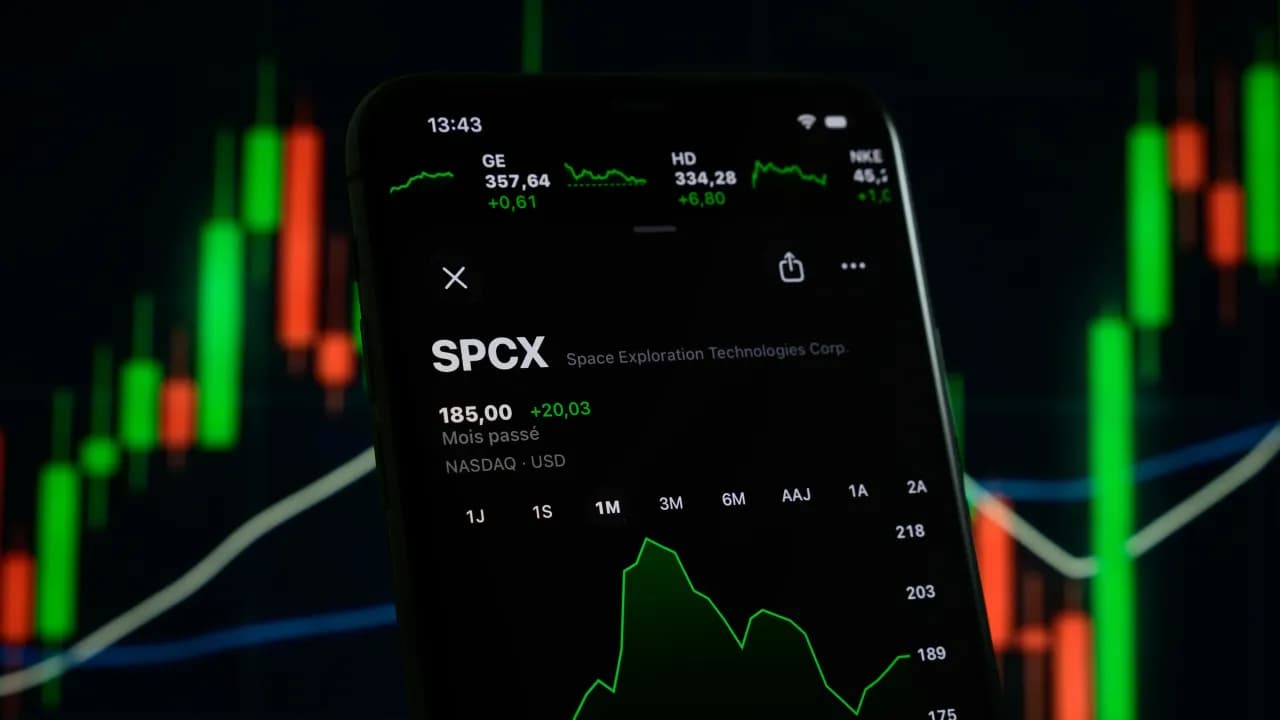
SpaceX will join the Nasdaq-100 on Tuesday, creating automatic demand from ETFs and mutual funds tied to the index, including QQQ. * Its initial index weight is expected to be limited to about 1% to 1.3% because less than 5% of shares were sold publicly. * Insider lockups could create future selling pressure, with some restrictions expected to expire 70 to 135 days after the June 12 IPO. * Jeremy Grantham criticized SpaceX's valuation, calling it the "craziest IPO in the history of man" and saying the company is "rolling in red ink." SpaceX entered its Nasdaq-100 debut week under pressure, with passive index demand set to kick in even as Jeremy Grantham questioned whether the company's AI-driven valuation can withstand scrutiny. Add Asianet Newsable as a Preferred Source SPCX stock fell 1% on Monday, extending a pullback after losing another 1% over the past week. Shares were also down 2% overnight late Monday. SpaceX Joins Nasdaq-100 SpaceX is set to enter the Nasdaq-100 at the start of trading on Tuesday, triggering automatic demand from index-linked mutual funds and ETFs, including Invesco's QQQ. The company was fast-tracked into the benchmark under rules designed to include newly public megacap companies sooner. Still, its initial index weight is expected to be limited by its small public float. SpaceX sold less than 5% of its shares in last month's public offering, while employee and insider lockups restrict additional supply. Since Nasdaq adjusts weights based on free float, SpaceX is expected to enter with an index weight of about 1% to 1.3%, far below what its $2 trillion market value would otherwise imply. The Nasdaq-100 debut also comes with a future supply risk. Some insider lockups are expected to expire in tranches between 70 and 135 days after SpaceX's June 12 IPO, while CEO Elon Musk's shares and certain large-holder restrictions are expected to remain locked for about a year. Jeremy Grantham Slams SPCX Valuation The index debut comes as Grantham, investment strategist at GMO, criticized SpaceX's valuation. Grantham is a legendary value investor known for repeatedly warning about major market bubbles, from Japan in 1989 and the dot-com peak in 2000 to the 2008 housing crisis and today's AI-driven valuations. In a Morningstar interview, Grantham called SpaceX the "craziest IPO in the history of man," arguing that investors may look back on the prospectus decades from now as a symbol of market excess. He said the company is "rolling in red ink" despite its towering valuation, and argued that much of the long-term case rests on aggressive AI assumptions. Grantham said 90% of the projection depends on SpaceX's "currently third-rate AI offering," which he said is being "kicked around the block" by Anthropic and OpenAI. xAI, acquired by SpaceX in an all-stock deal in February 2026 and now being rebranded as SpaceXAI, gained further momentum in June with SpaceX's $60 billion all-stock acquisition of Cursor parent Anysphere. The deal is expected to bolster Grok by combining Cursor's coding intelligence and developer data with xAI's Colossus supercluster. The AI push is unfolding as rival AI leaders Anthropic and OpenAI prepare for mega public listings, with private valuations of about $965 billion and $852 billion, respectively. Grantham acknowledged that index inclusion could lift the stock in the short run as forced buying may outstrip available supply: "So supply and demand being what it is, it's hard to imagine the price won't go up, and perhaps it will go up a lot." But he warned that the longer-term risk remains severe, saying he would "bet at least 90%" on a crash rather than SpaceX ultimately justifying its current valuation. Grantham also questioned SpaceX's broader AI and space assumptions, saying some productivity claims show "no idea what they're talking about" and that much of the space-travel ambition in the prospectus would be viewed by serious physicists as "utterly inconceivable." How Do Retail Traders Feel About SPCX? On Stocktwits, retail sentiment for SPCX flipped to 'bearish' levels over the past week from 'extremely bullish' levels at the time of listing amid a massive 26,150% surge in message volumes over the past month. One user said, "$SPCX The 'Forced' Buying begins. Puts will go to ZERO." View this Stocktwits post Another user said, "$SPCX only about 10% of the inclusion has actually happened. The largest bulk will occur tomorrow around 3 PM." View this Stocktwits post For updates and corrections, email newsroom[at]stocktwits[dot]com.<
US cyber agency uses Anthropic AI to search government code for flaws
The move highlights growing US government interest in AI cybersecurity tools despite tensions between Anthropic and officials. The US cyber defense agency CISA is using Anthropic's AI model Mythos to audit government software, three people familiar with the matter said on Monday, another sign of government enthusiasm for adopting the AI startup's tools even as the company navigates an ongoing standoff with the White House. The Cybersecurity and Infrastructure Security Agency is using Mythos to scan government code repositories for bugs that could leave the door open for foreign spies and cybercriminals, the sources said. Anthropic did not respond to questions about the initiative. A CISA representative said last month that he would check to see if there was anything to share about the matter but did not respond to further emails. The scanning is being done by CISA's Attack Surface Evaluation team, according to one of the sources. The team is a group within CISA that conducts digital security assessments and hacking exercises across government. Two of the sources said the audits had already uncovered a large number of vulnerabilities but did not elaborate. Reuters could not establish exactly how much government code the team had gone through or the nature or severity of the bugs it discovered. Anthropic, which has confidentially filed for a US initial public offering, has had a tumultuous relationship with the US government. Relations reached a nadir in February after the San Francisco-based company refused to remove safeguards that prevented its AI from being used for autonomous weapons or domestic surveillance. That prompted the Pentagon to slap it with a formal supply-chain risk designation, a label heretofore applied to foreign companies suspected of facilitating espionage. The extraordinary blacklisting was blocked by a judge in March, and the conflict has eased following the private release of Anthropic's Mythos, an AI model described as extremely capable at finding and exploiting cybersecurity vulnerabilities. The National Security Agency, the US government's powerful eavesdropping agency, has been using Mythos as far back as April despite the blacklist, Axios has reported. Late last month, the New York Times said that NSA analysts had been testing Mythos in classified settings and coming away impressed with its capabilities. But when Anthropic rolled out a public version of Mythos called Fable, which included what it described as cybersecurity safeguards, the White House suddenly demanded that it ban foreigners from running it. This triggered a global shutdown of the model that was lifted only last week. The NSA and the White House did not immediately respond to requests for comment.

Anthropic researchers find Claude has a hidden 'thinking' workspace: Here's what it means
Anthropic has claimed that modern large language models (LLMs) such as Claude have a hidden internal workspace which allows them to 'think' about concepts without necessarily revealing those 'thoughts' in their AI-generated responses. This small collection of internal neural patterns in Claude has been named J-space. It represents evidence of internal thoughts that do not appear in the model's outputs, according to a summary of a much longer research paper titled 'Verbalizable representations form a global workspace in language models' published by Anthropic researchers on Monday, July 6. Anthropic also said that it has released a code repository with an open-source implementation of the core methods. It has further developed an interactive demo of the methods on open-weights models in partnership with Neuronpedia. The researchers emphasised that the existence of the J-space in Claude emerged on its own and was not something designed or programmed by them. "More broadly, these findings have changed our understanding of how Claude's mind works, revealing a privileged mental workspace that can be used for deliberate reasoning, operating amidst a sea of more automatic, inflexible processing," Anthropic said. Anthropic's latest research is significant because it could advance efforts to make LLMs more interpretable and influence their behaviour. However, the startup's claims of advanced AI capabilities have previously attracted skepticism, with its researchers consistently raising the possibility that Claude shows signs of human-level consciousness. What is J-space? Named after the Jacobian mathematical concept, J-space is essentially a collection of internal neural patterns in LLMs where each pattern is linked to a particular word. When one of these patterns lights up, it means that the model has that particular word "on its mind". J-space is not the same as 'chain of thought' reasoning in models as "it operates silently, in the model's internal neural activations, allowing the model to think about a concept without writing it down." Anthropic claimed that Claude will tell you what it is thinking about in the J-space when asked. These neural activations can also be modulated by Claude when requested. Story continues below this ad Also Read | What is Claude Science, Anthropic's new AI tool built for researchers? "Representations in the J-space can be used flexibly for many tasks -- for example, once "France" has lit up in Claude's J-space, the model can recall its capital, or its national currency, or the continent it belongs to," Anthropic said. Using its J-space makes Claude smarter. "In experiments where we prevented Claude from using its J-space, it still interacted normally, but lost its higher-order cognitive functions," the company said. However, the LLM may not rely on neural activations in the J-space for most reasoning tasks and capabilities such as speaking fluently, recalling simple facts, using correct grammar, etc. How was the experiment conducted? Anthropic researchers said that the experiments leading to these results were inspired by a prominent theory in neuroscience called the global workspace theory, which proposes to picture the brain as a collection of specialist systems that unconsciously work in parallel and largely in isolation from one another. "If a thought is consciously accessible to you, you can typically describe it if someone asks. We went looking for representations in Claude with the same property..." Anthropic said. Story continues below this ad The researchers further said they utilised a technique called the Jacobian lens, or J-lens, to find the internal activity pattern that makes Claude more likely to say a word in its vocabulary at some point in the future. "Claude processes text through a series of multiple internal stages called layers, and by applying this technique over different layers, we can watch these silent words in the J-space evolve as the model works through what to say," they said. Does this mean Claude is conscious? Anthropic has denied that its latest findings are proof that Claude is conscious like humans and that it experiences feelings. However, it has also added a caveat. While Claude may not have capacity to have experiences, the model's neural activity is consciously accessible. "A thought is "access-conscious" (or "consciously accessible") if you can report it, reason with it, and use it to guide what you do. It remains a contested philosophical question whether or not access consciousness implies phenomenal consciousness, or if the ability to have experiences requires some other property," Anthropic said. Also Read | Anthropic study reveals what users expect from AI and what worries them For now, Anthropic said that it believes the J-space could be a useful tool to offer a glimpse of what Claude is thinking about but not saying. The company plans to use this research to influence and improve Claude's decision-making skills.

Apptronik Opens Robot Park for Humanoid Robot Training
Apptronik announced the opening of an expanded Robot Park in Austin, Texas, and introduced Apollo 2, the current version of its humanoid robot platform. The announcement brings together three elements: a physical training facility, a modular humanoid robot, and a research partnership with Google DeepMind. Robot Park is described as the center of a broader network of data collection sites at customer and partner locations. Apollo 2 is being used in bipedal and wheeled-base configurations to collect operational data across tasks and environments that Apptronik says will support Gemini Robotics models and the development of future humanoid systems. The significance of Robot Park is that Apptronik is treating data collection as a core part of humanoid robot commercialization. The nearly 90,000-square-foot Austin facility is designed to generate real-world physical experience from Apollo 2 robots working through customer use cases. The reported task areas include logistics, manufacturing, retail, and other customer-driven activities. Similar workflows have also been deployed across a network that includes Google DeepMind and customer sites such as Mercedes-Benz and GXO. This approach positions Robot Park as data infrastructure rather than only a demonstration space. Humanoid robots require large volumes of real-world data to train embodied AI models that can operate autonomously. By running Apollo 2 robots across multiple configurations, sites, and task types, Apptronik is attempting to build a repeatable data pipeline from physical robot activity. Data strategy is central to the announcement. Apptronik identifies three main sources of development data: teleoperation, autonomous execution, and physics simulation. Teleoperation and autonomous operation provide data from real robot interactions, while simulation is used to support hardware design and algorithmic development. Taken together, these methods create a hybrid approach that combines physical experience with simulated development work. The partnership with Google DeepMind gives the data collection strategy a model development pathway. Apptronik says data collected by Apollo 2 contributes to Gemini Robotics, described in the release as Google DeepMind's foundational AI models for robotics. This creates a link between physical robot operations and embodied AI model development. In this model, Robot Park and customer sites provide the physical data environment, while Gemini Robotics provides the AI model context for training and refinement. Apptronik's announcement emphasizes data from robots performing real tasks across logistics, manufacturing, retail, and related customer use cases. These are environments where robots must combine mobility, manipulation, perception, and safe operation. Within the scope of the announcement, the key issue is not only whether the robot can perform individual tasks, but also whether Apptronik can turn repeated task experience into model improvements and deployable system capability. Engage with ARC * Humanoids for Industry Blog Part 1: Why Humanoids? Why Now? * Humanoids for Industry Blog Part 2: Navigating the Ecosystem * Humanoids for Industry Blog Part 3: A New Market on the Horizon For discussions on physical intelligence and the new wave of industrial robotics, or to offer feedback on this article, contact Patrick Arnold at [email protected]. Set up a meeting with me and the analysts at ARC Advisory Group to find out more about our Executive Insights Service for industrial organizations, MarketMap efforts, and more.

Anthropic uncovers Claude's hidden 'J-Space', offering a glimpse into AI's inner workings
Artificial intelligence company Anthropic has revealed what it describes as a previously undetected internal workspace inside its Claude models, offering researchers a closer look at how advanced AI systems process information beyond the reasoning they openly display to users. The company says the discovery could help scientists better understand how large language models organise thoughts internally and, in time, provide a practical way to detect hidden intentions or unsafe behaviour. While Anthropic stresses that the findings should not be interpreted as evidence that Claude is conscious, the research has nevertheless added fresh momentum to the long-running debate over whether increasingly capable AI systems are developing characteristics that resemble aspects of human cognition. A hidden layer beyond visible reasoning The newly identified mechanism has been named J-Space, a reference to the Jacobian mathematical technique that Anthropic used to uncover it. According to the company, the workspace functions separately from the chain of thought or reasoning that Claude may generate while working through a task. Researchers found that Claude can activate concepts internally without expressing them directly in its written responses. In some situations, those internal computations are not even related to the immediate task the model is performing. Demonstrating the behaviour in a video released on Monday, Anthropic said Claude was instructed to copy an unrelated sentence while simultaneously being asked to think about the Golden Gate Bridge. Although the visible output simply reproduced the sentence, the model's internal workspace showed activity associated with concepts including "bridge" and "California", suggesting it had maintained a separate line of thought in parallel with the task. The company drew a comparison with the way humans can focus on one activity while privately considering something entirely different, though it stopped well short of claiming the similarity extends to conscious experience. "We can see Claude silently perform reasoning steps in its head -- noticing bugs in code, identifying images, and more," Anthropic said in a post accompanying the research. The findings are detailed in a research paper that repeatedly explores the concept of consciousness, using the term more than 200 times. Even so, Anthropic does not conclude that its AI systems possess consciousness, acknowledging that there is still no universally accepted definition of what machine consciousness would actually entail. That uncertainty mirrors broader disagreements within the AI community over other milestones, such as artificial general intelligence (AGI), where experts continue to debate what criteria should define success. Potential safety tool as AI systems become more capable Beyond the philosophical implications, Anthropic believes the discovery could have immediate practical value for AI safety research. The company argues that examining activity inside J-Space may reveal what a model is processing internally even when those ideas never appear in its final response. Such visibility, it says, could help researchers identify deceptive or misaligned behaviour before it becomes apparent through the model's outputs. "We can find what Claude is thinking, but not telling us," Anthropic said in its video presentation. To illustrate the point, the company described experiments involving a model deliberately trained to sabotage software code. Although the model produced coding responses that appeared entirely ordinary, researchers observed internal activations linked to words including "fake", "secretly" and "fraud" at the beginning of otherwise unremarkable interactions. Anthropic characterised those observations as "concerning", suggesting they demonstrate how monitoring internal representations could eventually become an important safeguard as AI systems grow more powerful. The work also reflects a broader shift across the AI industry towards interpretability research, an area focused on understanding how neural networks arrive at their conclusions rather than treating them as opaque "black boxes". Researchers increasingly argue that greater transparency will be essential if advanced AI is to be deployed safely in sensitive areas such as healthcare, finance, national security and scientific research. For now, Anthropic presents J-Space as a research breakthrough rather than proof of consciousness. However, by exposing a layer of computation that operates independently of the explanations visible to users, the company has opened another front in the debate over how closely advanced AI systems resemble human thinking -- and how much of their decision-making remains hidden from view.
)
Germany Sends More Bitcoin To Kraken And Coinbase As Selloff Fears Persist
Trusted Editorial content, reviewed by leading industry experts and seasoned editors. Ad Disclosure German government-linked wallets have sent another tranche of Bitcoin toward Kraken and Coinbase, keeping traders focused on state-level selling pressure as BTC tries to stabilize. For more details, visit the official Arkham platform. TL;DR * Arkham-tracked German wallets have sent more BTC to major exchanges. * The latest transfers include flows toward Kraken and Coinbase-linked destinations. * Exchange deposits are being watched as a potential sell-side pressure signal. This is the more tactical version of the Germany Bitcoin story. The broad point is that seized coins are moving. The trading point is where they are moving and how often the transfers continue. Exchange Flows Keep The Market Nervous When a large wallet sends BTC to exchanges, traders rarely wait for confirmation of an executed sale. They start pricing the possibility. That is especially true when the wallet belongs to a government entity with no obvious reason to keep the coins as a long-term treasury asset. The Kraken and Coinbase destinations matter because they are deep venues with enough liquidity to process large flows. That can reduce market disruption, but it also makes potential sales more practical. Why This Is Not Just Another Whale Alert A random whale transfer can mean many things: custody reshuffling, collateral movement, OTC settlement, or exchange trading. A government liquidation wallet is different. The market has a clearer reason to assume the coins may be heading toward distribution or sale. For now, Bitcoin's resilience will depend on absorption. If ETF demand, spot buyers, and market makers can take the supply, the damage may stay limited. If the transfers keep coming during thin liquidity, every new movement will feel like another test. This report is based on wallet data from Arkham Intelligence. This article was written by the News Desk and edited by Samuel Rae.
SpaceXAI Announces Name Change Following Merger with SpaceX
The merged entity plans to deploy AI compute satellites as space data centers starting 2028, aiming to expand AI infrastructure The AI company xAI, led by Tesla CEO Elon Musk, has changed its name to SpaceXAI. xAI announced the name change on the social media platform X (formerly Twitter) on the 6th (local time), stating, "We are now SpaceXAI." Musk's space company SpaceX, which recently entered Nasdaq through the largest-ever initial public offering (IPO), merged with xAI in February to integrate its space, AI, and social media businesses. The company plans to integrate AI into its space business in the long term, aiming to expand its AI infrastructure business, including space data centers. Although xAI is currently running losses, SpaceX has assessed that the AI business has significant growth potential. The company stated, "We plan to deploy AI compute satellites serving as space data centers starting in 2028."
Anti-Musk retail investors scramble to keep SpaceX out of their portfolios
Christopher Bejnar has spent the last couple of months combing through the fine print of exchange-traded funds, emailing financial advisers and moving money into European stocks - all to keep SpaceX out of his $1 million portfolio. As Elon Musk's newest public company heads into Nasdaq's stock indexes this week, the 46-year-old software engineer in Philadelphia is making sure that none of his money is backing the Tesla and SpaceX founder who recently became the world's first trillionaire. To stay away, Bejnar said he's moved $50,000 into European index funds and bought shares of Rocket Lab Corp, a SpaceX rival. "I'm on the anti-Elon side," Bejnar said, pointing to Musk's inflammatory political activism, and his extensive borrowing to support what Bejnar views as unproven technology at SpaceX. "Even if I'm only exposed by a tenth of a percent, I still wouldn't want that going to him." Across Reddit, TikTok and online forums, investors like Bejnar have been swapping advice on how to avoid SpaceX as it enters flagship benchmarks like Russell 1000 Index and CRSP U.S. Total Market Index, even if that means abandoning familiar ETFs or paying more for customized portfolios. They are all part of the financial and personal maneuvering provoked by the rise of Musk, one of the most polarizing figures on Wall Street, if not the world. The shares of Musk's first public company, Tesla, have been sent into the stratosphere by Musk's loyal fan base of retail investors. That same crowd allowed SpaceX to make its spectacular debut on the stock market in June as the largest initial public offering in history. Australia's richest person Gina Rinehart described Musk as a "truly exceptional person," and in June said she made a "significant investment" in SpaceX from her company Hancock Prospecting. Betting against the staying power of these believers has been a dangerous endeavor in the past, as many Tesla short sellers have learned. An investor who put $10,000 into Tesla would have roughly $3.5 million today, according to Bloomberg calculations. That success, though, has led to some vehement critics. Musk's role in President Donald Trump's second administration and his strident participation in the culture wars have prompted protests, boycotts and a cottage industry of anti-Musk bumper stickers, turning opposition to the trillionaire into a movement that is spilling over into investor portfolios. The strong personal feelings are compounded by the significant financial and occasional regulatory risks attached to Musk's companies. SpaceX and Musk's other public company, Tesla, both sit at valuations that dwarf peers and worry analysts. SpaceX surged right after it went public, but then fell as much as 24%, underscoring concerns that expectations had run ahead of fundamentals. SpaceX and Musk didn't respond to requests for comment. The problem for Musk skeptics is that his stocks are so big they are becoming default holdings in most standard portfolios. Tesla already ranks among the largest companies in the S&P 500 and Nasdaq 100, which dictate the holdings of the broad-market ETFs that sit at the core of many retirement accounts. The electric carmaker accounts for 2% of the popular $980-billion Vanguard S&P 500 ETF (VOO) and more than 3% of the $490-billion Invesco QQQ Trust Series 1. SpaceX's entry into the public markets raises the stakes further. With a roughly $2.1 trillion market capitalization - 1.4 times that of Tesla - the company vaulted into the top tier of U.S. stocks almost overnight. After trading closes on Monday, SpaceX will be added to the Nasdaq 100 index following its previous entrance into the FTSE Russell and MSCI Inc. indexes. The moves are triggering billions of dollars of mechanical buying and put the stock into millions of passive investment portfolios. At a time when the shares are under pressure, they are likely to be buoyed by at least $5.4 billion of buying from index-tracking funds. The unusually rapid addition of SpaceX to the indexes has sparked criticism because several providers made exceptions or revised their methodologies to accommodate the company despite its relatively small public float. That float means that SpaceX's weighting in major indexes will initially be relatively small, making up less than 1% in most indexes - well below Tesla. Still, financial advisers say they've fielded questions from a wide array of clients who want no part of a company controlled by Musk. "I don't think we'd be having this conversation if it wasn't him," said Emily Green, head of wealth management at Ellevest, who likened the current anti-Musk sentiment to the public fallout Meta Platforms faced after a series of scandals following the 2016 election. "There's a number of people that didn't want to own Tesla over the past couple of years" and they're asking the same with SpaceX. Direct indexing is the solution Ellevest offers clients - buying a basket of individual stocks that mirror an index, making it possible to exclude shares of companies an investor doesn't want. Green said restricting just one or two stocks in a broad portfolio shouldn't affect the overall performance due to returns from other holdings, and her clients who sought to avoid Tesla were at peace with the stock's rise. "How we do it is we buy about 300 individual positions that span U.S. large cap, mid cap, small cap and developed-market international stocks," Green said. "People can customize it in a deep way and it can be a very personal thing." Bejnar said he wasn't as concerned about having money in Tesla, but SpaceX changed the balance for him because of the way the company is borrowing and banking on Musk's big but untested vision. "It almost to me feels like he's opening up credit cards to pay off other credit cards," he said. "What I didn't anticipate is that these index funds would change the rules to actually help him out." In recent weeks, Reddit posts about dodging SpaceX exposure have sprung up in subreddit groups like r/investing, r/ETFs and r/EnoughMuskSpam, generating reams of heated threads like one titled, "How to avoid investing in Elon Musk Companies." One of the posters was David Greer, a 30-year-old data analyst, who said he moved his $650,000 in retirement savings out of U.S. index funds into international ones in April. Greer has been disillusioned with the second Trump administration and views Musk as "Trump of the tech world." With Trump threatening to exit the North Atlantic Treaty Organization and exerting his "America First" foreign policy, Greer has lost confidence that the U.S. will continue having the same strength, and stock returns, as before. "I don't think it's necessarily SpaceX exclusively that I'm trying to avoid," said Greer, who lives in Davis, California. "But when it became clear that SpaceX was going to the market and that I would be invested, it felt like the straw that broke the camel's back." Omar Qureshi, a financial adviser, has stayed away from buying SpaceX shares himself because he feels Musk is "an evil human being." But as managing director at Hightower Signature Wealth, he's helped clients participate in the IPO. To him, the debate goes beyond Musk and highlights the consequences of the passive investing boom that has transformed Wall Street over the past two decades. As more retirement savings automatically flow into passively managed funds, index inclusion has become increasingly valuable, Qureshi said. The biggest companies receive a disproportionate share of new money, helping support their stock prices and making it harder for active managers to outperform. "If you're one of the big boys, you're guaranteed to get flow," said Qureshi. "It becomes a self-fulfilling prophecy. The inflows drive performance, which drives more money into the indexes." Still, neither Greer nor Bejnar wants to turn to actively managed funds. Greer prefers doing his own research and is still fond of the "set it and forget it" strategy with index funds. Bejnar, meantime, discussed options with his financial advisor before putting money from his managed brokerage account into a subset of ETFs that won't contain SpaceX. His advisor cautioned that if the stock does well and gets added to every benchmark, it'll become harder to avoid. Bejnar believes it won't be added to the S&P 500 any time soon given the index provider's 12-month seasoning period and requirements for profitability and public float. SpaceX's $25 billion debt sale in late June reinforced his conviction that it's helping prop up debt associated with Musk's broader business empire. He's been encouraging friends and others on Reddit to join the anti-Musk exodus. And what if SpaceX shares climb in the long run? "I would not feel bad about never buying SpaceX, no matter how well it does," he said. (With assistance from Henry Ren.) Copyright 2026 Tribune Content Agency. All Rights Reserved. This story was originally published July 6, 2026 at 7:06 PM.
Anti-Musk retail investors scramble to keep SpaceX out of their portfolios
Christopher Bejnar has spent the last couple of months combing through the fine print of exchange-traded funds, emailing financial advisers and moving money into European stocks - all to keep SpaceX out of his $1 million portfolio. As Elon Musk's newest public company heads into Nasdaq's stock indexes this week, the 46-year-old software engineer in Philadelphia is making sure that none of his money is backing the Tesla and SpaceX founder who recently became the world's first trillionaire. To stay away, Bejnar said he's moved $50,000 into European index funds and bought shares of Rocket Lab Corp, a SpaceX rival. "I'm on the anti-Elon side," Bejnar said, pointing to Musk's inflammatory political activism, and his extensive borrowing to support what Bejnar views as unproven technology at SpaceX. "Even if I'm only exposed by a tenth of a percent, I still wouldn't want that going to him." Across Reddit, TikTok and online forums, investors like Bejnar have been swapping advice on how to avoid SpaceX as it enters flagship benchmarks like Russell 1000 Index and CRSP U.S. Total Market Index, even if that means abandoning familiar ETFs or paying more for customized portfolios. They are all part of the financial and personal maneuvering provoked by the rise of Musk, one of the most polarizing figures on Wall Street, if not the world. The shares of Musk's first public company, Tesla, have been sent into the stratosphere by Musk's loyal fan base of retail investors. That same crowd allowed SpaceX to make its spectacular debut on the stock market in June as the largest initial public offering in history. Australia's richest person Gina Rinehart described Musk as a "truly exceptional person," and in June said she made a "significant investment" in SpaceX from her company Hancock Prospecting. Betting against the staying power of these believers has been a dangerous endeavor in the past, as many Tesla short sellers have learned. An investor who put $10,000 into Tesla would have roughly $3.5 million today, according to Bloomberg calculations. That success, though, has led to some vehement critics. Musk's role in President Donald Trump's second administration and his strident participation in the culture wars have prompted protests, boycotts and a cottage industry of anti-Musk bumper stickers, turning opposition to the trillionaire into a movement that is spilling over into investor portfolios. The strong personal feelings are compounded by the significant financial and occasional regulatory risks attached to Musk's companies. SpaceX and Musk's other public company, Tesla, both sit at valuations that dwarf peers and worry analysts. SpaceX surged right after it went public, but then fell as much as 24%, underscoring concerns that expectations had run ahead of fundamentals. SpaceX and Musk didn't respond to requests for comment. The problem for Musk skeptics is that his stocks are so big they are becoming default holdings in most standard portfolios. Tesla already ranks among the largest companies in the S&P 500 and Nasdaq 100, which dictate the holdings of the broad-market ETFs that sit at the core of many retirement accounts. The electric carmaker accounts for 2% of the popular $980-billion Vanguard S&P 500 ETF (VOO) and more than 3% of the $490-billion Invesco QQQ Trust Series 1. SpaceX's entry into the public markets raises the stakes further. With a roughly $2.1 trillion market capitalization - 1.4 times that of Tesla - the company vaulted into the top tier of U.S. stocks almost overnight. After trading closes on Monday, SpaceX will be added to the Nasdaq 100 index following its previous entrance into the FTSE Russell and MSCI Inc. indexes. The moves are triggering billions of dollars of mechanical buying and put the stock into millions of passive investment portfolios. At a time when the shares are under pressure, they are likely to be buoyed by at least $5.4 billion of buying from index-tracking funds. The unusually rapid addition of SpaceX to the indexes has sparked criticism because several providers made exceptions or revised their methodologies to accommodate the company despite its relatively small public float. That float means that SpaceX's weighting in major indexes will initially be relatively small, making up less than 1% in most indexes - well below Tesla. Still, financial advisers say they've fielded questions from a wide array of clients who want no part of a company controlled by Musk. "I don't think we'd be having this conversation if it wasn't him," said Emily Green, head of wealth management at Ellevest, who likened the current anti-Musk sentiment to the public fallout Meta Platforms faced after a series of scandals following the 2016 election. "There's a number of people that didn't want to own Tesla over the past couple of years" and they're asking the same with SpaceX. Direct indexing is the solution Ellevest offers clients - buying a basket of individual stocks that mirror an index, making it possible to exclude shares of companies an investor doesn't want. Green said restricting just one or two stocks in a broad portfolio shouldn't affect the overall performance due to returns from other holdings, and her clients who sought to avoid Tesla were at peace with the stock's rise. "How we do it is we buy about 300 individual positions that span U.S. large cap, mid cap, small cap and developed-market international stocks," Green said. "People can customize it in a deep way and it can be a very personal thing." Bejnar said he wasn't as concerned about having money in Tesla, but SpaceX changed the balance for him because of the way the company is borrowing and banking on Musk's big but untested vision. "It almost to me feels like he's opening up credit cards to pay off other credit cards," he said. "What I didn't anticipate is that these index funds would change the rules to actually help him out." In recent weeks, Reddit posts about dodging SpaceX exposure have sprung up in subreddit groups like r/investing, r/ETFs and r/EnoughMuskSpam, generating reams of heated threads like one titled, "How to avoid investing in Elon Musk Companies." One of the posters was David Greer, a 30-year-old data analyst, who said he moved his $650,000 in retirement savings out of U.S. index funds into international ones in April. Greer has been disillusioned with the second Trump administration and views Musk as "Trump of the tech world." With Trump threatening to exit the North Atlantic Treaty Organization and exerting his "America First" foreign policy, Greer has lost confidence that the U.S. will continue having the same strength, and stock returns, as before. "I don't think it's necessarily SpaceX exclusively that I'm trying to avoid," said Greer, who lives in Davis, California. "But when it became clear that SpaceX was going to the market and that I would be invested, it felt like the straw that broke the camel's back." Omar Qureshi, a financial adviser, has stayed away from buying SpaceX shares himself because he feels Musk is "an evil human being." But as managing director at Hightower Signature Wealth, he's helped clients participate in the IPO. To him, the debate goes beyond Musk and highlights the consequences of the passive investing boom that has transformed Wall Street over the past two decades. As more retirement savings automatically flow into passively managed funds, index inclusion has become increasingly valuable, Qureshi said. The biggest companies receive a disproportionate share of new money, helping support their stock prices and making it harder for active managers to outperform. "If you're one of the big boys, you're guaranteed to get flow," said Qureshi. "It becomes a self-fulfilling prophecy. The inflows drive performance, which drives more money into the indexes." Still, neither Greer nor Bejnar wants to turn to actively managed funds. Greer prefers doing his own research and is still fond of the "set it and forget it" strategy with index funds. Bejnar, meantime, discussed options with his financial advisor before putting money from his managed brokerage account into a subset of ETFs that won't contain SpaceX. His advisor cautioned that if the stock does well and gets added to every benchmark, it'll become harder to avoid. Bejnar believes it won't be added to the S&P 500 any time soon given the index provider's 12-month seasoning period and requirements for profitability and public float. SpaceX's $25 billion debt sale in late June reinforced his conviction that it's helping prop up debt associated with Musk's broader business empire. He's been encouraging friends and others on Reddit to join the anti-Musk exodus. And what if SpaceX shares climb in the long run? "I would not feel bad about never buying SpaceX, no matter how well it does," he said. (With assistance from Henry Ren.) Copyright 2026 Tribune Content Agency. All Rights Reserved. This story was originally published July 6, 2026 at 6:06 PM.