News & Updates
The latest news and updates from companies in the WLTH portfolio.
PMI Launches Manifesto for Enterprise Agility in Support of Business Transformation in MENA - Middle East Business News and Information - mid-east.info
New set of principles equips organizations in the MENA region to navigate disruptions, accelerate decision-making, and drive sustainable growth. Dubai, United Arab Emirates, April 2026 - The Project Management Institute (PMI) has unveiled its groundbreaking Manifesto for Enterprise Agility, an empowering set of principles designed to help organizations remain resilient, innovative, and better equipped to navigate frequent global disruptions. Developed by the PMI Agile Alliance, the Manifesto calls for a shift in leadership mindset, moving away from rigid hierarchical structures toward shared purpose, decentralized decision-making, and enterprise-wide adaptability. For businesses and leaders in the Middle East and North Africa (MENA) region, where economic diversification, sustainability, and digital transformation initiatives dominate national agendas, the Manifesto provides timely insights to anchor strategies that drive resilience, success, and growth in increasingly complex environments. Why Enterprise Agility Matters in MENA Frequent disruptions caused by global economic shifts, technological advancements, and changing sector demands have created an urgent need for organizational agility. The Manifesto encourages leaders to reframe business transformation by emphasizing collaborative decision-making, adaptive governance mechanisms, and the strategic use of technology to build organizations capable of responding to change quickly. In MENA, this aligns strongly with regional priorities: By promoting agility across regions, ecosystems, and sectors, the Manifesto gives MENA organizations the tools needed to thrive in a globally competitive landscape. Key Principles of the Manifesto for Enterprise Agility PMI's Manifesto outlines nine actionable principles, encouraging organizations to: These principles are particularly relevant to MENA organizations combatting legacy systems, rigid governance models, and change fatigue, which often slow down transformation efforts. Speaking on the launch of the Manifesto, Hanny Alshazly, Managing Director for the Middle East and North Africa (MENA) at PMI, said: "The MENA region is witnessing unprecedented transformation, from economic diversification to the rapid adoption of technology and sustainability-focused initiatives. Enterprise agility is not just a buzzword; it's a leadership imperative. PMI's Manifesto for Enterprise Agility delivers innovative solutions to help leaders confidently navigate uncertainty, foster collaboration, and unlock the full potential of their organizations. By embracing agility, MENA businesses can align strategic intent with sustainable growth, reinforcing their role as a competitive force in the global economy." Navigating Enterprise Agility in MENA: The Manifesto defines enterprise agility as the ability to adapt at scale without losing strategic coherence. It highlights that agility is not simply a toolset but a mindset necessary for continuous reinvention, promoting resilience through purpose-driven decision-making. PMI research indicates that high levels of enterprise agility are associated with greater visibility, enhanced value delivery, and more empowered teams, helping organizations remain resilient and adaptable over time. Through the Manifesto, PMI offers practical approaches for leaders, such as redefining organizational structures, investing in adaptive operating models, and empowering teams with integrated capabilities. By prioritizing agility, organizations in banking, retail, infrastructure, technology, and fintech across the MENA region can address market complexities and respond to challenges with flexibility and foresight. PMI's Manifesto for Enterprise Agility is now available at https://www.pmi.org/learning/agile/manifesto-for-enterprise-agility to help leaders evaluate their organizational readiness for change and take strategic action toward sustainable growth. Visit PMI.org to also access PMI's certifications, training resources, and programs designed to foster enterprise agility across industries. About Project Management Institute (PMI) PMI is the leading authority in project success. Since 1969, PMI has shone a light on the people and advanced practices behind successful projects. Supported by a global community of millions of project professionals and by thousands of corporations, government agencies and academic institutions, PMI provides the knowledge, resources and certifications to lead projects and transformations effectively and responsibly. Join PMI in elevating our world -- one project at a time. Connect with us at www.pmi.org, linkedin.com/company/projectmanagementinstitute, on Instagram @pmi_org, and on TikTok @PMInstitute. PMI Trademarks: Project Management Institute and PMI are trademarks and/or registered marks of Project Management Institute, Inc., in the US and/or in other countries. Third Party Trademarks: All other trademarks are the property of their respective owners.

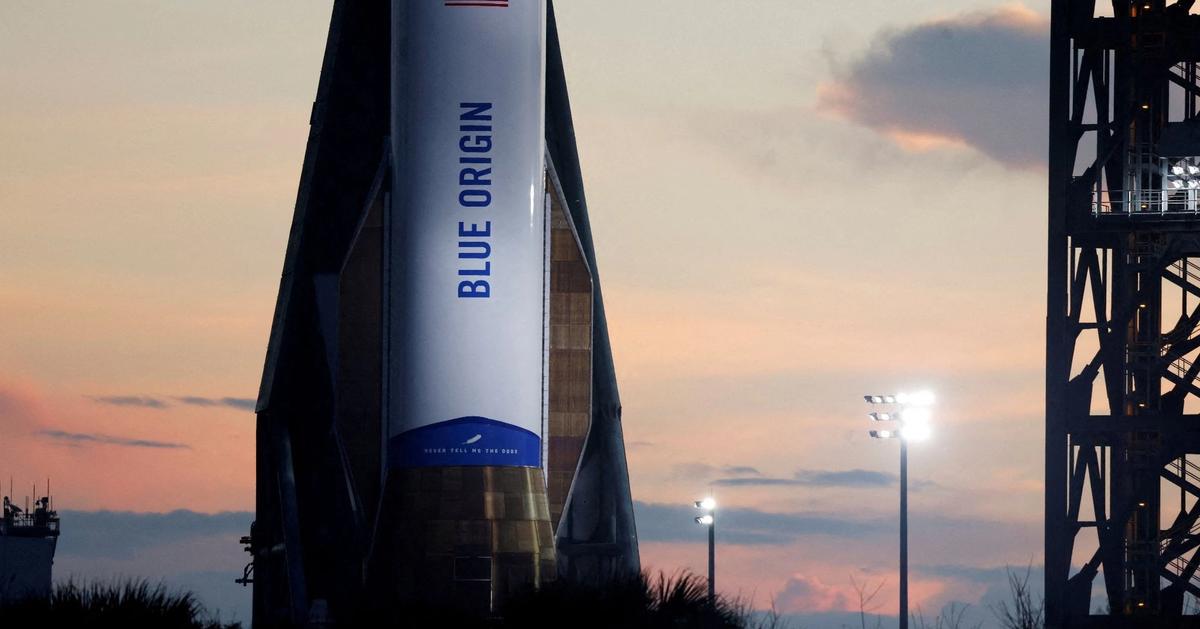
Blue Origin reusable rocket - rivalling SpaceX - called off before launch
Blue Origin, the space company owned by the billionaire Amazon founder Jeff Bezos, has postponed the launch of a new reusable rocket because of a technical issue. The rocket, named New Glenn, had been due to blast off from Florida and had already been delayed several times. Posting on social media, Blue Origin said: "We're standing down on today's launch attempt to troubleshoot a vehicle subsystem issue that will take us beyond our launch window." The rocket is now being drained of fuel before another launch is scheduled. "We're reviewing opportunities for our next launch attempt," the company said.

Nigerian equities rally masks fragile economy amid global chaos
NIGERIA'S surging stock market may be projecting resilience, but beneath the record-breaking rally lies an economy still exposed to inflation shocks, fiscal strain and global geopolitical turbulence, according to Johnson Chukwu, Group Managing Director of Cowry Asset Management Limited. Presenting at the firm's Quarterly Economic Discourse for Q1 2026, Chukwu described the economy as "resilient but vulnerable," warning that strong financial market performance continues to diverge sharply from the realities facing households. At the heart of that paradox is the Nigerian equities market, now one of the best-performing asset classes globally. The NGX All-Share Index surged 29.35 per cent in the first quarter of 2026, building on a 51.19 per cent gain recorded in 2025. Market capitalisation climbed to N129.21 trillion, translating to nearly N30 trillion in investor gains within three months. Chukwu said the rally is largely liquidity-driven, rather than anchored on broad economic strength. "This is a liquidity-driven market," he noted, pointing to declining real yields in fixed income instruments that have pushed investors toward equities in search of higher returns. With inflation still elevated at 15.38 percent in the month of March having reversed its 11 months consecutive decline from 15.06 percent in February, driven largely by FX pass-through, energy costs, and persistent food supply constraints; equities have increasingly served as a hedge against value erosion. Regulatory changes, particularly increased pension fund exposure to stocks, have further boosted demand, alongside strong corporate earnings and attractive dividend yields. Sectoral performance reflects a market lifted by select themes, rather than broad-based growth. Oil and gas stocks surged 64.22 percent, buoyed by rising crude prices amid Middle East tensions. Industrial goods followed with a 54.60 percent gain, supported by resilient construction demand and pricing power. Banking stocks rose 22.75 percent on higher interest income and foreign exchange revaluation gains, while consumer goods lagged at 9.67 percent due to weak purchasing power. Insurance stocks recorded the weakest gains, underscoring uneven investor appetite. Chukwu cautioned that the rally is unfolding against a volatile global backdrop defined by geopolitical conflict and slowing growth. Disruptions in the Strait of Hormuz have heightened uncertainty, pushing oil prices higher and amplifying global inflation risks. While this offers revenue upside for oil-exporting Nigeria, it also threatens capital inflows and financial stability. "The markets are holding up, for now, but may be underpricing the risk of a deeper macroeconomic disruption," he warned. Nigeria's economy grew by 3.87 percent in 2025, supported by improved oil output and non-oil sector expansion. Yet, Chukwu stressed that macroeconomic gains have not translated into improved living conditions. "This highlights the disconnect between macro stability and household reality," he said. The Central Bank of Nigeria has begun cautiously easing policy, cutting its benchmark rate to 26.5 percent, while maintaining tight liquidity controls. At the same time, the naira has stabilised and foreign reserves have strengthened, supported by improved portfolio inflows and foreign exchange reforms. However, fiscal risks remain significant. The N68.32 trillion 2026 budget is built on optimistic assumptions, while rising debt servicing costs continue to limit fiscal flexibility. Despite bullish momentum, Chukwu warned that the equities market remains vulnerable to shocks. Rising interest rates, persistent inflation and global risk aversion could trigger capital outflows and corrections, particularly in emerging markets. "War shocks transmit through oil to inflation, then to interest rates and ultimately to equities," he said. Giving an outlook, Chukwu maintained that equities could remain attractive in the near term, supported by liquidity and inflation-hedge demand. But sustaining the rally, he said, will depend on macroeconomic stability, policy consistency and the ability to navigate an increasingly uncertain global environment. "In chaotic markets, clarity is alpha," he stated. For now, Nigeria's stock market may be booming, but the broader economy is still walking a tightrope. Copyright © 2026 Nigerian Tribune Provided by SyndiGate Media Inc. (Syndigate.info).

Who's Running Iran? Confusion and Chaos in the Middle East
James is our wordsmith extraordinaire, a legislation hound and lover of all things self-reliant and free. An author of politics and what often sounds like fiction at LibertyNation.com he homesteads in the Arkansas wilderness. The US military seized an Iranian cargo ship on Sunday after it tried to defy President Donald Trump's naval blockade. The development comes after government officials from Iran said Friday that the Strait of Hormuz was open - but the military said on Saturday it was closed. What's going on over there, and who's calling the shots? Confusion and chaos seem the order of the day in the Middle East, but Trump isn't waiting for them to figure it out. Dire Straits As Liberty Nation News National Security Correspondent and former Deputy Undersecretary of Defense, Comptroller, Dave Patterson wrote last week, "when the talks between the US and Iran failed, the Trump administration took direct action." The US Navy set up a blockade of the Strait of Hormuz and all Iranian ports. This quickly produced the desired results - or so we thought. On April 14, Israel and Lebanon agreed to a ten-day ceasefire, and on Friday, April 17, Iran Foreign Minister Seyed Abbas Araghchi announced the strait was open to all vessels. President Trump was pleased, posting on Truth Social in all caps: "IRAN HAS JUST ANNOUNCED THAT THE STRAIT OF IRAN IS FULLY OPEN AND READY FOR FULL PASSAGE. THANK YOU!" The market was thrilled, as well. Oil prices dropped 11%. And on Saturday morning, the Islamic Revolutionary Guard Corps (IRGC), Iran's military, announced that the strait was closed until the US lifts its blockade - and even went so far as to fire on a tanker in the area. Meanwhile, at least one Iranian ship attempted to run the blockade in the Gulf of Oman. President Trump posted on Truth Social: "Today, an Iranian-flagged cargo ship named TOUSKA, nearly 900 feet long and weighing almost as much as an aircraft carrier, tried to get past our Naval Blockade, and it did not go well for them." "The U.S. Navy Guided Missile Destroyer USS SPRUANCE intercepted the TOUSKA in the Gulf of Oman, and gave them fair warning to stop." he continued. "The Iranian crew refused to listen, so our Navy ship stopped them right in their tracks by blowing a hole in the engineroom. Right now, U.S. Marines have custody of the vessel. The TOUSKA is under U.S. Treasury Sanctions because of their prior history of illegal activity. We have full custody of the ship, and are seeing what's on board!" This latest action comes amid accusations against Iran for violating the ceasefire agreements by blocking passage through the Strait of Hormuz. Instability in Iran So, who's actually in charge in Iran right now? It's hard to say for certain, but it sure seems like the IRGC has, in a very practical sense, the reins. The military certainly appears to control the strait, and Foreign Minister Araghchi and Speaker of Parliament Mohammad Bagher Ghalibaf may not hold quite the authority they once did. Iran International reported strife between them and IRGC Commander-in-Chief Ahmad Vahidi earlier this month, with the latter trying to undermine the authority of the priors. Then, after Araghchi opened the strait (apparently against the will of the IRGC commander), Iran's state media issued a rare and severe criticism. Just minutes after the foreign minister's announcement on Friday, Trump responded. Shortly thereafter, the Tasnim News Agency called Araghchi's post a "bad and incomplete tweet that created a misleading ambiguity about the reopening of the Straite of Hormuz." Mehr News said the minister's tweet "provided the best opportunity for Trump to go beyond reality, declare himself the winner of the war and celebrate victory." In other words, the Strait of Hormuz was "never open," and Araghchi's claim otherwise was all a big misunderstanding. On Sunday, April 19, Speaker Ghalibaf reiterated Iran's intention to restrict shipping and denied that the country would participate in the new round of peace talks Trump has planned for today in Pakistan. Iran's military headquarters responded to the capture of its tanker by calling it a violation of the ceasefire and "maritime piracy" - despite their own attacks and reclosing of the strait. "Iran will respond soon," the military said. Such instability should come as no surprise, however, all things considered. Nearly 50 high-ranking Iranian officials - including one, perhaps two, Supreme Leaders - have been killed since Operation Epic Fury began. But this most recent action in the strait seems to have galvanized Iran into one faction yet again, as now even Araghchi is accusing America of "bad intentions and lack of seriousness in diplomacy." So, what will become of the Strait of Hormuz? When asked by the BBC when Iran might be willing to give up control of the critical waterway, Ebrahim Azizi, a top lawmaker in Iran and former IRGC commander answered: "Never." "It's our inalienable right," he declared. But President Trump has made it clear the strait will be opened - whether by Iran or the US Navy. Iranian lawmakers may well claim to have authority over the Strait of Hormuz, and the IRGC can try to enforce it - but like the attempt at running the blockade on Sunday, that probably won't go well for them.

Chaos in Hormuz Should Be a Reality Check for Oil Prices
Welcome to our guide to the commodities driving the global economy. Today, oil and shipping reporter Weilun Soon says the mayhem in the Persian Gulf doesn't bode well for both ending the war and restraining crude prices. The chaos in the Strait of Hormuz over the weekend was a reality check for the oil market about how hard it will be to reopen the vital waterway. For a brief moment on Friday, it seemed as though the more than 800 vessels stuck in the Persian Gulf had a window of opportunity to make an escape after the Iranian foreign minister declared the strait "completely open." But with the US refusing to lift its own blockade, the Iranians reversed their position within 24 hours and the strait became a picture of mayhem and panic. As Tehran and Washington battled over the narrative of who had control of the corridor, it was the Iranians who first put words into action. One Indian tanker that was attempting to exit was approached by small boats with armed men. Crew on board ships nearby heard a captain shouting in despair that his vessel was given clearance to transit, but was instead getting shot at. Other vessels attempting to exit then U-turned en masse. Not to be outdone, the US Navy fired upon and boarded an Iranian-flagged cargo ship in the Gulf of Oman, the first seizure of a vessel since it started its blockade. The day of pandemonium left traffic through the strait back at a near standstill, with the double blockade remaining in place. With the current ceasefire set to expire on Tuesday, the outlook for potential peace talks in Pakistan between the two sides isn't looking great. The Iranians say they see no "clear prospect" of an agreement, despite President Donald Trump's insistence that a deal is possible. The global shipping community is struggling to make sense of the situation. Yet Brent crude was up only around 5% at the time of writing near $95 a barrel, indicating that many in the oil market still have a glass-half-full mindset about the prospect of a detente. -- Weilun Soon, Bloomberg News Chart of the day Around the world, a wave of mega installations of batteries are lining up to be connected to the grid this year -- from solar hubs in Texas to grasslands in Inner Mongolia and the site of a former coal plant north of Sydney. BloombergNEF analysts had already expected installations to jump by about a third this year, but that momentum could build further if fuel disruptions due to the war in the Middle East persist. Top stories The European Union will propose measures to "optimize" jet fuel distribution among member states and help source alternative supplies, with energy flows through the Strait of Hormuz still at a standstill. China is set to import a record volume of US ethane this month as petrochemical producers seek alternative feedstocks for their operations after Middle East supplies were choked off. For decades, the world's biggest commodity traders have sought to remain outside of politics, doing deals with anyone who has natural resources to buy or sell. Now, Donald Trump is changing the rules of the game. A high-profile Chinese coal-to-gas venture that lay dormant for over a decade is set to launch this year, part of a wave of investments that will allow Beijing to mitigate threats to fuel supply at a time of heightened geopolitical tensions. China's exports of rare-earth magnets and materials to Japan fell sharply in March, as souring relations between the Asian nations heighten concerns about a potential supply squeeze. Weekly agenda Monday: China's March output data for base metals and oil products; FT Commodities Global Summit in Lausanne (through April 22) Tuesday: Renewable Energy Markets Asia and LNG Supplies for Asian Markets conferences in Singapore (through April 22); Columbia Global Energy Summit in New York; BNEF Summit in New York (through April 22); Earnings: Halliburton Co. Wednesday: Genscape weekly crude inventory report for Europe's ARA region; Invest in African Energy conference in Paris (through April 23); US Energy Information Administration report on US oil inventories Thursday: Singapore onshore oil-product stockpile weekly data; EIA weekly report on US natural gas inventories; BP Plc annual general meeting; Earnings: Santos Ltd., Baker Hughes Co., NextEra Energy Inc., Dow Inc. Friday: Shanghai exchange weekly commodities inventory; Baker Hughes weekly rig count; Earnings: SLB Ltd, Eni SpA BNEF today As the Iran war disrupts liquefied natural gas supplies from Qatar and the United Arab Emirates, the market will see only marginal relief from other countries, according to BloombergNEF. About 5.2 million metric tons per year of US export capacity came online last quarter after the March startup of Golden Pass LNG. Eni's Nguya floating project in the Republic of the Congo and Australia's Darwin LNG restart will also add cargoes. Coming up Bloomberg Tech returns to San Francisco on June 3-4, convening leading CEOs, investors and innovators to explore the capital, connectivity and ideas driving the industry forward. Register here. More from Bloomberg * Economics Daily for what the changing landscape means for policymakers, investors and you * Business of Food for a weekly look at how the world feeds itself in a changing economy and climate, from farming to supply chains to consumer trends * Green Daily for the latest in climate news, zero-emission tech and green finance * Hyperdrive for expert insight into the future of cars * Supply Lines for daily insights into supply chains and global trade You have exclusive access to other subscriber-only newsletters. Explore all newsletters here to get most out of your Bloomberg subscription.

TfL tube strikes this week: Full dates, affected lines and travel chaos explained
The first strike will occur on Tuesday and persist through Wednesday London commuters and visitors are bracing for looming travel chaos as TfL tube strikes will go ahead this week. As per The Rail, Maritime and Transport union (RMT) confirmation, its members will go on strike from 12pm for 24 hours on Tuesday, April 21, and Thursday. April 23. The first strike will occur on Tuesday and persist through Wednesday and the second strike will last from Thursday into Friday. The dispute stems from the Transport for London's (TfL) proposal for imposing a new, four-day working week. Even the negotiations with TfL have failed to break any impasse. RMT general secretary Eddie Dempsey said, "We have approached negotiations with TfL in good faith throughout this entire process, but despite our best efforts, TfL seems unwilling to make any concessions in a bid to avert strike action. "This is extremely disappointing and has baffled our negotiators. The approach of TfL is not one which leads to industrial peace and will infuriate our members who want to see a negotiated settlement to this avoidable dispute." he added. According to Claire Mann, TfL's Chief Operating Officer, the proposed four-day work week aims to modernize London Underground operations by aligning with the schedules of other rail companies. She added, the changes will be voluntary and contractual hours will also remain the same and even the employees who agree to a five-day work week can stick to the existing pattern. The commuters and travellers will not experience any disruption until mid-morning on Tuesdays and Thursdays. Soon after midday, all the lines will be disrupted and those lines which run will finish early. On Wednesdays and Fridays, the trains that do operate will be delayed as no train will run before 7:30am. Travellers will witness significant disruption throughout the morning until midday. Even the delays are highly possible even with the resumption of services. According to TfL, the demonstration will hit the whole Tube network. Some lines will continue the limited services with significant disruption. The lines with no service at all include: On the contrary, Elizabeth line, DLR, London Overground, and tram services will be operational but with busy schedules.

Iran War Shock: Global Growth Stumbles as Oil Chaos Fuels Inflation Fears
Oil prices spiked above $100 a barrel. Tanker traffic through the Strait of Hormuz ground to a halt. Markets shuddered. The U.S.-Israeli strikes on Iran in late February triggered this mess. Tehran fired back, closing the vital waterway that carries 20% of the world's oil. Seven weeks in, a fragile cease-fire holds -- but the damage mounts. Global growth forecasts tumble. Inflation reignites. Central banks scramble. IMF chief economist Pierre-Olivier Gourinchas captured the shift. "The global outlook has abruptly darkened following the outbreak of war in the Middle East," he wrote in the fund's latest report, as reported by the New York Times. The war interrupted steady expansion. Even a short conflict slashes 2026 global GDP growth to 3.1%, down from January's 3.3% projection and last year's 3.4% pace. And that's the optimistic case. Prolong the fight, and growth could dip to 2% -- recession territory unseen since the worst downturns. Oil at $110 this year, $125 next. Financial markets seize. Central banks hike rates harder. "We are somewhere in between the reference scenario and the adverse scenario," Gourinchas told reporters, per Reuters. "Every day that passes... we are drifting closer towards the adverse scenario." Energy Chokepoint Strangles Supply Lines Iran's retaliation hit hard. Strikes on refineries in neighboring states. A drone attack knocked out 17% of Qatar's LNG capacity, its energy minister said to the Council on Foreign Relations. The Strait's closure -- de facto since early March -- drains 8-10 million barrels a day from markets, estimates Rystad Energy's Jorge Leon, via Investing.com. Brent crude hit $106 by mid-March, up 40% from pre-war levels, Al Jazeera noted. Gas prices soar worldwide. U.S. motorists face hikes for months. Europe, hooked on imports, sees natural gas prices spike -- TTF futures toward €80-100/MWh if Qatar woes persist, ING analysts predict in their outlook. But. Not all doom. U.S. Energy Secretary Chris Wright promised relief. Gas prices drop post-conflict, he said in a Wall Street Journal interview. Treasury eyes easing some Iranian oil sanctions. Seven allies, from UK to Japan, pledge to secure the strait. Gulf exporters suffer too. Qatar's GDP could shrink 8.6%, Iraq 6.8%, per IMF via Reuters. Yet Russia benefits -- growth bumped to 1.1% on high prices. Asymmetric pain. Central bankers face stagflation echoes. Growth slows. Prices climb to 4.4% globally in 2026, up from prior 3.8% hopes, AP News details from the IMF report. Eurozone output at 1.1%, down sharply. Sub-Saharan Africa to 4.3%. Ukraine's inflation jumps to 7.9%, its bank governor calls it a "razor blade" balance. Business surveys confirm the hit. Purchasing managers report weaker activity, hotter prices -- twin stagflation signals after two months of war, Bloomberg warns. OECD scrapped its growth upgrade, fanning inflation flames, per earlier Reuters coverage. Markets Brace for Prolonged Pain Stocks plunged 5.5% globally since February 28. NYSE down 6%. Airlines tank. Energies rally. Gold tops $5,400 an ounce on safe-haven bids. Treasuries wobble as rate-cut bets fade. World Bank President Ajay Banga sees cascading effects. Global growth off 0.3-0.4 points in baseline; 1 full point if war drags. Emerging markets inflation to 4.9%, or 6.7% worst-case, Reuters reports. Germany slashed 2026 growth to 0.5% from 1.0%, citing oil shocks. WTO pegs Europe 1% below prior paths. Goldman Sachs eyes Kuwait-Qatar GDPs down 14% if fighting lasts to April. China cushions blows with policy. U.S. holds at 2.3%. But prolonged Hormuz woes? UBS says growth lags until 2028. President Trump calls it a "little excursion." Netanyahu pushes for Iranian uprising. Tehran demands compensation. Cease-fire teeters. Markets price quick de-escalation. Nasdaq streaks higher on supply-chain bets. Yet every drone strike, every blockade day, tilts toward IMF's nightmare. Oil steady at $80 in base case. Surge higher otherwise. And so the world watches. Growth fragile. Inflation stubborn. War's bill arrives daily.

Blue Origin reuses launch booster in race with SpaceX
Blue Origin reused a launch booster for the first time, although the mission it was used on was unsuccessful. Landing and reusing a rocket â€" something only SpaceX had done before â€" is a major milestone for the Jeff Bezos-backed space company, but an unspecified malfunction with the craft’s upper stage meant its payload, a communications satellite, did not reach a high enough orbit to work. Blue Origin is well behind SpaceX, which accounted for 82% of all commercial launches last year and has a thousands-strong fleet of Starlink internet satellites. But Bezos has deep pockets, and has pledged to invest billions to catch up.
Anthropic says will put AI risks 'on the table' with Mythos model
Guillaume Princen said Europe is Anthropic's fastest-growing market American AI developer Anthropic plans to "lay the risks out on the table" even as it restricts deployment of a new model dubbed Mythos, whose powerful cybersecurity capabilities raise stark questions for companies and governments. "We have a model that's beginning to outstrip human capabilities in the cyber world," Anthropic's Paris-based chief of relations with startups and tech firms Guillaume Princen told AFP in an interview.
Anthropic MCP Design Vulnerability Enables RCE, Threatening AI Supply Chain - IT Security News
The technical storage or access is necessary for the legitimate purpose of storing preferences that are not requested by the subscriber or user. The technical storage or access that is used exclusively for statistical purposes. The technical storage or access that is used exclusively for anonymous statistical purposes. Without a subpoena, voluntary compliance on the part of your Internet Service Provider, or additional records from a third party, information stored or retrieved for this purpose alone cannot usually be used to identify you.

Inside the strategy of Anthropic's CFO as AI spending surges
At Anthropic, the race to build cutting-edge artificial intelligence (AI) is increasingly defined by one constraint: computing, and at the center of the company's response is its low-profile chief financial officer, Krishna Rao, who has emerged as a key architect of its rapid expansion. In February, Anthropic raised US$30 billion in a Series G round led by GIC and Coatue Management, valuing the company at US$380 billion post-money. The round drew a broad coalition of global investors, including D. E. Shaw Ventures, Dragoneer Investment Group, Founders Fund, ICONIQ Capital, and MGX, alongside participation from tech giants like Microsoft and Nvidia. The funding is being directed toward frontier research, product development, and most critically, infrastructure, as Anthropic seeks to maintain its position in enterprise AI and coding tools. "The message from our customers is the same: Claude is increasingly becoming critical to how businesses work," Rao said, pointing to demand from both startups and large corporations. That demand has translated into extraordinary growth. Less than three years after generating its first dollar of revenue, Anthropic has reached a US$14 billion run rate, expanding more than tenfold annually over that period. More recently, that figure has surged past US$30 billion, driven by the rapid adoption of its Claude models. To sustain that trajectory, Anthropic is making its largest infrastructure bet yet. The company has signed a new agreement with Google and Broadcom to secure multiple gigawatts of next-generation TPU capacity, expected to come online starting in 2027. Most of that compute will be based in the US, expanding on an earlier US$50 billion commitment to domestic infrastructure. The deal reflects a strategy Rao has championed since joining in 2024: diversify supply. Anthropic now operates across chips from Nvidia, Google, and Amazon, and remains the only frontier AI developer with models deployed across all three major cloud platforms, including Amazon Web Services (AWS), Google Cloud, and Microsoft Azure. That flexibility has become a competitive advantage in an industry constrained by scarce chips and soaring demand. But it also underscores the scale of the challenge. Training and running advanced AI models requires vast, costly clusters of hardware, and competition for those resources is intensifying -- particularly with rivals like OpenAI. Rao, who previously held roles at Blackstone and Airbnb, is now tasked with balancing that growth against financial discipline. He has already overseen roughly US$60 billion in fundraising, helping position Anthropic among the most valuable private companies in the world. Yet even as capital pours in, the margin for error remains thin. Anthropic's chief executive, Dario Amodei, has warned that misjudging future compute needs could determine whether the company succeeds or fails. For Rao, the job is no longer just about raising money. It is about securing the physical backbone of the AI era and doing so fast enough to keep up with demand that shows no sign of slowing.

Piraeus launches AI Hub with Accenture and Anthropic to modernize banking operations
Piraeus Bank has launched a dedicated AI hub with Accenture and Anthropic, as it shifts from isolated AI use cases to a unified, enterprise-level capability embedded across its operations. Designed as a central engine for building and scaling advanced AI systems, the hub will support changes across core banking functions, including operations, customer experience, risk management, and compliance, while also updating the bank's underlying technology stack. As part of the rollout, Piraeus will use Udacity, Accenture's AI-native learning platform, to train employees and integrate AI skills into day-to-day workflows across the organization. The initiative extends the bank's existing work with Accenture on a cloud-first operating model, which included migrating its infrastructure to Microsoft Azure to improve delivery speed, security, and efficiency. "The AI Hub represents a strategic inflection point for Piraeus," said Harry Margaritis, group chief operating officer at Piraeus. "We are advancing from individual AI deployments to a unified, enterprise-level capability that is deeply embedded in how the Bank operates. Our collaboration with Accenture, together with the integration of Anthropic's AI technology, enables us to scale advanced AI responsibly, anchored in strong governance, transparency and human control." He added that the initiative will strengthen internal capabilities, support trust with customers and regulators, and help build a more resilient foundation for banking services in Greece. The launch comes shortly after Accenture expanded its AI strategy through an investment in AI-native firm General Robotics. General Robotics' GRID platform connects robots across different original equipment manufacturers, allowing companies to deploy and continuously adapt task-specific robotic systems within a unified framework. Through the partnership, Accenture will work on delivering enterprise-grade robotics intelligence along with an orchestration layer to help organizations deploy robotic systems in a more structured and scalable manner. The investment was made via Accenture's venture capital arm, although financial terms were not disclosed. The collaboration is expected to support companies in rolling out robotics systems safely and efficiently, with a focus on faster deployment and coordinated operations at scale.

News Explorer -- Polymarket in Talks to Raise $400M at $15B Valuation: Report
Polymarket in Talks to Raise $400M at $15B Valuation: Report Prediction market Polymarket is reportedly in talks to raise $400 million at a valuation of around $15 billion, according to The Information. The firm previously reached a $9 billion valuation in October 2025 as Intercontinental Exchange completed a $2 billion investment. Rival prediction market Kalshi saw its valuation double to $22 billion following a $1 billion raise last month.

Anthropic: Claude Design Launches As AI-Powered Visual Creation And Prototyping Platform
Anthropic has introduced Claude Design, a new product from Anthropic Labs that enables users to collaborate with its AI assistant to create polished visual content, including designs, prototypes, presentations, and marketing assets. The launch marks an expansion of Anthropic's capabilities beyond text and code into end-to-end design workflows. Claude Design is powered by the company's latest vision model, Claude Opus 4.7, and is available in research preview for Claude Pro, Max, Team, and Enterprise subscribers, with a phased rollout to users. The platform is designed to address a longstanding constraint in design workflows: limited time for exploration. Designers often must narrow their options early, while non-designers can struggle to translate ideas into visual outputs. Claude Design aims to remove those barriers by allowing users to generate initial designs from simple prompts and refine them iteratively through conversation, inline edits, and adjustable controls. The system can automatically apply a company's design system by analyzing its codebase and design files, ensuring consistency across outputs. Teams can also maintain multiple design systems and refine them over time. Claude Design supports a wide range of use cases. Designers can convert static mockups into interactive prototypes for testing and feedback without requiring engineering resources. Product managers can create wireframes and workflows that can be handed off for implementation, while founders and sales teams can generate complete presentation decks from outlines. Marketers can produce campaign visuals, landing pages, and social assets, and teams can experiment with advanced prototypes incorporating voice, video, 3D elements, and AI-driven features. The product integrates into existing workflows by allowing users to import inputs from text prompts, uploaded documents such as DOCX, PPTX, and XLSX files, or directly from codebases. A web capture tool enables users to pull elements from live websites to ensure realism in prototypes. Collaboration features include organization-wide sharing, private or public access controls, and real-time co-editing with Claude in group conversations. Designs can be exported in multiple formats, including Canva, PDF, PPTX, and standalone HTML, or shared internally via links. For development handoff, Claude Design can package completed designs into a structured bundle that integrates with Claude Code, enabling a smoother transition from prototype to production. Anthropic said it plans to expand integrations in the coming weeks, allowing Claude Design to connect with additional tools used across design and product teams. KEY QUOTES: "We've loved collaborating with Anthropic over the past couple of years and share a deep focus on making complex things simple. At Canva, our mission has always been to empower the world to design, and that means bringing Canva to wherever ideas begin. We're excited to build on our collaboration with Claude, making it seamless for people to bring ideas and drafts from Claude Design into Canva, where they instantly become fully editable and collaborative designs ready to refine, share, and publish." Melanie Perkins, Co-Founder and CEO, Canva "Brilliant's intricate interactivity and animations are historically painful to prototype, but Claude Design's ability to turn static designs into interactive prototypes has been a step change for us. Our most complex pages, which took 20+ prompts to recreate in other tools, only required 2 prompts in Claude Design. Including design intent in Claude Code handoffs has made the jump from prototype to production seamless." Olivia Xu, Senior Product Designer, Brilliant

'Significantly accelerated by AI' - Vercel breach adds to April's crypto attack wave - AMBCrypto
This time it's Vercel - a Web3 infrastructure provider that fell prey to an attack comprising a 'limited subset' of customers' credentials. As per the bulletin presented by the Vercel team, an illicit actor got access to API keys of various Vercel customers, maneuvering the entire app. Further investigation revealed that the hacker had mainly aimed at the Google Workspace OAuth app, initiated via Context.ai, a third-party AI tool. With this small tool, the attacker was able to impact multiple users of the OAuth app across various organizations, including Vercel. Once getting access to the platform's Google Workspace, the hacker was capable of manipulating unmarked "sensitive" environment variables. However, after the attack, the team ensured: Environment variables marked as "sensitive" in Vercel are stored in a manner that prevents them from being read, and we currently do not have evidence that those values were accessed. All this hints at the fact that the security incident was not spontaneous but a smartly polished one. As expected, Vercel CEO Guillermo Rauch also echoed similar sentiments when he said, We believe the attacking group to be highly sophisticated and, I strongly suspect, significantly accelerated by AI. They moved with surprising velocity and in-depth understanding of Vercel. Guillermo added, Unfortunately, the attacker got further access through their enumeration. Therefore, to avoid further strain from the attack, Vercel advised its customers to review, rotate, investigate, and take advantage of "sensitive" environment variables. Notably, in a plot twist, an X user shared a screenshot of how Vercel also struck a deal to sell their company's internal database, starting from $500K BTC payments on BreachForum. Though this move seems to be made by the supposed hacker as a ransom demand from Vercel. This is because in another screenshot of a conversation between Vercel's team and the hacker, the former requested the wrongdoer to discontinue contacting their employees. Needless to say, amidst ongoing FUD around the Vercel security incident, its supply chain also became a point of concern. The CEO, however, came forward to assure everyone and noted, We've analyzed our supply chain, ensuring Next.js, Turbopack, and our many open source projects remain safe for our community. Additionally, despite being unaffected by the incident, the team at Jupiter took their safety measures. We have reviewed all our logs, finding no suspicious activity, and have begun the process of rotating all our keys. At the same time, since Orca's (a Solana-based DEX) front end is hosted on Vercel, the team also took its steps and penned, Out of precaution, we've rotated all secrets and deployment credentials that could have been exposed. This incident comes on the heels of a DPRK-linked actor attacking the device of one of Zerion's team members, resulting in $100K lost in funds. Moreover, just a day ago, $294 million was lost in the KelpDAO exploit that had hit over 20 chains and was identified as the biggest attack of 2026.

Polymarket Seeks $400 Million Raise at $15 Billion Valuation, Report Says
The company is also said to be exploring additional strategic backing that could lift the total funding figure to $1 billion. Polymarket is reportedly back in fundraising mode, this time at a valuation that would place it firmly among the most heavily priced companies in crypto-adjacent markets. According to the report, the prediction market platform is seeking to raise $400 million at a $15 billion valuation. The talks would build on reports from October that Polymarket had already been in early-stage discussions with investors around a valuation range of $12 billion to $15 billion. The latest fundraising effort would come on top of capital already tied to Polymarket through its connection with Intercontinental Exchange, the parent of the New York Stock Exchange. In October, the company was said to have reached a $9 billion post-money valuation after ICE agreed to invest up to $2 billion. The new round would add to the $600 million already committed by ICE, according to the report. That detail matters because it shows the current raise is not being framed as rescue capital or opportunistic financing. It looks more like a continuation of a larger institutional backing story that has already been underway for months. That said, a jump from $9 billion to $15 billion is not trivial. Even in private markets, that kind of repricing suggests either very strong demand, very strong conviction, or both. Polymarket is also reportedly looking beyond ICE for new capital. The company is said to be seeking additional strategic investors, which could bring the total funding size to $1 billion. That would make this more than an ordinary private raise. It would suggest Polymarket is trying to build a shareholder base that extends beyond financial backing into broader strategic alignment, perhaps around infrastructure, market access or regulatory positioning. For now, the company's valuation story remains striking enough on its own. Prediction markets have moved from being treated as a niche crypto-adjacent experiment to something large institutions are apparently willing to price like a serious financial platform. Whether the market agrees with that number in the long run is another matter, but at this stage Polymarket is clearly trying to raise as if it already belongs in that category.

Third-party AI hack triggers Vercel breach, internal environments accessed - Security Affairs
Third-party AI hack triggers Vercel breach, internal environments accessed AI Model Claude Opus turns bugs into exploits for just $2,283 Cyber attacks fuel surge in cargo theft across logistics industry SECURITY AFFAIRS MALWARE NEWSLETTER ROUND 93 Security Affairs newsletter Round 573 by Pierluigi Paganini - INTERNATIONAL EDITION Hidden VMs: how hackers leverage QEMU to stealthily steal data and spread malware Nexcorium Mirai variant exploits TBK DVR flaw to launch DDoS attacks Microsoft Defender under attack as three zero-days, two of them still unpatched, enable elevated access Kyrgyzstan-based crypto exchange Grinex shuts down after $13.7M cyber heist, blames Western Intelligence DraftKings hacker sentenced to prison, ordered to pay $1.4 Million Operation PowerOFF: 53 DDoS domains seized and 3 Million criminal accounts uncovered Inside ZionSiphon: politically driven malware aims at Israeli water systems U.S. CISA adds a flaw in Apache ActiveMQ to its Known Exploited Vulnerabilities catalog Cisco fixed four critical flaws in Identity Services and Webex Cookeville Regional Medical Center hospital data breach impacts 337,917 people AI platform n8n abused for stealthy phishing and malware delivery From clinics to government: UAC-0247 expands cyber campaign across Ukraine Sweden reports cyberattack attempt on heating plant amid rising energy threats CVE-2026-33032: severe nginx-ui bug grants unauthenticated server access

'Highly Sophisticated,' AI-Powered Hackers Behind Vercel Breach: CEO - Decrypt
Many crypto frontends use Vercel to host their UI, with the company advising immediate credential rotation. Vercel's CEO said a "highly sophisticated," potentially AI-assisted hacking group was behind a recent security incident that exposed some customer credentials following a breach of internal systems. "We believe the attacking group to be highly sophisticated and, I strongly suspect, significantly accelerated by AI," CEO Guillermo Rauch tweeted, adding that the attackers "moved with surprising velocity and in-depth understanding of Vercel." The company, which is a cloud platform for developers, said Sunday it had identified unauthorized access to certain internal systems and was actively investigating. The incident affected a limited subset of customers whose credentials were compromised, prompting the company to advise immediate credential rotation. The breach originated from the compromise of Context.ai, a third-party AI tool used by a Vercel employee, which allowed attackers to take over the employee's Google Workspace account and gain access to some Vercel environments and non-sensitive environment variables. The disclosure highlights growing concerns about the security risks posed by third-party integrations and AI-powered tooling, as attackers increasingly exploit supply chain vulnerabilities to gain footholds inside organizations. Natalie Newson, CertiK senior blockchain security researcher, told Decrypt the event has triggered urgency among crypto developers specifically. "Because many crypto frontends use Vercel to host their UI, a breach can allow attackers to implant a wallet drainer. Users interacting with a trusted page won't be expecting anything malicious to occur," she said, adding that,"Exploits in the crypto space can lead to substantial financial losses." Even if smart contracts remain secure, front end compromises still pose risks. "Front end compromises can be particularly damaging for end users," she noted, pointing to the CoW Swap incident in April in which one user saw $316k drained from their wallet. She said the rising trend of agentic AI has led to many users posting the latest apps and extensions to improve productivity and malicious actors are taking advantage of this trend. "Companies should be extra cautious when utilising new AI apps and extensions while reviewing internal security models to ensure that if a breach does occur the impact remains as limited as possible," she said. Rauch said the attack unfolded through "a series of maneuvers" beginning with the compromised employee account and escalating into broader access to internal environments. While Vercel stores customer environment variables encrypted at rest, the company allows some variables to be marked as non-sensitive, which the attackers were able to access. The company believes the number of affected customers is limited and said it has contacted those potentially impacted as a priority. Vercel has since deployed additional monitoring and protection measures, while also reviewing its supply chain to ensure the safety of projects such as Next.js and Turbopack. John Woods, CEO of Nillion, told Decrypt that "limited subset" usually means the observed affected-customer set appears limited so far, but it does not necessarily rule out broader internal movement or wider downstream risk. "In modern cloud platforms, blast radius is not only about how many customers were visibly impacted at first, but also about what the compromised systems could reach behind the scenes," Woods said. He recommended companies follow a variety of best practices to avoid this sort of situation. "Lock down OAuth grants, use least privilege, enforce strict controls around sensitive environment variables, separate frontend deployment from secret or signing authority, and monitor deployments and logs closely," he said. "For anyone whose credentials may have been taken, the immediate priority is to revoke access, rotate credentials, and review every system those credentials could reach," he added, noting that, "At a higher level, the lesson is to avoid architectures where one compromise can reach too much." It is not yet clear who is behind the attack. Screenshots have surfaced of a user with the name of the hacking group "ShinyHunters" claiming on a forum to have breached Vercel and to be selling access to company data, including source code, API keys and internal systems. The actor, who may also be impersonating ShinyHunters, also claimed to have discussed a $2 million ransom demand with the company. Vercel did not immediately respond to a request to confirm those claims.

All you need to know as tube strikes set to cause travel chaos this week
At Reach and across our entities we and our partners use information collected through cookies and other identifiers from your device to improve experience on our site, analyse how it is used and to show personalised advertising. You can opt out of the sale or sharing of your data, at any time clicking the "Do Not Sell or Share my Data" button at the bottom of the webpage. Please note that your preferences are browser specific. Use of our website and any of our services represents your acceptance of the use of cookies and consent to the practices described in our Privacy Notice and Terms and Conditions.

Polymarket Seeks $400 Million Raise at Reported $15 Billion Valuation - TokenPost
Polymarket is in talks to raise an additional $400 million, a funding push that could lift the blockchain-based prediction market's valuation to roughly $15 billion -- an aggressive mark that is already sparking debate over whether the sector is experiencing genuine institutional maturation or another bout of speculative overheating. People familiar with the discussions say the round is being negotiated with multiple investors and would follow a major capital injection in March, when Intercontinental Exchange (ICE) invested $600 million into Polymarket. If the new round closes as contemplated, Polymarket's cumulative funding could reach as much as $1 billion, further cementing prediction markets as one of the fastest-moving intersections of crypto infrastructure and event-driven trading. Polymarket operates a crypto-native marketplace where users trade contracts tied to real-world outcomes -- elections, sports results, economic indicators, and corporate earnings. Activity surged around the 2024 U.S. presidential election and has since broadened as traders increasingly use the platform to position around earnings seasons and headline political events globally. Industry estimates now suggest monthly prediction-market turnover has climbed beyond $10 billion, underscoring the category's rapid growth compared with most other consumer-facing crypto applications. The funding talks come as traditional financial institutions and major exchanges show growing interest in bringing event-linked contracts into regulated market structures. Alongside ICE's investment, Nasdaq MRX -- an exchange under the Nasdaq umbrella -- has been evaluating binary-style contracts tied to the Nasdaq-100 index, according to industry sources. CME Group (CME) has also been exploring partnerships with sports betting operators as it looks for ways to expand event contracts beyond conventional derivatives. Competition is intensifying. Rival platform Kalshi has recently been valued around $22 billion in fundraising discussions, highlighting both investor appetite for the space and the premium being placed on firms that can secure regulatory clarity and mainstream distribution. Market participants also say Wall Street heavyweights including Charles Schwab and Citadel are examining potential entry points, whether through partnerships, liquidity provision, or building in-house capabilities. Supporters argue prediction markets are emerging as a kind of real-time information layer -- what some describe as a new 'information market' that translates political and economic expectations into prices. Unlike traditional financial products that reference cash flows or asset ownership, prediction contracts trade probabilities themselves, offering a mechanism for aggregating dispersed beliefs into a single signal. That framing has helped attract 'institutional demand' from investors who see the sector as an early-stage financial primitive with potential to scale like other derivatives markets. Still, the proposed $15 billion valuation for Polymarket is far from universally accepted. Bulls point to explosive volume growth, the arrival of major institutional backers, and expanding global interest as evidence the industry is building a new piece of financial infrastructure. If prediction markets are ultimately incorporated into the regulated derivatives ecosystem, proponents say, platforms with strong liquidity and brand recognition could capture significant market share. Skeptics counter that much of the volume remains highly cyclical and tied to episodic political moments rather than recurring, diversified demand. They also question whether the business model has been proved across market regimes, noting that lofty valuations imply strong confidence in long-term monetization and sustained user retention. In that view, today's pricing reflects expectations that may be difficult to meet if activity cools outside major election or macro-event cycles. Regulation remains the central swing factor. In parts of the United States, critics have argued that prediction-market contracts should be treated as 'unlicensed gambling' rather than financial instruments. Kalshi is already embroiled in a legal dispute with Nevada regulators, and analysts warn similar challenges could expand across jurisdictions. The industry's trajectory may ultimately depend on whether courts and regulators treat event contracts as derivatives subject to commodities oversight or as wagering products governed by state-level gaming rules. Some legal observers believe the issue could escalate through the appellate system and potentially reach the U.S. Supreme Court, a path that would inject uncertainty into fundraising, product development, and institutional partnerships. For platforms like Polymarket, the ability to convince regulators -- and mainstream financial counterparties -- that prediction markets serve a legitimate price-discovery function will likely be decisive. For now, Polymarket is balancing accelerating momentum against intensifying scrutiny. If it secures the additional $400 million, the deal would signal that prediction markets are edging closer to 'mainstream finance' -- but whether a $15 billion headline valuation is justified will depend on profitability, regulatory outcomes, and trust in the market's integrity. Over the next several years, the sector's institutionalization process will determine whether prediction markets become a durable new financial category or fade as a transient boom. Article Summary by TokenPost.ai 🔎 Market Interpretation Polymarket is negotiating a potential $400M raise, targeting an implied valuation of ~$15B, which is fueling debate over whether prediction markets are entering a durable institutional phase or a speculative cycle. The round would follow ICE's $600M investment in March; if completed, Polymarket's total funding could approach $1B, signaling escalating institutional interest in event-linked trading venues. Prediction-market activity has expanded beyond elections into earnings, macro indicators, and global political events; industry estimates cited place monthly turnover above $10B, positioning the category as one of the fastest-growing consumer crypto use cases. Traditional market infrastructure is circling the space: Nasdaq MRX is evaluating binary-style index contracts and CME is exploring ways to broaden event contracts, suggesting convergence between crypto-native prediction markets and regulated derivatives frameworks. Valuation dispersion is widening: rival Kalshi is discussed at ~$22B, reflecting a "winner-takes-liquidity" narrative where regulatory clarity and distribution are rewarded with outsized premiums. 💡 Strategic Points Key investment hinge: regulation -- the primary swing factor is whether event contracts are treated as derivatives (commodities/financial oversight) or gambling (state gaming rules). Outcomes could materially impact product scope, user access, and institutional partnerships. Institutionalization pathway -- ICE's backing and interest from major exchanges indicate a plausible route where prediction markets become integrated into mainstream market structure (clearing, surveillance, compliance), improving credibility but potentially constraining product design. Durability vs. cyclicality risk -- skeptics argue volumes remain event-driven (election spikes) and may fade between major cycles; sustaining valuation requires evidence of repeatable demand, retention, and monetization across regimes. Competitive differentiation -- winners likely secure (1) liquidity depth, (2) brand trust and integrity, (3) distribution (brokers/exchanges/partners), and (4) regulatory cover. Fundraising itself becomes a strategic moat by financing incentives, market-making, and compliance. Legal overhang scenario -- ongoing disputes (e.g., Kalshi with Nevada regulators) could escalate to higher courts, potentially up to the U.S. Supreme Court, prolonging uncertainty and affecting valuations, partnerships, and product roadmaps. Valuation justification checklist -- a $15B headline valuation will ultimately be judged on profitability, take-rate durability, compliant market access, and demonstrable price-discovery value rather than one-off headline volumes. 📘 Glossary Prediction market: A marketplace where participants trade contracts whose payoff depends on a future real-world outcome (e.g., who wins an election), making prices interpretable as implied probabilities. Event-linked contracts: Financial instruments tied to a specific occurrence (sports result, economic release, earnings outcome) rather than an asset's cash flow. Binary contract: A yes/no style instrument that pays a fixed amount if a condition is met and zero otherwise; often used to express a probability view. Turnover (trading volume): Total notional value traded over a period; high turnover can signal engagement but may not translate directly to revenue or profitability. Liquidity: The ability to enter/exit positions with minimal price impact; deep liquidity is crucial for credible price signals and institutional participation. Price discovery: The process by which markets incorporate information into prices; proponents argue prediction markets aggregate dispersed beliefs into a real-time signal. Derivatives oversight vs. gaming regulation: Competing regulatory classifications -- derivatives are typically federally overseen (commodities/financial rules), while gambling is often governed by state-level gaming authorities. Market integrity: Confidence that prices are not distorted by manipulation, poor surveillance, or settlement disputes -- central for attracting mainstream counterparties.